The Effectiveness of the Use of Custom-Made Foot Orthotics on Temporal-Spatial Gait Parameters in Children
With Spastic Cerebral Palsy
Sung-gyung Kim
1, MSc, PT, Young-uk Ryu
2, PhD, PT
1Dept. of Physical Therapy, General Graduate School, Catholic University of Daegu
2Dept. of Physical Therapy, Catholic University of Daegu
Abstract 1)
This study examined the effects of custom-made foot orthotics on the temporal-spatial gait parameters in children with cerebral palsy. Twenty spastic bilateral cerebral palsy (spastic CP) children (11 boys and 9 girls) participated in this study. GAITRite was used to examine the velocity, cadence, step length differential, step length, stride length, stance time, single support time, double support time, base of support, and toe angle while walking with and without foot orthotics. The differences in temporal-spatial parameters were analyzed using paired t-test. The significance level was set at .05. The velocity, cadence, both step lengths, both stride lengths, both bases of support and right toe angle significantly increased when the children with spastic CP with foot orthotics compared to without foot orthotics (p<.05). The step length differential between the two extremities, left stance time and left single support time, significantly decreased with foot orthotics (p<.05). Right stance time, right single support time, both double support times and left toe angle showed little change (p>.05). This study demonstrated that foot orthotics were beneficial for children with spastic CP as a gait assistance tool.
[Sung-gyung Kim, Young-uk Ryu. The Effectiveness of the Use of Custom-Made Foot Orthotics on Temporal-Spatial Gait Parameters in Children With Spastic Cerebral Palsy. Phys Ther Kor.
2012;19(4):16-23.]
Key Words: Cerebral palsy; Foot orthotics; Temporal-spatial gait parameters.
Introduction
Cerebral palsy (CP) describes a group of disorders of the development of movement and posture, caus- ing activity limitation, that are attribute to non-pro- gressive disturbance that occurred in the developing fetal or infant brain (Rosenbaum et al, 2007). Spastic CP, which is the most common form in CP, show a variety of abnormal gaits such as crouch, equinus, and scissor gait (Himmelmann et al, 2005). The dif- ferent gaits are due to musculoskeletal system de- formation, limited ranges of motion of joints, in- adequate movement between joints resulting from spasticity, or muscle weakness (Gage, 2004). And
weight bearing pressure is concentrated on the fore- foot region; this causes foot deformity and difficulty in the balance and support of the ankle joint (Flett, 2003). Furthermore, the stride and step length are functionally short and their time related elements decrease. Therefore, spastic CP may have difficulty in walking independently at home or in community environments (Pirpiris et al, 2003).
Conservative methods for improving gait in chil- dren with spastic CP include physical therapy, ortho- ses, and gait assistance equipment (Ubhi et al, 2000).
Ankle-foot orthosis (AFO) has been utilized to pre-
vent foot and ankle deformation and provide ankle
stability for children with CP (Morris, 2002). So nu-
Corresponding author: Sung-gyung Kim [email protected]
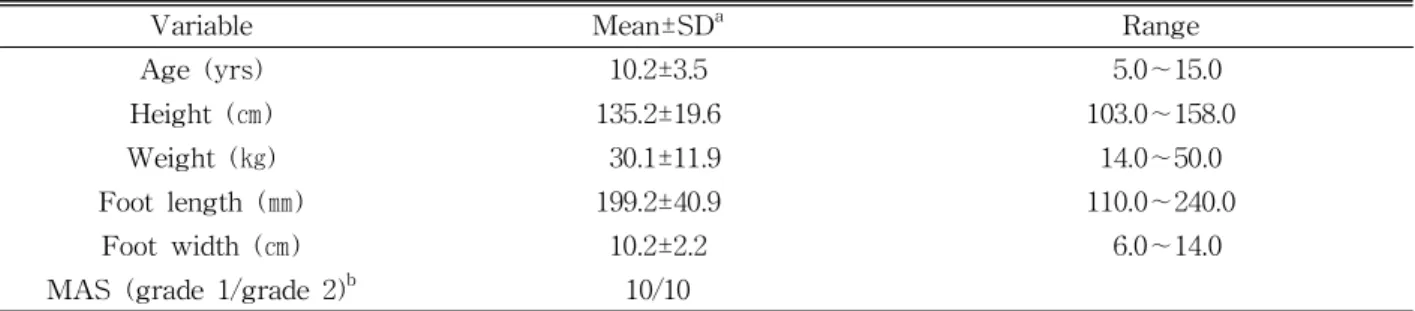
Variable Mean±SD
aRange
Age (yrs) 10.2±3.5 5.0∼15.0
Height (㎝) 135.2±19.6 103.0∼158.0
Weight (㎏) 30.1±11.9 14.0∼50.0
Foot length (㎜) 199.2±40.9 110.0∼240.0
Foot width (㎝) 10.2±2.2 6.0∼14.0
MAS (grade 1/grade 2)
b10/10
a
mean±standard deviation,
bmodified Ashworth scale.
Table 1. Characteristics of the subjects (N=20)
merous studies apply AFOs to children with spastic CP to determine muscle activity or changes in joint angles that occur during walking. However, AFOs have been suggested main orthoses for CP children with an equinus deformity caused by severe spas- ticity (Radtka et al, 1997). AFOs provide assistance during gait since deformed feet and ankles are lim- ited when AFOs are worn so that stability can be felt. Despite the diverse forms of AFOs, they affect only some muscle activities or changes in joint an- gles during walking and do not significantly affect functional changes in gait, such as the tempo- ral-spatial variables of gaits (Abel et al, 1998).
Foot orthotics is a medical tool that is used to improve foot functions and prevent or correct foot deformation (Wu, 1990). This is more commonly known as a functional insole or correcting insert by aligning and supporting the feet. When foot orthotics is inserted, pressure on the foot is distributed and the sole contact surfaces are widened. This improves sole sensation and stability, and reduces medial or lateral rotation of the feet (Landorf and Keenan, 2000). Therefore, foot orthotics is applied to diverse cases, ranging from those who have special diseases of the feet to those who need orthopedic manage- ment because of leg deformation or leg length differ- ence seen in climbers and athletes (Coughlin et al, 1995; Hawke et al, 2008). Although foot orthotics has many benefits on gait, few studies have been done for children with CP.
Likewise, children with spastic CP without an equinus deformity who have independent walking level may need an assistive device to increase sta-
bility of foot and ankle. In the present study, foot orthotics was used by children with spastic CP to examine the effects of foot orthotics on gait through changes in temporal-spatial gait parameters and us- ing foot orthotics as a gait assistance tool would be applicable to children with CP. The present study al- so would provide a basic information for application of foot orthotics to children with CP.
Methods
Subjects
Twenty children with spastic CP (11 boys, 9 girls)
participated and ranged in age from 5 to 15 years
(Table 1). Children were recruited randomly by two
physiotherapists who had more than five years of
clinical experiences from local pediatric center for re-
habilitation in Pohang city. Inclusion criteria were as
follows: 1) Spasticity of the children classified into
Grade 1 or Grade 2 using the Modified Ashworth
Scale (MAS) measurement (Fosang et al, 2003). 2)
Children had to be classified as level 1 or level 2
according to the Gross Motor Function Classification
System (GMFCS). These individuals were selected
because they were limited in travelling long dis-
tances or in some environments but still could walk
independently (Rosenbaum et al, 2002). 3) Children
needed to have a level of cognition that was neces-
sary for understanding instructions (SystemSM
WeeFIM, 1998). 4) Children had not undergone sur-
gery or an operation during the past year and for
the duration of the study.
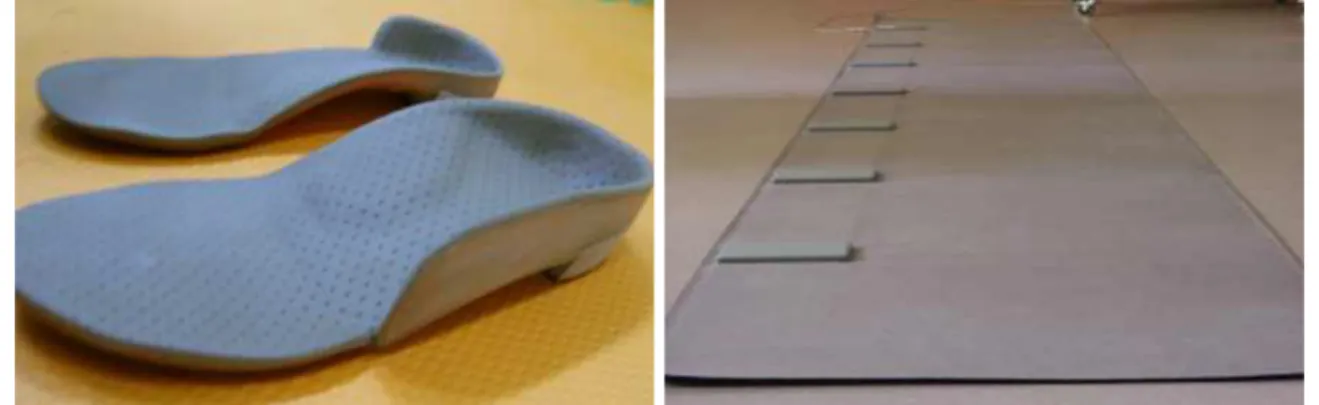
Figure 1. Custom-made foot orthotics. Figure 2. GAITRite system.
Experimental method
Researcher explained the purpose and meaning of the experiment to the children and their parents.
Then informed consent was obtained from patients, and assent was also given by the children. After in- formed consent had been obtained, measurements were taken of height, weight, foot length, and foot width for the purpose of collecting basic data to pre- pare for the gait tests. The children with spastic CP stood in front of a GAITRite board, which was 4.5 m long, and then performed at self-selected comfort- able speed along the walkway after a command to start was given. That is because the previous study has shown that the self-selected comfortable speed is associated with discrimination of potential for re- habilitation (Bowden et al, 2008). The other reason to use the self-selected speed can be that it is for functional ambulation in patients (Goldi et al, 1996).
During the gait test, the children were instructed to walk by themselves without the application of foot orthotics first. This provided a base-line information in comparisons of the other experimental conditions.
Data for three walks that were performed well, which was defined as the children not leaving the walkway, were selected and averaged. After taking a rest for five minutes, the children walked on the walkway with foot orthotics and in the same manner as before.
Measurement tools
Foot orthotics
2)In the present study, the insoles applied were cus- tom-made foot orthotics that were molded to fit the shapes of individual, and were dispensed to the children. Foot orthotics was made of polyurethane (PU) and equipped with high density repulsive elastic pads, cup soles for supporting the arch, and low elasticity pads and polymer gel that were used to absorb impact on the heels (Figure 1). The foot or- thotics was made by alFOOTs
1)using the following identical procedure: 1) Measurement and assessment of the feet, 2) Casting: feet shape molding using Pedilen foam
2), 3) Preparation of positive plaster models, 4) Plaster model revision: checking for any compressed region or sensitive region, 5) Shell pro- duction: modeling using thermoplastic plastic, 6) Posting and grinding: finishing and alignment adjust- ment, 7) Covering.
GAITRite system
To examine changes in the temporal-spatial gait parameters, a GAITRite system
3)which is an equip- ment that can sense pressure from the feet during walking, was used to collect data. The GAITRite is an equipment that is useful as a clinical assessment tool because the degree of asymmetry of the lower
1) OrthoCom
TM, alFoots Co., Ltd., Seoul, Korea.
2) Pedilen
Ⓡfoams, Otto Bock Health Care, Salt Lake City, U.S.A.
3) GAITRite System, CIR Systems Inc., CA, U.S.A.
extremities can be seen using spatial parameters, such as step length. Lower extremity disorders can be assessed using temporal parameters, such as sup- port time and velocity. After which, gait inter- ventions can be digitized using the equipment (Kressing et al, 2004). The GAITRite is an electronic gait board that is 4.5 m long and .9 m wide (Figure 2). On this board, 13.824 sensors, which are .6 ㎝ in diameter, are vertically arranged along the walking path at intervals of 1.27 ㎝. This is done so that in- formation on temporal-spatial parameters can be col- lected from these sensors. Out of the total length of the gait board, a 3.6 m long and .61 m wide area on the center is an active region where the sensors recognize pressure and the loads imposed by the feet of the children during walking are collected at a sampling rate of 90 ㎐/sec. The information is sent to the computer through a series of interface cables.
The collected information on temporal-spatial param- eters was processed using the GAITRite system ver.
3.8 software.
Temporal-spatial gait parameters
The definitions of the temporal-spatial parameters of gait used in the present study are as follows (Kirtley, 2006).
1) Velocity: value obtained by dividing the walked distance by the time spent
2) Cadence: the number of steps per unit time 3) Step length: distance from the heel of a foot to
the heel of the other foot
4) Stride length: distance from the heel of a foot to the heel of the same foot in the next step 5) Stance time: time to support the weight from
the time when the heel of a foot is in contact with the ground to the time when the toes are taken off the ground
6) Single support time: time during which one leg is in contact with the ground
7) Double support time: time during which both legs are in contact with the ground
8) Base of support: the step width between the
two feet
9) Toe angle: the angle made by the direction of progress and the major axis of the foot
Statistical Analysis
Statistical analysis of collected data were con- ducted using SPSS ver. 18.0 software. Differences in the temporal-spatial gait parameters of between with and without foot orthotics were compared using paired t-test. The significance level was set at α=.05.
Results
Changes in the temporal-spatial gait parameters
Using the GAITRite, the temporal-spatial gait pa- rameters were measured with and without foot or- thotics and the measured values were compared.
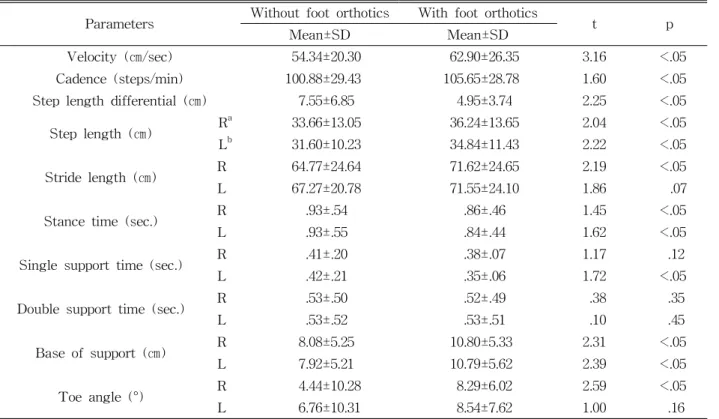
According to the results, the velocity, cadence, left/right step length, left/right stride length, left/right base of support, and right toe angle of gait increased during walking with foot orthotics com- pared to without foot orthotics (p<.05). The step length differential, left stance time and left single support time significantly decreased with foot or- thotics (p<.05). On the other hand, right stance time, right single support time, left/right double support time and left toe angle showed little change (p>.05) (Table 2).
Discussion
In the present study, custom-made foot orthotics
that fit an individual’s feet were made for children
with spastic CP to assist gait and data were ob-
tained during walking with and without foot or-
thotics using a GAITRite. Walking with self-selected
speed on the GAITRite reflected a patient’s func-
tional ambulation, although the gait could be influ-
enced by subjective and environmental factors
Parameters Without foot orthotics With foot orthotics
t p
Mean±SD Mean±SD
Velocity (㎝/sec) 54.34±20.30 62.90±26.35 3.16 <.05
Cadence (steps/min) 100.88±29.43 105.65±28.78 1.60 <.05
Step length differential (㎝) 7.55±6.85 4.95±3.74 2.25 <.05
Step length (㎝) R
a33.66±13.05 36.24±13.65 2.04 <.05
L
b31.60±10.23 34.84±11.43 2.22 <.05
Stride length (㎝) R 64.77±24.64 71.62±24.65 2.19 <.05
L 67.27±20.78 71.55±24.10 1.86 .07
Stance time (sec.) R .93±.54 .86±.46 1.45 <.05
L .93±.55 .84±.44 1.62 <.05
Single support time (sec.) R .41±.20 .38±.07 1.17 .12
L .42±.21 .35±.06 1.72 <.05
Double support time (sec.) R .53±.50 .52±.49 .38 .35
L .53±.52 .53±.51 .10 .45
Base of support (㎝) R 8.08±5.25 10.80±5.33 2.31 <.05
L 7.92±5.21 10.79±5.62 2.39 <.05
Toe angle (°) R 4.44±10.28 8.29±6.02 2.59 <.05
L 6.76±10.31 8.54±7.62 1.00 .16
a