• 검색 결과가 없습니다.

A Review on the Flammability and Flame Retardant Properties of Natural Fibers and Polymer Matrix Based Composites

N/A
N/A
Protected

Academic year: 2021

Share "A Review on the Flammability and Flame Retardant Properties of Natural Fibers and Polymer Matrix Based Composites"

Copied!
11
0
0

로드 중.... (전체 텍스트 보기)

전체 글

(1)

ISSN 2288-2103(Print), ISSN 2288-2111(Online)

Review Paper

A Review on the Flammability and Flame Retardant Properties of Natural Fibers and Polymer Matrix Based Composites

M.N. Prabhakar*, Atta Ur Rehaman Shah*, Jung-Il Song*

ABSTRACT: Natural fibers reinforced polymer composites are being used in several low strength applications. More research is going on to improve their mechanical and interface properties for structural applications. However, these composites have serious issues regarding flammability, which are not being focused broadly. A limited amount of literature has been published on the flame retardant techniques and flammability factor of natural fibers based polymer matrix composites. Therefore, it is needed to address the flammability properties of natural fibers based polymer composites to expand their application area. This paper summarizes some of the recent literature published on the subject of flammability and flame retardant methods applied to natural fibers reinforced polymer matrix composites. Different factors affecting the flammability, flame retardant solutions, mechanisms and characterization techniques have been discussed in detail.

Key Words: Flammability, Natural fibers, Polymer composites, Flame retardants, Nano-fillers

1. INTRODUCTION

Light weight, low cost and ecofriendly characteristics of nat- ural fibers based polymer matrix composites have become a need of the hour due to the rising prices of petroleum prod- ucts and their environmental risks [1]. Due to the uncertainty of aluminum supply during the Second World War, Mr. Gor- don (an undergraduate) at Trinity College presented an idea to utilize flax fiber. The Aero Research Limited Company adopted this idea and the first natural fiber reinforced composite (flax/

phenol formaldehyde) was developed and used in the spar of a bomber aircraft [2]. Natural fibers reinforced composites (NFRC) are also being used extensively in the interior parts of automobiles and construction industry [3,4]. Aside numerous potentials, The NFRC has inferior flame resistant character- istic [5-7]. Several in-flight flame incidents have been recorded in the transport airplanes history [8]. According to a report of society of automotive engineers, in USA, in-flight smoke inci- dents happen frequently [9]. This smoke may sometime erupt flame, which causes major accidents. Flames in automobiles can be extinguished if detected in the beginning. According to Boeing Company, most of the flame incidents are caused by

the fume or smoke created through electrical sources [10].

Due to their undesirable flammability characteristics, more research is needed on the flame retardant approach and mech- anism of NFRC [11-13]. Researchers are trying to invent new mechanisms which can make NFRC able to resist to the flame propagation [14]. Still not much literature is available on the flammability and flame retardancy of NFRC. Fig. 1 shows an estimated comparison of the number of articles published in the last five years in Elsevier publishing journals on the topics of natural fiber composites and flame retardant natural fiber composites. The comparison clearly shows how little research is being carried out on the flammability of natural fiber com- posites. However the encouraging factor is that the trend is going on increasing with time. It is expected to increase more in future.

The different phenomenon has been introduced to achieve flame retardancy. One way is to modify the chemistry of the polymer matrices. Sauca et al. obtained phosphorous-con- taining polymers by chemically modifying poly(vinyl alcohol) [15]. Flame retardant coatings of polymers and composites are also a well-known method against flammability. Zeytuncu et al. deposited UV-curable boron containing hybrid coatings on

Received 27 December 2014, received in revised form 25 April 2015, accepted 28 April 2015

*

*

Department of Mechanical Engineering, Changwon National University

Department of Mechanical Engineering, Changwon National University, Corresponding author (E-mail: [email protected])

(2)

polycarbonate substrates to obtain flame retardancy [16]. Tsa- fack et al., Caiwong et al., and Paosawatyanyong et al. used plasma coating technology to achieve cotton fibers based flame retardant composites [17-19]. The most famous way to induce flame retardancy in polymeric composites is incorpo- rating micro/nano flame retardants (FRs) in the materials. It has been broadly reviewed by different authors in literatures [20-23]. Umemura et al. used ammonium polyphosphate (APP), melamine polyphosphate (MPP) and aluminum hydroxide to modify flammability of wood-plastic composites [24]. Shah et al. used oyster shell powder as a calcium car- bonate resource to achieve flame retardancy in polypropylene [25]. Sabbagh et al. used two different additives of non-organic mineral and organic phosphate FRs in flax fiber reinforced engineering plastic composites [26].

Although NFRC are cheaper and can replace glass fiber in some of the applications if the flammability problem is addressed, but this may cause an increase in the total cost of the composite. The increase in flame retardant and thermal properties may also affect some of the other properties. Most of the FR fillers decrease the mechanical strength of com- posites and polymers [27-29]. However, this effect can be con- trolled (or avoided) with different physical and chemical techniques, which include proper distribution of the FR filler, their surface treatment and the use of compatibilizer [30,31].

This will be one of the future research focus in the field of flame retardant natural fiber composites.

2. NATURAL FIBERS

To understand the properties of the natural fibers, it is important to investigate their structure and composition. It

depends mainly upon the source from where the fibers are obtained. These sources include plants, animals and minerals.

Animal fibers are obtained from hair, wool or silk and they are mostly composed of protein [32,33]. Plant fibers mainly con- sist of lignin matrix, hemicellulose and cellulosic micro-fibrils as shown in the structure in Fig. 2. Secondary wall S2 is nor- mally responsible for the mechanical properties of the fiber.

Natural fiber itself is a composite structure where the micro- fibrils act as fibers while the lignin and hemicellulose act as a matrix [33]. Therefore the cellulosic micro-fibrils are the load bearing components of natural fibers. Beside this, the hemi- cellulose is responsible for thermal and biological degradation properties while lignin and hemicellulose together are respon- sible for flame degradation properties [34-36]. However the final properties of NFRC do not only depend upon the fibers, but also depend greatly upon matrix, compatibilizer and pre- treatment of the fibers. The flame properties of natural fibers have been described by different researchers in the literature [37-40].

3. POLYMER MATRICES

Polymeric matrices are generally divided into thermoplastic and thermoset polymers. Besides the two major types, bio- polymers are known to be a third type of polymers which are more common in research now-a-days. The properties of composites greatly depend upon the polymeric matrices and the fabrication processes. Generally matrix plays a role to sup- port the reinforcements against compression and shear. But polymeric matrices are weak against flame propagation and thermal loads [41]. Several articles have been published on the flammability of polymers or polymer composites [42-45].

Flammability of polymers is explained on the basis of some parameters, e.g. limiting oxygen indices (LOI) and the heat release rates (HRR). Flammability properties of some of the commonly used polymers are listed in Table 1. A variety of fibers or additives are used in combination with polymer matrices to develop composites. The fibers or additives may be of different kinds, including natural, synthetic, organic or inor- Fig. 1. Number of articles published on NFRC and flame retar-

dant and flammability phenomenon of NFRC in Elsevier journals. Source: www.sciencedirect.com (19 Nov 2014).

Keywords: natural fiber composites, flame retardant natu- ral fiber composites, flammability of natural fiber com- posites

Fig. 2. Structure of natural fiber, source [33]

(3)

ganic. Different methods to fabricate polymers based com- posites include compression molding, extrusion, injection molding, infusion molding, resin transfer molding etc.

4. FACTORS EFFECTING FLAMMABILITY OF NATURAL FIBER REINFORCED POLY- MER COMPOSITES

According to the famous flame triangle, fuel, heat and oxy- gen are the three important elements in a combustion pro- cess. Once the flame is ignited then stopping any of the above three elements may stop (or reduce) the propagation of flame. Natural fibers rapidly decompose under heat sources while polymer matrices melt. The hemicellulose decomposition starts first in the beginning of flame and with the increase in temperature lignin also gets decomposed.

Mass is lost continuously during the decomposition process because of the evaporating gases.

Different techniques are used to study the flammability and thermal behavior of natural fiber reinforced polymer com- posites (NFRP). These methods include flame tests (horizontal

& vertical), limiting oxygen indices (LOI) test, cone calorim- etry, thermogravimetric analysis (TGA), differential scanning calorimetry (DSC) and dynamic mechanical analysis (DMA) [49,50].

The amount of fiber content, matrix type, surface treatment and filler concentration are the factors which affect the final properties of the NFRP. The flammability and thermal behav- ior of the composites are also affected by these factors. Dif- ferent authors have studied the effects these factors on the flammability of composites.

4.1 Effect of fiber reinforcements

Helwig and Paukszta evaluated flammability of flax fibers reinforced polypropylene composites [51]. They found that flax fiber concentration of 30% and above resulted in a decrease in HRR and mass loss rate (MLR) of flax/PP com- posites. However, flax reinforcement reduced the burning time of the composites.

Chai et al. studied the effects of natural fiber reinforcement on the flammability of composites and compared its perfor-

mance with glass fiber composites [52]. They observed that flax fibers reinforced epoxy composites have higher HRR and more burning rates as compared to the glass/epoxy compos- ites.

Borysiak et al. presented flammability properties of wood- polypropylene composites [53]. They concluded that the wood-PP composite specimens have shorter time to ignite than the pure PP specimens. However HRR, MLR and toxic gas emissions are reduced by wood reinforcements in PP.

4.2 Effect of matrices

Thermal degradation of polymers is fast, therefore poly- meric matrices have poor flammability behavior. Shah et al.

studied the properties of polypropylene against flame and heat [25]. Polypropylene is weak against fire, how they can be improved after particulate reinforcement? Being thermally weak, a polymer matrix itself has no prominent role in improving the flame resistance of the composites; it depends upon the reinforcements and fillers. Natural fiber reinforce- ments generally reduce the thermal stability of the polymer matrices and increase their flammability. Russo et al. studied the effect of kenaf fiber on the flammability of different poly- mers [54]. They found that the degradation temperature of virgin polymers was higher than the kenaf fiber reinforced polymers. However, some nano particle fillers may increase the thermal stability and flame resistance of polymers through different mechanisms. Flammability of different polymeric matrices can be compared to each other on the basis of their LOI and HRR values as shown in Table 1.

4.3 Effect of treatments

Different types of chemical or physical treatments modify the interfacial chemistry which leads to the improvement of different properties of composites. Carosio et al. investigated the influence of plasma surface treatment on PET fabric nanoparticle composites [55]. They concluded that plasma treatment has a positive effect on thermal stability. The results also showed that plasma treatment affected the combustion behavior and improved the flame resistance. Lee and Wang reported the effect of lysine-based diisocyanate (LDI) as a cou- pling agent on the properties of bamboo fiber based biocom- posites [56]. The thermal stability of the composites was improved by increasing the LDI content, but still lower than the virgin polymers. Lee et al. studied the effect of silane cou- pling agent on the properties of the kenaf/polylactic acid (PLA) composite [57]. They observed that silane treatment improved the storage modulus of the composite. Sudhakara et al. characterized borassus fruit fiber/polypropylene (BFF/PP) composite after NaOH surface treatment and used MAPP as a compatibilizer [58]. They found that the alkali surface treated composites performed better under thermal loads. MAPP also played a role in the thermal stability of the BFF/PP composites.

Table 1. Flammability properties of some polymers [46-48]

Polymer HRR (W·cm

-2

) LOI (%)

Polypropylene 150.9 18

Polystyrene 110.1 18

Polycarbonate 42.9 27

Poly(vinyl chloride) 17.5 42

Polyethylene 140.8 18

Polylactic acid 27.2 21

(4)

4.4 Effect of flame retardant fillers

4.4.1 Types of flame retardants based on mechanism 4.4.1.1 Gas phase flame retardants

Gas phase flame retardants minimize the heat release in the gas phase from combustion by releasing the reactive free rad- icals that react, inhibit the chain reactions whereby the decom- position products of combustible materials propagate combustion [59,60]. Examples of gas phase flame retardants are halogen (F, Cl, Br, I), phosphorus (P-O or P) etc.

4.4.1.2 Endothermic flame retardants

Endothermic flame retardants work in both gas and con- densed phase through endothermic decomposition of releas- ing non-flammable gases like H

2

O, CO

2

, which dilute the fuel and cool the polymer. The lower substrate temperature slows the pyrolysis rate. These materials also leave behind a ceramic- like residue, which protects the underlying polymer [61].

Examples are magnesium hydroxide, aluminium hydroxide, mixture of huntite and hydomagnesite.

4.4.1.3 Char forming flame retardants

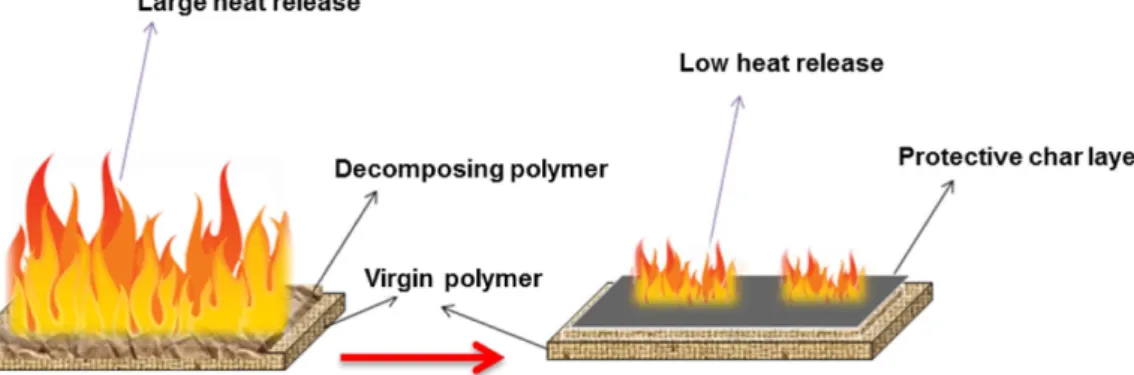
Char forming flame retardants works in the condensed phase by preventing fuel release through binding up fuel as non-pyrolyzable carbon (char) and providing thermal insu- lation for underlying polymer through the formation of char protection layers [62]. Charing mechanism in polymers has shown in Fig. 3. Examples are organophosphorus, ammonium polyphosphate, etc. For example the organic groups on POSS cages undergo homolytic Si-C bond cleavage at 300-350

o

C in air. This process is immediately followed by fusion of POSS cages to form a thermally insulating and oxidatively stable sil- icon oxycarbide “black glass” surface char (Si-O-C ceramified char.

4.4.2 Types of flame retardants based on mode of action 4.4.2.1 Reactive flame retardants

Reactive flame retardants producing a special kind of com- ponents by assembling with polymers. This resists polymer composites from the propagation of flame. In addition, they have no plasticising effect and do not affect the thermal sta-

bility of the polymer [63]. Examples are aluminium hydroxide, organochlorines, etc.

4.4.2.2 Additive flame retardants

Additive flame retardants are not chemically bond with base polymer, but they act as plasticiser, otherwise they are con- sidered as fillers. These fillers grafts the chemical groups onto these materials to enable them to become integrated without losing their retardant efficiency [64].

4.4.2.3 Combinations reactive and additive flame retardants The combinations of reactive and additive flame retardants are able to create a modified additive, synergistic or antago- nistic effect. The synergistic effect occurs when they are used together with specific flame retardants. The flame retardants/

synergist systems have achieved great importance in practical use because they are usually less expensive than flame retar- dants used alone.

4.4.3 Types Flame retardants based on their functional ele- ment

4.4.3.1 Mineral flame retardants

Metal hydroxides: Metal hydroxide flame retardants are low- smoke flame retardant compounds. The flame retardant are decomposing endothermically into water and metal oxide upon heating. The released water vapour, in an amount of about a third of total metal hydroxide used, dilutes the com- bustible ambience while removing the combustion heat. The oxide by-product formed from the hydroxide decomposition chars on the surface of polymeric materials to prevent heat and oxygen from approaching the polymer [65,66]. Examples are aluminium tri-hydroxide (Al(OH)

3

), Magnesium di-hydroxide (Mg(OH)

2

), Antimony trioxide (Sb

2

O

3

), Expandable graphite, etc.

Hydroxycarbonates: Hydroxy carbonate flame retardants are not only alternative to metal hydroxides, but also environ- mentally compatible and act both condense as well as gas phase through endothermic reaction. They release water to the gas phase, which dilutes the flame. All carbonates release CO

2

Fig. 3. Charing mechanism in polymers

(5)

at high temperatures but only magnesium and calcium car- bonates release it below 1000

o

C, with magnesium carbonate presenting the lowest release temperature (550

o

C). The oxides produced by the decomposition can contribute to the forma- tion of an insulating charred layer [67].

Borates: Borate flame retardants are environmentally friendly, low mammalian toxicity and low volatility fillers.

They decomposition leads to the creation of glassy protective layer which acts as barrier for polymer chain oxidation. Their endothermic decomposition (503 KJ/Kg) between 290 and 450

o

C liberates water, boric acid and boron oxide (B

2

O

3

) [68].

Examples of most frequently using borates is zing borate (2ZnO. 3B

2

O

3

. 3.5H

2

O).

4.4.3.2 Halogenated flame retardants

Halogenated flame retardants are very effective in capturing the free radicals (Equation 1) so that it resists the capability of the flame propagation. The efficiency of the halogens has decreased with the increasing the size (F < Cl < Br < I). Flu- orinated compounds are very stable because of its stable bond and decompose at much higher temperatures than most organic matter burns. But in the case of Iodine, it has loose bond so it decompose at slightly elevated temperatures. Con- sequently, only organochlorine and organobromine com- pounds are used as flame retardants.

Brominated and chlorinated flame retardants: Brominated flame retardants have higher trapping efficiency and lower decomposing temperature so that it is available at a high con- centration in the flame zone. Their flame retardancy mech- anism is similar for all compounds and involves decomposition upon heat application, to prevent flammable gas formation [69]. Examples are Polybrominated diphenyl ethers, hexabro- mocyclododecanes, and tetrabromobisphenol-A.

Chlorinated flame retardants have lower stability than bro- minated, so higher quantities are needed to accomplish com- parable flame retardancy. They have partial plasticising and thermal stability at higher temperatures (222

o

C). Cycloal- iphatic chlorinated compounds have a higher thermostability and used as additive flame retardants in engineering plastics [70]. Examples are Chlorinated paraffins, antimony trichlo- ride, etc.

(R-X = flame retardant; X* = Cl, Br) (1) 4.4.3.3 Phosphorous

The phosphorus flame retardants act in the condensed phase while metal phosphates may also act in the gas phase.

They are very much effective with the materials containing rich oxygen. These flame retardants transformed into phos- phoric acid by thermal degradation, and water released. A pro-

tective layer consists of interpenetrating networks of carbon and phosphorous oxide is developed by the phosphoric acid (Equation 2). The formation of the radicals P and PO are interrupting the radical chain mechanism of the combustion process [71]. Examples are ammonium polyphosphate, chlo- rophosphates, bromophosphate, etc.

(2)

4.4.3.4 Nitrogen containing flame retardants

Nitrogen containing flame retardants are environmental friendly, low toxicity and low evolution of smoke flame retar- dants. They may act by the release of inter gases like ammonia, nitrogen into the gas phase or condensation reactions in the solid phase (Equation 3). The reaction with flame of these flame retardants is to make charring because of abundant nitrogen. These flame retardants are suitable for recycling because they have high decomposition temperatures [72].

Examples are Melamine, Melamine cyanurate, Melamine poly- phosphate, Ammonium poly phosphate, etc.

(3)

4.4.3.5 Silicon-based flame retardants

Many forms of silicon compounds have been explored as potential flame retardants to polymeric materials, such as sil- icones, silanes, silsequioxane, silica and silicates.

Silicones: Silicone flame retardants exhibit relatively low rates of heat release, and low dependence of the rate of release on external heat flux in the gas phase, because of the lower burn- ing rate is attributed to the accumulation of the silica ash layer at the silicone fuel surface. These are excellent thermal stability and high resistance with very limited release of toxic gases during decomposition [73,74].

Silica: Silicon has been playing a protective role when loaded one of its forms of silica nanoparticles or layered silicates in addition silica affects the thermal stability of thermoplastic polymers. Flame retardant Mechanism, during combustion it forms of an inorganic barrier on the surface that protects the underlying polymer from oxygen and also reduces heat trans- fer [75].

4.4.3.6 Nano-metric particles

Nano-metric particles when individualized and properly

(6)

dispersed in polymer matrices are known to contribute to the enhancement of properties such as thermal, mechanical or flame resistance [76,77].

Carbon nanotubes: Carbon nanotube (single, double and multi-walled) flame retardants are more sought after than car- bon nano-fibers because of CNT particles not only provides non-flammability in relatively small concentrations compared to the other fillers and also enhancing the material strength.

CNTs percolate to form a network at very low loading in the polymer matrix and lead to substantial enhancement of sev- eral functional properties such as flame retardant properties [78-81].

Nano clays: Nano-scale particulate flame retardant additives have the ability to incorporate polymers between the layers by intercalation or exfoliation. They do not act as flame retardants on their own, but may together with other flame retardants, enhancing the charring and reduce the heat release of the poly- mers. Further taking into account, eco-friendliness, mechanical and physical properties are required for end applications but due to processing difficulties better to use nanoscale additives as a flame retardant in polymers, because at low loading with no additional flame retardants in the system, heat release rates and mass loss rates were greatly reduced compared to neat polymers [82-84].

Metallic oxide particles: Metallic oxide flame retardants have proven that, they are efficient additives for improving the ther- mal stability and morphological structure of char residues and the flame retardant of the polymers because of not only strong interactions between polymer and nano-particle surface and also the degradation temperature of these particles are higher than the polymer processing temperature [85,86]. Reaction mechanism of aluminium trihydraxide on decomposition is shown in Equation (4). Examples are magnesium oxide (MgO), zinc oxide (ZnO), and ferric oxide (Fe

2

O

3

), Tita- nium oxide (TiO

2

).

(endpthermic 1050 kj/kg) (4)

5. MECHANISM OF FLAME RETARDANCY

Five specific mechanisms by which flame retardancy may occur: physical dilution, chemical interaction, inert gas dilu- tion, thermal quenching and protective coatings [87].

Physical dilution: The flame retardant can act as a thermal sink, increasing the heat capacity of the product or reducing the fuel content to a level below the lower limit of flamma- bility. Inert fillers such as glass fibers and microspheres and minerals such as talc act by this mechanism.

Chemical interaction: The flame retardant dissociates into radical species that compete with chain propagating and branching steps in the combustion process. This is the general flame-retarding mechanism by which brominated flame retar- dants operate.

Inert gas: Flame-retardant additives produce large volumes of non-combustible gases when the product decomposes during combustion. The gases dilute the oxygen supply to the flame or dilute the fuel concentration below the flammability limit. Metal hydroxides, metal carbonates and some nitrogen producing compounds function in this way when used as flame retardants.

Thermal quenching: Endothermic reaction in the presence of flame to release water molecules that quenching the polymer and dilute the combustion process. Examples are Metal hydroxides and carbonates.

Char-formation: Char-forming flame retardants react to form a carbon layer on the material’s surface. This layer insu- lates the polymer, slowing pyrolysis, and creates a barrier that hinders the release of additional gases to fuel combustion.

Phosphorous compounds that decompose to give phosphoric acid and intumescent systems operate by this mechanism.

6. LABORATORY FLAME TESTING

The flammability of the polymer materials can be charac- terized by the ignitability, flame spread rate and heat release.

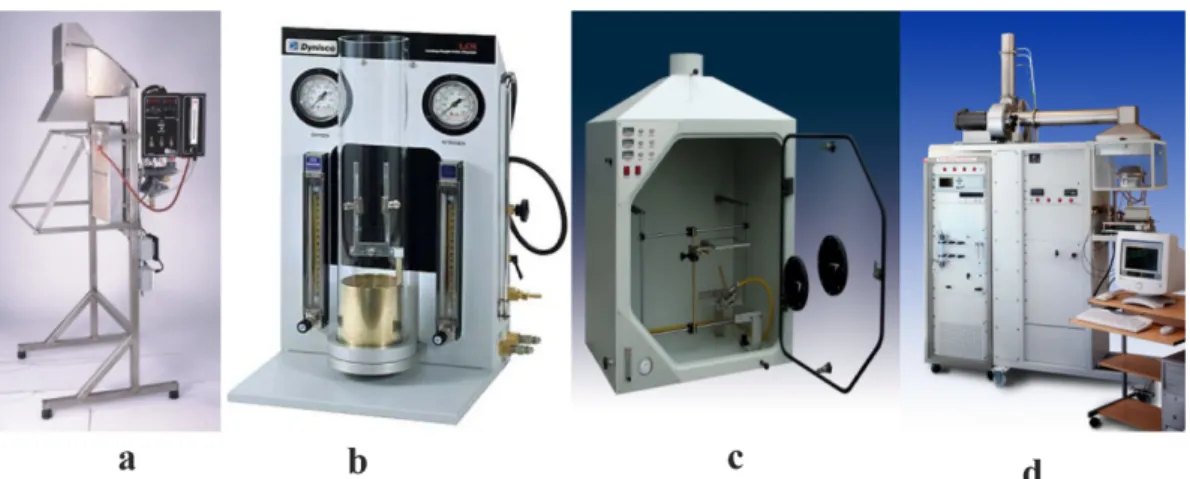
There are commonly used flammability test for polymers are presented in Table 2; they are radiant panel, limited oxygen indices (LOI), underwriter’s laboratories (UL 94), and cone calorimeter.

Radiant panel test (RPT) can be used to evaluate flame- retardant coatings for wood-base materials and what extent the thickness of the surface finish material and the substrate to which it is applied govern the flame spread behaviour of com- posite assemblies. RPT measurements can be used to classify flooring materials. Samples are exposed to an external flux and ignited by an additional burner on one side. Measurement results are the distance of flame propagation. Furthermore, the temperature inside the RPT is measured with a thermocouple [88].

Limiting oxygen indices (LOI) is the minimum concentra- tion of oxygen in a mixture of oxygen and nitrogen that is needed to support the flaming combustion of a material. It is expressed in volume percent (Vol%). It is used to indicate the relative flammability of materials [89].

LOI = 100 × [O

2

] / ([O

2

] + [N

2

])

UL94 testing procedures and rating system for thermoplas-

(7)

tics flammability are the generally accepted standard through- out most of the world. It measures ignitability and flame spread of vertical bulk materials exposed to small flame[90].

Cone calorimetry is a technique used to quantify the flam- mability of materials by determining various flammability parameters Cone calorimetry is one of the most effective medium sized flame behaviour tests used to study the rate of heat released by materials exposed to radiant heat flux. Its principle is based on the measurement of decreasing oxygen concentration in the combustion gases of the sample that is subjected to a given heat flux (10–100 kWm

−2

) [91].

7. SUMMARY

In this review, we have presented a broad range of flam- mability of natural fiber reinforced polymer composites and flame retardant additive systems. Flammability of natural fiber reinforced polymer composites remains a very complex sci- entific problem for which no single solution can be found, especially with regard to the extensive diversification of poly- mer matrices available. The selection of suitable flame retar- dants supports to create flame resistant composites, and prolonging the variety of their uses. The use of relatively low amounts of flame retardants with polymers shows very prom- ising results. Among non-halogenated flame retardant addi- tives, phosphorus and nitrogen-based compounds have proved to be very powerful solutions, especially in matrices

containing oxygen or nitrogen atoms in their backbone, while silicon-based additives also appear to provide efficient solu- tions. However, the improvement of flame retardance in nat- ural flame reinforced composite materials is being a great task, but the effective selection and adding of most appropriate flame retardant additives will hopefully contribute to produc- ing flame resistant natural fiber reinforced polymer compos- ites.

ACKNOWLEDGEMENTS

This work was supported by the National Research Foun- dation of Korea (NRF) grant funded by the Government of the Republic of Korea (Ministry of Science, ICT and Future Plan- ning (MSIP)) (No. 2013R1A2A2A01017108 and 2011-0030058) and also financially supported by Changwon National Uni- versity (CWNU) during 2013-2014.

REFERENCES

1. Sergio Neves Monteiro, Felipe Perissé D. Lopes, Ailton Silva Ferreira, and Denise Cristina O. Nascimento, “Natural-fiber polymer-matrix Composites: Cheaper, Tougher, and Environ- mentally Friendly,” JOM, Vol. 61, 2009, pp. 17-22.

2. John A. Bishopp, “The History of Redux® and the Redux Bond- ing Process,” International Journal of Adhesion and Adhesives, Vol. 17, 1997, pp. 287-301.

3. Liliana B. Manfredi, Exequiel S. Rodríguez, Maria Wladyka- Przybylak, and Analía Vázquez, “Thermal Degradation and Flame Resistance of Unsaturated Polyester, Modified Acrylic Resins and Their Composites with Natural Fibres,” Polymer Degradation and Stability, Vol. 91, 2006, pp. 255-261.

4. James Holbery and Dan Houston, “Natural-fiber-reinforced Polymer Composites in Automotive Applications,” JOM, 2006, Vol. 58, pp. 80-86.

5. David, B., Dittenber, Hota V.S., and Ganga Rao, “Critical Review of Recent Publications on Use of Natural Composites in Infrastructure,” Composites Part A: Applied Science and Manu- facturing, Vol. 43, 2012, pp. 1419-1429.

Fig. 4. Flame testing apparatus: (a) Radiant panel; (b) LOI; (c) UL 94; (d) cone calorimeter

Table 2. Flammability tests for polymers [92]

ASTM

standards Description Characteristic mea- sure E162-87 Radiant panel (Fig. 4a) Flame spread D2863-87 Limited Oxygen indices (Fig. 4b) Ease of ignition UL94 Vertical burn (Fig. 4c) Ignition resistance E1354-90 Cone calorimeter (Fig. 4d) Heat release and

smoke

(8)

6. Dorez, G., Taguet, A., Ferry, L., and Lopez-Cuesta, J.M., “Ther- mal and Flame Behavior of Natural Fibers/PBS Biocomposites,”

Polymer Degradation and Stability, Vol. 98, 2013, pp. 87-95.

7. Zhang, Z.X., Zhang, J., Lu, B.-X., Xin, Z.X., Kang, C.K., and Kim, J.K., “Effect of Flame Retardants on Mechanical Proper- ties, Flammability and Foamability of PP/Wood–fiber Com- posites,” Composites Part B: Engineering, Vol. 43, 2012, pp. 150- 158.

8. Royal Aeronautical Society - Smoke, Flame and Fumes in Transport Aircraft - Past History, Current Risk And Recom- mended Mitigations. Second Edition 2013 (www.aerosoci- ety.com

9. Shaw, J., “A Review of Smoke and Potential In-flight Flame Events in 1999,” Tech. Rep. Doc 185, Society of Automotive Engineers, Washington, DC, USA, 2000.

10. Boeing Aero, “Flight and Cabin Crew Response to Inflight Smoke,” 2013.

11. Bourbigot, S., and Fontaine, G., “Flame Retardancy of Polylac- tide: An Overview,” Polymer Chemistry, Vol. 1, 2010, pp. 1413–

1422.

12. Chapple, S., and Anandjiwala, R., “Flammability of Natural Fibre-reinforced Composites and Strategies for Flame Retar- dancy: A Review,” Journal of Thermoplastic Composite Materi- als, Vol. 23, 2010, pp. 871–893.

13. Kandola, B.K., “Flame Retardant Characteristics of Natural Fibre Composites”, In M. J. John, & S. Thomas (Eds.), Natural Polymers, volume 1: Composites (pp.86–117). United King- dom: The Royal Society of Chemistry (2012).

14. Price, D., Anthony, G., and Carty, P., Introduction: Polymer Combustion, Condensed Phase Pyrolysis and Smoke Forma- tion. In A. R. Horrocks, & D. Price (Eds.), Flame Retardant Materials (pp. 1–30). England: Wood Head Publishing Limited, 2001.

15. Silvana Saucă, Marta Giamberini, and José Antonio Reina,

“Flame Retardant Phosphorous-containing Polymers Obtained by Chemically Modifying Poly(vinyl alcohol),” Polymer Degra- dation and Stability, Vol. 98, 2013, pp. 453-463.

16. The Minerals, Metals & Materials Society (TMS) (2011) Syn- thesis and Characterization of Flame Retarding UV-Curable Boron Containing Hybrid Coatings, in Supplemental Proceed- ings: General Paper Selections, Vol. 3, John Wiley & Sons, Inc., Hoboken, NJ, USA.

17. Tsafack, M.J., and Levalois-Grützmacher, J., “Towards Multi- functional Surfaces Using the Plasma-induced Graft-polymer- ization (PIGP) Process: Flame and Waterproof Cotton Textiles,”

Surface and Coatings Technology, Vol. 201, 2007, pp. 5789-5795.

18. Chaiwong, C., Tunma, S., Sangprasert, W., Nimmanpipug, P., and Boonyawan, D., “Graft Polymerization of Flame-retardant Compound onto Silk via Plasma Jet,” Surface and Coatings Technology, Vol. 204, 2010, pp. 2991-2995.

19. Boonchoat Paosawatyanyong, Piyarat Jermsutjarit, and Worawan Bhanthumnavin, “Surface Nanomodification of Cotton Fiber for Flame Retardant Application,” Journal of Nano-science and Nanotechnology, Vol. 12, 2012, pp. 748-753.

20. Morgan, A.B., “Flame Retarded Polymer Layered Silicate Nano-

composites: A Review of Commercial and Open Literature Sys- tems,” Polymer Advanced Technology, Vol. 17, 2006, pp. 206–

217.

21. Chen, L., and Wang, Y.Z., “A Review on Flame Retardant Tech- nology in China. Part I: Development of Flame Retardants,”

Polymer Advanced Technology, Vol. 21, 2010, pp. 1–26.

22. Siska Hamdani, Claire Longuet, Didier Perrin, José-Marie Lopez-cuesta, and François Ganachaud, “Flame Retardancy of Silicone-based Materials,” Polymer Degradation and Stability, Vol. 94, 2009, pp. 465-495.

23. Richard Hull, T., Artur Witkowski, and Luke Hollingbery,

“Flame Retardant Action of Mineral Fillers,” Polymer Degrada- tion and Stability, Vol. 96, 2011, pp. 1462-1469.

24. Toshikazu Umemura, Yoshihiko Arao, Sakae Nakamura, Yuta Tomita, and Tatsuya Tanaka, “Synergy Effects of Wood Flour and Flame Retardants in Flammability of Wood-plastic Com- posites,” Energy Procedia, Vol. 56, 2014, pp. 48-56.

25. Atta ur Rehman Shah, Prabhakar, M.N., D.-W. Lee, B.-S., Kim, and Song, J.I., “Development and Characterization of Oyster Shell Powder Filled Polypropylene Composite,” Composites Research, Vol. 27, 2014, pp. 201-206.

26. Ahmed El-Sabbagh, Leif Steuernagel, Gerhard Ziegmann, Dieter Meiners, and Oliver Toepfer, “Processing Parameters and Characterisation of Flax Fibre Reinforced Engineering Plastic Composites with Flame Retardant Fillers,” Composites Part B: Engineering, Vol. 62, 2014, pp. 12-18.

27. Yoshihiko Arao, Sakae Nakamura, Yuta Tomita, Kyouhei Taka- kuwa, Toshikazu Umemura, and Tatsuya Tanaka, “Improve- ment on Flame Retardancy of Wood Flour/polypropylene Composites Using Various Flame Retardants,” Polymer Degra- dation and Stability, Vol. 100, 2014, pp. 79-85.

28. Aruna Subasinghe, and Debes Bhattacharyya, “Performance of Different Intumescent Ammonium Polyphosphate Flame Retardants in PP/kenaf Fibre Composites,” Composites Part A:

Applied Science and Manufacturing, Vol. 65, 2014, pp. 91-99.

29. Nadir Ayrilmis, Turgay Akbulut, Turker Dundar, Robert H.

White, Fatih Mengeloglu, Umit Buyuksari, Zeki Candan, and Erkan Avci, “Effect of Boron and Phosphate Compounds on Physical, Mechanical, and Flame Properties of Wood–polypro- pylene Composites,” Construction and Building Materials, Vol.

33, 2012, pp. 63-69.

30. Nitinat Suppakarn, and Kasama Jarukumjorn, “Mechanical Properties and Flammability of Sisal/PP Composites: Effect of Flame Retardant Type and Content,” Composites Part B: Engi- neering, Vol. 40, 2009, pp. 613-618.

31. Cárdenas, M.A., García-López, D., Gobernado-Mitre, I., Merino, J.C., Pastor, J.M., J. de D. Martínez, Barbeta, J., and Calveras, D.,

“Mechanical and Flame Retardant Properties of EVA/clay/ATH Nanocomposites – Effect of Particle Size and Surface Treatment of ATH Filler,” Polymer Degradation and Stability, Vol. 93, 2008, pp. 2032-2037.

32. David B. Dittenber, and Hota V.S. GangaRao, “Critical Review

of Recent Publications on Use of Natural Composites in Infra-

structure,” Composites Part A: Applied Science and Manufactur-

ing, Vol. 43, 2012, pp. 1419-1429.

(9)

33. John, M., and Thomas, S., “Bio-fibres and Biocomposites,” Car- bohydrate Polymers, Vol. 71, 2008, pp. 343–64.

34. Methacanon, P., Weerawatsophon, U., Sumransin, N., Prahsarn, C., and Bergado, D.T., “Properties and Potential Application of the Selected Natural Fibers as Limited Life Geotextiles,” Car- bohydrate Polymers, Vol. 82, 2010, pp. 1090–1096.

35. Beg, M.D.H., and Pickering, K.L., “Accelerated Weathering of Unbleached and Bleached Kraft Wood Fibre Reinforced Poly- propylene Composites,” Polymer Degradation and Stability, Vol.

93, 2008, pp.1939–46.

36. Suardana, N.P.G., Ku, M.S., and Lim, J.K., “Effects of Diammo- nium Phosphate on the Flammability and Mechanical Proper- ties of Bio-composites,” Materials and Design, Vol. 32, 2011, pp.

1990–1999.

37. Grexa, O., and Lübke, H., “Flammability Parameters of Wood Tested on Acone Calorimeter”, Polymer Degradation and Sta- bility, Vol. 74, 2001, pp. 427–432.

38. Hapuarachchi, T.D., and Peijs, T., “Multiwalled Carbon Nano- tubes Andsepiolite Nanoclays as Flame Retardants for Polylac- tide and Its Natural Fibre Reinforced Composites”, Composites:

Part A, Vol. 41, 2010, pp. 954–963.

39. Jang, J.Y., Jeong, T.K., Oh, H.J., Youn, J.R., and Song, Y.S.,

“Thermal Stability and Flammability of Coconut Fiber Rein- forced Poly(lactic acid) Composites,” Composites: Part B, Vol.

43, 2012, pp. 2434–2438.

40. Reti, C., Casetta, M., Duquesne, S., Delobel, R., Soulestin, J., and Bourbigot, S., “Intumescent Biobased-polylactide Films to Flame Retard Nonwovens”, Journal of Engineered Fibers and Fabrics, Vol. 4, 2009, pp. 33–39.

41. Sikoutris, D.E., and Kostopoulos, V., “Flame Response of Poly- mers and Polymer Composites. Part A: Multistage Degradation Kinetics,” Journal of Composite Materials, 2013, pp. 1-7.

42. Serge Bourbigota, and Sophie Duquesne, “Flame Retardant Polymers: Recent Developments and Opportunities,” Journal of Materials Chemistry, Vol. 17, 2007, pp. 2283-2300.

43. Guobo Huang, Jianrong Gao, Xu Wang, Huading Liang, and Changhua Ge, “How Can Graphene Reduce the Flammability of Polymer Nanocomposites?,” Materials Letters, Vol. 66, 2012, pp. 187-189.

44. Zhengping Fang, Pingan Song, Lifang Tong, Zhenghong Guo,

“Thermal Degradation and Flame Retardancy of Polypropyl- ene/C

60

Nanocomposites,” Thermochimica Acta, Vol. 473, 2008, pp. 106-108.

45. Ngakan Putu Gede Suardana, Min Seuck Ku, and Jae Kyoo Lim, “Effects of Diammonium Phosphate on the Flammability and Mechanical Properties of Bio-composites,” Materials and Design, Vol. 32, 2011, pp. 1990-1999.

46. Hirschler, M., “Heat Release from Plastic Materials. In Heat Release in Flames,” Babrauskas V, Grayson S (eds). E & FN Spon: UK, 1996.

47. Ke, C.H., Li, J., Fang, K.Y., Zhu, Q.L., Zhu, J., and Yan, “Q., Syn- ergistic Effect between a Novel Hyper Branched Charring Agent and Ammonium Polyphosphate on the Flame Retardant and Anti-dripping Properties of Polylactide”, Polymer Degrada- tion and Stability, Vol. 95, 2010, 763–770.

48. Joseph, P., and Ebdon, J., Recent Developments in Flame- retarding Thermoplastics and Thermosets. In Flame Retardant Material, Horrocks AR, Price D (eds). Wood head Publishing Limited: UK, 2000.

49. Nicole M. Stark, Robert H. White, Scott A. Mueller, and Tim A.

Osswald, “Evaluation of Various Flame Retardants for Use in Wood Flour–polyethylene Composites,” Polymer Degradation and Stability, Vol. 95, 2010, pp. 1903-1910.

50. Shumao, L., Jie, R., Hua, Y., Tao, Y., and Weizhong, Y., “Influ- ence of Ammonium Polyphosphate on the Flame Retardancy and Mechanical Properties of Ramie Fiber-reinforced Poly(lac- tic acid) Biocomposites,” Polymer International, Vol. 59, 2010, pp. 242–248.

51. Helwig, M., and Pauksta, D., “Flammability of Composites Based on Polypropylene and Flax Fibers,” Molecular Crystals and Liquid Crystals, Vol. 354, 2000, pp. 373–380.

52. Chai, M.W., Bickerton, S., Bhattacharyya, D., and Das, R.,

“Influence of Natural Fibre Reinforcements on the Flammabil- ity of Bio-derived Composite Materials,” Composites Part B:

Engineering, Vol. 43, 2012, pp. 2867-2874.

53. Borysiak, S., Pauksta, D., and Helwig, M., “Flammability of Wood-polypropylene Composites,” Polymer Degradation and Stability, Vol. 91, 2006, pp. 3339–43.

54. Russo, P., Carfagna, C., Cimino, F., Acierno, D., and Persico, P.,

“Biodegradable Composites Reinforced with Kenaf Fibre: Ther- mal, Mechanical, and Morphological Issues,” Advances in Poly- mer Technology, Vol. 32, 2012, pp. 313–322.

55. Federico Carosio, Jenny Alongi, and Alberto Frache, “Influence of Surface Activation by Plasma and Nanoparticle Adsorption on the Morphology, Thermal Stability and Combustion Behaviour of PET Fabrics,” European Polymer Journal, Vol. 47, 2011, pp. 893-902.

56. Lee, S.-H., and Wang, S., “Biodegradable Polymers/bamboo Fiber Bio-composite with Bio-based Coupling Agent,” Compos- ites Part A: Applied Science and Manufacturing, Vol. 37, 2006, pp. 80-91.

57. Lee, B.H., Kim, H.S., Lee, S., Kim, H.J., and Dorgan, J. R., “Bio- composites of Kenaf Fibers in Polylactide: Role of Improved Interfacial Adhesion in the Carding Process,” Composites Sci- ence and Technology, Vol. 69, 2009, pp. 2573–2579.

58. Sudhakara, P., Kamala Devi, A.P., Venkata Prasad, C., Obi Reddy, K., Dong Woo, L., Kim, B.S. and Song, J.I., “Thermal, Mechanical, and Morphological Properties of Maleated Poly- propylene Compatibilized Borassus Fruit Fiber/polypropylene Composites”, Journal of Applied Polymer Science, Vol. 128, 2013, pp. 976–982.

59. Lin, H., Han, L., and Dong, L., “Thermal Degradation Behaviour and Gas Phase Flame retardant Mechanism of Polylactide/

PCPP Blends”, Journal of Applied Polymer Science, Vol. 131, 2014, pp. 40480.

60. Wang, Z.Y., Liu, Y., and Wang, Q., “Flame Retardant Poly- oxymethylene with Aluminium Hydroxide/melaminE/Navolac Resin Synergistic System”, Polymer Degradation and Stability, Vol. 95, 2010, pp. 945.

61. Nana Tian, Xin Wen, Zhiwei Jiang, Jiang Gong, Yanhui Wang,

(10)

Jian Xue, and Tao Tang, “Synergistic Effect between a Novel Char Forming Agent and Ammonium Polyphosphate on Flame Retardancy and Thermal Properties of Polypropylene,” Indus- trial & Engineering Chemistry Research, Vol. 52, 2013, pp.

10905–10915.

62. Bernhard Schartel, “Phosphorus-based Flame Retardancy Mechanisms-Old Hat or a Starting Point for Future Develop- ment?”, Materials, Vol. 3, 2010, pp. 4710-4745.

63. Li, G., Wang, W., Cao, S., Cao, Y., and Wang, J., “Reactive, Intu- mescent, Halogen-free Flame Retardant for Polypropylene”, Journal of Applied Polymer Science, 2014, pp. 131.

64. Su, G., Saunders, D., Yu, Y., Yu, H., Zhang, X., Liu, H., and Giesy, J.P., “Occurrence of Additive Brominated Flame Retar- dants in Aquatic Organisms from Tai Lake and Yangtze River in Eastern China,” Chemosphere, Vol. 114, 2014, pp. 340-346.

65. Zhengyi Jiang, Xianghua Liu, Sihai Jiao and Jingtao Han, “Zinc Hydroxystannate-Coated Mineral Grade Mg(OH)

2

as Flame- Retardant and Smoke Suppression for Flexible PVC,” Advanced Materials Research, Vol. 652, 2013, pp. 481-484.

66. Walker, J.K., Luke, E., Chen, T., and Ivarov, A., “Synergies of Metal Hydroxides and Metal Molybdates in Low-Smoke Flex- ible PVC”, Proceedings of the 57th IWCS Conference, Provi- dence, RI 2008.

67. Giovanni Camino, A. Maffezzoli, M. Braglia, M. De Lazzaro, and M. Zammarano, “Effect of Hydroxides and Hydroxycar- bonate Structure on Flame Retardant Effectiveness and Mechanical Properties in Ethylene-vinyl Acetate Copolymer,”

Polymer Degradation and Stability, Vol. 74, 2001, pp. 457-464.

68. Belousova, R.G., Schwartz, E.M., Zariņa, I.E., and Valdniece, D.

J., Low-Toxicity Boron-Containing Flame-Retardant Additives for Polymeric Coatings”, Russian Journal of Applied Chemistry, Vol. 83, 2010, pp. 328−331.

69. Mehran Alaee, Pedro Arias, Andreas Sjödin, and Åke Bergman,

“An Overview of Commercially Used Brominated Flame Retar- dants, Their Applications, Their Use Patterns in Different Countries/regions and Possible Modes of Release,” Environment International, Vol. 29, 2003, pp. 683-689.

70. Eunha Hoh, Lingyan Zhu, and Ronald A. Hites, “Dechlorane Plus, a Chlorinated Flame Retardant, in the Great Lakes,” Envi- ronmental Science and Technology, Vol. 40, 2006, pp. 1184-1189.

71. Chang, Y.L., Wang, Y.Z., Ban, D.M., Yang, B., and Zhao, G.M.

“A Novel Phosphorus-Containing Polymer as a Highly Effective Flame Retardant”, Macromol. Mater. Eng., Vol. 289, 2004, pp.

703–707.

72. Klatt, M., Nitrogen-Based Flame Retardants, in Non-Haloge- nated Flame Retardant Handbook (eds A. B. Morgan and C. A.

Wilkie), John Wiley & Sons, Inc., Hoboken, NJ, USA (2014).

73. Kashiwagi, T., Gilman, J.W., Flame Retardancy of Polymeric Materials, Marcel Dekker Inc., New York, A. F. Grand and C. A.

Wilkie Editors, Vol. 10, 2000, pp. 353.

74. Siska Hamdania, Claire Longueta, Didier Perrina, José-Marie Lopez-cuestaa, and François Ganachaudb, “Flame Retardancy of Silicone-based Materials,” Polymer Degradation and Stability, Vol. 94, 2009, pp. 465–495.

75. Takashi Kashiwagi, John R. Shields, Richard H. Harris, Jr., and

Rick D. Davis, “Flame-Retardant Mechanism of Silica: Effects of Resin Molecular Weight,” Journal of Applied Polymer Science, Vol. 87, 2003, pp. 1541–1553.

76. Galloa, E., Schartela, B., Aciernob, D., and Russob, P., “Flame Retardant Biocomposites: Synergism between Phosphinate and Nanometric Metal Oxides,” European Polymer Journal, Vol. 47, 2011, pp. 1390–1401.

77. Gallo, E., Schartel, B., Braun, U., Russo, P., and Acierno, D.,

“Flame Retardant Synergisms between Nanometric Fe

2

O

3

and Aluminum Phosphinate in Poly(butylene terephthalate)”, Poly- mer Advvanced Technologies, Vol. 22, 2011, pp. 2382–2391.

78. Kashiwagi, T., Du, F., Winey, K.I., Groth, K.M., Shields, J.R., Bellayer, S.P., Kim, H., and Douglas, J.F., “Flammability Prop- erties of Polymer Nanocomposites With Single-Walled Carbon Nanotubes: Effects of Nanotube Dispersion and Concentra- tion,” Polymer, Vol. 46, 2005, pp. 471.

79. Schartel, B., Potschke, P., Knoll, U., and Abdel-Goad, M.,

“Flame Behaviour of Polyamide 6/multiwall Carbon Nanotube Nanocomposites”, European Polymer Journal, Vol. 41, 2005, pp.

1061.

80. Bocchini, S., Frache, A., Camino, G., and Claes, M., “Polyeth- ylene Thermal Oxidative Stabilisation in Carbon Nanotubes Based Nanocomposites,” European Polymer Journal, Vol. 43, 2007, pp. 3222.

81. Bettina Dittricha, Karen-Alessa Wartigb, Daniel Hofmannb, Rolf Mülhauptb, and Bernhard Schartela, “Flame Retardancy Through Carbon Nanomaterials: Carbon Black, Multiwall Nanotubes, Expanded Graphite, Multi-layer Graphene and Graphene in Polypropylene,” Polymer Degradation and Stability, Vol. 98, 2013, pp. 1495–1505.

82. Takashi Kashiwagi, Fangming Du, Jack F. Douglas, Karen I.

Winey, Richard H. Harris, and Jr & John R. Shields, “Nanopar- ticle Networks Reduce the Flammability of Polymer Nanocom- posites,” Nature Materials, Vol. 4, 2005, pp. 928-933.

83. Aravind Dasari, Zhong-Zhen Yu, Yiu-Wing Mai, Guipeng Cai, Huaihe Song, B., “Roles of Graphite Oxide, Clay and POSS during the Combustion of Polyamide 6, Polymer,” Polymer, Vol.

50, 2009, pp. 1577–1587.

84. Elsa Franchini, Jocelyne Galy, Jean-François Gerard, Daniela Tabuani, Andrea Medici, “Influence of POSS Structure on the Flame Retardant Properties of Epoxy Hybrid Networks,” Poly- mer Degradation and Stability, Vol. 94, 2009, pp. 1728–1736.

85. Lin, M., Li, B., Li, Q., Li, S., and Zhang, S., “Synergistic Effect of Metal Oxides on the Flame Retardancy and Thermal Deg- radation of Novel Intumescent Flame-retardant Thermoplastic Polyurethanes,” Journal of Applied Polymer Science, Vol. 121, 2011, pp. 1951–1960.

86. Ynh-Yue Yena, Hsin-Ta Wanga, and Wen-Jen Guob, “Synergis- tic Flame Retardant Effect of Metal Hydroxide and Nano-clay in EVA Composites,” Polymer Degradation and Stability, Vol.

97, 2012, pp. 863–869.

87. Nah, C., Oh, J., Mensah, B., Jeong, K.-U., Ahn, D.U., Kim, S.-J., Lee, Y., and Nam, S.-H., “Effects of Thermal aging on Degradation Mechanism of Flame Retardant-filled Ethylene–propylene–

diene Termonomer Compounds,” Journal of Applied Polymer

(11)

Science, Vol. 132, 2015, pp. 41324.

88. Aaron C. Small, CCT-M, Thomas Plaisted, Martin Rogers, Frances Davis and Lisa Sterner, “A Non-Halogenated Flame Retardant Additive for Pultrusion,” Composites Research Jour- nal, Vol. 2, 2008, pp. 15.

89. Kandola, B.K., “Flame Retardant Characteristics of Natural Fibre Composites”, In M. J. John, and S. Thomas (Eds.), Natural Polymers, Vol. 1: Composites, 2012, pp. 86–117.

90. Patel, P., Hull, T.R., and Moffatt, C., “PEEK Polymer Flamma-

bility and the Inadequacy of the UL-94 Classification,” Flame and Materials, Vol. 36, 2012, pp. 185–201.

91. Guillaume, E., Marquis, D., and Saragoza, L., “Calibration of Flow Rate in Cone Calorimeter Tests,” Flame and Materials, Vol. 38, 2014, pp. 194–203.

92. Pettigrew, A., “Halogenated Flame Retardants. In: Kirk-Othmer

Encyclopaedia of Chemical Technology,” 4th ed. New York,

John Wiley & Sons, Vol. 10, 1993, pp. 954-976.

수치

Fig. 2. Structure of natural fiber, source [33]
Table 1. Flammability properties of some polymers [46-48]
Fig. 3. Charing mechanism in polymers
Fig. 4. Flame testing apparatus: (a) Radiant panel; (b) LOI; (c) UL 94; (d) cone calorimeter

참조

관련 문서

“Effects of Sizing Treatment of Carbon Fibers on Mechanical Interfacial Properties of Nylon6 Matrix Composites”, Elastomer, Vol. Lee, H.L., Ha, S.M., Yoo, Y.J., and Lee,

a Review of Polymer/Carbon Nanotube Composites,” Polymer Composites, Vol. and Chung D.D.L.,“Self-Sensing of Flexural Strain and Damage in Carbon Fiber Polymer-Matrix Composite

We investigated the tribochemical and wear properties of Polytetrafluoroethylene (PTFE) based polymer matrix composites with nanoceramic (NC) β-sialon, and Al 2 O 3 particles

The improved thermal stability and anti-oxidation properties of lyocell fiber were studied based on flame retardant treatment by using Na 3 PO 4 solution.. The optimized

Effective properties of ceramic matrix plain woven textile composites were calculated using finite element analysis.. The considered geometry is a unit cell of plain weave

Abstract: We investigated effects of a compatibilizer on the rheological properties during mixing and thermal properties of polypropylene (PP)-natural fiber composites.. Two

Abstract This paper investigates the dependency of the critical content for electrical conductivity of carbon powder-filled polymer matrix composites with different matrixes

Abstract: In this study, the dielectric properties of flame retardant silicone rubber mixed with the amount of silica 50~65 phr were measured at frequencies ranging from 1