*1 Received on March 3, 2009; accepted on March 12, 2009
*2 Lab. of Adhesion & Bio-Composites, Program in Environmental Materials Science
*3 Research Team for Biomass based Bioplastics and Bio-Composites, Research Institute for Agriculture & Life Science, Seoul National University, Seoul 151-921, Korea
*4 Research and Development Department of Biopolymer, SK networks Ecol-Green Co., LTD, Incheon 405-820, Korea
† Corresponding author : Hyun-Joong Kim (e-mail: [email protected])
Thermal behavior of Flame Retardant Filled PLA-WF Bio-Composites*
1Seung-Woo Choi*
2, Byoung-Ho Lee*
2, Hyun-Joong Kim*
2,3†, and Hee-Soo Kim*
3,4ABSTRACT
This study examined the thermal stability of PLA-WF bio-composites. Wood flour (WF)-filled PLA bio-composites were reinforced with the flame retardants, Melamine pyrophosphate (MPP), resorcinol bis (diphenyl phosphate) (RDP) and zinc borate (ZB). The flame retardant was compounded with PLA and natural biodegradable filler. The thermal properties of the biodegradable polymer and bio-composites re- inforced with the flame retardant were measured and analyzed by DSC, DMA and TGA. The results showed that the flame retardant-reinforced biodegradable bio-composite exhibited improved thermal properties.
Keywords : thermal property, bio-composites, flame retardant, poly lactic acid, wood flour
1. INTRODUCTION
Petroleum-based synthetic polymers have sev- eral advantages, such as excellent chemical re- sistance, good mechanical properties and low cost, and are used in a variety of applications.
However, excessive use of petroleum-based synthetic polymers causes problems, such as en- vironmental pollution from polymer waste in landfill (Kim et al., 2005; Kim et al., 2005).
The problem of environmental pollution has be- come an important issue and various solutions have been suggested, one of which is the use of composites made from a biodegradable matrix
polymer and a natural reinforce filler. Biode- gradable polymers have high mechanical prop- erties that are similar to petroleum-based syn- thetic polymers (Mohanty et al., 2000). The nat- ural filler supports the biodegradable matrix polymer but has the limitation of low cost, non- toxic, low density and reduction of weight (Lee et al., 2006). These biodegradable bio-compo- sites have several advantages, such as good me- chanical properties, wide productivity, low den- sity, high specific stiffness and light weight (Huda et al., 2005). However, biodegradable bio-composites generally have weak thermal stability, which is one of barriers to their wider
(c)
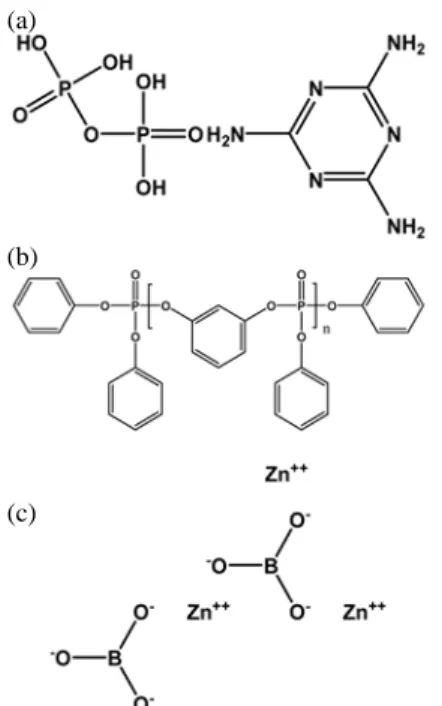
Fig. 1. Chemical structures of (a) melamine py- ropho- sphate (MPP), (b) resorcinol bis(di- phenyl phosphate) (RDP), and (c) zinc bo- rate (ZB).
use. Therefore, a variety of methods have been made to improve the thermal properties of bio- degradable polymers, such as the use of addi- tives, mechanical treatment and reinforcement in the polymerization stage (Nikolic et al., 2001;
Loo et al., 2005; Kim et al., 2007).
Flame retardants hinder the combustion of polymer materials generally by volatilizing after absorbing heat through an endothermic reaction and remove the heat of polymer combustion.
They react with the residues, such as char or a gas foam layer, which can effectively hinder the heat and fuel transfer process during combus- tion, leading to the self-extinguishment of burn- ing materials (Agrawal et al., 1991; Camino et al., 1991; Zhu et al., 1996). This mechanism can be effective in reinforcing the thermal sta- bility of bio-composites.
This study investigated the thermal stability of
2.1. Materials
Poly lactic acid (PLA) was supplied by Nature Works Co., USA. PLA has an MFI of 15 g/10 min (190°C/2, 160 g) and a density of 1.22 g/cm3. Wood flours (WF), as the reinforc- ing natural-filler, were obtained from Saron Filler Co., South Korea. The AS additives to re- inforce flame retardation, melamine pyropho- sphate (MPP), resorcinol bis (diphenyl phos- phate) (RDP) and zinc borate (ZB) were sup- plied by Chempia Co., South Korea. Fig. 1 shows the chemical structure of the flame retardants.
2.2. Compounding and Making Spe- cimens
PLA was blended with WF, MPP, RDP and ZB in a laboratory-sized, co-rotating, twin screw extruder (Bau Technology, South Korea) using three general processes: melt blending, extrusion and pelletizing. The weight ratio of PLA to WF was 70 to 30. Two types of flame retardant, MPP and RDP were applied at 5 wt%, 10 wt%
and 10 wt% with 3 phr ZB based on the total weight of resin such as PLA and PLA-WF bio-composites. The extruder barrel was divided into eight zones with the temperature in each zone being individually adjustable. The materi- als were blended with a screw speed of 250 rpm at 185°C. After extruding, the blended ma-
(a)
(b) Fig. 2. DSC curves of (a) PLA and (b) PLA-WF bio-composites.
terials were cooled with water, and pelletized.
The pellets ware dried at 60°C for 24 hrs. The dried pellets were made into specimens for dy- namic mechanical analysis (DMA) with an in- jection molding machine at a heating temper- ature of 185°C, an injection pressure of 1,200 psi and a device pressure of 1,500 psi.
2.3. Differential Scanning Calorimetry (DSC)
DSC was carried out using a TA Instrument DSC Q1000 in NICEM, at Seoul National University, South Korea. Each sample was scanned from -80 to 200°C at a heating rate of 10 °C/min and then cooled at the same rate under a nitrogen atmosphere. The thermal properties, melting temperature (Tm) and glass temperature (Tg), were determined from the second scan. Tm
was considered the maximum of the endother- mic melting peak from the second heating scan, and a deflection of the baseline was observed at the Tg from the second cooling scan.
2.4. Dynamic Mechanical Analyzer (DMA)
DMA was carried out using a TA Instrument
DMA Q800. The storage modulus, loss modulus and loss factor (tan delta) of the composites was measured in type of dual cantilever. The measurements were carried out from -20.0°C to 140.0°C at a heating rate of 2.0°C/min and at a frequency of 1 Hz.
2.5. Thermo Gravimetric Analysis (TGA)
TGA (Q-5000 IR, TA Instrument, USA) was used at NICEM, Seoul National University, South Korea. The sample was measured in nitrogen gas at a heating rate of 20°C/min, from 35°C to 700°C. The sample weight was 8∼14 mg.
3. RESULTS and DISCUSSIONS
3.1. Differential Scanning Calorimetry (DSC)
The thermal properties, such as melting tem- perature (Tm) and glass temperature (Tg) of the PLA and PLA-WF bio-composites were meas- ured from DSC analysis. Fig. 2 show the heat- ing thermograph of PLA and PLA-WF bio-com- posites according to the amount of flame re- tardant added. Table 1 summarizes the thermal
PLA-RDP10phr 47.8 147.9 PLA-RDP10phr-ZB3phr 47.7 147.8
PLA-WF30% 58.0 149.9∼153.6
PLA-WF30%-MPP5phr 56.7 147.6∼152.0 PLA-WF30%-MPP10phr 56.5 145.3∼151.3 PLA-WF30%-MPP10phr
-ZB3phr 57.0 148.5∼152.2
PLA-WF30%-RDP5phr 56.3 147.7∼152.4 PLA-WF30%-RDP10phr 52.9 150.7 PLA-WF30%-RDP10phr
-ZB3phr 40.5 130.3∼143.8
properties of the flame retardant filled PLA and PLA-WF bio-composites obtained from DSC.
The Tm of the MPP filled PLA specimens was lower than that of the neat PLA. However, as soon as the MPP content was increased from 5 phr to 10 phr, the Tm of MPP filled PLA speci- mens increased. The Tm of the 10 phr MPP and 3 phr ZB-filled PLA specimens was slightly higher than that of the 10 phr MPP filled PLA specimen. It was expected that MPP and ZB would reinforce the thermal stability of the PLA with their heat resistance (Kandola et al., 2001;
Cai et al., 2008). The Tm of the RDP filled PLA specimen also was lower than that of neat PLA. The Tm of the RDP filled PLA decreased with increasing RDP content, and the addition of ZB exacerbated the decrease in Tm.
In Fig. 2(b), the Tm of PLA-WF bio-compo- sites were slightly lower than that of the PLA
tively rapid ramping of the heating temperature.
The MPP filled PLA-WF bio-composites showed a similar tendency to that of the MPP filled PLA specimens. The Tm of the RDP-filled PLA- WF bio-composites also decreased. In particular, the RDP 10 phr and ZB 3 phr PLA-WF bio- composites showed a large decrease. This shows the anti-synergic effect among WF, RDP and ZB.
In Table 2, the Tg of the PLA and PLA-WF bio-composite showed a similar tendency to Tm
of the PLA and PLA-WF bio-composites. The Tg of the PLA specimens was slightly higher than that of the PLA-WF bio-composites, and the Tg of the MPP filled samples was higher than that of the RDP filled specimens. The Tg
of the MPP filled PLA and PLA-WF bio-com- posites were lower than that of the neat PLA and PLA-WF bio-composites. However, the ad- dition of ZB increased the Tg of the MPP filled PLA and PLA-WF bio-composites. This was at- tributed due to the heat resistance of ZB and MPP, and the synergic effect of MPP and ZB (Kandola et al., 2001; Cai et al., 2008). The an- ti-synergic effect between RDP and ZB could also be confirmed as a decrease in the Tg of RDP and ZB filled PLA.
3.2. Dynamic Mechanical Analyzer (DMA)
The storage modulus of the PLA bio-compo- sites was obtained from DMA. Fig. 3 shows the
(a)
(b)
(c)
(d)
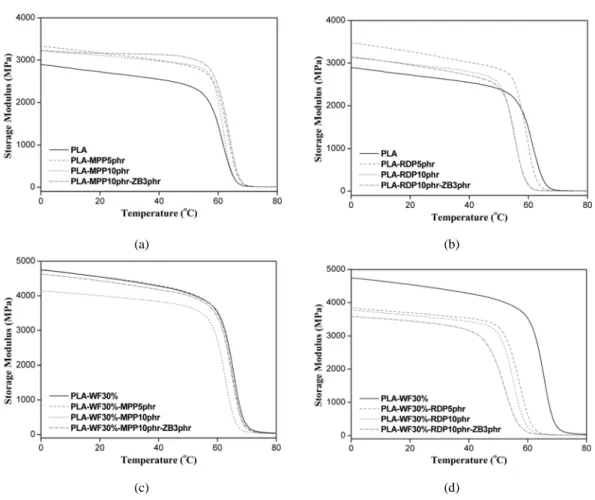
Fig. 3. Storage modulus of (a) MPP filled and (b) RDP filled PLA and (c) MPP filled (d) RDP filled PLA-WF bio-composites.
dynamic storage modulus of the flame retardant filled PLA and PLA bio-composites as a func- tion of temperature. The storage modulus of the flame retardant added PLA specimens was high- er than that of the neat PLA (Fig. 3(a)). This was attributed to the improvement of thermal sta- bility of the specimens by the flame retardants.
In Fig. 3(a), the storage modulus of the 10 phr MPP-filled PLA over the same temperature was slightly lower than that of the 5 phr MPP-filled PLA. It is believed that the increase in MPP content has little effect on the ratio storage modulus of PLA. The storage modulus of the 10 phr MPP and 3 phr ZB-filled PLA specimen
was lower than that the only 10 phr MPP-filled PLA until 30°C, but was highest in after 50°C.
This may be due to reinforcement of the ther- mal stability from ZB. The storage modulus the RDP filled PLA was lower than that of the MPP filled PLA except for PLA containing 5 phr RDP until 30°C. The storage modulus of the 10 phr RDP-filled PLA and 10 phr RDP and 3 phr ZB-filled PLA specimens was lower than that of the 5 phr RDP-filled PLA specimens, and the storage modulus of the 10 phr RDP and 3 phr ZB-filled PLA specimen was higher than that of the 10 phr RDP-filled PLA specimen until 10°C. However, the ratio of the storage
(a)
(b)
(c)
(d)
Fig. 4. TGA curves of (a) MPP filled and (b) RDP filled PLA and (c) MPP filled (d) RDP filled PLA-WF bio-composites.
modulus of PLA with 10 phr RDP and 3 phr ZB-filled PLA specimens was lower than that of the 10 phr RDP-filled PLA specimens after 10°C. Therefore, the content of RDP and ZB in the RDP filled PLA had little effect on the stor- age modulus.
Fig. 3(b) shows the storage modulus of the PLA-WF bio-composites that was higher than that of the PLA specimens and it may be due to the increase of stiffness of PLA-WF bio- composites from natural filler loading which al- low effective stress transfer from the PLA ma- trix to the flours (Huda et al., 2005). And the
aspect of the DMA curve of the PLA bio-com- posites was generally similar to that of the PLA polymer in that an increase in the content of flame retardant decreased the storage modulus and ZB had a synergic effect with MPP and an anti-synergic effect with RDP.
3.3. Thermo Gravimetric Analysis (TGA)
The weights loss of the PLA bio-composites caused by thermal degradation was examined by TGA. Fig. 4 shows a thermograph of PLA with
(a)
(b)
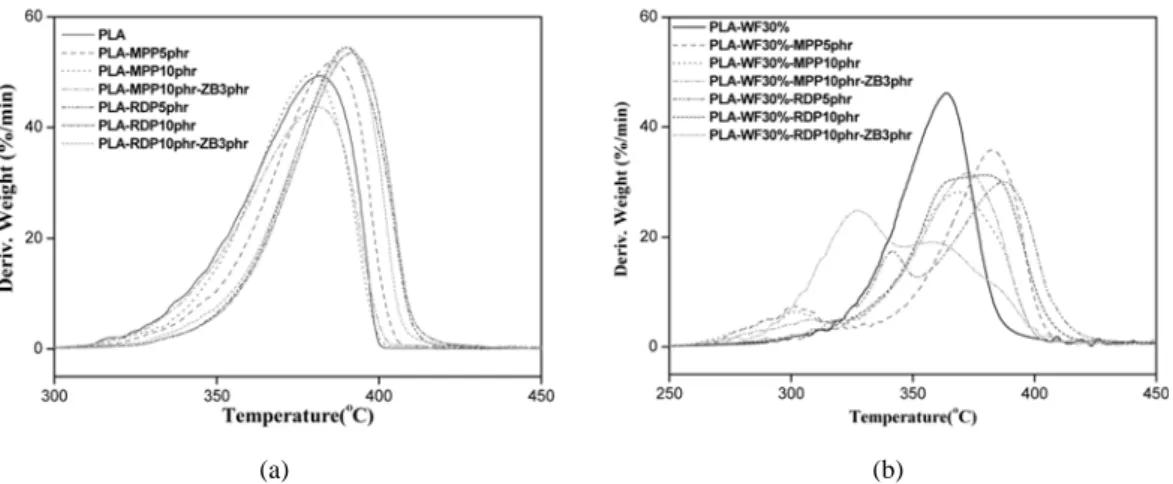
Fig. 5. Derivative thermo gravimetric curve (DTGmax) of (a) PLA and (b) PLA-WF bio-composites.
the flame retardant. In Fig. 4(a), the weight loss of the samples began from approximately 300°C, and only one peak was observed in the derivative thermo gravimetric curve (DTGmax) temperature at approximately 380°C (Fig. 5(a)).
This tendency was attributed to the properties of PLA and the flame retardants, as shown in Fig.
6. The decreasing rate of the flame retardant- added PLA specimens was lower than that of the non flame retardant filled PLA sample. This is due to the thermal volatilization of MPP through an endothermic reaction (Kandola et al., 2001). The weight loss of the 10 phr MPP-filled PLA and 10 phr MPP and 3 phr ZB filled PLA specimens were more than that of the only 5 phr MPP-filled PLA. This may be due to the increase in the MPP content, and is supported by the fact that thermal decreasing rates of the 10 phr MPP-filled PLA and 10 phr MPP and 3 phr ZB-filled PLA specimens were smaller than that of the 5 phr MPP-filled PLA.
In the end of thermal degradation, there was more residue in the additive-filled PLA than that of the neat PLA because of char and in- organic residue from the thermal reaction of MPP. The 10 phr MPP and 3 phr ZB-filled PLA showed a lower degradation rate and more
residue than that the 10 phr MPP PLA.
Therefore, ZB reinforced the flame retardation effect of MPP.
In Fig. 4(b), the decreasing rate of the flame retardant added PLA specimens was lower than that of the non flame retardant filled PLA samples. The thermal degradation of the flame retardant filled PLA ended later than that of the neat PLA and MPP-filled PLA at the same content. In Fig. 5(a), the RDP filled PLA speci- mens also showed a single peak in the de- rivative thermo gravimetric curve (DTGmax) at approximately 390°C, which was higher than that of PLA and MPP-filled PLA. This was at- tributed to the flame retardant mechanism of RDP that volatilized and form a gas phase (Murashko et al., 1999). This was confirmed from the weight loss of each material shown in Fig. 6 The TGA curve of PLA with 10 phr RDP was similar to that of PLA with 5 phr RDP but there was a slight increase in flame retardation. It is expected that the contents of RDP influenced the flame retardation slightly.
However, compared to the 10 phr RDP fil- led-PLA specimen, the degradation ratio and residue of PLA with 10 phr RDP and 3 phr ZB was higher. It is possible that the anti-syner-
Fig. 6. TGA curves of the materials.
gistic effect between RDP and ZB influenced the flame retardation of PLA.
Fig. 4(c) shows the PLA-WF bio-composites.
The weight loss of the PLA-WF bio-composites began earlier than that of PLA. In addition, the two peaks were observed in the derivative ther- mo gravimetric curve (DTGmax) of the flame re- tardant filled PLA-WF bio-composites (Fig.
5(b)). This may be due to the degradation of the hemicellulose, cellulose and lignin con- stituents in the bio-composites and reaction of flame retardant for degradation (Kim et al., 2005). This tendency is supported by the TGA curve of WF, as shown in Fig. 6. The MPP- and MPP with ZB filled PLA-WF bio-compo- sites showed more weight loss than the neat PLA-WF bio-composites until 340∼350°C.
However, after 350°C, the weight loss of flame retardant filled PLA was less than that of the non-flame retardant filled PLA-WF. This TGA curve of the flame retardant filled PLA-WF bio-composites may be due to the flame re- tardation mechanism of MPP and ZB. The early weight loss indicates the volatilization of the flame retardant, which decreased the thermal degradation through an endothermic reaction (Kandola et al., 2001). On the other hand, the flame retardation of 10 phr RDP and 3 phr ZB filled PLA-WF bio-composite, like that of the 10 phr RDP and 3phr ZB-filled PLA specimen,
posites with the exception for volatilization of the flame retardant in the early stages (Fig. 4(d)).
4. CONCLUSION
The Tm of the flame retardant filled PLA and PLA-WF bio-composites was lower than that of the neat PLA bio-composites, but the decrease of that was slight change. The storage modulus of PLA was higher than that of PLA-WF bio- composites. MPP, RDP and ZB reinforced the thermal stability of the PLA and PLA-WF bio-composites. Therefore, the thermal stability of the PLA and PLA-WF bio-composite was af- fected by a flame retardation mechanism from an endothermic reaction. RDP stabilized the PLA polymer and MPP reinforced the stability of the PLA-WF bio-composites. However, the addition of both RDP and ZB decreased the thermal stability of the PLA and PLA-WF bio- composites. This might be due to an anti-syn- ergetic reaction between RDP and ZB. In con- trast, the supplemental addition of ZB to the MPP filled PLA polymer and PLA-WF bio- composites decreased the thermal degradation of the PLA polymer and PLA-WF bio-composites.
ACKNOWLEDGEMENTS
This project was initiated through research grants (500-20070113) supported by the Korea Forest Service.
REFERENCES
1. Agrawal, J. P., D. C. Gupta, Y. Khare, and R. S.
Satpute. 1991. Zinc Borate Complex as Flame- Retardardant Filler. Journal of Applied Polymer Science 43(2): 373∼377.
2. Cai, Y. B., Q. F. Wei, F. L. Huang, and W. D.
Gao. 2008. Preparation and properties studies of halogen-free flame retardant form-stable phase change materials based on paraffin/high density polyethylene composites. Applied Energy 85(8):
765∼775.
3. Camino, G., L. Costa, and M. P. L. Dicortemiglia.
1991. Overview of Fire retardadant Mechnisms.
Polymer Degradation and Stability 33(2): 131∼
154.
4. Huda, M. S., A. K. Mohanty, L. T. Drzal, E.
Schut, and M. Misra. 2005. “Green” composites from recycled cellulose and poly(lactic acid):
Physico-mechanical and morphological properties evaluation. Journal of Materials Science 40(16):
4221∼4229.
5. Iovino, R., R. Zujjo, M. A. Rao, L. Cassar, and L. Gianfreda. 2008. Biodegradation of poly (lactic acid)/starch/coir biocomposites under controlled composting conditions. Polymer Degradation and Stability 93(1): 147∼157.
6. Kandola, B. K., A. R. Horrocks, and S. Horrocks.
2001. Complex char formation in flame-retarded fibre-intumescent combinations. Part V. Exploring different fibre/intumescent combinations. Fire and Materials 25(4): 153∼160.
7. Kim, H. S., B. H. Lee, S. W. Choi, S. Kim, and H.-J. Kim. 2007. The effect of types of maleic anhydride-grafted polypropylene (MAPP) on the interfacial adhesion properties of bio-flour-filled polypropylene composites. Composites Part a-App- lied Science and Manufacturing 38(6): 1473∼
1482.
8. Kim, H. S., H. S. Yang, and H.-J. Kim. 2005.
Biodegradability and mechanical properties of Agro-Flour-filled polybutylene succinate biocom- posites. Journal of Applied Polymer Science.
97(4): 1513∼1521.
9. Kim, H.-S., H. S. Yang, H.-J. Kim, B. J. Lee, and T. S. Hwang. 2005. Thermal properties of agro-flour-filled biodegradable polymer bio-com- posites. Journal of Thermal Analysis and Calori- metry 81(2): 299∼306.
10. Lee, B.-H., H.-S. Kim, S.-W. Choi, and H.-J.
Kim. 2006. Improvement of interfacial adhesion for surface treated rice husk flour-filled poly- propylene bio-composites. Journal of the Korean Wood Science and Technology 34(3): 38∼45 11. Loo, S. C. J., C. P. Ooi, and Y. C. F. Boey.
2005. Influence of electron-beam radiation on the hydrolytic degradation behaviour of poly (lactide- co-glycolide) (PLGA). Biomaterials 26(18): 3809
∼3817.
12. Mohanty, A. K., M. Misra, and G. Hinrichsen.
2000. Biofibres, biodegradable polymers and bio- composites: An overview. Macromolecular Mate- rials and Engineering 276(3): 1∼24.
13. Murashko, E. A., G. F. Levchik, S. V. Levchik, D. A. Bright, and S. Dashevsky. 1999. Fire-re- tardant action of resorcinol bis(diphenyl phos- phate) in PC-ABS blend. II. Reactions in the condensed phase. Journal of Applied Polymer Science 71(11): 1863∼1872.
14. Nikolic, M. S. and J. Djonlagic. 2001. Synthesis and characterization of biodegradable poly(buty- lene succinate-co-butylene adipate)s. Polymer De- gradation and Stability 74(2): 263∼270.
15. Zhu, W. M., E. D. Weil, and S. Mukhopadhyay 1996. Intumescent flame-retardant system of pho- sphates and 5,5,5'5',5'',5''-hexamethyltris(1,3,2- dioxaphosphorinanemethan)amine 2,2',2''-trioxide for polyolefins. Journal of Applied Polymer Sci- ence 62(13): 2267∼2280.