http://dx.doi.org/10.9721/KJFST.2015.47.5.593
593
©The Korean Society of Food Science and Technology
레토르트 곡물 두유 내 Bacillus cereus, Escherichia coli O157:H7,
Listeria monocytogenes의 내열특성
김남희·구재명·이민석*
고려대학교 일반대학원 생명공학과
Thermal Resistance Characteristics of Bacillus cereus, Escherichia coli
O157:H7, and Listeria monocytogenes in a Multi-grain Soy Milk Product
Nam Hee Kim, Jae Myung Koo, and Min Suk Rhee*
Department of Biotechnology, College of Life Sciences and Biotechnology, Korea University
Abstract This study determined the thermal resistance of Bacillus cereus, Escherichia coli O157:H7, and Listeria monocytogenes in multi-grain soymilk and proposes processing conditions that meet the national standard for retort food products in Korea. D and z values were calculated from thermal inactivation kinetic curves after heating at 55, 60, and 65oC. The D value for B. cereus at 55oC was the highest (22.8 min), followed by that for E. coli O157:H7 (18.8 min) and L. monocytogenes (17.6 min). At 60-65oC, the order was L. monocytogenes (D60-65°C=3.4-0.9 min), E. coli O157:H7 (3.0-0.3 min), and B. cereus (1.2-0.3 min). The z values for these species were 5.2, 5.5, and 7.7°C, respectively. The Korean national standard for retort food products was achieved by thermal processing at 124±2oC for 0.3-2.2 min. This study provides useful data for ensuring both the microbiological safety and product quality of multi-grain soymilk products. Keywords: multi-grain soymilk, foodborne pathogenic bacteria, thermal resistance, retort food product
Introduction
Soy milk is produced by soaking dried soybeans in water and then grinding them with or without other grains. It is a popular alternative to cow’s milk due to the reported beneficial effects of plant proteins on nutrition and health (1). Soy beans have a variety of health-promoting effects, including reducing cholesterol (2), lowering blood pressure (3), and preventing diseases such as cancer (4), diabetes (5), and obesity (6). As some consumers tend to prefer soy milk to cow’s milk for these reasons, food manufacturers have released various types of new commercial products (7).
Microbial contamination of raw materials and unsanitary food processing environments may affect the microbiological quality of the final product (8,9). Because soy milk has a rather complicated manufacturing processes (i.e., soaking, shelling, grinding, boiling, filtration, and homogenization), either in the presence or absence of a number of other ingredients (e.g., barley, brown rice, corn, soybean, or wheat), it is likely to
contain microbial contaminants such as spoilage or pathogenic bacteria. Indeed, several pathogens (including Bacillus cereus, Salmonella spp., and Staphylococcus aureus) have been isolated from various soy milk products (10-12). In addition, the long-term survival and growth of Escherichia coli O157:H7 and Listeria monocytogenes in soy milk and cow’s milk have been reported previously (13-15). In China, 3,936 students and 260 teachers suffered from infectious disease after drinking soy milk, and a 13-year-old girl died in 2003 (16). As the microbiological safety of soy milk is a growing concern for consumers, it is important to specify appropriate processing conditions for these commercial products.
Modern food consumers prefer soy milk supplemented with various ingredients (e.g., black bean, black sesame, or oatmeal) as a breakfast substitute or a diet food; therefore, the market for these products has expanded (17). Supplementation changes not only the nutritional value of the soy milk product, but also its physicochemical characteristics such as viscosity and heat conductivity (18); thus, it is generally considered that the nutritional value and physicochemical characteristics of multi-grain soy milk are significantly different from those of common soy milk. In addition, both inherent and added nutrients (e.g., plant proteins, isoflavone, taurine, or oligosaccharides) may affect its biological activity and resistance to external stresses. For instance, Anderson et al. (19) and Gibson (20) reported that adding dextrose or sucrose to products increases the heat resistance of the micro-organisms present in these products. Kenney and Beuchat (21) *Corresponding author: Min Suk Rhee, Department of
Biotechnol-ogy, College of Life, Sciences and BiotechnolBiotechnol-ogy, Korea University, Seoul 02841, Korea
Tel: 82-2-3290-3058 Fax: 82-2-3290-4984 E-mail: [email protected]
Received July 8, 2015; revised August 25, 2015; accepted August 26, 2015
also reported that a higher fat content results in increased thermal resistance of L. monocytogenes. Thus, because the ability of microorganisms to survive thermal processing may be affected by the abundance of nutrients in foods, it is important to investigate the heat resistance characteristics of various foodborne pathogens and ascertain appropriate thermal processing conditions to ensure the microbiological safety of that product.
Here, B. cereus, E. coli O157:H7, and L. monocytogenes were selected as potential microbiological hazards of multi-grain soy milk products, because B. cereus has been frequently isolated from raw soybeans, grains, and related-products (22,23), and E. coli O157:H7 and L. monocytogenes are major causative micro-organisms of foodborne illness outbreaks associated with the consumption of commercial milk products (24-27). In addition, D’Aoust et al. (28) found that E. coli O157:H7 had the strongest resistance to thermal inactivation among three foodborne pathogens (i.e. Campylobacter spp., E. coli O157:H7, and Yersinia enterocolitica).
Therefore, this study aimed to devise appropriate thermal processing conditions that inactivate B. cereus, E. coli O157:H7, and L. monocytogenes in commercial multi-grain soy milk products and that meet the national standards for retort food products described in the Korea Food Code, by examining the thermal resistances of these microorganisms in these products.
Materials and Methods
Suspensions of the target microorganisms
Three strains of B. cereus (ATCC 10876, 13061, and 14579), E. coli O157:H7 (ATCC 35150, 43889, and 43890), and L. monocytogenes (ATCC 19111, 19115, and 19117) were used in this study. All test strains were obtained from the Food Micro-biology Culture Collection at Korea University (Seoul, Korea) and stored at −80oC in tryptic soy broth (TSB, Difco, Detroit, MI, USA) supplemented with glycerol (20%). The stock microorganisms were sub-cultured monthly in tryptic soy agar
(TSA, Difco). Each strain was inoculated into TSB and incubated at 30oC (B. cereus and L. monocytogenes) or 37oC (E. coli O157:H7) for 24 h. The cultured strains of each bacterial species were then combined into a sterile 50 mL centrifuge tube and washed twice with sterile 0.85% saline solution at 3,000×g (Centra-CL2, IEC, Needham Heights, MA, USA) for 15 min.
Preparation of soy milk sample
The multi-grain soy milk sample used in this study was a commercially produced retort pouch product and comprised 22 ingredients: adlay, barley, black rice, black soybean, brown rice, brown rice oil, corn, dried chestnut, embryo bud of brown rice, fructo-oligosaccharide, glutinous millet, glutinous rice, honey, millet, non-glutinous rice, refined sugar, rye, salt, sesame, sorghum, wheat, and white soybean. All of the ingredients were produced and made in Korea. The semi-final product (the product obtained immediately prior to sterilization) was supplied by the manu-facturing company (Doctorsoy Inc., Yangju, Korea) on the day of the experiment (July to August, 2012). The viscosity of this product was measured using a cone/plate viscometer (cone #CP-40; LVT, Brookfield, Stoughton, MA, USA) with stirring at 12 rpm at room temperature.
Before the experiment, the absence of target bacteria (B. cereus, E. coli O157:H7, and L. monocytogenes) was confirmed by qualitative microbiological analysis, according to the method described in the Korea Food Code (2012), with minor modi-fications. Briefly, 25 mL of product were poured into stomacher bags containing 225 mL of enrichment broth, homogenized at 230 rpm for 2 min, and incubated under the following conditions: B. cereus, TSB supplemented with polymyxin at 30oC for 24 h; E. coli O157:H7, modified TSB at 35-37oC for 24 h; and L. monocytogenes, Listeria enrichment broth (Difco) at 30oC for 24 h. To check that the target bacteria were present in the enriched samples, each enriched sample was streaked onto selective media and incubated as follows: B. cereus, mannitol-egg yolk-Table 1. Bacterial strains used in this study
Bacteria Strain Application Sources
Bacillus cereus
ATCC 10876 -a Contaminated flask
ATCC 13061 Produces penicillinase beta-lactamase I -ATCC 14579 Produces restriction endonuclease Bce14579I
Food testing
-Escherichia coli O157:H7
ATCC 35150 - Feces, human
ATCC 43889 Quality control strain for biosynthetic products Produces Shiga-like toxin II
Feces of patient with hemolytic uremic syndrome, North Carolina, USA ATCC 43890 Produces Shiga-like toxin I Human feces, California, USA
Listeria monocytogenes ATCC 19111 Media testing Enteric research Food testing Poultry, England
ATCC 19115 Quality control strain
Enteric research Human
ATCC 19117 Enteric research Sheep, USA
polymyxin agar (MYP, Difco) supplemented with 50% egg yolk and antimicrobial vial P (Difco) at 30oC for 24 h; E. coli O157:H7, Sorbitol MacConkey Agar with Cefixime and Tellurite (CT-SMAC, Difco) at 37oC for 24 h; and L. monocytogenes, modified Oxford agar supplemented with modified Oxford anti-microbic supplement (mOxford, Difco) at 30oC for 24 h. Only target pathogen-free samples were used for the subsequent experiments.
Bacterial survival during heat treatment
Prior to the experiment, glass culture tubes (18 mm inside diameter×150 mm length) containing 9.9 mL of target pathogen-free multi-grain soy milk were placed in shaking water baths set at 55, 60, and 65oC (VS-1205SW1, Vision Scientific Co. Ltd., Daejeon, Korea) for pre-warming. Cell suspensions of the target pathogens were separately inoculated into the prepared samples to yield approximate 7-8 log colony forming units (CFU)/mL per inoculum. Heat treatment was performed with regular shaking at 100 rpm, and the survival of each pathogen was confirmed at appropriate time intervals (four time points) and heating temperatures (i.e., B. cereus: 30 min at 55oC, 1 min at 60oC, and 15 s at 65oC; E. coli O157:H7: 15 min at 55oC, 1.5 min at 60oC, and 15 s at 65oC; and L. monocytogenes: 10 min at 55oC, 2 min at 60oC, and 30 s at 65oC). These pathogen-specific time points and heating temperatures were determined according to the results of previous studies on the general thermal resistance of each of these pathogens in laboratory media or foodstuffs (29-31).
The following procedure was conducted to confirm the number of survivors in each of the treated samples. Briefly, each sample was serially diluted 10-fold in sterile 0.85% saline and then spread-plated in duplicate on MYP (B. cereus), CT-SMAC (E. coli O157:H7), or mOxford (L. monocytogenes) agar medium. The plates were then incubated at 30oC (B. cereus and L. monocytogenes) or 37oC (E. coli O157:H7) for 24 h, and the number of typical colonies on each plate was counted and expressed as a log value (log CFU/mL). Each experiment was repeated three times.
Determination of D- and z- values and thermal death time (TDT)
The data for each individual pathogen at each of the treatment temperatures were used to plot a thermal death curve (TDC; log population of survivors against heating time). The linear fit for the plot was determined using a linear regression application in Sigma Plot software (version 10, Systat Software, Richmond, CA, USA). The D value at each temperature was obtained by calculating the inverse negative of the slope for the log population of survivors (D value=−1/slope). The log10 D values were then plotted against temperature and the z values were calculated from the curve (i.e., z value=−1/slope of the log10 D versus temperature curve).
Korea national standard for sterilization processing of retort food products is defined as ‘heat treatment at 120°C for 4 min or higher level of heating condition’ (Korea Food Code, 2015).
The TDT at a specific temperature (T) and z value for each pathogen required to achieve this standard was calculated using following equation:
Statistical analysis
Statistical analyses were performed using SAS software version 9.1 (SAS Institute, Inc., Cary, NC, USA). Data from triplicate experiments were compared using analysis of variance (ANOVA). Statistical significance was determined using Tukey’s studentized range test. A p<0.05 was considered significant.
Results and Discussion
Survival of target pathogens in a multi-grain soy milk product after heating
The viscosity of the multi-grain soy milk product ranged from 19-20 cP, which was higher than that of a normal soy milk product that did not contain any supplementary ingredients (4-5 cP) (18). The initial populations of B. cereus, E. coli O157:H7, and L. monocytogenes in the inoculum were 6.4-6.5, 7.1-7.3, and 6.4-6.5 log CFU/mL, respectively. The TDCs at 55, 60, and 65oC were generated by fitting the data to the log linear model, with R2>0.9; thus the models fitted the data well. Figure 1 shows the survival of each pathogen in the multi-grain soy milk after heating at 55, 60, or 65oC. Heating at 55oC for 30 min reduced the B. cereus and L. monocytogenes populations by 1.9 and 2.1 log CFU/mL, respectively; however, the same treatment reduced the E. coli O157:H7 population by <1 log CFU/mL (Fig. 1A). At 60oC, the viable cell count for B. cereus was reduced by up to 3.0 log CFU/mL within 4 min; however, E. coli O157:H7 and L. monocytogenes survived (4.5-5.2 log CFU/mL), even after heating for 6 min (Fig. 1B). More than 4 log CFU/mL of L. monocytogenes endured heating to 65oC for 2 min, whereas heat treatment for 1 min at the same temperature reduced the number of B. cereus and E. coli O157:H7 by up to 2.9 and 3.9 log CFU/mL, respectively (Fig. 1C).
Farber et al. (32) reported that heating a milk product inoculated with L. monocytogens to 64.5-66oC for <17 s significantly reduced the population by 3.1-3.7 log CFU/mL, resulting in 1.2-1.8 log CFU/mL of L. monocytogens remaining after this procedure. D’Aoust et al. (28) also reported that E. coli O157:H7 in a fluid milk was completely inactivated after pasteurization at >64.5oC for 16.2 s. Thus, the thermal resistances of these micro-organisms are higher in multi-grain soy milk than in cow’s milk. Thermal resistance characteristics of the target patho-gens in a multi-grain soy milk product
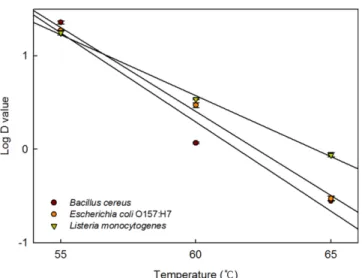
Table 2 shows the D55-65°C values and z values for B. cereus, E. coli O157:H7, and L. monocytogenes in the multi-grain soy milk product. D55°C was highest for B. cereus (22.8 min), followed by E. coli O157:H7 (18.8 min) and L. monocytogenes (17.6
TDTT 10 4 ( ) log 120 T– z ---+ =
min) (p<0.05). When heated at 60oC, the thermal resistance of L. monocytogenes (D value=4.5 min) was higher than that of E. coli O157:H7 (3.0 min) and B. cereus (1.2 min). Heating at 65oC rapidly inactivated the target pathogens, resulting in D values of 0.3-0.9 min. The D value versus heating temperature curves were generated by fitting the data to a log linear model, with R2>0.95 (Fig. 2). The calculated z values are shown in the right-hand column of Table 2. The z values for B. cereus, E. coli O157:H7, and L. monocytogenes in the multi-grain soy milk product were 5.2, 5.6, and 7.7oC, respectively, meaning that B. cereus was more susceptible to changes in heating temperature than either E. coli O157:H7 or L. monocytogenes (p<0.05).
Previous studies calculated D values for these pathogens in a variety of food samples. Byrne et al. (29) reported that the D55°C and D60°C values for B. cereus in pork luncheon roll were only 6.4 and 1.0 min, respectively (z value=6.6). Juneja and
Marmer (33) examined E. coli O157:H7 in various ground meat products (lamb, turkey, and pork) at 55-65oC, and reported the following D55-65°C values: 11.9-0.4 min for lamb (z value=6.5), 11.5-0.3 min for turkey (z value=6.9), and 11.5-0.3 min for pork (z value=6.5). When E. coli O157:H7-inoculated ground beef was heated to the same temperature, the D values were 21.1-0.4 min (z value=6.0), while those in ground chicken (11.8-0.4 min) were similar to those of lamb, turkey, and pork (z value=6.8) (30). McCormick et al. (31) reported that the D60°C and D65°C for L. monocytogenes in a packaged low-fat ready-to-eat turkey bologna were 2.1 and 0.3 (z value=4.4), respectively. Farber (34) reported that D values for L. monocytogenes in ground meat at 56-62oC ranged from 13.2-1.0 min, resulting in a z value of 4.9.
Here, we found that the D55°C valuesfor B. cereus (22.8 min), E. coli O157:H7 (18.7 min), and L. monocytogenes (17.6 min) in a multi-grain soy milk product were higher than those for meat Fig. 1. Time-dependent reduction in the Bacillus cereus, Escherichia coli O157:H7, and Listeria monocytogenes populations present in a multi-grain soy milk product heated at 55oC (A), 60oC (B), and 65oC (C) for different times.
Table 2. D and z values for Bacillus cereus, Escherichia coli O157:H7, and Listeria monocytogenes in a multi-grain soy milk product at 55, 60, and 65°C
Bacteria D values (min) at temperature below (R
2)
Z values (oC)
55oC 60oC 65oC
Bacillus cereus 22.80±0.85B (0.97) 1.17±0.02A (0.94) 0.28±0.00A (0.95) 5.24±0.04A (0.96) Escherichia coli O157:H7 18.74±0.16A (0.95) 2.97±0.17B (0.98) 0.30±0.02A (0.97) 5.55±0.08A (0.99) Listeria monocytogenes 17.60±1.02A (0.97) 3.44±0.06C (0.98) 0.87±0.05B (0.98) 7.66±0.27B (0.99) A-CValues denoted by different superscript capital letters in the same column are significantly different (p<0.05).
products examined in the previous reports mentioned above. The D60°C values also tended to be higher. In general, when heating a solid-liquid mixture, the rate of heat transfer in the liquid part is higher than that in the solid part. Sandeep and Puri (35) showed that during the heating procedure, the temperature of the liquid fraction increases first. This heat is then transferred to the solid particles by convection. Thus, it is generally believed that the thermal resistance of a microorganism is higher in solid products than in liquid products. By contrast, in this study, the thermal resistances of B. cereus, E. coli O157:H7, and L. monocytogenes were higher than those in solid products such as meat products. This may be attributed to the higher content in solid substances, such as the powder of various grains (adlay, barley, black rice, dried chestnut, embryo bud of brown rice, sesame, wheat), in multi-grain soy milk, which may decrease the heat conductivity of this product, thereby diminishing the thermal inactivation of the pathogenic bacteria present. Therefore, it can be concluded that target pathogens contaminating multi-grain soy milk are more difficult to kill by pasteurization at low temperatures (55-60oC) than those in a normal soy milk product that does not contain various grains.
TDT for industrial retort processing
Using the calculated z values, we next calculated the TDT required to achieve the national standard for sterilization of retort food products (120oC, 4 min) using an industrial steam retort processor (122±2oC) (Table 3). L. monocytogenes required the longest time (0.7-2.2 min) to achieve this standard (122-126
oC; p<0.05), whereas E. coli O157:H7 and B. cereus required
0.3-1.7 and 0.3-1.8 min, respectively. In other words, L. monocytogenes had the highest thermal resistance, followed by E. coli O157:H7 and B. cereus.
However, if this product is contaminated with more than one species of pathogenic bacteria or with the heat resistant endospores of B. cereus, the thermal resistance values of the target
microorganism (i.e., D value, z value, and thermal death time for industrial retort processing) may be altered.
Conclusion
This study suggests that major foodborne pathogenic bacteria (B. cereus, E. coli O157:H7, and L. monocytogenes) in a multi-grain soy milk consisting of 22 ingredients had relatively higher thermal resistance than in other liquid food products. We attribute this to the higher fluid viscosity of the multi-grain soy milk compared with that of plain soy milk. In particular, L. mono-cytogenes had the strongest thermal resistance followed by E. coli O157:H7 and B. cereus. The data presented in this study will be useful for soy milk manufacturers and will enable them to design appropriate sterilization processes (methods and target microorganisms) and procedures (specific conditions: temperature and time) to control potential microbiological hazards present in commercial soy milk products. In addition, these data can be used practically to set the critical limit for the multi-grain soy milk product-specific critical control point (commercial sterilization) in the Hazard Analysis Critical Control Point (HACCP) system.
Acknowledgments
This study was supported by a Korea University Grant and partially supported by School of Life Sciences and Biotechnology of Korea University for BK21 PLUS. The authors also thank the Institute of Biomedical Science and Food Safety, CJ-Korea University Food Safety Hall for providing equipment and facilities.
References
1. Friedman M, Brandon DL. Nutritional and health benefits of soy proteins. J. Agr. Food Chem. 49: 1069-1086 (2001)
2. Sautier C, Flament C, Doucet C, Suquet JP. Effects of eight dietary proteins and their amino acid content on serum, hepatic and faecal steroids in the rat. Nutr. Rep. Int. 34: 1051-1059 (1986)
3. Rivas M, Garay RP, Escanero JF, Cia jr P, Cia P, Alda JO. Soy milk lowers blood pressure in men and women with mild to moderate essential hypertension. J. Nutr. 132: 1900-1902 (2002) 4. Wu AH, Ziegler RG, Nomura AM, West DW, Kolonel LN,
Horn-Ross PL, Hoover RN, Pike MC. Soy intake and risk of breast cancer in asians and asian americans. Am. J. Clin. Nutr. 68:
Fig. 2. Temperature-dependent-changes in the thermal resistance (D values) of Bacillus cereus, Escherichia coli O157:H7, and Listeria monocytogenes in a multi-grain soy milk product.
Table 3. Thermal death time required for an industrial retort processor to meet a mandatory regulation regarding retort products (120°C, 4 min)
Temp (T, oC)
Thermal death time at T (min) Bacillus cereus Escherichia coli
O157:H7 Listeria monocytogenes 122 1.66±0.01 A 1.75±0.02 B 2.19±0.05 C 123 1.07±0.01 A 1.15±0.02 B 1.62±0.05 C 124 0.69±0.01 A 0.76±0.02 A 1.20±0.05 B 125 0.44±0.01 A 0.50±0.01 B 0.89±0.05 C 126 0.29±0.01 A 0.33±0.01 A 0.66±0.04 B A-CValues denoted by different superscript capital letters in the same
1437S-1443S (1998)
5. Miraghajani MS, Esmaillzadeh A, Najafabadi MM, Mirlohi M, Azadbakht L. Soy milk consumption, inflammation, coagulation, and oxidative stress among type 2 diabetic patients with nephrop-athy. Diabetes Care 35: 1981-1985 (2012)
6. Choi JY, Jeon JE, Jang SY, Jeong YJ, Jeon SM, Park HJ, Choi MS. Differential effects of powdered whole soy milk and its hydrolysate on antiobesity and antihyperlipidemic response to high-fat treatment in C57BL/6N mice. J. Agr. Food Chem. 59: 2584-2591 (2011)
7. Shin HC, Seong HS, Sohn HS. The industrial development and health benefits of the soymilk. Korea Soybean Dig. 21: 15-27 (2004)
8. Jang HG, Kim NH, Choi YM, Rhee MS. Microbiological quality and risk factors related to sandwiches served in bakeries, cafés, and sandwich bars in South Korea. J. Food Protect. 76: 231-238 (2013)
9. Choi ES, Kim NH, Kim HW, Kim SA, Jo JI, Kim SH, Lee SH, Ha SD, Rhee MS. Microbiological quality of seasoned roasted laver and potential hazard control in a real processing line. J. Food Protect. 77: 2069-2075 (2014)
10. Brooks AA, Asamudo NU, Udoukpo FC. Microbiological and physico-chemical analysis of soymilk and soyflour sold in Uyo metropolis, Nigeria. Glob. J. Pure Appl. Sci. 9: 457-464 (2003) 11. Adeleke OE, Adeniyi BA, Akinrinmisi AA. Microbiological
qual-ity of local soymilk: A public health appraisal. Afr. J. Biomed. Res. 3: 89-92 (2000)
12. Adebayo-Tayo BC, Adegoke AA, Akinjogunla OJ. Microbial and physico-chemical quality of powdered soymilk samples in Akwa Ibom, South Southern Nigeria. Afr. J. Biotechnol. 8: 3066-3071 (2009)
13. Ferguson RD, Shelef LA. Growth of Listeria monocytogenes in soymilk. Food Microbiol. 7: 49-52 (1990)
14. Liu JG, Lin TS. Survival of Listeria monocytogenes inoculated in retail soymilk products. Food Control 19: 862-867 (2008)
15. Wang G, Zhao T, Doyle MP. Survival and growth of Escherichia coli O157:H7 in unpasteurized and pasteurized milk. J. Food Pro-tect. 60: 610-613 (1997)
16. Wenting Z. Growing concern over school milk program. Available from: http://www.chinadaily.com.cn/china/2011-04/28/content_ 12408775_2.htm. Accessed May 2, 2015.
17. Food Information Statistics System. Segmental market report on processed food in 2013: Soy milk. Available from: http://www. atfis.or.kr/home/M000000000/index.do. Accessed May 6, 2015. 18. Liu ZS, Chang SKC. Soymilk viscosity as influenced by heating
methods and soybean varieties. J. Food Process. Pres. 31: 320-333 (2007)
19. Anderson EE, Esselen jr WB, Fellers CR. Effect of acids, salt, sugar, and other food ingredients on thermal resistance of Bacil-lus thermoaciduranx. J. Food Sci. 14: 499-510 (1949)
20. Gibson B. The effect of high sugar concentrations on the heat resistance of vegetative micro-organisms. J. Appl. Bacteriol. 36: 365-376 (1973)
21. Kenney SJ, Beuchat LR. Survival, growth, and thermal resistance of Listeria monocytogenes in products containing peanut and chocolate. J. Food Protect. 67: 2205-2211 (2004)
22. Logan NA. Bacillus and relatives in foodborne illness. J. Appl. Microbiol. 112: 417-429 (2012)
23. Arnesen LPS, Fagerlund A, Granum PE. From soil to gut: Bacil-lus cereus and its food poisoning toxins. FEMS Microbiol. Rev. 32: 579-606 (2008)
24. Keene WE, Hedberg K, Herriott DE, Hancock DD, McKay RW, Barrett TJ, Fleming DW. A prolonged outbreak of Escherichia coli O157:H7 infections caused by commercially distributed raw milk. J. Infect. Dis. 176: 815-818 (1997)
25. Denny J, Bhat M, Eckmann K. Outbreak of Escherichia coli O157:H7 associated with raw milk consumption in the Pacific Northwest. Foodborne Pathog. Dis. 5: 321-328 (2008)
26. Fleming DW, Cochi SL, MacDonald KL, Brondum J, Hayes PS, Plikaytis BD, Holmes MB, Audurier A, Broome CV, Reingold AL. Pasteurized milk as a vehicle of infection in an outbreak of listeriosis. N. Engl. J. Med. 312: 404-407 (1985)
27. Dalton CB, Austin CC, Sobel J, Hayes PS, Bibb WF, Graves LM, Swaminathan B, Proctor ME, Griffin PM. An outbreak of gastroenteritis and fever due to Listeria monocytogenes in milk. N. Engl. J. Med. 336: 100-106 (1997)
28. D’Aoust JY, Park CE, Szabo RA, Todd ECD, Emmons DB, McKellar RC. Thermal Inactivation of Campylobacter Species, Yersinia enterocolitica, and Hemorrhagic Escherichia coli O157:H7 in fluid milk. J. Dairy Sci. 71: 3230-3236 (1988)
29. Byrne B, Dunne G, Bolton DJ. Thermal inactivation of Bacillus cereus and Clostridium perfringens vegetative cells and spores in pork luncheon roll. Food Microbiol. 23: 803-808 (2006)
30. Juneja VK, Snyder jr OP, Marmer BS. Thermal destruction of Escherichia coli O157:H7 in beef and chicken: Determination of D-and Z-values. Int. J. Food Microbiol. 35: 231-237 (1997) 31. McCormick K, Han IY, Acton JC, Sheldon BW, Dawson PL. D
and z-values for Listeria monocytogenes and Salmonella Typh-imurium in packaged low-fat ready-to-eat turkey bologna sub-jected to a surface pasteurization treatment. Poultry Sci. 82: 1337-1342 (2003)
32. Farber JM, Sanders GW, Speirs JI, D'Aoust JY, Emmons DB, McKellar R. Thermal resistance of Listeria monocytogenes in inoculated and naturally contaminated raw milk. Int. J. Food Microbiol. 7: 277-286 (1988)
33. Juneja VK, Marmer BS. Lethality of heat to Escherichia coli O157:H7: D-and z-value determinations in turkey, lamb, and pork. Food Res. Int. 32: 23-28 (1999)
34. Farber JM. Thermal resistance of Listeria monocytogenes in foods. Int. J. Food Microbiol. 8: 285-291 (1989)
35. Sandeep KP, Puri VM. Aseptic processing of liquid and particu-late foods-2.4. Heat transfer aspects of processing. pp. 29-40. In: Food Processing Operations Modeling: Design and Analysis. Jun S, Irudayaraj JM (eds). CRC Press, Inc., Boca Raton, FL, USA (2009)