ORIGINAL ARTICLE
기능성 소화불량증 환자에서 헬리코박터 파일로리 제균 치료 효과 및 관련 요인: 국내 전향적, 다기관 연구
김성은1, 김나영2, 박선미3, 김원희4, 백광호5, 조윤주6, 박경식7, 이주엽7, 심기남8, 김광하9, 이봉은9, 홍수진10, 박선영11, 최석채12, 오정환13, 김현진14
고신대학교 의과대학 내과학교실1, 분당서울대학교병원 내과2, 충북대학교 의과대학 내과학교실3, 차의과학대학교 분당차병원 소화기센터4, 한림대학교 의과대학 내과학교실5, 을지대학교 의과대학 내과학교실6, 계명대학교 의과대학 내과학교실7, 이화여자대학교 의과대학 내과학교실8, 부산대학교 의학전문대학원 내과학교실 및 부산대학교병원 의생명연구원9, 순천향대학교 의과대학 내과학교실 소화기병연구소10, 전남대학교 의과대학 내과학교실11, 원광대학교 의과대학 내과학교실12, 가톨릭대학교 의과대학 내과학교실13, 경상대학교 의학전문대학원 내과학교실14
Female Gender is a Poor Predictive Factor of Functional Dyspepsia Resolution after Helicobacter pylori Eradication: A Prospective, Multi-center Korean Trial
Sung Eun Kim1, Nayoung Kim2, Seon Mee Park3, Won Hee Kim4, Gwang Ho Baik5, Yunju Jo6, Kyung Sik Park7, Ju Yup Lee7, Ki-Nam Shim8, Gwang Ha Kim9, Bong Eun Lee9, Su Jin Hong10, Seon-Young Park11, Suck Chei Choi12, Jung Hwan Oh13 and Hyun Jin Kim14
Department of Internal Medicine, Kosin University College of Medicine1, Busan;Department of Internal Medicine, Seoul National University Bundang Hospital2, Seongnam; Department of Internal Medicine, College of Medicine, Chungbuk National University3, Cheongju;Digestive Disease Center, CHA Bundang Medical Center, CHA University4, Seongnam; Department of Internal Medicine, Hallym University College of Medicine5, Chuncheon; Department of Internal Medicine, Eulji University School of Medicine6, Seoul; Department of Internal Medicine, Keimyung University School of Medicine7, Daegu; Department of Internal Medicine, Ewha Womans University College of Medicine8, Seoul;
Department of Internal Medicine, Pusan National University School of Medicine and Biomedical Research Institute, Pusan National University Hospital9, Busan; Department of Internal Medicine and Research Institute, Soonchunhyang University College of Medicine10, Bucheon;
Department of Internal Medicine, Chonnam National University Medical School11, Gwangju;Department of Internal Medicine, Wonkwang University School of Medicine12, Iksan; Department of Internal Medicine, College of Medicine, The Catholic University of Korea13, Seoul;
Department of Internal Medicine, Gyeongsang National University School of Medicine14, Jinju, Korea
Background/Aims: The predictive factors of functional dyspepsia (FD) remain controversial. Therefore, we sought to investigate symp- tom responses in FD patients after Helicobacter pylori (H. pylori) eradication and used predictive factor analysis to identify significant factors of FD resolution at one-year after commencing eradication therapy.
Methods: This prospective, multi-center clinical trial was performed on 65 FD patients that met Rome III criteria and had H. pylori infection. Symptom responses and factors that predicted poor response were determined by analysis one year after commencing H. pylori eradication therapy.
Received September 2, 2018. Revised November 6, 2018. Accepted November 7, 2018.
CC This is an open access article distributed under the terms of the Creative Commons Attribution Non-Commercial License (http://creativecommons.org/licenses/
by-nc/4.0) which permits unrestricted non-commercial use, distribution, and reproduction in any medium, provided the original work is properly cited.
Copyright © 2018. Korean Society of Gastroenterology.
교신저자: 김나영, 13620, 경기도 성남시 분당구 구미로 173번길 82, 분당서울대학교병원 내과
Correspondence to: Nayoung Kim, Department of Internal Medicine, Seoul National University Bundang Hospital, 82 Gumi-ro 173beon-gil, Bundang-gu, Seongnam 13620, Korea. Tel: +82-31-787-7008, Fax: +82-31-787-4051, E-mail: [email protected], ORCID: https://orcid.org/0000-0002-9397-0406
Financial support: This research was supported by Support Program for Women in Science, Engineering and Technology through the National Research Foundation of Korea (NRF) funded by the Ministry of Science, ICT and Future Planning (Grant no. 2016H1C3A1903202). The funding source had no role in the design, collection, analysis, or interpretation of the data.
Conflict of interest: None.
Results: A total of 63 patients completed the one-year follow-up. When an eradication success group (n=60) and an eradication failure group (n=3) were compared with respect to FD response rate at one year, results were as follows; complete response 73.3% and 0.0%, satisfactory response 1.7% and 0.0%, partial response 10.0% and 33.3%, and refractory response 15.0% and 66.7%, respectively (p=0.013). Univariate analysis showed persistent H. pylori infection (p=0.021), female gender (p=0.025), and medication for FD dur- ing the study period (p=0.013) were associated with poor FD response at one year. However, age, smoking, alcohol consumption, and underlying disease were not found to affect response. Finally, multivariate analysis showed that female gender (OR, 4.70; 95%
CI, 1.17-18.88) was the sole independent risk factor of poor FD response at one year after commencing H. pylori eradication therapy.
Conclusions: Female gender was found to predict poor response in FD patients despite H. pylori eradication. Furthermore, successful H. pylori eradication appears to be associated with FD improvement, but the number of non-eradicated patients was too small to conclude. (Korean J Gastroenterol 2018;72:286-294)
Key Words: Helicobacter pylori; Dyspepsia; Female; Symptom assessment
INTRODUCTION
Functional dyspepsia (FD) has been defined as a medical condition that significantly influences daily life, and is charac- terized by one or more upper abdominal symptoms, post- prandial fullness, early satiation, epigastric pain, and epi- gastric burning in the absence of any explanatory organic or metabolic disease.1,2 Large-scale studies have shown the prevalence of FD lies between 10 and 30% worldwide3 and between 8.1% and 37% in the Korean population.4,5 FD re- duces qualities of life and its symptoms cause emotional dis- tress, and thus, FD imposes financial burdens due to direct medical costs and productivity losses.
A number of studies have been conducted to identify fac- tors associated with FD and its response to treatments, but these factors have not been well demonstrated to date. For example, in patients with dyspepsia, the prevalence of Helicobacter pylori (H. pylori) infection has been shown to be between 40% and 70%,6 and the H. pylori infection rate has been reported to be 2.3 times higher than in healthy controls,7 which suggest H. pylori might be a risk factor of FD. However, the results of studies on the effects of H. pylori eradication on FD symptom improvements differ.8,9 In addition, various predictive factors of poor symptom responses have been pro- posed, such as female gender, lower BMI, H. pylori infection, or delayed gastric emptying.10,11 Unfortunately, few studies have evaluated relations between other clinical factors and symptom response in patients with FD, and even in these studies cohorts were not composed of H. pylori-eradicated patients.10-12 Accordingly, we undertook to identify predictors of symptom response in FD patients.
SUBJECTS AND METHODS
1. Study design and patients
This prospective, multi-center clinical trial was performed between July 2014 and May 2016 in 14 tertiary hospitals distributed throughout Korea.13 All patients underwent screen- ing gastroscopy for the identification of organic disease and completed a questionnaire prior to treatment commencement.
Inclusion criteria were age ≥18 years, a diagnosis of FD in accordance with the Rome III criteria, and H. pylori-positivity as determined one of the following three methods: 1) the rapid urease test (CLOtest®; Delta West, Bentley, Australia); 2) the 13C-urea breath test (13C-UBT, UBiTkit; Otsuka Pharmaceutical Co., Ltd., Tokyo, Japan); or 3) histologic confirmation of H.
pylori by modified Giemsa staining. The exclusion criteria ap- plied were: 1) an age of <18 years; 2) endoscopically confirmed structural disease (e.g., erosive esophagitis, peptic ulcer, muco- sa-associated lymphoid tissue lymphoma, or dysplasia) but no gastritis or intestinal metaplasia; 3) history of gastric sur- gery; 4) gastric cancer or another malignancy; 5) previous H. pylori eradication therapy; 6) abnormal liver or renal function;
7) liver cirrhosis or chronic kidney disease or another uncon- trolled concurrent disease; 8) pregnancy, lactation, or refusal to use contraception during the study period; 9) a drug history that might have affected eradication results, such as proton pump inhibitor (PPI), H2 receptor antagonist, mucosal pro- tective agent, or antibiotics during the prior four weeks prior to study commencement; 10) a genetic or mental disorder or alcohol or drug addiction; 11) history of drug allergy or any specific contraindication for study drugs; or 12) any con- dition that might influence clinical results (as determined by the principal investigator), such as a well-controlled underlying cardiological, respiratory, or gynecological disease.
This study protocol was approved beforehand by the Korean Food and Drug Administration (KFDA No. 30157) and by the Institutional Review Boards and Ethics Committees of all hospitals involved, which included Seoul National University Bundang Hospital (IRB number: B-1403/234-003).
Written informed consent was obtained from all patients prior to enrollment, and the study was conducted according to Good Clinical Practices and the Declaration of Helsinki. The study protocol was registered at ClinicalTrials.gov and the Clinical Research Information Service as a secondary out- come measure of NCT02159976 and KCT0001176.
2. Questionnaire and symptom assessment
The questionnaire requested demographic data, BMI, smoking (never smoker/ex-smoker/current smoker) and alco- hol (never drinker/ex-drinker/current drinker) habits, and de- tails of comorbidities and of the Rome III criteria of FD.1 The Korean version of the questionnaire used was derived by translation from the original Rome III FD module and has been validated.14 Briefly, the questionnaire consisted of 11 ques- tions, which addressed the presence of FD and the severities of symptoms using symptom frequencies. FD was defined as the existence of one or more of the following symptoms: 1) bothersome postprandial fullness; 2) early satiation; 3) epi- gastric pain; or 4) epigastric burning for at least the previous three months with a symptom onset at least six months prior to diagnosis based on Rome III criteria. In the questionnaire, FD was classified as postprandial distress syndrome (PDS) or epigastric pain syndrome (EPS). PDS was defined as the existence of one or both of the following symptoms: 1) bother- some postprandial fullness occurring after ordinary sized meals at least several times per week or 2) early satiation preventing complete consumption of a regular meal at least several times per week. EPS was defined as the existence of all of the following symptoms: 1) pain or burning of at least moderate severity localized to epigastrium at least once per week; 2) pain not relieved during the same day; and 3) pain not relieved by defecation or flatus. In addition, patients that met the criteria for PDS and EPS were assigned to a PDS/EPS group. Patients were also required to rate baseline symptom severity using a 5-point Likert scale: 1. minimal dis- comfort, 2. mild discomfort, 3. moderate discomfort, 4. severe discomfort, 5. very severe discomfort.
Patients were requested to revisit one year after H. pylori
eradication commencement when patients completed the same questionnaire and were evaluated to assess symptom improvements. When a patient was unable to visit hospital, the questionnaire was completed by phone. Dyspeptic symp- tom responses were classified as; complete response (>75%
symptom resolution), satisfactory response (≥50% but <75%), partial response (≥25% but <50%), and refractory response (<25% symptom resolution). Patients with ‘complete’ or
‘satisfactory’ response were defined as responders, and those with ‘partial’ or ‘refractory’ response were defined as poor responders.11 During the follow-up period, the patients were allowed to take prescribed drugs for symptom control after completing H. pylori eradication therapy, but these medication histories were recorded.
3. Assessment of H. pylori infection
H. pylori infection statuses were determined by Giemsa staining or by using the rapid urease test (CLOtest®) or the
13C-urea breath test (13C-UBT, UBiTkit). Four gastric mucosal tissues (from the greater and lesser curvatures of antrum and corpus) were acquired from each patient by forceps biopsy during endoscopy and fixed in formalin for Giemsa staining.
Two additional gastric mucosal tissues from the lesser curva- ture of antrum and corpus were used for rapid urease testing (CLOtest®).
Patients fasted for at least four hours prior to the 13C-urea breath test (13C-UBT, UBiTkit). Briefly, after obtaining an initial breath sample, patients drank 100 mL water containing 100 mg of 13C-urea powder (UBiTkitTM; Otsuka Pharmaceutical Co., Ltd.), and 20 minutes later a second breath was obtained.
H. pylori infection status was determined using an isotope ratio mass spectrometer (UBiT-IR300; Otsuka Electronics, Osaka, Japan) using the obtained breath samples. The cut-off value of the procedure was 2.5%.
4. H. pylori eradication therapy and follow-up Initially, patients were randomized to receive sequential therapy for 10 days or modified bismuth quadruple therapy for 14 days.13 If a patient failed to achieve eradication after 10 days on sequential therapy or 14 days on modified bis- muth quadruple therapy and requested a second-line erad- ication therapy, quinolone-based triple therapy or traditional bismuth quadruple therapy was recommended. 13C-urea breath testing (13C-UBT, UBiTkit) was conducted to determine H. pylori
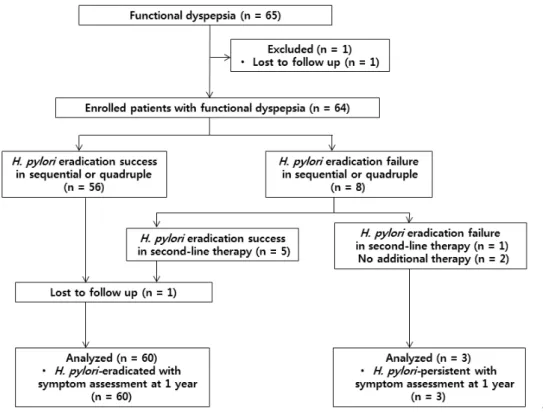
Fig. 1. Flowchart of participants. H.
pylori, Helicobacter pylori.
eradication status four weeks after treatment completion.
5. Statistical analyses
The statistical analysis was performed using the SPSS version 20.0 (SPSS Inc., Chicago, IL, USA). Categorical varia- bles were analyzed using Pearson’s chi-square (χ2) test or Fisher’s exact test and results are presented as numbers (percentages). Continuous variables were analyzed using the Student’s t-test and results are presented as means±standard deviations. Univariate and multivariate logistic regression analyses were used to identify risk factors; results are ex- pressed as ORs and 95% CIs. Statistical significance was accepted for p-values <0.05.
RESULTS
1. Patients characteristics
Sixty-five H. pylori-infected treatment-naïve patients with FD were enrolled in the present study (Fig. 1). Mean age of the 65 patients was 51.9 years (range, 23-76 years), and 33 (50.8%) were women. Numbers of patients with PDS, EPS, or overlapping PDS/EPS were 53 (81.5%), 43 (66.2%), and 31 (47.7%), respectively. Other clinical data and personal health habits are detailed in Table 1.
2. Responses to H. pylori eradication treatment One patient of the 65 patients was lost to follow-up. Of the remaining 64 patients, 56 (87.5%) achieved eradication success, and of the eight patients in whom eradication ther- apy failed, six received second-line eradication therapy and two refused further treatment. Of these six patients, five (83.3%) achieved eradicated success after second-line erad- ication therapy. Therefore, 61 patients (95.3%) were allocated to the H. pylori-eradicated group and three (4.3%) to the H.
pylori-persistent group. However, one patient in the H. pylo- ri-eradicated group could not be contacted for the one-year symptom assessment (Fig. 1).
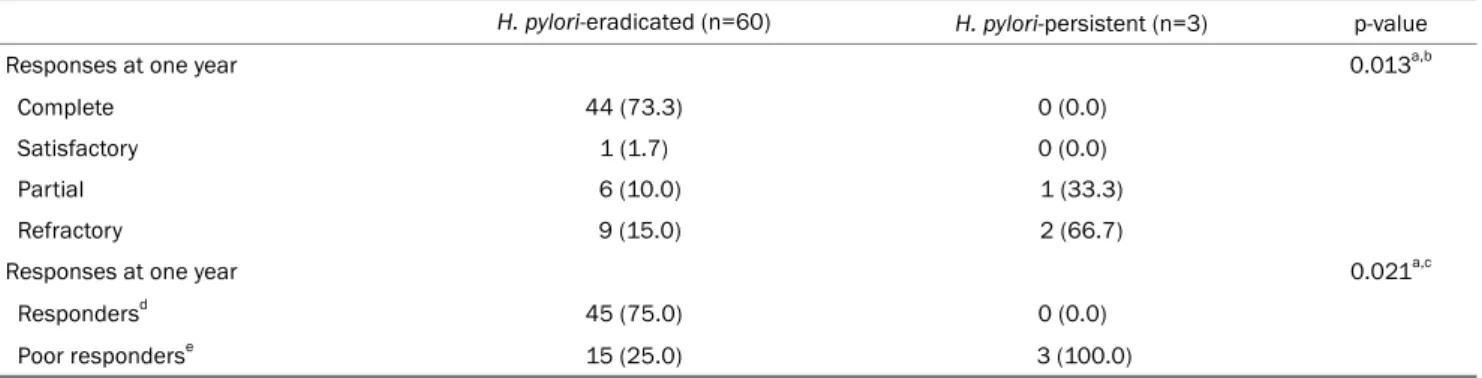
FD response rates at one year in the H. pylori-eradicated (n=60) group were 75% for responders (complete or sat- isfactory FD response) and 25% for poor responders (partial and refractory FD response) and in the H. pylori-persistent (n=3) group were 0.0% and 100.0%, respectively (p=0.021) (Table 2).
3. Medication received during follow-up
Of the 64 patients, 10 (15.6%) received medication during follow-up. Mean prescription period was 2.3 months (range, one to 9.5 months). More specifically, four patients (6.3%) received a prescription for one month, five (7.8%) for two
Table 1. Baseline Characteristics of Participants
FD patients (n=65)
Age (years) 51.9±13.0
Gender
Male 32 (49.2)
Female 33 (50.8)
BMI (kg/m2) 23.6±3.0
Cigarette smoking
None 43 (66.2)
Ex-smoker 7 (10.8)
Current smoker 15 (23.1)
Alcohol intake
None 35 (53.8)
Ex-drinker 6 (9.2)
Current drinker 24 (36.9)
Diabetes mellitus 9 (13.8)
Hypertension 5 (7.7)
FD types
PDS 53 (81.5)
EPS 43 (66.2)
Overlapping PDS-EPS 31 (47.7)
5-point Likert scale
1. Minimal discomfort 9 (13.8)
2. Mild discomfort 9 (13.8)
3. Moderate discomfort 37 (56.9)
4. Severe discomfort 10 (15.4)
5. Very severe discomfort 0 (0.0) Values are presented as mean±standard deviation or n (%).
FD, functional dyspepsia; BMI, body mass index; PDS, postprandial distress syndrome; EPS, epigastric pain syndrome.
Table 2. Symptom Responses Following Helicobacter pylori Eradication in Patients with Functional Dyspepsia One Year after Commencing Eradication Treatment
H. pylori-eradicated (n=60) H. pylori-persistent (n=3) p-value
Responses at one year 0.013a,b
Complete 44 (73.3) 0 (0.0)
Satisfactory 1 (1.7) 0 (0.0)
Partial 6 (10.0) 1 (33.3)
Refractory 9 (15.0) 2 (66.7)
Responses at one year 0.021a,c
Respondersd 45 (75.0) 0 (0.0)
Poor responderse 15 (25.0) 3 (100.0)
Values are presented as n (%).
H. pylori, Helicobacter pylori.
aIndicates statistical significance; bp<0.05, linear by linear association; cp<0.05, Fisher’s exact test; dResponders included patients who showed complete and satisfactory responses; ePoor responders included patients who showed partial and refractory responses.
months, and one (1.6%) received a prescription for 9.5 months. None of these patients had taken a prescribed drug during the two weeks before one-year assessments. Regarding types of drugs taken, two patients took PPIs, two PPIs and antacids, two PPIs, antacids, and prokinetic agents, one took a prokinetic agent, and other three took antacids and proki- netic agents.
4. Predictive factors of poor response of functional dyspepsia at one year
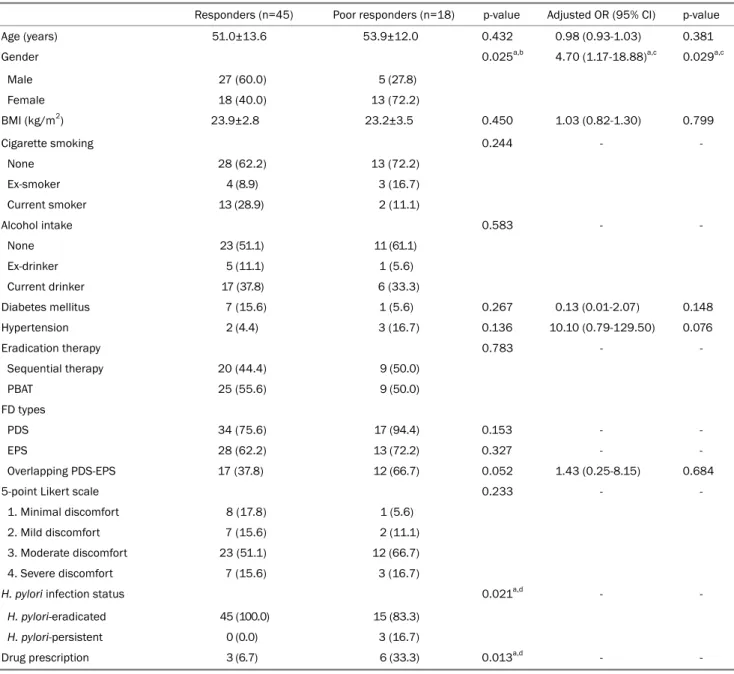
The predictive factors for poor FD response at one year are presented in Table 3. Univariate analysis showed H. pylori persistence (p=0.021), a female gender (p=0.025), and re- ceipt of medication (p=0.013) were significantly associated with poor response, and that age, smoking, alcohol con- sumption, the presence of an underlying disease (e.g., dia- betes mellitus and hypertension), type of eradication therapy, FD subtype, and baseline symptom severity were not asso- ciated with poor FD response. Multivariate analysis with re- spect to age, gender, BMI, diabetes mellitus, hypertension, and overlapping PDS/EPS showed only a female gender (OR, 4.70; 95% CI, 1.17-18.88) was independently related with poor FD response at one year. Unfortunately, multivariate analysis computation of the OR for H. pylori eradication was not possible because there was no H. pylori-persistent patient in the responder group.
Table 3. Factors Associated with Poor Symptom Response in Patients with Functional Dyspepsia at One Year after Commencing Eradication Treatment
Responders (n=45) Poor responders (n=18) p-value Adjusted OR (95% CI) p-value
Age (years) 51.0±13.6 53.9±12.0 0.432 0.98 (0.93-1.03) 0.381
Gender 0.025a,b 4.70 (1.17-18.88)a,c 0.029a,c
Male 27 (60.0) 5 (27.8)
Female 18 (40.0) 13 (72.2)
BMI (kg/m2) 23.9±2.8 23.2±3.5 0.450 1.03 (0.82-1.30) 0.799
Cigarette smoking 0.244 - -
None 28 (62.2) 13 (72.2)
Ex-smoker 4 (8.9) 3 (16.7)
Current smoker 13 (28.9) 2 (11.1)
Alcohol intake 0.583 - -
None 23 (51.1) 11 (61.1)
Ex-drinker 5 (11.1) 1 (5.6)
Current drinker 17 (37.8) 6 (33.3)
Diabetes mellitus 7 (15.6) 1 (5.6) 0.267 0.13 (0.01-2.07) 0.148
Hypertension 2 (4.4) 3 (16.7) 0.136 10.10 (0.79-129.50) 0.076
Eradication therapy 0.783 - -
Sequential therapy 20 (44.4) 9 (50.0)
PBAT 25 (55.6) 9 (50.0)
FD types
PDS 34 (75.6) 17 (94.4) 0.153 - -
EPS 28 (62.2) 13 (72.2) 0.327 - -
Overlapping PDS-EPS 17 (37.8) 12 (66.7) 0.052 1.43 (0.25-8.15) 0.684
5-point Likert scale 0.233 - -
1. Minimal discomfort 8 (17.8) 1 (5.6)
2. Mild discomfort 7 (15.6) 2 (11.1)
3. Moderate discomfort 23 (51.1) 12 (66.7)
4. Severe discomfort 7 (15.6) 3 (16.7)
H. pylori infection status 0.021a,d - -
H. pylori-eradicated 45 (100.0) 15 (83.3)
H. pylori-persistent 0 (0.0) 3 (16.7)
Drug prescription 3 (6.7) 6 (33.3) 0.013a,d - -
Values are presented as mean±standard deviation or n (%).
OR, odds ratio; CI, confidence interval; BMI, body mass index; PBAT, modified bismuth quadruple therapy; FD, functional dyspepsia; PDS, postprandial distress syndrome; EPS, epigastric pain syndrome; H. pylori, Helicobacter pylori.
aIndicates statistical significance; bp<0.05, univariate logistic regression test; cp<0.05, multivariate logistic regression test. Logistic model including terms of age, gender, BMI, diabetes mellitus, hypertension, and overlapping PDS-EPS; dp<0.05, Fisher’s exact test.
DISCUSSION
A previous randomized, double-blind, placebo-controlled study failed to evaluate the efficacy of H. pylori eradication in H. pylori-infected Korean patients with FD, because most patients diagnosed with FD using the Rome III criteria would not agree with the suggestion that they should not use rescue medications during the study period.15 Given this experience,
we focused on identifying predictors of FD among several fac- tors, including H. pylori eradication, at one year after com- mencing eradication treatment. Our multivariate analysis re- sults showed a female gender predicted the presence of dys- peptic symptoms at this time. The natural history of FD has not been well characterized, although the limited data avail- able suggest that approximately 50% of patients remain symp- tomatic over five years of follow-up.16,17 In the present study,
it is difficult to conclude anything regarding the benefit of H. pylori eradication because eradication failed in only three patients. However, 73.3% of the eradicated group achieved complete FD response (≥75%) and 1.7% achieved satisfactory FD response (50-74%), which suggests successful H. pylori eradication is associated with FD improvement.
FD is regarded a multifactorial disease that may involve the brain-gut axis, gastroduodenal motility, visceral hyper- sensitivity, psychosocial factors, high gastric acid levels, the presence of H. pylori, genetic factors, dietary factors, and post-infectious conditions.18-21 Of these, H. pylori has been suggested to be a potent risk factor of FD, because several of the factors of FD are also affected by H. pylori infection.
Involvement of the brain-gut axis in FD pathophysiology is an area of active research. In a recent Kyoto global consensus, it was suggested dyspeptic symptoms in patients with H. pylori infection be viewed as a disease entity distinct from FD and recommended that H. pylori eradication be adopted as a first-line therapy for H. pylori-infected patients with dyspepsia.22 Although this recommendation was controversial with respect to costs and adverse effects of H. pylori eradication in pa- tients with FD,23,24 we suggest H. pylori eradication therapy might be a reasonable option for some FD patients with H.
pylori infection.
Despite the limitations of the present study, our results concur with those of randomized controlled trials and meta-analyses studies in terms of symptom response in FD patients after H. pylori eradication.8,25-27 A recent meta-analysis of 23 randomized controlled trials also demonstrated the bene- fits of H. pylori eradication on FD symptoms (pooled risk ratio [RR], 1.23 [95% CI, 1.12-1.36]).8 Interestingly, when subgroup analysis was performed with respect to follow-up period, H.
pylori eradication was found to result in FD symptom improve- ments after follow-up for more than one year (RR, 1.24; 95%
CI, 1.12-1.37) but not in the short-term (<1 year; RR, 1.26;
95% CI, 0.83-1.92).8 The authors considered long-term elimi- nation of H. pylori improved symptoms by reducing inflammation and allowing gastric hormone levels to normalize. Interestingly, in another study, FD symptom improvement by H. pylori erad- ication was found to be more effective in Asian (OR, 1.54;
95% CI, 1.07-2.21) than in European (OR, 1.49; 95% CI, 1.10-2.02) or American populations (OR, 1.43; 95% CI, 1.12-1.83).25
In terms of factors that predict FD symptom response after
H. pylori eradication, we found a female gender was sig- nificantly associated with poor response by multivariate analysis. Despite this finding, we do not suggest that physi- cians dispense with H. pylori eradication treatment in women with dyspepsia. Rather we suggest that physicians and female patients understand the lower likelihood of an improvement of dyspepsia by H. pylori eradication. In a study on a young healthy population, it was found dyspeptic symptoms were more frequent in females than males (p<0.05),28 and in an- other, female patients with FD were found to have significantly longer gastric emptying times than male patients and female controls.29
Higher prevalences of psychological co-morbidities in wom- en may have influenced symptom response.30,31 We recently suggested gender-related differences of ghrelin and noci- ception-related genes and psychological factors in males and females underlie FD symptoms,32 and recommended more attention be paid to psychological or emotional status, espe- cially in female FD patients.32
Furthermore, the drug prescription rate was significantly higher in the poor responder group, indicating patients with poor symptom responses need more drug prescriptions. Lacy et al.33 conducted an interesting study that identified medi- cation risk-taking behavior among FD patients. When asked whether they would take a hypothetical medication that might cure their FD symptoms, 49% of FD patients replied they would accept a mean 12.7% risk of sudden death (range 1-90%) for a 99% chance of cure.33
Regarding psychopathologic aspects, Hsu et al.34 studied 187 FD patients diagnosed using the Rome III criteria and found patients exhibiting PDS and EPS overlap had more se- vere psychopathological distress symptoms than those with- out overlapping symptoms. In the current study, the proportion of the overlapping PDS/EPS type was higher in the poor res- ponders group (66.7%) than in the responders group (37.8%), but low numbers prevented analysis. Therefore, we suggest further studies be conducted to evaluate the association be- tween symptom response and PDS/EPS overlap in FD patients.
Some limitations in this study warrant mention. First, the H. pylori-persistent group was very small. Furthermore, pa- tients who failed first eradication therapy requested sec- ond-line eradication during follow-up, particularly those with FD symptoms, and these requests could not be denied. A
similar situation arose in a previous randomized, prospective multi-center study that sought to evaluate the effect of H.
pylori eradication on H. pylori-infected Korean patients with FD. The study was abandoned because only four patients sat- isfied the study criteria after one year.15 Second, we did not evaluate whether oral contraception had been used at one-year follow-up visits. However, in terms of oral contra- ceptive use, the current rate was found to be less than 1%
in a Korean Health Examinee cohort study,35 and thus, its effect is likely to have been negligible in the present study.
Third, we did not evaluate gastrointestinal symptoms, anxiety, or depression using a validated scoring system such as the Gastrointestinal Symptom Rating Scale, gastrointestinal symp- tom scores, or the Hospital Anxiety and Depression Scale.
Finally, second-line eradication therapy was not preselected.
However, we believe it had little impact on eradication rates, because the eradication rates of second-line eradication ther- apy in the present study were similar to those observed in recent Korean studies that investigated the eradication rates of second-line H. pylori eradication therapies.36,37
In conclusion, the study shows female gender predicts poor FD response to H. pylori eradication in H. pylori-infected pa- tients with FD. Successful H. pylori eradication appeared to be associated with the FD improvement, but the number of non-eradicated patients was too small to permit analysis.
REFERENCES
1. Tack J, Talley NJ, Camilleri M, et al. Functional gastroduodenal disorders. Gastroenterology 2006;130:1466-1479.
2. Stanghellini V, Chan FK, Hasler WL, et al. Gastroduodenal disorders. Gastroenterology 2016;150:1380-1392.
3. Mahadeva S, Goh KL. Epidemiology of functional dyspepsia: a global perspective. World J Gastroenterol 2006;12:2661-2666.
4. Jung HK, Keum BR, Jo YJ, et al. Diagnosis of functional dyspepsia:
a systematic review. Korean J Gastroenterol 2010;55:296-307.
5. Kim SE, Park HK, Kim N, et al. Prevalence and risk factors of func- tional dyspepsia: a nationwide multicenter prospective study in Korea. J Clin Gastroenterol 2014;48:e12-e18.
6. Jin X, Li YM. Systematic review and meta-analysis from Chinese literature: the association between Helicobacter pylori erad- ication and improvement of functional dyspepsia. Helicobacter 2007;12:541-546.
7. Armstrong D. Helicobacter pylori infection and dyspepsia. Scand J Gastroenterol Suppl 1996;215:38-47.
8. Du LJ, Chen BR, Kim JJ, Kim S, Shen JH, Dai N. Helicobacter pylori eradication therapy for functional dyspepsia: systematic review and meta-analysis. World J Gastroenterol 2016;22:3486-3495.
9. Jodaki A, Sahraie A, Yasemi M, Peyman H, Yasemi MR, Hemati K.
Helicobacter pylori eradication effect on patients with functional dyspepsia symptoms. Minerva Gastroenterol Dietol 2016;62:
148-154.
10. Talley NJ, Locke GR, Saito YA, et al. Effect of amitriptyline and esci- talopram on functional dyspepsia: a multicenter, randomized controlled study. Gastroenterology 2015;149:340-349.e2.
11. Kim SE, Park YS, Kim N, et al. Effect of Helicobacter pylori erad- ication on functional dyspepsia. J Neurogastroenterol Motil 2013;19:233-243.
12. Holtmann G, Kutscher SU, Haag S, et al. Clinical presentation and personality factors are predictors of the response to treatment in patients with functional dyspepsia; a randomized, dou- ble-blind placebo-controlled crossover study. Dig Dis Sci 2004;
49:672-679.
13. Lee JY, Kim N, Park KS, et al. Comparison of sequential therapy and amoxicillin/tetracycline containing bismuth quadruple ther- apy for the first-line eradication of Helicobacter pylori: a pro- spective, multi-center, randomized clinical trial. BMC Gastroenterol 2016;16:79.
14. Song KH, Jung HK, Min BH, et al. Development and validation of the Korean Rome III questionnaire for diagnosis of functional gastrointestinal disorders. J Neurogastroenterol Motil 2013;19:
509-515.
15. Hong SJ, Sung IK, Kim JG, et al. Failure of a randomized, dou- ble-blind, placebo-controlled study to evaluate the efficacy of H.
pylori eradication in H. pylori-infected patients with functional dyspepsia. Gut Liver 2011;5:468-471.
16. El-Serag HB, Talley NJ. Systemic review: the prevalence and clin- ical course of functional dyspepsia. Aliment Pharmacol Ther 2004;19:643-654.
17. Lacy BE, Talley NJ, Locke GR 3rd, et al. Review article: current treatment options and management of functional dyspepsia.
Aliment Pharmacol Ther 2012;36:3-15.
18. Miwa H, Ghoshal UC, Fock KM, et al. Asian consensus report on functional dyspepsia. J Gastroenterol Hepatol 2012;27:626-641.
19. Nan J, Zhang L, Zhu F, et al. Topological alterations of the intrinsic brain network in patients with functional dyspepsia. J Neurogastroenterol Motil 2016;22:118-128.
20. Choi YJ, Kim N, Kim J, Lee DH, Park JH, Jung HC. Upregulation of vanilloid receptor-1 in functional dyspepsia with or without Helicobacter pylori infection. Medicine (Baltimore) 2016;95:
e3410.
21. Yamawaki H, Futagami S, Shimpuku M, et al. Leu72Met408 poly- morphism of the ghrelin gene is associated with early phase of gastric emptying in the patients with functional dyspepsia in Japan. J Neurogastroenterol Motil 2015;21:93-102.
22. Sugano K, Tack J, Kuipers EJ, et al. Kyoto global consensus report on Helicobacter pylori gastritis. Gut 2015;64:1353-1367.
23. Massarrat S. Unacceptability of Kyoto global consensus report on Helicobacter pylori gastritis. Arch Iran Med 2016;19:527-528.
24. Chen Q, Lu H. Kyoto global consensus report on Helicobacter py- lori gastritis and its impact on Chinese clinical practice. J Dig Dis 2016;17:353-356.
25. Zhao B, Zhao J, Cheng WF, et al. Efficacy of Helicobacter pylori eradication therapy on functional dyspepsia: a meta-analysis of randomized controlled studies with 12-month follow-up. J Clin
Gastroenterol 2014;48:241-247.
26. Kim YJ, Chung WC, Kim BW, et al. Is Helicobacter pylori asso- ciated functional dyspepsia correlated with dysbiosis? J Neurogastroenterol Motil 2017;23:504-516.
27. Ang TL, Fock KM, Teo EK, et al. Helicobacter pylori eradication versus prokinetics in the treatment of functional dyspepsia: a randomized, double-blind study. J Gastroenterol 2006;41:
647-653.
28. Kawakubo H, Tanaka Y, Tsuruoka N, et al. Upper gastrointestinal symptoms are more frequent in female than male young healthy Japanese volunteers as evaluated by questionnaire. J Neurogastroenterol Motil 2016;22:248-253.
29. Lorena SL, Tinois E, Brunetto SQ, Camargo EE, Mesquita MA.
Gastric emptying and intragastric distribution of a solid meal in functional dyspepsia: influence of gender and anxiety. J Clin Gastroenterol 2004;38:230-236.
30. Winthorst WH, Post WJ, Meesters Y, Penninx BW, Nolen WA.
Seasonality in depressive and anxiety symptoms among primary care patients and in patients with depressive and anxiety dis- orders; results from the Netherlands study of depression and anxiety. BMC Psychiatry 2011;11:198.
31. Kim YS, Kim N, Kim GH. Sex and gender differences in gastro-
esophageal reflux disease. J Neurogastroenterol Motil 2016;22:
575-588.
32. Choi YJ, Park YS, Kim N, et al. Gender differences in ghrelin, noci- ception genes, psychological factors and quality of life in func- tional dyspepsia. World J Gastroenterol 2017;23:8053-8061.
33. Lacy BE, Yu J, Crowell MD. Medication risk-taking behavior in functional dyspepsia patients. Clin Transl Gastroenterol 2015;6:
e69.
34. Hsu YC, Liou JM, Liao SC, et al. Psychopathology and personality trait in subgroups of functional dyspepsia based on Rome III criteria. Am J Gastroenterol 2009;104:2534-2542.
35. Park B, Kim J. Oral contraceptive use, micronutrient deficiency, and obesity among premenopausal females in Korea: the neces- sity of dietary supplements and food intake improvement. PLoS One 2016;11:e0158177.
36. Hwang JJ, Lee DH, Lee AR, et al. Efficacy of 14-d vs 7-d moxi- floxacin-based triple regimens for second-line Helicobacter pylo- ri eradication. World J Gastroenterol 2015;21:5568-5574.
37. Lee BH, Kim N, Hwang TJ, et al. Bismuth-containing quadruple therapy as second-line treatment for Helicobacter pylori in- fection: effect of treatment duration and antibiotic resistance on the eradication rate in Korea. Helicobacter 2010;15:38-45.