Ayse Ozcan Kucuk
Department of Oral and Maxillofacial Surgery, Faculty of Dentistry, Mersin University, Mersin 33343, Turkey
TEL: +90-324-361-0037 FAX: +90-324-361-0092 E-mail: [email protected]
ORCID: https://orcid.org/0000-0002-8289-8066
This is an open-access article distributed under the terms of the Creative Commons Attribution Non-Commercial License (http://creativecommons.org/
licenses/by-nc/4.0/), which permits unrestricted non-commercial use, distribution, and reproduction in any medium, provided the original work is properly cited.
CC
Fate of abstracts presented at the Turkish Association of Oral and Maxillofacial Surgeons (TAOMS) meetings between 2007 and 2009
Umit Yolcu1, Ayse Ozcan Kucuk2
1Department of Oral and Maxillofacial Surgery, Faculty of Dentistry, Inonu University, Malatya,
2Department of Oral and Maxillofacial Surgery, Faculty of Dentistry, Mersin University, Mersin, Turkey
Abstract(J Korean Assoc Oral Maxillofac Surg 2018;44:237-241)
Objectives: The aim of this study was to determine the rate of peer-reviewed publication of abstracts presented at the annual meetings of the Turkish Association of Oral and Maxillofacial Surgeons (TAOMS) and to identify the time to publication, subspecialty, and study design.
Materials and Methods: All abstracts accepted for presentation at a TAOMS meeting between 2007 and 2009 were identified from a book of ab- stracts and were searched for publication using PubMed and Google Scholar. The following variables were evaluated: publication rate, type of presen- tation (oral or poster), time to publication, subspecialty, study design, and name of the journal in which the article was published.
Results: A total of 478 abstracts were presented at the TAOMS meetings between 2007 and 2009. Of these, 140 abstracts (29.3%) were subsequently published in peer-reviewed journals, including 38.2% of oral presentations and 26.6% of poster presentations. The mean time from presentation to pub- lication was 22 months. Regarding publication fields, research and emerging technologies presentations had the highest publication rate (100%). With regard to study type, animal study (70.0%) and basic research (55.0%) had the highest publication rates.
Conclusion: Only 29.3% of abstracts presented at the TAOMS meeting were subsequently published as full-text articles. This rate was found to be similar to the previously reported publication rates in the field of oral and maxillofacial surgery.
Key words: Abstracs, Congresses, Publications, Turkey
[paper submitted 2017. 12. 18 / revised 2018. 3. 20 / accepted 2018. 3. 22]
Copyright © 2018 The Korean Association of Oral and Maxillofacial Surgeons. All rights reserved.
I. Introduction
Scientific meetings are environments where researchers working in a specialized field come together and share their scientific studies. Many researchers present first results ob- tained from their studies in these meetings1. Scientific studies are presented orally or as posters at a conference. Abstracts presented at these conferences provide a quick way to com- municate the latest developments and current trends on various issues to the scientific community2. It is a naturally desired result that the papers presented at conferences result
in publications and is also the main aim of many research- ers3. The publication rate of abstracts presented at meetings in peer-reviewed journals is accepted as a criterion of the sci- entific level of the meeting3-5. On the other hand, it has been shown that publication rates depend on several factors that are independent from the quality of the research6. However, it is known that more than half of the presented abstracts at meetings are published in a peer-reviewed journal. In the literature, studies investigating publication rates of abstracts in scientific meetings of the different branches are available.
To our knowledge, only four studies were identified regard- ing publication of oral and maxillofacial surgery (OMFS) presentations7-10. In this study, subsequent publication rates of the abstracts presented at a Turkish Association of Oral and Maxillofacial Surgeons (TAOMS) meeting between 2007 and 2009, the time to publication, and the journals that they were published were investigated.
II. Materials and Methods
All abstracts presented at TAOMS meetings between
2007 and 2009 were collected from the conference booklets.
Subsequent publication in peer-reviewed journals was inves- tigated using PubMed and Google Scholar databases with a comprehensive literature review. To assess full text publica- tion status, the search was started with the first, second, or third author’s names using ‘OR’ in the Boolean investigation operator. When many relevant publications were detected, the investigation was continued to find the right article by combining the author names and keywords that can facilitate the search from titles of abstracts using ‘AND’ in the Boolean investigation operator. When the full-text article was found, the time between presentation of the article in the conference and publication, the journal name in which it was published, the impact factor of the publishing journal, and the type of presentation (oral or poster) were recorded. Some abstracts were published in various journals before the date of the conference, and a value of zero was assigned to these articles as the time to publication. The study type was also evaluated for each abstract and was classified as prospective studies, retrospective studies, case reports, case series, basic review, technical note, animal study, and basic research (genetic study, cell study, study anatomy, imaging procedure, etc.). In addition, the publication fields of the abstracts (subspecialty) were grouped as congenital and craniofacial deformity, trau- ma, temporomandibular joint disorders, head and neck oncol- ogy, implantology, orthognathic surgery, anatomy, clinical pathology, dentoalveolar surgery, anesthesia and analgesia, reconstructive surgery, research and emerging technologies, endodontic surgery, biomaterials, and others. When avail- able, impact factors of the journals were obtained from the Journal Citation Report for the year in which the article was published. The deadline of April 30, 2015 was chosen as the cutoff publication date.
IBM SPSS Statistics 22.0 software (IBM Co., Armonk, NY, USA) was used for statistical analysis of data. Descriptive statistics were calculated for each variable. The chi-square test was used to identify relationships between categorical variables. P<0.05 was considered statistically significant.
III. Results
A total of 478 abstracts were presented as oral and poster presentations at TAOMS meetings between 2007 and 2009.
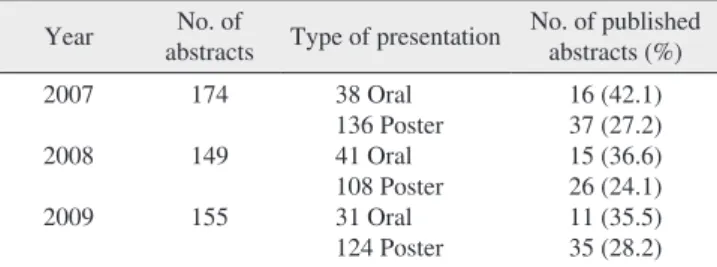
Of these, 140 abstracts were published in peer-reviewed jour- nals through April 30, 2015. The publication rates in 2007, 2008, and 2009 were 30.5%, 27.5%, and 29.7%, respectively.
When the published papers were analyzed according to
type of presentation, 42 of 110 oral presentations (38.2%) and 98 of 368 poster presentations (26.6%) were published after congress. The difference was statistically significant (P<0.05).
The publication rates of the abstracts by year of congress are shown in Table 1.
The mean time until publication for abstracts presented in the conferences was found to be 21.96±17.43 (standard de- viation) months. Most of the articles (88.6%) were published in journals within four years of presentation in congress. The number of articles published after four years was only 16 (11.4%).
When abstracts were analyzed according to subspecialty, clinical pathology reports were presented most often, with a total of 231 publications. The highest numerical abstract- publication transformation was seen in this field (n=56).
However, the highest rate of abstract-publication transforma- tion was realized for research and emerging technologies ab- stracts (100%). When the published abstracts were evaluated according to study type, animal study (70.0%) and basic re- search (55.0%) had the highest publication rates. On the other hand, case reports had the highest number among all papers (n=325) and the highest publication rate (21.8%). Publication rates regarding study types and subspecialties are provided in Table 2.
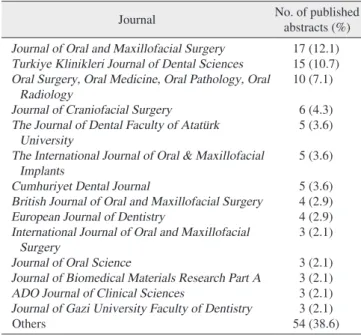
When examining the journals of these 140 abstracts, it was observed that most studies were published in Journal of Oral and Maxillofacial Surgery (n=17). Of these 140 abstracts, 86 appeared in just 14 journals, while the remaining 54 papers were published in a total of 47 other journals.(Table 3)
Of the 140 papers, 85 papers (48 of 86 articles published in 14 journals and 37 of 54 articles published in 47 other jour- nals) were indexed by Institute for Scientific Information (ISI) Web of Science.
The average impact factor of the journals published was 1.41±0.66 (determined for 85 publications). The number of
Table 1. Publication rate of abstracts according to conference year
Year No. of
abstracts Type of presentation No. of published abstracts (%) 2007
2008 2009
174 149 155
38 Oral 136 Poster 41 Oral 108 Poster 31 Oral 124 Poster
16 (42.1) 37 (27.2) 15 (36.6) 26 (24.1) 11 (35.5) 35 (28.2) Umit Yolcu et al: Fate of abstracts presented at the Turkish Association of Oral and Max- illofacial Surgeons (TAOMS) meetings between 2007 and 2009. J Korean Assoc Oral Maxillofac Surg 2018
articles published in the journals with impact factors <1, be- tween 1 and 2, and >2 were 19 articles (22.4%), 52 articles (61.2%), and 14 articles (16.5%), respectively.
The institutions with the most published reports were Gul- hane Military Medical Academy (n=17) and Mayıs Univer- sity (n=16), Gazi University (n=16), and Istanbul University (n=15). In addition, 97.9% of the published papers (n=137) were derived from national institutions, and 2.1% (n=3) were derived from international institutions.
IV. Discussion
Studies regarding the publication rates of papers presented in conferences of various specialty areas of medicine are available in the literature. Previous studies in various special- ization fields showed that many reports presented at scientific meetings did not become full-text publications in a peer- reviewed journal4. Only a few studies are available that eval- uate publication rates in the field of OMFS7-10. This study is the only study conducted to determine the publication rates of
OMFS abstracts presented at the annual TAOMS meetings.
The primary purpose of scientific research is to introduce new knowledge and to publish study outcomes in the scien- tific literature. Publishing provides dissemination, exchange, and discussion of knowledge in a broad manner and allows the building of new ideas and research. Additionally, espe- cially in academic world, publication plays a major role in career advancement. For various reasons, many investigation results are not published and go to waste or are not available to the public in a timely manner. In medicine, a cluster of studies on clinical trials demonstrated that most human trials are unreported. Especially for many medical studies involv- ing patients, interruption of work or non-publication of ob- tained data ultimately creates many ethical problems11-13.
Publication rates in different subspecialties vary between 11% and 78%, and the average was reported as 45%14. The publication rate was reported as 34.8% for abstracts presented in American Association of Oral and Maxillofacial Surgeons (AAOMS) meetings between 1997 and 19997. A low rate was found (24%) in a study conducted by Rodriguez and Laskin9 evaluating the publication rate in AAOMS meetings between 2006 and 2009. Collier et al.8 have found the publication rate to be 27% for abstracts presented at British Association of Oral and Maxillofacial Surgery meetings between 2002 and 2006. The publication rate was found to be 73.8% in Ameri- can and International Association of Dental Research (IADR) and AAOMS meetings between 2000 and 201015. In this
Table 2. Publication rates according to study type and publica- tion area
No. of abstracts
(n=478) No. of published abstracts (%) Subspecialty
Research and emerging technologies
Biomaterials Temporomandibular
joint disorders Anesthesia and analgesia Head and neck oncology Congenital and
craniofacial deformity Reconstructive surgery Dentoalveolar surgery Trauma
Clinical pathology Implantology Endodontic surgery Orthognathic surgery Anatomy
Others Study design
Animal study Basic research Prospective Technical note Retrospective Case report Case series Basic review
1 20 16 6 15 22 8 76 18 231 42 4 13 3 3 20 20 55 3 36 325 9 10
1 (100) 14 (70.0)
9 (56.3) 3 (50.0) 5 (33.3) 10 (45.5) 4 (50.0) 20 (26.3) 5 (27.8) 56 (24.2) 9 (21.4) 2 (50.0) 3 (23.1) 0 (0) 0 (0) 14 (70.0) 11 (55.0) 30 (54.5) 1 (33.3) 6 (16.7) 71 (21.8) 3 (33.3) 4 (40.0) Umit Yolcu et al: Fate of abstracts presented at the Turkish Association of Oral and Max- illofacial Surgeons (TAOMS) meetings between 2007 and 2009. J Korean Assoc Oral Maxillofac Surg 2018
Table 3. Journals in which abstracts were published (n=140)
Journal No. of published
abstracts (%) Journal of Oral and Maxillofacial Surgery
Turkiye Klinikleri Journal of Dental Sciences Oral Surgery, Oral Medicine, Oral Pathology, Oral
Radiology
Journal of Craniofacial Surgery
The Journal of Dental Faculty of Atatürk University
The International Journal of Oral & Maxillofacial Implants
Cumhuriyet Dental Journal
British Journal of Oral and Maxillofacial Surgery European Journal of Dentistry
International Journal of Oral and Maxillofacial Surgery
Journal of Oral Science
Journal of Biomedical Materials Research Part A ADO Journal of Clinical Sciences
Journal of Gazi University Faculty of Dentistry Others
17 (12.1) 15 (10.7) 10 (7.1)
6 (4.3) 5 (3.6) 5 (3.6) 5 (3.6) 4 (2.9) 4 (2.9) 3 (2.1) 3 (2.1) 3 (2.1) 3 (2.1) 3 (2.1) 54 (38.6) Umit Yolcu et al: Fate of abstracts presented at the Turkish Association of Oral and Max- illofacial Surgeons (TAOMS) meetings between 2007 and 2009. J Korean Assoc Oral Maxillofac Surg 2018
study, 478 abstracts were evaluated, and the publication rate was found to be 29.3%. Although this ratio falls below the overall average in medical science, it was similar to that of abstracts in the field of OMFS.
Some studies have reported no differences in publication rates of oral and poster presentations, while others have con- cluded that oral presentations were published more frequently compared to poster presentations4,5,16-18. It was determined in our study that oral presentations (38.2%) were published more often than poster presentations (26.6%). The cause may be associated with the preferences of researchers to present studies that have higher scientific quality as an oral presenta- tion instead of a poster, better planning of oral presentations, and a more rigorous selection process for oral presentations by the congressional committee.
It has been reported that most publications occur within two years of congress presentations, and more than 90% of abstracts were published within 4 years5. In this study, it was observed that 31.4%, 63.6%, and 88.6% of the articles were published within 1 year, 2 years, and 4 years, respectively.
Presentations with the maximum publication rate presented at the TAOMS congresses were studies conducted in the clinical pathology field. The larger number of publications in the clinical pathology field may be due to clinicians treating many and different kinds of patients in this field. Although it was observed that most papers presented at these congresses between 2007 and 2009 were case reports, animal studies had the maximum publication rate. The reason that animal studies have a higher probability of publication may be associated with the requirement of more rigorous experimental design and planning.
There are studies investigating the reasons why the papers presented at congresses were not subsequently published6. The reasons may be that the study was not accepted for pub- lication, that the results and subject of the study were not important enough, poor study design, disagreement among researchers, publications offering the same findings for the studied subject, lack of interest and motivation, and ongoing studies6. Although negative findings have been defined as those not to be published in a study conducted by Chapman, many journals have published negative studies with high methodological rigor11. However, the concerns of editors that studies with negative results will be cited less and not garner interest for readers reduce the publication possibility of stud- ies with negative results19. Travel costs of interns presenting papers at national meetings are usually paid by the training programs. This encourages interns to prepare papers; howev-
er, the absence of a similar award to write articles reduces in- terest in publication4. The lack of Turkish journals in interna- tional indexes, the requirement of translation of papers from Turkish to other languages, and difficulties during translation can also be factors20. In addition, one of the reasons for less publication in OMFS may be the presence of fewer journals in this field.
Abstract acceptance criteria for a scientific meeting may also affect subsequent full-text publication. Some societies have restricted the amount of work accepted to require higher standards for abstracts presented at meetings to increase competition among participants. This increases the chance of an abstract being published as full text8,9,13,21,22. On the other hand, a lot of young trainees are involved in scientific meet- ings. Therefore, review committees are careful to not discour- age trainees from abstract submittal.
As mentioned above, the data obtained from most studies cannot be published and are wasted. Therefore, issues such as measures taken to rectify this situation and strategies to be de- veloped are a focus of many articles11,13. Knowing the reasons why papers are not published may lead to the development of encouraging policies for publications such as providing more funding, ensuring the possibility of discussion between au- thors and editors at conferences, providing publication advis- ers for interns to facilitate writing and submission of articles;
to produce higher-quality publications, professional help for translation, preparing guidelines for solving problems that can occur between researchers, and awards for publications could be considered8,20,23. In addition, training on writing in a scientific manner would be helpful for young researchers.
A number of measures can be taken to increase publication, such as improving meeting quality to restrict the number of papers containing case reports and have sanctions for authors of papers not presented but were accepted8.
There are some limitations to this study. First, our literature survey was only conducted using PubMed and Google Schol- ar databases. Scanning the entire directory of search engines may identify further publications. The second limitation is the possibility of errors while scanning. These errors may arise from mistyping of names of authors or persons who scanned.
Third, this study did not investigate the reasons for publica- tion. For this reason, further studies that evaluate reasons for publication are needed.
V. Conclusion
About one-third of papers presented at TAOMS meetings
between 2007 and 2009 were subsequently published in peer- reviewed journals. More rigor in accepting reports for con- ferences will increase publication rates. In addition, papers submitted to conferences should be carefully prepared, and authors should be encouraged to emphasize solutions for con- ference presentations to become publications.
ORCID
Umit Yolcu, https://orcid.org/0000-0001-7312-2867 Ayse Ozcan Kucuk, https://orcid.org/0000-0002-8289-8066
Authors’ Contributions
U.Y. and A.O.K. participated in study design, coordination, data collection and wrote the manuscript. All authors read and approved the final manuscript.
Conflict of Interest
No potential conflict of interest relevant to this article was reported.
References
1. Ravn AK, Petersen DB, Folkestad L, Hallas P, Brabrand M. Full- text publication of abstracts in emergency medicine in Denmark.
Scand J Trauma Resusc Emerg Med 2014;22:33.
2. Abicht BP, Donnenwerth MP, Borkosky SL, Plovanich EJ, Rou- kis TS. Publication rates of poster presentations at the American College of Foot and Ankle Surgeons annual scientific conference between 1999 and 2008. J Foot Ankle Surg 2012;51:45-9.
3. Arrivé L, Boelle PY, Dono P, Lewin M, Monnier-Cholley L, Tubiana JM. Subsequent publication of orally presented original studies within 5 years after 1995 RSNA Scientific Assembly. Radi- ology 2004;232:101-6.
4. Autorino R, Quarto G, Di Lorenzo G, De Sio M, Damiano R. Are abstract presented at the EAU meeting followed by publication in peer-reviewed journals? A critical analysis. Eur Urol 2007;51:833- 40; discussion 840.
5. Scherer RW, Dickersin K, Langenberg P. Full publication of results initially presented in abstracts. A meta-analysis. JAMA 1994;272:158-62.
6. Sprague S, Bhandari M, Devereaux PJ, Swiontkowski MF, Tornetta P 3rd, Cook DJ, et al. Barriers to full-text publication following presentation of abstracts at annual orthopaedic meetings. J Bone Joint Surg Am 2003;85:158-63.
7. Bagheri SC, Lenox N, Verschueren DS, Holmgren E, Kademani
D, Bell RB, et al. Abstracts from the American Association of Oral and Maxillofacial Surgeons annual scientific meeting: propor- tion published and time to publication. J Oral Maxillofac Surg 2005;63:838-40.
8. Collier JM, Vig N, Hammond D. Publish or perish? A survey of abstracts accepted for meetings of the British Association of Oral and Maxillofacial Surgeons, and subsequently published. Br J Oral Maxillofac Surg 2010;48:540-3.
9. Rodriguez JL, Laskin DM. Subsequent publication of oral and maxillofacial surgery meeting abstracts. J Oral Maxillofac Surg 2012;70:1261-4.
10. Yolcu U, Ozcan A. Publication rates in peer-reviewed journals of abstracts presented at the Oral and Maxillofacial Surgery So- ciety of Turkey meetings 2007-2012. Br J Oral Maxillofac Surg 2015;53:849-53.
11. Chapman SJ, Shelton B, Mahmood H, Fitzgerald JE, Harrison EM, Bhangu A. Discontinuation and non-publication of surgi- cal randomised controlled trials: observational study. BMJ 2014;349:g6870.
12. Ross JS, Tse T, Zarin DA, Xu H, Zhou L, Krumholz HM. Publica- tion of NIH funded trials registered in ClinicalTrials.gov: cross sectional analysis. BMJ 2012;344:d7292.
13. Scherer RW, Langenberg P, von Elm E. Full publication of re- sults initially presented in abstracts. Cochrane Database Syst Rev 2007;18:MR000005.
14. Ha TH, Yoon DY, Goo DH, Chang SK, Seo YL, Yun EJ, et al.
Publication rates for abstracts presented by Korean investigators at major radiology meetings. Korean J Radiol 2008;9:303-11.
15. Smart RJ, Susarla SM, Kaban LB, Dodson TB. Factors associated with converting scientific abstracts to published manuscripts. J Craniofac Surg 2013;24:66-70.
16. Carroll AE, Sox CM, Tarini BA, Ringold S, Christakis DA. Does presentation format at the Pediatric Academic Societies’ annual meeting predict subsequent publication? Pediatrics 2003;112:1238- 17. Greenberg D, Wacht O, Pliskin JS. Peer review in publication: fac-41.
tors associated with the full-length publication of studies presented in abstract form at the annual meeting of the Society for Medical Decision Making. Med Decis Making 2008;28:938-42.
18. Harel Z, Wald R, Juda A, Bell CM. Frequency and factors influ- encing publication of abstracts presented at three major nephrology meetings. Int Arch Med 2011;4:40.
19. Salami K, Alkayed K. Publication bias in pediatric hematology and oncology: analysis of abstracts presented at the annual meeting of the American Society of Pediatric Hematology and Oncology. Pe- diatr Hematol Oncol 2013;30:165-9.
20. Seçil M, Uçar G, Sentürk C, Karasu S, Dicle O. Publication rates of scientific presentations in Turkish national radiology congresses.
Diagn Interv Radiol 2005;11:69-73.
21. Weale AR, Edwards AG, Lear PA, Morgan JD. From meeting presentation to peer-review publication--a UK review. Ann R Coll Surg Engl 2006;88:52-6.
22. Stewart SB, Oeppen RS, Cascarini L, Brennan PA. Educational article: what gets accepted for presentation?: a study of submitted abstracts for the 2009 BAOMS conference. Br J Oral Maxillofac Surg 2010;48:297-300.
23. Yun PY. The importance of information technology for clinical and basic researches on the field of oral and maxillofacial surgery. J Korean Assoc Oral Maxillofac Surg 2013;39:149.