Printed in the Republic of Korea https://doi.org/10.5012/jkcs.2020.64.2.61
ReaxFF and Density Functional Theory Studies of Structural and Electronic Properties of Copper Oxide Clusters
Joo-Hyeon Baek† and Gyun-Tack Bae*
Department of Chemistry Education, Chungbuk National University, Cheongju 28644, Korea
*E-mail: [email protected]
†Ungcheon Middle School, Boryeong 33522, Korea (Received November 18, 2019; Accepted January 7, 2020)
ABSTRACT. In this study, we investigate the structural and electronic properties of copper oxide clusters, CunOn (n = 9 - 15). To find the lowest energy structures of copper oxide clusters, we use ReaxFF and density functional theory calculations. We calculate many initial copper oxide clusters using ReaxFF quickly. Then we calculate the lowest energy structures of copper oxide clusters using B3LYP/LANL2DZ model chemistry. We examine the atomization energies per atom, average bond angles, Bader charges, ion- ization potentials, and electronic affinities of copper oxide clusters. In addition, the second difference in energies is investigated for rela- tive energies of copper oxide clusters.
Key words: Copper oxide clusters, Density functional theory, Particulate matter, ReaxFF, Molecular dynamics
INTRODUCTION
Copper oxide clusters have been used in many areas, such as solar cells,1 organic light emitting diodes (OLED),2 photo-catalysis,3 and electrochemical applications.4 Cop- per oxide clusters are very useful in industries, being a very well-known the catalyst in promoting the formation of polychlorinated dibenzo-p-dioxins and dibenzofurans (PCDD/Fs). Copper oxide clusters have had their struc- tural and electronic properties studied in experiments.5-18 However, theoretical studies of copper oxide clusters are not much. Small copper oxide clusters have been researched using density functional theory (DFT). CuO2,19 CuO3,20 CuO4,21 CuO5,21 CuO6 clusters22,23 and their several isomers are calculated with DFT. CunOn clusters with n = 1 - 8 have been examined using Monte Carlo (MC) simulations and DFT.24 Also, Cu3On clusters with n = 1 - 6 have been examined using ab initio MC simulations and DFT.25
In general, DFT calculations need many resources such as CPU time and memory for large molecules. For finding the global minimum energy structures, if the structures of many initial copper oxide clusters need to be calculated using DFT, these procedures are very expensive compu- tationally. Fortunately, the ReaxFF for Cu/O/H interaction were developed by Adri van Duin in 2010.26 ReaxFF is a bond based force field in Molecular Dynamics simulations.
ReaxFF energy terms in the system are in equation (1) Esystem= Ebond+Eover+Eval+Epen+Etors+Econj+EvdWaals+ECoulomb
(1)
ReaxFF describes chemical bonding without expensive quantum mechanics (QM) calculations. Therefore, the local energy structures of copper oxide clusters can be calculated with ReaxFF inexpensively. Then, the lowest structures of each copper oxide clusters are optimized using DFT. In this article, we investigate the structures and electronic prop- erties of copper oxide clusters (CunOn, n = 9 - 15) using ReaxFF and DFT.
METHODS
For finding local minimum energy of copper oxide clus- ters, we made about 200 initial copper oxide clusters by turning Cu9O9 clusters to Cu15O15 clusters. We attached a Cu-O unit to an optimized Cu8O8 cluster,24 studied previously for making initial Cu9O9 structures. By this process, we made each initial copper oxide clusters from Cu9O9 and Cu15O15 clusters. All initial structures were calculated using ReaxFF.
The LAMMPS program was used for ReaxFF calculations.
We used parameters for the Cu-O system.26,27 The NVE- MD simulations on copper and oxygen were relaxed to 0 K with 100 Å 100 Å × 100 Å. After ReaxFF calculations, we calculated single point calculations using DFT for all initial copper oxide clusters structures to obtain ReaxFF calcula- tions, then, decided the lowest energy structure of each cop- per oxide cluster. We put single point calculation energies of initial Cu9O9 clusters in Table S1. We used the B3LYP/
LANL2DZ model chemistry to optimize copper oxide cluster calculations, because this model is in very good
agreement with experimental data.24 We also calculated the lowest spin-state energy of copper oxide clusters structures.
All calculations were done using the Gaussian 09 program.28 RESULTS AND DISCUSSION
The copper oxide clusters, CunOn (n = 1 - 8), were stud- ied in the previous investigation using ab initio Monte Carlo simulations and DFT.24 Figure 2 shows the optimized neutral CunOn clusters with n = 9 - 15 using the B3LYP/
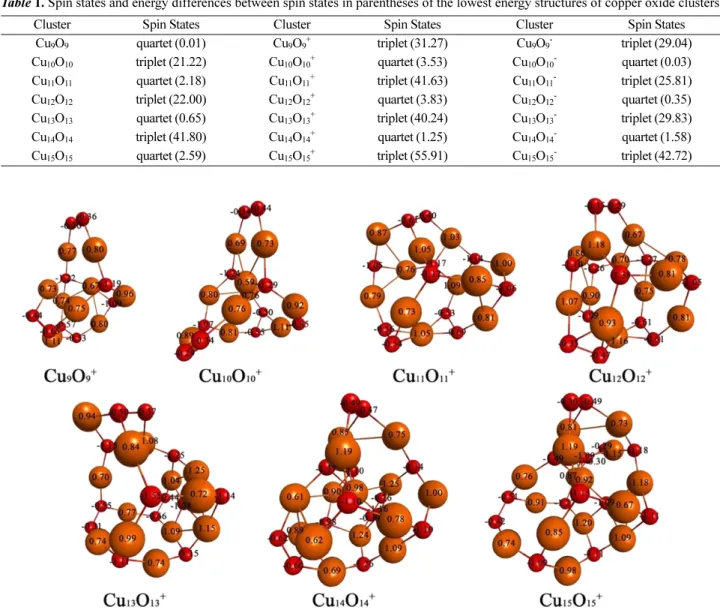
LANL2DZ model chemistry. The numbers of each atom of copper oxide clusters are Bader charges.29 We calculated doublet and quartet spin states for odd-numbered copper oxide clusters and singlet and triplet spin states for even- numbered copper oxide clusters in neutral copper oxide clusters. Table 1 shows the spin states of the lowest energy structures of copper oxide clusters. In neutral copper oxide clusters, odd-numbered copper oxide clusters have quar- tet spin states and even-numbered copper oxide clusters have triplet spin states. In cationic and anionic copper oxide clusters, odd-numbered copper oxide clusters have triplet spin states and even-numbered copper oxide clus- ters have quartet spin states.
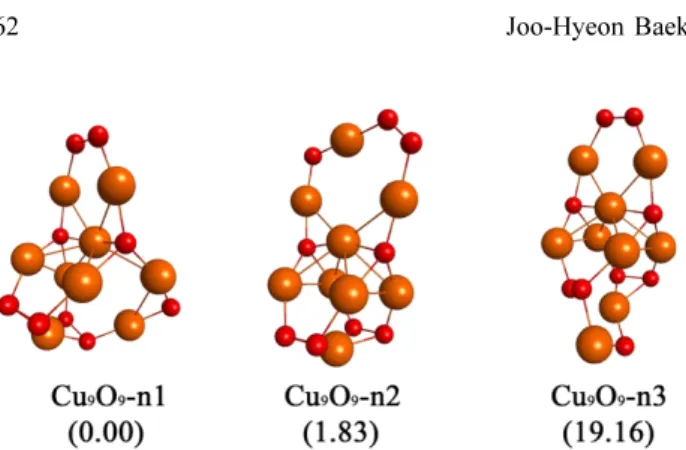
Neutral Cu9O9 cluster, Cu10O10 cluster, and Cu11O11 clus- ter have the CuO4 group at the bottom of each cluster as does the Cu8O8 cluster. The copper atoms of CuO4 groups have a large positive charge. (1.07 for the Cu9O9 cluster, 1.10 for the Cu10O10 cluster, and 1.11 for the Cu11O11 cluster) A neutral Cu9O9 cluster was made by adding a Cu-O unit at the bottom of a neutral optimized Cu8O8 cluster. The struc- tures of neutral, cationic and anionic Cu9O9 clusters are the same (Figures 2 - 4). Three isomers are found in the neutral Cu9O9 clusters in Figure 1. The relative energies of the second and third most stable structures are 1.83 and Figure 1. Optimized structures of neutral Cu9O9 clusters using
the B3LYP/LANL2DZ model chemistry. The numbers in paren- theses indicate the relative energies in kcal/mol. Copper/oxygen atoms colored yellow/red.
Figure 2. Optimized structures of neutral CunOn clusters (n = 9 - 15) using the B3LYP/LANL2DZ model chemistry. The numbers of atoms are Bader charges. Copper/oxygen atoms colored yellow/red.
19.16 kcal/mol, respectively.
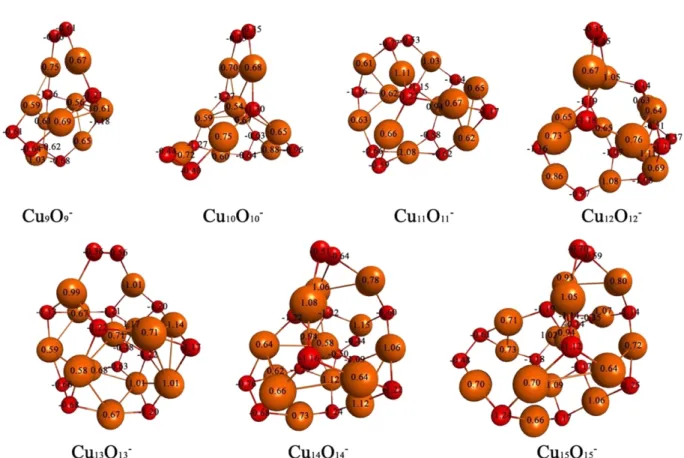
Figures 3 and 4 shows the optimized structures of cat- ionic and anionic copper oxide clusters (CunOn with n = 9 - 15), respectively.
Next, a neutral Cu10O10 cluster was formed by attaching a Cu-O unit to the top of the neutral optimized Cu9O9 clus- ter. The structure of the neutral Cu10O10 cluster is different from that of cationic and anionic Cu10O10 clusters. How- ever, the structures of cationic and anionic Cu10O10 clus- ters are the same, and these clusters are made by adding a Cu-O unit at the bottom of the CuO4 group. Therefore, the CuO4 group was broken.
In Cu11O11 clusters, a Cu-O unit was added at the top of neutral, cationic, and anionic optimized Cu10O10 clusters,
respectively. The structures of cationic Cu11O11 cluster is the same with the structure of anionic Cu11O11 cluster. In Cu12O12 clusters, the CuO4 group of the neutral Cu12O12 cluster was destroyed, because a Cu-O unit is attached. Cat- ionic and anionic Cu12O12 clusters were made by adding a Cu-O unit to the bottom side of the optimized cationic and anionic Cu11O11 clusters, but the CuO4 group still remains for a cationic Cu12O12 cluster and is broken for an anionic Cu12O12 cluster.
A Cu-O unit is attached to the middle of the back of a neutral Cu12O12 cluster to make a Cu13O13 cluster, and the structures of neutral, cationic, and anionic Cu13O13 clusters are very similar. Neutral Cu14O14 was constructed by adding a Cu-O unit to the lower part of the back of neutral opti- Table 1. Spin states and energy differences between spin states in parentheses of the lowest energy structures of copper oxide clusters
Cluster Spin States Cluster Spin States Cluster Spin States
Cu9O9 quartet (0.01) Cu9O9+ triplet (31.27) Cu9O9- triplet (29.04) Cu10O10 triplet (21.22) Cu10O10+ quartet (3.53) Cu10O10- quartet (0.03) Cu11O11 quartet (2.18) Cu11O11+ triplet (41.63) Cu11O11- triplet (25.81) Cu12O12 triplet (22.00) Cu12O12+ quartet (3.83) Cu12O12- quartet (0.35) Cu13O13 quartet (0.65) Cu13O13+ triplet (40.24) Cu13O13- triplet (29.83) Cu14O14 triplet (41.80) Cu14O14+ quartet (1.25) Cu14O14- quartet (1.58) Cu15O15 quartet (2.59) Cu15O15+ triplet (55.91) Cu15O15- triplet (42.72)
Figure 3. Optimized structures of cationic CunOn clusters (n = 9 - 15) using the B3LYP/LANL2DZ model chemistry. The numbers of atoms are Bader charges. Copper/oxygen atoms colored yellow/red.
mized Cu13O13 clusters. Like Cu13O13 clusters, neutral, cat- ionic, and anionic Cu14O14 clusters are very similar structurally each other. A neutral Cu15O15 cluster was made by attach- ing the side of a neutral optimized Cu14O14 cluster. How- ever, the structure of a neutral Cu15O15 cluster is somewhat different from that of cationic and anionic Cu15O15 clusters.
Table 2 shows the HOMO-LUMO gaps of neutral (CuO)n clusters with n = 9 - 15. The Cu9O9 cluster has the largest HOMO-LUMO gap (2.10 eV) and the average value of HOMO-LUMO gaps (from Cu10O10 to Cu15O15 clusters) is 1.54 eV.
Calculated atomization energies per atom are shown in Figure 5. Atomization energies per atom are calculated by
equation (2).
Ea = [nE(Cu) + nE(O) - E (CunOn)]/2n (2) The atomization energies per atom are increased as the cluster size increases. However, the atomization ener- gies per atom increase very slowly from the Cu11O11 cluster to the Cu12O12 cluster. The values of atomization energies per Figure 4. Optimized structures of anionic CunOn clusters (n = 9 - 15) using the B3LYP/LANL2DZ model chemistry. The numbers of atoms are Bader charges. Copper/oxygen atoms colored yellow/red.
Table 2. HOMO-LUMO gaps of neutral copper oxide clusters
Cluster HOMO-LUMO gap (eV)
Cu9O9 2.01
Cu10O10 1.63
Cu11O11 1.60
Cu12O12 1.31
Cu13O13 1.64
Cu14O14 1.49
Cu15O15 1.58
Figure 5. Atomization energies per atom of neutral CunOn clus- ters (n = 9 - 15) using the B3LYP/LANL2DZ model chemistry.
atom of the Cu11O11 and the Cu12O12 clusters are 2.62 eV and 2.63 eV, respectively. The atomization energies per atom of copper oxide clusters (CunOn, n = 1 - 8) rise rapidly from n = 1 to n = 5 and then almost no change at about 2.5 eV.24 Second difference in energies is calculated from equa- tion (3).
∆2E(n) = [E(n + 1) - E(n)] - [E(n) - E(n - 1)] (3) Figure 6 shows the second difference in energies of neu- tral, cationic, and anionic copper oxide clusters. In gen- eral, the second difference in energies tells which a cluster is more stable than other clusters. In neutral copper oxide clusters, odd-numbered copper oxide clusters are more stable than even-numbered copper oxide clusters, except for the Cu14O14 cluster. In CunOn clusters with n = 1 - 8, the odd-numbered copper oxide clusters are more stable than even-numbered copper oxide clusters, because the stabil- ity of neutral copper oxide clusters is correlated with a Cu- O-Cu angle from a tetrahedral geometry.24
However, in our investigation, the stability of neutral copper oxide clusters cannot be explained by Cu-O-Cu
angels. Table 3 shows the average Cu-O-Cu angles of neu- tral copper oxide clusters. The average Cu-O-Cu angles have similar values of about 104.4 degree except for the average Cu-O-Cu angle of the Cu13O13 cluster.
We think that the structural stability is correlated with a six-membered ring in our study. Generally, a six-membered ring is more stable than other rings. From the calculated second difference in energies, we know that Cu11O11, Cu13O13, and Cu14O14 clusters are more stable than are the Cu10O10
and Cu12O12 clusters. The Cu11O11, Cu13O13, and Cu14O14 clusters have one or two six-membered rings, and the Cu10O10 and Cu12O12 clusters have no six-membered ring.
In cationic and anionic clusters, there is the odd-even oscillation. Even-numbered clusters are more stable than are odd-numbered clusters. It is interesting that an anionic Cu12O12 cluster is more stable than other anionic clusters.
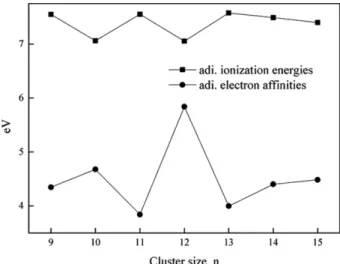
Figure 7 shows the calculated adiabatic ionization poten- tials and electron affinities of copper oxide clusters. There are odd-even oscillations from Cu9O9 to Cu13O13 clusters.
After the Cu13O13 cluster, ionization energies and electron affinities are decreased and increased, respectively.
CONCLUSION
We use ReaxFF and DFT calculations for finding the lowest energy copper oxide clusters, CunOn with n = 9 - 15.
Using ReaxFF, we calculated lots of initial copper oxide clusters quickly. Then, the lowest energy structures of neutral, cationic, and anionic copper oxide clusters can be found with DFT. The structures of neutral, cationic, and anionic copper oxide clusters are very similar. (Cu9O9, Cu13O13, Figure 6. Second difference in energies of neutral, cationic, and
anionic copper oxide clusters (CunOn) with n = 9 - 15. using the B3LYP/LANL2DZ model chemistry.
Table 3. Average Cu-O-Cu angles of neutral copper oxide clusters Cluster Average Cu-O-Cu angles
Cu9O9 102.7
Cu10O10 104.8
Cu11O11 104.5
Cu12O12 105.0
Cu13O13 98.4
Cu14O14 104.5
Cu15O15 105.1
Figure 7. Calculated adiabatic ionization energies and electron affinities of CunOn clusters (n = 9 - 15) using the B3LYP/LANL2DZ model chemistry.
and Cu14O14 clusters) From the second difference in ener- gies, in neutral copper oxide clusters, the Cu11O11, Cu13O13, and Cu14O14 clusters are more stable than are other copper oxide clusters. These clusters have one or two six-mem- bered rings. Whether or not these clusters have a six-mem- bered ring determines their structural stability.
Supporting Information. Single point calculation ener- gies of initial Cu9O9 clusters.
REFERENCES
1. Musselman, K. P.; Marin, A.; Schmidt-Mende, L.; Mac- Manus-Driscoll, J. L. Adv. Funct. Mater. 2012, 22, 2202.
2. Kim, S.; Hong, K.; Kim, K.; Lee, I.; Lee, J.-L. J. Mater.
Chem. 2012, 22, 2039.
3. Barreca, D.; Fornasiero, P.; Gasparotto, A.; Gombac, V.;
Maccato, C.; Montini, T.; Tondello, E. ChemSusChem 2009, 2, 230.
4. Park, J. C.; Kim, J.; Kwon, H.; Song, H. Adv. Mater. 2009, 21, 803.
5. Shirk, J. S.; Bass, A. M. J. Chem. Phys. 1970, 52, 1894.
6. Tevault, D. E.; Mowery, R. L.; Marco, R. A. D.; Smardze- wski, R. R. J. Chem. Phys. 1981, 74, 4342.
7. Bagus, P. S.; Nelin, C. J.; Charles W. Bauschlicher, J. J.
Chem. Phys. 1983, 79, 2975.
8. Ozin, G. A.; Mitchell, S. A.; Garcia-Prieto, J. J. Am. Chem.
Soc. 1983, 105, 6399.
9. Igel, G.; Wedig, U.; Dolg, M.; Fuentealba, P.; Preuss, H.;
Stoll, H.; Frey, R. J. Chem. Phys. 1984, 81, 2737.
10. Bondybey, V. E.; English, J. H. J. Phys. Chem. 1984, 88, 2247.
11. Howard, J. A.; Sutcliffe, R.; Mile, B. J. Phys. Chem. 1984, 88, 4351.
12. Kasai, P. H.; Jones, P. M. J. Phys. Chem. 1986, 90, 4239.
13. Madhavan, P. V.; Newton, M. D. J. Chem. Phys. 1985, 83, 2337.
14. Langhoff, S. R.; Bauschlicher Jr, C. W. Chem. Phys. Lett.
1986, 124, 241.
15. Polak, M. L.; Gilles, M. K.; Ho, J.; Lineberger, W. C. J.
Phys. Chem. 1991, 95, 3460.
16. Wu, H.; Desai, S. R.; Wang, L.-S. J. Chem. Phys. 1995, 103, 4363.
17. Wang, L.-S.; Wu, H.; Desai, S. R.; Lou, L. Phys. Rev. B 1996, 53, 8028.
18. Chertihin, G. V.; Andrews, L.; Bauschlicher, C. W. J. Phys.
Chem. A 1997, 101, 4026.
19. Hrusak, J.; Koch, W.; Schwarz, H. J. Chem. Phys. 1994, 101, 3898.
20. Deng, K.; Yang, J.; Zhu, Q. J. Chem. Phys. 2000, 113, 7867.
21. Massobrio, C.; Pouillon, Y. J. Chem. Phys. 2003, 119, 8305.
22. Pouillon, Y.; Massobrio, C. Chem. Phys. Lett. 2002, 356, 469.
23. Pouillon, Y.; Massobrio, C. Appl. Surf. Sci. 2004, 226, 306.
24. Bae, G.-T.; Dellinger, B.; Hall, R. W. J. Phys. Chem. A 2011, 115, 2087.
25. Bae, G.-T. Bull. Korean Chem. Soc. 2016, 37, 638.
26. van Duin, A. C. T.; Bryantsev, V. S.; Diallo, M. S.; God- dard, W. A.; Rahaman, O.; Doren, D. J.; Raymand, D.;
Hermansson, K. J. Phys. Chem. A 2010, 114, 9507.
27. Rahaman, O.; van Duin, A. C. T.; Bryantsev, V. S.; Mueller, J. E.; Solares, S. D.; Goddard, W. A.; Doren, D. J. The Jour- nal of Physical Chemistry A 2010, 114, 3556.
28. Frisch, M. J.; Trucks, G. W.; Schlegel, H. B.; Scuseria, G.
E.; Robb, M. A.; Cheeseman, J. R.; Scalmani, G.; Barone, V.; Mennucci, B.; Petersson, G. A.; Nakatsuji, H.; Cari- cato, M.; Li, X.; Hratchian, H. P.; Izmaylov, A. F.; Bloino, J.; Zheng, G.; Sonnenberg, J. L.; Hada, M.; Ehara, M.; Toyota, K.; Fukuda, R.; Hasegawa, J.; Ishida, M.; Nakajima, T.;
Honda, Y.; Kitao, O.; Nakai, H.; Vreven, T.; Montgomery Jr., J. A.; Peralta, J. E.; Ogliaro, F.; Bearpark, M. J.; Heyd, J.; Brothers, E. N.; Kudin, K. N.; Staroverov, V. N.;
Kobayashi, R.; Normand, J.; Raghavachari, K.; Rendell, A. P.; Burant, J. C.; Iyengar, S. S.; Tomasi, J.; Cossi, M.;
Rega, N.; Millam, N. J.; Klene, M.; Knox, J. E.; Cross, J.
B.; Bakken, V.; Adamo, C.; Jaramillo, J.; Gomperts, R.;
Stratmann, R. E.; Yazyev, O.; Austin, A. J.; Cammi, R.;
Pomelli, C.; Ochterski, J. W.; Martin, R. L.; Morokuma, K.; Zakrzewski, V. G.; Voth, G. A.; Salvador, P.; Dannen- berg, J. J.; Dapprich, S.; Daniels, A. D.; Farkas, Ö.; Foresman, J. B.; Ortiz, J. V.; Cioslowski, J.; Fox, D. J.; Gaussian, Inc.: Wallingford, CT, USA, 2009.
29. Henkelman, G.; Arnaldsson, A.; Jónsson, H. Comput. Mater.
Sci. 2006, 36, 354.