Printed in the Republic of Korea
https://doi.org/10.5012/jkcs.2019.63.2.138
Note
Synthesis of Monogallic Acid Conjugates of Quercetin at the 3-, 7-, and 4′-Hydroxyl Groups through Selective Protection of Hydroxyl Groups
Jongyun Jang and Dong Wook Kang*
Department of Pharmaceutical Science and Technology, Natural Science Research Institute & Advanced Healthcare Industry Research Center, Catholic University of Daegu, Kyeongsan 38430, Korea.
*E-mail: [email protected]
(Received January 6, 2019; Accepted January 24, 2019)
Key words: Quercetin, Gallic acid, Conjugate, Flavonoid, Esterification
INTRODUCTION
Flavonoid, a secondary metabolite of plants, aids in build- ing the body’s resistance to bacteria, viruses, and allergens as well as cancer, in addition to preventing oxidative action.
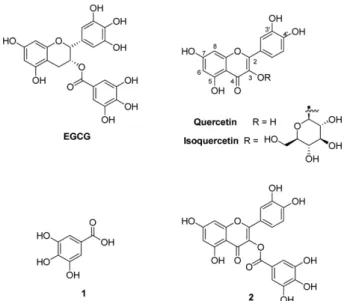
It is therefore being studied for the purpose of developing therapeutic agents for various diseases.1,2 Epigallocatechin gallate (EGCG), a type of catechin contained in green tea, inhibits the expression of enhancer of zeste homolog 2 (EZH2), a methyltransferase. EGCG is being developed as a treatment for colorectal cancer3 and as a potential thera- peutic agent for Alzheimer’s disease by reducing β-amy- loid and plaque.4 In addition, it has been reported that ROS signaling associated with apoptosis in endothelial cells inhib- its H2O2-induced apoptosis by regulating the expression of Bcl-2 and Bax.5 EGCG has also bene demonstrated to show about 100 times stronger anti-influenza effect in cell and animal experiments6 as compared to Tamiflu, which was used as a treatment for the prevalent H1N1 flu in 2009.7 However, EGCG is not suitable for use as a drug because it has been shown that a daily intake of 800 mg or more may increase the risk of liver damage.8 Thus, Thapa et al. syn- thesized the analogous quercetin-3-gallate (Fig. 1), and antiviral tests showed the effective dose for 50% virus reduction (ED50) are similar to those of EGCG, with a higher therapeutic index.6 In this study, quercetin-3-gallate was synthesized more easily than in the previous method. Querce- tin-7-gallate and quercetin-4′-gallate, which had not been previously synthesized, were also prepared.
CHEMISTRY
In the previous synthesis of quercetin-3-gallate (2), iso- quercetin was used as the starting material.6 In this study, quercetin dihydrate (3) was used instead of isoquercetin.
The hydroxyl groups in gallic acid must be protected prior to the synthesis of the monogallic acid conjugates of quer- cetin. Among the various methods for protecting the hydroxyl groups of gallic acid, tribenzyl ether formation was employed in this study.9
First, a benzylation reaction was carried out to protect the 3′-, 4′-, and 7-hydroxyl groups in 3,10 and then, a gallic acid coupling compound was synthesized through a cou- pling reaction with gallic acid tribenzyl ether (Scheme 1).
Quercetin-7-gallate was synthesized by a two-step reac- tion reported by L. Roubalava et al.11 In their method, 3,4,5-tri- O-benzylgalloyl chloride is employed without using gal- lic acid tribenzyl ether, and the reaction is carried out at -60 °C. The resulting mixture of two substances is then separated by flash chromatography. However, it is gen- erally difficult to conduct the reaction at -60 °C. Hence,
Figure 1. Chemical structures of EGCG, quercetin, isoquerce- tin, gallic acid (1) and quercetin-3-gallate (2).
we attempted to develop a reaction that can be carried out under simple conditions.
For the synthesis of quercetin-7-gallate (11), the 3′- and 4′-hydroxyl groups that were similar in reactivity to the 7- hydroxyl group were protected in acetal ring form, and then, a benzylation reaction was carried out to protect the 3-hydroxyl group.12 Compound 8 was esterified with gallic acid tribenzyl ether and hydrogenated to synthesize quercetin-7-gallate (10) (Scheme 2).
The synthesis of quercetin-4′-gallate (17) commenced from compound 7. A mixture of compounds 11 and 12 was obtained through benzylation of the 3-, 5-, and 7-hydroxyl groups with excess benzyl bromide. When acetic acid was added and the reaction mixture was heated, the 5-hydroxyl group was deprotected and the acetal ring structure was
simultaneously removed. An acetylation reaction was then performed to protect the 4′-hydroxyl group. During the benzylation reaction to protect the 3′-hydroxyl group, the acetyl group at the 4′-hydroxyl moiety was hydrolyzed.
Coupling of gallic acid tribenzyl ether to compound 15, followed by hydrogenation to remove the benzyl groups, gave quercetin-4′-gallate (17) (Scheme 3).
EXPERIMENTAL
General
Reagents and solvents were commercially available and used without purification. Reactions were monitored by thin-layer chromatography carried out on 0.25 mm Merck silica gel plates (60F254) using UV light as the 254 nm visualization agent. The separation of samples by flash chromatography was performed using Merck silica gel 60 (40–63 μm). 1H NMR spectra were obtained using a JEOL superconducting magnet JMTC-400/54/JJ/YH (400 MHz).
Chemical shifts were recorded in ppm downfield from tetramethylsilane (TMS), and coupling constant (J) values are given in Hertz.
Experimental Procedure
7-Benzyloxy-2-(3,4-bis(benzyloxy)phenyl)-3,5-di-hydroxy- chromen-4-one (4): Benzyl bromide (0.10 mL, 0.87 mmol) and potassium carbonate (160 mg, 1.16 mmol) were added to a solution of quercetin dihydrate (3) (100 mg, 0.29 mmol) in DMF (2 mL). The mixture was stirred at room temperature for 12 h. The resulting mixture was diluted with water (40 mL) Scheme 1. Synthesis of quercetin-3-gallate.
Reagents and reactions: (i) BnBr, K2CO3, DMF, rt, 12 h, 39%; (ii) gallic acid tribenzyl ether, EDC, DMAP, methylene chloride, 12 h, 82%; (iii) Pd/C, H2, THF/EtOH (1:1), 6 h, 60%.
Scheme 2. Synthesis of quercetin-7-gallate.
Reagents and reactions: (i) Ph2CCl2, Ph2O, 170 °C, 12 h, 40%; (ii) BnBr, K2CO3, DMF, 12 h, 50%; (iii) gallic acid tribenzyl ether, EDC, DMAP, methylene chloride, rt, 52%; (iv) Pd/C, H2, THF/
EtOH (1:1), 6 h, 30%.
Scheme 3. Synthesis of quercetin-4′-gallate.
Reagents and reactions: (i) BnBr, K2CO3, DMF, 12 h; (ii) AcOH/
H2O (80:20), 180 °C, 6 h, 83%; (iii) Ac2O, pyridine, 70 °C, 3 h, 56%;
(iv) BnBr, K2CO3, DMF, rt, 12 h, 35%; (v) gallic acid tribenzyl ether, EDC, DMAP, methylene chloride, rt, 12 h, 90%; (vi) Pd/C, H2, THF/
EtOH (1:1), 6 h, 41%.
and extracted with ethyl acetate (40 mL ×2). The organic layer was washed with brine (30 mL), dried over MgSO4, and filtered. The filtrate was concentrated under reduced pres- sure. The crude material was separated by column chro- matography using methylene chloride as the eluent to yield 4 (65 mg, 39%).
1H NMR (CDCl3, 400 MHz) δ: 5.05 (2H, s, -OCH2Ph), 5.12 (2H, s, -OCH2Ph), 5.19 (2H, s, -OCH2Ph), 5.68 (1H, s, 3- OH), 6.43 (1H, d, J=2.2Hz, 6-H), 6.49 (1H, s, J=2.2Hz, 8- H), 6.95 (1H, d, J=9.2Hz, 5’-H), 7.26-7.43 (15H, m, aro- matic H), 7.61 (2H, dd, 2’-, 6’-H) 12.68 (1H, s, 5-OH).
3,4,5-Tris(benzyloxy)benzoic acid 7-benzyloxy-2-(3,4- bis(benzyloxy)phenyl)-5-hydroxy-4-oxo-4H-chromen-3- yl ester (5): Gallic acid tribenzyl ether (74.9 mg, 0.17 mmol), EDC (36.4 mg, 0.19 mmol), and DMAP (6.1 mg, 0.05 mmol) were added to a solution of compound 4 (100 mg, 0.17 mmol) in methylene chloride (5 mL). The mixture was stirred at room temperature for 12 h. The resulting mix- ture was added to methylene chloride (20 mL) and washed with water (20 mL). The organic layer was dried over MgSO4
and filtered. The filtrate was concentrated under reduced pressure. The crude material was separated by column chro- matography using methylene chloride as the eluent to yield 5 (141 mg, 82%).
1H NMR (CDCl3, 400 MHz) δ: 5.10 (2H, s, -OCH2Ph), 5.11 (2H, s, -OCH2Ph), 5.14 (4H, s, -OCH2Ph), 5.15 (2H, s, -OCH2Ph), 5.18 (2H, s, -OCH2Ph), 6.44 (1H, d, J=2.2Hz, 6-H), 6.50 (1H, s, J=2.2Hz, 8-H), 7.04 (1H, d, J=9.2Hz, 5’-H), 7.24 (2H, m, aromatic H), 7.27-7.43 (28H, m, aro- matic H), 7.55 (2H, dd, 2’-, 6’-H) 7.91 (2H, d, gallic acid), 12.68 (1H, s, 5-OH); HRMS (ESI+) calcd for C36H29O7: 573.1913, Found : 573.1834.
3,4,5-Trihydroxybenzoic acid 2-(3,4-dihydroxy-phe- nyl)-5,7-dihydroxy-4-oxo-4H-chromen-3-yl ester (2): To solution of 5 (140 mg, 0.14 mmol) dissolved in ethanol (5 mL) and THF (5 mL) was added 10% Pd/C (10 mg) with vigorous stirring. The reaction vessel was then evacuated, and the atmosphere was replaced with hydrogen. After 12 h, the reaction mixture was filtered through Celite, and the fil- trate was concentrated under reduced pressure. The crude material was purified by column chromatography using methylene chloride/MeOH (4:1) as the eluent to give 2 as a pale yellow solid (36 mg, 57%).
1H NMR (DMSO-d6, 400 MHz) δ: 6.15 (1H, d, J=2.2Hz, 6- H), 6.17 (1H, d, J=2.6Hz, 8-H), 7.07 (1H, d, J=8.6Hz, 5’- H) 7.89 (1H, s, 2’-H), 7.90 (1H, s, 6’-H) 7.95 (2H, s, gallic acid);
HRMS calcd for C22H15O11 : 455.0614, Found : 455.0620.
2-(2,2-Diphenylbenzo[d][1,3]dioxol-5-yl)-3,5,7-tri- hydroxyl-4H-chromen-4-one (7): To a stirring mixture
of quercetin (6) (1.0 g, 3.48 mmol) in diphenyl ether (30 mL) was added dichlorodiphenylmethane (1.38 mL, 6.96 mmol), and the reaction mixture was heated at 180 °C for 30 min.
The mixture was cooled to room temperature, and the solid compound was obtained by adding petroleum ether (200 mL).
After filtration, the solid product was purified by column chromatography using n-hexane/ethyl acetate (4:1) as the eluent to yield 7 (0.91 g, 86%).
1H NMR (DMSO-d6, 400 MHz) δ: 6.19 (1H, d, J=2.0Hz, 6- H), 6.47 (1H, d, J=2.0Hz, 8-H), 7.23 (1H, d, J=8.3Hz, 5’-H), 7.47 (10H, m, aromatic H), 7.57 (1H, d, J=1.7Hz, 6’-H), 7.58 (1H, d, J=2.0Hz, 2’-H), 9.68 (1H, s, 3-OH), 10.85 (1H, s, 7-OH), 12.38 (1H, s, 5-OH); HRMS (ESI+) calcd.
for C28H19O7 467.1131, found 467.1102.
3-(Benzyloxy)-2-(2,2-diphenylbenzo[d][1,3]dioxol-5- yl)-5-hydroxy-4H-chromen-4-one (8): Benzyl bromide (0.89 mL, 7.52 mmol) and potassium carbonate (1.30 g, 9.4 mmol) were added to a solution of compound 7 (3.51 g, 7.52 mmol) in DMF (30 mL). The mixture was stirred at room temperature for 12 h. The resulting mixture was diluted with water (200 mL) and extracted with ethyl acetate (300 mL). The organic layer was then washed with brine (200 mL) and dried over MgSO4. The filtrate was concentrated under reduced pressure. The crude material was separated by col- umn chromatography using methylene chloride/ethyl ace- tate (20:1) as the eluent to yield 8 (2.47 g, 59%).
1H NMR (CDCl3, 400 MHz) δ: 5.02 (2H, s, -OCH2Ph), 6.28 (1H, s, 6-H), 6.36 (1H, s, 8-H), 6.92 (1H, d, J=8.3Hz, 5’-H), 7.25 (5H, m, aromatic H), 7.40-7.60 (12H, m, aro- matic H), 12.75 (1H, s, 5-OH); HRMS (ESI+) calcd. For C35H25O7 557.1600, found 557.1532.
3,4,5-Tris(benzyloxy)benzoic acid 3-benzyloxy-2-(3,4- bis(benzyloxy)phenyl)-5-hydroxy-4-oxo-4H-chromen-7- yl ester (9): Gallic acid tribenzyl ether (79.3 mg, 0.18 mmol), EDC (38.0 mg, 0.20 mmol), and DMAP (3.3 mg, 0.03 mmol) were added to a solution of compound 8 (100 mg, 0.18 mmol) in methylene chloride (5 mL). The mixture was stirred at room temperature for 13 h. The resulting mix- ture was added to methylene chloride (20 mL) and washed with water (20 mL). The organic layer was dried over MgSO4 and filtered. The filtrate was concentrated under reduced pressure. The crude material was separated by column chroma- tography using methylene chloride as the eluent to yield 9 (165 mg, 94%).
1H NMR (CDCl3, 400 MHz) δ: 5.06(2H, s, -OCH2Ph), 5.17 (6H, s, -OCH2Ph), 6.63 (1H, d, J=1.7Hz, 6-H), 6.84 (1H, d, J=1.7Hz, 8-H), 6.91 (1H, d, J=8.3Hz, 5’-H), 7.14-7.19 (4H, m, aromatic H), 7.33-7.59 (30H, m, aromatic H), 12.74 (1H, s, 5-OH).
3,4,5-Trihydroxybenzoic acid 2-(3,4-dihydroxy-phe- nyl)-3,5-dihydroxy-4-oxo-4H-chromen-7-yl ester (10):
To a solution of 9 (108 mg, 0.11 mmol) dissolved in eth- anol (5 mL) and THF (5 mL) was added 10% Pd/C (10 mg) with vigorous stirring. The reaction vessel was then evac- uated, and the atmosphere was replaced with hydrogen.
After 12 h, the reaction mixture was filtered through Celite, and the filtrate was concentrated under reduced pressure.
The crude material was purified by column chromatog- raphy using methylene chloride/MeOH (4:1) as the eluent to give 10 as a pale yellow solid (17 mg, 34%).
1H NMR (DMSO-d6, 400 MHz) δ: 6.66 (1H, d, J=2.0Hz, 6-H), 6.86 (1H, d, J=8.6Hz, 5’-H), 7.01 (1H, d, J=2.1Hz, 8-H), 7.07 (2H, s, gallic acid), 7.56 (1H, dd, J=8.5Hz, 6’-H), 7.71 (1H, d, J=2.2Hz, 2’-H); HRMS calculated for C22H15O11 : 455.0614, Found : 455.0630.
3,7-Bis(benzyloxy)-2-(3,4-dihydroxyphenyl)-5-hydroxy- chromen-4-one (13): Benzyl bromide (2.30 mL, 19.31 mmol) and potassium carbonate (2.67 g, 19.31 mmol) were added to a solution of compound 7 (3.00 g, 6.43 mmol) in DMF (20 mL). The mixture was stirred at room tempera- ture for 12 h. The resulting mixture was diluted with water (200 mL) and extracted with ethyl acetate (200 mL ×2).
The organic layer was washed with brine (100 mL). The organic layer was dried over MgSO4 and filtered. The fil- trate was concentrated under reduced pressure to give a yellow solid, which was a mixture of 11 and 12.
A solution of the mixture of compounds 11 and 12 in acetic acid/H2O (80:20, 100 mL) was refluxed at 140 °C for 6 h with stirring. The mixture was diluted with water (200 mL) and extracted with ethyl acetate (200 mL). The organic layer was washed with an aqueous saturated NaH- CO3 solution (100 mL). The organic layer was dried over MgSO4 and filtered. The filtrate was concentrated under reduced pressure. The solid was recrystallized using methy- lene chloride to afford compound 13 (2.58 g, overall yield 91%).
1H NMR (DMSO-d6, 400 MHz) δ: 5.01 (2H, s, -OCH2Ph), 5.24 (2H, s, -OCH2Ph) 6.46 (1H, s, 6-H), 6.80 (1H, s, 8-H), 6.87 (1H, d, J=8.4Hz, 5’-H), 7.20-7.60 (13H, m, aromatic H) 12.73 (1H, s, 5-OH); HRMS (ESI+) calcd. For C29H23O7
483.1444, found 483.1365.
Acetic acid 4-(3,7-bis(benzyloxy)-5-hydroxy-4-oxo- 4H-chromen-2-yl)-2-hydroxyphenyl ester (14): Acetic anhydride (0.08 mL, 0.83 mmol) was added to a solution of compound 13 (0.50 g, 1.04 mmol) in pyridine (5 mL).
The mixture was stirred at 70 °C for 3 h. The resulting mixture was acidified with 1 M HCl (20 mL). The mixture was diluted with water (20 mL) and extracted with ethyl acetate (40 mL
×2). The organic layer was dried over MgSO4 and filtered.
The filtrate was concentrated under reduced pressure. The crude material was separated by column chromatography using methylene chloride as the eluent to give 14 as a pale yellow solid (0.21 g, 48%).
1H NMR (CDCl3, 400 MHz) δ: 2.36 (3H, s, -OCH3), 5.08 (2H, s, -OCH2Ph), 5.12 (2H, s, -OCH2Ph), 6.43 (1H, d, J=2.2Hz, 6-H), 6.49 (1H, d, J=2.2Hz, 8-H), 7.03 (1H, d, J=8.4Hz, 5’-H), 7.22-7.41 (12H, m, aromatic H), 12.64 (1H, s, 5-OH).
3,7-Bis(benzyloxy)-2-(3-benzyloxy-4-hydroxy-phenyl)- 5-hydroxychromen-4-one (15): Benzyl bromide (0.05 mL, 0.42 mmol) and potassium carbonate (69.7 mg, 0.50 mmol) were added to a solution of compound 14 (219 mg, 0.42 mmol) in DMF (3 mL). The mixture was stirred at room temperature for 12 h. The resulting mixture was diluted with water (30 mL) and extracted with ethyl acetate (30 mL ×2).
The organic layer was washed with brine (30 mL). The organic layer was dried over MgSO4 and filtered. The fil- trate was concentrated under reduced pressure. The crude material was separated by column chromatography using methylene chloride as the eluent to give 15 as a yellow solid (83.9 mg, 35%).
1H NMR (CDCl3, 400 MHz) δ: 5.06 (2H, s, -OCH2Ph), 5.12 (2H, s, -OCH2Ph), 5.18 (2H, s, -OCH2Ph), 6.43 (1H, d, J=2.2Hz, 6-H), 6.49 (1H, d, J=2.2Hz, 8-H), 6.95 (1H, d, J=9.4Hz, 5’-H), 7.25-7.42 (15H, m, aromatic H), 7.62 (2H, m, 2’-, 6’-H), 12.64 (1H, s, 5-OH); HRMS (ESI+) calcd.
For C36H29O7 573.1913, found 573.1903.
3,4,5-Tris(benzyloxy)benzoic acid 2-benzyloxy-4-(3,7- bis(benzyloxy)-5-hydroxy-4-oxo-4H-chromen-2-yl) phe- nyl ester (16): Gallic acid tribenzyl ether (53 mg, 0.12 mmol), EDC (25 mg, 0.20 mmol), and DMAP (4.9 mg, 0.04 mmol) were added to a solution of compound 15 (69 mg, 0.12 mmol) in methylene chloride (5 mL). The mixture was stirred at room temperature for 13 h. The resulting mixture was added to methylene chloride (20 mL) and washed with water (20 mL).
The organic layer was dried over MgSO4 and filtered. The filtrate was concentrated under reduced pressure to give 16 as a yellow solid (138 mg, 90%).
1H NMR (CDCl3, 400 MHz) δ: 5.09 (2H, s, -OCH2Ph), 5.10 (2H, s, -OCH2Ph), 5.12 (2H, s, -OCH2Ph), 5.14 (2H, s, -OCH2Ph), 5.16 (2H, s, -OCH2Ph), 5.19 (2H, s, -OCH2Ph), 6.43 (1H, d, J=2.2Hz, 6-H), 6.50 (1H, d, J=2.2Hz, 8-H), 7.03 (1H, d, J=8.7Hz, 5’-H), 7.25-7.42 (30H, m, aromatic H), 7.55(2H, s, 2’-, 6’-H), 7.92 (2H, s, gallic acid), 12.65 (1H, s, 5-OH).
3,4,5-Trihydroxybenzoic acid 2-hydroxy-4-(3,5,7-trihy- droxy-4-oxo-4H-chromen-2-yl) phenyl ester (17): To
solution of 16 (180 mg, 0.18 mmol) dissolved in ethanol (5 mL) and THF (5 mL) was added 10% Pd/C (30 mg) with vigorous stirring. The reaction vessel was then evacuated, and the atmosphere was replaced with hydrogen. After 12 h, the reaction mixture was filtered through Celite, and the filtrate was concentrated under reduced pressure. The crude material was purified by column chromatography using methylene chloride/MeOH (4:1) as the eluent to give 17 as a pale yellow solid (33.3 mg, 41%).
1H NMR (DMSO-d6, 400 MHz) δ: 6.15 (1H, d, J=2.2Hz, 6-H), 6.44 (1H, d, J=2.6Hz, 8-H), 7.07 (3H, m, 5’-H, gal- lic acid) 7.89 (1H, s, 2’-H), 7.94 (1H, s, 6’-H) 12.39 (1H, s, 5-OH); HRMS calcd for C22H15O11 : 455.0614, Found : 455.0608.
RESULTS AND DISCUSSION
All three quercetin monogallate coupling compounds were obtained through the selective protection of the hydroxyl groups of quercetin. Among the hydroxyl groups of quer- cetin, the esterification reaction with gallic acid and other carboxylic acids proceeded well at the 3-, 7-, and 4′-hydroxyl groups, but not at the 5-hydroxyl group. This was due to intramolecular hydrogen bonding of the 5-hydroxyl group and the 4-carbonyl group of quercetin. In addition, quercetin- 3′-gallate was prepared via an efficient synthetic route reported by Thapa et al.6
In order to synthesize quercetin-3-gallate (2), the 3′- and 4′-hydroxyl groups of quercetin were initially protected with an acetal ring structure, and then, conjugation was carried out with gallic acid tribenzyl ether. However, a mixture with gallic acid bonded at the 3- and 7-hydroxyl groups was obtained, which was difficult to separate. Thus, 2 was syn- thesized by simultaneously protecting the 7-, 3′-, and 4′- hydroxyl groups of quercetin dihydrate with benzyl groups.
This method is more efficient than that used by Thapa et al.6 In benzylation, quercetin is used as starting material to synthesize 3,7,4′-tribenzylated quercetin and 3,7,3′,4′-tetraben- zylated quercetinin,6 and quercetin dihydrate as starting materials, 7,3′,4′-tribenzylated quercetin and 3,7,3′,4′-tetra- benzylated quercetin are obtained.10 In this case, it was nec- essary to open 3-position of quercetin, so quercetin dihydrate was used as a starting material.
Quercetin-7-gallate (10) was obtained by applying the 7-O-methyl quercetin synthesis method reported by Li et al.12 and Hao et al.13 Compound 10 was synthesized via a 4-step reaction by protecting the 3-, 3′-, and 4′-hydroxyl groups of quercetin.
The synthesis of quercetin-4′-gallate (17) was accom-
plished by exploiting the difference in reactivity at the 3′- and 4′-positions. When the 3′- and 4′-hydroxyl groups were unprotected and the substituted gallic acid conjugation was carried out, a mixture of compounds having one gallic acid at the 3′- or 4′- position and a compound having two gallic acids at both the 3′,4′-positions were formed. Com- pounds in which one gallic acid was bonded to the 3′- or 4′-position of the three synthesized mixtures could not be separated by the chromatographic conditions examined.
Thus, after the 4′-hydroxyl group of compound 13 was protected by acetylation, in the course of protecting the 3′- hydroxyl group by benzylation, deacetylation at the 4′-posi- tion also proceeded to afford compound 15. Subsequently, gallic acid conjugation and debenzylation occurred, and quercetin-4′-gallate (17) was synthesized from quercetin in 7 steps.
CONCLUSION
We studied synthetic methods for quercetin monogal- late conjugates and obtained three quercetin monogallate conjugates. Among them, quercetin-3-gallate (2) was syn- thesized via a new method, which was an improvement over the existing method. Quercetin-7-gallate (10) and quercetin- 4′-gallate (17) were synthesized as gallic acid tribenzyl ethers for the first time in this study. Compounds 10 and 17 were synthesized from quercetin in 4 and 7 steps, respec- tively.
Acknowledgments. This work was supported by research grants from Daegu Catholic University in 2018.
Conflicts of Interest: The authors declare no conflict of interest.
REFERENCES
1. Bohm, B. A. Introduction to Flavonoids; Harwood Aca- demic: Amsterdam, 1998.
2. Packer, L. In Flavonoids and Other Polyphenols. Methods in Enzymology; Packer L., Ed.; Academic Press: San Diego, 2001; Vol. 335, p 3.
3. Ying, L.; Yan, F.; Williams, B. R. G.; Xu, P.; Li, X.; Zhao, Y.; Hu, Y.; Wang, Y.; Xu, D.; Dai, J. Clin. Exp. Pharma- col. Physiol. 2018, 45, 58.
4. Johnson, M. K.; Loo, G. Mutat. Res., DNA Repair 2000, 459, 211.
5. Choi, Y. J.; Jeong, Y. J.; Lee, Y. J.; Kwon, H. M.; Kang, Y. H. J. Nutr. 2005, 135, 707.
6. Thapa, M.; Kim, Y.; Desper, J.; Chang, K. O.; Hua, D. H.
Bioorg. Med. Chem. Lett. 2012, 22, 353.
7. Song, J. M.; Lee, K. H.; Seong, B. L. Antiviral Res. 2005, 68, 66.
8. Hu, J.; Webster, D.; Cao, J.; Shao, A. Regul. Toxicol. Phar- macol. 2018, 95, 412.
9. Reshmi, J. R.; Biju, S.; Reddy, M. L. P. Inorg. Chem. Com- mun. 2007, 10, 1091.
10. Lee, J. Y.; Park, W. H.; Cho, M. K.; Yun, H. J.; Chung, B. H.; Pak, Y. K.; Hahn, H. G.; Cheon, S. H. Arch. Pharm.
Res. 2005, 28, 142.
11. Lenka, R.; David, B.; Barbora, P.; Jan, V.; Marek, K.;
Vladimir, K.; Jitka, U.; Albena, T.D.; Jiri, V. Chem.-Biol.
Interact. 2016, 260, 58.
12. Li, N. G.; Wang, J. X.; Liu, X. R.; Lin, C. J.; You, Q. D.;
Guo, Q. L. Tetrahedron Lett. 2007, 48, 6586.
13. Shi, Z. H.; Li, N. G.; Tang, Y. P.; Wei, L.; Lian, Y.; Yang, J. P.; Hao, T.; Duan, J. A. Eur. J. Med. Chem. 2012, 54, 210.