Original Article
비알콜성 지방간을 가진 제2형 당뇨병 환자에서 지방간 개선에 대한 Dapagliflozin의 효과
이미진*, 박상현*, 황현정, 윤인상, 최경희† 순천대학교 약학대학
Effect of Dapagliflozin on Fatty Liver Improvement in Type 2 Diabetes Patients with Nonalcoholic Fatty Liver Disease
Mijin Lee*, Sang Hyun Park*, Hyunjung Hwang, Insang Yoon and Kyung Hee Choi†
College of Pharmacy, Sunchon National University, 255 Jungangno, Suncheon, Jeonnam, 57922, Republic of Korea
Background : The global prevalence of type 2 diabetes mellitus (T2DM) is rapidly growing worldwide, and accordingly, the number of patients with concomitant diseases is increasing.
Type 2 diabetes mellitus is closely related to nonalcoholic fatty liver disease (NAFLD), and in this study, a meta-analysis was conducted to investigate the effect of dapagliflozin on improv- ing liver enzyme levels in NAFLD patients taking.
Methods : This study identified eligible trials based on MeSH terms in the PubMed, EMBASE, and CENTRAL database published from 2012 to March 2020 that reported effects on liver out- comes in patients with type 2 diabetes. The primary outcomes were alanine aminotransferase (ALT), as partate aminotransferase (AST), and fibrosis-4 (FIB-4) index scores and the second outcomes were body mass index (BMI), and high-density lipoprotein (HDL) and low-density lipoprotein (LDL) cholesterol levels. For the statistical analysis, standardized mean difference (SMD) was calculated at 95% confidence intervals (CIs), and fixed or random-effects models were used to assess the outcomes.
*이미진과 박상현은 공동 제1저자로서 본 논문에 동등하게 기여함
투고일자 2020.10.23; 심사완료일자 2020.11.24; 게재확정일자 2020.12.16
†교신저자 최경희 Tel:061-750-3763 E-mail:[email protected]
Results : From the 423 records identified, seven articles with a total of 795 patients met the inclusion criteria and were analyzed. Compared to the placebo or other diabetes medication groups, patients treated with dapagliflozin showed significantly decreased adjusted mean change in ALT levels (p=0.0002, SMD=-0.39), but no major difference was found in AST levels (p=0.10, SMD=-0.24) or FIB-4 index scores (p=0.19, SMD=-0.11). BMI (p=0.008, SMD=-1.20) was significantly decreased, but the HDL and LDL cholesterol levels showed no major differ- ences.
Conclusion : Reductions in the ALT levels and BMI by dapagliflozin suggest that it may help prevent liver damage in type 2 diabetes patients with NAFLD. Although more research is need- ed, dapagliflozin may be a suitable treatment strategy for T2DM patients with non-alcoholic fatty liver, which will provide a clinical reference for the treatment of T2DM.
[Key words] Type 2 diabetes mellitus, Dapagliflozin, Non-alcoholic fatty liver disease, Me- ta-analysis
제2형 당뇨병의 유병률이 증가함에 따라 병존질환 을 가진 사람의 비율도 점차 늘어나고 있다. 세계보 건기구가 발표한 내용에 따르면 1980년 제2형 당뇨 병 유병률이 4.7%인 것에 비해 2014년에는 8.5%
으로 약 2배 가까이 증가했으며, 국내 통계청 자료 에서도 제2형 당뇨병 환자 수가 최근 5년 동안 꾸준 히 증가하여 2019년 280만 명을 넘어섰다.1),2) 특 히 병존질환으로 간질환을 가진 당뇨병 환자의 경우 약제를 선택함에 있어 주의가 필요한데, 이는 제2형 당뇨병 환자에게 1차 경구용 혈당강하제로 사용되는 metformin이 간질환 환자에게 심각한 젖산 산증 을 유발할 수 있는 것으로 알려져 있기 때문이다.3) 당뇨병 환자를 대상으로 동반질환 유병률을 확인하 는 연구에서는 간 기능 이상 유병률이 25.7%로 나 타났으며, 국내 연구에서도 제2형 당뇨병 환자에서 비알코올성 지방간질환(nonalcoholic fatty liv- er disease, NAFLD)이 흔하게 나타난다고 보고 되기도 했다.4),5) 또한, NAFLD의 유병률과 비만, 고혈압, 고중성지방혈증, 당뇨병 등 연관 인자들에 대한 연구에서는 당뇨병이 가장 중요한 연관 인자 (OR=2.950, p<0.001)로 나타났다.6)
NAFLD의 약물치료에는 인슐린 저항성 개선 약물, 항산화제, 고지혈증 치료제 등의 약물이 사용되는 데, 이 중 나트륨-포도당 공수송체(sodium-glu-
cose cotransporter-2, SGLT-2) 억제제는 신 장의 근위세뇨관에서 SGLT-2에 의한 나트륨, 포도 당 재흡수를 억제하는 기전으로 환자의 혈당을 조절
한다.7)-9) SGLT-2 억제제인 dapagliflozin은 심
각한 이상반응 없이 지속적인 당뇨병 치료 효과를 나 타낸다. 이는 간으로 기질 공급을 감소시켜 간에서 중성지방 축적을 감소시키는 것에 의한 것으로 보이 며, 혈당 조절 및 인슐린 민감성 향상, 체중 감소의 복합적인 효과로 추정된다.10),11) 한 연구 결과에 따르 면 dapagliflozin은 pioglitazone과 비교했을 때 동등한 정도의 혈당 조절, 간 기능의 정상화, 간 염 증 및 섬유화 감소 효과를 나타냈고, dapagliflozin 을 투여한 군에서만 체중 감소가 보고되었다.9) 또한 Dong Wang 등의 연구에서는, 저지방식단과 서양 식식단을 섭취한 C57BL/6J 마우스에게 각각 26주 동안 dapagliflozin을 복용시켰을 때, dapagli- flozin이 간손상과 간 내 지질 축적 완화 및 간 섬유 화를 감소시킨다는 것을 확인하였다.12) 이는 dapa- gliflozin이 지방간 발생을 예방한다고 추론할 수 있다.
현재 SGLT-2 억제제와 NAFLD의 개선 효과에 대한 연구는 그 범위가 매우 제한적이다. 따라서 본 연구에서는 NAFLD를 병존질환으로 하는 제2형 당 뇨병 환자에서 SGLT-2 억제제 중 dapagliflozin
을 복용한 환자의 간수치 개선 효과를 확인하고자 체 계적 문헌고찰 및 메타분석을 진행하였다. 선행 연구 결과를 종합하여 NAFLD 개선 효과를 확인하기 위 해 알라닌아미노전달효소(alanine amino trans- ferase, ALT), 아스파르테이트아미노전달효소(as- partate aminotransferase, AST), Fibrosis-4 (FIB-4) 지수, 체질량 지수(body mass index, BMI), 고밀도 지질단백질 콜레스테롤(high-den- sity lipoprotein cholesterol, HDL-C), 저밀 도 지질단백질 콜레스테롤(low-density lipopro- tein cholesterol, LDL-C)을 확인 지표로 선정하 고 그 변화를 관찰하였다.13)-16)
연구방법
1. 문헌수집 및 선정/제외
Dapagliflozin의 NAFLD를 가진 제2형 당뇨병 환자에서의 지방간 개선 효과에 대한 체계적 문헌 고찰을 수행하기 위해 PubMed, EMBASE, Co- chrane Central Register of Controlled Tri- als (CENTRAL)을 검색 대상 데이터베이스로 선정 하였으며, 2012년 1월부터 2020년 3월까지 출판된 논문을 대상으로 문헌검색을 진행하였다. 검색어는 PubMed의 MeSH 용어를 기반으로 조합하였으며,
‘dapagliflozin’, ‘Sodium-Glucose Trans- porter 2 Inhibitors’, ‘Liver’, ‘Fatty Liver’,
‘Liver Cirrhosis’, ‘Fibrosis’ 등의 단어를 사용 하였다. 실제 검색은 ‘(“dapagliflozin” OR “So- dium-Glucose Transporter 2 Inhibitors”) AND (“Liver” OR “Fatty Liver” OR “Liver Cirrhosis” OR “Fibrosis”)’으로 진행되었다.
문헌 선정은 다음과 같은 기준으로 이루어졌다.
(1) 무작위 배정 임상시험, 코호트 연구와 같은 연 구 설계 형태를 모두 포함
(2) 환자군은 20세 이상 75세 미만의 성인으로 NAFLD가 병존하는 제2형 당뇨병 환자로 함 수집된 문헌의 선정기준이 적합한지를 평가하기 위 해 2인의 연구자가 독립적으로 제목과 초록을 검토하 여 1차 배제를 진행하였고, 배제 기준은 다음과 같다.
(1) 사람을 대상으로 연구한 논문이 아닌 경우 (2) 제2형 당뇨병 환자가 연구 대상이 아닌 경우 (3) 간질환과 관련이 없는 경우
(4) Dapagliflozin을 사용하지 않은 경우 (5) 메타분석 연구인 경우
제목과 초록만으로 적합한 논문인지 판단하기 어려 운 경우 원문을 검토하여 2차 배제를 진행하였고, 원 문을 확인하기 전 배제 기준을 정하여 2인 이상의 연 구자가 독립적으로 수행하였다. 최종 선택된 문헌은 연구자 간의 교차 검증을 통해 선택 결과의 일치 여 부를 확인하였고, 선택의 불일치가 발생한 경우 연구 자 간 논의를 통해 최종 선택 여부를 결정하였다. 배 제 사유가 배제 기준에서 중복으로 해당하는 경우 주 요한 한 가지 사유로 분류하였고, 그 배제 기준은 다 음과 같다.
(1) 영어 이외의 언어로 작성된 경우
(2) 연구 대상의 나이가 20세 이하이거나 75세 이 상인 경우
(3) 간기능에 대한 적절한 평가 도구가 제시되지 않 은 경우
(4) 논문의 전문을 구하지 못한 경우
(5) 아직 연구가 진행중이거나 학회 초록만 있는 경우 (6) 임상시험이 아닌 경우(동일한 임상시험에서 여 러 논문이 출판된 경우는 데이터가 가장 자세히 기록된 하나의 논문만을 포함함)
최종 선택 문헌의 서지 정보 및 연구 유형, 연구 기 간 및 시기, 연구 대상자의 일반적 특성에 대한 내용, 중재 및 비교 중재의 용량 및 용법, 결과 변수 등에 대 한 정보가 사전에 표준화된 양식을 따라 추출되었다.
2. 문헌의 질 평가
문헌의 질 평가는 Cochrane에서 개발한 Risk of bias (RoB) 1.0 도구를 이용하여 수행되었으며, 평 가자 간 불일치는 문헌의 질 평가 과정에서 적었던 사 유를 바탕으로 해결하였다. 평가자는 각 항목에 대하 여 비뚤림 위험이 ‘높음’(high risk), ‘낮음’(low risk), ‘불확실’(unclear risk) 세 가지로 나누어 판단했다. ‘비뚤림 위험 불확실’(unclear risk of
bias)은 비뚤림에 대한 위험을 판단하기 어려운 경 우가 해당되었다.17),18) ‘Other bias’ 부분은 원문을 바탕으로 6개 영역 이외의 비뚤림의 가능성을 확인하 여 high risk로 분류하였다.
3. 데이터 추출
각 연구에서 ALT, AST, FIB-4 지수, BMI, HDL-C, LDL-C의 변화에 관한 데이터를 추출하였 다. NAFLD의 직접적인 개선을 살펴보기 위한 1차 지표로 ALT, AST, FIB-4 지수를 선정하였으며, BMI, HDL-C, LDL-C은 NAFLD에 간접적으로 영향을 주는 인자로서 2차 지표로 선정하여 그 정보 를 추출하였다.13),19)
4. 통계적 분석
결과는 Review manager 5.3 (The Cochrane Collaboration) 소프트웨어를 이용하여 도출하였 다. 본 연구에서 확인하고자 하는 지표는 연속형 변수 이므로 개별 연구들에서 추출된 중재군과 대조군 각 각의 대상 환자 수, 평균, 표준편차에 대한 정보의 가 중치를 부여하여 표준화된 평균차(Standardized Mean Difference, SMD)를 95% 신뢰구간(con- fidence intervals, CIs)에서 계산하고, 숲 그림 으로 나타내었다.20) 개별 분포는 중재군(dapagli- flozin 복용군)과 대조군(위약 복용군, 비 SGLT-2 억제제 계열 당뇨병 약제 복용군)이다. 1차 평가변수 로는 간의 상태를 직접적으로 반영하는 ALT, AST, FIB-4 지수를 선정하였고, 2차 평가변수로 지방간 의 병리적 변화를 간접적으로 확인하기 위해 BMI, LDL-C, HDL-C를 선정하였으며, 각 지표에 대해 치료 전 기저치 대비 치료 후 변화에 대한 군간 차이 를 변량효과모형을 이용하여 산출하였다. 연구 결과 간의 이질성에 대한 평가는 Higgins의 I² 통계량을 이용하였으며, 0% ≤ I² ≤ 40%이면 통계적 이질성 이 낮은 것, 30% ≤ I² ≤ 60%이면 중간정도의 이질 성이 있는 것, 50% ≤ I² ≤ 90%: 이질성의 가능성 이 있는 것, 75% ≤ I² ≤ 100%이면 이질성 정도가 높은 것으로 하였다.17),21)
연구결과 1. 대상문헌
3개의 데이터베이스에서 2020년 3월 총 423편의 문헌이 검색되었고, 중복 문헌을 제외하여 390편이 었다. 제목과 초록을 통해 1차 배제를 진행한 후 남 은 97편의 전문을 검토하여 최종 7편이 최종문헌으 로 선정되었다(Fig. 1). 총 795명의 환자를 대상으 로 메타분석을 진행하였고, 분석에 포함된 환자의 기 본 특성과 환자의 초기 간 기능 관련 수치 등을 확인 하였다(Table 1). Gastaldelli A 등의 연구는 추 적기간이 가장 길 뿐만 아니라 대상 환자의 수도 가장 많았으며, Choi DH 등의 연구는 유일한 코호트 연 구로써 2015년부터 2017년까지 기간 동안의 환자 를 관찰한 결과를 보여주었다.22),23) Latva-Rasku A 등의 연구에서 추적 관찰 기간이 가장 짧았으며, Eriksson JW 등의 연구는 평가 지표 중 BMI의 정 보만을 포함하고 있었다.24),25) 비무작위 배정 임상시 험 연구이지만, Tobita H 등의 연구와 Kurinami N 등의 연구는 본 연구에서 확인하고자 하는 모든 평 가 지표를 포함하고 있었으며, 무작위 배정 임상시험 연구인 Shimizu M 등의 연구 또한 모든 평가 지표 를 포함하고 있었다.26)-28)
2. 연구의 질 평가
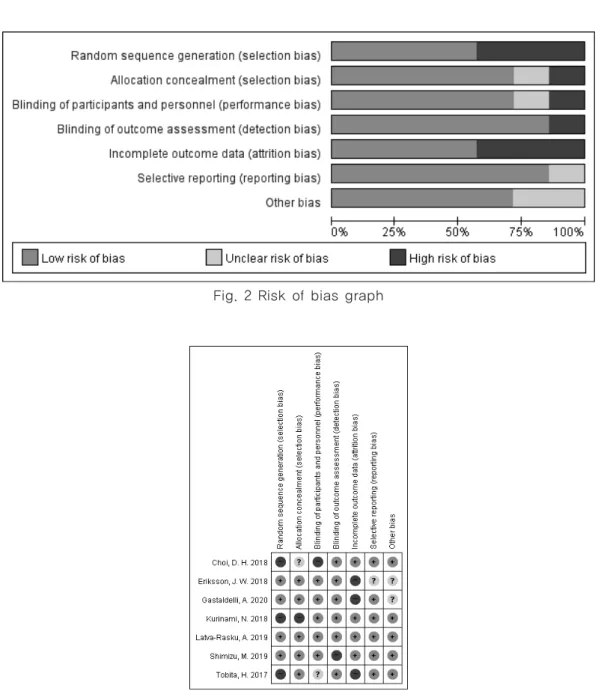
7개의 연구에 대해 비뚤림 위험을 평가하였다. ‘탈 락 비뚤림’은 임상시험 중간에 탈락한 숫자가 많거나 탈락한 이유가 명확하지 않은 경우에 비뚤림 위험이 높은 것으로 분류하였고 Eriksson JW 등의 연구와 Gastaldelli A 등의 연구, Tobita H 등의 연구가 해당되었다.29) ‘선택 비뚤림’ 평가에서는 연구 설계 형태가 코호트 연구인 Choi DH 등의 연구와 비무작 위 배정 임상시험 연구인 Kurinami N 등의 연구와 Tobita H 등의 연구는 비뚤림 위험이 높다고 평가 하였다(Fig. 2, 3). Latva-Rasku A 등의 연구는 모든 영역에서 비뚤림 위험이 낮은 것으로 나타났다.
Eriksson JW 등의 연구에서는 판단의 근거가 충분 하지 않았지만, 대부분의 연구에서 연구방법에 언급 된 주요 결과지표에 대한 연구결과를 제시하고 있어
‘선택적 결과보고’에 대한 선택 비뚤림 위험이 낮다 고 판단하였다.
3. 1차 지표 평가
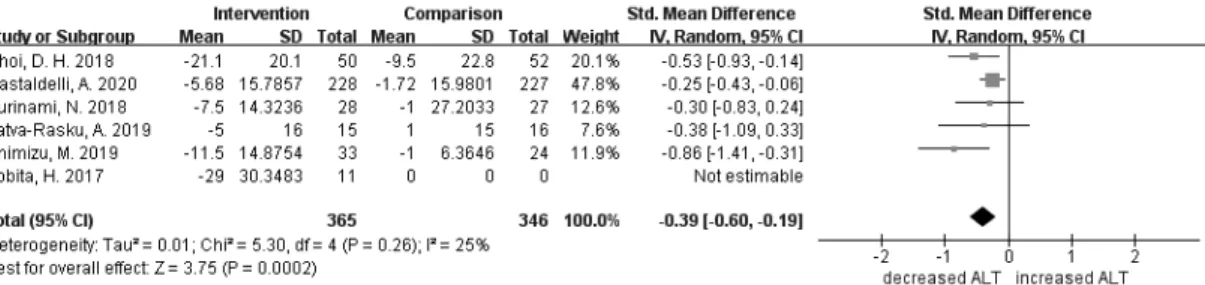
간 기능의 변화를 확인하기 위해 ALT와 AST, FIB-4를 1차 지표로 선정하고, dapagliflozin 복용군과 대조군을 대상으로 치료 전 기저치와 종 료시점의 수치를 비교하여 그 차이(SMD)를 확인하 였다. ALT 수치를 보고하고 있는 6편의 연구에 대 한 메타분석 결과, 통계적으로 유의한 감소가 나타 났다(SMD: -0.39 [95% CI: -0.60, -0.19], I²=25%, P=0.0002)(Fig. 4). 또한 AST 수치를 포함한 6편의 연구에 대한 메타분석 결과에서는, 통 계적으로 유의한 차이가 나타나지 않았다(SMD:
-0.24 [95% CI: -0.52, 0.05], I²=55%, P=0.10) (Fig. 5). 4편의 연구에서는 FIB-4 지수를 메타분 석한 결과, 기저치와 종료 시점에서 통계적으로 유 의한 차이가 없는 것을 확인하였다(SMD: -0.11 [95% CI: -0.28, 0.05], I²=0%, P=0.19)(Fig.
6).
4. 2차 지표 평가
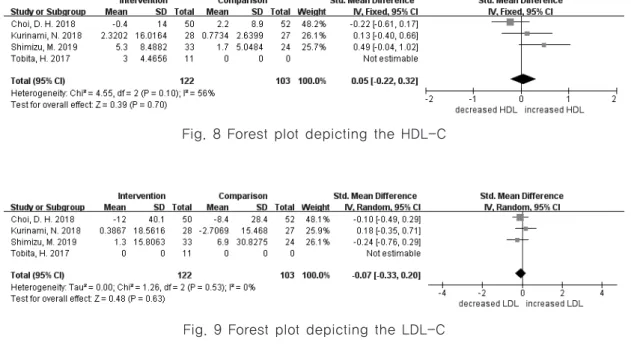
2차 지표로 선정한 BMI와 HDL-C 및 LDL-C 에 대해서도 dapagliflozin 복용군과 대조군에 대 해 치료 전 기저치와 종료시점의 수치를 비교하여 그 차이(SMD)를 확인하였다. BMI를 결과변수로 나타 내는 4편의 연구에서는, BMI가 통계적으로 유의하 게 감소하였으나, 이질성이 높은 것으로 나타났다 (SMD: -1.20 [95% CI: -2.10, -0.31], I²=82%, P=0.008)(Fig. 7). 4편의 연구에서 함께 보고된 HDL-C (SMD: 0.05 [95% CI: -0.22, 0.32], I²=56%, P=0.70)과 LDL-C (SMD: -0.07 [95% CI: -0.33, 0.20], I²=0%, P=0.63)는 통계적으로 유의한 차이가 없었다(Fig. 8, 9). 이때 Kurinami N 등의 연구에서 HDL-C과 LDL-C 수 치의 단위가 ‘mmol/L’로 표현되어 다른 연구들의 단 위와 통일되도록 ‘mg/dL’로 변환하여 계산하였다.
고찰
본 연구는 NAFLD가 병존하는 제2형 당뇨병환자 에서 dapagliflozin 복용 후 간수치 개선 효과를 나 타내는 임상 지표들에 대해 메타분석을 수행하였다.
NAFLD은 간경변 및 간암으로 진행될 수 있으며, 이 는 간 섬유화를 동반한 경우에 가능성이 증가한다.30) Fig. 1 Study flow diagram
Sources identified through database searching (n=423)
∙EMBASE (n=331)
∙MEDLINE (n=79)
∙Cochrane Library (n=13) Soueces excluded by title and abstract evaluation (n=295)
∙Animal/cell models (n=91)
∙Non-type 2 diabetes mellitus patient (n=41)
∙Studies without fatty liver disease (n=74)
∙Not Dapaglifozin (n=83)
∙Meta-Analysis (n=6)
Full texts excluded (n=90)
∙Non-English language (n=3)
∙Patient under 20 and over 75 (n=1)
∙Not evaluate fatty liver disease (n=9)
∙Non clinical trials (n=41)
∙Other drug intervention but not Dapaglifozin (n=11)
∙Ongoing study (n=1)
∙Conference Abstract (n=12)
∙No full text (n=12) Full texts assessed for futther evaluation (n=97)
∙EMBASE (n=84)
∙MEDLINE (n=7)
∙Cochrane Library (n=6)
Sources after duplicates removed (n=392)
Studies included in Meta-Analysis (n=7)
Table 1 Baseline and general characteristics of the included studies
Author, Year
Author, Year
Patients (n, com- parison) Patients
(n, Inter- vention) Study
length Compari-
Interven- sion Study tion
design
Mean (years)age
Mean (kg/mBMI 2)
Mean HBA1c
(%)
Mean FIB-4 index
Mean HDL-C (mg/dL)
Mean LDL-C (mg/dL)
Mean (U/L)ALT
Mean (U/L)AST Tobita H et al. 2017
Tobita H et al. 2017 Shimizu M et al. 2019
Shimizu M et al. 2019 Latva-Rasku A et al.
2019
Latva-Rasku A et al.
2019
Kurinami N et al. 2018
Kurinami N et al. 2018 Gastaldelli A et al. 2020
Gastaldelli A et al. 2020 Eriksson JW et al. 2018
Eriksson JW et al. 2018 Choi DH et al. 2018
Choi DH et al. 2018
nRCT*
53 31 7.4 1.83 52 116 59 52
56.2 27.6 8.37 1.32 49.7 108.1 38 28
62 32.1 7.0 - - - 50 30
53.8 33.2 9.3 1.0 - - 26.4 21.3
65.5 31.2 7.41 - - - - -
50.7 28.56 8.3 - 48.5 102.3 51.9 36.3
56 27.4 7.6 1.21 26.5 25.0
RCT† RCT nRCT
RCT
RCT
Cohort study
Dapagliflozin (5 mg/day) Dapagliflozin
(5 mg/day) Dapagliflozin
(10 mg/day) Dapagliflozin
(5 mg/day) Dapagliflozin
Dapagliflozin
Dapagliflozin (10 mg/day)
-
Non-SGLT-2 inhibitor
Placebo
Non-SGLT-2 inhibitor
Placebo
Placebo
DPP-4 inhibitor
24 weeks
24 weeks
8 weeks
6 months 28 weeks,
52 weeks 12 weeks
12 weeks
11 33 15 28 228
20 -
- 24 16 27 227
20 50
*nRCT: non-RCT, †RCT: randomized controlled trial
1.17
(mmol/L) 2.07 (mmol/L)
따라서 섬유화 정도의 예측이 중요한데, NAFLD에 서 이를 예측하는 여러 도구 중 FIB-4 지수는 다양한 인종에서 검증된 비교적 정확도가 높은 방법이며, 나 이, 혈소판, AST, ALT로 이루어진 간단한 수식이
다.30)-32) 또한, 간 섬유화 정도와 유의한 관련성이 있
는 변수로는 당뇨병 유병기간, BMI, 낮은 HDL-C,
ALT 상승, 알부민뇨 등이 있는데, 특히 BMI의 작은 변화는 인슐린 민감성에 크게 영향을 줄 수 있다고 보 고되기도 하였다.32),33) 이와 같은 문헌을 토대로 1차 및 2차 지표를 선정하여 확인한 결과, NAFLD의 직 접적인 개선을 보여주는 지표인 AST, ALT, FIB- 4 지수 중 ALT가 통계적으로 유의하게 감소한 것을 Fig. 2 Risk of bias graph
Fig. 3 Risk of bias summary
확인하였다(p=0.0002, I²=25%). 이는 일부 연구 에서 ALT 수치를 이용하여 NAFLD의 진행을 예측 한다는 결과와도 관련된다.34),35) AST의 경우 이질 성이 55%로, 실제적으로 이질성이 있을 수 있다고
판단되므로 지방간에 대한 효과를 알기 위해서는 더 많은 피험자군이 필요하다고 생각되며, FIB-4 지수 의 경우 dapagliflozin 처리 전과 후에 차이가 있 을 것으로 예상되었으나, 메타분석 결과 통계적으로 Fig. 4 Forest plot depicting the ALT level
Fig. 5 Forest plot depicting the AST level
Fig. 6 Forest plot depicting the FIB-4 index
Fig. 7 Forest plot depicting the BMI
유의한 차이가 관찰되지 않았다(p=0.19). NAFLD 의 개선 여부에 직접적으로 영향을 준다고 생각되는 1차 지표들 중 유일하게 ALT의 감소가 통계적으로 유의한 결과로서 관찰되었지만, dapagliflozin이 NAFLD 개선에 긍정적인 효과를 나타내는 것으로 결론을 도출하였다.
NAFLD에 간접적으로 영향을 주는 요소로서 2차 지표로 선정한 BMI, HDL-C 및 LDL-C 중 BMI 에서 dapagliflozin 투여 전과 후의 차이가 가장 큰 것으로 나타났고(SMD> 0.7), 통계적 유의성 도 확인되었다(p=0.008). 하지만 상당히 높은 이 질성(I²=82%)이 있다고 판단되어 dapagliflozin 의 BMI에 대한 추가적인 연구가 필요할 것으로 사 료된다. BMI가 높은 지방간 환자의 경우 간 지방 침윤이 더 심해지고 지질 과산화가 증가하여 결과적 으로 간경변과 말기 간질환으로 이어진다는 점에서 NAFLD 환자에서의 BMI 감소는 중요한 요인이며, 따라서 dapagliflozin이 NAFLD 예방에 효과를 보일 것으로 생각된다.36) 반면, HDL-C (p=0.70) 과 LDL-C (p=0.63)의 결과에서는 통계적으로 유 의한 차이가 나타나지 않았다.
문헌의 질 평가 결과 선택 비뚤림과 탈락 비뚤림 위
험이 높은 것으로 확인되었다. 선택 비뚤림은 무작위 배정되지 않은 연구들이 포함되었고, 탈락 비뚤림은 연구의 시작시점에 비해 종료시점의 탈락률이 높은 경우가 해당되었다.
본 연구에서 진행한 메타분석의 한계점은 대상 문헌 이 적어 dapagliflozin 제제가 지방간 개선에 효과 가 있는지 알아보기 위해 본 연구에서 선정한 지표들 에 대한 분석 자료가 충분하지 않았다는 점과, 문헌 의 비뚤림 위험이 높은 연구까지 포함되었다는 점이 다. 또한 지방간의 개선에 대해서 정확한 진단을 내 리기 위한 직접적인 조직검사 자료나 영상검사자료 가 보고되었다면 더 정확한 결과를 보여줄 수 있었 을 것으로 생각된다.19) 그러나 NAFLD를 병존질환 으로 하는 제2형 당뇨병 환자에서 간 기능 개선을 나 타내는 지표인 ALT와 지방간의 병리적 변화를 확인 할 수 있는 지표인 BMI 모두에서 dapagliflozin을 투여하였을 때 통계적으로 유의한 감소가 확인되었으 므로 간질환 개선 효과에 대한 dapagliflozin의 가 능성을 확인했다는 데 의의가 있다. 추가 연구를 통 해 dapagliflozin이 NAFLD가 병존하는 제2형 당 뇨병 환자에서 새로운 약물치료 전략이 될 수 있을 것 으로 기대된다.
Fig. 8 Forest plot depicting the HDL-C
Fig. 9 Forest plot depicting the LDL-C
결론
우리는 병존질환으로 NAFLD를 가진 제2형 당뇨 병 환자에게 dapagliflozin을 투여하였을 때 지 방간 개선에 미치는 영향을 확인하기 위해 체계적 문헌고찰 및 메타분석을 진행하였다. 메타분석 결 과 dapagliflozin이 ALT 수치와 BMI를 통계적 으로 유의하게 감소시키는 효과를 확인하였으며, dapagliflozin이 NAFLD 예방효과를 나타낼 수 있다는 결론을 얻어냈다. 하지만 간에 대한 직접적 인 조직검사나 영상검사자료를 확인하지 못했다는 한 계가 있어, dapagliflozin과 관련된 추가적인 연구 를 통해 NAFLD가 병존하는 제2형 당뇨병 환자에 게 적절한 약물치료 전략임을 명확히 할 수 있을 것 으로 예상된다.
참고문헌
1) World Health Organization. Global Re- port on Diabetes; 2016.
2) Health Insurance Review & Assess- ment Service. Healthcare Bigdata Hub.
https://opendata.hira.or.kr/.
3) Miralles-Linares F, Puerta-Fernandez S, Bernal-Lopez MR et al. Metformin- induced hepatotoxicity. Diabetes Care.
2012;35(3):e21.
4) Kim S, Nah E-H, Cho S. Prevalence of comorbidities among patients with dia- betes. Journal of Health Informatics and Statistics. 2018;43(3):237-44.
5) Kim S-K, Choi YJ, Huh BW et al. Non- alcoholic fatty liver disease is associat- ed with increased carotid intima-media thickness only in type 2 diabetic subjects with insulin resistance. The Journal of Clinical Endocrinology & Metabolism.
2014;99(5):1879-84.
6) Seo S-H, Lee H-W, Park H-W et al. Prev- alence and associated factors of nonal- coholic fatty liver disease in the health
screen examinees. The Korean Journal of Medicine. 2006;70(1):26-32.
7) Park SY, Ryu DH, Kwon JE et al. Com- parisons of Efficacy Between Sodi- um-Glucose Cotransporter 2 Inhibitors and Dipeptidyl Peptidase 4 Inhibitors Add-on to Metformin Therapy in Type 2 Diabetes Mellitus Patients. Journal of Korean Society of Health-System Phar- macists. 2020;37(3):341-52.
8) Park SH. Behavior and drug treatment of nonalcoholic fatty Liver disease.
Clinical and Molecular Hepatology.
2010;16(5s):74-84.
9) Yang H, Park C-Y. Glucose-Lowering Agents in the Management of Nonalco- holic Fatty Liver Disease. The Journal of Korean Diabetes. 2018;19(2):88-96.
10) Han YH, Choi HJ, Min MN et al. Safety Assessment of Dapagliflozin in Patients with Type 2 Diabetes. Journal of Kore- an Society of Health-System Pharma- cists. 2019;36(2):223-31.
11) Cusi K. Treatment of patients with type 2 diabetes and non-alcoholic fat- ty liver disease: current approaches and future directions. Diabetologia.
2016;59(6):1112-20.
12) Wang D, Luo Y, Wang X et al. The so- dium-glucose cotransporter 2 inhibitor dapagliflozin prevents renal and liver disease in western diet induced obesity mice. International journal of molecu- lar sciences. 2018;19(1):137.
13) Angulo P, Hui JM, Marchesini G et al.
The NAFLD fibrosis score: a noninva- sive system that identifies liver fibrosis in patients with NAFLD. Hepatology.
2007;45(4):846-54.
14) Min H-K, Kapoor A, Fuchs M et al.
Increased hepatic synthesis and dys-
regulation of cholesterol metabolism is associated with the severity of nonal- coholic fatty liver disease. Cell metab- olism. 2012;15(5):665-74.
15) Ekstedt M, Franzén LE, Mathiesen UL et al. Long-term follow-up of pa- tients with NAFLD and elevated liver enzymes. Hepatology. 2006;44(4):865- 73.
16) Liu M, Wang J, Zeng J et al. Association of NAFLD with diabetes and the impact of BMI changes: a 5-year cohort study based on 18,507 elderly. The Journal of Clinical Endocrinology & Metabolism.
2017;102(4):1309-16.
17) Kim S, Park J, Seo H et al. NECA’s guidance for undertaking system- atic reviews and meta-analyses for intervention. In Seoul: National Ev- idence-based Healthcare Collaborat- ing Agency. National Evidence-based Healthcare Collaborating Agency:
2011.
18) Higgins JP, Sterne JA, Savovic J, et al. A revised tool for assessing risk of bias in randomized trials. Cochrane da- tabase of systematic reviews. 2016;10 (Suppl 1):29-31.
19) Clinical Practice Guideline for Non-Al- coholic Fatty Liver Disease. Korean Association for the study of the Liver:
2013.
20) Bakbergenuly I, Hoaglin DC, Kulin- skaya E. Estimation in meta-analyses of mean difference and standardized mean difference. Statistics in medi- cine. 2020;39(2):171-91.
21) Higgins J, Thompson S, Deeks J et al.
Statistical heterogeneity in systemat- ic reviews of clinical trials: a critical appraisal of guidelines and practice.
Journal of health services research &
policy. 2002;7(1):51-61.
22) Gastaldelli A, Repetto E, Guja C et al.
Exenatide and dapagliflozin combina- tion improves markers of liver steato- sis and fibrosis in patients with type 2 diabetes. Diabetes, Obesity and Metab- olism. 2020;22(3):393-403.
23) Choi DH, Jung CH, Mok JO et al. Ef- fect of Dapagliflozin on Alanine Ami- notransferase Improvement in Type 2 Diabetes Mellitus with Non-alcoholic Fatty Liver Disease. Endocrinology and Metabolism. 2018;33(3):387-94.
24) Eriksson JW, Lundkvist P, Jansson PA et al. Effects of dapagliflozin and n-3 carboxylic acids on non-alcoholic fatty liver disease in people with type 2 dia- betes: a double-blind randomised pla- cebo-controlled study. Diabetologia.
2018;61(9):1923-34.
25) Latva-Rasku A, Honka M-J, Kullberg J et al. The SGLT2 inhibitor dapag- liflozin reduces liver fat but does not affect tissue insulin sensitivity: a ran- domized, double-blind, placebo-con- trolled study with 8-week treatment in type 2 diabetes patients. Diabetes Care. 2019;42(5):931-7.
26) Tobita H, Sato S, Miyake T et al. Ef- fects of Dapagliflozin on Body Compo- sition and Liver Tests in Patients with Nonalcoholic Steatohepatitis Associ- ated with Type 2 Diabetes Mellitus: A Prospective, Open-label, Uncontrolled Study. Current Therapeutic Research - Clinical and Experimental. 2017;87:
13-9.
27) Kurinami N, Sugiyama S, Yoshida A et al. Dapagliflozin significantly reduced liver fat accumulation associated with
a decrease in abdominal subcutaneous fat in patients with inadequately con- trolled type 2 diabetes mellitus. Dia- betes Research and Clinical Practice.
2018;142:254-63.
28) Shimizu M, Suzuki K, Kato K et al.
Evaluation of the effects of dapagli- flozin, a sodium-glucose co-transport- er-2 inhibitor, on hepatic steatosis and fibrosis using transient elastography in patients with type 2 diabetes and non-alcoholic fatty liver disease. Dia- betes, obesity & metabolism. 2019;21 (2):285-92.
29) Higgins JP, Thomas J, Chandler J et al. Cochrane handbook for systematic reviews of interventions. John Wiley &
Sons: 2019.
30) Jun DW. Practice guideline for the di- agnosis and management of non-alco- holic fatty liver disease. The Korean Journal of Gastroenterology. 2012;60 (1):64-6.
31) Sun W, Cui H, Li N et al. Comparison of FIB-4 index, NAFLD fibrosis score and BARD score for prediction of ad- vanced fibrosis in adult patients with non-alcoholic fatty liver disease: A me- ta-analysis study. Hepatol Res. 2016;
46(9):862-70.
32) Lee Y-h. Diagnosis of non-alcoholic fatty liver disease based on clinical and laboratory data. The Journal of Korean Diabetes. 2017;18(2):102-8.
33) Pagano G, Pacini G, Musso G et al.
Nonalcoholic steatohepatitis, insulin resistance, and metabolic syndrome:
further evidence for an etiologic associ- ation. Hepatology. 2002;35(2):367-72.
34) Verma S, Jensen D, Hart J et al. Pre- dictive value of ALT levels for non-al-
coholic steatohepatitis (NASH) and ad- vanced fibrosis in non-alcoholic fatty liver disease (NAFLD). Liver Int. 2013;
33(9):1398-405.
35) Kunde SS, Lazenby AJ, Clements RH et al. Spectrum of NAFLD and diagnostic implications of the proposed new nor- mal range for serum ALT in obese wom- en. Hepatology. 2005;42(3):650-6.
36) Angulo P, Keach JC, Batts KP et al. In- dependent predictors of liver fibrosis in patients with nonalcoholic steatohepa- titis. Hepatology. 1999;30(6):1356-62.