• 검색 결과가 없습니다.

The purpose of this study was to evaluate the 6-year cumulative survival rate (CSR) of single implants placed in mandibu- lar posterior free end region and examined associated factors.

N/A
N/A
Protected

Academic year: 2021

Share "The purpose of this study was to evaluate the 6-year cumulative survival rate (CSR) of single implants placed in mandibu- lar posterior free end region and examined associated factors. "

Copied!
9
0
0

로드 중.... (전체 텍스트 보기)

전체 글

(1)

1

Dep. of Implantology, Graduate School of Clinical Dentistry, Ewha Womans University

2

Dep. of Dentistry, School of Medicine, Ewha Womans University

Abstract

The purpose of this study was to evaluate the 6-year cumulative survival rate (CSR) of single implants placed in mandibu- lar posterior free end region and examined associated factors.

One hundred and eight single implants placed in mandibular posterior free end region were selected from subjects who had visited the Dental Hospital of Ewha Womans University, from January 2002 through June 2008. One to six year CSR was calculated using the life-table analysis. In addition, associated factors, such as the implant systems, length and diameter of the implant fixture, and the age and gender of patients were compared and analyzed using the chi-squre test.

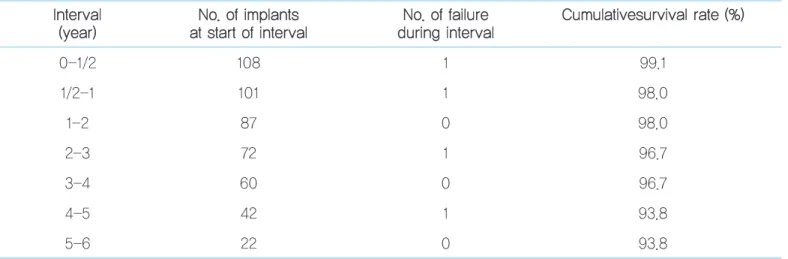
Of 108 implants, four has failed. The 6 year CSR was 93.8%. There were no significant differences between the age groups and gender of patients in the CSR and the CSR between the implant systems were not significant. The length and diameter of the implant fixtures may not be related with cumulative survival rate. The single implants placed in mandibular posterior free end region presented a reliable CSR, 93.8% for 6years. Within the limitation of this results, the length, diame- ter, and the implant systems did not show any significant differences in cumulative survival rate.

Key words: free end; posterior mandible; survival rate; single implant;

Survival rate of the single implant restoration placed in posterior mandibular free end

Ho-Jin Kwon

1

, Myung-Rae Kim

1, 2

, Ji-Man Park

2

, Eun-Kyoung Pang

2

, Sun-Jong Kim

1, 2

하악 구치부 유리단에 식립된 단일 임프란트보철물의 생존률에 대한 연구

권호진1, 김명래1, 2, 박지만2, 방은경2, 김선종1, 2

1

이화여자대학교 임상치의학대학원 임프란트과

2

이화여자대학교 의학전문대학원 치과학교실

(2)

프란트의 성공은 식립 위치는 물론 임프란트의 종 류와 길이, 고정체의 표면 처리, 고정체와 지대주 의 연결방식, 술자의 숙련도 등 다양한 요소의 영 향을 받을 수 있다. 최근에는 재료와 술식의 발달로 합병증이 많이 줄고 치료의 신뢰성도 높게 평가받고 있으나 단일 임프 란트 수복은 인접 구조의 지지를 받지 못하므로 시술 방법과 임프란트 선택에 신중해야 하며 특히 최후방 구치의 경우 세 심한 고려가 필요하다. 상악과 하악은 골질이 다르고 동일 악 골 내에서도 후방으로 갈수록 교합력이 증가하므로 성공률도 다르게 나타날 수 있다. 또 인접치의 존재 여부도 영향을 미칠 수 있으나 최후방 구치에 관한 보고는 많지 않다. Levin 등

1)

은 10년간의 장기적인 연구에서 81명의 환자를 대상으로 상 하악 대구치 부위 단일 임프란트의 성공율을 92.6%로 보고했 으며 Schwartz-Arad 등

2)

은 상하악대구치 부위에 식립된 78개 단일 임프란트의 성공률을 93.6%로 보고했다. 이 등

3)

이 Brånemark 임프란트를 대상으로 분석한 하악 대구치 단 일 임프란트에 관한 연구를 보면 제 1대구치의 생존율이 100%, 제 2대구치는 70.37%로 많은 차이를 보였고, Jung 등

4)

은 하악 대구치 부위에 식립된 sand-blasted, large-grit,

과 같은 의미로 임프란트를 제거하기 전까지 구강 내에 남아 있으면서 기능하는 임프란트의 비율로 정의할 수 있으며, 임 프란트의 임상적 적합성에 대한 다양한 평가 기준을 만족시 키는 성공률과는 차이가 있다.

본 연구는 하악 최후방 대구치 유리단에 식립된 단일 임프 란트의 6년 누적생존율을 통해 치료의 신뢰성을 평가하고, 연 령, 성별, 임프란트 종류, 임프란트 고정체의 길이와 직경과 같은 관련 요소의 영향을 알아보기 위해 시행되었다. 방사선 사진을 통해 임프란트 주위 골변화도 를 조사하여 임프란트 의 안정성에 대해 알아보았다.

1. 연구대상

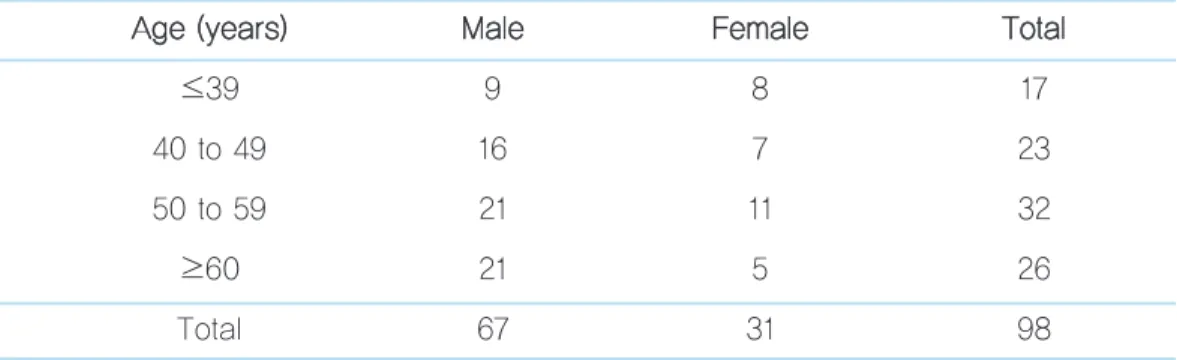
2002년 1월부터 2008년 6월까지 이화여자대학교 목동병 원 치과진료부에 내원하여 하악 최후방 구치부 유리단에 단 일 임프란트가 식립된 98명의 환자를 대상으로 하였다. 10명 의 환자에서 양측 최후방에 2개의 단일 임프란트를 식립되어

Table 1. Age and Gender of the Subjects Followed up for 6 Years A

Ag ge e ((y ye ea arrs s)) M Ma alle e F Fe em ma alle e T To otta all

≤39 9 8 17

40 to 49 16 7 23

50 to 59 21 11 32

≥60 21 5 26

Total 67 31 98

Ho-Jin Kwon et al: Survival rate of the single implant restoration placed in posterior mandibular free end. Implantology 2010

(3)

original article

임프란트 개수는 모두 108개였다. 98명 중 남성은 67명, 여성 은 31명이었다. 연령은 24세부터 76세까지의 분포를 보였고 50대 환자가 32명으로 가장 많았으며 60대 이상이 26명, 40 대가 23명 순이었다. 평균 연령은 51.3세였다(Table 1).

2. 연구방법

통상적인 술식으로 임프란트 수술을 시행하였고 최소 2개 월 이상의 치유기간이 지난 후 상부 보철물을 제작하였다. 보 철물 장착 여부와 관계없이 구강 내에서 제거된 임프란트는 실패로 간주하였다. 생존율은 연령 및 성별, 임프란트 종류, 임프란트 고정체의 길이와 직경을 일정 범위로 분류하여 각 각 계산하였다. 사용된 임프란트는 5종류로서Replace Select

(Nobel Biocare, Sweden)가 36개, Branemark MKIII

(Nobel Biocare, Sweden)가 25개, Osstem SSII

(Osstem, Korea)가 25개, Ankylos

(Degussa, Germany) 가 18개, ITI

(Straumann, Swiss)가 4개 식립되었다.

고정체의 길이와 직경은 각 제조회사에 따라 차이가 있어 일정범위를 정하였다. 길이는 8, 8.5, 9.5, 10, 11, 11.5, 13, 14 mm로 8종류를 세 범위로 나누었고 직경은 4, 4.1, 4.3, 4.5, 4.8, 5, 5.5mm 모두 7종류를 두 범위로 나누어 생존율 을 계산하였다(Table 2, Table 3).

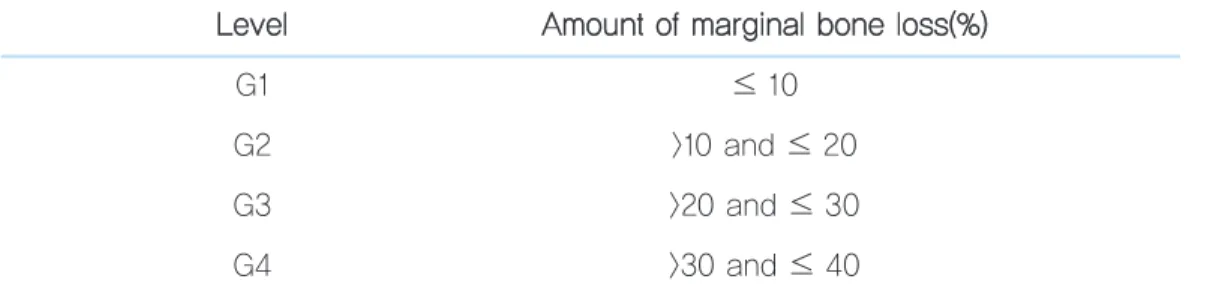
임프란트 주위 변연골 흡수 정도를 알아보기 위해 파노라마 사진을 이용하였다. 식립 당시 고정체가 매식된 골양, 즉 골- 임프란트 계면의 최하방으로부터 임프란트 collar 부근 골이 덮여있는 높이까지를 100으로 하였으며 근원심 중 흡수가 더 많이 된 최저점을 기준으로 하여 수직골 소실만을 조사하였 다. 6개월, 1년, 2년, 4년, 6년에 걸쳐 흡수된 양에 따라 Table 4에서 보는 바와 같이 10% 단위로 등급을 정했다.

식립된 총 108개의 임프란트에 대하여 Life-table analy- sis를 시행하고, 각 기간별로 제거된 임프란트 수를 기록하여 6년간의 누적 생존율을 계산하였다.

6)

Table 2. Number of Implants Grouped by Fixture Length F

Fiix xttu urre e L Le en ng gtth h((m mm m)) T To otta all

≤9.5 12

10-11.5 65

≥13 31

Total 108

Ho-Jin Kwon et al: Survival rate of the single implant restoration placed in posterior mandibular free end. Implantology 2010

Table 3. Number of Implants Grouped by Fixture Diameter F

Fiix xttu urre e D Diia am me ette err((m mm m)) T To otta all

4.0-4.5 74

(4)

3. 통계학적 분석

각 항목의 자료를 토대로 여러 요인에 따른 생존율을 계산 하고, SPSS 프로그램에서 χ

2

- test를 통해 유의성을 검증하 였다(P <0.05).

연령별 생존율을 보면 40대에서 2개 실패하여 91.3%, 50 대, 60대 이상에서 1개씩 실패하여 각각 96.9%, 96.2%를 보 였다. 전체 생존율은 95.9%였다(Table 5). 성별에 따른 생존 율의 차이를 보면 남성은 95.5%, 여성은 96.8%였다. 두 요인

모두 통계학적 유의성은 없었다(P>0.05).

1. 임프란트 종류에 따른 생존율

Replace Select

가 2개, Branemark MKIII

가 2개 실패 하여 94.4%, 92%를 보였고 다른 임프란트는 모두 생존하였 으나 통계학적 유의성은 없었다(Table 6).

2. 임프란트 고정체의 길이와 직경에 따른 생존율

10mm 길이의 임프란트가 2개, 11.5mm, 13mm의 임프란 트가 각각 1개씩 실패하였고, 4mm 직경 임프란트가 2개, 4.3mm 임프란트가 2개 실패하였다. 생존율에 다소 차이가 있으나 통계적 유의성은 없었다(Table 7, Table 8).

G2 >10 and ≤ 20

G3 >20 and ≤ 30

G4 >30 and ≤ 40

Ho-Jin Kwon et al: Survival rate of the single implant restoration placed in posterior mandibular free end. Implantology 2010

Table 5. Survival Rate According to Age Group A

Ag ge e T To otta all F Fa aiille ed d iim mp plla an ntts s S Su urrv viiv va all rra atte e((% %))

≤39 17 0 100

40 to 49 23 2 91.3

50 to 59 32 1 96.9

≥60 26 1 96.2

Total 98 4 95.9

Ho-Jin Kwon et al: Survival rate of the single implant restoration placed in posterior mandibular free end. Implantology 2010

(5)

original article

3. 누적 생존율

개를 제거하여 3년 누적 생존율이 96.7%였으며 4년 이후 하 Table 6. Survival Rate According to the Implant System

S

Sy ys stte em m P Plla ac ce ed d F Fa aiille ed d S Su urrv viiv va all rra atte e((% %))

Replace Select

36 2 94.4

Branemark MKIII

25 2 92.0

Osstem SSII

25 0 100

Ankylos

18 0 100

ITI

4 0 100

Total 108 4 96.3

Ho-Jin Kwon et al: Survival rate of the single implant restoration placed in posterior mandibular free end. Implantology 2010

Table 7. Survival Rate According to Implant Fixture Length

IIm mp plla an ntt F Fiix xttu urre e L Le en ng gtth h((m mm m)) P Plla ac ce ed d F Fa aiille ed d S Su urrv viiv va all rra atte e((% %))

≤9.5 12 0 100

10-11.5 65 3 95.4

≥13 31 1 96.8

Total 108 4 96.3

Ho-Jin Kwon et al: Survival rate of the single implant restoration placed in posterior mandibular free end. Implantology 2010

Table 8. Survival Rate According to Implant Fixture Diameter F

Fiix xttu urre e D Diia am me ette err P Plla ac ce ed d F Fa aiille ed d S Su urrv viiv va all rra atte e ((% %))

4.0 - 4.5 mm 74 4 94.6

4.8 - 5.5 34 0 100

Total 108 4 96.3

Ho-Jin Kwon et al: Survival rate of the single implant restoration placed in posterior mandibular free end. Implantology 2010

(6)

0-1/2 108 1 99.1

1/2-1 101 1 98.0

1-2 87 0 98.0

2-3 72 1 96.7

3-4 60 0 96.7

4-5 42 1 93.8

5-6 22 0 93.8

Ho-Jin Kwon et al: Survival rate of the single implant restoration placed in posterior mandibular free end. Implantology 2010

Fig. 1. Cumulative survival rates of 108 implants for 6 years.

Ho-Jin Kwon et al: Survival rate of the single implant restoration placed in posterior mandibular free end. Implantology 2010

(7)

original article

임프란트 식립이 보편화되면서 임프란트 성공율에 관한 연 구가 많이 이루어지고 있다. 이 연구에서는 Albreksson 등

5)

의 성공 조건의 일부 항목을 선택하여 기준 이상의 골소실 없 이 구강내에 남아 기능하고 있는 임프란트의 생존율을 조사 하였다. 최근에는 임프란트의 성공률이 높아지면서 기준도 엄격해졌으며 심미성의 개선이나 환자의 만족도 등 주관적인 평가도 이루어지고 있다. Misch

6)

는 임프란트 성공을 판단하 기 위해 임프란트의 수명, 환자가 느끼는 통증, 초기고정, 타 진검사, 골소실 측정, 방사선학적 평가, 임프란트 주위염, 탐 침 깊이, 식립 부위의 골질, 상부 보철물과 임프란트 매식체의 비율, 출혈지수를 평가해야 한다고 하였다.

Van Steenberghe

7)

는 국소적 또는 전신적으로 알러지나 독성, 감염반응을 일으키지 않고, 보철물을 지지하고, 파절이 나 굽힘 등의 징후가 없으며 동요도가 없고 방사선 사진에 방 사선투과상이 나타나지 않아야 한다고 성공기준을 제시하였 으며 부가적으로 임프란트의 예후를 평가하기 위해서는 변연 골의 흡수나 부착소실을 측정해야 한다고 하였다.

Zablotsky

8)

도 임프란트의 안정성, 적절한 방사선 사진상의 골수준과 최소한의 탐침깊이를 유지하고, 감염의 증상이나 증거가 없으며 환자 스스로 청결하게 할 수 있는 상태를 성공 요건으로 제시하였다.

대구치 단일 임프란트의 성공율에 대한 연구를 보면 Becker 등

9)

은 상하악 대구치 단일 임프란트 282개 중 상악 70개의 성공율을 82.9%로, 하악 212개의 성공율을 91.5%로 보고했고 Levine 등

10)

은 675개의 상하악 구치부 단일 임프란 트 전체의 성공율을 99.1%로 보고했는데 상악 대구치와 소구

의 생존율을 보고했다. 이 연구에서 하악 최후방에 식립된 단 일 임프란트의 6년 누적생존율은 93.8%이었고 연령, 성별, 임프란트 종류 및 길이와 직경에 따른 생존율은 조금씩 차이 가 있었으나 통계적 유의성은 없었다(p>0.05). 108개의 임프 란트 중 제거된 4개의 임프란트는 감염 또는 과부하에 의한 동요도가 원인인 것으로 추정된다. 실패한 임프란트를 분석 해 본 결과 식립 후 1년 이내에 제거된 2개의 임프란트는 보철 물 장착 전이었고 나머지 2개는 보철물 장착 이후에 실패하였 다. 제거된 4개의 임프란트 중 하나는 하악 제 2대구치 부위 에 식립되었고 골질이 type 3이었다. 만성치주염으로 골이 흡수된 제 1대구치의 치근이개부에 자가골 이식을 함께 시행 하였으며 식립 20일 후 감염으로 인한 부종과 이식편 이탈을 확인 후 고정체를 제거하였다. 다른 하나는 만성치주염으로 발거한지 5개월이 지난 제 2대구치 부위에 식립되었다. 골질 이 type 3, 식립 토크(insertion torque)가 22 Ncm이었고 PTV(periotest value)가 -3이었다. 2개월 후 PTV +5의 동 요도를 보여서 제거하였다. 세 번째는 자가골 이식과 함께 하 악 제 2대구치 부위에 23 Ncm로 식립되었고 골질은 type 2 였다. 식립한지 3년 8개월후 동요도를 주소로 내원하였으며 대합치가 정출된 상태로 보철물이 제작된 상태였다. 나머지 한 개 역시 하악 제 2대구치 부위에 식립되었다. 골질은 type 3였고 25Ncm로 식립되었으며. 보철물 장착 4개월 후 동요도 로 내원하였다. 크라운/고정체 길이 비가 1.0이었고 근심측 캔틸레버가 보이는 교합면이 크게 제작된 상태였다.

부분 무치악에서 임프란트 치료는 인접치아를 보존하면서 교합을 안정시키고, 통상적인 금관계속가공의치 치료에 비해 변연적합성 불량으로 인한 치아우식이나 치주질환의 가능성 을 감소시키는 장점이 있다. 특히 상실된 단일 대구치가 악궁 의 최후방에 위치한 경우 근심 치아를 지대치로 하는 캔틸레 버형 고정성 계속 가공의치나 가철성 국소 의치로 치료했을

(8)

절같은 기계적 합병증이 더 많이 나타난다. 이런 경우 임프란 트에 가해지는 스트레스가 나사풀림이나 시멘트 소실 등으로 해소되지 않으면 지속적인 골흡수나 고정체 파절 등의 부작 용을 낳을 수 있다. 더구나 상실된 대구치가 악궁 최후방 유리 단에 위치하면 양쪽에 인접치가 존재하는 단일 임프란트보다 더 불리할 수 있다. 교합력에 의한 측방력이 인접 접촉을 통해 분산되지 못하고 모두 임프란트 몸체에 가해지기 때문에 임 프란트의 성공에 영향을 줄 가능성이 있다.

12)

임프란트 초기 의 실패는 골유착 부전으로 주로 재료 및 구조적 약점, 부적절 한 외과적 시술, 골양 부족과 골질 불량, 골내 감염과 임프란 트 주위염이 주된 원인이다. 사용하고 있던 임프란트의 실패 는 점진적인 골흡수의 진행 결과이며 임프란트 구조와 보철 의 무리한 연결 및 생역학적 과부하가 문제가 된다. 임프란트 의 생존을 평가하는 중요한 척도인 골의 안정성도 연구의 범 위에 포함되었다. 파노라마 방사선 사진이 이용되었는데 방 사선 사진은 상의 확대나 축소가 나타날 수 있고 2차원적이므 로 협설측 변연골의 중첩으로 골높이를 평가하기 어렵다. 또 연조직에 의한 산란 등이 골밀도의 변화를 가져올 수 있어 정 확한 측정에 어려움이 있다.

13)

이 연구에서는 실제 흡수량을 계측하지 않고 식립 당시 골높이를 기준으로 흡수된 비율을 조사하였다. 식립 후 6개월, 1년, 2년, 4년, 6년에 걸쳐 흡수 된 비율에 따라 10% 단위로 정한 등급을 매긴 후 같은 등급별 로 개수를 표시하였다. 대부분 10% 이내의 골소실을 보였고 그 이상 소실된 경우도 시간이 지남에 따라 일정 수준으로 안 정되는 경우가 많았다. 40%를 초과하여 흡수된 경우는 없었 으므로 위 성공 기준에 부합된다. 임프란트 주위 변연골이 소 실되는 이유는 판막거상시의 외과적 외상, 골삭제시에 발생 되는 과열, 임프란트 삽입시에 생기는 과도한 힘, 저작시 발생 되는 과부하, 생리적 치조정 흡수, 치태에 의한 연조직 염증 등이다. 임프란트를 식립한 첫 해에는 생물학적 폭경이 재형

이번 연구에서도 비슷한 결과를 보였으나 의도적으로 깊게 매식하거나 이식재 상부의 빠른 흡수로 초기 6개월 내에 10%

를 초과하는 골흡수를 보인 예외적인 경우도 있었다. 또 부하 첫 해가 지났어도 골소실이 안정되지 않는 경우가 드물게 있 었다. 2년 이후의 결과치에서 G2 이상이 나타나지 않은 것은 변연골 흡수가 진행된 임프란트 환자가 내원하지 않았기 때 문이다. 골소실 측정외에도 다양한 평가 방법이 있으나 이 연 구에서는 제외되었다.

본 연구는 제거된 임프란트 만을 실패로 간주하였고 50%

이상 골과 긴밀히 접해있으면서 기능이 유지되고 있는 임프 란트는 모두 생존하고 있는 것으로 평가하였다. 따라서 임프 란트 주변에 골소실이 진행되고 있다면 잠재적인 실패 가능 성을 가지고 있다고 할 수 있다. 또 연구에서 환자 검진과 방 사선 사진 촬영 시기가 일정치 않아 일정기간 간격으로 조사 할 수 없었고 장기간 추적이 가능한 환자 수도 많지 않았다.

향후 관련요인의 평가를 위해서는 전향적인 연구가 필요할 것으로 사료된다.

본 연구의 결과를 통하여 다음과 같은 결론을 얻었다. 하악 최후방 구치가 상실되었을 때 임프란트를 이용한 단일 치아 수복은 6년간 93.8%가 잔존하여 기능할 수 있으며, 연령이나 성별, 임프란트 시스템 및 임프란트 길이와 직경 등의 요소들 이 유의성 있는 실패 원인으로 지목되지는 않았다.

(9)

original article

1. Levin L, Laviv A, Schwartz-Arad D. Long-term Success of Implants Replacing a Single Molar. J Periodontol 2006;77:1528-1532.

2. Schwartz-Arad D, Samet N, Samet N. Single tooth replacement of miss- ing molars: A retrospective study of 78 implants. J Periodontol 1999;70:449-454

3. Lee HB, Paik JW, Kim CS, et al. The Comparison between the success rates of single implants replacing the mandibular first and second molar.

J Korean Acad Periodontol 2004;34:101-111.

4. Jung UW, Choi JY, Kim CS, et al. Evaluation of Mandibular Posterior Single Implants With Two Different Surfaces: A 5-Year Comparative Study. J Periodontol 2008;79:1857-1863.

5. Albrektsson T, Zarb GA, Worthington P. The long term efficacy of cur- rently used dental implants: a review and proposed criteria of success.

Int J Oral Maxillofac Impl 1986;1:11-25.

6. Misch CE. A key determinant for clinical success. In: Misch CE, ed.

Contemporary Implant Dentistry, 2nd ed. St.Louis: Mosby Co.

1999:109.

7. Van Steenberghe D, Quirynen M, Naert I. Survival and success rates with oral endosseous implants. In Proceedings of the 3rd European Workshop

on Periodontology. Quintessence Publishing Co. 1999;242-254.

8. Zablotsky MH. A retrospective nanalysis of the management of ailing and failing endosseous dental implants. Impl Dent. 1998;7:185-191.

9. Becker W, Becker BE. Long-term evaluation of 282 implants in maxil- lary and mandibular molar positions: A prospective study. J Periodontol 1999;70:896-901.

10. Levine RA, Clem D, Beagle J, et al. Multicenter retrospective analysis of the solid-screw ITI implant for posterior single-tooth replacements.

Int J Oral Maxillofac Implants 2007;22:736-742.

11. Lee SM, Chae GJ, Jung UW, et al. Retrospective study on ITI SLA (sand-blasted, Large-grit, acid-etched) implant for mandibular posterior single tooth replacement. J Korean Acad Periodontol 2006;36:661-670.

12. Southard TE, Behrents RG, Tolley EA. The anterior component of occlusal force. Part I. Measurement and distribution. Am J Orthod Dentofacial Orthop 1990;97:24-25.

13. Wyatt CC, Byant SR, Avivi-Arber S, Chaytor Dv,Zarb GA. A comput- er-assisted measurement technique to assess bone proximal to oral implants on intraoral radiographs. Clin Oral Impl Res 2001;12:225-229.

14. Oh TJ, Yoon JK, Misch CE, Wang HL. The causes of early implant bone loss: Myth or Science J Periodontol 2002;73:322-333.

15. Cochran DL, Hermann JS, Buser D. Biologic width around titanium implants. A histometric analysis of the implanto-gingival junction around unloaded and loaded nonsubmerged implants in the canine mandible. J Periodontol 1997;68:186-198.

교신저자: 김선종

주소: 서울시 양천구 목동 911-1

이화여대 목동병원 치과진료부 구강악안면외과

Tel: 02-2650-5631 Fax: 02-2650-5764

수치

Table 1.   Age and Gender of the Subjects Followed up for 6 Years  A
Table 3.   Number of Implants Grouped by Fixture Diameter  F
Table 5.   Survival Rate According to Age Group   A
Table 7.   Survival Rate According to Implant Fixture Length
+2

참조

관련 문서

Long-term outcomes of short dental implants supporting single crowns in posterior region: a clinical retrospective study of 5-10 years.. Osteotome sinus

The purpose of this study is to research prevalence of nonnutritive sucking for Korean preschool children, evaluate the relation of contributing factors

The purpose of this study was to identify the frequency and related factors of advanced airway management for patients with cardiac arrest by the

The purpose of this study was to provide primary material in discussing methods to activate the treatment effects of diabetes and reduce the rate of

The aim of this study was to evaluate the sealing ability in Type II root canal obturation by comparing the presence of voids between single cone technique using Endoseal MTA

The purpose of this study was to evaluate the curvature of Vertucci's type II mesial canals of mandibular molar using new method; The radius and angle

The purpose of this study is to present the background, necessity and purpose of the study in Chapter 1, and the second part of the theoretical study is related to the

The purpose of this study was to investigate the effect of complex exercise program on Lifestyle-related factors and blood free oxygen radical of