Received: March 17, 2014 Revised: May 14, 2014 Accepted: May 22, 2014
Correspondence: Kyungwon Lee, Department of Laboratory Medicine, Severance Hospital, Research Institute of Bacterial Resistance, Yonsei University College of Medicine, 50-1, Yeonsei-ro, Seodaemun-gu, Seoul 120-752, Korea
Tel: 02-2228-2446, Fax: 02-313-0908 E-mail: [email protected]
국내 중환자실 환자에서 분리된 세균의 항균제 내성
이양순1ㆍ김영아2ㆍ송원근3ㆍ이혁민4ㆍ이혜수5ㆍ장숙진6ㆍ정석훈1ㆍ홍성근7 용동은1ㆍ이경원1ㆍ정윤섭1ㆍKONSAR Group
연세대학교 세브란스병원 진단검사의학과, 세균내성연구소1, 국민건강보험 일산병원 진단검사의학과2,
한림대학교 강남성심병원 진단검사의학과3, 관동대학교 진단검사의학교실4, 전북대학교 의학전문대학원 진단검사의학교실5, 조선대학교병원 진단검사의학과6, 차의과학대학교 분당차병원 진단검사의학과7
Recent Trends in Antimicrobial Resistance in Intensive Care Units in Korea
Yangsoon Lee
1, Young Ah Kim
2, Wonkeun Song
3, Hyukmin Lee
4, Hye Soo Lee
5, Sook Jin Jang
6, Seok Hoon Jeong
1, Seong Geun Hong
7, Dongeun Yong
1, Kyungwon Lee
1, Yunsop Chong
1, KONSAR Group
Department of Laboratory Medicine, Severance Hospital, Research Institute of Bacterial Resistance, Yonsei University College of Medicine
1, Seoul, Department of Laboratory Medicine, National Health Insurance Service Ilsan Hospital
2, Goyang, Department of Laboratory Medicine, Hallym University Kangnam Sacred Heart Hospital
3, Seoul, Department of Laboratory Medicine, Kwandong University College of Medicine
4, Gangneung, Department of Laboratory Medicine, Chonbuk National University Medical School
5, Jeonju, Department of Laboratory Medicine, Chosun University Hospital
6, Gwangju, Department of Laboratory Medicine, CHA Bundang Medical Center, CHA Univeristy
7, Seongnam, Korea
Background: In general, higher resistance rates are observed among intensive care unit (ICU) isolates than non-ICU isolates. In this study, resistance rates of isolates from ICUs and non-ICUs were compared using the data generated from 20 hospitals in Korea.
Methods: Susceptibility data were collected from 20 hospitals participating in the Korean Nationwide Surveillance of Antimicrobial Resistance (KONSAR) program. Duplicate isolates were excluded from the analysis. The resistance rates did not include intermediate susceptibility.
Results: The most prevalent bacteria in the ICUs were Staphylococcus aureus (21%) and Acinetobacter spp. (19%), and those in non-ICU were Escherichia coli (27%) and S. aureus (14%). The resistance rates were higher in ICUs than in non-ICUs at 84% and 58% for methicillin-resistant S. aureus, 86% and 70% for methicillin-resistant coagulase-negative Staphylcoccus (CNS), 34% and 19% for vancomycin-resistant Enterococcus faecium, 38% and 19% for cefotaxime-resistant E. coli, 45% and 25% for cefotaxime-resistant Klebsiella pneumoniae, 42% and 24% for ceftazidime-resistant Enterobacter cloacae, 29% and 11% for ceftazidime-resistant Serattia marcescens, 83% and 44%
for imipenem-resistant Acinetobacter spp., and 32% and 17% for imipenem-resistant Pseudomonas aeruginosa, respectively.
Conclusion: The most prevalent bacteria in ICUs were S. aureus, CNS, and Acinetobacter spp., and high multi-drug resistance rates were observed in the Acinetobacter isolates. Therefore, infection control should be practiced in ICUs to prevent infections caused by multi-drug resistant bacteria.
Keywords: Acinetobacter spp., Antimicrobial resistance surveillance, Intensive care units (ICU), KONSAR,
Staphylococcus aureus
Introduction
항균제 내성은 세계적인 문제가 되고 있으나, 나라와 지역에 따라서 내성률에 큰 차이가 있다.
과거에는 포도알균, 장알균 등의 그람양성 세균 의 내성이 문제되었으나, 2000년대에 들어서는 다제내성 그람음성 막대균이 심각한 문제가 되 고 있다[1,2]. 특히 다제내성 Acinetobacter spp.의 현저한 증가[3,4]와 최근에는 carbapenem 내성
Enterobacteriaceae의 출현이 여러 나라에서 보고되었다[5-7]. 국내에서는 인도에서 부상 당한 내 국인 환자에서 carbapenem 분해효소인 OXA-48의 아형[8] OXA-232 생성 Klebsiella pneumoniae가 보고되었고, 그 후 이 균주가 국내에서 확산되어 여러 병원의 환자에서 분리되었다[9].
우리나라에서 분리된 세균의 항균제 내성률은 다른 나라보다 비교적 높다고 알려져 있다[10].
세균의 내성률은 병원감염에서 분리된 세균이 지역사회감염에서 분리된 세균보다 높고, 병원감 염 중에서는 중환자실(ICU) 환자 분리주가 일반 병실 환자 분리주보다 높음이 보고되었다[2,10,11].
그러나, 중환자실 환자 분리주의 내성률이 항상 높은 것은 아니다. Sievert 등[12]은 병원내 감염 중 주요 감염증인 중심관 관련 혈류감염과 도뇨 관 관련 요로 감염 세균에 대하여 중환자실과 일 반병실 환자 분리주의 내성률을 비교하였는데, 대부분의 세균-항균제 짝에 있어서 유의한 차이 가 없었음을 보고하였다.
우리나라의 항균제 내성 감시 프로그램인 Korean Nationwide Surveillance of Antimicrobial Resistance (KONSAR)는 1997년부터 국내 주요 병원의 임상 검체에서 분리된 세균의 내성률을 조사하여 왔다[1,13]. 그러나, 중환자실 분리주의 주요 세균의 내성 경향은 소수 병원에서만 분석 하였기 때문에, 다기관의 중환자실 자료를 수집 하여 분석할 필요성이 있다. 따라서, 본 연구에서 는 국내 20개 병원의 ICU와 그 외의 일반 병실 및 외래 환자(non-ICU)에서 분리된 세균의 내성 률을 비교 분석하였다.
Materials and Methods
24개 KONSAR 참여기관에서 2011년에 시험된 항균제 감수성 자료를 수집하였다. 항균제 감수 성 자료는 각 기관 환자에서 분리된 균주 중 중 복 분리주를 제외한 자료를 대상으로 분석하였 고, 중복 분리주가 포함된 4개 병원의 자료는 분 석에서 제외하였다. 항균제 감수성 시험 방법은 19개 병원은 자동화 장비를 이용한 액체배지 미 량희석법으로 시험하였고, 1개 병원은 Clinical and Laboratory Standards Institute (CLSI) 디스크 확산법으로 시험하였다[14].
병원에 따라서 시험한 항균제로, fluoroqui- nolone 내성은 ciprofloxacin 또는 levofloxacin으로, 제3세대 cephalosporin내성은 cefotaxime 또는 cef- tazidime으로 시험하였다. Streptococcus pneumo-
niae의 penicillin G 감수성에 대한 해석은 수막염기준을 적용하였다. ESBL 생성 E. coli 및 K.
pneumoniae는 2009년 CLSI 지침에 따라서 cefo-
taxime, ceftazidime 및 cefepime에 내성으로 해석 하였다. 내성률에 중간 감수성은 포함시키지 않 았다. 큰 병원의 많은 분리 균주수로 인한 오류 를 줄이기 위해서, 평균내성률은 각 병원의 내성 률을 평균하였다[15,16]. 또한 한 균종의 분리 수 가 10주 이내이면 평균내성률 계산에서는 제외 하였다.
ICU와 non-ICU 환자에서 분리된 주요 세균의 항균제 내성률의 비교를 위해서 카이제곱검정 (Fisher’s 정확검정)을 시행하였고, 양측성으로 검 정하여 P값이 0.05 미만인 경우를 통계적으로 유 의한 것으로 평가하였다[12]. 통계분석에는 SAS 9.2 (SAS Institute Inc., Cary, NC, USA)를 사용하 였다.
Results
1. 세균의 분리 순위
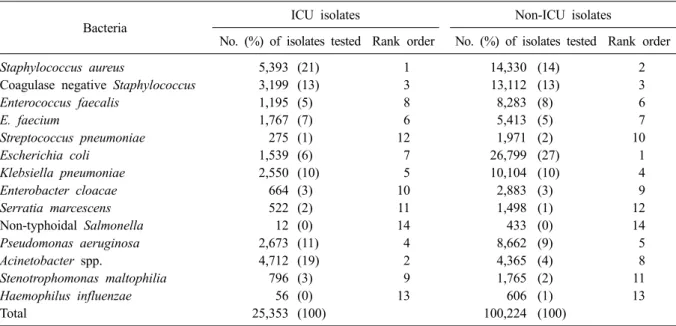
2011년에 총 125,577주가 분리되었고, 이 중
25,353주(20%)는 ICU 환자에서, 100,224주(80%)
는 non-ICU 환자에서 분리되었다(Table 1). ICU
환자에서는
Staphylococcus aureus (21%)가 가장많이 분리되었고, 그 다음은 Acinetobacter spp.
Table 1. Number, proportion, and rank order of clinically important bacteria from ICU and non-ICU patients
Bacteria ICU isolates Non-ICU isolates
No. (%) of isolates tested Rank order No. (%) of isolates tested Rank order
Staphylococcus aureus 5,393 (21) 1 14,330 (14) 2
Coagulase negative Staphylococcus 3,199 (13) 3 13,112 (13) 3
Enterococcus faecalis 1,195 (5) 8 8,283 (8) 6
E. faecium 1,767 (7) 6 5,413 (5) 7
Streptococcus pneumoniae 275 (1) 12 1,971 (2) 10
Escherichia coli 1,539 (6) 7 26,799 (27) 1
Klebsiella pneumoniae 2,550 (10) 5 10,104 (10) 4
Enterobacter cloacae 664 (3) 10 2,883 (3) 9
Serratia marcescens 522 (2) 11 1,498 (1) 12
Non-typhoidal Salmonella 12 (0) 14 433 (0) 14
Pseudomonas aeruginosa 2,673 (11) 4 8,662 (9) 5
Acinetobacter spp. 4,712 (19) 2 4,365 (4) 8
Stenotrophomonas maltophilia 796 (3) 9 1,765 (2) 11
Haemophilus influenzae 56 (0) 13 606 (1) 13
Total 25,353 (100) 100,224 (100)
Table 2. Antimicrobial resistance of clinically important Gram-positive cocci
Antimicrobial agents
Resistance rate (%)
SAU CNS EFA EFM SPN
19,723* 16,311 9,478 7,180 2,246
Penicillin/ampicillin
†96 93 3 93 70
Gentamicin 47 41 - - -
Fluoroquinolone 51 41 29 92 7
Clindamycin 58 38 - - 59
Erythromycin 60 56 68 89 74
Oxacillin/cefoxitin 67 73 - - -
Cotrimoxazole 2 28 - - 55
Tetracycline 51 29 85 32 71
Teicoplanin 0 0 1 19 -
Vancomycin 0 0 1 23 -
*No. of isolates tested;
†Penicillin for Staphylococcus spp., SPN, and ampicillin for Enterococcus spp.
Abbreviations: SAU, Staphlyococcus aureus; CNS, coagulase negative Staphylococcus; EFA, Enterococcus faecalis;
EFM, E. faecium; SPN, Streptococcus pneumoniae.
(19%), coagulase 음성 Staphylococcus (CNS) (13%),
Pseudomonas aeruginosa (11%), K. pneumoniae(10%) 순이었다. 반면에 non-ICU 환자에서는
Escherichia coli (27%)가 가장 많이 분리되었고,그 다음은 S. aureus (14%), CNS (13%), K. pneu-
moniae (10%), P. aeruginosa (9%) 순이었다.2. 항균제 내성
주요 그람양성 알균의 항균제 내성률은 Table 2와 같다. S. aureus와 CNS 중 penicillin G 내성률 은 각각 96%와 93%로 높았고, oxacillin 내성률은
각각 67%와 73%이었고, cotrimoxazole 내성률은 각각 2%와 28%이었다. Enterococcus faecalis의 ampicillin과 vancomycin 내성률은 각각 3%와 1%
로 낮았으나, E. faecium의 내성률은 각각 93%와 23%로 높았다. Streptococcus pneumoniae의 pen- icillin G 내성률은 70%이었다.
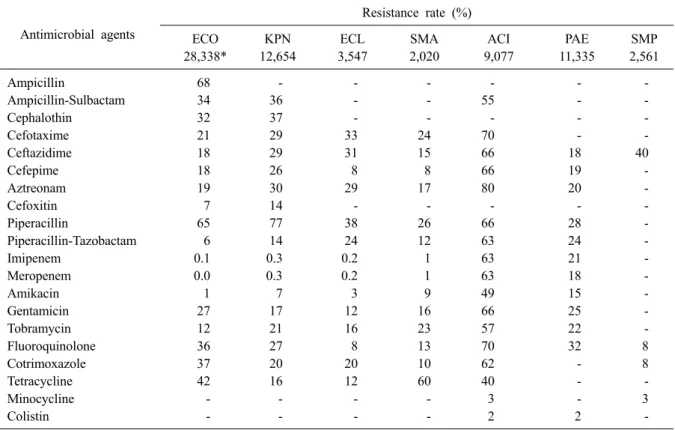
주요 그람음성 막대균의 항균제 내성률은
Table 3과 같다. E. coli의 내성률은 ampicillin
68%, cefotaxime 21%, piperacillin-tazobactam 6%,
amikacin 1%, fluoroquinolone 36%, cotrimoxazole
37%이었다. K. pneumoniae의 내성률은 ceftazi-
Table 3. Antimicrobial resistance of clinically important Gram-negative bacilli Antimicrobial agents
Resistance rate (%)
ECO KPN ECL SMA ACI PAE SMP
28,338* 12,654 3,547 2,020 9,077 11,335 2,561
Ampicillin 68 - - - - - -
Ampicillin-Sulbactam 34 36 - - 55 - -
Cephalothin 32 37 - - - - -
Cefotaxime 21 29 33 24 70 - -
Ceftazidime 18 29 31 15 66 18 40
Cefepime 18 26 8 8 66 19 -
Aztreonam 19 30 29 17 80 20 -
Cefoxitin 7 14 - - - - -
Piperacillin 65 77 38 26 66 28 -
Piperacillin-Tazobactam 6 14 24 12 63 24 -
Imipenem 0.1 0.3 0.2 1 63 21 -
Meropenem 0.0 0.3 0.2 1 63 18 -
Amikacin 1 7 3 9 49 15 -
Gentamicin 27 17 12 16 66 25 -
Tobramycin 12 21 16 23 57 22 -
Fluoroquinolone 36 27 8 13 70 32 8
Cotrimoxazole 37 20 20 10 62 - 8
Tetracycline 42 16 12 60 40 - -
Minocycline - - - - 3 - 3
Colistin - - - - 2 2 -
*No. of isolates tested.
Abbreviations: ECO, Escherichia coli; KPN, Klebsiella pneumoniae; ECL, Enterobacter cloacae; SMA, Serratia marces- cens; ACI, Acinetobacter spp.; PAE, Pseudomonas aeruginosa; SMP, Stenotrophomonas maltophilia.
dime 29%, piperacillin-tazobactam 14%, cefoxitin 14%, amikacin 7%, fluoroquinolone 27%이었다.
Enterobacter cloacae와 Serratia marcescens의 내성
률은 각각 ceftazidime 31%와 15%, cefepime 8%와 8%, amikacin 3%와 9%, fluoroquinolone 8%와 13%이었다. Acinetobacter spp.는 amicillin-sulbac- tam 55%, cefepime 66%, imipenem 63%, amikacin 49%, fluoroquinolone 70%의 내성률을 보였고, minocycline과 colistin에는 각각 3%와 2%의 낮은 내성률을 보였다. P. aeruginosa의 내성률은 cefta- zidime 18%, imipenem 21%, amikacin 15%, fluo- roquinolone 32%이었다. Stenotrophomonas malto-
philia의 내성률은 ceftazidime 40%, fluoroquino-lone 8%, cotrimoxazole 8%이었다.
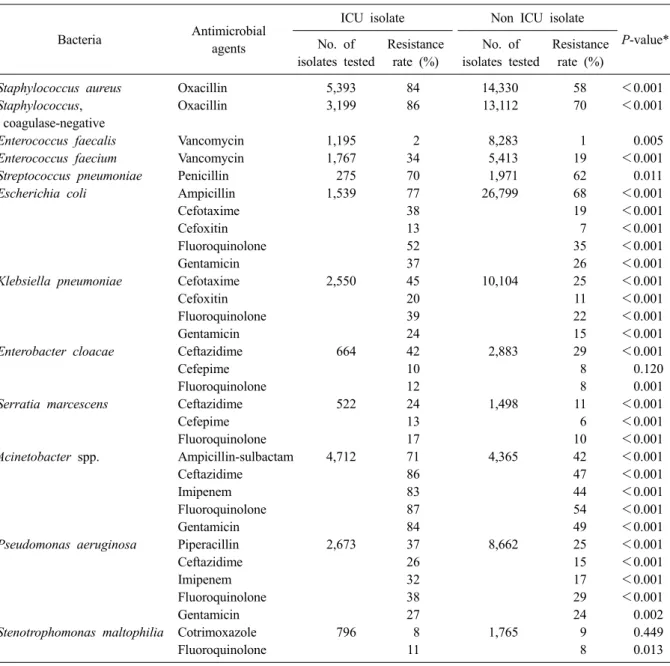
ICU 분리 주요 그람양성 알균-항균제 짝의 비 율은 non-ICU 분리 주요 세균에 비하여 대부분 높았다(Table 4). 즉, ICU와 non-ICU 분리주의 비 율은 methicillin-resistant S. aureus (MRSA)가 각각 84%와 58%, methicillin-resistant CNS (MRCNS)가
각각 86%와 70%, vancomycin 내성 E. faecium가 각각 34%와 19%로, 통계적으로 유의한 차이를 보였다(P<0.05). Penicillin G 내성 S. pneumoniae 도 ICU 분리주의 비율이 통계적으로 유의하게 높았다(P<0.05).
그람음성 막대세균에서도 ICU 환자 분리주의 내성률이 대체로 높았다(Table 4). ICU와 non-ICU 분리 cefotaxime 내성 E. coli의 비율은 각각 38%
와 19%, fluoroquinolone 내성 E. coli는 52%와
35%, cefotaxime 내성 K. pneumoniae는 45%와
25%, ceftazidime 내성 E. cloacae는 42%와 29%,
ceftazidime 내성 S. marcescens는 24%와 11%로,
통계적으로 유의한 차이를 보였다(P<0.05). 또한
ICU와 non-ICU에서 분리된 ampicillin-sulbactam
내성
Acinetobacter spp.는 71%와 42%, imipenem내성
Acinetobacter spp.는 83%와 44%, imipenem내성
P. aeruginosa는 32%와 17%로 통계적으로유의한 차이를 보였다. 반면에, cotrimoxazole 내
성
S. maltophilia 비율은 ICU와 non-ICU에서 각Table 4. Comparison of resistance rates of clinically important species isolated from ICU and non-ICU patients
Bacteria Antimicrobial agents
ICU isolate Non ICU isolate
P-value*
No. of isolates tested
Resistance rate (%)
No. of isolates tested
Resistance rate (%)
Staphylococcus aureus Oxacillin 5,393 84 14,330 58 < 0.001
Staphylococcus, Oxacillin 3,199 86 13,112 70 <0.001
coagulase-negative
Enterococcus faecalis Vancomycin 1,195 2 8,283 1 0.005
Enterococcus faecium Vancomycin 1,767 34 5,413 19 <0.001
Streptococcus pneumoniae Penicillin 275 70 1,971 62 0.011
Escherichia coli Ampicillin 1,539 77 26,799 68 <0.001
Cefotaxime 38 19 <0.001
Cefoxitin 13 7 <0.001
Fluoroquinolone 52 35 <0.001
Gentamicin 37 26 <0.001
Klebsiella pneumoniae Cefotaxime 2,550 45 10,104 25 <0.001
Cefoxitin 20 11 <0.001
Fluoroquinolone 39 22 <0.001
Gentamicin 24 15 <0.001
Enterobacter cloacae Ceftazidime 664 42 2,883 29 <0.001
Cefepime 10 8 0.120
Fluoroquinolone 12 8 0.001
Serratia marcescens Ceftazidime 522 24 1,498 11 <0.001
Cefepime 13 6 <0.001
Fluoroquinolone 17 10 <0.001
Acinetobacter spp. Ampicillin-sulbactam 4,712 71 4,365 42 <0.001
Ceftazidime 86 47 <0.001
Imipenem 83 44 <0.001
Fluoroquinolone 87 54 <0.001
Gentamicin 84 49 <0.001
Pseudomonas aeruginosa Piperacillin 2,673 37 8,662 25 <0.001
Ceftazidime 26 15 <0.001
Imipenem 32 17 <0.001
Fluoroquinolone 38 29 <0.001
Gentamicin 27 24 0.002
Stenotrophomonas maltophilia Cotrimoxazole 796 8 1,765 9 0.449
Fluoroquinolone 11 8 0.013
*Statistical significance was declared for P-values less than 0.05 by the χ
2test (Fisher’s exact test).
각 8%와 9%로 통계적인 유의한 차이가 없었다 (P=0.449).
Discussion
우리나라의 종합병원 및 상급종합병원의 중환 자실 비율은 신생아 중환자실을 포함하여 전체 병상의 약 5-10%정도를 차지하며, 소수의 환자들 이 입원하고 있다[17]. 그러나, 중환자실에는 주 로 종양환자와 면역저하 환자 및 중환수술 후 환 자들이 내원하므로 기회감염이 많고, 분리되는
세균 수도 많다. 본 연구에서는 ICU와 non-ICU 분리 균주 수가 각각 25,353주와 100,224주로, 병 원전체 환자에서 분리되는 균주 수의 약 20%가 ICU 환자에서 분리되고 있음을 알 수 있었다.
ICU 환자에서 많이 분리된 균종 상위 3가지는
S. aureus, Acinetobacter spp., CNS로, 이들 세 균종이 ICU 전체 분리주의 50% 이상을 차지하였 다. 2010년 7월부터 2011년 6월에 우리나라 ICU 환자의 감염률을 조사한 연구[18]에 의하면, S.
aureus가 가장 많았고, 그 다음이 Acinetobacter
spp.로 본 연구결과와 유사하였다.
Non-ICU 환자에서 분리된 상위 3가지는 E.
coli, S. aureus 및 CNS로, 이들 세 균종이 전체 분
리 균주 수의 50% 이상을 차지하였다. 이를 비교 해 보면, ICU과 non-ICU 환자에서 분리된 균종 중
S. aureus와 CNS은 공통적으로 많음을 알 수있었다. 반면에 ICU에서 다수 분리된 Acineto-
bacter spp.와 non-ICU에서 주로 분리되는 E. coli가 두 군간에 큰 차이점이라고 할 수 있겠다.
ICU에서의 E. coli는 6%로 7 순위였고, non-ICU 에서의 Acinetobacter spp.는 4%로 8 순위로 낮았 다.
ICU 환자 분리주의 내성률이 non-ICU 환자 분 리주보다 항상 높은 것은 아니다[12]. 본 연구에 서는 ICU 환자 분리주의 내성률이 non-ICU 환자 분리주에 비하여 대부분 높았다. 특히 병원내 감 염관리의 주요 대상인 MRSA, VRE, 제3세대 cephalosporin 내성 E. coli 및 K. pneumoniae, car- bapenem 내성 Acinetobacter spp. 및 P. aeruginosa 의 비율이 통계적으로 유의하게 높았다.
유럽의 International Nosocomial Infection Con- trol Consortium (INICC)[19]가 2004-2009년에 ICU 환자의 중심관 관련 혈류감염 분리 세균에 대한 항균제 내성률 분석에 의하면, MRSA가 84%, fluoroquinolone 내성 E. coli가 53%로, 본 연구 결 과와 비슷하였다. 그러나, carbapenem 내성 P.
aeruginosa 및 Acinetobacter spp.는 각각 47%와
55%로, 본 연구 결과의 32%와 83%와 차이를 보 였다. 반면에, 미국 National Healthcare Safety Network (NHSN) 자료[12]에 따르면 2009-2010년 에 분리된 ICU환자의 중심관 관련 혈류감염 분 리 세균의 항균제 내성 비율이 MRSA 52%, fluo- roquinolone 내성 E. coli 37%, carbapenem 내성 P.
aeruginosa 27%, carbapenem 내성 Acinetobacter
spp. 65%로 본 연구에서의 비율보다 5%-32%가 낮았다.
Acinetobacter spp.는 ICU에서 분리된 균주 수
가 많고, 내성률도 또한 유의하게 높았다. 다약제 내성
Acinetobacter spp.는 ICU 환자의 사망률을높여, 병원내 감염의 주요 문제로 대두되며, 이에 대한 연구가 다수 보고되었다. Jung 등[20]은
Acinetobacter spp.가 정착한 ICU 입실환자의 50%이상이 균혈증을 일으켰고, 이는 침습적 시술과
관련이 있다고 보고하였다. 또, ICU 입원 환자 중 carbapenem 내성 Acinetobacter spp. 균혈증에 의한 30일 사망률이 79.8%로 매우 높으며, 사망 률을 높이는 독립적인 위험인자로 부적절한 항 균제 치료, 많은 종류의 항생제 사용 및 침습적 시술 등이라고 보고하였다[21,22]. 따라서 ICU 환 자에서의 다약제 내성
Acinetobacter spp. 감염예방을 위한 적극적인 감염관리가 필요함을 강조 하였다. S. maltophilia의 ICU와 non-ICU 환자 분 리주의 cotrimoxazole과 fluoroquinolone 내성률에 는 유의한 차이가 없었는데, 이는 S. maltophilia 에 의한 원외감염이 적고, 이들 항균제에 대한 내성률이 낮아서, 차이가 적은 것으로 추정된다.
본 연구는 각 검사실이 시험한 감수성 시험결 과를 분석한 것이므로, 검사실에 따른 감수성 시 험방법 및 해석의 차이로 인한 오류가 있음을 배 제할 수 없다. 또 감염균과 정착균을 구별하기가 때로는 대단히 어렵기 때문에 분리주가 정착균 인지 감염균인지는 구별할 수 없었다.
결론적으로, ICU환자에서 다수 분리된 세균은
S. aureus, CNS와 Acinetobacter spp.이며, 특히ICU 분리 Acinetobacter spp.는 non-ICU분리 균주 보다 높은 항균제 내성률을 보였다. 내성률이 높 은 균종이 있는 중환자실에서 손 위생, 환경관리 및 주요 삽입기구의 최소한의 사용 등에 대한 체 계적이고 적극적인 감염관리가 매우 중요할 것 으로 사료된다.
Summary
배경: 일반적으로 중환자실(ICU) 환자 분리주 의 내성률이 일반병실(non-ICU) 환자 분리주의 내성률보다 높음이 알려져 있다. 본 연구에서는 국내 20개 병원의 ICU와 non-ICU 환자에서 분리 된 세균의 내성률을 조사하고 비교 분석하였다.
방법: 2011년에 KONSAR 참여기관 중 ICU 환
자 분리주의 항균제 감수성 자료가 있는 20개 병
원 자료를 대상으로 하였다. 중복분리주를 제외
하였고, 내성률에 중간 감수성률은 포함시키지
않았다. 큰 병원의 많은 분리 균주 수로 인한 오
류를 줄이기 위해서, 평균내성률은 각 병원의 내
성률을 평균하였다.
결과: ICU 환자에서는 Staphylococcus aureus (21%), Acinetobacter spp. (19%)가 가장많이 분리 되었고, non-ICU 환자에서는 Escherichia coli (27%), S. aureus (14%) 순으로 많았다. ICU와 non-ICU 환자 분리주의 내성률은 MRSA가 각각 84%와 58%, MRCNS가 각각 86%와 70%, vanco- mycin 내성 E. faecium이 각각 34%와 19%, cefo- taxime 내성 E. coli가 각각 38%와 19%, cefotax- ime 내성 K. pneumoniae는 45%와 25%, ceftazi- dime 내성 E. cloacae는 42%와 24%, ceftazidime 내성
S. marcescens는 29%와 11%로, ICU 분리주의 내성률이 통계적으로 유의하게 높았다(P<0.05).
Imipenem 내성 Acinetobacter spp.는 83%와 44%, imipenem 내성 P. aeruginosa는 32%와 17%로, 통 계적으로 유의한 차이를 보였다(P<0.05).
결론: ICU환자에서 다수 분리된 세균은 S.
aureus, CNS와 Acinetobacter spp.이며, 특히 ICU