Chapter 7. Separation of Particles from a Gas:
Cyclones and Impactors
For either gas cleaning (removal of dusts) or recovery of particulate products
7.S Inertial Motion and Impact of Particles
입자는 질량이 그것을 담고 다니는 유체의 그것보다 크기 때문에 (액체보다 는 특히 기체에서 두드러짐) 유체의 흐름(속도와 방향)에 급격한 변화가 일 어날 때 적응하지 못하고 관성을 가지고 독자적인 운동을 하게 된다. 이를 입자의 관성운동이라 부르며, 고체표면 가까이서 이 현상이 일어나면 입자 는 표면에 부딪히게 된다. 이를 충돌 (impaction)이라 한다.
1) Stop Distance
For Stokesian particles
Momentum(force) balance for a single sphere
mp dU
dt =- 3πμdpU Cc
Integrating once
U =U0e- t/τ
where τ = mpCc
3πμdp = ρ
pd2pCc 18μ
relaxation time Integrating twice
x =U0τ(1 -et/τ) As τ →∞t ,
x ∼ U0τ = ρ
pd2pU0Cc 18μ ≡s
stop distance
* out of Stokes' range
2) Simiulitude Law for Impaction : Stokesian Particles
Particle
diameter,μm Re0 S at U0=10m/s time to travel 95% of S
0.01 0.0066 7.0×10⁻⁵ 2.0×10⁻⁸
0.1 0.066 9.0×10⁻⁴ 2.7×10⁻⁷
1.0 0.66 0.035 1.1×10⁻⁵
10 6.6 2.3* 8.5×10-4*
100 66 127* 0.065*
Net displacement in 1s due to Brownian motion and gravity for satandard-density spheres at standard conditions
For Re < 1
Force balance around a particle (equation of particle motion)
mp d U
dt =- 3 πμdp( U - Up)
Defining dimensionless variables
U1≡ U
L , Uf1≡ Uf
L and θ≡ tU
L
where U, L: characteristic velocity and length of the system
∴St d U1
dθ =- ( U1- Uf1)
or In terms of displacement,
St d2r1
dθ2 + d r1 dθ = Uf1
where r: dispacement vector
r1≡ r L St≡ ρpd2pU
18μL = τU
L ≡ particle persistence size of obstacle
Stokes number
∴ r1 = f ( St, Re, R) ~ ηR
↑ ↑ ↑
particle Uf1 B.C.
trajectory
* For the two particle systems
If Re,St and B.C. are the same, particle trajectories are the same.
* 이와 같은 관성현상은 운동방정식을 풀어 입자의 시간에 따른 변위(궤
적)을 추적하여 입자의 거동을 해석한다.
7.0 Introduction
1) Separation Mechanisms Sedimentation :
Settling chamber, centrifuge
Migration of charged particle in an electric field : Electrostatic precipitator
Inertial deposition :
Cyclone, scrubber, filters, inertial impactor Brownian diffusion :
Diffusion batteries * Filters
2) Collection efficiency
Fractional (grade) efficiency Figure 7.1
GN(dp)≡ N feed(dp) - N product(dp) Nfeed(dp) based on number of particles
GM(dp)≡ Mfeed(dp) - Mproduct(dp) M feed(dp)
based on mass of particles Total efficiency
ET= ⌠⌡
∞
0 G(dp)dF( dp)
↓
Fraction of feed particles dp ~ dp+ddp
3) Inertial Separators
입자의 관성을 이용하여 유체에서 분리한다...
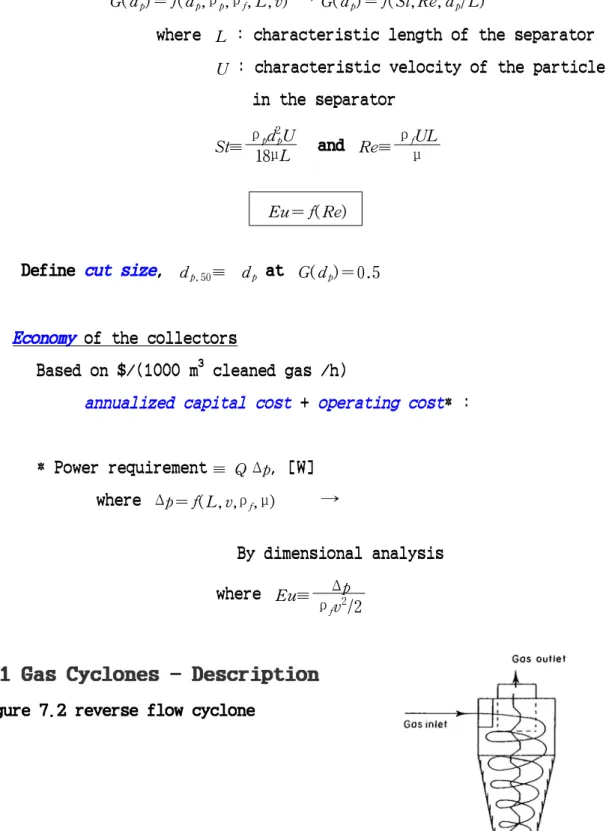
Dimensional analysis for G( dp)
Eu = f( Re)
G( dp) = f( dp,ρp,ρf,L,v) →G( dp) = f( St,Re,dp/L)
where L : characteristic length of the separator U : characteristic velocity of the particle
in the separator St≡ ρpd2pU
18μL and Re≡ ρfμUL
Define cut size, dp, 50≡ dp at G( dp)= 0.5
Economy of the collectors
Based on $/(1000 m3 cleaned gas /h)
annualized capital cost + operating cost* :
* Power requirement≡ Q Δp, [W]
where Δp = f(L,v,ρf,μ) →
By dimensional analysis where Eu≡ Δp
ρfv2/2
7.1 Gas Cyclones - Description
Figure 7.2 reverse flow cyclone
7.2 Flow Characteristics
Rotational flow in the forced vortex Radial pressure gradient
R
r Uθ Ur
Characteristic velocity
v= 4q πD2
where q: Gas flow rate
D:cyclone inside diameter
7.3 Efficiency of Separation
1) Total and Grade Efficiencies M: solids mass rate to cyclone
Mf:fine solids mass flow rate leaving cyclone with gas Mc: Coarse solids mass flow rate leaving from oriface
Total: M=Mf+Mc
Component: M dF
ddp =MfdFf
ddp +McdFc ddp
Total efficiency: ET= Mc M
Grade efficiency: G(dp) =
McdFc ddp M dF
ddp
= ET dFc
ddp dF ddp
2) Simple Analysis for Particle Collection Figure 7.3
At equilibrium orbit, r
3πdpμUr= πd3p
6 ( ρp- ρf)U2θ
r
FD FC- FB where Uθr1/2= constant
for confined vortex = U θRR1/2
Urr=constant
for radially inward flow = URR
∴d2p= ρ18μ
p-ρf UR U2θR r
where r : the radius of the equilibrium orbit
(displacement) for a particle of diameter dp
For all the particles to be collected,r≥R d2p, crit= 18μ
ρp- ρf UR U2θR R
where dp, crit : Critical(minimum) diameter of the particles to be collected
↓ or
If dp> dp, crit, G( dp)= 1 and otherwise,G( dp)= 0
Grade efficiency curve (G( dp) vs.dp)는 진정 step function인가?
3) Cyclone Grade Efficiency in Practice More Practical Analysis
Leith and Licht (1980) Velocity distribution
Uθrm= constant
where m = 1- (1- 0. 67D0.14c )
(
283T)
0.3Grade efficiency
GN(dp) = 1 - exp ( - ΨdMp)
where M = 1
m+1
Ψ = 2
[
KQρp18μDCc(m+1)3c]
M/2K :geometric configuration parameter
∴ Grade efficiency curve for cyclone - Figure 7.4, Figure 7.6
Why not a step function? ☞ distorted due to velocity fluctuation particle-particle interaction
∴dp, 50 and St50 in stead of dp, crit and Stcrit
↑ ↑ GN(0.5) GN(1.0)
7.4 Scale-Up of Cyclones
Design of Cyclone
From both theoretical and actual analysis for given cyclone,
St50
(
≡ ρp18μDd2p, 50U)
~ constant → dp, 50∝ μD3/ρpQEu
(
≡ ρfUΔp2/2)
∼ constant → Δp∝Q2/D4 ↑ ↑independent U= Q/ π 4 D2
ofRe
Standard Cyclone Designs - dimension Figure 7.5
For suspension concentration less than ~ 5g/m3 - High efficiency Stairmand cyclone:
St50= 1.4×10- 4 and Eu = 320 - High flow rate Stairmand cyclone
St50= 6×10- 3 and Eu = 46
Approximately
U
Dj
Streamline Particle
trajectory
S Eu= 12
Stk50
Practical grade efficiency =
(
ddp, 50p)
21+
(
ddp, 50p)
2
for typical dimension Figure 7.6
7.5 Range of Operation
Efficiency and pressure drop Figure 7.7 From theory, ET↑ as q↑
But! there is maximum ET due to re-entrainment of separated solids at high q...
Recommended range of Δp: 500 to 1500Pa...
In this range ET↑ as q↑....
N cyclones in parallel
처리양이 많으면 한 개의 cyclone으로는 부족하다.. 그래서 여러 개를 병렬 연결하여 처리한다.
Q → Q/N
Worked Example 7.1 Worked Example 7.2
7.6 Aerosol Impactor
dp
St ∼ G(dp)
1.0
dP,50
St50∼ 0.5
In general, for inertial motion of particles from Chapter 3,
G( dp) = f
(
St( dp),Re,DSj)
where St( dp)= τ(dp) U D
For given geometry (S/Dj)
0.5 = f( St50, Re) → St50= f1(Re)
From numerical and/or experimental analysis
St( dp): almost independent of Re
Or for 500 < Re < 3000 and S/D > 1.5 For circular nozzle, St50 = 0.22 For rectangular nozzle, St50 = 0.53
∴dp, 50=
[
9μDStρpUC50c]
1/2작은 입자를 잡으려면 노즐 입경을 줄이고, 유속을 올리는 방법과 Cc를 올 리는 방법이 있다.
Cc를 올리려면 어떻게 해야 하나?
dp
St∝ dp,50,1 dp,50,2
dp,50,3 G(dp)
0.5 1.0
To filter Particle- laden air
Stage 1
Stage 2
Stage 3
* Cascade impactor
- Measurement of particle size distribution - Classification of particles