Staphylococcal scalded skin syndrome (SSSS) collectively refers to a group of diseases charac- terized by superficial blistering of the skin caused by exfoliative toxins released by Staphylococcus aureus, including Ritter disease, ranging from bul- lous impetigo to general epidermal exfoliation.1 Only about 3–4% of S. aureus strains are known to release exfoliative toxins.2,3 There are two types of exfoliative toxins, A and B, and exfoliative toxin
B is generally identified in S. aureus strains isolated from children with SSSS in Korea.4
The reported rates of S. aureus nasal colo- nization were 38.3% in preschool-aged children in childcare centers and 32.1% in children pre- senting to a tertiary healthcare institution.5,6 The proportions of methicillin-resistant S. aureus (MRSA) strains in the colonized S. aureus from the above studies were 24.4% and 18.9%, respectively.
Original Article
Antibiotic resistance of Staphylococcus aureus colonized in children with staphylococcal scalded skin syndrome
Seom Gim Kong
Department of pediatrics, Kosin University College of Medicine, Busan, Korea
Objectives: Systemic antibiotic therapy with semisynthetic penicillinase-resistant penicillin or vancomycin and clindamycin are recommended for the treatment of staphylococcal scalded skin syndrome (SSSS). This study assessed the rate of antibiotic resistance of Staphylococcus aureus isolated from the anterior nares or skin of children diagnosed with SSSS.
Methods: A retrospective review of the medical records of 25 patients with SSSS between July 2010 and October 2014 was conducted. The clinical characteristics of patients were collected and the antibiotic susceptibility of S. aureus were analyzed using automated systems.
Results: The median age of the patients was 22 months (range: 2-95). Ninety-two percent of patients were less than 5 years of age. Nasal swab samples of all patients and skin swab samples of 17 patients were cultured to isolate S. aureus. Twenty-one (84%) of 25 patients were colonized with methicillin-resistant S. aureus (MRSA).
The results of swab samples of the other four patients were no growth or isolation of bacteria other than S. aureus. Among 20 strains isolated from the anterior nares, 1 strain (5%) was methicillin-susceptible S. aureus. All 15 strains isolated from the skin were MRSA. All 21 strains isolated from anterior nares or skin were found to be resistant to clindamycin upon evaluation using automated systems.
Conclusions: The rates of methicillin and clindamycin resistance in S. aureus colonized in children with SSSS were very high. Further studies evaluating proper antibiotic regimens and the effectiveness of systemic antibiotic therapy are needed.
Key Words: Bacterial, Child, Colonization, Drug resistance, Staphylococcal scalded skin syndrome
Corresponding Author: Seom Gim Kong, Department of pediatrics, Kosin University College of Medicine, 262, Gamcheon-ro, Seo-gu, Busan 49267, Korea
Tel: +82-51-990-6278 Fax: +82-51-990-3065 E-mail: [email protected]
Received:
Revised:
Accepted:
Nov. 29, 2017 Dec. 18, 2017 Dec. 28, 2017 Articles published in Kosin Medical Journal are open-access, distributed under the terms of the Creative Commons Attribution Non-Commercial License (http://creativecommons.org/licenses/by-nc/4.0/) which permits unrestricted non-commercial use, distribution, and reproduction in
Corresponding Author: Seom Gim Kong, Department of pediatrics, Kosin University College of Medicine, 262, Gamcheon-ro, Seo-gu, Busan 49267, Korea
Tel: +82-51-990-6278 Fax: +82-51-990-3065 E-mail: [email protected]
Received:
Revised:
Accepted:
Nov. 29, 2017 Dec. 18, 2017 Dec. 28, 2017
However, the proportion of MRSA strains in skin-colonized S. aureus was very high (96.2–
100%) in a study of pediatric patients with SSSS.7,8 Semisynthetic penicillinase-resistant penicillin or vancomycin and clindamycin are recom- mended for the treatment of pediatric patients with SSSS;9 however, many cases involving MRSA strains show improvement even without the use of susceptible antibiotics, such as vancomycin.4,7
This study investigates the rates of oxacillin and clindamycin (a key recommended medication) re- sistance in nasal- and skin-colonized S. aureus strains in pediatric patients with SSSS.
MATERIALS AND METHODS
Subjects
We retrospectively analyzed the medical re- cords of 25 pediatric patients diagnosed with SSSS based on symptoms, including erythema, epi- dermal exfoliation, and blistering, at our pedia- trics department between July 2010 and October 2014. This study was approved by the Institutional Review Board of Kosin University Gospel Hospital (2017-11-010).
Methods
1) Clinical features
We examined medical records to identify pa- tient sex, age, and the presence of fever and skin lesions with discharge. We also analyzed hospital- ization status, length of hospital stays, empirical
antibiotic administration, and finally selected an- tibiotics after antibiotic sensitivity testing.
2) Nasal and skin S. aureus colonization In the research facility, the anterior nares of patients diagnosed with SSSS were swabbed with a cotton swab and the sample was cultured to identify S. aureus strains colonized in the nasal cavity. For patients with skin lesions with dis- charge, the lesions were swabbed for bacterial culture.
3) Antibiotic susceptibility of S. aureus To determine the bacterial strains and anti- biotic susceptibilities, a Phoenix 100 automated system (BD Diagnostics, Sparks, USA) was mainly used with the aid of a Vitek 2 (bioMérieux, Marcy l'Etoile, France) instrument. In S. aureus strains isolated after 2013, D-zone tests were performed for strains with erythromycin resistance and clin- damycin susceptibility, with inducible clindamy- cin resistance being considered clindamy- cin-resistant.
4) Statistical analysis
The distributions of descriptive statistics were examined using IBM SPSS Statistics for Windows, version 24.0 (IBM Corp., Armonk, NY, USA).
Medians and ranges were computed for con- tinuous variables with non-normal distributions.
RESULTS
Clinical features
Among 25 patients diagnosed with SSSS during the study period, 14 were male (56%) (Table 1).
The median age was 22 months, with age ranging from two months to 7 years and 11 months.
Ninety-two percent of the study population was children aged 60 months or younger, with chil- dren aged 24 months or younger accounting for 60% of the study population. Seven patients (28%) had an accompanying fever, which lasted less than two days in six of them (85.7%). Twenty-four (96%) patients were hospitalized and one patient (4%) was treated as an outpatient. The median length of hospital stay was seven days, ranging from 3–12 days.
All patients had head and neck lesions at admis- sion, 72% had extremities, and 88% had trunk lesions. The accompanying diseases were atopic dermatitis, otitis media, and hand-foot-mouth disease. Laboratory tests were performed in 23 patients. Seven patients had leukocytosis and three patients had eosinophilia. SSSS mainly oc- curred in autumn and 56% of patients were diag- nosed in September-November (Fig. 1).
Results of bacterial culture from nasal and skin samples
Bacterial culture was performed for all patients diagnosed with SSSS to determine nasal S. aureus colonization. In addition, culture of skin lesions
Variables n (%)
Sex
Male 14 (56)
Female 11 (44)
Age (months), median (range) 22 (2 - 95)
< 24 15 (60)
24-60 8 (32)
≥ 60 2 (8)
Fever 7 (28)
Admission 24 (96)
Hospital days, median (range) 7 (3 - 12)
Involved location
Head and neck 25 (100)
Extremities 18 (72)
Trunk 22 (88)
Associated disease
Atopic dermatitis 1 (4)
Acute otitis media 2 (8)
Hand foot mouth disease 1 (4)
Leukocytosis (≥ 15,000/㎣) 7/23 (30.4)
Eosinophilia (≥ 500/㎣) 3/23 (13)
Table 1. Clinical characteristics of 25 children diagnosed with staphylococcal scalded skin syndrome
with discharge was performed in 17 (68%) patients (Table 2). Nasal S. aureus colonization was con- firmed in 20 (80%) patients, and S. aureus was cultured in the skin sample from 15 (88%) patients for whom additional skin culture was performed.
The presence of S. aureus was confirmed in the nasal cavity or skin in 21 patients (84%), all of whom had strains of MRSA. One of these patients had a methicillin-resistant strain in the skin but a methicillin-susceptible strain in the nasal cavity.
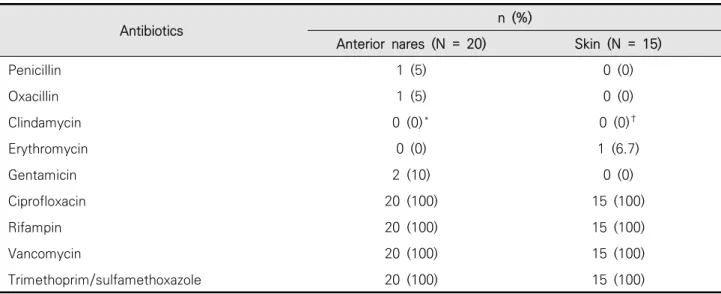
Antibiotics resistance of colonized S. aureus Nineteen of 20 (95%) nasal-colonized S. aureus strains were methicillin-resistant; the remaining strain was susceptible to methicillin (Table 3). The strain with methicillin susceptibility was also sus- ceptible to penicillin. Eighteen of 20 strains were tested for clindamycin susceptibility and 18 were resistant to clindamycin. Two of these clindamy- cin-resistant strains were resistant to eryth- romycin but sensitive to clindamycin but were
found to have inducible clindamycin resistance in the D-zone test. All of the strains were suscep- tible to ciprofloxacin, rifampin, vancomycin, and trimethoprim/sulfamethoxazole.
All 15 S. aureus strains isolated from the skin cultures were methicillin-resistant. The clinda- mycin susceptibility results were reported for 14 of the isolates, 13 of which were clindamycin-re- sistant; for the remaining strain, clindamycin sus- ceptibility could not be verified because the strain was resistant to erythromycin and susceptible to clindamycin but a D-zone test was not performed.
Thus, all 13 strains in which clindamycin suscepti- bility was assessed were resistant to clindamycin.
One strain (6.7%) was susceptible to erythromycin, and all of the strains were susceptible to cipro- floxacin, rifampin, vancomycin, and trimetho- prim/sulfamethoxazole.
Antimicrobials used for treatment and treat- ment outcomes
Fig. 1. Monthly distribution of staphylococcal scalded skin syndrome.
Cefazolin and clindamycin were used as the ini- tial empiric antibiotics in 20 patients (80%).
Cefazolin alone was used for two patients (8%), oral trimethoprim/sulfamethoxazole for two pa- tients (8%), and oral clindamycin for the remain- ing patient.
A total of eight patients (40%) were administered vancomycin at least once during the course of treat- ment for a methicillin-resistant strain in the nasal cavity or skin; six of these patients (62.5%) were
infants aged 12 months or younger. Four patients (16%) continued to use cefazolin until discharge.
Although three of these patients were confirmed to have MRSA, the antibiotic was not changed. A total of 16 patients (64%) were prescribed trimetho- prim/sulfamethoxazole at discharge.
None of the patients required a change of anti- biotics due to worsened symptoms prior to con- firming the antibiotic susceptibility of the nasal- or skin-colonized S. aureus strains. Furthermore,
Nasal swab (N = 25) Skin swab (N = 17)
Isolation of S. aureus 20 (80) 15 (88)
MRSA 19 (76) 15 (88)
MSSA 1 (4) 0 (0)
No growth or isolation of bacteria other than S. aureus 5 (20) 2 (12) Data are presented n (%).
Abbreviations: MRSA, Methicillin-resistant Staphylococcus aureus; MSSA, Methicillin-seusceptible Staphylococcus aureus
Table 2. Results of bacterial cultures using swab specimens from the anterior nares and skin
Antibiotics n (%)
Anterior nares (N = 20) Skin (N = 15)
Penicillin 1 (5) 0 (0)
Oxacillin 1 (5) 0 (0)
Clindamycin 0 (0)* 0 (0)†
Erythromycin 0 (0) 1 (6.7)
Gentamicin 2 (10) 0 (0)
Ciprofloxacin 20 (100) 15 (100)
Rifampin 20 (100) 15 (100)
Vancomycin 20 (100) 15 (100)
Trimethoprim/sulfamethoxazole 20 (100) 15 (100)
*N = 18. The results of two isolates were not reported.
†N = 13. The result of one isolate was not reported. The other was erythromycin-resistant and clindamycin-susceptible strain, but the double-disk diffusion test was not conducted.
Table 3. Antimicrobial susceptibility of Staphylococcus aureus isolates by colonization sites
none of the patients developed complications or died during the course of treatment.
DISCUSSION
This study aimed to confirm the colonization of S. aureus strains in the nasal cavity or skin of pediatric patients diagnosed with SSSS and to ex- amine the proportions of antibiotic resistance, particularly to oxacillin and clindamycin, in the isolated strains.
SSSS may develop in adults, but it generally af- fects infants and young children.10 General blis- tering and skin exfoliation are usually present in children, presumably because children are less able to excrete toxins and have a lower concen- tration of antibodies that can neutralize toxins.11 The majority of our study sample was children under 5 years of age. The prognosis of SSSS is relatively good in children;12 as anticipated, most patients in our study were discharged within 10 days.
Nasal or skin S. aureus colonization was con- firmed in 84% of our patients, all of whom had MRSA. Previous Korean studies have reported that a substantial proportion of colonized S. aureus strains in SSSS patients are methicillin-resistant.4,7,8 The proportion of MRSA is very high among pa- tients with SSSS compared to that in patients with general nasal S. aureus colonization5 or invasive diseases,13 but the reason for this observation has yet to be elucidated.
Because SSSS is a toxin-induced disease, guide- lines suggest the additional use of clindamycin to suppress toxin formation.9 In the present study, all of the nasal- or skin-colonized strains with verified antibiotic susceptibility were resistant to clindamycin. Although clindamycin may suppress the production of exfoliative toxins by S. aureus,14 it was difficult to find data directly supporting clindamycin’s capability to suppress exfoliative toxin release in clindamycin-resistant strains.
However, Schlievert et al.15 reported that clinda- mycin can suppress the production of toxic shock syndrome toxins even in clindamycin-resistant strains. Because clindamycin was used as an early intervention for most patients in this study, it was difficult to analyze its clinical efficacy in sup- pressing toxin production.
All of the MRSA isolates in this study were sus- ceptible to ciprofloxacin, rifampin, vancomycin, and trimethoprim/sulfamethoxazole. Similar re- sults were found in previous studies with regard to the isolated strains and skin- or nasal-colon- ized S. aureus strains in children with SSSS.8
SSSS is characterized by toxin-induced blister- ing; in many cases, the primary lesions are im- proved or cannot be examined by the time the patient presents to a hospital. Therefore, there may be doubts as to whether antibiotics must be used; in fact, in clinical practice, patients with MRSA have shown improvement of symptoms even without the administration of antibiotics to which the MRSA isolates are susceptible.4,7 Similarly, in our study, cefazolin (beta-lactam)
and clindamycin were used as early empiric anti- biotics in most patients, but none of the patients required a change of antibiotics due to worsening symptoms prior to receiving the culture results.
No study has directly analyzed antibiotic efficacy in patients with SSSS or compared patients in whom drugs to which the MRSA were susceptible were used and those to whom the conventionally recommended beta-lactams and clindamycin were administered.
The present retrospective review of medical re- cords computed the proportions of isolates with methicillin and clindamycin resistance based on the automated analysis of antibiotic resistance of S. aureus isolates obtained from patients with SSSS. We could not perform genetic analysis of the staphylococcal cassette chromosome mec gene and toxin gene and susceptibility testing by disc diffusion method on Mueller Hinton agar or E-test. However, unlike previous SSSS studies that only performed cultures with skin samples, we cultured samples from the nasal cavity, a major source of S. aureus in all patients diagnosed with SSSS, and confirmed that most patients had MRSA strains. Furthermore, we examined and discussed the proportion of isolates with clindamycin resist- ance and presented topics in need of additional research.
Most S. aureus strains in patients with SSSS were MRSA, and all of these strains were also resistant to clindamycin. Considering these resistance rates, additional research is needed to sub- stantiate the efficacy of the current recom-
mendation of beta-lactams and clindamycin therapy.
REFERENCES
1. Lillibridge CB, Melish ME, Glasgow LA. Site of action of exfoliative toxin in the staphylococcal scald- ed-skin syndrome. Pediatrics 1972;50:728-38.
2. Dancer SJ, Noble WC. Nasal, axillary, and perineal carriage of Staphylococcus aureus among wom- en: identification of strains producing epi- dermolytic toxin. J Clin Pathol 1991;44:681-4.
3. Adesiyun AA, Lenz W, Schaal KP. Exfoliative toxin production by Staphylococcus aureus strains iso- lated from animals and human beings in Nigeria.
Microbiologica 1991;14:357-62.
4. Heo SY, Song YJ, Kim SJ, Park SY, Kang DC, Ma SH. A clinical review of community acquired me- thicillin resistant staphylococcal scalded skin syndrome. Korean J Pediatr Infect Dis 2007;14:
83-90.
5. Lee J, Sung JY, Kim YM, Oh CE, Kim HB, Choi EH, et al. Molecular characterization of methi- cillin-resistant Staphylococcus aureus obtained from the anterior nares of healthy Korean chil- dren attending daycare centers. Int J Infect Dis 2011;15:e558-63.
6. Ko KS, Lee JY, Baek JY, Peck KR, Rhee JY, Kwon KT, et al. Characterization of Staphylococcus aur- eus nasal carriage from children attending an outpatient clinic in Seoul, Korea. Microb Drug Resist 2008;14:37-44.
7. Park AY, Yeon EK, Lee HK, Shin MY. A clinical review of staphylococcal scalded skin syndrome for the last 10 years. Soonchunhyang Med Sci 2012;18:32–7.
8. Jeon H, Ma SH, Jo HJ, Woo MS, An H, Park H, et al. Long-term persistence of sequence type 89 methicillin-resistant Staphylococcus aureus iso- lated from cases of staphylococcal scalded skin syndrome in a Korean community. J Med Microbiol 2016;65:1542-4.
9. Juern A. Staphylococcal scalded skin syndrome.
In: Kliegman RM, Stanton BF, St Geme JW, Schor NF, editors. Nelson textbook of pediatrics. 20th ed. Philadelphia: Elsevier; 2015. p.3206-7.
10. Ladhani S, Evans RW. Staphylococcal scalded skin syndrome. Arch Dis Child 1998;78:85-8.
11. Ladhani S. Understanding the mechanism of ac- tion of the exfoliative toxins of Staphylococcus
aureus. FEMS Immunol Med Microbiol 2003;39:
181-9.
12. Ladhani S, Joannou CL, Lochrie DP, Evans RW, Poston SM. Clinical, microbial, and biochemical aspects of the exfoliative toxins causing staph- ylococcal scalded-skin syndrome. Clin Microbiol Rev 1999;12:224-42.
13. Ericson JE, Popoola VO, Smith PB, Benjamin DK, Fowler VG, Benjamin DK Jr, et al. Burden of in- vasive Staphylococcus aureus infections in hospi- talized infants. JAMA Pediatr 2015;169:1105–11.
14. Shibl AM. Role of Staphylococcus aureus exfoliatin toxin in staphylococcal infections in mice.
Chemotherapy 1981;27:224–7.
15. Schlievert PM, Kelly JA. Clindamycin-induced suppression of toxic-shock syndrome--asso- ciated exotoxin production. J Infect Dis 1984;149:
471.