• 검색 결과가 없습니다.

Severe Mitral Regurgitation due to Traumatic Anterolateral Papillary Muscle Rupture: A Case Report

N/A
N/A
Protected

Academic year: 2021

Share "Severe Mitral Regurgitation due to Traumatic Anterolateral Papillary Muscle Rupture: A Case Report"

Copied!
3
0
0

로드 중.... (전체 텍스트 보기)

전체 글

(1)

Korean J Thorac Cardiovasc Surg 2012;45:401-403 □ Case Report □ http://dx.doi.org/10.5090/kjtcs.2012.45.6.401 ISSN: 2233-601X (Print) ISSN: 2093-6516 (Online)

− 401 −

Department of Thoracic and Cardiovascular Surgery, Catholic University of Daegu School of Medicine Received: May 25, 2012, Revised: July 11, 2012, Accepted: July 15, 2012

Corresponding author: Oh Choon Kwon, Department of Thoracic and Cardiovascular Surgery, Catholic University of Daegu School of Medicine, 33 Duryugongwon-ro 17-gil, Nam-gu, Daegu 705-718, Korea

(Tel) 82-53-650-4564 (Fax) 82-53-629-6963 (E-mail) [email protected]

C

The Korean Society for Thoracic and Cardiovascular Surgery. 2012. All right reserved.

CC
This is an open access article distributed under the terms of the Creative Commons Attribution Non-Commercial License (http://creative- commons.org/licenses/by-nc/3.0) which permits unrestricted non-commercial use, distribution, and reproduction in any medium, provided the original work is properly cited.

Severe Mitral Regurgitation due to Traumatic Anterolateral Papillary Muscle Rupture: A Case Report

Chul Ho Lee, M.D., Oh Choon Kwon, M.D., Sub Lee, M.D., Jae Seok Jang, M.D.

A 29-year-old man was admitted for abrupt dyspnea and hemoptysis. An echocardiogram revealed severe mitral re- gurgitation due to papillary muscle rupture for which an emergency mitral valve replacement operation was per- formed 4 days after admission. Herein, we report our experience with this case along with a review of the literature.

Key words: 1. Papillary muscles 2. Mitral valve insufficiency

CASE REPORT

A 29-year-old man was admitted for dyspnea and hemopt- ysis via the emergency department. His medical history was unremarkable. Ten hours before admission, he was involved in an automobile accident in which his car crashed into a tree along the street. At that time, he was not wearing his seat belt and was driving under the influence of alcohol. He was initially treated at a local medical center where, after a bat- tery of diagnostic and imaging work-ups, which included brain and chest computed tomography (CT), he was assessed to be fine except for a nasal bone fracture. However, after several hours, he experienced abrupt dyspnea and hemoptysis (about 40 mL) for which he promptly visited the emergency department of our hospital. On arrival, he was mentally alert with a blood pressure of 130/80 mmHg, a pulse rate of 140 beats per minute (bpm), a respiratory rate of 25 bpm, body temperature of 36.5

o

C, and SpO

2

of 70% after 10 L of O

2

by mask. On lung auscultation, we heard rales. The echocardio- gram findings were compatible with acute myocardial in-

farction and sinus tachycardia. Laboratory findings showed creatine kinase-MB (CK-MB) of 75.2 ng/mL and troponin I of 15.04 ng/mL. An initial chest X-ray showed mild con- solidation and ground-glass opacity in both lung fields (Fig.

1). On arterial blood gas analysis, the pulmonary arterial oxy- gen saturation was 43.1 mmHg. Traumatic lung contusion was suspected, and due to the severe dyspnea the patient was placed on mechanical ventilation. A serial chest X-ray a few hours later showed aggravated bilateral lung consolidation.

Despite inotropic support, hemodynamic instability persisted, for which transthoracic echocardiography (TTE) and transeso- phageal echocardiography (TEE) were performed on hospital day 4 (Fig. 2). The findings revealed an acute mitral regur- gitation due to papillary muscle rupture necessitating emer- gency cardiac surgery.

We performed an emergency operation. The right ventricle

and atrium appeared distended. Hematoma and tearing were

found around the anterolateral left ventricular (LV) wall, and

the myocardium of this area was akinetic. A standard car-

diopulmonary bypass with bicaval cannulation was initiated,

(2)

Chul Ho Lee, et al

− 402 −

Fig. 1. Chest X-ray showing right dominant lung consolidation. Fig. 3. Anterior leaflet of the mitral valve with attached antero- lateral papillary muscle.

Fig. 2. Transthoracic echocardiographic image showing avulsion of the papillary muscle.

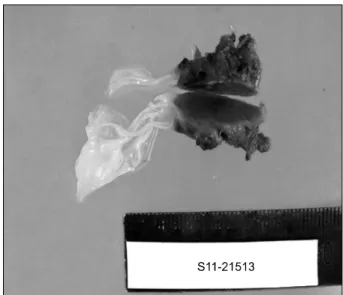
and cold hematic cardioplegia was performed for myocardial protection after aortic cross-clamping. As active bleeding from the anterolateral LV wall tear was no longer noted, the lesion was reinforced with the application of Tachocomb (4×6 cm; CSL Behring, Tokyo, Japan), BioGlue (CryoLife, Kennesaw, GA, USA), and Surgicel (Johnson & Johnson, New Brunswick, NJ, USA). The left atrial cavity was ap- proached through a transseptal atrial incision, which revealed a completely detached anterolateral papillary muscle head and rupture of the accessory chordae tendineae (Fig. 3). The de- tached papillary muscle was necrotic and edematous. As mi- tral valve replacement was judged to be the best therapeutic

option, mitral valve replacement was performed with a 27 mm (SJM 27MECJ-502 mitral valve; St. Jude Medical Inc., St. Paul, MN, USA) mechanical valve.

As the patient showed rapid symptomatic improvement, he was extubated on post-operative day 2. A pericardiostomy was performed on post-operative day 20 for significant peri- cardial effusion. Afterwards, the patient improved gradually.

DISCUSSION

The total number of car accidents has steadily decreased

over the years due to a growing awareness of the need to

sustain traffic order and to provide continuing traffic safety

education. However, the majority of major cases of trauma

warranting an emergency center visit are still attributed to au-

tomobile accidents. Complications from blunt chest trauma

may range over a wide spectrum of complications from being

asymptomatic to experiencing major injuries such as cardiac

rupture. The aortic valve is the most frequently involved

heart valve in trauma, followed by the mitral and tricuspid

valves [1]. Mitral regurgitation caused by papillary muscle

rupture is a very rare complication. Parmley et al. [2] de-

scribed papillary muscle rupture in only 24 out of 546 autop-

sy cases of non-penetrating chest trauma. Only a few cases

have been reported in Korea as well.

(3)

Traumatic Papillary Muscle Rupture

− 403 − The transfer of kinetic energy to a victim’s chest from the sudden deceleration in an automobile accident can cause valv- ular injury. The atrioventricular valves are most susceptible to damage by deceleration of the automobile or compression of the heart and blood column when closed in systole [3].

Papillary muscle rupture usually causes mitral insufficiency after a non-penetrating cardiac injury [4]. On initial trauma, symptoms can appear immediately if the damaged papillary muscle abruptly ruptures. A contused papillary muscle can al- so rupture later, leading to symptoms at a later time [5].

Frazee et al. [6] suggested that two-dimensional echo- cardiography should be performed if the CK and CK-MB values increase for 24 hours after admission. Transthoracic echocardiography is usually an especially apt modality for di- agnosing papillary muscle rupture. However, when patients have chest wall tenderness, pneumothorax, pneumomedia- stinum, or ventilator dependence, the window for performing a TTE may be extremely limited. In these situations, TEE is a better modality. A major advantage of TEE over TTE is the ability to provide better resolving power. Therefore, TEE is a superior method for assessing intrathoracic pathologic processes such as papillary muscle rupture [7]. Therefore, it is important to include not only blood samples and chest ra- diography but also TTE and TEE when initially assessing a patient with severe chest trauma who is visiting an emer- gency department.

Generally, in the case of mitral regurgitation caused by blunt chest trauma, the treatment options are mitral valve re- pair or replacement. After considering the status of the mitral apparatus, extent of damage, and estimated probability of suc- cess, we should decide whether valve replacement or valve repair can be performed [8]. Of the two methods, there is no absolute standard or consensus on choosing one over the other. The choice should be based on the characteristics of each case individually.

In this case, there was no definite rib or sternal fracture. In the radiologic examination, there was right dominant con-

solidation on the lung field. We performed lung auscultation, but did not closely perform cardiac auscultation, managing this patient in accordance with lung contusion treatment.

However as a result, the cause of hemodynamic instability and hypoxemia was cardiac injury. Lung injury is relatively easier to access and examine using X-ray and CT. On the other hand, a cardiac injury is easy to miss because it is dif- ficult to find on an X-ray or CT, and cardiac injury is also rare. Therefore, in the case of chest trauma, especially from a traffic accident, we should consider the possibility that ac- companying injuries may be hidden.

CONFLICT OF INTEREST

No potential conflict of interest relevant to this article was reported.

REFERENCES

1. Liedtke AJ, DeMuth WE Jr. Nonpenetrating cardiac in- juries: a collective review. Am Heart J 1973;86:687-97.

2. Parmley LF, Manion WC, Mattingly TW. Nonpenetrating traumatic injury of the heart. Circulation 1958;18:371-96.

3. Simmers TA, Meijburg HW, de la Riviere AB. Traumatic papillary muscle rupture. Ann Thorac Surg 2001;72:257-9.

4. McDonald ML, Orszulak TA, Bannon MP, Zietlow SP.

Mitral valve injury after blunt chest trauma. Ann Thorac Surg 1996;61:1024-9.

5. Cuadros CL, Hutchinson JE 3rd, Mogtader AH. Laceration of a mitral papillary muscle and the aortic root as a result of blunt trauma to the chest: case report and review of the literature. J Thorac Cardiovasc Surg 1984;88:134-40.

6. Frazee RC, Mucha P Jr, Farnell MB, Miller FA Jr. Objective evaluation of blunt cardiac trauma. J Trauma 1986;26:510- 20.

7. Mazzucco A, Rizzoli G, Faggian G, et al. Acute mitral re- gurgitation after blunt chest trauma. Arch Intern Med 1983;

143:2326-9.

8. Halstead J, Hosseinpour AR, Wells FC. Conservative surgi- cal treatment of valvular injury after blunt chest trauma.

Ann Thorac Surg 2000;69:766-8.

수치

Fig. 2. Transthoracic echocardiographic image showing avulsion of  the papillary muscle.

참조

관련 문서

The “Asset Allocation” portfolio assumes the following weights: 25% in the S&P 500, 10% in the Russell 2000, 15% in the MSCI EAFE, 5% in the MSCI EME, 25% in the

1 John Owen, Justification by Faith Alone, in The Works of John Owen, ed. John Bolt, trans. Scott Clark, "Do This and Live: Christ's Active Obedience as the

Changes in functional physical fitness, after the experiment compared to before the experiment in the group of exercise, showed a significant difference in

After listening to the opinions of firemen in field activities, we confirmed that the firepower can be secured by reducing the loss of firepower caused

RWC (Restricted Work Case): Injuries by which workers are reassigned to other duties or cannot perform the full range of normal duties MTC (Medical Treatment Case):

RWC (Restricted Work Case): Injuries by which workers are reassigned to other duties or cannot perform the full range of normal duties MTC (Medical Treatment Case):

RWC (Restricted Work Case): Injuries by which workers are reassigned to other duties or cannot perform the full range of normal duties MTC (Medical Treatment Case):

Generally, in case that we predict the vibration by blasting, we compute it on the basis of the charge weight per delay but in case of shocking