pISSN 2288-9272 eISSN 2383-8493 J Oral Med Pain 2018;43(2):34-40 https://doi.org/10.14476/jomp.2018.43.2.34
Reliability of the Korean Version of Tampa Scale for Kinesiophobia for Temporomandibular Disorders
In Hee Park, Ji Hee Jang, Jin Woo Chung
Department of Oral Medicine and Oral Diagnosis, School of Dentistry and Dental Research Institute, Seoul National University, Seoul, Korea
Received April 10, 2018 Revised April 30, 2018 Accepted April 30, 2018
Purpose: The aim of this study was to translate the original English version of tampa scale for kinesiophobia for temporomandibular disorders (TSK-TMDs) for cultural equivalency into Korean language and to evaluate the reliability of the Korean version of the TSK-TMD among symptom free subjects.
Methods: The original version of TSK-TMD was translated and cross-culturally adapted follow- ing international guidelines. A total 90 subjects (50 women, 40 men) were participated to fill out the questionnaire. The internal consistency and test-retest reliability with a one- or two- week time interval were evaluated.
Results: The internal consistency of TSK-TMD of the original and the modified 12-item TSK- TMD were 0.866, and 0.858, respectively using the Cronbach’s alpha coefficient. And the in- ternal consistency of activity avoidance (AA) and somatic focus (SF) subscale were 0.838 and 0.807 assessed with Cronbach’s alpha indicating excellent reliability. Test-retest reliability of the original TSK-TMD measured by the intra-class correlation coefficient (ICC) was 0.764, and coefficients value of the 12-question TSK-TMD was 0.752. Test-retest reliability of AA subscale was 0.722 and SF subscale was 0.677 measured by ICC.
Conclusions: The Korean version of the TSK-TMD questionnaire was found to be a reliable in- strument and successfully translated to Korean language. There are no significant differences between overall and modified version of TSK-TMD. It can be used as a valuable instrument for the analyses of the psychosocial aspects of the TMD patients in Korea.
Key Words: Fear of movement; Kinesiophobia; Reliability; Tampa scale; Temporomandibular disorders
Correspondence to:
Jin Woo Chung
Department of Oral Medicine and Oral Diagnosis, School of Dentistry and Dental Research Institute, Seoul National University, 103 Daehak-ro, Jongno-gu, Seoul 03080, Korea Tel: +82-2-2072-3021 Fax: +82-2-744-9135 E-mail: [email protected]
JOMP
Journal of Oral Medicine and PainCopyright Ⓒ 2018 Korean Academy of Orofacial Pain and Oral Medicine. All rights reserved.
CC This is an open-access article distributed under the terms of the Creative Commons Attribution Non-Commercial License (http://creativecommons.org/licenses/by-nc/4.0/),
INTRODUCTION
Temporomandibular disorders (TMDs) encompass a range of commonly occurring orofacial conditions that compro- mise the comfort and healthy functioning of the hard and soft tissues of the masticatory system.
1)The prime manifes- tations of these disorders are described as acute or chronic pain in the area of the temporomandibular joint (TMJ) and/
or masticatory muscles, limitations or deviations in range of mandibular motion, and TMJ clicking and/or crepitus
sounds during mandibular function.
TMD has been considered as a chronic pain condition and
reported to be associated with psychologic, behavioral, and
social factors in addition to physical pathology. There are
many cross-sectional studies demonstrate that chronic pain
patients show greater levels of psychological distress, en-
vironmental stress, catastrophizing, and somatic symptoms
compared with pain-free controls.
2-4)The negative role of
pain-related fear on functioning recently gained consider-
able attention in the field of musculoskeletal pain research.
5)In the fear-avoidance model of pain and disability,
6)and pain catastrophizing is suggested to predispose individuals toward the development of fear of movement (FM) which, in turn, may lead to increased disability and a heightening of the overall pain experience. FM seems particularly rel- evant for patients with musculoskeletal disorders, and is of- ten assessed with the tampa scale for kinesiophobia (TSK).
7)There is good evidence FM measured with TSK is a strong predictor of disability in patients with acute and chronic low back pain,
8-10)fibromyalgia,
9)and osteoarthritis.
5)TMD patients share many commonalities with the chronic musculoskeletal patients, and have association with psycho- social factors. However, there are only few researches about fear-avoidance model in TMD. Turner et al.
11)reported that catastrophizing may play an important role in TMD pain problems both as reported by patients and as assessed dur- ing a clinical examination. Recently, TSK-TMDs has been developed for evaluating FM in TMD patients by Visscher et al.
12)And several studies are showed high validity and reliability of TSK-TMD.
12,13)But, there is currently no vali- dated Korean version of TSK-TMD for the Korean popula- tion. Because of variations in social structures, culture, and language, an instrument must be cross-cultural adapted and validated to retain the psychometric properties of the origi- nal version.
14)The aims of this study were to translate the original English version of TSK-TMD for cultural equiva- lency into Korean language and to evaluate the reliability of the Korean version of TSK-TMD.
MATERIALS AND METHODS
1. Subjects
One hundred subjects without any symptoms and signs of TMD volunteered and participated in the study. One subject refused to participate in the study, 7 subjects did not answer the second questionnaire, and 2 subjects did not complete the questionnaire. Therefore total 90 subjects were evalu- ated in this study. Participates were consisted of 50 women and 40 men, and mean age was 27.46±4.75 years (ranged from 21 to 41 years). There is no statistical significance be- tween age and gender between the study participants and the respondents.
The study was approved by the Institutional Review
Board of Seoul National University Dental Hospital (IRB no.
CRI14012). Each subject gave informed consent.
2. TSK-TMD Questionnaire
The original TSK questionnaire is developed for assessing fear of movement, particularly for patients with musculo- skeletal disease. Because TMD patients have distinguish- able feature from other musculoskeletal disease, Visscher et al.
12)modified for TSK and developed TSK-TMD for as- sessing FM of TMD patient. The original TSK-TMD is an English-language instrument
12)contains 18 items to assess FM in patients with TMD. The answer of each question is a 4-point Likert scale: strongly disagree, somewhat disagree, somewhat agree, and strongly agree (equivalent to scores of 1-4). As in the original TSK-TMD questionnaire, 4 items are reversely scored (i.e., items 4, 8, 12, and 16). High and low total scores of TSK-TMD indicate high and low degrees of kinesiophobia, respectively. Through confirmatory fac- tor analysis, Visscher et al.
12)proposed that the original 18- item instrument be reduced to the indicated 12 items for routine assessment in TMD, and questionnaire divided into two domains which is estimate activity avoidance (AA) and somatic focus, respectively. The first factor, AA, reflected the belief that activity may result in (re)injury or increased pain (items 1, 2, 10, 13, 15, 17, and 18) and the second fac- tor, somatic focus (SF), reflected a belief in underlying and serious medical problems (items 3, 5, 6, 7, and 11). And FM was sum of AA and SF subscale.
12)Visscher et al.
12)sug- gested that 12-item version of the TSK-TMD has generally good reliability and validity and more suitable for assess TMD patients, as a result of construct validity assessment.
Therefore, in this study we analyzed both TSK-TMD with original 18 items, and modified 12 items.
3. Translation and Cross-Cultural Adaptation
According to the standard guidelines proposed by Guil- lemin et al.,
15)the process of translation and cross-cultural adaptation of the TSK-TMD included following major steps.
1) Forward translation
A faculty in the Department of Oral Medicine and Oral
Diagnosis, Seoul National University who was fluent in
both Korean and English first translated the TSK-TMD from
English to Korean. This translation was evaluated and re- vised by several faculty members.
2) Back-translation
Then, the back-translation from Korean to English was performed by a native English speaker who was also fluent in Korean.
3) Expert panel reviewer
An expert panel then compared and assessed the two ver- sions of TSK-TMD. This was to ensure that the translated version reflected the same content as the original version.
An initial Korean version of TSK-TMD was then produced.
All the findings were re-evaluated and discussed by the expert panel and then, the final Korean version was com- pleted. The Korean version of TSK-TMD questionnaire is attached in the Appendix 1 (available online only) of this manuscript.
4. Data Collection and Interval of the Test
On the first visit of the subjects, an examiner who was an oral medicine specialist instructed them brief information for the Korean version of TSK-TMD questionnaire and the patients completed the series of the questionnaire and the checklist on TMD symptoms. One or two weeks later, on the second visit of the subjects, the questionnaire was drawn up once again using the simple blind technique. The one or two weeks interval was selected as a period short enough to eliminate the likelihood of significant changes in the sub- ject’s TMD symptoms taking place, but long enough to en- sure that subjects could not recall their responses to the first questionnaire.
16)5. Statistical Analysis
To compare gender differences in each sum of original TSK-TMD and FM, AA, and SF subscales, independent t- tests were performed. Internal consistency was measured using Cronbach’s alpha. This method has the advantage of the alpha coefficient being calculated through only one test.
Figures in the range of 0.7-0.9 are preferable even though values as low as 0.6 may be acceptable. Test-retest reliabil- ity was assessed using an intra-class correlation coefficient (ICC). To investigate whether the each subscale of TSK-TMD is associated with the symptoms of TMD, we analyzed cor- relation between symptom checklist and each subscale with Spearman’s rho coefficient. These statistical analyses were performed using the SPSS ver. 12.0 software (SPSS Inc., Chicago, IL, USA).
RESULTS
1. Subject Characteristics
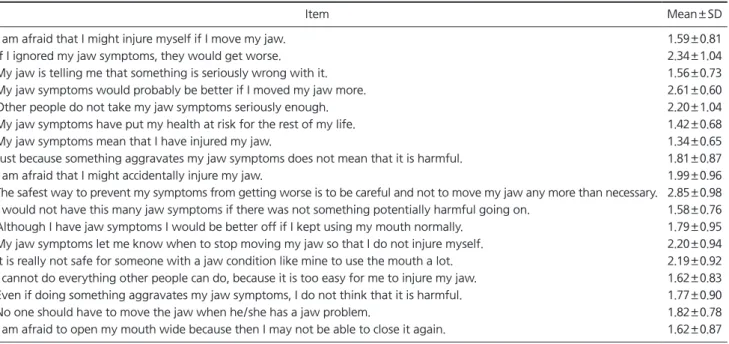
A total 90 subjects were participated in this study. All the participants fully completed the Korean version of TSK- TMD questionnaires and declared that the items of TSK- TMD were easy to understand. The demographic features of the subjects are shown in Table 1. There was no significant difference in age between men and women. There were no significant differences between genders in total score of TSK-TMD and each subscale of FM, AA, and SF. The mean score of each question is shown in Table 2.
2. Test-Retest Reliability
The optimal interval between the two test-retest reliabil- ity measurements was approximately one to two weeks.
The Korean version of TSK-TMD was administered to all
Table 1. Demographic features of the subjects and mean values of total score and each subscale of TSK-TMD according to gender
Variable Women (n=50) Men (n=40) Total (n=90) p-value
Age, y (range) 26.78±4.32 (21-40) 28.30±5.18 (21-41) 27.46±4.75 (21-41) 0.132
TSK-TMD 34.06±5.78 34.61±7.01 34.31±6.33 0.683
FM 22.06±4.58 22.25±6.55 22.14±5.51 0.945
AA 14.02±3.40 14.08±4.17 14.04±3.74 0.782
SF 8.04±1.73 8.18±2.65 8.10±2.18 0.877
TSK-TMD, tampa scale for kinesiophobia for temporomandibular disorders; FM, fear of movement; AA, activity of avoidance; SF, somatic focus.
Values are presented as mean±standard deviation.
p-values were obtained from independent t-test.
participants, re-administered after one or two weeks to de- termine the test-retest reliability. Test-retest reliability of the original TSK-TMD measured by the ICC was 0.764, and coefficients value of the 12-question TSK-TMD was 0.752 (Table 3). Test-retest reliability of each subscale; AA and SF was evaluated, and ICC was 0.722 and 0.677, respectively (Table 4).
3. Internal Consistency
Internal consistency was considered in each subscale and total score of TSK-TMD. The Cronbach’s alpha value of the original and the modified 12-item TSK-TMD were 0.866, and 0.858, respectively. Internal consistency of each sub- scale was measured. AA and SF were 0.838 and 0.807 as- sessed with Cronbach’s alpha indicating excellent reliability (Table 4).
4. Correlation among Subscales and Check List
The TSK-TMD has 4 questions of TMD symptom check list. We conducted correlation analysis between symptom check list and TSK-TMD. There are weak but significant re- lations were found between symptom check list and TSK- TMD score and each subscale. “Jaw pain” symptom were correlated with AA, SF, and FM scale. There are correlation between “Noises in my jaw when I move my mouth” ques- tion and SF scale. “Other jaw problem” were correlated with AA and FM scale. But “Lower jaw is stuck or locked such that it cannot be opened or closed” was not related with TSK-TMD (Table 5).
DISCUSSION
Pain-related fear has been increasingly recognized as an
Table 2. Mean scores of each item of the Korean version of TSK-TMD questionnaire
Item Mean±SD
1. I am afraid that I might injure myself if I move my jaw. 1.59±0.81
2. If I ignored my jaw symptoms, they would get worse. 2.34±1.04
3. My jaw is telling me that something is seriously wrong with it. 1.56±0.73
4. My jaw symptoms would probably be better if I moved my jaw more. 2.61±0.60
5. Other people do not take my jaw symptoms seriously enough. 2.20±1.04
6. My jaw symptoms have put my health at risk for the rest of my life. 1.42±0.68
7. My jaw symptoms mean that I have injured my jaw. 1.34±0.65
8. Just because something aggravates my jaw symptoms does not mean that it is harmful. 1.81±0.87
9. I am afraid that I might accidentally injure my jaw. 1.99±0.96
10. The safest way to prevent my symptoms from getting worse is to be careful and not to move my jaw any more than necessary. 2.85±0.98 11. I would not have this many jaw symptoms if there was not something potentially harmful going on. 1.58±0.76 12. Although I have jaw symptoms I would be better off if I kept using my mouth normally. 1.79±0.95 13. My jaw symptoms let me know when to stop moving my jaw so that I do not injure myself. 2.20±0.94 14. It is really not safe for someone with a jaw condition like mine to use the mouth a lot. 2.19±0.92 15. I cannot do everything other people can do, because it is too easy for me to injure my jaw. 1.62±0.83 16. Even if doing something aggravates my jaw symptoms, I do not think that it is harmful. 1.77±0.90
17. No one should have to move the jaw when he/she has a jaw problem. 1.82±0.78
18. I am afraid to open my mouth wide because then I may not be able to close it again. 1.62±0.87 TSK-TMD, tampa scale for kinesiophobia for temporomandibular disorders; SD, standard deviation.
Table 3. Test-retest reliability of the Korean version of TSK-TMD
Version
Internal consistency (Cronbach’ s alpha)
Test-retest (ICC)
Range (95% CI)
Original version 0.866 0.764 0.662-0.838 Modified 12 version 0.858 0.752 0.645-0.829 TSK-TMD, tampa scale for kinesiophobia for temporomandibular disorders; ICC, intra-class correlation coefficient; CI, confidence intervals.
Table 4. Test-retest reliability of TSK-TMD subscale
Subscale Internal consistency (Cronbach’ s alpha)
Test-retest reliability (ICC)
Range (95% CI)
FM 0.858 0.752 0.645-0.829
AA 0.838 0.722 0.606-0.808
SF 0.807 0.677 0.547-0.775
TSK-TMD, tampa scale for kinesiophobia for temporomandibular
disorders; ICC, intra-class correlation coefficient; CI, confidence
intervals; FM, fear of movement; AA, activity avoidance; SF, somatic
focus.
important mediator from acute to chronic pain, and also as contributor to the maintenance of chronic pain. The im- portance of pain-related fear has been stressed in the fear- avoidance model of chronic pain.
9,17)In fear-avoidance model, a prolonged pain experience is interpreted in a cata- strophic way, leading to pain-related fear and behavioral avoidance. Avoidance, in its turn, fosters negative psycho- logical consequences, such as low mood and negative phys- iological consequences.
18,19)In 1990, Kori and colleagues
7)developed the TSK to measure fear of movement/(re)injury in chronic pain patients. This scale was later translated into a Dutch version, and validated in patients with chronic back pain,
6,9,20)acute back pain,
10,21)osteoarthritis,
5)and fi- bromyalgia.
9,20)In 2010, The TSK-TMDs was developed by Visscher et al.
12)to assess of FM in TMD patients. Through confirmatory factor analysis, Visscher et al.
12)recommend that the original 18-item instrument be reduced to the in- dicated 12 items based on Woby et al.
22)for routine assess- ment in TMD, with AA and SF as subscales.
TSK-TMD was translated into various language includ- ing Chinese,
13)Japanese,
23)and Brazilian Portuguese
24)and widely used in FM in TMD patients. In the present study, the English version of TSK-TMD was successfully translated into Korean and validated with good reliability. With regard to the reliability, both the internal consistency and test-re- test reliability were confirmed to be good. The Cronbach’s alpha for original version of TSK-TMD and 12-question TSK-TMD were 0.866, and 0.858, respectively. The test-re- test reliability of the Korean version of TSK-TMD question- naire was relatively satisfactory.
The test-retest reliability for the original and modified TSK-TMD were regarded as good with an ICC value of 0.764, and 0.752 that was above 0.7 and thus exhibited good re- producibility. The test-retest reliability of each subscale
using ICC was greater than 0.7 which may be considered very acceptable.
25,26)There are no significant differences be- tween reliability of original and modified 12-question in Korean version of TSK-TMD. As established by Visscher et al.,
12)we recommend 12-question TSK-TMD version to as- sess FM in Korean TMD patients. Based on our results, we could suggest the test-retest reliability of the Korean version of TSK-TMD questionnaire indicated good reproducibility.
It demonstrated that subjects’ responses to the Korean ver- sion of TSK-TMD were stable over time. All the participants completed Korean version of TSK-TMD without any diffi- culties, suggesting it could be meaningfully used in clini- cal situation. It is important to evaluate FM and pain cata- strophizing in Korean TMD patients with Korean version of TSK-TMD. And this can understand better characteristics of Korean TMD patients and will lead to better treatment outcome.
To assess whether there is an association between the de- gree of FM and symptoms of TMD, all subjects also com- pleted the checklist regarding their specific complaints.
There are weak but significant relations were found be- tween symptom checklist and TSK-TMD score and each subscale. Based on these results, the questionnaire itself can be used not only to evaluate fear of movement, but also to understand overall symptoms of TMD. In the study of Visscher et al.,
12)TMD functional problems (i.e., joint sounds or stuck/locked feeling) were more strongly associated with fear of movement. Unlike these results, in our study showed jaw pain was most correlated with fear of movement. This is thought to be due to the differences in the subjects sur- veyed. This is thought to be due to the differences in the subjects surveyed. We investigated the general population, but Visscher et al.
12)investigated only TMD patients. Further research is needed on these differences.
Table 5. Correlations between symptom checklist and each subscale of TSK-TMD
Symptom checklist FM AA SF
Jaw pain 0.335* 0.316* 0.306*
Noises in my jaw when I move my mouth 0.177 0.125 0.245**
Lower jaw is stuck or locked such that it cannot be opened or closed 0.142 0.114 0.160
Other jaw problem 0.217** 0.218** 0.139
TSK-TMD, tampa scale for kinesiophobia for temporomandibular disorder; FM, fear of movement; AA, activity of avoidance; SF, somatic focus.
*Significant at 0.01 level.
**Significant at 0.05 level.
There are several limitations in the present study. Firstly, we only examined TSK-TMD for general populations. Thus it is difficult to determine whether the data could reflect characteristics of TMD. But pain-related fear and catastro- phizing were considered as stable characteristics of individ- uals, and showed in general populations. Buer and Linton
27)showed that fear-avoidance beliefs and pain catastroph- izing already existed in the general population of nonpa- tients. And Houben et al.
28)investigated fear of movement/
injury in the general population. They showed factor struc- ture of TSK for general populations were similar compared with low back complaints people. Therefore, in translating instrument for psychological characteristics, it is more im- portant to focus on linguistic and cultural translation than whom to target.
Secondly, some items showed lower reliability than ex- pected. There is a need to re-evaluate the questions that show low test-retest reliability and replace the phrases to ones that cause less confusion and are more appropriate to reflect the cultural belief of the Korean people concerning pain behavior. For more reliable and effective international collaboration studies, further development to reduce cultur- al and sociodemographic differences is imperative. The cur- rent study gives preliminary data with regard to the Korean TSK-TMD. And future study would be conducted in Korean TMD patients to assess characteristics of disease and FM and pain catastrophizing using Korean version of TSK-TMD questionnaire.
In conclusion, the Korean version of the TSK-TMD ques- tionnaire was found to be a reliable instrument and suc- cessfully translated to Korean language. There are no sig- nificant differences between overall and modified version of TSK-TMD. Therefore we recommended use 12-TSK-TMD for assessing FM in Korean TMD patients. This study has provided a valid and reliable cross-culturally adapted in- strument for TMD researchers in Korea that will allow com- parison with data from other international studies.
CONFLICT OF INTEREST
No potential conflict of interest relevant to this article was reported.
REFERENCES
1. LeResche L. Epidemiology of temporomandibular disorders: im- plications for the investigation of etiologic factors. Crit Rev Oral Biol Med 1997;8:291-305.
2. Dworkin RH, Breitbart WS. Psychosocial aspects of pain: a hand- book for health care providers. Seattle: IASP Press; 2004. pp.
405-425.
3. Gatchel RJ, Peng YB, Peters ML, Fuchs PN, Turk DC. The bio- psychosocial approach to chronic pain: scientific advances and future directions. Psychol Bull 2007;133:581-624.
4. Keefe FJ, Rumble ME, Scipio CD, Giordano LA, Perri LM. Psycho- logical aspects of persistent pain: current state of the science. J Pain 2004;5:195-211.
5. Heuts PH, Vlaeyen JW, Roelofs J, et al. Pain-related fear and dai- ly functioning in patients with osteoarthritis. Pain 2004;110:228- 235.
6. Vlaeyen JW, Kole-Snijders AM, Boeren RG, van Eek H. Fear of movement/(re)injury in chronic low back pain and its relation to behavioral performance. Pain 1995;62:363-372.
7. Kori SH, Miller RP, Todd DD. Kinesophobia: a new view of chron- ic pain behavior. Pain Manag 1990;3:35-43.
8. Crombez G, Vlaeyen JW, Heuts PH, Lysens R. Pain-related fear is more disabling than pain itself: evidence on the role of pain- related fear in chronic back pain disability. Pain 1999;80:329- 339.
9. Roelofs J, Goubert L, Peters ML, Vlaeyen JW, Crombez G. The Tampa Scale for Kinesiophobia: further examination of psycho- metric properties in patients with chronic low back pain and fibromyalgia. Eur J Pain 2004;8:495-502.
10. Swinkels-Meewisse IE, Roelofs J, Verbeek AL, Oostendorp RA, Vlaeyen JW. Fear of movement/(re)injury, disability and partici- pation in acute low back pain. Pain 2003;105:371-379.
11. Turner JA, Brister H, Huggins K, Mancl L, Aaron LA, Truelove EL.
Catastrophizing is associated with clinical examination findings, activity interference, and health care use among patients with temporomandibular disorders. J Orofac Pain 2005;19:291-300.
12. Visscher CM, Ohrbach R, van Wijk AJ, Wilkosz M, Naeije M. The tampa scale for kinesiophobia for temporomandibular disorders (TSK-TMD). Pain 2010;150:492-500.
13. He S, Wang J, Ji P. Validation of the tampa scale for kinesiopho- bia for temporomandibular disorders (TSK-TMD) in patients with painful TMD. J Headache Pain 2016;17:109.
14. Aaronson N, Alonso J, Burnam A, et al. Assessing health status and quality-of-life instruments: attributes and review criteria.
Qual Life Res 2002;11:193-205.
15. Guillemin F, Bombardier C, Beaton D. Cross-cultural adaptation of health-related quality of life measures: literature review and proposed guidelines. J Clin Epidemiol 1993;46:1417-1432.
16. Iigaya M, Sakai F, Kolodner KB, Lipton RB, Stewart WF. Reliabil- ity and validity of the Japanese migraine disability assessment (MIDAS) questionnaire. Headache 2003;43:343-352.
17. Lethem J, Slade PD, Troup JD, Bentley G. Outline of a fear-avoid-
ance model of exaggerated pain perception—I. Behav Res Ther
1983;21:401-408.
18. Westman AE, Boersma K, Leppert J, Linton SJ. Fear-avoidance beliefs, catastrophizing, and distress: a longitudinal subgroup analysis on patients with musculoskeletal pain. Clin J Pain 2011;27:567-577.
19. Geisser ME, Haig AJ, Wallbom AS, Wiggert EA. Pain-related fear, lumbar flexion, and dynamic EMG among persons with chronic musculoskeletal low back pain. Clin J Pain 2004;20:61-69.
20. Goubert L, Crombez G, Van Damme S, Vlaeyen JW, Bijttebier P, Roelofs J. Confirmatory factor analysis of the tampa scale for kinesiophobia: invariant two-factor model across low back pain patients and fibromyalgia patients. Clin J Pain 2004;20:103-110.
21. Swinkels-Meewisse EJ, Swinkels RA, Verbeek AL, Vlaeyen JW, Oostendorp RA. Psychometric properties of the tampa scale for kinesiophobia and the fear-avoidance beliefs questionnaire in acute low back pain. Man Ther 2003;8:29-36.
22. Woby SR, Roach NK, Urmston M, Watson PJ. Psychometric prop- erties of the TSK-11: a shortened version of the tampa scale for kinesiophobia. Pain 2005;117:137-144.
23. Uritani D, Kawakami T, Okazawa N, Kirita T. Development of the tampa scale for kinesiophobia for temporomandibular disorders-
Japanese edition: a preliminary study. Musculoskelet Sci Pract 2016;25:e87.
24. Aguiar AS, Bataglion C, Visscher CM, Bevilaqua Grossi D, Chaves TC. Cross-cultural adaptation, reliability and construct valid- ity of the tampa scale for kinesiophobia for temporomandibular disorders (TSK/TMD-Br) into Brazilian Portuguese. J Oral Rehabil 2017;44:500-510.
25. Dworkin SF, LeResche L, DeRouen T, Von Korff M. Assessing clinical signs of temporomandibular disorders: reliability of clini- cal examiners. J Prosthet Dent 1990;63:574-579.
26. Wahlund K, List T, Dworkin SF. Temporomandibular disorders in children and adolescents: reliability of a questionnaire, clinical examination, and diagnosis. J Orofac Pain 1998;12:42-51.
27. Buer N, Linton SJ. Fear-avoidance beliefs and catastrophizing:
occurrence and risk factor in back pain and ADL in the general population. Pain 2002;99:485-491.
28. Houben RM, Leeuw M, Vlaeyen JW, Goubert L, Picavet HS. Fear
of movement/injury in the general population: factor structure
and psychometric properties of an adapted version of the tampa
scale for kinesiophobia. J Behav Med 2005;28:415-424.
Appendix 1.
턱관절장애 환자를 위한 탐파 운동공포증 설문지
(Tampa Scale for Kinesiophobia for Temporomandibular Disorders)
턱의 통증은 다양한 경로를 통하여 많은 불편감을 가져올 수 있습니다. 아래의 보기 중 당신을 불편하게 하고 있는 턱의 문제를 표시하여 주십시오(‘예’ 또는
‘아니오’ 중에서 선택하여 주십시오. 여러 개를 중복하여 ‘예’로 선택하셔도 무방합니다).
• 턱의 통증 예 아니오
• 입을 움직일 때 턱에서 나는 소리(예로 딸각거리거나 갈리는 소리) 예 아니오
• 입을 더 이상 벌리거나 다물기 힘들게 턱이 걸려있거나 붙어있음 예 아니오
• 그 이외의 턱 문제 - 자세히 묘사해 주시기 바랍니다: ___________________________
아래의 문항에 관하여 당신이 그렇게 느끼거나 느끼지 않는 정도를 표시해 주십시오.
아래의 척도에 따라 표시해 주시면 됩니다.
1 2 3 4
전혀 그렇지 않다
아주 그렇지는 않다
약간 그렇다
매우 그렇다
1. 턱을 움직이면 다칠까 봐 겁이 난다. 1 2 3 4
2. 내가 턱관절 증상을 무시하고 지낸다면 더욱 증상이 악화될 것이다. 1 2 3 4
3. 턱관절의 증상으로 보아 내 턱에 심각한 문제가 있는 것 같다. 1 2 3 4
4. 내가 턱을 더 움직인다면 턱관절의 증상이 개선될 것이다. 1 2 3 4
5. 다른 사람들은 나의 턱관절 문제에 대하여 심각하게 받아들이지 않는다. 1 2 3 4
6. 턱관절 증상 때문에 앞으로 나는 전반적 건강에 악영향을 받게 되었다. 1 2 3 4
7. 턱관절의 증상으로 보아 나는 턱을 다쳤다고 할 수 있다. 1 2 3 4
8. 나의 턱관절 증상을 악화시키는 것이 모두 해로운 것이라고 볼 수는 없다. 1 2 3 4
9. 내가 실수로 나의 턱을 다치게 할까 봐 겁이 난다. 1 2 3 4
10. 나의 턱관절 증상을 악화시키지 않는 가장 안전한 방법은 턱을 조심하고 턱을 필요 이상으로 움직이지 않는 것이다. 1 2 3 4
11. 내 몸에 어떤 해로운 일들이 일어나는 게 아니라면 나에게 이렇게 많은 턱관절 증상이 나타날 리가 없다 1 2 3 4
12. 비록 나는 턱관절 증상을 가지고 있지만 입을 평상시와 같이 정상적으로 사용하는 편이 좋을 것 같다. 1 2 3 4
13. 나의 턱관절 증상을 보아 언제 턱 움직임을 멈추어야 더 이상 다치지 않을지 알 수 있다. 1 2 3 4
14. 나와 같은 턱관절 증상을 가진 사람이 입을 많이 사용하는 것은 안전하지 않다. 1 2 3 4
15. 나는 턱을 다치기 쉽기 때문에 다른 사람들이 하는 모든 활동들을 똑같이 할 수 없다. 1 2 3 4
16. 어떤 활동을 하는 것이 나의 턱관절 증상을 악화시킨다고 하여도 이 활동이 모두 해로운 것이라고 생각하지 않는다. 1 2 3 4
17. 누구든지 턱관절에 문제가 있다면 턱을 움직이면 안된다. 1 2 3 4
18. 입을 크게 벌리면 다물지 못할까 봐 입을 크게 벌리기가 무섭다. 1 2 3 4
J Oral Med Pain 2018;43(2):34-40