Reliability of the Korean Version of Research Diagnostic Criteria for Temporomandibular Disorders (RDC/TMD)
Byung-Jin Sohn, D.D.S., Min-Woo Park, D.D.S., Ji-Woon Park, D.D.S.,M.S.D., Sung-Chang Chung, D.D.S.,Ph.D., and Jin-Woo Chung, D.D.S.,Ph.D.
Department of Oral Medicine and Oral Diagnosis
School of Dentistry and Dental Research Institute, Seoul National University
Objectives: The aim of this study was to analyze the reliability of the Korean language version of the Research Diagnostic Criteria for Temporomandibular Disorders (RDC/TMD) axis II questionnaire among TMD patients.
Methods: The Korean version of the RDC/TMD questionnaire was distributed to 154 TMD patients (31 men, 123 women) who visited Seoul National University Dental Hospital. The test-retest reliability was also assessed among the same subjects with a one- or two-week time interval. The subjects did not receive any form of therapy until the retest administration was completed.
Results: The internal consistency reliability of pain intensity, disability score, jaw disability, and psychosocial status were 0.92, 0.94, 0.68, and 0.94, respectively using the Cronbach's alpha coefficient of the 1st test. Test-retest reliability coefficients of each items of the questionnaire ranged from 0.40 to 0.94 assessed with kappa value, and the intra-class correlation coefficient (ICC) for each subscale ranged from 0.81 to 0.93. Test-retest reliability coefficient of the graded chronic pain (GCP) scale was 0.63.
Conclusions: The Korean language version of RDC/TMD axis II questionnaire demonstrated good reliability. It can be used as a valuable instrument for the analyses of the psychosocial aspects of the TMD patients in Korea.
Key words: RDC/TMD, Questionnaire, Test-retest, Internal consistency, Reliability
1)
Ⅰ. INTRODUCTION
Temporomandibular disorders (TMD) encompass a range of commonly occurring orofacial conditions that compromise the comfort and healthy functioning Corresponding author: Jin-Woo Chung
Department of Oral Medicine and Oral Diagnosis School of Dentistry and Dental Research Institute, Seoul National University
28 Yunkeun-Dong, Chongro-Ku, Seoul 110-749, Korea TEL: 02-2072-3021
FAX: 02-744-9135 E-mail: [email protected] Received: 2008-08-14 Accepted: 2008-10-02
of the hard and soft tissues of the masticatory system.
1-3)The prime manifestations of these disorders are described as acute or chronic pain in the area of the TMJ and/or masticatory muscles, limitations or deviations in range of mandibular motion, TMJ clicking and/or crepitus sounds during mandibular function.
3,4)Further complicating the diagnosis of TMD is the
presence of negative or maladaptive behavioral,
emotional, and psychosocial factors, which have
been extensively documented in patients with
TMD.
5)There is a widespread agreement that
chronic pain involves psychological, behavioral, and
social factors in addition to physical pathology, so
for the complete assessment of TMD the evaluation
of biobehavioral factors should generally be included.
6)However, there have been few systematic attempts to integrate behavioral, emotional, and psychosocial findings into a coherent diagnostic or assessment scheme for TMD.
7)As an initial step to redress these shortcomings, Research Diagnostic Criteria for Temporomandi- bular Disorders (RDC/TMD) has recently been developed and made available to researchers and clinicians for scientific evaluation.
8,9)The RDC/TMD contains clinical examination and history-gathering methods, and comprises a dual axis system for diagnosing and classifying TMD patients. Axis I assigns physical diagnoses: Group I, Muscle Disorders; Group II, TMJ Disc Displacements; and Group III, Arthralgia, Arthritis, and arthroses of the TMJ.
8,9)Axis II is used to assess behavioral, psychological, and psychosocial factors which can affect the prognosis of TMD or can be the results from chronic orofacial pain.
10-14)The axis II profile consists of several components derived from self-reported ratings on Likert scales and endorsement of symptoms or limitations on categorical scales. The profile measures perceived pain intensity, pain-related disability, resulting limitations, depression, and nonspecific physical symptoms suggesting somatization tendencies. The RDC/TMD criteria for both axes I and II have been used in numerous clinical research studies to characterize the physical, psychological, and psychosocial factors associated with TMD as well as to elucidate the relationship among these factors.
The RDC/TMD has been suggested as a model system for the diagnosis and assessment of all chronic pain conditions.
8-12)In addition, translations of the RDC/TMD, in whole or in part, have been created and used in clinical studies as Dutch, Finnish, French, German, Hebrew, Japanese, Spanish, Swedish, Chinese, Danish, Italian, Portuguese, Romanian, and Korean versions.
15)The reliability of RDC/TMD axis II was also studied by Dworkin et al.
16)They proved the reliability, validity, and clinical utility of the
RDC/TMD axis II scales: depression, somatization, and Graded Chronic Pain. However, the test-retest reliability was not validated, and only the reliability of internal consistency using Cronbach's alpha based on a single test was described.
Cultural and sociodemographic differences limit the usefulness of the original version of RDC/TMD around the world. Therefore there is a need to translate the original RDC/TMD into Korean language to assess TMD in the local population for multicenter comparison. The present study was carried out with the aim of translating the RDC/TMD into the Korean language and assessing its reliability and validity in the Korean people.
Ⅱ. MATERIALS AND METHODS 1. Subjects
The subjects were the consecutive patients who visited the Orofacial Pain Clinic, Department of Oral Medicine in Seoul National University Dental Hospital with the complaint of TMD pain, from November, 2002 to September, 2003. The number of subjects was 154 (men: 31, women: 123) and age ranged from 15 to 63 years. Table 1 shows the demographic distribution of the subjects by gender and age.
2. RDC/TMD axis II questionnaire
The RDC/TMD axis II questionnaire consisted of 31 questions covering information devoted to demographics and psychosocial assessment. The
Gender Number participated Age (mean±SD, range)
Men 31 24.3±8.7 (15-53 yrs)
Woman 123 26.1±7.6 (15-63 yrs)
Total 154 25.7±7.9 (15-63 yrs)
Table 1. Demographic features of the subjects by gender and age
parameters of psychological profiles including depression, somatization (including or excluding pain items), jaw disability, pain intensity, disability days, disability score, and Graded Chronic Pain scale were analyzed. Method of assessing depression and somatization was derived from Symptom Checklist-90-Revision (SCL-90-R).
Participants responded to 13 items of depression parameter and 7 items of an additional parameter of the SCL-90-R, and then resultant raw mean score was regarded as depression scale. Somatization scale was also obtained by raw mean score from the responses to 12 items of non-specific physical symptoms of SCL-90-R.
Jaw disability scale was gained from the ratio of the numbers of positively responded items to 12 items of the jaw disability checklist based on items commonly used in clinical TMD research.
The RDC/TMD axis II questionnaire includes three questions to pain intensity of Graded Chronic Pain scale: one for the actual pain, one for maximal pain in the last 6 months, and one for average pain in the last 6 months. The response options for each of the three items were based on the ordinal rating of 0 to 10 scales. To obtain the final score, we multiplied the average of the responses to each item by 10. Therefore pain intensity is expressed in a 0 to 100 score derived from the above three questions.
The number of disability days was used to assess the days with pain during the previous 6 months.
Graded chronic pain scale was classified to five stages (0=no TMD pain in the prior 6 months; I=low intensity-low disability; II=high intensity-low disability; III=high intensity-high disability- moderately limiting; IV=high intensity-high disability-severely limiting). According to the severity of chronic pain symptoms derived from the pain intensity and disability point which is summed by adding disability score point to disability days score point. Grade I and II are defined as low a disability group, and grade III and IV are defined as a high disability group.
3. Korean translation
The original English version of the RDC/TMD questionnaire was translated into Korean by the authors for the first time. This translation was evaluated and revised by several faculty members in the Department of Oral Medicine and Oral Diagnosis, Seoul National University. The draft Korean version was then translated back into English by a native English speaker who was also fluent in Korean. The backward translated English version was compared with the original English version to check whether the questions were properly translated. This was to ensure that the translated version reflected the same content as the original version. The final Korean version was completed through this process. The full translation of the Korean version of the RDC/TMD questionnaire is shown in the appendix of the manuscript.
4. Data collection and interval of the test
On the first visit of the patient, an examiner who was a dentist specialized in TMD and orofacial pain, told them brief information for the Korean version of RDC/TMD axis II questionnaire and the patients completed the questionnaire. One or two weeks later, on the second visit of the patients, the questionnaire was drawn up once again using the simple blind technique. During this interval, no one received any treatment for their TMD pain. The one or two week interval was selected as a period short enough to eliminate the likelihood of significant changes in the subject's TMD symptoms taking place, but long enough to ensure that subjects could not recall their responses to the first questionnaire.
17)5. Statistical analysis
Internal consistency was measured using
Cronbach's alpha for each subgroup.
18,19)This
method has the advantage of the alpha coefficient
being calculated through only one test. Figures in
the range of 0.7-0.9 are preferable even though
values as low as 0.6 may be acceptable. Test-retest reliability was assessed using a kappa index and intraclass coefficients (ICCs) were used alternati- vely. The intraclass coefficient is more advantageous than Pearson's coefficient since it counts for the actual magnitude of scores and the agreement between ratings, and not only the correlation and linear association among variables.
These statistical analyses were completed by SPSS (version 11.0).
Ⅲ. RESULTS 1. Internal consistency
Internal consistency was considered in axis II-related questions and physical characteristics items since clinical examinations of the TMJ had already been performed. Axis I-related items only provide information concerning the physical status of the patients.
Internal consistency of the physical characteristics
Categories Question Internal consistency
(Cronbach's alpha)
Physical characteristics Q1,2,21,22 0.64
Q1,2,15-e,f,g,21,22 0.59
Axis II
Q7,8,9
Pain intensity 0.92
Q11,12,13
Disability score 0.94
Jaw disability
Q19 : 12 items 0.68
Psychosocial status
Q20 : 32 items 0.96
Depression
Q20 : 20 items 0.94
Somatization including pain
Q20 : 12 items 0.89
Somatization excluding pain
Q20 : 7 items 0.83
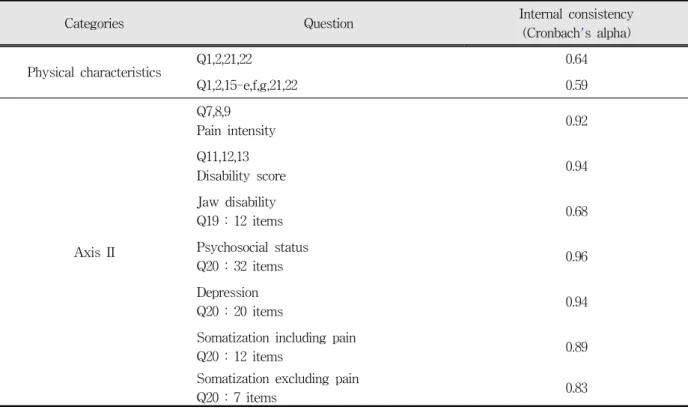
Table 2. Internal consistency of each item
is 0.64 and 0.59 assessed with Cronbach's alpha indicating acceptable reliability. The internal consistencies of axis II-related subscales were 0.92, 0.94, 0.68, 0.94, 0.89, and 0.83 for pain intensity, disability score, jaw disability, depression, somatization including pain, somatization excluding pain items, respectively. The items reflecting the psychosocial status related to depression and somatization showed 0.96. Table 2 shows the internal consistency of each subscale.
2. Test-retest reliability
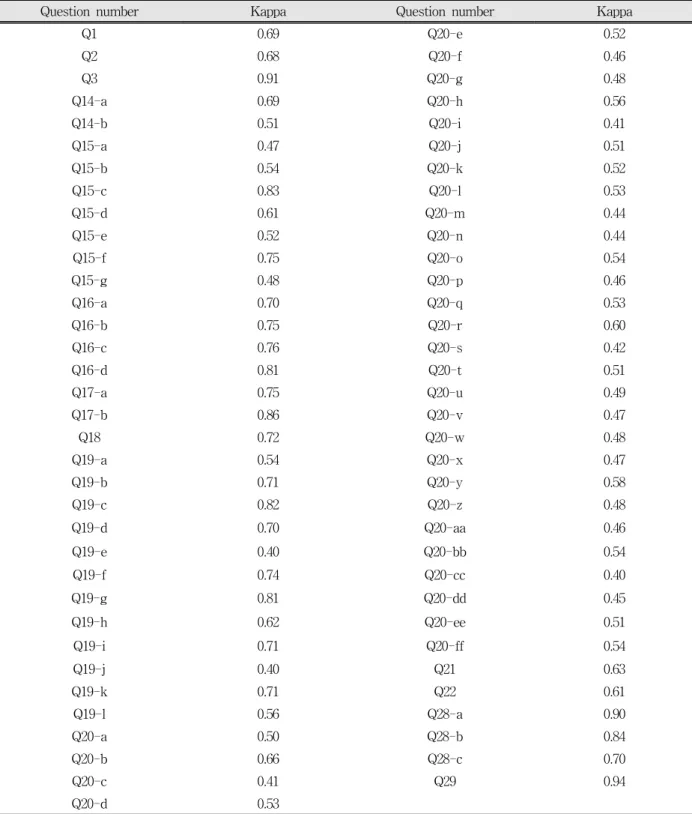
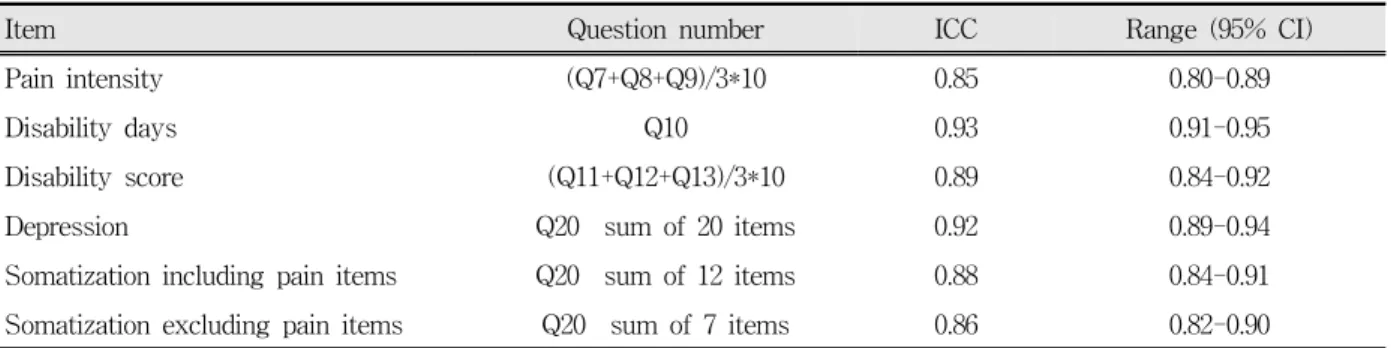
Test-retest reliability of all questions and their sub-questions ranged from 0.40 to 0.94 analyzed with kappa value (Table 3). Test-retest reliability of each subscale measured by intraclass coefficients (ICC) were 0.85, 0.93, 0.88, 0.81, 0.92, 0.88, and 0.86;
pain intensity, disability days, disability score, jaw
disability, depression, somatization including pain,
and somatization excluding pain items, respectively
(Table 4).
Question number Kappa Question number Kappa
Q1 0.69 Q20-e 0.52
Q2 0.68 Q20-f 0.46
Q3 0.91 Q20-g 0.48
Q14-a 0.69 Q20-h 0.56
Q14-b 0.51 Q20-i 0.41
Q15-a 0.47 Q20-j 0.51
Q15-b 0.54 Q20-k 0.52
Q15-c 0.83 Q20-l 0.53
Q15-d 0.61 Q20-m 0.44
Q15-e 0.52 Q20-n 0.44
Q15-f 0.75 Q20-o 0.54
Q15-g 0.48 Q20-p 0.46
Q16-a 0.70 Q20-q 0.53
Q16-b 0.75 Q20-r 0.60
Q16-c 0.76 Q20-s 0.42
Q16-d 0.81 Q20-t 0.51
Q17-a 0.75 Q20-u 0.49
Q17-b 0.86 Q20-v 0.47
Q18 0.72 Q20-w 0.48
Q19-a 0.54 Q20-x 0.47
Q19-b 0.71 Q20-y 0.58
Q19-c 0.82 Q20-z 0.48
Q19-d 0.70 Q20-aa 0.46
Q19-e 0.40 Q20-bb 0.54
Q19-f 0.74 Q20-cc 0.40
Q19-g 0.81 Q20-dd 0.45
Q19-h 0.62 Q20-ee 0.51
Q19-i 0.71 Q20-ff 0.54
Q19-j 0.40 Q21 0.63
Q19-k 0.71 Q22 0.61
Q19-l 0.56 Q28-a 0.90
Q20-a 0.50 Q28-b 0.84
Q20-b 0.66 Q28-c 0.70
Q20-c 0.41 Q29 0.94
Q20-d 0.53
Kappa value: 0-0.2, no reliability; 0.2-0.4, poor reliability; 0.4-0.6, fair reliability; 0.6-0.8, good reliability; 0.8-1.0, excellent reliability.
Table 3. Test-retest reliability of each question measured by kappa
Item Question number ICC Range (95% CI)
Pain intensity (Q7+Q8+Q9)/3*10 0.85 0.80-0.89
Disability days Q10 0.93 0.91-0.95
Disability score (Q11+Q12+Q13)/3*10 0.89 0.84-0.92
Depression Q20 sum of 20 items 0.92 0.89-0.94
Somatization including pain items Q20 sum of 12 items 0.88 0.84-0.91 Somatization excluding pain items Q20 sum of 7 items 0.86 0.82-0.90 Table 4. Test-retest reliability measured by intraclass coefficients (ICC) of each item
3. Reliability of Graded Chronic Pain scale
Graded Chronic Pain (GCP) scale was obtained from pain intensity, disability days, and disability score. The GCP scale was also used to evaluate the physical status of the patients. The test-retest reliability of GCP scale was 0.63 measured by kappa statistics (Table 5).
4. Correlations among RDC/TMD axis II profiles
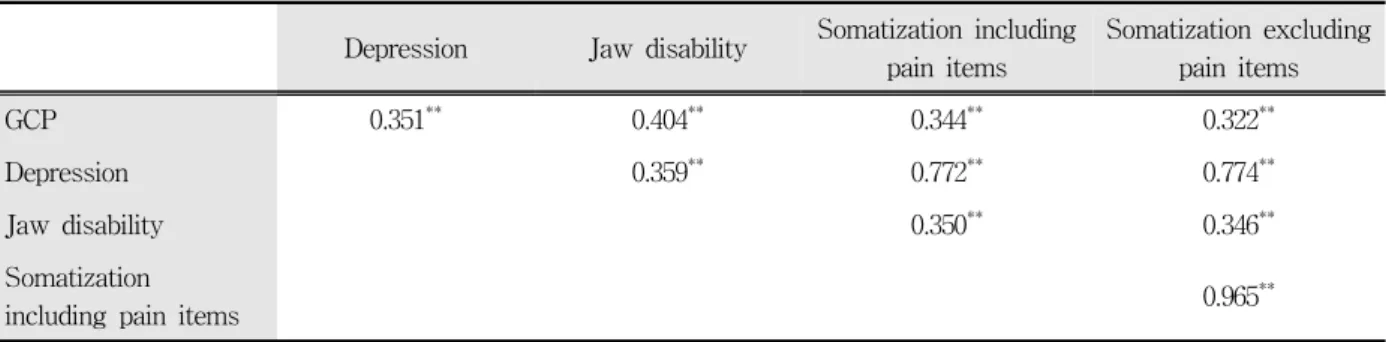
Table 6 shows the correlations among RDC/TMD axis II profiles. All the psychological profiles including depression and somatization showed significantly high correlations.
The GCP scale and jaw disability score also showed modest correlations with psychological profiles.
Re-test of GCP
0 Ⅰ Ⅱ Ⅲ Ⅳ Total
Test of GCP
0 1 1
Ⅰ 1 40 4 3 1 49
Ⅱ 6 7 2 15
Ⅲ 4 4 34 5 47
Ⅳ 1 7 28 36
Total 1 52 15 46 34 148
Kappa = 0.63
Table 5. Test-retest correlation of Graded Chronic Pain (GCP) scale
Ⅳ. DISCUSSION
The Korean version of RDC/TMD axis II
Questionnaire showed good internal consistency and
test-retest reliability. Internal consistency of the
axis II-related subscales were above 0.70 except for
jaw disability that showed a value nearby 0.70
(alpha=0.68) which indicates adequate reliability.
20)The reason for this lower value for jaw disability
may be found in the cultural difference of the Korean
people that find it unnatural to smile/laugh (19-f)
occasionally and make facial expressions (19-l),
causing potential difficulties in understanding the
exact meaning of the question. Compared with US
data,
15)the value for depression (alpha=0.94) is
greater (0.91-0.93), and somatization (0.83, 0.89) is
alike or higher than US results (0.78-0.87) accen-
tuating the fact that the translation was successful
and cross-cultural adaptation accomplished.
Depression Jaw disability Somatization including pain items
Somatization excluding pain items
GCP 0.351** 0.404** 0.344** 0.322**
Depression 0.359** 0.772** 0.774**
Jaw disability 0.350** 0.346**
Somatization
including pain items 0.965**
**: significant at 0.01 level (2-tailed)
Table 6. Pearson's correlations among RDC/TMD axis II profiles
We analyzed 24 items excluding seven items which demonstrated age, gender, ethnicity, level of education, income level, and ancestors of the study population. The age and gender of the patients were confirmed by their dental charts. The mean age of the patients was 25.7 years, with the greater part of the subject group composed of students who did not earn money and did not know their family income, exactly. In addition, the questions about ethnicity and their ancestors were excluded since the Korean people are composed of a single race.
The reliability of RDC/TMD axis I had already been proved in past studies. Dworkin et al.
demonstrated the reliability of assessing clinical signs of TMD, later these reliable methods were under consideration for developing RDC/TMD axis I.
12)Several previous studies have demonstrated that the Axis I component of the RDC/TMD is associated with acceptable to high levels of reliability when the clinical examination is performed as specified.
11,15)The test-retest reliability of the Korean version of RDC/TMD Axis II questionnaire indicated good to excellent reliable. The Kohen's Kappa of all the items was above 0.4, ranging from 0.40 to 0.94 indicating fair to excellent reliabilities.
21,22)The number of items showing 'fair' reliability (k:
0.4-0.6) was 40, and that of 'good' reliability (k:
0.6-0.8) was 18. The other 9 items showed 'excellent' reliability (k: 0.8-1.0). The test-retest reliability of each subscale using intraclass coefficients (ICC) was greater than 0.75 which may
be considered very acceptable.
13,23)Finally, the test-retest reliability of GCP was good. There is a need to re-evaluate the items that show rather low test-retest reliability and replace the phrases to ones that cause less confusion and are more appropriate to reflect the cultural belief of the Korean people concerning pain behavior.
Recently, the RDC/TMD has been used in the numerous clinical researches regarding the physical, psychological, and psychosocial factors of TMD and the relationships among these factors. The RDC/TMD questionnaire has been translated into over 20 languages, and these translations can be obtained in the RDC/TMD consortium website (http://rdc-tmdinternational.org). For more reliable and effective international collaboration studies, further development to reduce cultural and sociodemographic differences is imperative.
In conclusion, the Korean version of the RDC/TMD axis II questionnaire was found to be a reliable instrument for the analysis of TMD and chronic orofacial pain symptoms. This study has provided a valid and reliable cross-culturally adapted instrument for TMD researchers in Korea that will allow comparison with data from other international studies.
REFERENCES
1. LeResche L. Epidemiology of Temporomandibular disorders: Implications for the investigation of etiologic factors. Crit Rev Oral Biol Med 1997;8:
291-305.
2. Laskin D, Greenfield W, Gale E et al. The President's Conference on the Examination, Diagnosis, and Management of Temporomandibular Disorders.
Chicago, 1983, American Dental Association.
3. Dworkin SF, Huggins KH, Wilson L et al. A randomized clinical trial using Research Diagnostic Criteria for Temporomandibular Disorders-Axis II to target clinic cases for tailored self-care TMD treatment program. J Orofac Pain 2002;16:48-63.
4. de Wijer A, Lobbezoo-Scholte AM, Steenks MH, Bosman F. Reliability of clinical findings in temporomandibular disorders. J Orofac Pain 1995;9:
181-190.
5. Rugh JD, Dahlstrom L. Psychological management of the orofacial pain parients. In Stohler CF, Carlsson DS (Ed). Biological and Psychological Aspects of Orofacial Pain. Ann Arbor, Michigan, 1995, University of Michigan Press, pp. 133-147.
6. Dworkin SF. Diagnosis and assessment: Behavioral characteristics (axis II). In Sessle BJ, Bryant PS, Dionne RA (Ed). Progress in Pain Research and Management. Seattle, 1995, IASP press.
7. Merskey H. Classification of chronic pain- Descri- ptions of chronic pain syndromes and definitions of pain terms. Pain 1986;(suppl 3):S1-S226.
8. Dworkin SF, LeResche L. Research Diagnostic Criteria for Temporomandibular Disorders: review, criteria, examinations, and specifications, critique. J Craniomand Disord 1992;6:301-355.
9. List T, Dworkin SF. Comparing TMD diagnoses and clinical findings at Swedish and US TMD Centers using Research Diagnostic Criteria for Temporomandibular Disorders. J Orofac Pain 1996;10:240-253.
10. Gatchel RJ, Garofalo JP, Ellis E, Holt C. Major psychological disorders in acute and chronic TMD:
An initial examination. J Am Dent Assoc 1996;
127:1365-1374.
11. Ohrbach R, Dworkin SF. Five-year outcomes in TMD: Relationship of changes in pain to changes in physical and psychological variables. Pain 1998;74:
315-326.
12. Von Korff M, Ormel J, Keefe FJ, Dworkin SF.
Grading the severity of chronic pain. Pain 1992;50:
133-149.
13. Dworkin SF, LeResche L, DeRouen T, Von Korff M.
Assessing clinical signs of temporomandibular disorders: Reliability of clinical examiners. J Prosthet Dent 1990;63:574-579.
14. Rudy TE. Psychophysiological assessment in chronic orofacial pain. Anesth Prog 1990;37:82-87.
15. http://www.rdc-tmdinternational.org
16. Dworkin SF, Sherman J, Mancl L, Ohrbach R, LeResche L, Truelove E. Reliability, validity, and clinical utility of the Research Diagnostic Criteria for Temporomandibular Disorders Axis II scales:
Depression, Non-specific physical symptoms, and Graded chronic pain. J Orofac Pain 2002;16:207-220.
17. Iigaya M, Sakai F, Kolodner KB, Lipton RB, Stewart WF. Reliability and validity of the Japanese Migraine Disability Assessment (MIDAS) questionnaire.
Headache 2003;43:343-352.
18. Ghiselli EE, Campbell JP, Zedeck S. Measurement Theory for the Behavioral Sciences. San Francisco, 1981, W.H. Freeman, pp. 230-264.
19. Bergstrm G, Jensen IB, Bodin L, Linton SJ, Nygren AL, Carlsson SG. Reliability and factor structure of the multidimensional pain inventory Swedish language version (MPI-S). Pain. 1998;75:101-110.
20. Jensen MP. Questionnaire validation: A brief guide for readers of the research literature. Clin J Pain 2003;19:345-352.
21. Fleiss JL. Statistical Methods for Rates and Proportions. 2nd ed., New York, 1981, John Willey &
Sons, pp. 212-235.
22. Landis JR, Koch GG. The measurement of observer agreement for categorical data. Biometrics 1977;33:
159-174.
23. Wahlund K, List T, Dworkin SF. Temporomandibular disorders in children and adolescents: Reliability of a questionnaire, clinical examination, and diagnosis. J Orofac Pain 1998;12:42-51.
국문요약
한국어판 측두하악장애 연구진단기준 (RDC/TMD) 설문지의 신뢰도에 관한 연구
서울대학교 치과대학 구강내과진단학교실, 치학연구소
손병진․박민우․박지운․정성창․정진우
한국어판 측두하악장애 연구진단기준 (RDC/TMD) 설문지의 신뢰도를 분석하기 위하여 서울대학교 치과병원 구강내과에 내원한 154명의 턱관절장애 환자들(남자 31명, 여자 123명)에게 한국어판 RDC/TMD 설문지를 작성하게 하였다. 검사-재검 사 신뢰도는 동일한 피검자에게 1주 내지 2주 간격으로 같은 설문지를 작성토록 하였다. 설문지의 검사-재검사가 완료되기 전까지는 환자에게 어떠한 치료도 제공되지 않았다.
첫번째 검사로 본 통증강도(pain intensity), 장애점수(disability score), 악기능장애(jaw disability) 및 심리사회적 상태 (psychosocial status)의 내적 일관성(internal consistency)의 신뢰도는 크론바흐-알파(Cronbach’s alpha) 계수로 각각 0.92, 0.94, 0.68, 0.94 였다. 검사-재검사 신뢰도의 각 설문항목별 상관계수는 0.40에서 0.94까지의 범위로 나타났으며, 각각의 세부 항목별 등급내 상관계수(intra-class correlation coefficient; ICC)는 0.81에서 0.93의 범위로 나타났다. 만성통증척도(Graded Chronic Pain)의 검사-재검사 신뢰도계수는 0.63이었다. 한국어판 RDC/TMD 설문지는 좋은 신뢰도를 보였으며, 한국인의 측두하악장애 환자들에서 심리사회적측면을 분석하는데 유용하게 사용될 수 있다.
주제어: 측두하악장애 연구진단기준, 설문지, 내적 일관성, 검사-재검사, 신뢰도
환자병력 설문지