Clin Nutr Res 2013;2:143-148
http://dx.doi.org/10.7762/cnr.2013.2.2.143 pISSN 2287-3732 ∙ eISSN 2287-3740
© 2013 The Korean Society of Clinical Nutrition
Introduction
The Nutrition Care Process (NCP), developed by the Ameri- can Dietetic Association (now the Academy of Nutrition and Dietetics), was designed to improve the consistency and qual- ity of individualized care for patients/clients or groups and the predictability of the patients/client outcome [1]. It consists of four distinct, interrelated steps - nutrition assessment, nutri- tion diagnosis, nutrition intervention, and nutrition monitoring and evaluation. The NCP provides dietetic professionals with a framework for critical thinking and decision-making. It is thought that use of the NCP can lead to more efficient and effective care and greater recognition of the role of dietetic professionals in all care settings [1,2]. Also the Academy of Nutrition and Dietetics developed International Dietetics and Nutritional Terminology (IDNT) to describe the unique func- tions of dietetic professionals in each step of NCP [2,3]. Now the dietetic professionals have shown significant interest in NCP and are trying to implement NCP in many countries [4-6].
Also in Korea, the attention to NCP has been increasing among the dietetic professionals.
This is an Open Access article distributed under the terms of the Creative Commons Attribution Non-Commercial License (http://creativecommons.org/licenses/by-nc/3.0/) which permits unrestricted non-commercial use, distribution, and reproduction in any medium, provided the original work is properly cited.
*Corresponding author Eun Mi Kim
Address Department of Dietetics, Kangbuk Samsung Hospital, 29 Saemunan-ro, Jongno-gu, Seoul 110-746, Korea
Tel +82-2-2001-2724 Fax +82-2-2001-2723 E-mail [email protected]
Received June 5, 2013 Revised June 18, 2013 Accepted June 20, 2013
A Survey on the Status of Nutrition Care Process Implementation in Korean Hospitals
Eun Mi Kim
1*, Hee Joon Baek
21Department of Dietetics, Kangbuk Samsung Hospital, Seoul 110-746, Korea
2Department of Food and Nutrition Service, Hanyang University Hospital, Seoul 133-792, Korea
The Nutrition Care Process (NCP), developed by the American Dietetic Association, is a significant issue to dietetic professionals in many countries and there are rising needs for NCP implementation in Korea. We surveyed clinical nutrition managers of Ko- rean general hospitals regarding the perception of NCP, the status of NCP implementation, and the opinions on NCP. The ques- tionnaire was collected from 35 hospitals. Most clinical nutrition managers perceived NCP, but NCP implementation in hospital was at early stage. NCP was implemented in a fourth of the surveyed hospitals and many clinical nutrition managers responded that the lack of knowledge and the concern on increasing working time were major barriers to implementing NCP. To success- fully implement NCP in Korean hospital, ongoing education and training programs should be developed to provide adequate knowledge and help dietitians to cope with the barriers.
Key Words: Dietetics, Nutrition care process, Hospital, Korea
Several Korean hospitals attempted to apply NCP into their clinical practices and made many efforts to improve NCP implementation consistently for years. The Korean Dietetic As- sociation (KDA) recognized the needs to gather information on NCP and the necessity of NCP implementation in Korea. Ac- cordingly KDA undertook a few projects, and the ‘International Dietetics and Nutritional Terminology (IDNT), second edition’
was translated into Korean in March 2012. The Korean Society of Hospital Dietitians (KSHD, the organization under KDA) held the workshops and education programs on NCP for hospital dietitians, and in 2012, organized a taskforce team to develop NCP education programs for dietetic professionals. Not only KSHD but some local branches of KDA also constructed educa- tion programs. Besides KDA, several academic societies have made an effort to enhance the abilities to apply and to teach NCP. Moreover NCP is included in the standard education cur- riculum for Clinical Dietitian training. As Clinical Dietitian is now certified by the Ministry of Health and Welfare (legislated in 2010), it is recommended that Clinical Dietitian candidates fully experience NCP at Clinical Dietitian training institutes. These various situations provoke the dietetic professionals’ attention to NCP in Korea.
In this circumstance, we conducted the survey to investi- gate the status of NCP implementation in Korean hospitals.
Also we surveyed the perception and the opinions on NCP of clinical nutrition managers of general hospitals in Korea.
Materials and Methods
Survey participation
This survey was carried out among clinical nutrition man- agers of general hospitals in Korea. The questionnaires were delivered to 82 general hospitals located nationwide via e-mail in May 2012. These 82 hospitals had experiences of attend- ing the second Hospital Evaluation Program conducted by the Ministry of Health and Welfare (2007-2009) and the clinical nutrition managers of those hospitals are recognized to pos- sess relatively higher awareness of the professional perfor- mance of clinical dietitians at their own fields in Korea. Of the 82 questionnaires delivered, 37 responses were collected, for a response rate of 45.1%. We analyzed data from 35 responses and 2 incomplete responses were excluded.
Questionnaire
The questionnaire was composed of three parts. The ques- tions included in the first part were on the information on structural characteristics of hospitals related to clinical nutri- tion care performance. The second part was composed of questions on the perceptions and knowledge on NCP. The questions related to the NCP practice were included in the fi- nal part. A pretest was conducted and the initial questionnaire was corrected and revised according to results of the pretest.
Statistics
Data were analyzed using the SPSS program (PASW Statics 18.0). Descriptive statistics analysis, chi-square test, and student
Table 1. General characteristics of the hospitals
Characteristic Tertiary care hospital
(n = 24) Secondary hospital
(n = 11) Total
(n = 35) p value
Number of beds 1,047.6 ± 473.4* 541.9 ± 193.8 888.7 ± 468.4 0.002‡
Number of dietitians
Belonged to hospital 8.5 ± 5.9 3.6 ± 1.8 7.0 ± 5.5 0.01‡
Belonged to contract company 3.0 ± 4.4 1.2 ± 1.5 2.4 ± 3.8 0.08‡
Number of dietitians per 100 beds 0.8 ± 0.3 0.7 ± 0.2 0.8 ± 0.3 0.151‡
Number of CD* 8.8 ± 6.2 3.5 ± 1.9 7.1 ± 5.8 0.001‡
Mean years of dietitians’ career 3.8 ± 2.0 1.5 ± 0.7 3.0 ± 2.0 <0.001‡
Training institute of CD*
Yes/No 19 (79.2%)/5 (20.8%)† 2 (18.2%)/9 (81.8%) 21 (60.0%)/14 (40.0%) 0.001§
Number of nutrition therapy cases ordered by
doctor in 2011 8,845.0 ± 16,585.7 609.0 ± 791.6 6,180.3 ± 13,980.7 0.029‡
CD: Clinical Dietitian certified by Ministry of Health and Welfare.
*Mean ± SD; †n (%); ‡Independent t-test; §Chi-square test.
t-test were conducted. Statistical significance was set at p < 0.05.
Results
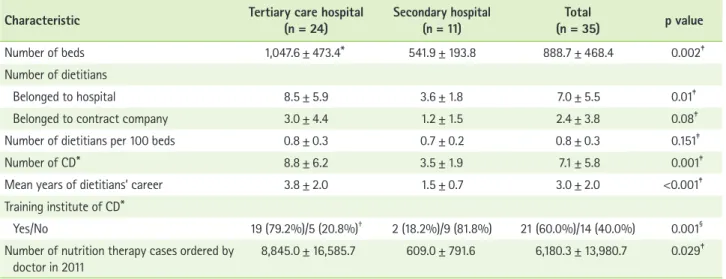
General characteristics of surveyed hospital are presented in Table 1. Sixty-eight percent of hospitals were tertiary care hos- pitals (designated by Ministry of Health and Welfare among general hospitals, and should be satisfied the assigned levels of disease severity of treated, staffs, facilities, and equipment etc) and 45.7% of hospitals (16 hospitals) were located in Seoul. The percentage of Clinical Dietitian training institutes
was significantly higher in tertiary care hospital.
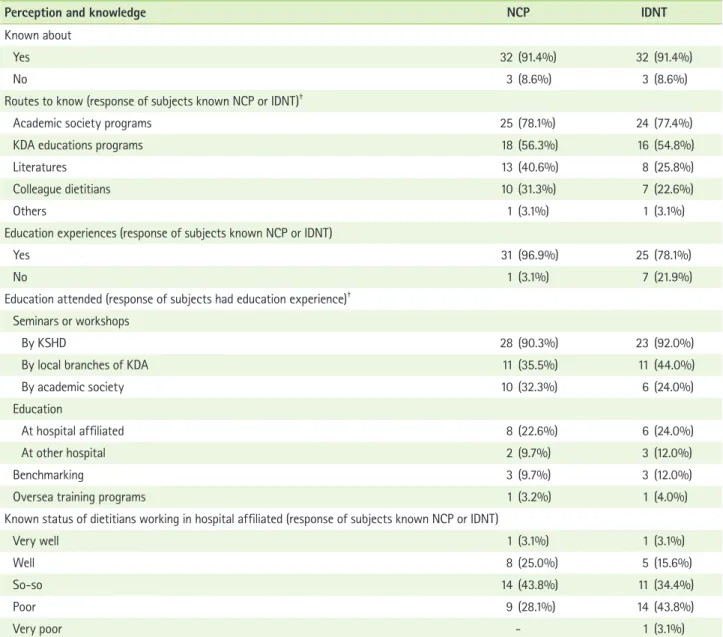
The responses to questions regarding perception and knowl- edge on NCP and IDNT are shown in Table 2. More than 90%
of respondents answered that they had known NCP or IDNT, and major routes to know them were academic programs and the education programs of the KDA. Most respondents had taken education on NCP and more than 75% of respondents had taken education on IDNT. Seminars or workshops held by the KSHD played important roles in providing hospital dieti- tians with the opportunities to know NCP and IDNT. Respon- dents answered that the known levels of dietitians working
Table 2. Perception and knowledge on NCP and IDNT*
Perception and knowledge NCP IDNT
Known about
Yes 32 (91.4%) 32 (91.4%)
No 3 (8.6%) 3 (8.6%)
Routes to know (response of subjects known NCP or IDNT)†
Academic society programs 25 (78.1%) 24 (77.4%)
KDA educations programs 18 (56.3%) 16 (54.8%)
Literatures 13 (40.6%) 8 (25.8%)
Colleague dietitians 10 (31.3%) 7 (22.6%)
Others 1 (3.1%) 1 (3.1%)
Education experiences (response of subjects known NCP or IDNT)
Yes 31 (96.9%) 25 (78.1%)
No 1 (3.1%) 7 (21.9%)
Education attended (response of subjects had education experience)† Seminars or workshops
By KSHD 28 (90.3%) 23 (92.0%)
By local branches of KDA 11 (35.5%) 11 (44.0%)
By academic society 10 (32.3%) 6 (24.0%)
Education
At hospital affiliated 8 (22.6%) 6 (24.0%)
At other hospital 2 (9.7%) 3 (12.0%)
Benchmarking 3 (9.7%) 3 (12.0%)
Oversea training programs 1 (3.2%) 1 (4.0%)
Known status of dietitians working in hospital affiliated (response of subjects known NCP or IDNT)
Very well 1 (3.1%) 1 (3.1%)
Well 8 (25.0%) 5 (15.6%)
So-so 14 (43.8%) 11 (34.4%)
Poor 9 (28.1%) 14 (43.8%)
Very poor - 1 (3.1%)
NCP: nutrition care process, IDNT: international dietetics and nutritional terminology, KDA: The Korean Dietetic Association, KSHD: The Korean Society of Hospi- tal Dietitians.
*Values are presented as n (%); †Multiple responses.
in their hospitals were not relatively high, especially IDNT. Al- though there were shown no significant differences, the per- Table 3. Comparison of the perception and knowledge on NCP and IDNT according to NCP implementation in the hospital*
Perception and knowledge Hospitals
implementing NCP Hospitals not
implementing NCP p value
NCP
Known about
Yes 9 (100.0%) 23 (88.5%) 0 . 287†
No - 3 (11.5%)
Known status of dietitians
Very well 1 (11.1%) - 0 . 021†
Well 5 (55.6%) 3 (11.5%)
So-so 2 (22.2%) 12 (46.2%)
Poor 1 (11.1%) 8 (30.8%)
Very poor - -
Not responded - 3 (11.5%)
IDNT
Known about
Yes 9 (100.0%) 23 (88.5%) 0 . 287†
No - 3 (11.5%)
Known status of dietitians
Very well 1 (11.1%) - 0 . 007†
Well 4 (44.4%) 1 (3.8%)
So-so 3 (33.3%) 8 (30.8%)
Poor - 14 (53.8%)
Very poor - 1 (3.8%)
Not responded 1 (11.1%) 2 (7.7%)
NCP: nutrition care process, IDNT: international dietetics and nutritional terminology.
*Values are presented as n (%); †Chi-square test.
Table 4. NCP implementation in the hospitals adopted NCP
NCP implementation N (%)
Extent to apply
Full to all cases 3 (33.3%)
Partly 6 (66.7%)
Computerized program
Developed 6 (33.3%)
Not developed 3 (66.7%)
Medical record
Using newly revised form 4 (44.4%)
Using newly previous form 5 (55.6%)
Use of IDNT
Using 7 (77.8%)
Not using 2 (22.2%)
NCP: nutrition care process, IDNT: international dietetics and nutritional ter- minology.
4 (57.1%)
2 (28.6%) 3 (42.9%)
7 (100.0%) Nutrition assessment
Nutrition diagnosis Nutrition intervention Nutrition monitoring
& evaluation
Figure 1. The steps of NCP using IDNT in 7 hospitals using IDNT. NCP: nutrition care process, IDNT: international dietetics and nutritional terminology.
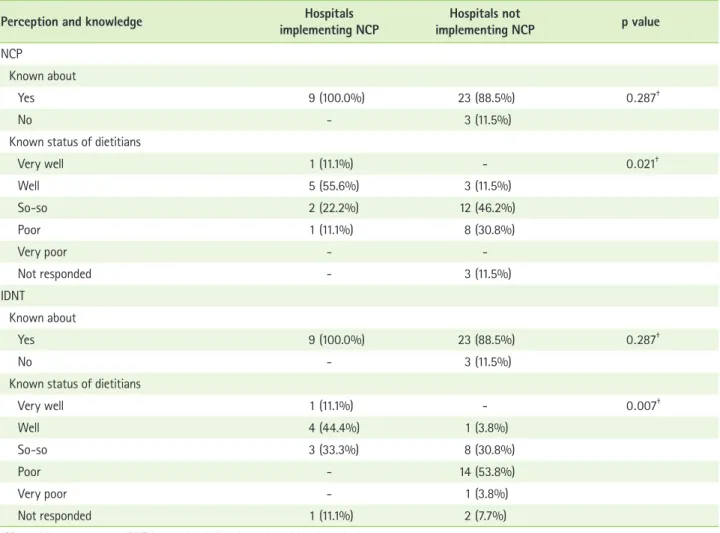
centages of respondents perceived NCP and IDNT were higher in those who worked in the hospitals implementing NCP (Table 3). However there were significant differences in dietitians’
knowledge levels on NCP and IDNT between the hospitals implementing NCP and the hospitals not implementing NCP.
The percentages of dietitians responded “very well” and “well”
were higher in the hospitals implementing NCP.
NCP was implemented in 9 hospitals among surveyed hos-
pitals and Table 4 shows the status of NCP implementation in these hospitals. Six of those hospitals were Clinical Dietitian training institutes. Mean duration of NCP implementation was 21.9 months, but the duration varied greatly depending on the hospital (2 to 52 months). In a-third of those hospitals, NCP was applied to all nutrition therapy cases. Computerized programs were using in NCP implementation in two-thirds of hospitals implementing NCP. IDNT had been used in NCP Table 5. Opinions of the clinical nutrition managers on NCP
Opinions N (%)
Hospital implementing NCP (n = 9) Most difficult NCP step to implement
Nutrition assessment -
Nutrition diagnosis 2 (22.2%)
Nutrition intervention 2 (22.2%)
Nutrition monitoring & evaluation 2 (22.2%)
All 1 (11.1%)
None 2 (22.2%)
Benefits of NCP implementation (multiple response)
Easy decision making on nutrition therapy 8 (88.9%)
Standardization of performance among colleagues 5 (55.6%)
Saved time to spent on implementing nutrition therapy 1 (11.1%)
Efficient communication 4 (44.4%)
Enhanced medical staff’s recognition to nutrition therapy 3 (33.3%)
Quality improvement of nutrition therapy 7 (77.8%)
Others 1 (11.1%)
Difficulties in settlement of NCP implementation (multiple response)
Lack of dietitians’ knowledge 6 (66.7%)
Lack of sympathy on dietitians 4 (44.4%)
Increased time to spent due to system change 6 (66.7%)
Difficulties in medical recording 3 (33.3%)
Lack of medical staffs’ understanding 4 (44.4%)
Organizational circumstance 2 (22.2%)
Hospital not implementing NCP (n = 26)
Reasons to do not introducing NCP (multiple response)
Lack of knowledge 14 (53.8%)
No needs 4 (15.4%)
Difficulties to apply into practice 11 (42.3%)
Lack of human power & time 18 (69.2%)
Avoidance of troublesome problems despite feeling needs 9 (34.6%)
No conclusion on the introduction of NCP in the organization 5 (19.2%)
NCP: nutrition care process.
records in 7 hospitals and the steps of NCP using IDNT were different depending on the hospital (Figure 1). The clinical nutrition managers of 21 hospitals among 26 hospitals not implementing NCP responded that they planned to introduce NCP in the near future.
The opinions of clinical nutrition managers on NCP are shown in Table 5. The percentages of NCP steps responded as the most difficult to implement were similar among 3 steps except nutrition assessment step. The major benefits of NCP implementation thought by the clinical nutrition managers from NCP implementing hospitals were the easy decision- making and the quality improvement of nutrition care. Lack of knowledge and increased time spent were pointed out as the major difficulties in settlement of NCP implementation. These were also the major reasons that made the clinical nutrition managers hesitate to introduce NCP to their hospitals.
Discussion
The results of this survey showed that NCP implementation in Korea is in an early stage. Most clinical nutrition managers perceived NCP and IDNT and had the education experiences on NCP and IDNT. However many hospitals did not implement NCP. Even among Clinical Dietitian training institutes, NCP was implemented in less than a third of the hospitals. This low NCP implementation rate is going to be a problem not only in the improvement of nutrition care, but in the training of Clinical Dietitian candidates. Many clinical nutrition managers were concerned about the lack of knowledge and skills of their dietitians and the increase of time spent with adopting NCP.
It was consistent with the responses on difficulties in imple- menting NCP from the clinical nutrition managers in hospitals that had adopted NCP. However many clinical nutrition man- gers responded ‘easy decision-making’ and ‘efficient commu- nication’ as the benefits of NCP implementation. This suggests that there is no need to delay NCP implementation because of the concern in the extra time spent. In the initial stage, it may become an issue because dietitians have to change their way of work, but the working time may decrease after the adapt- ing to the new method. In fact, the periods of NCP implemen- tation were less than a year in about a half of hospitals that had adopted NCP. The barriers to adopt NCP and difficulties in implementing NCP pointed out from our survey results were similar to the responses reported in the U.S. [7].
IDNT was used in many hospitals implemented NCP, but the
extent of IDNT use varied depending on the hospital. IDNT was used at nutrition diagnosis step in all hospitals using IDNT, but used at other steps of NCP in less than a half of those hospi- tals. Nutrition diagnosis is the new step that distinguishes NCP from the existing process and requires using IDNT. As a result, nutrition diagnosis terminology will be familiar and widely used in practice compared to other terminologies (nutrition assessment terminology, nutrition intervention terminology, and nutrition monitoring & evaluation terminology). It was found that nutrition diagnosis terminology was the most fa- miliar and was most widely used in the U.S. [8].
Our survey was carried out on a small scale and administered to limited subjects, clinical nutrition managers. Therefore it is possible that there were differences between our results and the thought of overall working dietitians in clinical fields. The role of clinical manager is important to adopt NCP, however di- etitians who practice nutrition therapy in the fields play an im- portant role also. The extensive comprehensive survey will be needed and it will provide us with valuable information needed to implement NCP and to improve NCP implementation.
Implementation of NCP is required to enhance efficiency, effectiveness, and quality of nutrition therapy. To successfully implement NCP in Korean hospital, ongoing education and training programs should be developed to provide adequate knowledge and help dietitians to cope with the barriers to NCP implementation.
References
1. Lacey K, Pritchett E. Nutrition Care Process and Model: ADA adopts road map to quality care and outcomes management. J Am Diet Assoc 2003;103:1061-72.
2. American Dietetic Association. International Dietetics & Nutrition Termi- nology (IDNT) reference manual: standardized language for the nutrition care process. 3rd ed. Chicago (IL): American Dietetic Association; 2010.
3. Writing Group of the Nutrition Care Process/Standardized Language Committee. Nutrition care process part II: using the International Dietetics and Nutrition Terminology to document the nutrition care process. J Am Diet Assoc 2008;108:1287-93.
4. Baker SD, Cotugna N. Students entering internship show readiness in the nutrition care process. J Hum Nutr Diet. Forthcoming 2013.
5. Van Heukelom H, Fraser V, Koh JC, McQueen K, Vogt K, Johnson F.
Implementing nutrition diagnosis at a multisite health care organiza- tion. Can J Diet Pract Res 2011;72:178-80.
6. Atkins M, Basualdo-Hammond C, Hotson B; Dietitians of Canada. Cana- dian perspectives on the nutrition care process and international dietet- ics and nutrition terminology. Can J Diet Pract Res 2010;71:e18-20.
7. Gardner-Cardani J, Yonkoski D, Kerestes J. Nutrition care process implementation: a change management perspective. J Am Diet Assoc 2007;107:1429-33.
8. Ayres EJ, Hoggle LB. 2011 nutrition informatics member survey. J Acad Nutr Diet 2012;112:360-7.