대한임상병리사회지 : 제 24 권 1 호 1992
방향족 탄화수소화합물 분해세균의 핵산염기조성
토:!. 1L .....,
셔충남대학교병원 임상병리과
양 병 선
Key words : G + C content
,
HPLC1 •
서 론방향족 탄화수소 화합물은 분자구조상 분해하기 어려운 구조 때문에 토양이나 수계의 자연환경에 서 오랜 잔존력을 가지며 그 자체의 특성으로 인 하여 직접적으로 생태계를 파괴할 뿐 아니라 생명 체에 암이나 기형을 유발하는 치명적인 돌연변이 물질로 밝혀졌다1).
방향족 화합물의 대부분은 방향족 고리가 절단 될 수 있는 catech이, gentisate, 혹은 protocate- choate 풍으로 전환된다.
페놀의 경우는 catechol로 전환되어 분해되는 반 면, 벤조산은 m-hydroxy benzoate를 거쳐 protoca-
techuate로 되 는 과정 과 L-mandelate를 거 쳐 cate-
chol로 전환되는 두 가지의 방향족 고리 분해과정 에 의해서 산화된다. 최근 Pseudomonas속 세균을 이용한 페놀 분해실험에 의하면 biofilm을 이용한 연속배양에 의헤 페놀 외에 다른 방향족화합물의
aerobic activity를 높일 수 있음이 알려졌으며 2), 이 런 페놀 및 그 화합물 산화과정은 toluene dioxyge- nase 활성 의 영 향을 받는 다3). Ortho-clearage나
metaclearage 경로를 거쳐 분해되는 벤조산의 경
우 세균 유전자상의 벤조산 분해유전자의 확인과 그 조절에 관하여 활발히 연구가 이루어지고 있다4).
현재 생태계에서 난분해성의 오염물질로 보고된 물 질 로는 benzen, toluene, phen이, halogenated aromatic compounds와 polycyclic aromatic com- p~)Unds 동의 방향족 화합물로서 이 들을 분해 할 수 있는 세 균들로는 주로 Pseudomonas, Alcaligenes, Acinetobacter
,
Arthrobacter,
Corynebacterium 동으 로 알려져 있다5). 미생물을 이용하여 난분해성 물 질을 자연계로부터 제거하는 것은 생태계의 보존및 평형유지를 위하여 극히 중요한 관제라 할 수 있다. 따라서 그러한 목적으로 이용될 수 있는 미 생물을 자연계로부터 분리 동정하여 체계화하는 연구는 미생물 자원의 발굴이라는 관점에서 우선 수행되어져야 한다. 본 실험은 난분헤성의 방향족 화합물 분헤세균을 대전지역의 공장폐수로부터 분 리하여 화학분류학적 방법을 도입하여 정확한 동 정 및 분류를 시도하였다.
종래의 생화학적 방법이 갖는 결점, 즉 서식환경 이 다양한 모든 미생물 종을 같은 배지, 같은 조건 에서 시험할 수 없고 시험결과의 판정에 있어 시 험자에 따른 주관적 성향을 배제할 수 없다. 그러 나 화학분류학적 방법은 미생물 세포의 생명유지 를 위해 필수불가결한 구성성분(세포막기질, 호흡 계 퀴논, 핵산, 세포벽의 아미노산 퉁)을 기기분석 을 통하여 동일한 기준하에 얻어진 결과, 즉 보다 객관적이고 정량적 data를 분류지표로 이용함으로 써 보다 객관적이며 계통을 반영한 분류가 가능하 다 (Komagata et al., 1986).
본 연구에서는 신종기재에 있어 필수적인
DNA
의 GC 함량 (mol% G+C) 을 측정하여 분리된 방향 족 탄화수소 화합물 분해세균의 동정을 하였기에 보고하고자 한다.
n .
재료 및 방법 1. 재 료1) 사용 균주
본 실험에서는 폐수로부터 phenol 이나 benzoic
acid를 단일 탄소원과 에너지원으로 사용하는 균주 에 한정하였다 (Table 1).
- 158-
Luria-Bertani medium(g/l,OOO ml) Tryptone ... 10g Yeast extract ... 5g NaCI ...
… … … ...
10g Table 4.List of bacterial strains investigated Aromatic compounds
strams HNB 111 HNB 116 HNP 304
" HNP 307 HNP 314 HNP 315 HNB 221 HNB 222 HNB 223 HNB 224 HNB 302
PHE2 BEN1
Adjusted to pH 7.0
1) 균주 폴리
대전 근교 공업단지의 하천에서 채취한 폐수 5ml를 최소배지 (Table 2) 에 넣은 다음 탄소원 및 에너지원으로 벤조산 또는 페놀을 첨가하여 100ml를 250C 에서 12 시간 진탕배양하였다. 이 배 양액을 101_105 배로 히석하여 탄소원으로 각각 벤조산 또는 페놀이 첨가된 최소 고체배지에 도말 하였다. 이들을 25"C 에서 3 일간 배양한 후 단일 군락의 관찰을 통해 이들 방향족 화합물을 분해하 는 균주를 분리하였다 (Fig.1). 이렇게 분리된 균주 들을 최소 배지에서 단일 군락을 몇 번 계대하여 더욱 순수분리하였다.
법
2.
방+ + + + + + + + + +
Table 1.
+
1BEN : Benzoic
,
2PHE : Phenol + : Growth, - :
No growth2)
배 지세균의 순수분리와 배양을 위하여 최소배지
(Table 2) 와 Starr 배지 (Table 3) 를 사용하였으며,
G+C 함량측정을 위하여 LB 액체배지 (Table 4) 를
사용하였다. Waste water
added minimal medium components
,
benzoate or phen이 as carbon and ener잉r source (500 I용Iml)incubated with shaking for 12 hours at 250C spread in minimal media with benzoate or phe- nol, respectively.
streaked in minimal media with benzoate or phenol, respectively.
Minimal medium for aromatic compounds (g/l
,
OOO ml)Table 2.
NH~Û3 ... 0.5g K2HPÛ4
.……… ... ……
.0.8g KH2P04 ...… ... ………… .... ……·…
O.2g MgS04.7H20 ... … O.2g FeSÛ4 ... 0.03g CaCh • 2H20 ... 0.02g Carbon source ...………·…………
.0.5gcolonies Benzoate or phenol degrading-bacterial
were isolated.
Adjust to pH 7.0
Starr medium for Klebsiella oxytoca (g/l
,
OOO ml)Table 3.
Procedure for the isolation of aromatic hydrocarbon degrading bacteria.
2) DNA의 GC 함량
분리된 균주를 LB 액체배지(1 50 ml) 를 사용하여 24 시간 300C 에서 배양 후 5 배량의 saline-EDTA[O.
15M NaCI
,
O.lM ethylene diamino tetra acetate(EDTA)] 로 2 회 세정 하였으며, DNA 의 추출 및
Fig.1.
Adjusted to pH 7.3
CaClz • 2H20 ... 10g Bromethymolblue ... 0.lg Yeast extract ... 0.6g Sodium polygalacturonate ... 3.0g
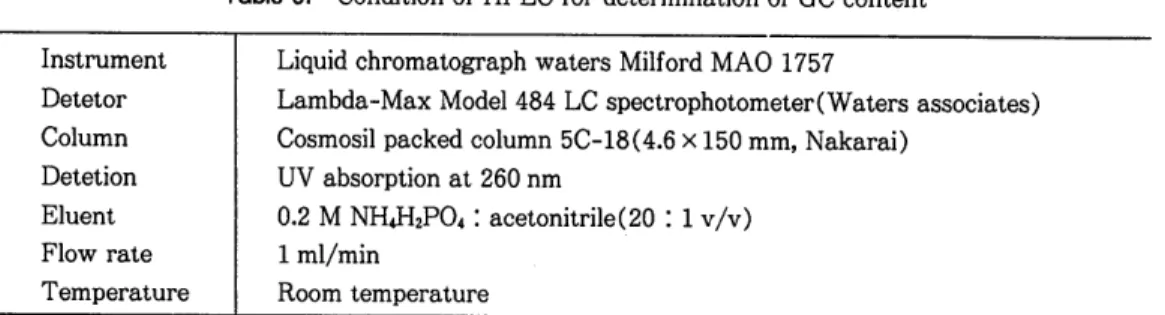
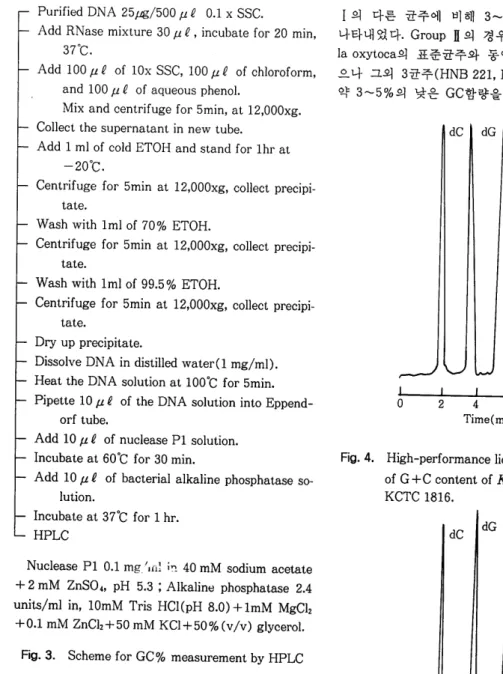
정제는 Saito & Miura8) 의 방법을 변형시켜 사용히 (Sigma) 를 이용하여 nucleoside까지 분해하여, high 였고 (Fig. 2)
,
DNA 의 GC 함량은 Tamaoka&
Ko- performance liquid chromatography(HPLC) 에 의 해 magata6) 방법 에 따라 측정 하였 다.DNA를 nuclease nucleoside의 mole 농 도 비 를 구 하 였 다. 실 험 순 서 는 P1 (Boehringer mannheim) 와 alkaline phosphatase Fig. 3 에 HPLC의 분석조건은 Table 5 에 나타냈다.Harvest bacterial cells at a stage of logarithmic growth(about 1 g).
Wash two times with 10 ml of saline-EDT A.
Suspend in 2 ml of saline-EDT A.
Add 2 mg of lysozyme
,
and incubate at 37.C for 30 min.Add 8 ml of Tris buffer
,
0.5 ml of SDS 1 g/10 ml and incubate at 60.C for 10 min.Add 2.5 ml of phenol, shake and cool on ice.
Add 2.5 ml of chloroform
,
shake for 30 min.Centrifuge at 10,000 xg for 10 min.
Collect the supernatant.
Add 5 ml of SSC to the residue, shake, centrifuge, and collect the supernatant.
Add 1 ml of phenol
,
1 ml of chloroform,
shake and cool on ice.Centrifuge at 12
,
000 xg for 10 min.Collect the supernatant in a small beaker(50 ml content).
Add 20-25 ml of ethanol, and spool the DNA with a glass rod.
Rinse the spooled DNA with 80%(v/v) ethanol and 99% (v/v) ethanol.
Dissolve in 5 ml of 1/10x SSC.
Add 0.3 ml of RNase solution
,
incubate at 37.C for 20 min.Add 0.5 ml of 10x SSC, 1 ml of phenol, and 1 ml of chloroform, shake for 15 min.
Centrifuge at 12
,
000 xg for 20 min.Collect the supernatant in a small beaker.
Add 10 ml of ethanol
,
spool the DNA with a glass rod.Rinse with 80 % (v /v) ethanol and 9 % (v /v) ethanol.
Dissolve in 4.5 ml of 1/10 x SSC
,
then add 0.5 ml of acetate-EDTA.Add 2.7 ml of isopropanol dropwise while stirring the solution rapidly
,
and spool the DNA.Rinse with 80 % (v /v) ethanol and 99 % (v /v) ethanol.
Saline-EDTA, 0.15M NaCI+0.1M EDTA, pH 8.0 ; Tris bUffer, O.lM Tris+O.lM NaCI, pH 9.0 ; SSC, 0.15M NaCI + 15 mM trisodium citrate, pH 7.0 ; RNase, RNase A 1 mg/ml of 0.05M Tris-HCI, pH 7.5 ; acetate-EDTA
,
3M sodium acetate+1 mM EDTA,
pH 7.0Instrument Detetor Column Detetion Eluent Flow rate Temperature
Fig.2. Scheme for isolating and purifying bacterial DNA.
Table 5. Condition of HPLC for determination of GC content Liquid chromatograph waters Milford MAO 1757
Lambda-Max Model 484 LC spectrophotometer(Waters associates) Cosmosil packed column 5C-18(4.6 x 150 mm
,
Nakarai)UV absorption at 260 nm
0.2 M NH~2P04 : acetonitrile(20 : 1 v/v) 1 ml/min
Room temperature
- 160-
Purified DNA 25,ug/500 μR 0.1 x SSC.
1
의 다른 균주에 비해 3-4% 의 높은 GC 함량을Add RNase mixture 30 μ R , incubate f or 20 min, 나타내 었 다. Group
n
의 경 우 HNB 224-는 Klebsiel-37.C. la oxytoca의 표준균주와 동얼한 GC함량을 나타냈
Add 100 μ R of 10x SSC
,
100 μ R of chloroform,
으나 그외 3 균주 (HNB 221,
HNB 222,
HNB 223) 는and 100 μ R of aqueous phen이. 약 3-5% 의 낮은 GC 함량을 나타내 었다 (Table 6).
Mix and centrifuge for 5min, at 12,000xg.
Collect the supernatant in new tube.
Add 1 ml of cold ETOH and stand for 1hr at -20.C.
Centrifuge for 5min at 12
,
000xg,
collect precipi- tate.Wash with 1ml of 70% ETOH.
Centrifuge for 5min at 12,000xg, collect precipi- tate.
Wash with 1ml of 99.5% ETOH.
Centrifuge for 5min at 12
,
000xg,
collect precipi- tate.Dη up precipitate.
Dissolve DNA in distilled water(1 mg/ml).
Heat the DNA solution at 100.C for 5min.
Pipette 10 μ R of the DNA solution into Eppend- orf tube.
Add 10 μ R of nuclease P1 solution.
Incubate at 60.C for 30 min.
Add 10 μ i of bacterial alkaline phosphatase so- lution.
Incubate at 370C for 1 hr.
HPLC
Nuclease P1 0.1 mg'lül 년 40 mM sodium acetate + 2 mM ZnSO 4
,
pH 5.3 ; Alkaline phosphatase 2.4 units/ml in,
10mM Tris HCI(pH 8.0) + 1mM MgCb +0.1 mM ZnCh+50 mM KCI+50% (v/v) glycerol.Fig.3. Scheme for GC% measurement by HPLC
m. 결 과
1) DNA의 GC함량
HPLC(Fig. 4 , 5) 를 이용하여 GC함량을 측정한 결 과 본 실험에 사용된 방향족 탄화수소 화합물 분 해세균은 크게 두 group으로 대별되었으며 group
I
은 40.5-45.9%,
groupn
는 53 .4%에서 57.9%까지의 GC함량 (mol%) 분포를 보였다. Group
1
의 경우 DNA 의 GC 함량 분포에 있어서는 Acinetobac- ter calcoaceticus와 일치하였다. HNP 307 및 HNP314는 각각 44.4 %, 45.9 %의 GC 함량을 보여 group
dC I dG I dT I dA
o
2 4 6 8Time(min)
Fig.4. High-performance liquid chromatograms of G +C content of Klebsiella oxytoca KCTC 1816.
dC IdG I
dT I IdA
o
2 4 6Time(min)
Fig. 5. High-performance liquid chromatograms of G+C content of HNB 221.
Table 6. DNA base composition(mol%) of DNAs determined by HPLC
Group strain
Acinetobacter calcoaceticus KCTC 2357 NNB 111 HNB 116 HNP 302 HNP 304 HNP 307 HNP 314 HNP 315
n
Klebsiella oxytoca KCTC 1816 HNB 221 HNB 222 HNB 223 HNB 224 Escherichia ColiIAM 12119
taxonomic GC content status (mol%)
type
type
40.8 41.7 40.5 41.5 41.7 44.4 45.9 41.8
57.9 54.5 55.0 53.4 57.9
51.0
Table 7. Characteristics of aerobic Gram-negative aromatic hydrocarbon-degrading bacteria Group strains DNA G+C content
Acinetobacter 40.8-45.9 calcoaceticus
n
Klebsiella 53.4-57.9oxytoca
N. 고 찰
연구는 주로 Pseudomonas의 세균을 재료로 많이 연구되었으나, 이들 균주 이외에 Acinetobacter 속 을 비롯하여 Arthrobacter, Corynebacterium 그리
고 Alcaligenes 속 동도 방향족 화합물 분해놓이
있는 것으로 알려져 있다.
본 실험에서는 최소배지에 단일 탄소원 및 에너 지원으로 벤조산과 페놀을 첨가하여 대전지역의 공업폐수로부터 균주들을 분리한 결과 분해능이 다른 여러 균주가 분리되었다.
방향족 화합물 분해능이 HNP302 은 페놀, 이외 에 균주는 벤조산을 단일 탄소원 및 에너지원으로 이용하였다.
지금까지 보고된 바에 의하면 방향족 화합물 분 해세균은 분해농 소실 동으로 균주의 안정성이 매 우 불안정 하기 때문에 생화학적 특성과 같은 표 현형에 의한 동정 결과는 낮은 재현성을 나타낼 수 있기 때문에 화학분류학적 방법을 도입하여, 분 자수준에서의 비교를 통하여 보다 정확한 동정을 기대할 수 있다.
대개 세균 chromosomal DNA 의 G+C content
(mol%) 는 약 25% (Mycoplasma) 에서 최고 75%
(Streptomycetes) 까지 넓은 분포를 갖는데 이 러한 넓은 분포의 G+C mol% 는 속, 종 동정에 좋은 지 침이 될 수 있다.
현재 G+C mol% 측정법에는 직접적인 방법과
간접 적 인 방법 이 있는 데 최 근 reversed -phase
HPLC을 이용한 DNA 에 관한 연구가 보고된 이래
nuclease P1 과 bacterial alkaline phosphate 처 리 를 통해 DNA를 nucleoside까지 분해 시 킹 후 reversed -phase HPLC를 사용하여 DNA base composition을 측정하는 직접적인 방법이 미생물 분류에 활발히 이용되고 있다,7) •
HPLC을 이용하여 DNA-base composition(mol
%)을 측정한 결과는 Group
1
균주는 40.54%(HNB116) 에서 45.94% (HNP314) 까지 나타났고,
Group
n
균주는 최저 HNB223 (53.36 % )와 최고HNB224(57.91 %)로 나타났다.
그리 고 Acinebacter속과 Klebsiella속 사이 에 는 약 10% 정도의 뚜렷한 차이를 보여 주었다. 그러 나 GC 함량분포에 있어서의 차이는 앞으로 fatty acids 분석 및 DNA-DNA hybridization을 통해 종 내의 변종여부를 밝힐 필요가 있무며 DNA-rRNA hybridization, rRNA sequencing 둥을 통하여 분류 난분해성 물질인 방향족 화합물의 분해에 관한 학적 위치를 검토할 필요가 있을 것으로 생각된다.
- 162-
V
• .7::1 2~~~~~ ~~ ~*~~~ ~~~ ~~*±
&} ?ff~
*Bll
.A·Jl if-& *~ ii]·O:l DNA~ G.C~EJ=-~~ ~ "6}0:] ~'-~ iij-~ c}.
1. %~ ~±i'::!.Q.~ phenol~ benzoic acid~ oj -§-ii}O:l ~.AJ.If]j*~~~
%
llTI-9-~ ftllir%*eli>]-~
t:l·.
2. HPLC BJ-lf;l% ~~ G.C ~EJ=~ ~;t~~.ll} 271]
~ ~.Q.~ rH~£1~.Q.o:], ~]1 ~(7-H-i=-).g..
40.5-45.9%~ G.C ~EJ= Jl.¥.~, ~12 ~(4-H
-9-).g_
53.4-57.9%~ G.C ~2cf*.:Y:~ .!2..~q-.
3. G.C ~EJ=% *~ ~ ~.ll} ~]1 ~-€:- Acineto- bacter calcoaceticus, ~~ 2 ~.g.. Klebsiella oxy-
toca~ -"8-Aa
£1
~ c}.DNA Base Composition Analysis of Aromatic Hydrocarbon-degrading Bacteria
Yang, B.S.
Dept. of Clinical Pathology, Chung Nam National Univ. Hospital
ABSTRACT
The aromatic hydrocarbon-degrading bacteria were isolated from industrial waste-water in Daejon aerea, and investigated by means of chemotaxo- nomic methods including G
+
C contents.1. The 11 strains were isolated from the industri- al waste-water to use phenol and/or benzoic acid as a sole carbon source.
2. In DNA base composition analysis with the
HPLC method, the bacteria tested were classi- fied into two major groups, GC contents of group
I
which had 7 strains ranged from 40.5% to 45.9%' group
n
which included 4 strains were 53.4% to 57.9%, respectively.3. Onthe basis of the GC contents, group
I
and groupll
were identified as Acinetobacter calcoaceticus, and Klebsiella oxytoca, respec- tively.REFERENCES
1. Pierce, G. E., J. J. Fackiam and J. M. Rice, Iso- lation and characterization of plasmids from en- vironmental strains of bacteria capable of de- grading the herbicide 2.4-D. Developments in Industrial Microbiology. 22 ( 32) : 401-408.
1981.
2. Spooner, R.A., M. Bagdasarian, and F. CH.
Franklin, Activation of the Xyl DLEGF pro- moter of the TOL toluene-xylene degradion pathway by over production of the xyiS regilation gene product J. Bacterial. 169(8) : 3581-3586, 1987.
3. Spain, J. C and D. T. Gibson, Oxidation of sub-
stituted phenols by Pseudomonas sp. strain JS6.
Appl. Environ. Microbial. 54(6) : 1399-1404, 1988.
4. Harayama, S., N. Mermod., M. Rekik., P. R.
Lehrbach and K. N. Timmis, Role of the diver- gent B ranches of the degration of benzoate and substituted benzoates. J. Bacterial. 169 ( 2)
: 558-564. 1987.
5. Pemberton, J. M. an<-"~ P F.. Fisher, 2, 4-D plas- mid and persistence, Nature. 2G8 : 732-733, 1977.
6. Tamaoka, J., K. Komagata, FEMS Microbiology Letter.25: 125-128,1984.
7. Gerhrke, C. W., K. C. Kuo., R. A. McCune., K.
0. Gerhardt and P. F. Agris, J. Chromatogr.
230 : 297-308, 1982.
8. Saito, H and K. Miura. Biophys. Acta. 72 : 619 -629. 1963.
9. Austin. B and F. Prist, Morden Bacterial Tax-
anomy. 1986.
10. Collins, M. D., In Methods in Microbiology, Vol.
18. Academicpress, London p. 329, 1985.
11. Krieg, N. Rand J. G. Holt. Bergey's manual of Systematic Bacteriology volume 1, 1984.
-164-