93
INTRODUCTION
Patients' and clinicians' esthetic demands have led to the devel- opment of high-technology processes such as glass infiltrat- ed spinell and alumina, fused alumina or zirconia materials that are becoming increasingly advanced in their optical properties.1-3 These restorations allow diffuse transmission as well as specular reflectance of light, reproducing a depth of translu- cency and color mimicking that of natural teeth.4Among a vari- ety of core materials, zirconia has been proved to possess bet- ter mechanical properties. However, it has poor translucency and therefore, it is difficult to satisfy the esthetic requirements.
Furthermore, the optical property of core materials plays an important role in matching the affected shade of the artificial restorations with the natural appearance of teeth. In addi- tion, the optical properties of the material depend on the amount of crystals within the core matrix, their chemical nature, and the size of the particles.5,6
Although the characteristics of coping is important for the clin- ical success, the variables that contribute to a durable and pre- dictable restoration includes the luting material, its polymer- ization behavior and mechanism, the nature and thickness of the restoration itself and the light polymerizing unit.3
The rapid advancement in esthetic dental restorative techniques has dramatically increased the use of light curing units (LCUs) to cure resin based materials. Nowadays, boosted ver- sions of high intensity quartz-tungsten-halogen (QTH), plas- ma arc (PAC) and light emitting diode (LED) LCUs that possess higher light intensity than conventional LCUs have been developed.7,8 However, doubts about the effectiveness of these LCUs still in doubt.
Since, the zirconia restorations permit the use of both resin luting agents and conventional cements (such as zinc phosphate or resin-modified glass ionomer cements) for cementation, the polymerization of resin-based luting agents is important for long- term stability of the restoration. In most clinical cases, dual- curing resin cement is used when bonding ceramic to enam- el and dentin.9Dual polymerization, the combination of light and chemical polymerization, provides a better conversion of monomers. This is important because inadequate polymerization is usually associated with poor mechanical and biological prop- erties of the resin cements.10Moreover, adequate polymerization of resin cements depends not only on resin cement but also on the LCU intensity, wavelength of the visible light and poly- merization time. Therefore, it is important to evaluate the effect of different light curing units or different thicknesses of zirconia
http://dx.doi.org/10.4047/jap.2012.4.2.93
Comparison of light transmittance in different thicknesses of zirconia under various light curing units
Isil Cekic-Nagas*, DDS, PhD, Ferhan Egilmez, DDS, PhD, Gulfem Ergun, DDS, PhD Department of Prosthodontics, Faculty of Dentistry, Gazi University, Ankara, Turkey
PURPOSE. The objective of this study was to compare the light transmittance of zirconia in different thicknesses using various light curing units.
MATERIALS AND METHODS. A total of 21 disc-shaped zirconia specimens (5 mm in diameter) in different thicknesses (0.3, 0.5 and 0.8 mm) were prepared. The light transmittance of the specimens under three different light-curing units (quartz tungsten halogen, light-emitting diodes and plasma arc) was compared by using a hand-held radiometer. Statistical significance was determined using two-way ANOVA (α=.05). RESULTS.
ANOVA revealed that thickness of zirconia and light curing unit had significant effects on light transmittance (P<.001). CONCLUSION. Greater thickness of zirconia results in lower light transmittance. Light-emitting diodes light-curing units might be considered as effective as Plasma arc light-curing units or more effective than Quartz-tungsten-halogen light-curing units for polymerization of the resin-based materials. [J Adv Prosthodont 2012;4:93-6]
ORIGINAL ARTICLE J Adv Prosthodont 2012;4:93-6
KEY WORDS: Zirconia; Light curing unit; Light transmittance
Corresponding author: Isil Cekic-Nagas
Department of Prosthodontics, Faculty of Dentistry, Gazi University, 06510, Emek, Ankara, Turkey
Tel. 90 312 203 41 91: e-mail, [email protected]
Received February 3, 2012 / Last Revison May 2, 2012 / Accepted May 4, 2012
ⓒ 2012 The Korean Academy of Prosthodontics
This is an Open Access article distributed under the terms of the Creative Commons Attribution Non-Commercial License (http://creativecommons.org/licenses/by- nc/3.0) which permits unrestricted non-commercial use, distribution, and reproduction in any medium, provided the original work is properly cited.
94
Comparison of light transmittance in different thicknesses of zirconia under various light curing units
J Adv Prosthodont 2012;4:93-6 Cekic-Nagas I et al.
on light transmittance of the zirconia restoration.
Based on these considerations, the tested null hypothesis was twofold. (1) No differences exist among the transmittance mea- surements of the various LCUs. (2) The thickness of zirconia would not affect the light transmittance of zirconia.
MATERIALS AND METHODS
Zirconia disc-shaped specimens (5 mm in diameter) (n = 21) (in A1 shade) were manufactured from pre-sintered Y-TZP disc shaped blocks (Copran Zr�, WhitePeaks Dental GmbH & Co.
KG, Essen, Germany); composition according to the manufacturer in wt%, ZrO2, 88.0 - 96.0%; Y2O3, 4.0 - 6.0%; and Al2O3, less than 0.4%) with Yenadent D40 unit (Yena CNC Milling Systems, Yena Makina San. Tic. Ltd. Sti, Istanbul, Turkey) and then sintered to full density in a high-temperature furnace (Protherm, B&D Dental Origin Milling, UT, USA); 1450℃ for 2 hours) according to the manufacturer's instructions. Three different thicknesses (0.3, 0.5 and 0.8 mm) (n = 7/group) of zir- conia were evaluated. Before measurement of translucency, the zirconia discs were ultrasonically cleaned in distilled water for 10 minutes and then dried with compressed air. The thickness of the discs was measured using a digital micrometer (Mitutoyo Manufacturing Company Ltd, Kawasaki, Japan). The accuracy of the micrometer was ± 10 ㎛.
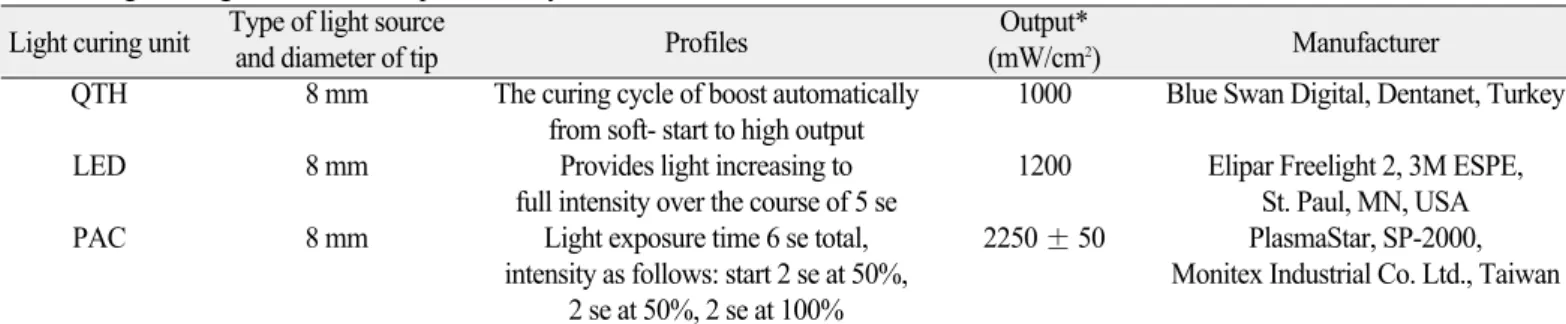
Light curing units used in the present study were given in Table 1. The power outputs from a QTH LCU (Blue Swan Digital, Dentanet, Ankara, Turkey), LED LCU (Elipar Freelight 2, 3M Espe, St. Paul, MN, USA) and PAC LCU (PlasmaStar, SP-2000, Monitex, Taiwan) were approved by a hand-held radiometer (Demetron, Kerr, Orange, CA, USA). The irradiation was per- formed top through the zirconia specimens. Then, the light trans- mission value of each thickness was measured by placing the disc on the aperture of the radiometer and recording the average of resultant light readings through the disc. Then transmittance percentage was calculated for each thickness.
Two-way analysis of variance (ANOVA) and Tukey's post- hoc tests were performed to determine the effects of different
zirconia thicknesses and LCUs on light transmittance (α
=.05).
RESULTS
The mean transmittance values and standard deviations for specimens are shown in Fig. 1. Statistical analysis demonstrated that different zirconia thickness and light curing unit had significant effects on light transmission percentage values (P<.001). Furthermore, no significant two factor interaction between zirconia thickness and LCUs was observed (P<.177).
Tukey's post-hoc test revealed that there were significant dif- ferences between LCUs (P<.001). Additionally, the trans- mitted light with respect to LCU can be ranked as follows: LED
> PAC > QTH. According to the zirconia thickness, the per- centage of light transmittance was ranked as follows: 0.3 mm > 0.5 mm > 0.8 mm (P<.001). As a result, percentage of light transmittance was decreased with the increase in thick- ness of zirconia disc.
Table 1. Light curing units used in the present study Light curing unit Type of light source
Profiles Output*
Manufacturer
and diameter of tip (mW/cm2)
QTH 8 mm The curing cycle of boost automatically 1000 Blue Swan Digital, Dentanet, Turkey from soft- start to high output
LED 8 mm Provides light increasing to 1200 Elipar Freelight 2, 3M ESPE,
full intensity over the course of 5 se St. Paul, MN, USA
PAC 8 mm Light exposure time 6 se total, 2250 ± 50 PlasmaStar, SP-2000,
intensity as follows: start 2 se at 50%, Monitex Industrial Co. Ltd., Taiwan 2 se at 50%, 2 se at 100%
*According to the manufacturer's information.
Fig. 1. Mean light transmittance (%) of the zirconia specimens in different thicknesses with different light curing units.
0.3 0.5 0.8 0.3 0.5 0.8 0.3 0.5 0.8 QTH LED PAC 50.00
45.00 40.00 35.00 30.00 25.00 20.00 15.00 10.00 5.00 0.00 Percentage of light transmission (%)
95
Comparison of light transmittance in different thicknesses of zirconia under various light curing units
J Adv Prosthodont 2012;4:93-6
Cekic-Nagas I et al.
DISCUSSION
The first null hypothesis was rejected as statistical analysis revealed differences in light transmittance percentage values after light curing with different LCUs. It is known that inad- equate polymerization of resin cements might be a problem espe- cially under ceramic restorations.9Therefore, to reach maxi- mum physical properties of resin cements; the conversion rate should be as high as possible.11In the present study, to simu- late clinical conditions, the LCUs were used at the top of the zirconia discs, where the end of the light guide was in contact with the discs.
Previous studies reported mechanical properties of LED LCU polymerized resin composites are as well or better than some QTH LCUs.8,12 Similarly, in the present study, light transmittance values obtained with LED LCU were higher than that of QTH LCUs. Furthermore, PAC LCUs are often discussed as an alternative to high-power LED and QTH LCUs.13A pre- vious study by Rasetto et al. indicated that, PAC polymerization units had comparable light transmission values when compared with QTH LCUs.3In accordance with these previous studies, the present study indicated comparable light transmittance val- ues of PAC LCUs with LED LCUs which are higher than that of QTH LCUs. The special spectrum of the PAC, which has very high light intensities (2250 ± 50 mW/cm2) at certain wave- lengths, might have caused this better outcome.
A previous study by Price et al. investigated the effects of dif- ferent LCUs on resin polymerization and the results were explained by a formula that indicated the total energy that reached the resin composite.14With reference to that formula, when the PAC LCU delivered 2200 mW/cm2and was used for 10 s, the resin-based material under the restoration should have received 22 J/cm2, after light transmission. Moreover, when both the QTH LCU which delivered 1000 mW/cm2 and the LED LCU which delivered 1200 mW/cm2were used for 20 s, the resin- based material under the restoration might have received 20 J/cm2 and 24 J/cm2, respectively (assuming that the same wavelengths are delivered). This could provide an explanation about the rank of LCUs for the present study (LED > PAC >
QTH).
The second null hypothesis that the light transmittance of zir- conia decreases when the thickness is increased should be reject- ed, as the different thicknesses of zirconia had a significant effect on light transmittance values of the tested zirconia speci- mens. This finding corroborates with the results of a previous pilot study by Rasetto et al., suggesting the decrease in light transmittance with the increase in thickness of the ceramic.3 In addition, a previous study by O'Keefe et al. indicated that the thickness of the porcelain veneer was the primary factor affecting the light transmission of the restoration.15
Traditional luting agents might provide adequate retention for cementation of zirconium oxide restorations. However, a
previous study indicated that cementation with dual-cured lut- ing agents is necessary for ensuring better retention and mar- ginal adaptation.16With the increase in zirconia thickness, the decreased light transmittance might have an effect on the mechanical properties of the cements.
In the current study, uniform thicknesses of zirconia speci- mens have been used. However, in a clinical condition, the zir- conia restoration thickness may vary at different regions of tooth.
Therefore, although the tip of the LCU seems to be in direct contact with the restoration surface, the distance between the tip and the surface of the luting material can vary marked- ly over the entire restoration. Accordingly, the differences in restoration translucency might have an effect on the light transmission. Consequently, the optical behavior of zirco- nia restorations with respect to thickness should also be tak- en into consideration when the resin-based material is select- ed for luting of these restorations.
CONCLUSION
Within the limitations of this in vitro study, the following con- clusions could be drawn:
1. Percentage of transmitted light was dependent on LCU.
Moreover, light transmission through even thin zirco- nia copings appears to be achievable with LED LCUs when compared with PAC and QTH LCUs.
2. Light transmission through the zirconia copings was reduced with increased coping thicknesses for all three LCUs.
REFERENCES
1. Turp V, Sen D, Poyrazoglu E, Tuncelli B, Goller G. Influence of zirconia base and shade difference on polymerization efficiency of dual-cure resin cement. J Prosthodont 2011;20:361-5.
2. Shiraishi T, Wood DJ, Shinozaki N, van Noort R. Optical properties of base dentin ceramics for all-ceramic restorations.
Dent Mater 2011;27:165-72.
3. Rasetto FH, Driscoll CF, Prestipino V, Masri R, von Fraunhofer JA. Light transmission through all-ceramic dental materials: a pilot study. J Prosthet Dent 2004;91:441-6.
4. Touati B, Miara P. Light transmission in bonded ceramic restorations. J Esthet Dent 1993;5:11-8.
5. Heffernan MJ, Aquilino SA, Diaz-Arnold AM, Haselton DR, Stanford CM, Vargas MA. Relative translucency of six all- ceramic systems. Part I: core materials. J Prosthet Dent 2002;88:
4-9.
6. Baldissara P, Llukacej A, Ciocca L, Valandro FL, Scotti R.
Translucency of zirconia copings made with different CAD/CAM systems. J Prosthet Dent 2010;104:6-12.
7. Jung H, Friedl KH, Hiller KA, Furch H, Bernhart S, Schmalz G.
Polymerization efficiency of different photocuring units through ceramic discs. Oper Dent 2006;31:68-77.
8. Ceballos L, Fuentes MV, Tafalla H, Mart′lnez A, Flores J, Rodrl′guez J. Curing effectiveness of resin composites at different exposure times using LED and halogen units. Med Oral Patol Oral Cir Bucal 2009;14:E51-6.
9. Jung H, Friedl KH, Hiller KA, Furch H, Bernhart S, Schmalz G.
Polymerization efficiency of different photocuring units through ceramic discs. Oper Dent 2006;31:68-77.
96
Comparison of light transmittance in different thicknesses of zirconia under various light curing units
J Adv Prosthodont 2012;4:93-6 Cekic-Nagas I et al.
10. Koran P, Ku¨rschner R. Effect of sequential versus continuous irradiation of a light-cured resin composite on shrinkage, viscosity, adhesion, and degree of polymerization. Am J Dent 1998;11:17- 22.
11. Jung H, Friedl KH, Hiller KA, Haller A, Schmalz G. Curing ef- ficiency of different polymerization methods through ceramic restorations. Clin Oral Investig 2001;5:156-61.
12. Mobarak E, Elsayad I, Ibrahim M, El-Badrawy W. Effect of LED light-curing on the relative hardness of tooth-colored restorative materials. Oper Dent 2009;34:65-71.
13. Cekic I, Ergun G, Lassila LV, Vallittu PK. Ceramic-dentin bonding: effect of adhesive systems and light-curing units. J Adhes
Dent 2007;9:17-23.
14. Price RB, Felix CA, Andreou P. Effects of resin composite com- position and irradiation distance on the performance of curing lights. Biomaterials 2004;25:4465-77.
15. O'Keefe KL, Pease PL, Herrin HK. Variables affecting the spectral transmittance of light through porcelain veneer samples.
J Prosthet Dent 1991;66:434-8.
16. de Oyagu¨e RC, Monticelli F, Toledano M, Osorio E, Ferrari M, Osorio R. Influence of surface treatments and resin cement selection on bonding to densely-sintered zirconium-oxide ceramic.
Dent Mater 2009;25:172-9.