Association of Polymorphism in MicroRNA 604 with
Susceptibility to Persistent Hepatitis B Virus Infection and Development of Hepatocellular Carcinoma
MicroRNA polymorphisms may be associated with carcinogenesis or immunopathogenesis of infection. We evaluated whether the mircoRNA-604 (miR-604) polymorphism can affect the persistence of hepatitis B virus (HBV) infection, and the development to hepatocellular carcinoma (HCC) in patients with chronic HBV infection. A total of 1,439 subjects, who have either past or present HBV infection, were enrolled and divided into four groups (spontaneous recovery, chronic HBV carrier without cirrhosis, liver cirrhosis and HCC). We genotyped the precursor miR-604 genome region polymorphism. The CC genotype of miR-604 rs2368392 was most frequently observed and T allele frequency was 0.326 in all study subjects. The HBV persistence after infection was higher in those subjects with miR-604 T allele (P = 0.05 in a co-dominant and dominant model), which implied that the patients with miR-604 T allele may have a higher risk for HBV chronicity. In contrast, there was a higher rate of the miR-604 T allele in the chronic carrier without HCC patients, compared to those of the HCC patients (P = 0.03 in a co-dominant model, P = 0.02 in a recessive model). The T allele at miR-604 rs2368392 may be a risk allele for the chronicity of HBV infection, but may be a protective allele for the progression to HCC in chronic HBV carriers.
Keywords: Hepatitis B Virus; Carcinoma, Hepatocellular; MicroRNAs; Polymorphism Jae Youn Cheong,1 Hyoung Doo Shin,2
Sung Won Cho,1 and Yoon Jun Kim3
1Department of Gastroenterology, Ajou University School of Medicine, Suwon; 2Department of Life Science, Sogang University, Seoul; 3Department of Internal Medicine and Liver Research Institute, Seoul National University College of Medicine, Seoul, Korea
Received: 19 May 2014 Accepted: 5 July 2014 Address for Correspondence:
Yoon Jun Kim, MD
Department of Internal Medicine, Seoul National University College of Medicine, 103 Daehak-ro, Jongno-gu, Seoul 110-799, Korea
Tel: +82.2-2072-3081, Fax: +82.2-743-6701 E-mail: [email protected]
Funding: This study was supported by grants from the SNUH Research Fund (03-2010-016), the Basic Science Research Program (2010-0009943) and the Basic Research Laboratory program through the National Research Foundation of Korea funded by the Ministry of Education, Science and Technology (2010-0001200).
http://dx.doi.org/10.3346/jkms.2014.29.11.1523 • J Korean Med Sci 2014; 29: 1523-1527
INTRODUCTION
Hepatocellular carcinoma (HCC) is one of the most commonly diagnosed cancers and the third leading cause of cancer-relat- ed deaths worldwide (1). Chronic infection of hepatitis B virus (HBV) and hepatitis C virus (HCV) are the most important causes of cirrhosis and HCC. In Korea, HBV is the leading cause of cir- rhosis and HCC (2). Screening with ultrasound and alpha feto- protein is hindered by suboptimal sensitivity and specificity.
Thus, identification of markers that are associated with an in- creased risk of HCC would better define the populations with highest risk for HCC.
Increasing evidence indicates that genetic variation in the regulatory regions could be a major contributor to phenotyptic diversity in the human population (3). MicroRNAs (miRNAs) are a class of single-stranded non-coding RNAs of 19-25 nucle- otides, in length, in their mature form that act as posttranscrip- tional regulators of gene expression (4). MiRNA has emerged as novel players in the control of genes expression in cancer. It has been hypothesized that polymorphisms in pre-miRNA may in-
fluence the miRNA maturation, and thereby, modulate miRNA expression. Because each miRNA has numerous targets, inher- ited minor variations in miRNA expression could have impor- tant consequences on the expression of various protein-coding oncogenes and tumor suppressors. Recently, a pre-miRNA sin- gle nucleotide polymorphism (SNP) in miR-196a2 was found to be associated with survival in individuals with non-small cell lung cancer (5). Another case-control study in Chinese women, with breast cancer, identified the rs11614913 (T > C) polymor- phism in miR-196a2 and an A > G SNP (rs3746444) in miR-499 were associated with a significantly increased risk of breast can- cer susceptibility (6).
Pre-miRNA polymorphism, which is associated with cancers, has been reported, but studies on miR-604 are rare. The associ- ation between miR-604 SNP and cancer development or recur- rence or survival was recently performed in patients with renal cell carcinoma (7) and oropharyngeal cancer (8), as well as co- lon cancer (9), but they showed negative results. To date, the role of miR-604 genetic variants in HCC susceptibility and dis- ease progression in patients with HBV infection has not been
reported. We thought that it is worthy to elucidate whether miR- 604 SNP is associated with the susceptibility to HCC develop- ment, because microRNA can affect to tumorigenesis in organ specific manner.
To identify genetic factors, that are associated with HBV-re- lated HCC and progression of HBV-related chronic liver dis- ease, we conducted an association study that analyzes miR-604 SNP in DNA isolated from peripheral blood.
MATERIALS AND METHODS Study patients
To serve as primary patients for the case-control study, a total of 1,439 individuals, having either past or present evidence of HBV infection, were recruited from the outpatient clinic of the liver unit and the Center for Health Promotion Center at Seoul National University Hospital, as well as Ajou University Hospi- tal. Spontaneously recovered subjects were defined by a repeat- ed seropositivity for both anti-HBs (antibody to hepatitis B sur- face antigen) and anti-HBc (antibody to hepatitis B core anti- gen) of the IgG type without HBsAg (10). The chronic carrier group was evaluated further for disease progression to cirrhosis or occurrence of HCC. Patients with chronic HBV infection had followed up regularly with serum alpha-fetoprotein level, ab- dominal ultrasonography, and/or a 4-phase spiral liver CT scan of more than twice a year for HCC screening. Dynamic contrast enhanced abdominal MRI, bone scans, chest CT, brain MRI, brain CT, hepatic angiography, or PET scan was also carried out in selected cases based on the clinical requirement.
Diagnosis of HCC was based on imaging findings of nodules that were larger than 1 cm, showing intense arterial uptake, fol- lowed by washout of contrast in the venous-delayed phases, in a 4-phase multi-detector CT scan or dynamic contrast enhanced MRI and/or biopsy (11). Cirrhosis of the liver was diagnosed ei- ther by liver biopsy or based on the clinical evidence of portal hypertension (esophageal varices, palpable splenomegaly and definite findings of cirrhotic liver or ascites by untrasonography).
The age of onset of HCC was determined, according to the date of initial diagnosis.
Exclusion criteria for the study patients included the follow- ing: 1) tested positive for anti-HBs, but not for anti-HBc; 2) test- ed positive for anti-HCV or anti-HIV (GENEDIA®; Greencross Life Science Corp., Yongin-shi, Korea, HCV®3.2; Dong-A Phar- maceutical Co., Seoul, Korea); 3) average alcohol consumption of ≥ 10 g/day or an average number of ≥ 1 cigarette pack(s) smoked daily, which was assessed through individual inter- views; and 4) incurrence of other types of liver diseases, such as autoimmune hepatitis, toxic hepatitis, hemochomatosis, Wil- son’s disease, non-alcoholic steatohepatitis, primary biliary cir- rhosis, or Budd-Chiari syndrome. None of the patients had pre- vious history of immunosuppressant or anti-viral treatment.
Genotyping of miR-604 genome region polymorphism, rs2368392
Using the Wizard genomic DNA purification kit (Promega, Ma- dison, WI, USA), genomic DNA was extracted from patients’
peripheral blood samples. SNP genotyping was performed us- ing the TaqMan® (12) assay in the ABI prism 7900HT sequence detection system (Applied Biosystems, Foster City, CA, USA), as previously described (10). Genotyping quality control was per- formed in 10% of the samples, by duplicate checking (rate of concordance in duplicates = 100%). Assay IDs of rs2368392 was
‘C__16218215_10’ (Applied Biosystems).
Statistical analyses
To determine the association of rs2368392, with hepatitis B vi- rus (HBV) clearance, and hepatocellular carcinoma (HCC) oc- currence, the odds ratio (95% confidence interval) was calcu- lated using logistic analysis adjusted for age (continuous value) and sex (male = 0, female = 1), as covariates to eliminate or re- duce any confounds that might influence the findings. Data was managed and analyzed, using the Statistical Analysis Sys- tem (SAS) version 9.1 (SAS Inc., Cary, NC, USA).
Ethics statement
The study protocol was reviewed and approved by the institu- tional review board for human research at Seoul National Uni- versity Hospital (H-1007-049-323) and Ajou University Hospital (AJIRB-GN2-11-003). The written consent was acquired from the patients prior to conducting the study.
RESULTS
Clinical profiles of the study patients
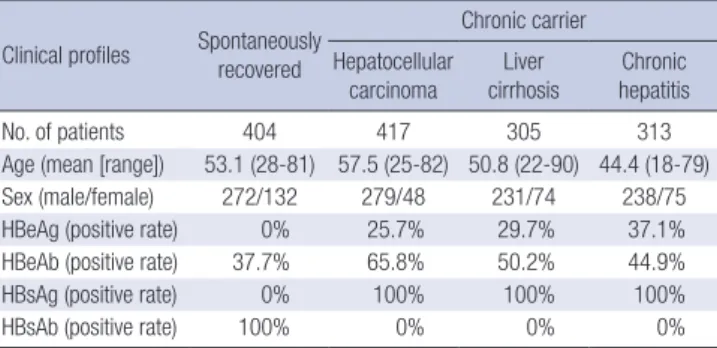
Baseline demographics of study subjects are shown in Table 1.
In total, 1,439 Korean subjects were included in this study and classified into two groups: 404 spontaneously recovered (SR) subjects and 1,035 chronic HBV carriers. Chronic HBV carriers were composed of 313 chronic hepatitis B, 305 liver cirrhosis and 417 HCCs (Table 1). In chronic carrier group, patients with more progressive status tended to be older and had higher male to female ratio and lower hepatitis Be antigen (HBeAg) positivity.
Table 1. Clinical profiles of the study patients Clinical profiles Spontaneously
recovered
Chronic carrier Hepatocellular
carcinoma
Liver cirrhosis
Chronic hepatitis
No. of patients 404 417 305 313
Age (mean [range]) 53.1 (28-81) 57.5 (25-82) 50.8 (22-90) 44.4 (18-79)
Sex (male/female) 272/132 279/48 231/74 238/75
HBeAg (positive rate) 0% 25.7% 29.7% 37.1%
HBeAb (positive rate) 37.7% 65.8% 50.2% 44.9%
HBsAg (positive rate) 0% 100% 100% 100%
HBsAb (positive rate) 100% 0% 0% 0%
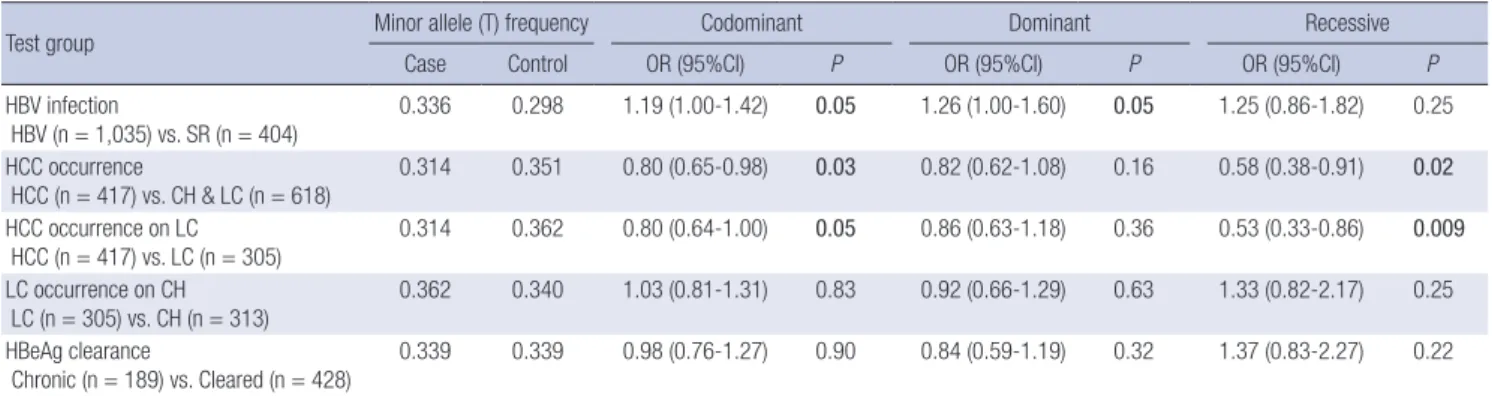
Table 2. Association analysis of rs2368392 (C>T) on pre-miRNA, mir-604 with risk of liver disease in Korean (n=1,439)
Test group Minor allele (T) frequency Codominant Dominant Recessive
Case Control OR (95%CI) P OR (95%CI) P OR (95%CI) P
HBV infection
HBV (n = 1,035) vs. SR (n = 404)
0.336 0.298 1.19 (1.00-1.42) 0.05 1.26 (1.00-1.60) 0.05 1.25 (0.86-1.82) 0.25 HCC occurrence
HCC (n = 417) vs. CH & LC (n = 618) 0.314 0.351 0.80 (0.65-0.98) 0.03 0.82 (0.62-1.08) 0.16 0.58 (0.38-0.91) 0.02 HCC occurrence on LC
HCC (n = 417) vs. LC (n = 305) 0.314 0.362 0.80 (0.64-1.00) 0.05 0.86 (0.63-1.18) 0.36 0.53 (0.33-0.86) 0.009 LC occurrence on CH
LC (n = 305) vs. CH (n = 313)
0.362 0.340 1.03 (0.81-1.31) 0.83 0.92 (0.66-1.29) 0.63 1.33 (0.82-2.17) 0.25 HBeAg clearance
Chronic (n = 189) vs. Cleared (n = 428) 0.339 0.339 0.98 (0.76-1.27) 0.90 0.84 (0.59-1.19) 0.32 1.37 (0.83-2.27) 0.22 Minor allele frequencies and P values for logistic analyses of three alternative models (co-dominant, dominant, and recessive models) are shown. HBV, hepatitis B virus; HCC, hepatocellular carcinoma; CH, chronic hepatitis; LC, liver cirrhosis; SR, spontaneously recovered; HBeAg, hepatitis Be antigen.
Fig. 1. Nucleotide sequence of miR-604 on chromosome 10p11.23. rs2368392 is marked with arrow head. The frequency in parentheses was based on the genotyping data (n = 1,439). The mature miRNA sequence is underlined.
Genotype and minor allele frequency of pre-miRNA 604 SNP (rs2368392) in Korean population
Fig. 1 shows schematic gene map and SNP. Nucleotide sequence of miR-604 on chromosome 10p11.23 (rs2368392) is marked with an arrow head (Fig. 1). The frequency in parentheses was based on the genotyping data. They were transcribed from chro- mosome 10 and their coordinate in human genome build 37 was 20834003, which had CC, CT, and TT genotypes. The geno- type distributions of miR-604 rs2368392, in enrolled subjects, are as follows; CC genotype (46.4%), CT genotype (42.0%) and TT genotype (11.5%). The minor allele frequency of rs2368392 C > T was 0.326 and its heterozygosity was 0.439. The P value of deviation, from Hardy-Weinberg Equilibrium among sponta- neously recovered group, was 0.229.
Association analysis of rs2368392 on pre-miRNA, miR-604 with risk of liver disease in Korean population
Table 2 shows the genotype distribution in the HCC and chron- ic HBV carrier, without HCC (chronic hepatitis or liver cirrho- sis) groups.
First, we analyzed association of SNPs on pre-miRNA, miR- 604 with risk of HBV persistence. Patients with T allele at pre- miRNA rs2368392 had a 1.19 odds of persistent HBV infection, and the rs2368392 C > T was found to be marginally associated with persistence of HBV infection (OR, 1.19; 95% CI, 1.00-1.42;
P = 0.05 in a co-dominant model, and OR, 1.26; 95% CI, 1.00-
1.60; P = 0.05 in a dominant model) (Table 2).
Next, we performed an association analysis of rs2368392 poly- morphisms, and the presence of HCC among patients with chron- ic HBV infection. There was a higher rate of the C allele in the HCC patients, compared to that of the chronic HBV infection without HCC patients. On the basis of unconditional logistic re- gression analysis, with adjustment for age and gender, rs2368392 T allele has protective effects on HCC occurrence (OR, 0.80;
95% CI, 0.65-0.98; P = 0.03 in a co-dominant model, and OR, 0.58; 95% CI, 0.38-0.91; P = 0.02 in a recessive model). Further, rs2368392 T allele also showed protective effect to the occur- rence of HCC in liver cirrhosis group (OR, 0.80; 95% CI, 0.64- 1.00; P = 0.05 in a co-dominant model, and OR, 0.53; 95% CI, 0.33-0.86; P = 0.009 in a recessive model).
However, we observed no statistically significant association between rs2368392 C > T SNP and the disease progression to cirrhosis or HBeAg clearance in patients with chronic HBV in- fection.
DISCUSSION
In this study, we analyzed SNP in the genomic region of miR- NA, as candidate loci for HBV related disease progression and HCC susceptibility in the association studies. We examined whether the miR-604 genotype correlated with the HBV persis- tence and the risk for HCC in patients with HBV related chronic hepatitis or cirrhosis and spontaneously recovered individuals.
We identified T allele in pre- miR-604 rs2368392 was associated with persistence of HBV infection and reduced HCC risk in pa- tients with chronic HBV infection. Our findings provide geno- mic implication that miR-604 polymorphism may play a role in the development of liver cancer and in the natural course of HBV infection.
There are several investigations in regards to HCC and miR- NA related genes. Recent studies imply considerable importance for both miR-155 and miR-21 in non-alcoholic steatohepatitis- associated HCC (13, 14), miR-96 in HBV associated HCC (15),
and miR-126 in alcohol-induced HCC (16). MiR-143 induced by NF-κB was found to be significantly up-regulated in HBV-re- lated metastatic HCC (17). Moreover, marked up-regulation of miR-30d in metastatic HCC has been shown to enhance migra- tion and invasion of HCC cells, and to promote intra-hepatic and distal pulmonary metastasis in an orthotopic mouse model (18).
Polymorphisms, which may affect miRNA mediated regula- tion of the cell, can be present not only in the 3´ UTR of miRNA target gene, but also in the genes involved in miRNA biogenesis, and in processed miRNAs. Genetic variation, in miRNA genes and their biogenesis pathway, has the potential to affect the regulation of multiple cellular pathways in cancer development and susceptibility (5, 19). Polymorphisms in miRNA related genes also have been implicated in HCC susceptibility. A G > C polymorphism in miR-146a precursor (rs2910164) predicted HCC development (20), and male individuals with GG geno- type were two fold more susceptible to HCC, compared with those with CC genotype. An insertion/deletion polymorphism at miRNA-122 binding site interleukin-1 alpha 3´ UTR confers risk for HCC (21). Qi et al, reported that miR-196a-2 rs11614913 was associated with susceptibility to HBV-related HCC in Chi- nese male population (22).
In this case-control study for the Korean population, we found that rs2368392 T allele on pre-miRNA, miR-604, was a protec- tive factor for the occurrence of HCC in patients with HBV re- lated chronic liver disease. This study presents supporting evi- dence that miR-604 variants might be useful for identifying pa- tients at high risk for progression to HBV-related HCC.
The natural history of HBV infection varies according to the age at which the infection was contracted (23). Although HBV infection age is important as a contributing factor to the natural course of HBV infection, it is unlikely to solely explain the HBV persistence, especially in the population whose transmission route is vertical infection, means almost all individuals had been exposed to the virus at the same age. In our study, the chronici- ty of HBV infection was higher in subjects with miR-604 T allele, compared with that of the subjects with C allele, which implies that the patients with miR-604 T allele may have a higher risk for HBV persistence, even though the statistical significance was marginal.
In addition to the association with viral resolution, SNP of miR-604 showed an association to the development of HCC in our work. Interestingly, T allele was associated with the persis- tence of HBV infection, but in contrast, it was a protective factor for the development of HCC. The involvement of the immune system in HCC development has been previously suggested and increased activity of the helper T cells, which promote in- flammation, is associated with HCC (24). Furthermore, chronic inflammation has been implicated in the development of HCC (25, 26). Thus, polymorphisms of miR-604 may have opposite
roles in HBV eradication and HCC development in view of im- mune response. Unfortunately, functional mechanism and bio- logical plausibility of miR-604 associated with the development of HCC/HBV clearance is not addressed by this study. The func- tion of miR-604 in cancer has not been studied extensively and it remains to be defined whether miR-604 function to modulate host immunity to eradicate virus during the early stage of infec- tion or function through other mechanisms. The role of miR-604 in HBV resolution and hepatocarcinogenesis should be clari- fied in the future.
In conclusion, the present investigation indicated that the pre-miR-604 rs2368392 polymorphism might confer genetic susceptibility to the occurrence of HCC in HBV related chronic liver disease, and HBV persistence after HBV infection. Such screening test may allow identification of individuals at increas- ed risk of HCC for more intensive monitoring. Larger well-de- signed epidemiological studies, with ethnically diverse popula- tions and functional evaluations, are warranted to confirm our findings.
ACKNOWLEDGEMENTS
The biospecimens from Ajou University Hospital were provided by the Ajou Human Bio-Resource Bank (AHBB), a member of the National Biobank of Korea, which is supported by the Min- istry of Health and Welfare.
DISCLOSURE
We have nothing to declare in terms of conflicts of interest in this study
ORCID
Jae Youn Cheong http://orcid.org/0000-0001-6246-1783 Sung Won Cho http://orcid.org/0000-0002-0232-0492 Hyoung Doo Shin http://orcid.org/0000-0003-1732-7838 Yoon Jun Kim http://orcid.org/0000-0001-9141-7773 REFERENCES
1. Won YJ, Sung J, Jung KW, Kong HJ, Park S, Shin HR, Park EC, Ahn YO, Hwang IK, Lee DH, et al. Nationwide cancer incidence in Korea, 2003- 2005. Cancer Res Treat 2009; 41: 122-31.
2. Kwon SY, Lee CH. Epidemiology and prevention of hepatitis B virus in- fection. Korean J Hepatol 2011; 17: 87-95.
3. Knight JC. Regulatory polymorphisms underlying complex disease traits.
J Mol Med (Berl) 2005; 83: 97-109.
4. Filipowicz W, Bhattacharyya SN, Sonenberg N. Mechanisms of post-tran- scriptional regulation by microRNAs: are the answers in sight? Nat Rev Genet 2008; 9: 102-14.
5. Hu Z, Chen J, Tian T, Zhou X, Gu H, Xu L, Zeng Y, Miao R, Jin G, Ma H,
et al. Genetic variants of miRNA sequences and non-small cell lung can- cer survival. J Clin Invest 2008; 118: 2600-8.
6. Hu Z, Liang J, Wang Z, Tian T, Zhou X, Chen J, Miao R, Wang Y, Wang X, Shen H. Common genetic variants in pre-microRNAs were associated with increased risk of breast cancer in Chinese women. Hum Mutat 2009;
30: 79-84.
7. Lin J, Horikawa Y, Tamboli P, Clague J, Wood CG, Wu X. Genetic varia- tions in microRNA-related genes are associated with survival and recur- rence in patients with renal cell carcinoma. Carcinogenesis 2010; 31: 1805- 12.
8. Clague J, Lippman SM, Yang H, Hildebrandt MA, Ye Y, Lee JJ, Wu X. Ge- netic variation in MicroRNA genes and risk of oral premalignant lesions.
Mol Carcinog 2010; 49: 183-9.
9. Boni V, Zarate R, Villa JC, Bandrés E, Gomez MA, Maiello E, Garcia-Fon- cillas J, Aranda E. Role of primary miRNA polymorphic variants in met- astatic colon cancer patients treated with 5-fluorouracil and irinotecan.
Pharmacogenomics J 2011; 11: 429-36.
10. Cheong JY, Shin HD, Kim YJ, Cho SW. Association of polymorphism in MicroRNA 219-1 with clearance of hepatitis B virus infection. J Med Vi- rol 2013; 85: 808-14.
11. Bruix J, Sherman M. Management of hepatocellular carcinoma: an up- date. Hepatology 2011; 53: 1020-2.
12. Livak KJ. Allelic discrimination using fluorogenic probes and the 5’ nu- clease assay. Genet Anal 1999; 14: 143-9.
13. Vinciguerra M, Sgroi A, Veyrat-Durebex C, Rubbia-Brandt L, Buhler LH, Foti M. Unsaturated fatty acids inhibit the expression of tumor sup- pressor phosphatase and tensin homolog (PTEN) via microRNA-21 up- regulation in hepatocytes. Hepatology 2009; 49: 1176-84.
14. Wang B, Majumder S, Nuovo G, Kutay H, Volinia S, Patel T, Schmittgen TD, Croce C, Ghoshal K, Jacob ST. Role of microRNA-155 at early stages of hepatocarcinogenesis induced by choline-deficient and amino acid- defined diet in C57BL/6 mice. Hepatology 2009; 50: 1152-61.
15. Ladeiro Y, Couchy G, Balabaud C, Bioulac-Sage P, Pelletier L, Rebouis- sou S, Zucman-Rossi J. MicroRNA profiling in hepatocellular tumors is associated with clinical features and oncogene/tumor suppressor gene mutations. Hepatology 2008; 47: 1955-63.
16. Morgan TR, Mandayam S, Jamal MM. Alcohol and hepatocellular car- cinoma. Gastroenterology 2004; 127: S87-96.
17. Zhang X, Liu S, Hu T, He Y, Sun S. Up-regulated microRNA-143 transcrib- ed by nuclear factor kappa B enhances hepatocarcinoma metastasis by repressing fibronectin expression. Hepatology 2009; 50: 490-9.
18. Yao J, Liang L, Huang S, Ding J, Tan N, Zhao Y, Yan M, Ge C, Zhang Z, Chen T, et al. MicroRNA-30d promotes tumor invasion and metastasis by targeting Galphai2 in hepatocellular carcinoma. Hepatology 2010;
51: 846-56.
19. Yang H, Dinney CP, Ye Y, Zhu Y, Grossman HB, Wu X. Evaluation of ge- netic variants in microRNA-related genes and risk of bladder cancer. Can- cer Res 2008; 68: 2530-7.
20. Xu T, Zhu Y, Wei QK, Yuan Y, Zhou F, Ge YY, Yang JR, Su H, Zhuang SM.
A functional polymorphism in the miR-146a gene is associated with the risk for hepatocellular carcinoma. Carcinogenesis 2008; 29: 2126-31.
21. Gao Y, He Y, Ding J, Wu K, Hu B, Liu Y, Wu Y, Guo B, Shen Y, Landi D, et al. An insertion/deletion polymorphism at miRNA-122-binding site in the interleukin-1alpha 3’ untranslated region confers risk for hepatocel- lular carcinoma. Carcinogenesis 2009; 30: 2064-9.
22. Qi P, Dou TH, Geng L, Zhou FG, Gu X, Wang H, Gao CF. Association of a variant in MIR 196A2 with susceptibility to hepatocellular carcinoma in male Chinese patients with chronic hepatitis B virus infection. Hum Immunol 2010; 71: 621-6.
23. Shimbo S, Zhang ZW, Qu JB, Wang JJ, Zhang CL, Song LH, Watanabe T, Higashikawa K, Ikeda M. Urban-rural comparison of HBV and HCV in- fection prevalence among adult women in Shandong Province, China.
Southeast Asian J Trop Med Public Health 1997; 28: 500-6.
24. Pentcheva-Hoang T, Corse E, Allison JP. Negative regulators of T-cell ac- tivation: potential targets for therapeutic intervention in cancer, autoim- mune disease, and persistent infections. Immunol Rev 2009; 229: 67-87.
25. Mantovani A, Allavena P, Sica A, Balkwill F. Cancer-related inflamma- tion. Nature 2008; 454: 436-44.
26. Park EJ, Lee JH, Yu GY, He G, Ali SR, Holzer RG, Österreicher CH, Taka- hashi H, Karin M. Dietary and genetic obesity promote liver inflamma- tion and tumorigenesis by enhancing IL-6 and TNF expression. Cell 2010;
140: 197-208.