Is There Any Age Cutoff to Treat Elderly Patients with Head and Neck Cancer? Comparing with Septuagenarians and
Octogenarians
With the increase in life expectancy, age is no longer considered as a limitation for treatment. Nevertheless, the treatment of elderly patients with head and neck cancer (HNC) remains controversial. Here, we aimed to review our experience with the treatment for elderly patients, while particularly focusing on the differences among older old patients (septuagenarians vs. octogenarians). We retrospectively reviewed the records of 260 elderly patients who were assigned to 3 groups according to age: 70 years old ≤ group 1 < 75 years old, 75 years old ≤ group 2 < 80 years old, and group 3 ≥ 80 years old. The patients were assessed for comorbidities using the Adult Comorbidity Evaluation (ACE)-27, and the American Society of Anesthesia (ASA) physical status was also compared. Group 1, 2, and 3, consisted of 97, 102, and 61 patients, respectively. No significant difference in demographic data was noted among the groups. However, group 3 showed more comorbidities than groups 1 and 2. With regard to the initial treatment for HNC, radiation therapy (RT) was more frequently performed in group 3 than in groups 1 and 2. Among 7 patients of non- compliant to treatment in group 3, 6 patients had have performed RT. In group 3, a total of 18 patients underwent surgery, including microvascular free flap reconstruction and no significant difference in complications was observed postoperatively compared with group 1 and 2. Moreover, no significant difference was noted in overall survival between the groups, regardless of the treatment modality chosen. In conclusion, octogenarians with HNC should be more carefully managed than septuagenarians with HNC. Surgical treatment can be considered in octogenarians with HNC, if it can be tolerated.
Keywords: Head and Neck Neoplasms; Geriatric Assessment; Surgical Procedures, Operative; Radiation Oncology
Heejin Kim,1 Seong Dong Kim,2 Ye Ji Shim,2 Sang Yeon Lee,2
Myung-Whun Sung,2,3 Kwang Hyun Kim,2 and J. Hun Hah2,3
1Department of Otorhinolaryngology-Head and Neck Surgery, Hallym University, Dongtan Sacred Heart Hospital, Hwaseong, Korea; 2Department of Otorhinolaryngology-Head and Neck Surgery, Seoul National University College of Medicine, Seoul, Korea; 3Cancer Research Institute, Seoul National University College of Medicine, Seoul, Korea Received: 15 September 2015
Accepted: 20 April 2016 Address for Correspondence:
J. Hun Hah, MD
Department of Otorhinolaryngology-Head and Neck Surgery and Cancer Research Institute, Seoul National University College of Medicine, 101 Daehak-ro Jongno-gu, Seoul 03080, Korea E-mail: [email protected]
http://dx.doi.org/10.3346/jkms.2016.31.8.1300 • J Korean Med Sci 2016; 31: 1300-1306
INTRODUCTION
Due to lower birth rates and better healthcare, the average age of the world’s population has increased. In Korea in particular, rapid increases in life expectancy have been observed over the past few decades, with the life expectancy of females increasing from 79.6 years in 2000 to 85.1 years in 2013 (1). This increase in life expectancy is closely related in the case of various cancers, since about 60% of all tumors arise in patients who are older than 65 years. Furthermore, 70% of all deaths due to cancer oc- cur in elderly patients (2-4). Although the majority of cases with head and neck cancer (HNC) occur between the fifth and sixth decade of life, the onset of the disease in patients older than 60 years is common (4), with up to 24% of HNC cases diagnosed in patients older than 70 years (2,3). Due to the increase in life expectancies as well as the improvements in global cancer care and survival rates, the traditional age limit of 65 years used by the European Organization for Research and Treatment of Can- cer (EORTC) has been challenged in recent years. Moreover,
sub-categories of “younger old” (65-70 years old) and “older old” (> 80 years old) have been introduced to allow for the allo- cation of elderly patients with cancer to homogenous patient groups (5).
Because of the complexity of the anatomy and function of head and neck region and aggressive features of tumor arising head and neck area, the treatment of HNC is often associated with high morbidity and mortality rates. In general, it is com- mon for elderly patients to display poor physical functions and poor social support. Also, elderly patients with HNC tend to dis- play numbers of comorbidities. As the number of elderly patients with HNC increases, head and neck surgeons are increasingly faced with a therapeutic dilemma.
In fact, several studies indicate that older patients with HNC are less likely to receive curative treatment compared to their younger counterparts (6-9). However, a number of recent stud- ies have shown that radical surgical or radiotherapy treatment can be performed safely in elderly patients without an increase in overall complication rates, provided that the patients do not Otorhinolaryngology
have severe comorbidities; these findings have led to a number of debates (6-8). In a study evaluating HNC patients who were 80 years of age or older, Italiano et al. (10) reported that, despite their age, overall survival was similar to the actuarial survival for general octogenarian populations, and that there was no significant difference in the frequency of preoperative and post- operative complications compared to younger patients (aged 65 years or younger). Indeed, as has previously been suggested (4,11,12), chronological age alone should not be a contraindi- cation to an aggressive surgical approach, which should be at- tempted whenever the risk assessment ratio is favorable.
It is hard to make a decision of age cutoff to treat radically in HNC patients. In this study, we aim to know which the chrono- logical age would be cutoff to treat HNC comparing septuage- narians and octogenarians by reviewing our treatment strate- gies for elderly patients with HNC. We also analyzed the effect of age on the choice of initial treatment and compliance to treat- ment of HNC patients. We also reviewed our experience with older old patients (octogenarians) with HNC.
MATERIALS AND METHODS
We performed a retrospective analysis of 260 HNC patients aged 70 years or older at the first diagnosis between 2000 and 2012.
Patients who had thyroid cancer and lymphoma were exclud- ed. Patients were divided into 3 groups according to age: group 1 consisted of patients of ages between 70 and 74 years; group 2 consisted of those aged between 75 and 79 years; and group 3 consisted of those who were 80 years of age or older. The follow- up period ranged from 0 to 133.5 months, with a median follow- up period of 29.4 months.
Demographic data such as age, sex, location of primary tu- mor, pathology, and TNM staging were reviewed, in addition to data regarding treatment modalities, treatment compliance, and outcome of treatment (overall survival).
In order to assess the effect of comorbidities on elderly pa- tients, we examined various indices for the general condition of elderly patients using the Adult Comorbidity Evaluation (ACE)- 27 (13) and the American Society of Anesthesiologists’ (ASA) risk classification system. ACE-27 provides a comprehensive review of the condition of the cardiovascular, gastro-intestinal, renal, endocrine, neurological, psychiatric, rheumatologic, and immunological systems, as well as body weight and any report- ed malignancies or substance abuse. Each category contains 3 grades (1, mild; 2, moderate; and 3, severe), with the overall co- morbidity score defined according to the highest ranked single disease. Two or more grade 2 ailments occurring in different organ systems indicate a classification of grade 3. ACE-27 grades were allotted as 0, 1, 2, or 3 in the hospital information system.
A complete ACE-27 data form is available on http://oto.wustl.
edu/clinepi/calc.html (Clinical Outcomes Research Office’s
Website) (14). ACE-27 has been widely validated for HNC (13).
The ASA class of the patient was obtained from the original anesthesia form assigned by the attending anesthesiologist. The latter is an index for perioperative risk; however, it can also be used to evaluate comorbidity as it describes the patient’s physi- cal status prior to surgery (15). ASA classifications are as follows:
class 1, a normal healthy patient; class 2, a patient with mild sys- temic disease; class 3, a patient with severe systemic disease;
class 4, a patient with disease that is a constant threat to life; class 5, a moribund patient who is not expected to survive without surgery; and class 6, a brain-dead patient (14).
Demographic data were subjected to univariate analysis us- ing Fischer’s exact or χ2 tests, and the Mann-Whitney rank sum test. For statistical analysis, a P value less than 0.05 was consid- ered significant. Kaplan-Meier estimates of the cumulative prob- ability of overall survival were obtained. All statistical analyses were conducted using the SPSS software, version 18.0 (SPSS Inc., Chicago, IL, USA)
Ethics statement
The institutional review board at the Seoul National University College of Medicine, Seoul, Korea reviewed and approved the study protocol and exempted the informed consent for this study (IRB No. H-1406-120-591). We performed all procedures in ac- cordance with the tenets of the World Medical Association’s Dec- laration of Helsinki.
RESULTS
Demographic data
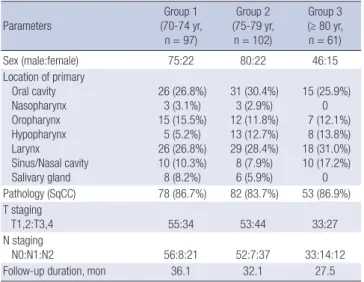
Demographic data of elderly patients with HNC are shown in Table 1. All patients had biopsy-proven HNC and were staged according to the TNM staging of the American Joint Committee
Table 1. Demographic data of elderly patients with head and neck cancer
Parameters Group 1
(70-74 yr, n = 97)
Group 2 (75-79 yr, n = 102)
Group 3 (≥ 80 yr, n = 61)
Sex (male:female) 75:22 80:22 46:15
Location of primary Oral cavity Nasopharynx Oropharynx Hypopharynx Larynx Sinus/Nasal cavity Salivary gland
26 (26.8%) 3 (3.1%) 15 (15.5%)
5 (5.2%) 26 (26.8%) 10 (10.3%) 8 (8.2%)
31 (30.4%) 3 (2.9%) 12 (11.8%) 13 (12.7%) 29 (28.4%) 8 (7.9%) 6 (5.9%)
15 (25.9%) 0 7 (12.1%) 8 (13.8%) 18 (31.0%) 10 (17.2%)
0 Pathology (SqCC) 78 (86.7%) 82 (83.7%) 53 (86.9%) T staging
T1,2:T3,4 55:34 53:44 33:27
N staging
N0:N1:N2 56:8:21 52:7:37 33:14:12
Follow-up duration, mon 36.1 32.1 27.5
SqCC, squamous cell carcinoma.
on Cancer, 7th edition (16). Group 1 consisted of 97 patients, of whom 75 (77.3%) were male and 22 (22.7%) were female; group 2 consisted of 102 patients, of whom 80 (78.4%) were male and 22 (21.6%) were female; and group 3 consisted of 61 patients, of whom 46 (75.4%) were male and 15 (24.6%) were female. The sex ratio of the patients did not show any significant differences between groups (Table 1). In all groups, the majority of patients had squamous cell carcinoma (SCC) according to their patho- logical reports. The primary cancer distribution appeared to be similar in all three groups. However, there was a trend towards a greater number of patients with cancer of the hypopharynx, larynx, and sinus in the oldest patient group (group 3). Interest- ingly, there was no patient with cancer of the nasopharynx and salivary gland in group 3. The distribution of T staging (T1,2/
T3,4) was similar in the 3 groups, whereas an advanced N stage at the first diagnosis was more frequently observed in group 3.
The data associated with comorbidities among the elderly HNC patients are presented in Table 2. Except those in group 3, a few patients in group 1 and 2 were classified as grade 0 accord- ing to the ACE-27. Group 3 consisted of patients with higher ACE-27 and ASA classification indices, and it displayed signifi- cantly more comorbidities such as diabetes, hypertension, or cerebrovascular accidents, compared to the younger groups (groups 1 and 2) (P < 0.005). In group 3, 15 patients (24.6%) were classified as ACE-27 grade 3 and 5 patients (8.2%) were classi- fied as ASA class 4. There was no significant difference in the indices of comorbidity between group 1 and group 2.
Treatment
In total, 180 of 260 patients (69.2%) completed standard treat- ment for HNC, including 70 (72.2%) in group 1, 69 (67.6%) in
group 2, and 41 (67.2%) in group 3 (Fig. 1). Fifty-one patients discontinued treatment for various reasons. In group 3, 13 pa- tients (21.3%) refused to receive any treatment at all, and the re- luctance rate to receive treatment was statistically significantly different between group 1, 2 (septuagenarians) and group 3 (oc- togenarians) (P = 0.006). On the other hand, there was no sig- nificant difference in treatment compliance between group 1 and group 2.
With regard to the initial treatment modality for HNC, group 3 displayed greater preference for radiation therapy (RT) than groups 1 and 2 (Fig. 2). On the other hand, the preference for chemotherapy was relatively low in group 3. Among 51 patients who ceased treatment after it has started, 44 patients belonged to groups 1 and 2. Over half of these (30/51, 58.8%) did not com- plete RT, followed by 12 patients (23.5%) who did not complete concurrent chemo-radiation therapy (CCRT), and 9 patients (17.6%) who did not complete chemotherapy. Among 7 patients who discontinued treatment in group 3, 6 patients did not com- plete RT and 1 patient did not complete CCRT.
Among octogenarian patients, 18 (41.9%) patients chose sur- Table 2. Indices of comorbidities in elderly patients with head and neck cancer; Adult
Comorbidity Evaluation (ACE)-27 and American Society of Anesthesiologists’ (ASA) risk classification system, and numbers of comorbidities in elderly patients
Risk indices
Relatively younger group Older group
P value Group 1
(70-74 yr, n = 97)
Group 2 (75-79 yr, n = 102)
Group 3 (≥ 80 yr, n = 61) ACE-27
0 1 2 3
48 10 14 14
45 12 8 23
0 4 17 15
< 0.005
ASA 1 2 3 4
39 25 7 1
32 29 9 0
12 21 21 5
< 0.005
Past medical history: numbers of diseases (DM, HTN, CVA, etc.) < 0.005
0 52 51 0
1-2 11 11 17
≥ 3 5 5 5
ACE-27, Adult Comorbidity Evaluation-27; ASA, American Society of Anesthesiologists;
DM, diabetes mellitus; HTN, hypertension; CVA, cerebrovascular accident.
(%)
Group 1 Group 2 Group 3 100
80 60 40 20 0
Refuse to treat Discontinue to treat Complete to treat P = 0.612 *P = 0.006
Fig. 1. The differences in treatment compliance ratios between septuagenarian and octogenarian head and neck cancer patients (Group 1: 70-75 years, Group 2: 76-80 years, Group 3: 80 years and older).
Fig. 2. The percentages of treatment modalities which were chosen for initial treat- ment for their head and neck cancer.
(%)
Group 1 Group 2 Group 3
100
50
0
Surgery RT CCRT Chemotherapy
Table 3. Types of operations which performed to age groups with head and neck cancer
Surgical procedure Group 1 Group 2 Group 3
Wide excision ± Neck dissection 20 (38.5%) 16 (32.7%) 8 (44.4%) LMS laser ± Neck dissection 13 (25.0%) 14 (28.6%) 5 (27.7%) Maxillectomy ± Neck dissection 5 (9.6%) 5 (10.2%) 3 (16.6%) Total laryngectomy ± Neck dissection 4 (7.7%) 4 (8.2%) 2 (11.1%) Mandibulectomy ± Neck dissection 5 (9.6%) 6 (12.2%) 1 (5.5%) Reconstruction
Regional flap 2 (3.8%) 2 (40.8%) 2 (11.1%)
Free flap (ALT, Scapular, LD,
Rectus abdominis) 0 5 (10.2%) 4 (22.2%)
LMS, laryngeal microsurgery; ALT, anterolateral thigh; LD, latissimus dorsi.
Fig. 4. Overall survival of elderly patients with head and neck cancer (HNC) following therapeutic intervention. (A) Overall survival of patients who completed treatment for HNC, excluding patients who ceased during treatment. (B) Overall Survival of patients who underwent surgery for their HNC; Group 1 & 2 (septuagenarians) vs. Group 3 (octogenari- ans).
Percent survival
Follow-up months
12 24 36 48 60 100
80 60 40 20 0
Log-rank test: P = 0.107 Group 1 Group 2 Group 3
Log-rank test: P = 0.311
Percent survival
Follow-up months
12 24 36 48 60 100
80 60 40 20 0
Septuagenarians Octogenarians
A B
Fig. 3. Major and minor complications occurring within 1 week after surgery in elder- ly head and neck cancer patients.
No.
Pulmonar y
Cardiovascular
Wound
Neurologic
Genitourinar y 5
4 3 2 1 0
Group 1 Group 2 Group 3
gery as their initial treatment for HNC. Most of these patients had one or more diseases that would affect their general medi- cal condition, and thus, influence the decision on whether to undergo surgery. With the exception of 2 patients, all patients displayed indices associated with ACE-27 grade 1, 2, and 3. In addition, 10 patients were classified as ASA class 3.
Table 3 lists the types of surgeries performed on elderly HNC patients according to age groups. Comparing relatively younger group (group 1 and 2), octogenarians even underwent radical surgery including neck dissection, maxillectomy, mandibulec- tomy, and laryngectomy. Furthermore, 4 of them underwent microvascularized free tissue transfer for reconstruction, includ- ing the use of anterolateral thigh flap, scapular flap, latissimus dorsi flap, and rectus abdominis flap. All patients underwent general anesthesia ranging from 75 to 795 minutes, with a mean anesthesia time of 300 minutes for octogenarians. Eight of the latter patients required a transfusion of 1 or 2 packed red blood cells during operation, and 5 patients were admitted to the sur- gical intensive care unit (SICU) for recovery for a maximum of 2 days. The mean hospitalization time ranged from 3 days to 30 days, with a mean hospitalization of 13 days. Only 1 patient had an intraoperative complication due to a heart rhythm problem
(PAC) after the induction of general anesthesia. Postoperative complications occurred in 9 patients, including 4 patients (22.2%) with major complications in group 3 (Fig. 3). Major postopera- tive complications included pneumonia, arrhythmia, wound infection, and development of a fistula. Genitourinary and pul- monary complications were often occurred in group 3.
During the 22.5 months of median follow-up, the 2-year dis- ease free survival of octogenarians was 52.5% and disease-spe- cific survival was 62.5%. Among the patients who completed the treatment for HNC, there were no significant differences in overall survival between the age groups (Fig. 4). While only con- sidering patients who underwent surgery for HNC, we did not find any difference in survival between septuagenarians and octogenarians. The average 2-year survival of group 3 was 65.7%, which was not significantly different to that in the general octo- genarian population in Korea.
DISCUSSION
It has been reported that HNC often displays aggressive progres- sion and poor prognosis. Treatment decisions for HNC patients are complicated by the fact that the head and neck area is ana-
tomically complex and plays vital physiological roles. From our review of the case history of elderly patients with HNC, we found that the majority of these patients presented with one or more comorbidities that affected the choice of the treatment modali- ty. In general, surgery, RT, and CCRT have long been the major treatment approaches for advanced HNC. However, the man- agement of HNC in a geriatric group is far more complex due to the high toxicity of loco-regional treatments and the high risk of functional deterioration in elderly HNC patients with a high co- morbidity burden and impaired functional status (17). For these reasons, the treatment for HNC of elderly patients represents a global health challenge.
Several studies have reported on the treatment of the geriat- ric population, with variable age limits. First, it is important to clarify what defines a person as “elderly.” This definition has been modified in recent years due to the increasing global life expectancy. In 2014, the life expectancy of Korean females was over 80 years old at birth, and the mean age of our study group was 76.9 years. The classical definition of an elderly person orig- inally referred to individuals who were at least 65 years of age in 1998, and this definition was used by the EORTC in clinical tri- als of radical RT to treat HNC (18). However, at present, an age of 65 years is no longer considered to describe an individual as
“elderly”. There have been many studies about geriatrics, and the definition of “elderly” was variable. Because of differences in efficacy of treatment such as altered pharmacokinetics and dynamics are observed after that age (19), age 70 is a reference point commonly used in clinical trials in oncology (20). We de- fined “elderly” patients were aged ≥ 70 years at the time of di- agnosis, and we sub-divided elderly patients into 3 groups to find any clinical differences between them; age ranged from 70 to 74, 75 to 79, and ≥ 80 years.
In our study groups, the most prevalent primary tumor site was the oral cavity and the larynx, followed by the oropharynx, and hypopharynx. It was concordant with a study of HNC pa- tients who were at least 80 years old (10). While reviewing our groups, there were significant differences of general conditions scaling by ACE-27 and ASA between their seventies and eight- ies or over.
In patients aged over 80 years old, the compliance of treat- ment was also significantly decreased. Among the patients who started to treat their HNC, the preference for surgery was dra- matically decreased in group 3, which was consistent with pre- vious studies of older HNC patients either surgery alone (21) or in combination with RT or CCRT (11). In contrast, RT was the most preferred in group 3. RT was thought to show lower toxici- ty than chemotherapy and thus, RT would be considered as an attractive curative option (alone or with systemic therapy) for elderly patients who refused to undergo surgery due to their frailty. It was supported by several studies which have describ- ed RT as a safe and effective treatment for HNC even in elderly
patients (6,22,23). In addition to the difficulties in terms of the choice of treatment modality for HNC, treatment compliance can also be problematic in elderly patients, due to several fac- tors including progressive loss of stress tolerance, decline in functional reserve of multiple organ systems, high prevalence of comorbid conditions, limited socioeconomic support, re- duced cognition, and higher prevalence of depression (24). Al- though preference of RT as an initial treatment for HNC was high in elderly patients, compliance to RT was poor in our study groups. Even over half of patients who agreed to receive RT even- tually discontinuing treatment. This finding is consistent with a recent study, which reported a treatment compliance of approx- imately 60% for both radical and palliative purposes in elderly patients (24). Since elderly patients had to receive RT 5 times per week, for several weeks in an outpatient clinic in Korea, such prolonged treatment can be an important cause of low compli- ance with RT.
Meanwhile, many studies have suggested that chronological age alone should not be a contraindication to an aggressive sur- gical approach and it should be attempted whenever risk-as- sessment ration is favorable (4,11,12). In addition to aggressive radical surgery, microvascular reconstruction in the elderly can be performed with high success rates even in the octogenarian group (25). In our study, radical surgery such as maxillectomy, mandibulectomy, or laryngectomy and even free microvascu- lar reconstruction were reportedly successfully performed in octogenarian patients. Despite the fact that the latter patients displayed at least 2 comorbidities, they showed no significant postoperative complications associated with these radical sur- geries.
The limitation of this study lies in the fact that the analysis was retrospective and represented the case histories of a rela- tively small number of patients. In addition, our study groups were so heterogeneous to reveal survival differences due to in- cluding all types of HNC. However, the incidence of HNC is rel- atively lower than other malignancies and even elderly patients of HNC are rare. For those reasons, our study has meaning that we can overview the results of treatment and compliances of treatment in elderly HNC patients. Moreover, our study focused on an Asian population, which has shown rapid increases in life expectancy over the past several decades, contrast to previ- ous large-scale studies in Western countries. Previous studies had shown various limitations in the treatment of elderly HNC patients. In our study, we divided a cohort of elderly patients into several groups, and analyzed the difference between elder- ly patients and older old patients. No significant differences were presented between the age groups; however, the tumor stage at the first diagnosis became more advanced as age in- creased. There were no significant differences in comorbidities between patients aged between 70 and 75 years and those aged between 76 and 80 years. However, octogenarians had signifi-
cantly more comorbidities than septuagenarians.
With regard to care for patients with HNC, octogenarians should receive special attention because they have more co- morbidities than septuagenarians. Despite being octogenarians and having several comorbidities, most of these patients were treated with surgical procedures without significant complica- tions. RT is preferred to various other treatment modalities, and yields several advantages for elderly patients. Considering the low compliance of patients to RT and its prolonged treatment duration, surgery for octogenarians would be an excellent treat- ment option whenever the risk assessment ratio is determined to be favorable.
DISCLOSURE
The authors have no potential conflicts of interest to disclose.
AUTHOR CONTRIBUTION
Conception and design of the works: Sung MW, Kim KH, Hah JH. Acquisition of data: Kim SD, Lee SY, Shim YJ. Analysis of data:
Kim H. Drafting of manuscript: Kim H, Hah JH. Revising and approval of the manuscript: all authors.
ORCID
Heejin Kim http://orcid.org/0000-0001-6157-3636 Seong Dong Kim http://orcid.org/0000-0001-8768-3462 Ye Ji Shim http://orcid.org/0000-0002-0597-9962 Sang Yeon Lee http://orcid.org/0000-0002-4671-2615 Myung-Whun Sung http://orcid.org/0000-0003-3513-9996 Kwang Hyun Kim http://orcid.org/0000-0002-7184-3887 J. Hun Hah http://orcid.org/0000-0002-5110-012X REFERENCES
1. Organisation for Economic Co-operation and Development. Health Sta- tus [Internet]. Available at http://stats.oecd.org/index.aspx?DataSetCode
=HEALTH_STAT# [accessed on 29 July 2015].
2. Muir CS, Fraumeni JF Jr, Doll R. The interpretation of time trends. Cancer Surv 1994; 19-20: 5-21.
3. Olmi P, Ausili-Cefaro G. Radiotherapy in the elderly: a multicentric pro- spective study on 2060 patients referred to 37 Italian radiation therapy centers. Rays 1997; 22: 53-6.
4. Balducci L. Management of cancer in the elderly. Oncology (Williston Park) 2006; 20: 135-43.
5. Mountzios G. Optimal management of the elderly patient with head and neck cancer: issues regarding surgery, irradiation and chemotherapy.
World J Clin Oncol 2015; 6: 7-15.
6. Pignon T, Horiot JC, Van den Bogaert W, Van Glabbeke M, Scalliet P. No age limit for radical radiotherapy in head and neck tumours. Eur J Can- cer 1996; 32: 2075-81.
7. Ang KK, Harris J, Wheeler R, Weber R, Rosenthal DI, Nguyen-Tân PF, Wes- tra WH, Chung CH, Jordan RC, Lu C, et al. Human papillomavirus and survival of patients with oropharyngeal cancer. N Engl J Med 2010; 363:
24-35.
8. Koch WM, Patel H, Brennan J, Boyle JO, Sidransky D. Squamous cell car- cinoma of the head and neck in the elderly. Arch Otolaryngol Head Neck Surg 1995; 121: 262-5.
9. Jones PA. DNA methylation errors and cancer. Cancer Res 1996; 56: 2463-7.
10. Italiano A, Ortholan C, Dassonville O, Poissonnet G, Thariat J, Benezery K, Vallicioni J, Peyrade F, Marcy PY, Bensadoun RJ. Head and neck squamous cell carcinoma in patients aged ≥ 80 years: patterns of care and survival.
Cancer 2008; 113: 3160-8.
11. Teymoortash A, Wulf H, Werner JA. Head and neck cancer surgery in the elderly. Laryngorhinootologie 2002; 81: 293-8.
12. McGuirt WF, Loevy S, McCabe BF, Krause CJ. The risks of major head and neck surgery in the aged population. Laryngoscope 1977; 87: 1378-82.
13. Piccirillo JF. Importance of comorbidity in head and neck cancer. Laryn- goscope 2000; 110: 593-602.
14. Thomas M, George NA, Gowri BP, George PS, Sebastian P. Comparative evaluation of ASA classification and ACE-27 index as morbidity scoring systems in oncosurgeries. Indian J Anaesth 2010; 54: 219-25.
15. Ferrier MB, Spuesens EB, Le Cessie S, Baatenburg de Jong RJ. Comorbidi- ty as a major risk factor for mortality and complications in head and neck surgery. Arch Otolaryngol Head Neck Surg 2005; 131: 27-32.
16. Edge SB, Compton CC. The American Joint Committee on Cancer: the 7th edition of the AJCC cancer staging manual and the future of TNM.
Ann Surg Oncol 2010; 17: 1471-4.
17. Sarris EG, Harrington KJ, Saif MW, Syrigos KN. Multimodal treatment strategies for elderly patients with head and neck cancer. Cancer Treat Rev 2014; 40: 465-75.
18. Vercelli M, Parodi S, Serraino D. Overall cancer incidence and mortality trends among elderly and adult Europeans. Crit Rev Oncol Hematol 1998;
27: 87-96.
19. Wedding U, Bokemeyer C, Meran JG; Working Group Geriatric Oncology of the German Society for Haematology and Oncology (DGHO); Austri- an Society for Haematology and Oncology (OGHO); German Society for Geriatrics (DGG). Elderly patients with acute myeloid leukaemia: char- acteristics in biology, patients and treatment. Recommendations of the Working Group Geriatric Oncology of the German Society for Haematol- ogy and Oncology (DGHO), the Austrian Society for Haematology and Oncology (OGHO) and the German Society for Geriatrics (DGG). Onkol- ogie 2004; 27: 72-82.
20. Balducci L. Geriatric oncology: challenges for the new century. Eur J Can- cer 2000; 36: 1741-54.
21. Derks W, de Leeuw JR, Hordijk GJ, Winnubst JA. Reasons for non-stan- dard treatment in elderly patients with advanced head and neck cancer.
Eur Arch Otorhinolaryngol 2005; 262: 21-6.
22. Yamakawa M, Shiojima K, Takahashi M, Saito Y, Matsumoto H, Mitsu- hashi N, Niibe H. Radiation therapy for esophageal cancer in patients over 80 years old. Int J Radiat Oncol Biol Phys 1994; 30: 1225-32.
23. Schilcher B, Curschmann J. Clinical results of radiotherapy in 140 elderly patients treated at Basel University Hospital between 1980 and 1985. Int J Radiat Oncol Biol Phys 1995; 33: 774.
24. Sharma A, Madan R, Kumar R, Sagar P, Kamal VK, Thakar A, Sharma A, Mohanti BK. Compliance to therapy-elderly head and neck carcinoma
patients. Can Geriatr J 2014; 17: 83-7.
25. Howard MA, Cordeiro PG, Disa J, Samson W, Gonen M, Schoelle RN, Meh- rara B. Free tissue transfer in the elderly: incidence of perioperative com-
plications following microsurgical reconstruction of 197 septuagenarians and octogenarians. Plast Reconstr Surg 2005; 116: 1659-68.