Development of Quality Management Systems for Clinical Practice Guidelines in Korea
This study introduces the Clinical practice guidelines (CPGs) appraisal system by the Korean Academy of Medical Sciences (KAMS). Quality management policies for CPGs vary among different countries, which have their own cultures and health care systems. However, supporting developers in guideline development and appraisals using standardized tools are common practices. KAMS, an organization representing the various medical societies of Korea, has been striving to establish a quality management system for CPGs, and has established a CPGs quality management system that reflects the characteristics of the Korean healthcare environment and the needs of its users. KAMS created a foundation for the development of CPGs, set up an independent appraisal organization, enacted regulations related to the appraisals, and trained appraisers. These efforts could enhance the ability of each individual medical society to develop CPGs, to increase the quality of the CPGs, and to ultimately improve the quality of the information available to decision- makers.
Keywords: Clinical Practice Guideline; Health Policy; Quality Control; Health Care Quality;
Korea, Korean Academy of Medical Sciences Heui-Sug Jo,1,2 Dong Ik Kim,3
Sung-Goo Chang,2,4 Ein-Soon Shin,2,5 and Moo-Kyung Oh6
1Department of Health Management and Policy, Kangwon National University, School of Medicine, Chuncheon; 2The Executive Committee for Clinical Practice Guideline, The Korean Academy of Medical Sciences, Seoul; 3Department of Radiology, Yonsei University Sevrance Hospital, Yonsei University College of Medicine, Seoul; 4Department of Urology, Kyung Hee University Medical Center, School of Medicine Kyung-Hee University, Seoul; 5Research Agency for Clinical Practice Guidelines, KAMS Research Center, The Korean Academy of Medical Sciences, Seoul; 6Department of Preventive Medicine, Kangwon National University Hospital, Chuncheon, Korea
Received: 15 May 2015 Accepted: 5 August 2015 Address for Correspondence:
Moo-Kyung Oh, MD
Department of Preventive Medicine, Kangwon National University Hospital, 156 Baengnyeong-ro, Chuncheon 24289, Korea
Tel: +82.33-258-9031, Fax: +82.33-258-9294 E-mail: [email protected]
Funding: This study was supported by a 2013 project grant for health promotion policy development from the Korea Health Promotion Foundation, and Korea Centers for Disease Control and Prevention (2013-84), a research grant from the National Evidence-based Healthcare Collaborating Agency (NC13-006).
http://dx.doi.org/10.3346/jkms.2015.30.11.1553 • J Korean Med Sci 2015; 30: 1553-1557
INTRODUCTION
Clinical practice guidelines (CPGs) are used to improve the quality of care by providing scientific information that can inform decision-makers (1). In terms of several notable characteristics, quality management policies vary among different countries (2), which have their own cultures and health care systems; CPGs management methods also vary accordingly.
In Korea, over 100 CPGs have been developed in the past decade, with more than 70 CPGs currently in development (3). Futhermore, Korean-specific appraisal tools have also been introduced (4). However, the development of these CPGs is disparate, and development competency remains insufficient (5,6). Unfortunately, there have been no discussions on the governance of CPGs at the early stages; as a result, CPG quality management policies are minimal and differ according to the organizations develop- ing the CPGs.
In the case of the Korean government, the majority of their focus has been on finan- cial support, but this has not been based on a long-term, detailed plan. Furthermore, different departments within the government support different developers. Guidelines have been developed by only a few research groups or academics working individually (7), such that an interdisciplinary approach is lacking. Moreover, support is not provid- ed after development, and appraisals or implementation strategies are not taken into consideration. As a result, low-quality CPGs and significant variations in their quality represent a serious problem (5,6).
To address this situation, the Korean Academy of Medical Sciences (KAMS), an or- ganization representing medical science in Korea, has been striving to establish quality control systems and is working in collaboration with the government to create policies that ensure the quality of CPGs. CPG development is now a priority; the situation has reached a point in Korea whereby systematic CPG quality management policies can
now be established.
To identify future directions in CPG quality management poli- cies in Korea, this study describes the CPG quality management systems used in Western countries, and introduces the apprais- al system of the KAMS, an organization that provides the main policies that provide CPG quality control in Korea.
CPGs QUALITY CONTRTOL SYSTEMS IN KOREA AND OTHER COUNTRIES
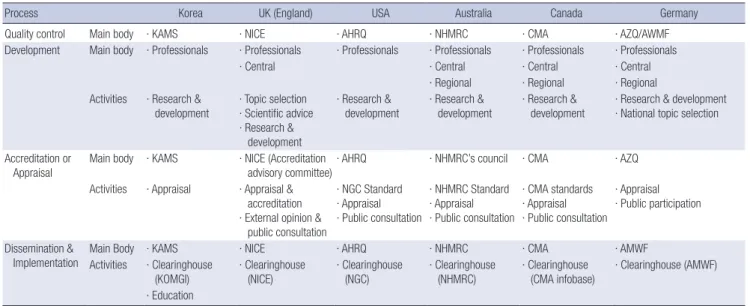
Countries that have actively introduced CPGs have established unique systems that enable the organization and step-by-step management of the development, distribution, evaluation of CPGs as well as the implementation phases for quality control (2,8). Furthermore, they manage the whole process in accor- dance with the cooperation of both public and private organi- zations; cooperation with the public and private sectors is achi- eved at a higher administrative level. For such collaborative de- velopment of CPGs to address national diseases, building con- sensuses for various forms of cooperation between countries have been achieved concerning the legal status of CPGs (Table 1).
Among quality control agencies, the relevant public organi- zations include the National Institute for Health and Care Ex- cellence (NICE) in the UK, the National Health and Medical Research Council (NHMRC) in Australia, and the Agency for Healthcare Research and Quality (AHRQ) in the US. These bod- ies are responsible for policies on healthcare quality manage- ment, which include CPGs (9,10). The private sector for CPG quality control is represented by the following organizations:
the Canadian Medical Association (CMA), the Association of the Scientific Medical Societies in Germany (AW MF), and the
German Agency for Quality in Medicine (AZQ). In Canada, the CMA has led CPG quality management activities, including de- velopment strategies and the application and implementation of guidelines (11). The AWMF is responsible for the development of CPGs and for the provision of professional training, whereas the AZQ focuses on quality assurance activities such as effec- tive implementation and CPG quality management programs (12). However, public and private cooperation is prevalent in the development of CPGs for high-burden chronic diseases and in quality control in Germany (13). In Korea, KA MS has carried out activities concerned with CPG quality control in Ko- rea. To achieve this, KAMS has established a CPG committee that supports the development and dissemination of CPGs. In particular, KAMS has studied the scientific methodology un- derlying the development of CPGs, including Korean-specific appraisal tools, scoring guides, etc. Moreover, it has enhanced the capabilities of developers by educating them on the devel- opment of CPGs. With respect to the government, the level of cooperation has increased to include CPG topic selection rath- er than just merely initial financial support.
In the majority of countries, appraisals have commonly been done using standardized tools to improve the quality of the de- velopment process. However, CPG accreditation processes vary among countries. Both the US and Canada require checklists to develop CPGs, in addition to periodic updates after guideline registration (14-16). Germany also considers each criterion sep- arately during the development and registration of CPGs, and assigns a rating based on the degree of development. In con- trast, the UK has a management process involving strict regula- tory and certification procedures. To accredit CPGs, Accredita- tion Advisory Committee meetings are held, with CPGs certi-
Table 1. Main body and activities of CPGs quality control in Korea and other countries
Process Korea UK (England) USA Australia Canada Germany
Quality control Main body · KAMS · NICE · AHRQ · NHMRC · CMA · AZQ/AWMF
Development Main body · Professionals · Professionals · Professionals · Professionals · Professionals · Professionals
· Central · Central · Central · Central
· Regional · Regional · Regional Activities · Research &
development · Topic selection
· Scientific advice
· Research &
development
· Research &
development · Research &
development · Research &
development · Research & development
· National topic selection
Accreditation or
Appraisal Main body · KAMS · NICE (Accreditation
advisory committee)· AHRQ · NHMRC’s council · CMA · AZQ Activities · Appraisal · Appraisal &
accreditation
· External opinion &
public consultation
· NGC Standard
· Appraisal
· Public consultation
· NHMRC Standard
· Appraisal
· Public consultation
· CMA standards
· Appraisal
· Public consultation
· Appraisal
· Public participation
Dissemination &
Implementation Main Body · KAMS · NICE · AHRQ · NHMRC · CMA · AMWF
Activities · Clearinghouse (KOMGI)
· Clearinghouse (NICE)
· Clearinghouse (NGC)
· Clearinghouse (NHMRC)
· Clearinghouse (CMA infobase)
· Clearinghouse (AMWF)
· Education
KAMS, Korean Academy of Medical Sciences; NICE, National Institute for Health and Care Excellence; AHRQ, Agency for Healthcare Research and Quality; NHMRC, National Health and Medical Research Council; CMA, Canadian Medical Association; AZQ, German Agency for Quality in Medicine; AWMF, Association of the Scientific Medical Societies in Germany; KoMGI, Korean Medical Guideline Information center; NGC, National Guideline Clearinghouse.
fied in accordance with regular evaluation procedures. NICE introduces all CPGs that are registered on the National Health Service, but the Accreditation Advisory Committee introduces only those guidelines that have obtained final accreditation (17).
Australia also has a CPG accreditation process, which involves eight recommendations with respect to the legal implications of guidelines pertaining to early breast cancer (18). In accordance with the CPG development process suggested by the NHMRC, these recommendations were then included at an institutional level (19).
When it comes to the dissemination of CPGs, almost all coun- tries operate on-line databases for the distribution of CPGs. Cle- aring houses in the US and Canada verify the requirements for CPGs upon guideline registration, and play a key role in evalu- ating their quality. In Korea, the Korean Medical Guideline In- formation center (KOMGI) – a CPG portal – also plays an impor- tant role in dissemination and quality assessment (20).
However, strategies and activities concerning the implemen- tation of CPGs are insufficient with respect to the active devel- opment and dissemination of CPGs. Countries have attempted to improve their level of CPG use, but establishing effective strat- egies is difficult because influential factors and health environ- ments vary among countries (21). The proportion of CPGs im- plemented in Korea reportedly remains at 30%‒50% (22).
KOREAN CPG QUALITY CONTROL: THE KAMS SYSTEM
Establishment of a quality management organization In Korea, KAMS, the main quality management body, has been
engaged in efforts to contribute to the development of evidence based medicine (EBM). Since 2006, KAMS has implemented new offices dedicated to CPGs, and has also operated both CPG and Executive committees. The CPG committee, composed of individuals drawn from 26 specialized academy societies, pro- motes dissemination activities (through networks that exist be- tween societies) and development projects (by cooperating with societies). The Executive Committee facilitates these practices by developing CPG-related systems and methodologies and by promoting direct training pertaining to guideline quality man- agement. These activities have led to the development of man- agement quality policies and a quality appraisal system, which have in turn enabled higher-quality CPGs (Fig. 1).
Establishment of the quality appraisal system
CPG quality appraisal involves the assessment of development processes rather than guideline contents, so that the most-reli- able information and recommendations are provided to guide- line users (23). In Korea, the demands are higher for the apprais- al and quality control of CPGs led by expert groups. Through several studies done on policies aimed at developing quality evaluation tools and on building a quality management system, KAMS developed a quality appraisal model reflecting the char- acteristics of the Korean health care system, and then collected opinions from other societies through two public hearings. As a result, in April 2013, regulations for CPG appraisal were estab- lished in accordance with the principles of independence, trans- parency, objectiveness and timeliness. Furthermore, procedures and methods related to quality appraisal were organized such that the Executive Committee and a research agency indepen- dently evaluate the CPGs (Table 2).
Manpower training for quality appraisal
To appraise CPGs, an Evaluative committee was established consisting of the Executive Committee members, clinical spe- cialists recommended by the various societies, and external ex- perts. Appraisers were able to provide professional-quality eval- uations and CPG appraisal following completion of the KAMS education program. To date, 58 appraisers have been trained and participated in these quality appraisal activities.
Table 2. Establishment activities for quality amanagement system of CPGs by KAMS
Date Goals Activities
2011.12
Establishment of quality appraisal system Research for quality appraisal model in Korea
2012.6 Development of Korean specific appraisal tools
2012.6-11 Collect opinions from interest Information session for presidents of 26 representative societies
2013.4 Institutionalization Announce the plan for the development of quality appraisal system
Enact policies for appraisal 2013.5-8
Operate quality appraisal Manpower training for quality appraisal
2013.9- Quality appraisal
Fig. 1. Quality management organizations of CPGs by KAMS.
Executive committee 26 Medical academies External experts President
CPG committee
Executive committee
Evaluation committee Research agency for CPG
Appraisers
Quality appraisal process
The quality appraisal of CPGs starts with requests from guide- line developers to KAMS. Following registration of a formal re- quest of a developer, the Executive Committee appoints four KAMS appraisers with professional interests relevant to the gui- deline in question. These appraisers are forwarded the apprais- al request and information on the guideline, and evaluate the CPG using the Korean AGREE II Scoring Guide document, which improves the reliability of the AGREE II tool (4,24). Appraisers evaluate the CPG for 2 weeks, and submit the results of their appraisal, including their opinions on whether the guideline should be used, to the Executive Committee. The Executive Com- mittee then determines whether KAMS recommends use of the CPG, based on the results of the appraisals, and informs the de- velopers of their final decision. If there is no objection from the guideline developers, the decision of the Committee is final- ized, and remains in effect for 5 yr. If there is an objection from the developer, the Executive Committee appoints four new ap- praisers, who re-appraise the CPG, in terms of whether it should be used, before making a final decision. The whole process from the request of a developer to the appraisal by the appointed ap- praisers and final notification of the appraisal results is con- ducted using the on-line portal KoMGI (Fig. 2).
CONCLUSION
The goals of CPG quality management are to improve the qual- ity of the development process, to provide fair and reliable eval-
uation recommendations, and to ensure evidence-based deci- sion-making during patient care and management.
US and Europe share common features in their quality man- agement policies on CPGs with which to appraise the develop- ment process by using standardized tools and disseminating qualified CPGs through clearinghouses. Besides, to ensure pro- fessionalism and objectivity, and to manage quality on a con- tinuous basis, appraisal by an independent organization of ex- perts is guaranteed (25).
Following the introduction of EBM, the requirement for spe- cialized agencies to support the development of CPGs, and to evaluate developed guidelines, has increased in Korea. KAMS, as a professional body representing the medical community, carries influence regarding the development and management of CPGs; it has established foundations for the assessment of CPGs, including the development of Korean-specific quality appraisal tools. KAMS has also set up an independent appraisal organization (the Executive Committee), established regula- tions related to appraisals, and improved the evaluation system for CPG quality (which is appropriate to the Korean health care environment). The Executive Committee appraises CPGs and gives accreditation only to those with high quality, which moti- vates the various societies to manage quality continuously. KAMS has trained staff to conduct appraisals in accordance with the participation of medical academies, to which it assigns apprais- als, thereby enhancing the ability of each society to develop CPGs and increasing the quality of CPGs.
KAMS has established a CPG quality management system Fig. 2. CPGs appraisal processs by KAMS.
Request
Appoint 4 appraisers
GPG developer · Application submission through informative system
· Pay for appraisal fee
Executive committee
· Discuss the appraiser’s qualification & appoint 4 appraisers - 1st round: 3 specialist, 1 methodologist
- 2nd round: 1 appraiser in 1st round
· Web-based appraisal
· Korean AGREE II & scoring guide
· Contents of appraisal report
- 23 items scores & standardized domain scores - General critique of chief appraiser (2nd round appraisal)
· Review the report
· Final decision of appraisal (Guarantee of KMA) Official
appraisers
Evaluation committee Appraisals
& report the result
Consideration of result
Final decision CPG committee
CPG committee Notifying to producer
Process step Key responsible party Activity
that reflects the characteristics of the Korean healthcare envi- ronment and the needs of its users. In particular, CPG quality appraisals assess their independence and the scientific meth- odologies used during the development process, and provide users with the most reliable guidelines and recommendations.
This could improve the quality of information available to deci- sion-makers and thus ultimately enhance EBM in practice.
DISCLOSURE
The authors have no conflicts of interest regarding the material presented here.
AUTHOR CONTRIBUTION
Design of the study: Jo HS, Oh MK. Data collection and analy- sis: Shin ES. Writing manuscript: Jo HS, Oh MK. Revision: Kim DI, Chang SG. Approval of final version of this manuscript: all authors.
ORCID
Heui-Sug Jo http://orcid.org/0000-0003-0245-3583 Dong-Ik Kim http://orcid.org/0000-0001-7527-3829 Sung-Goo Chang http://orcid.org/0000-0003-0733-7266 Ein-Soon Shin http://orcid.org/0000-0002-5086-6086 Moo-Kyung Oh http://orcid.org/0000-0002-2011-5708
REFERENCES
1. Darling G. The impact of clinical practice guidelines and clinical trials on treatment decisions. Surg Oncol 2002; 11: 255-62.
2. Legido-Quigley H, Panteli D, Brusamento S, Knai C, Saliba V, Turk E, Solé M, Augustin U, Car J, McKee M, et al. Clinical guidelines in the Eu- ropean Union: mapping the regulatory basis, development, quality con- trol, implementation and evaluation across member states. Health Poli- cy 2012; 107: 146-56.
3. Jo HS. Current status of development of clinical practice guidelies in Ko- rea and application for evidence based nursing. Korean Soc Evid Based Nurs 2014; 2: 1-4.
4. Lee YK, Shin ES, Shim JY, Min KJ, Kim JM, Lee SH; Executive Commit- tee for CPGs; Korean Academy of Medical Sciences. Developing a scor- ing guide for the Appraisal of Guidelines for Research and Evaluation II instrument in Korea: a modified Delphi consensus process. J Korean Med Sci 2013; 28: 190-4.
5. Jo MW, Lee JY, Kim NS, Kim SY, Sheen S, Kim SH, Lee SI. Assessment of the quality of clinical practice guidelines in Korea using the AGREE In- strument. J Korean Med Sci 2013; 28: 357-65.
6. Ahn HS, Kim HJ. Development and implementation of clinical practice guidelines: current status in Korea. J Korean Med Sci 2012; 27: S55-60.
7. OECD Health Division. OECD Heath Care Quality Review. Korea, As- sessment and Recommendation. Paris: OECD, 2012, p13-14.
8. AGREE in Europe Collaborative Group. Guideline development in Eu- rope. An international comparison. Int J Technol Assess Health Care 2000;
16: 1039-49.
9. Kelley E, Moy E, Kosiak B, McNeill D, Zhan C, Stryer D, Clancy C. Pre- vention health care quality in America: findings from the first National Healthcare Quality and Disparities reports. Prev Chronic Dis 2004; 1:
A03.
10. Kim NS, Kim SY, Park EJ. Promoting the quality of medicine: based on clinical practice guidelines. Seoul, Korea: Korea Institue for Health and Social Affairs, 2004.
11. Graham ID, Beardall S, Carter AO, Glennie J, Hébert PC, Tetroe JM, Mc- Alister FA, Visentin S, Anderson GM. What is the quality of drug therapy clinical practice guidelines in Canada? CMAJ 2001; 165: 157-63.
12. Nothacker M, Muche-Borowski C, Kopp IB. Reflections on 20 years of clinical practice guideline programmes in Germany: what is their im- pact? Z Evid Fortbild Qual Gesundhwes 2014; 108: 550-9.
13. Ollenschläger G, Kopp I, Lelgemann M, Sänger S, Heymans L, Thole H, Trapp H, Lorenz W, Selbmann HK, Encke A. The German program for disease management guidelines. Background, methods, and develop- ment process. Med Klin (Munich) 2006; 101: 840-5.
14. Canadian Medical Association. Criteria for inclusion of a CPG in the CMA Infobase. Available at https://www.cma.ca/En/Pages/submit-gui- deline.aspx [accessed on 12 May 2015].
15. National Guideline Clearinghouse. National Guideline Clearinghouse Inclusion Criteria 2014. Available at http://www.guideline.gov/about/
inclusion-criteria.aspx [accessed on 12 May 2015].
16. Canadian Medical Association. Handbook on clinical practice guide- lines. Ottawa, Canada: Canadian Medical Association, 2007.
17. National Institute for Health and Care Excellence. NICE Guidance 2015.
Available at https://www.nice.org.uk/guidance/published [accessed on 12 May 2015].
18. National Health Research and Medical Council. Procedures and require- ments for meeting the 2011 NHMRC standard for clinical practice guide- lines. Canberra, Australia: National Health and Medical Research, 2011.
19. Pelly JE, Newby L, Tito F, Redman S, Adrian AM. Clinical practice guide- lines before the law: sword or shield? Med J Aust 1998; 169: 330-3.
20. Korea Association of Medical Science. Korea Medical Guideline Infor- mation center. Seoul, Korea. Available at http://www.guideline.or.kr/
contents/index.php?code=044 [accessed on 12 May 2015].
21. Kim YK, Lee SH, Seo JH, Kim JH, Kim SD, Kim GK. A comprehensive model of factors affecting adoption of clinical practice guidelines in Ko- rea. J Korean Med Sci 2010; 25: 1568-73.
22. Yang J, Han C, Yoon HK, Pae CU, Kim MJ, Park SY, Ahn J. Experiences and barriers to implementation of clinical practice guideline for depres- sion in Korea. BMC Psychiatry 2013; 13: 150.
23. Brouwers MC, Kho ME, Browman GP, Burgers JS, Cluzeau F, Feder G, Fervers B, Graham ID, Grimshaw J, Hanna SE, et al. AGREE II: advanc- ing guideline development, reporting and evaluation in health care. CM- AJ 2010; 182: E839-42.
24. Oh MK, Jo H, Lee YK. Improving the reliability of clinical practice guide- line appraisals: effects of the Korean AGREE II scoring guide. J Korean Med Sci 2014; 29: 771-5.
25. Bussières A, Stuber K. The Clinical Practice Guideline Initiative: A joint collaboration designed to improve the quality of care delivered by doc- tors of chiropractic. J Can Chiropr Assoc 2013; 57: 279-84.