http://dx.doi.org/10.9713/kcer.2014.52.2.209 PISSN 0304-128X, EISSN 2233-9558
Preparation of Al@Fe
2O
3Core-Shell Composites Using Amphiphilic Graft Copolymer Template
Rajkumar Patel, Sang Jin Kim, Jin Kyu Kim, Jung Su Park* and Jong Hak Kim†
Department of Chemical and Biomolecular Engineering, Yonsei University, 262 Seongsanno, Seodaemun-gu, Seoul 120-749, Korea
*The 4th R&D Institute 2nd Directorate, Agency for Defense and Development (ADD), South Korea (Received 2 November 2013; Received in revised form 7 December 2013; accepted 12 December 2013)
Abstract − A graft copolymer of poly(vinyl chloride)-g-poly(oxyethylene methacrylate) (PVC-g-POEM) was synthe- sized via atom transfer radical polymerization (ATRP) and used as a structure-directing agent to prepare Al@Fe2O3 core-shell nanocomposites through a sol-gel process. The amphiphilic property of PVC-g-POEM allows for good dis- persion of Al particles and leads to specific interaction with iron ethoxide, a precursor of Fe2O3. Secondary bonding interaction in the sol-gel composites was characterized by Fourier transform-infrared (FT-IR) spectroscopy. The well- organized morphology of Al@Fe2O3 core-shell nanocomposites was observed using scanning electron microscopy (SEM) and transmission electron microscopy (TEM). Energy dispersive X-ray (EDX) and X-ray diffraction (XRD) were used to analyze the elemental composition and crystallization structure of the composites.
Key words: Sol-gel, Al, Fe2O3, Graft Copolymer, Core-shell, Atom Transfer Radical Polymerization
1. Introduction
Research involving bimetallic composites has become very important for applications related to energetics, optics, catalysis and electronics. Along these lines, there have been significant advances in photovoltaics, electrochemistry, separation science and catalysis due to bimetallic composites [1-6]. By changing the composition of inorganic bimetallic composites, the properties of these materials can be tuned [7-11]. The sol-gel method is a versatile way of preparing various metallic composites in a well-controlled way in which the templating agent plays a crucial role in determining the final mor- phology of the composite. The most commonly used templating agent is a block copolymer due to its well-defined structure and the generation of an interesting morphology [12-15]. For example, poly- styrene-block-poly(ethylene oxide) (PS-b-PEO) was used as a tem- plate in a sol-gel reaction to prepare TiO2 with a controlled morphology [12]. Also, a triblock copolymer (Pluronic, F127) was used as a tem- plating agent to prepare Au@Pd@Pt core-shell nanoparticles [15].
There is specific interest in the preparation of the bimetallic Al@Fe2O3 compound due to its application in the field of energetic materials. Al@Fe2O3 core-shell nanocomposites were prepared using a sol-gel method, as reported by Tillotson et al. [16]. Another study is based on Fe2O3 nanowires embedded into a thin aluminum foil in order to generate a composite material [17]. Also, there have been some reports on the preparation of Al/CuO and Al@Fe2O3 core/shell
composites by combining Al with CuO nanowire and Co3O4 nano- rods [18,19].
Due to the stringent conditions required for the synthesis of a block copolymer, alternative copolymers were explored as templating agents. In our group, poly(vinyl chloride)-g-poly(oxyethylene meth- acrylate) (PVC-g-POEM) graft copolymer was used as a structure- directing agent for the preparation of mesoporous TiO2 films for photovoltaic applications [20-23]. Graft copolymers have an advan- tage over block copolymers as synthesis tends to be more facile and economical.
We report here the synthesis of bimetallic Al@Fe2O3 core-shell composites prepared by a sol-gel method using PCV-g-POEM graft copolymer as a structure-directing agent. The interaction in the sol-gel composites was studied by Fourier transform-infrared (FT-IR) spec- troscopy. Morphology and structure of Al@Fe2O3 nanocomposites were characterized using scanning electron microscopy (SEM) and transmission electron microscopy (TEM). The elemental composition and crystallization structure of composites were investigated by energy dispersive X-ray (EDX) and X-ray diffraction (XRD) analysis.
2. Experimental
2-1. Materials
Aluminum nanoparticles (Al, 3~5 μm in size) were purchased from Kujundo Chemical Laboratory Co. Ltd, Japan. Iron (III) ethox- ide, poly(vinyl chloride) (PVC, Mn = 22,000 g/mol, Mw = 43,000 g/mol), poly(oxyethylene methacrylate) (POEM, Mn = 475 g/mol), 1,1,4,7,10,10- hexamethyltriethylene tetramine (HMTETA, 99%), copper(I) chlo- ride (CuCl, 99%), tetrahydrofuran (THF) and N-methyl pyrolidone (NMP) were purchased from Aldrich.
†To whom correspondence should be addressed.
E-mail: [email protected]
‡This article is dedicated to Prof. Byoungsik Kim on the occasion of his retirement from Dongguk University (President of Chodang University).
This is an Open-Access article distributed under the terms of the Creative Com- mons Attribution Non-Commercial License (http://creativecommons.org/licenses/by- nc/3.0) which permits unrestricted non-commercial use, distribution, and reproduc- tion in any medium, provided the original work is properly cited.
2-2. Synthesis of PVC-g-POEM graft copolymer
A PVC-g-POEM graft copolymer was synthesized via atom transfer radical polymerization (ATRP) according to a previously reported method [20-23]. In brief, 6 g of PVC was dissolved in 50 mL of NMP by stirring at 90oC for 4 h. After cooling the solution to room temperature, 15 g of POEM, 0.1 g of CuCl, and 0.23 mL of HMTETA were added to the solution. The green mixture was stirred until a homogeneous solution was obtained and was then purged with nitro- gen for 30 min. The reaction was carried out at 90oC for 18 h. After polymerization, the resulting mixture was diluted with THF. After passing through a column with activated Al2O3 to remove the cata- lyst, the solution was precipitated into methanol. The grafted copolymer was purified by dissolving in THF and re-precipitating three times in methanol. PVC-g-POEM graft copolymer with a PVC:POEM = 1 : 1.5 wt% ratio was obtained in a powder form and was dried in a vac- uum oven overnight at room temperature.
2-3. Synthesis of Al@Fe2O3 nanostructures
First, 0.2 g of the PVC-g-POEM graft copolymer was dissolved in 2 mL of THF. Then, 0.05 g of aluminum (Al) particles was dispersed in 1 ml of THF and added to the graft polymer solution. Because the surface of the Al particles was fully protected with Al2O3 layer, Al particles were not explosive. Separately, different amounts of iron ethox- ide, i.e., 0.05, 0.1 and 0.25 g for Al@Fe2O3-1, Al@Fe2O3-2 and Al@Fe2O3-3 composites, respectively, were dissolved in 1 mL THF and added to the PVC-g-POEM/Al solution. After slowly adding 0.1 mL of HCl, the sol-gel solution was mixed well for 24 h and calcined at 450 oC for 30 min to remove any organic material.
2-4. Characterization
FT-IR measurements were performed on a 6030 Mattson Galaxy Series FT-IR spectrometer; 64-64 scans were signal-averaged at a resolution of 4 cm−1. The morphology and structure of the compos- ites were characterized using FE-SEM (S-4700, Hitachi) and TEM (JEM 1010, JEOL). XRD measurements were carried out with Cu Kα radiation at a scanning speed of 1o/min using a wide-angle goni- ometer (D5005, Bruker, Germany) with a Cu cathode operated at 40 kV and 300 mA.
3. Results and Discussion
The hydrophobic PVC main chain was grafted with hydrophilic POEM chains via an ATRP process using the secondary chlorine atoms as an initiating site through the grafting-from approach to prepare an amphiphilic PVC-g-POEM graft copolymer. The amphiphilic graft copolymer is used as a templating agent instead of a typically used block copolymer due to its low cost. The self-assembled, amphiphilic properties of PVC-g-POEM graft copolymer result from a microphase- separated structure due to the hydrophobic PVC main chains, which have a higher glass transition temperature of 70oC, and the hydro- philic POEM side chains, which have a lower glass transition tem-
perature of -58 oC [23]. The high molecular weight (1.1 × 10⁵ g/mol) of the PVC-g-POEM graft copolymer also helps to induce the for- mation of a metal oxide without structural defects, keeping the struc- ture intact. The grafting of POEM from PVC main chains also resulted in the increase in polydispersity index value from 2.1 to 2.5.
Aluminum particles were well dispersed in a solution due to the amphiphilic properties of PVC-g-POEM graft copolymer. A hydro- philic precursor, iron ethoxide, undergoes hydrolysis and condensa- tion in the presence of an acidic medium through specific interaction with the hydrophilic POEM side chains. Thus, the core of the micelle is occupied by the hydrophobic PVC/Al composites, while the shell of the micelle consists of POEM/iron ethoxide composites. After calcination at 450 oC, the organic PVC-g-POEM graft copolymer is completely burned, while iron ethoxide is converted to crystalline Fe2O3, resulting in the formation of Al@Fe2O3 core-shell compos- ites. The synthesis of Al@Fe2O3 bimetallic composites is illustrated in Scheme 1.
Fig. 1 shows the FT-IR spectra of pristine PVC-g-POEM, PVC-g- POEM/Al, PVC-g-POEM/Al/Fe2O3 composites before and after calcination at 500oC for various compositions of Al particles and iron ethoxide. The pristine PVC-g-POEM graft copolymer showed strong bands at 1735 and 1100 cm−1 due to the stretching vibrational modes of carbonyl (C=O) and ether (C-O-C) groups, respectively, of
Scheme 1. Schematic illustration for the formation of Al@Fe2O3 composites using PVC-g-POEM template.
Fig. 1. FT-IR spectra of (a) PVC-g-POEM, (b) PVC-g-POEM/Al, (c) PVC-g-POEM/Al/Fe2O3-1, (d) PVC-g-POEM/Al/Fe2O3-2, (e) PVC-g-POEM/Al/Fe2O3-3 measured before calcination and (f) Al@Fe2O3-1, (g) Al@Fe2O3-2, (h) Al@Fe2O3-3 composites mea- sured after calcination at 500oC.
the POEM. The FT-IR absorption bands, including the carbonyl and ether mode, were not significantly changed upon the formation of a PVC-g-POEM/Al composite, indicating no specific bonding interac- tion of the graft copolymer with the Al particles. When the sol-gel process was performed with Al in the presence of iron precursor, i.e., iron ethoxide, the carbonyl and ether stretching bands were shifted from 1735 and 1100 cm−1 to 1720 and 1092 cm−1, respectively. The peak shifts toward lower wave numbers result from weakened bond- ing of carbonyl and ether groups due to secondary bonding interac- tions between the hydrophilic POEM chains and the dissociated iron cations [24]. Strong absorption bands at 3300 and 1630 cm−1 are due to the presence of large amounts of water bound to the composites.
After calcination of composites at 500oC, the typical IR absorption bands observed in PVC-g-POEM graft copolymer completely disap- peared, suggesting the removal of the organic parts to form Al@Fe2O3 nanocomposites. The broad band at 3400 cm−1 is attributed to the hydroxyl (-OH) groups at the surface of Fe2O3 [25].
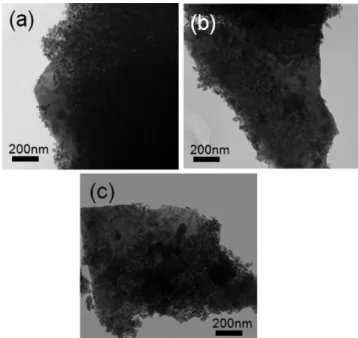
The changes in morphology of Al@Fe2O3 composites with differ- ent amounts of iron ethoxide were investigated using SEM and TEM analysis. Fig. 2 shows that the porosity of the Fe2O3 outer layer coated on Al was increased with an increase in the amount of iron ethoxide.
Also, the sol-gel concentration was increased with iron ethoxide con- tent, resulting in higher viscosity, yielding an elongated morphology of Fe2O3, as observed in Fig. 2f. This indicates the importance of the precursor content and the ratio of iron ethoxide to the PVC-g-POEM template in determining the final morphology of composites. TEM images of Al@Fe2O3 composites are presented in Fig. 3, in which the mesoporous Fe2O3 coated on Al particles was observed. As the concentration of iron ethoxide increased, the Fe2O3 outer layer became
Fig. 2. SEM images of (a)(b) Al@Fe2O3-1, (c)(d) Al@Fe2O3-2 and (e)(f) Al@Fe2O3-3 composites.
Fig. 3. EDX data of Al@Fe2O3-3 composite.
Fig. 4. TEM images of (a) Al@Fe2O3-1, (b) Al@Fe2O3-2, (c) Al@Fe2O3- 3 composites.
Fig. 5. XRD patterns of (a) Al@Fe2O3-1, (b) Al@Fe2O3-2, (c) Al@Fe2O3- 3 composites.
more porous and elongated due to higher possibility of specific inter- action between iron ethoxide and the PVC-g-POEM template.
Fig. 4 shows the EDX spectrum of the Al@Fe2O3 composite pre- pared by PVC-g-POEM copolymer. The presence of elements such as Al, Fe and oxygen is observed in the spectrum. XRD patterns of Al@Fe2O3 composites with various compositions are shown in Fig.
5. Several sharp peaks at 24.1, 33.2, 35.7, 49.5, 54.1, 62.5 and 64.1o correspond to planes (012), (104), (110), (024), (116), (214) and (300), respectively, of crystalline Fe2O3 (JCPDS25-1402). The Al peaks at 38.6, 44.9, 65.1 and 78.2o correspond to (116), (200), (220) and (311), respectively. The peak intensity of Fe2O3 relative to Al gradually increased with the amount of iron ethoxide, indicating good correla- tion between peak intensity and iron precursor concentration.
4. Conclusions
Bimetallic composites of Al@Fe2O3 were prepared using amphiphilic PVC-g-POEM graft copolymer as a templating agent via a sol-gel method. The core-shell structure was possible because the hydrophobic PVC main chains keep the structure intact with Al particles, while the hydrophilic POEM side chains preferentially interact with iron ethoxide, which is converted to Fe2O3 crystallite after calcination at 500oC. The FT-IR absorption bands of carbonyl and ether groups in POEM chains were shifted toward lower wave numbers for PVC-g- POEM/iron ethoxide, indicating secondary bonding interactions.
The morphology, elemental composition and the crystal structure were characterized using SEM, TEM, EDX and XRD. The Al@Fe2O3 bimetallic composites have potential for use in military applications due to their high energetic properties.
Acknowledgments
We acknowledge the financial support of the National Research Foundation (NRF) through the Core Research Program (NRF-2012 R1A2A2A02011268), and the Converged Energy Materials Research Center program of Defense Acquisition Program Administration and Agency for Defense Development.
References
1. Johnson, B. F. G., “Nanoparticles in Catalysis,” Top. Catal., 24, 1-4(2003).
2. Hernández, J., Solla-Gullón, J., Herrero, E., Aldaz, A. and Feliu, J. M. “Electrochemistry of Shape-controlled Catalysts: Oxygen Reduction Reaction on Cubic Gold Nanoparticles,” J. Phys. Chem. C, 111, 14078-14083(2007).
3. Park, J. T., Chi, W. S., Roh, D. K., Ahn, S. H. and Kim, J. H.,
“Hybrid Templated Synthesis of Crack-free, Organized Mesopo- rous TiO2 ELectrodes For High Efficiency Solid-state Dye-sen- sitized Solar Cells,” Adv. Funct. Mater., 23, 26-33(2013).
4. Chae, I. S., Kang, S. W., Park, J. Y., Lee, Y. G., Lee, J. H., Won, J. and Kang, Y. S., “Surface Energy-level Tuning of Silver Nanopar-
ticles for Facilitated Olefin Transport,” Angew. Chem. Int. Ed., 50, 2982-2985(2011).
5. Kim, S.-H., Na, S.-E., Kim, S.-Y., Kim, S.-S. and Ju, C.-S., “The Effect of Additives on the Preparation of Nanosized TiO2 Parti- cles,” Korean Chem. Eng. Res.(HWAHAK KONGHAK), 51, 426- 431(2013).
6. Ahn, C.-W., Chung, Y.-H., Hahn, B.-D., Park, D.-S. and Sung, Y.-E., “Structural Design of 3-dimensional Disk Electrode Based on Cu-CoO Composite for Li-ion Battery,” Korean J. Chem. Eng., 29, 985-988(2013).
7. Chin, S. F., Pang, S. C. and Dom, F. E. I., “Sol-gel Synthesis of Silver/titanium Dioxide (Ag/TiO2) Core-shell Nanowires for Photocatalytic Applications,” Mater. Lett., 65, 2673-2675(2011).
8. Fabbri, P., Ghahari, M., Pilati, F., Egadzadeh, T., Aghababaza- deh, R. and Ghasem, K., “Novel Approach to the Synthesis of Core-shell Particles by Sacrificial Polymer Shell Method,” Mater.
Lett., 64, 2265-2268(2010).
9. Fu, W., Yang, H., Li, M., Yang, N. and Zou, G., “Anatase TiO2 Nanolayer Coating on Cobalt Ferrite Nanoparticles for Mag- netic Photocatalyst,” Mater. Lett., 59, 3530-3534(2005).
10. Tadic, M., Panjan, M. and Dragana, M., “NiO/SiO2 Nanostructure and the Magnetic Moment of NiO Nanoparticles,” Mater. Lett., 64, 2129-2131(2010).
11. Zhang, X., Wang, B. and Xu, X., “Synthesis and Magnetic Prop- erties of Cu-coated Fe Composite Nanoparticles,” Appl. Surf. Sci., 256, 4109-4113(2010).
12. Cheng, Y. J. and Gutmann, J. S., “Morphology Phase Diagram of Ultrathin Anatase TiO2 Films Templated by a Single PS-b-PEO Block Copolymer,” J. Am. Chem. Soc., 128, 4658-4674(2006).
13. Nedelcu, M., Lee, J., Crossland, E. J. W., Warren, S. C., Orilall, M. C., Guldin, S., Huttner, S., Ducati, C., Eder, D., Wiesner, U., Steiner, U. and Snaith, H. J., “Block Copolymer Directed Syn- thesis of Mesoporous TiO2 for Dye-sensitized Solar Cells,” Soft.
Matter., 5, 134-139(2009).
14. Bastakoti, B. P., Guragain, S., Yusa, S.-I. and Nakashima, K.,
“Novel Synthesis Route for Ag@SiO2 Core-shell Nanoparticles Via Micelle Template of Double Hydrophilic Block Copolymer,”
RSC Adv., 2, 5938-5940(2012).
15. Wang, L. and Yamauchi, Y., “Autoprogrammed Synthesis of Triple-layered Au@Pd@Pt Coreshell Nanoparticles Consisting of a Au@Pd Bimetallic Core and Nanoporous Pt Shell,” J. Am.
Chem. Soc., 132, 13636-13638(2010).
16. Tillotson, T. M., A. E. Gash, R. L. Simpson, L. W. Hrubesh, J.
H. Satcher, Jr. and J. F. Poco, “Nanostructured Energetic Mate- rials Using Sol-gel Methodologies,” J. Non-Cryst. Solids, 285, 338-345(2001).
17. Menon, L., S. Patibandla, K. Bhargava Ram, S. I. Shkuratov, D.
Aurongzeb, M. Holtz, J. Berg, J. Yun and H. Temkin, “Ignition Studies of Al=Fe2O3 Energetic Nanocomposites,” Appl. Phys. Lett., 84, 4735-4737(2004).
18. Zhang, K. L., C. Rossi, G. A. Ardila Rodriguez, C. Tenailleau and P. Alphonse, “Development of a Nano-Al=CuO Based Energetic Material on Silicon Substrate,” Appl. Phys. Lett., 91, 113117-113117- 3(2007).
19. Xu, D. G., Y. Yang, H. Cheng, Y. Y. Li and K. L. Zhang, “Integration of Nano-Al with Co3O4 Nanorods to Realize High-exothermic Core-shell Nanoenergetic Materials on a Silicon Substrate,” Com-
bust. Flame, 159, 2202-2209(2012).
20. Ahn, S. H., Koh, J. H., Seo, J. A. and Kim, J. H., “Structure Con- trol of Organized Mesoporous TiO2 Films Templated by Graft Copolymers for Dye-sensitized Solar Cells,” Chem. Commun., 46, 1935-1937(2010).
21. Ahn, S. H., Park, J. T., Koh, J. K., Roh, D. K. and Kim, J. H.,
“Graft Copolymer Directed Synthesis of Micron-thick Organized Mesoporous TiO2 Films for Solid-state Dye-sensitized Solar Cells,”
Chem. Commun., 47, 5882-5884(2011).
22. Ahn, S. H., Chi, W. S., Park, J. T., Koh, J. K., Roh, D. K. and Kim, J. H., “Direct Assembly of Preformed Nanoparticles and Graft Copolymer for the Fabrication of Micron-thick, Organized TiO2 Films: High Efficiency Solid-state Dye-sensitized Solar Cells,”
Adv. Mater., 24, 519-522(2012).
23. Ahn, S. H., Chi, W. S., Kim, D. J., Heo, S. Y. and Kim, J. H.,
“Honeycomb-like Organized TiO2 Photoanodes with Dual Pores for Solid-state Dye-sensitized Solar Cells,” Adv. Funct. Mater., 23, 3901-3908(2013).
24. Kim, J. H., Min, B. R., Kim, C. K., Won, J. and Kang, Y. S., “Spec- troscopic Interpretation of Silver Ion Complexation with Propy- lene in Silver Polymer Electrolytes,” J. Phys. Chem. B, 106, 2786- 2790(2002).
25. Park, J. T., Koh, J. H., Koh, J. K. and Kim, J. H., “Surface-ini- tiated Atom Transfer Radical Polymerization from TiO2 Nano- particles,” Appl. Surf. Sci., 255, 3739-3744(2009).