D I A B E T E S & M E T A B O L I S M J O U R N A L
This is an Open Access article distributed under the terms of the Creative Commons At- tribution Non-Commercial License (http://creativecommons.org/licenses/by-nc/3.0/) which permits unrestricted non-commercial use, distribution, and reproduction in any medium, provided the original work is properly cited.
Diabetes Metab J 2015;39:481-488
Insulin Initiation in Insulin-Naïve Korean Type 2 Diabetic Patients Inadequately Controlled on Oral Antidiabetic Drugs in Real-World Practice: The Modality of Insulin Treatment Evaluation Study
Sang Soo Kim1,2, In Joo Kim1,2, Yong Ki Kim3, Kun Ho Yoon4, Ho Young Son5, Sung Woo Park6, Yeon Ah Sung7, Hong Sun Baek8
1Department of Internal Medicine, 2Biomedical Research Institute, Pusan National University Hospital, Pusan National University School of Medicine, Busan,
3Kim Yong Ki Internal Medicine Clinic, Busan,
4Department of Internal Medicine, Seoul St. Mary’s Hospital, College of Medicine, The Catholic University of Korea, Seoul,
5Department of Internal Medicine, Hallym University Kangdong Sacred Heart Hospital, Hallym University College of Medicine, Seoul,
6Department of Endocrinology and Metabolism, Kangbuk Samsung Hospital, Sungkyunkwan University School of Medicine, Seoul,
7Department of Internal Medicine, Ewha Womans University School of Medicine, Seoul,
8Department of Internal Medicine, Chonbuk National University Medical School, Jeonju, Korea
Background: The Modality of Insulin Treatment Evaluation (MOTIV) study was performed to provide real-world data concern- ing insulin initiation in Korean type 2 diabetes mellitus (T2DM) patients with inadequate glycemic control with oral hypoglyce- mic agents (OHAs).
Methods: This multicenter, non-interventional, prospective, observational study enrolled T2DM patients with inadequate glyce- mic control (glycosylated hemoglobin [HbA1c] ≥7.0%) who had been on OHAs for ≥3 months and were already decided to in- troduce basal insulin by their physician prior to the start of the study. All treatment decisions were at the physician’s discretion to reflect real-world practice.
Results: A total of 9,196 patients were enrolled, and 8,636 patients were included in the analysis (mean duration of diabetes, 8.9 years; mean HbA1c, 9.2%). Basal insulin plus one OHA was the most frequently (51.0%) used regimen. After 6 months of basal insulin treatment, HbA1c decreased to 7.4% and 44.5% of patients reached HbA1c <7%. Body weight increased from 65.2 kg to 65.5 kg, which was not significant. Meanwhile, there was significant increase in the mean daily insulin dose from 16.9 IU at base- line to 24.5 IU at month 6 (P<0.001). Overall, 17.6% of patients experienced at least one hypoglycemic event.
Conclusion: In a real-world setting, the initiation of basal insulin is an effective and well-tolerated treatment option in Korean patients with T2DM who are failing to meet targets with OHA therapy.
Keywords: Basal insulin; Diabetes mellitus, type 2; Korea; Pragmatic clinical trials as topic
Corresponding author: In Joo Kim
Division of Endocrinology and Metabolism, Department of Internal Medicine, Pusan National University Hospital, Pusan National University School of Medicine, 179 Gudeok-ro, Seo-gu, Busan 49241, Korea
INTRODUCTION
In 2011, an estimated 4 million patients were diagnosed with diabetes mellitus in Korea, and the number will increase to ap- proximately 5.9 million in 2050 [1]. Most organizations, in-
cluding the Korean Diabetes Association (KDA), generally recommend a glycosylated hemoglobin (HbA1c) target of 6.5% (48 mmol/mol) to 7.0% (53 mmol/mol) for preventing microvascular and macrovascular complications in patients with type 2 diabetes mellitus (T2DM) [2,3]. Recent Korean http://dx.doi.org/10.4093/dmj.2015.39.6.481
pISSN 2233-6079 · eISSN 2233-6087
data indicates that only 45.6% of Korean patients with T2DM achieved the American Diabetes Association (ADA) recom- mended target of HbA1c <7.0%, and only 27% attained the International Diabetes Federation and KDA recommended target of HbA1c <6.5% [4].
A number of studies, including the United Kingdom Pro- spective Diabetes Study, have demonstrated that tight glyce- mic control can decrease the chronic complications of T2DM, leading to a decrease in the associated morbidity and mortality [5,6]. In T2DM, a gradual impairment of pancreatic function is consequently followed by the depletion of insulin secretion.
Therefore, insulin therapy is required to achieve clinically meaningful long-term glycemic control. The fasting blood glucose (FBG) target can be achieved more easily with insulin than with oral hypoglycemic agents (OHAs) [7]. Furthermore, insulin is known to suppress basal hepatic glucose production and to protect pancreatic β-cells [2,7,8].
Despite the demonstrated benefits of insulin therapy and ex- isting recommendations in the guidelines for the timely initia- tion of insulin therapy, evidence suggests that insulin utiliza- tion and glycemic control remain suboptimal. The Korea Na- tional Health and Nutrition Examination Survey V (2010 to 2012) reported that only 11% of patients with diabetes mellitus were treated with insulin [4]. In the Hong Kong Diabetes Reg- istry, most Chinese patients (60.3%) with T2DM had HbA1c
>7.0%, although many were receiving multiple OHAs [9].
Moreover, the proportion of patients on OHAs with inadequate glycemic control (HbA1c ≥7%) increased as the duration of T2DM increased; from 23.7% of patients with T2DM for <5 years to 75.9% of patients with a disease duration ≥20 years. In another Asian registry of T2DM patients initiating insulin, the mean HbA1c level was 9.8%±1.6%, and the mean duration of diabetes was 9.3±6.5 years [10]. These studies indicate a delay in the timely initiation of insulin therapy, reflecting a large gap between treatment guidelines and real-world practice [9,10].
While T2DM is a condition marked by the progressive de- terioration of pancreatic function, evidence clearly shows that timely insulin initiation can help alleviate many of the subse- quent chronic effects of T2DM. However, evidence indicates a tendency to delay insulin initiation leading to poor glycemic control in Asian patients with T2DM [11]. While data from historic clinical trials from Korea may demonstrate the bene- fits of insulin therapy [12], there is no current data available to examine insulin initiation in real-world clinical practice.
The Modality of Insulin Treatment Evaluation (MOTIV)
study was conducted to assess the effect of insulin initiation in Korean patients who were inadequately controlled on OHAs.
The primary objective of this study was to explore the glucose- lowering effect of basal insulin therapy and its different regimens in T2DM patients inadequately controlled with OHAs in a real- world clinical setting. The secondary objective was to investigate the effects of different regimens containing basal insulin and concomitant anti-diabetes medications on plasma glucose levels (fasting and postprandial), body weight, insulin dose, and the occurrence of hypoglycemic event during the study.
METHODS
Study design and population
The MOTIV study was designed as a multicenter, non-inter- ventional, prospective, observational study to investigate dis- ease management practices using insulin in insulin-naïve Ko- rean T2DM patients with inadequate glycemic control. Patients with T2DM were enrolled from 566 geographically representa- tive centers in South Korea from May 2007 to February 2009, as previously described [13]. Of the included centers, 22.7%
(129/566) were endocrinology centers, and 77.3% (437/566) were internal medicine centers. Overall, 9,196 patients were enrolled in the MOTIV study. The study was approved by the institutional ethics committees of each participating center.
Patients were eligible for the study if they were insulin-naïve and on OHA therapy for at least 3 months, had HbA1c levels
≥7.0%, had a clinical assessment for their suitability for basal insulin initiation performed by their physicians prior to re- cruitment, and had provided informed consent. At baseline, the study patients were prescribed either basal insulin alone or basal insulin in combination with one or more OHA, or a short acting insulin. The clinical decisions regarding the choice, du- ration, and changes in the existing or prospective therapy were based solely on the judgment of the investigator. There was no specific intervention for treatment such as life style change after the initiation of basal insulin. To investigate the effects of differ- ent regimens containing basal insulin and concomitant diabe- tes medications, the patients were stratified into basal insulin only (group A), basal insulin plus one OHA (group B), basal insulin plus two or more OHAs (group C), and basal insulin plus short acting insulin (group D) groups.
Data collection
The collected data included the patients’ demographics, medical
histories, anthropometric data, blood analysis for glycemic con- trol parameters (HbA1c, FBG, and 2-hour postprandial glucose [PPG2hr]), existing and new regimens targeting HbA1c levels, and hypoglycemic events. These data were collected from the patients’ medical records at baseline (start of insulin prescrip- tion), and 3 and 6 months post-baseline by the investigators us- ing a case report form. Glycemic control was determined by measuring HbA1c; and changes in the blood glucose levels (fasting and postprandial), body weight, insulin doses, and the incidence of hypoglycemic events were noted. The definition of hypoglycemia used in this study was as follows: (1) the relief of hypoglycemic symptoms after the administration of glucose or carbohydrates; (2) a blood glucose level below 56 mg/dL regard- less of hypoglycemic symptoms.
Statistical analyses
Descriptive statistics were used to evaluate the patient data. The qualitative parameters were summarized by frequencies and percentages, and the quantitative parameters were assessed as the frequency, mean, standard deviation, median, and range.
All statistical tests were performed at a significance level of 5%
using two-sided tests. Differences within and between the groups were analyzed using analysis of covariance. The soft- ware used for all statistical analysis was SAS version 9.1 (SAS Institute, Cary, NC, USA).
RESULTS
Baseline demographics
Of the total 9,196 patients, data from 8,636 patients were ana- lyzed. A total of 560 patients were excluded from the analysis because either they did not meet the inclusion criteria (57 pa- tients), they were lost follow-up (500 patients), or their glyce- mic parameters were not recorded (three patients) (Fig. 1). In the study population, 54.4% subjects were men. The mean age of the population was 58.1 years, the mean HbA1c was 9.2%, and the mean duration of diabetes was 8.9 years. Most of the patients in this study were prescribed insulin glargine for basal insulin. Insulin detemir and Neutral Protamine Hagedorn (NPH) were prescribed for 2 (0.02%) and 10 patients (0.12%) out of the 8,636 total patients, respectively. Previous OHA therapy (prior to initiation of basal insulin) included sulpho- nylurea (83.6%), metformin (65.5%), α-glucosidase inhibitor (20.8%), thiazolidinedione (10.4%), and meglitinide (7.0%) (Table 1). Sulfonylurea and meglitinide were the least fre-
quently prescribed to patients in group D before insulin was started (Table 1).
During the baseline visit, the most commonly prescribed regimen was basal insulin with a single OHA (group B, 51.0%
patients) followed by basal insulin with two or more OHAs (group C, 30.8%), basal insulin only (group A, 16.6%), and bas- al insulin plus short acting insulin (group D, 1.6%). There were differences in the demographic and anthropometric measures across groups receiving different treatment options. The lowest mean age at insulin initiation was seen in group D (54.2±14.0 years) and the mean duration of diabetes was longest in group C. The mean body mass index and body weight were lowest in group D (23.1±4.1 kg/m2 and 62.4±12.7 kg, respectively) and highest in group C (24.6±2.9 kg/m2 and 65.8±10.6 kg, respec- tively). The mean HbA1c was highest in group D (10.4%±
2.0%) followed by group C (9.4%±1.5%), B (9.1%±1.4%), and A (8.9%±1.4%).
Overall effectiveness and safety
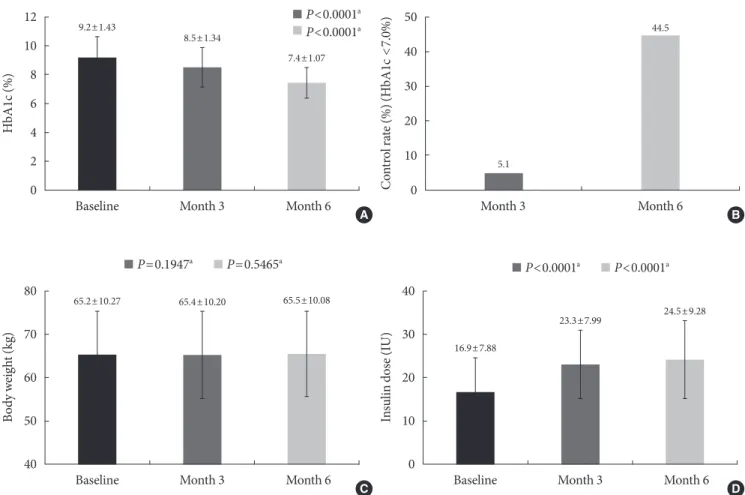
The mean HbA1c in the study population significantly de- creased from 9.2% at baseline to 8.5% at month 3 and to 7.4%
at month 6. The differences in HbA1c from baseline to both time-points were significant (P<0.0001). At month 6, 44.5% of patients achieved HbA1c <7% (Fig. 2). Body weight at baseline was 65.2 kg and changed to 65.4 kg and 65.5 kg at month 3 and 6, respectively. These changes were not significant. There was significant increase in the mean daily insulin dose from 16.9 U (0.26 U/kg) at baseline to 23.3 U (0.36 U/kg) at month 3 and to 24.5 U (0.37 U/kg) at month 6 (compared to baseline at both time-points, P<0.0001). During the study period, 1,518 pa- tients (17.6%) experienced at least one hypoglycemic event,
9,196 Patients enrolled
10 Basal insulin missing 39 Premix insulin 8 Eligibility not met
500 Missed visit
3 No HbA1c value at month 6 9,139 Month 3 follow-up
8,636 Month 6 follow-up
Fig. 1. Patient disposition. HbA1c, glycosylated hemoglobin.
and the total number of hypoglycemic events was 4,311, most commonly observed in group B followed by group C (Table 2).
Subgroup analysis
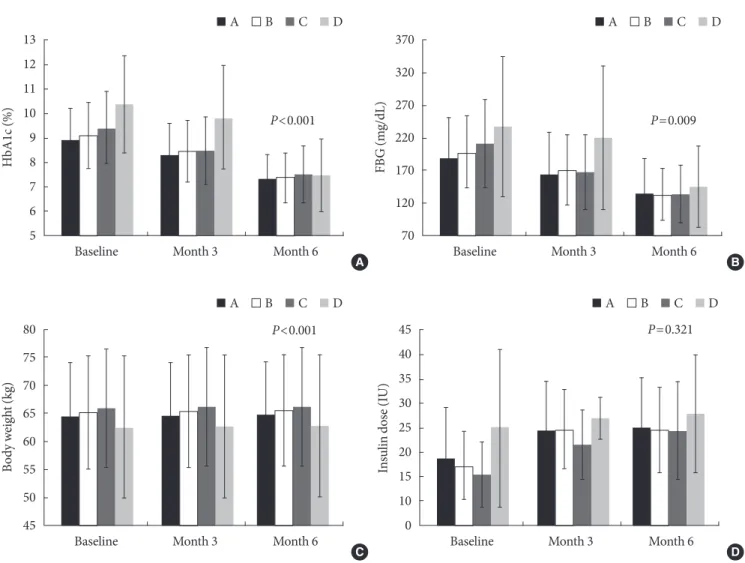
A similar trend of intergroup variation was observed in the FBG and PPG2hr levels. The largest reductions in HbA1c and FBG levels were observed in group D. The insulin dose became simi- lar between groups at week 24 (P=0.3211) (Fig. 3). The propor- tion of patients who experienced at least one hypoglycemic event was highest in group D and lowest in group A (P<0.0001) (Table 2). In addition, we analyzed the results according to the type of clinic (endocrinology vs. internal medicine) (Table 3).
The patients treated in endocrinology centers had higher HbA1c levels compared to those treated in internal medicine centers at baseline (9.3% vs. 9.1%, P<0.001). Although the pa- tients from endocrinology centers had higher HbA1c levels 6 months after initiating insulin (7.6% vs. 7.2%, P<0.001), the proportion achieving HbA1c <7% was higher in patients from endocrinology centers compared to those from internal medi- cine centers at 6 months (59.8% vs. 51.1%, P<0.001).
DISCUSSION
The results of the MOTIV study indicate that in Korean pa- tients with T2DM uncontrolled on OHA therapy, the initia- tion of basal insulin provides clinically meaningful improve- ments in glycemic control. However, the current study also shows that the initiation of insulin therapy in Korea is delayed, despite its demonstrated clinical benefits and the recommen- dations of international treatment guidelines [2,14,15].
This study included T2DM patients with inadequate glyce- mic control, with a mean HbA1c level of 9.2%, and a mean duration of diabetes of 8.9 years prior to the initiation of basal insulin. This shows that insulin initiation is delayed in Korea, regardless of the evolving treatment guidelines [2,14]. This finding is confirmed by evidences from previous studies. In the Cardiovascular Risk Evaluation in People with Type 2 Dia- betes on Insulin Therapy registry of 3,031 patients, the mean duration of diabetes was 11 years and the HbA1c level at base- line was 9.5% [16]. The First Insulinization with Basal Insulin in Patients with Type 2 Diabetes in a Real-world setting in Asia (FINEASIA) study included patients with a mean dura- Table 1. Patient characteristics at baseline stratified by the concomitant diabetes medications
Characteristic Total
(n=8,636) Group A
(n=1,437) Group B
(n=4,402) Group C
(n=2,658) Group D
(n=139) P value
Male sex 4,698 (54.4) 805 (56.0) 2,352 (53.4) 1,466 (55.2) 75 (54.0) 0.0237
Age, yr 58.1±11.4 57.7±11.6 58.2±11.4 58.5±11.0 54.2±14.0 <0.0001
Body weight, kg 65.2±10.3 64.5±9.6 65.2±10.2 65.8±10.6 62.4±12.7 <0.0001
Waist circumference, cm 84.5±10.6 83.0±10.3 84.7±10.3 85.0±11.1 81.0±9.1 <0.0001
BMI, kg/m2 24.3±2.8 23.9±2.7 24.2±2.7 24.6±2.9 23.1±4.1 <0.0001
Duration of diabetes, yr 8.9±5.9 7.4±5.3 8.8±5.8 9.9±6.2 9.0±6.6 <0.0001
HbA1c, % 9.2±1.4 8.9±1.4 9.1±1.4 9.4±1.5 10.4±2.0 <0.0001
HbA1c, mmol/mol
FBG, mg/dL 200.8±61.9 189.0±63.1 197.3±54.9 210.9±67.0 237.6±107.1 <0.0001
PP2BG, mg/dL 279.3±79.2 257.2±77.4 280.9±78.0 286.7±78.8 327.1±105.7 <0.0001
Prior therapy
Sulphonylurea 7,217 (83.6) 1,191 (82.9) 3,612 (82.1) 2,332 (87.7) 82 (59.0) <0.0001
Metformin 5,654 (65.5) 770 (53.6) 2,625 (59.6) 2,176 (81.9) 83 (59.7) <0.0001
α-Glucosidase inhibitor 1,795 (20.8) 197 (13.7) 821 (18.7) 748 (28.1) 29 (20.9) <0.0001
Thiazolidinedione 900 (10.4) 101 (7.0) 534 (12.1) 251 (9.4) 14 (10.1) <0.0001
Meglitinide 600 (7.0) 70 (4.9) 372 (8.5) 154 (5.8) 4 (2.9) <0.0001
Values are presented as number (%) or mean±standard deviation. Group A: basal insulin only, group B: basal insulin+1 OHA, group C: basal insulin+≥2 OHAs, and group D: basal insulin+short acting insulin.
BMI, body mass index; HbA1c, glycosylated hemoglobin; FBG, fasting blood glucose; PP2BG, postprandial 2-hour blood glucose.
tion of diabetes of 9.3 years and a mean HbA1c level of 9.8%.
Evidence from these studies indicate that insulin initiation is often delayed, exposing patients to many years of uncontrolled hyperglycemia.
The initiation of basal insulin in the current study resulted in a statistically and clinically significant reduced HbA1c lev- els from 9.2% to 7.4% in 6 months. In addition, approximately 44% of patients achieved the ADA-recommended HbA1c tar- get of <7%. The mean insulin dose of 0.37 U/kg prescribed at month 6 was relatively lower compared to other studies in
Western populations. In the Treat-to-Target study of North American patients with T2DM, the mean change in HbA1c was approximately –1.6% over 6 months with insulin doses of 0.48 U/kg (47.2 IU) for insulin glargine and 0.42 U/kg (41.8 IU) for NPH insulin [8].
There were also several notable variations in the demo- graphic characteristics of the study population across treat- ment groups. Group D had the poorest glycemic control, de- spite having the youngest population with the lowest mean body weight. The use of sulfonylurea and metformin at base- Fig. 2. (A) Glycosylated hemoglobin (HbA1c), (B) control rate (HbA1c <7%), (C) body weight, and (D) insulin dose at baseline, month 3 and 6. aAll P values are compared to baseline.
50 40 30 20 10
0 Month 3 Month 6
Control rate (%) (HbA1c <7.0%)
5.1
44.5
12 10 8 6 4 2
0 Baseline Month 3 Month 6
HbA1c (%)
7.4±1.07 8.5±1.34
9.2±1.43 P<0.0001a
P<0.0001a
A B
80
70
60
50
40 Baseline Month 3 Month 6
Body weight (kg)
65.5±10.08 65.4±10.20
65.2±10.27
P=0.1947a P=0.5465a
40
30
20
10
0 Baseline Month 3 Month 6
Insulin dose (IU)
24.5±9.28 23.3±7.99
16.9±7.88
P<0.0001a P<0.0001a
C D
Table 2. Hypoglycemic events stratified by the concomitant diabetes medications
Variable Total
(n=8,636) Group A
(n=1,437) Group B
(n=4,402) Group C
(n=2,658) Group D
(n=139) P value Patients experienced hypoglycemia 1,518 (17.6) 131 (9.1) 864 (19.6) 495 (18.6) 28 (20.1) <0.0001 No. of hypoglycemia event 4,311 (49.9) 274 (19.1) 2,783 (63.2) 1,198 (45.1) 56 (40.3) NA Values are presented as number (%). Group A: basal insulin only, group B: basal insulin+1 OHA, group C: basal insulin+≥2 OHAs, and group D: basal insulin+short acting insulin.
Table 3. The subgroup analysis according to the type of clinic (endocrinology centers versus internal medicine centers) Variable
At baseline At month 6
Total
(n=8,636) Endocrinology
(n=4,380) Others
(n=4,256) P value Total
(n=8,636) Endocrinology
(n=4,380) Others
(n=4,256) P value
HbA1c, % 9.2±1.4 9.3±1.5 9.1±1.3 <0.0001 7.4±1.1 7.6±1.2 7.2±0.8 <0.0001a
HbA1c, <7.0% - - - - 4,793 (55.5) 2,618 (59.8) 2,175 (51.1) <0.0001a
Body weight, kg 65.2±10.3 64.5±10.6 65.9±9.9 <0.0001 65.5±10.1 65.1±10.4 66.0±9.7 <0.0001a Insulin dose, IU 16.9±7.9 16.3±7.4 17.6±8.2 <0.0001 24.5±9.3 24.6±10.4 24.4±8.0 <0.0001a
Duration of diabetes, yr 8.9±5.9 9.1±6.2 8.7±5.6 0.0028 - - - -
Values are presented as mean±standard deviation or the number (%).
HbA1c, glycosylated hemoglobin; IU, international unit.
aAnalysis of covariance (covariates: baseline value).
Fig. 3. (A) Glycosylated hemoglobin (HbA1c), (B) fasting blood glucose (FBG), (C) body weight, and (D) insulin dose at base, month 3 and 6 by groups. Group A: basal insulin only, group B: basal insulin+1 oral hypoglycemic agent (OHA), group C: basal insulin+≥2 OHAs, and group D: basal insulin+short acting insulin. All P values compared the difference between groups at week 24.
45 40 35 30 25 20 15 10
0 Baseline Month 3 Month 6
Insulin dose (IU)
A B C D
P=0.321 80
75 70 65 60 55 50
45 Baseline Month 3 Month 6
Body weight (kg)
A B C D
P<0.001
C D
370 320 270 220 170 120
70 Baseline Month 3 Month 6
FBG (mg/dL)
A B C D
P=0.009
A B
13 12 11 10 9 8 7 6
5 Baseline Month 3 Month 6
HbA1c (%)
A B C D
P<0.001
line was also less common in this group. Considering the ob- servational nature of this study, it can be speculated that physi- cians tend to initiate the most complex insulin regimens in pa- tients with the worst glycemic profile not appropriately con- trolled with OHAs. There is also possibility that more latent autoimmune diabetes of adults patients might be included in this group compared to other groups, although this cannot be confirmed.
Interestingly, varying levels of HbA1c across treatment groups, including the highest HbA1c levels seen in group D at baseline, converged around a mean value after 6 months of re- spective treatments. This convergence to a certain HbA1c level has been observed in other studies with a treat-to-target strategy [8,17]. Thus, an HbA1c level aim for of 7% seems to be an ideal target for Korean physicians to aim in patients with T2DM.
The analysis results stratified by clinic type provide us with interesting information in this study. As the patients from en- docrinology centers are considered to have longer durations of diabetes and more complicated conditions, it is reasonable that they had higher glucose levels compared to those from internal medical centers both initially and at 6 months after being insu- lin treatment. Although a larger proportion of patients of endo- crinologists reached the glycemic target (HbA1c <7%) com- pared to those of general internal medicine doctors, primary physicians without specialties led more than half of their pa- tients in achieving this target after the initiation of basal insulin.
There are several noteworthy considerations while assessing the results of the current study. The major advantages of a reg- istry are the potential for larger-scale trials with greater num- bers of patients and the ability to monitor therapy under “real- world” conditions that may better reflect how treatment is used in clinical practice. The MOTIV study was able to recruit a large number of patients with unacceptably high HbA1c levels for assessing possible treatment modification and intensifica- tion modalities [15]. However, registry studies are not ran- domized, and the characteristics of patients receiving the dif- ferent treatment modalities may not be consistent; there may also be differences within regimens. Thus, conclusions regard- ing the comparative efficacy of each regimen cannot be drawn from the present study. Furthermore, initiation of the appro- priate insulin dose was determined by a physician, which may also have led to procedural variations. In addition, type 2 dia- betic patients were enrolled based on clinician’s judgment rather than definitive criteria such as autoantibodies and C- peptide. Although these are potential limitations to the study
analysis, they are reflective of “real-world” clinical practice, which was a key aspect of the present study. This study was conducted from 2007 to 2009, when incretin therapies includ- ing dipeptidyl peptidase-4 inhibitors were not commonly used in Korea. Therefore, the results of this study might not reflect recent clinical understandings of such factors as the duration of diabetes in influencing the initiation of insulin.
The applicability of the results can be assessed by the concur- rence of the findings from the current study with those from pri- or registry studies that indicate insulin initiation is delayed and glycemic control is suboptimal in Asian patients with T2DM [2,14]. The evidence from the current study lends credence to the observation that in a real-world setting, the initiation of basal insulin is an effective and well-tolerated treatment option in Ko- rean T2DM patients with inadequate glycemic control on OHA therapy.
CONFLICTS OF INTEREST
This study was sponsored by Sanofi Korea Ltd.
REFERENCES
1. Jeon JY, Ko SH, Kwon HS, Kim NH, Kim JH, Kim CS, Song KH, Won JC, Lim S, Choi SH, Jang MJ, Kim Y, Oh K, Kim DJ, Cha BY; Taskforce Team of Diabetes Fact Sheet of the Korean Diabe- tes Association. Prevalence of diabetes and prediabetes accord- ing to fasting plasma glucose and HbA1c. Diabetes Metab J 2013;
37:349-57.
2. Asian-Pacific Type 2 Diabetes Policy Group; Western Pacific Region of IDF: Type 2 diabetes: practical targets and treat- ments. Available from: http://www.idf.org/webdata/docs/T2D_
practical_tt.pdf (cited 2015 Oct 8).
3. American Diabetes Association. Standards of medical care in diabetes: 2014. Diabetes Care 2014;37 Suppl 1:S14-80.
4. Jeon JY, Kim DJ, Ko SH, Kwon HS, Lim S, Choi SH, Kim CS, An JH, Kim NH, Won JC, Kim JH, Cha BY, Song KH; Task- force Team of Diabetes Fact Sheet of the Korean Diabetes As- sociation. Current status of glycemic control of patients with diabetes in Korea: the fifth Korea National Health and Nutri- tion Examination Survey. Diabetes Metab J 2014;38:197-203.
5. Turner RC, Cull CA, Frighi V, Holman RR. Glycemic control with diet, sulfonylurea, metformin, or insulin in patients with type 2 diabetes mellitus: progressive requirement for multiple therapies (UKPDS 49). UK Prospective Diabetes Study (UKP-
DS) Group. JAMA 1999;281:2005-12.
6. UK Prospective Diabetes Study (UKPDS) Group. Intensive blood-glucose control with sulphonylureas or insulin com- pared with conventional treatment and risk of complications in patients with type 2 diabetes (UKPDS 33). Lancet 1998;352:
837-53.
7. Jabbour S. Primary care physicians and insulin initiation: mul- tiple barriers, lack of knowledge or both? Int J Clin Pract 2008;
62:845-7.
8. Riddle MC, Rosenstock J, Gerich J; Insulin Glargine 4002 Study Investigators. The treat-to-target trial: randomized addition of glargine or human NPH insulin to oral therapy of type 2 dia- betic patients. Diabetes Care 2003;26:3080-6.
9. Wahlqvist ML. Nutrition and diabetes in the Asia-Pacific re- gion with reference to cardiovascular disease. Asia Pac J Clin Nutr 2001;10:90-6.
10. Tong PC, Ko GT, So WY, Chiang SC, Yang X, Kong AP, Ozaki R, Ma RC, Cockram CS, Chow CC, Chan JC. Use of anti-diabetic drugs and glycaemic control in type 2 diabetes: The Hong Kong Diabetes Registry. Diabetes Res Clin Pract 2008;82:346-52.
11. Tsai ST, Pathan F, Ji L, Yeung VT, Chadha M, Suastika K, Son HS, Tan KE, Benjasuratwong Y, Nguyen TK, Iqbal F. First in- sulinization with basal insulin in patients with type 2 diabetes in a real-world setting in Asia. J Diabetes 2011;3:208-16.
12. Pan CY, Sinnassamy P, Chung KD, Kim KW; LEAD Study In- vestigators Group. Insulin glargine versus NPH insulin thera- py in Asian type 2 diabetes patients. Diabetes Res Clin Pract 2007;76:111-8.
13. Kim SS, Kim IJ, Kim YK, Yoon KH, Son HY, Park SW, Sung YA, Baek HS, Ha KS. Duration of diabetes and effectiveness of insulin in the management of insulin-naive Korean patients uncontrolled on oral antidiabetic drugs: a sub-analysis of the MOdaliTy of Insulin treatment eValuation (MOTIV) registry results. Acta Diabetol 2014;51:655-61.
14. International Diabetes Federation: Global guideline for type 2 diabetes. Available from: http://www.idf.org/sites/default/files/
IDF-Guideline-for-Type-2-Diabetes.pdf (2015 Oct 8).
15. Inzucchi SE, Bergenstal RM, Buse JB, Diamant M, Ferrannini E, Nauck M, Peters AL, Tsapas A, Wender R, Matthews DR;
American Diabetes Association (ADA); European Association for the Study of Diabetes (EASD). Management of hyperglyce- mia in type 2 diabetes: a patient-centered approach: position statement of the American Diabetes Association (ADA) and the European Association for the Study of Diabetes (EASD).
Diabetes Care 2012;35:1364-79.
16. Marre M, Danchin N, Freemantle N, Balkau B, Admane K, Blonde L, Home P. Cardiovascular Risk evaluation in people with type 2 diabetes (T2D) on insulin therapy (CREDIT) study: patterns of initial prescription of insulin and associated changes in oral glucose-lowering drug (OGLD) therapy. Dia- betes 2009;58:A126.
17. Fritsche A, Schweitzer MA, Haring HU, Study G. Glimepiride combined with morning insulin glargine, bedtime neutral protamine hagedorn insulin, or bedtime insulin glargine in patients with type 2 diabetes. A randomized, controlled trial.
Ann Intern Med 2003;138:952-9.