Endocrinol Metab 2018;33:260-267 https://doi.org/10.3803/EnM.2018.33.2.260 pISSN 2093-596X · eISSN 2093-5978
Original Article
Prevalence and Annual Incidence of Thyroid Disease in Korea from 2006 to 2015: A Nationwide Population-Based Cohort Study
Hyemi Kwon1, Jin-hyung Jung2, Kyung-Do Han2, Yong-Gyu Park2, Jung-Hwan Cho1, Da Young Lee3, Ji Min Han4, Se Eun Park1, Eun-Jung Rhee1, Won-Young Lee1
1Division of Endocrinology and Metabolism, Department of Internal Medicine, Kangbuk Samsung Hospital, Sungkyunkwan University School of Medicine; 2Department of Medical Statistics, College of Medicine, The Catholic University of Korea, Seoul; 3Division of Endocrinology and Metabolism, Department of Internal Medicine, Korea University Ansan Hospital, Korea University College of Medicine, Ansan; 4Division of Endocrinology and Metabolism, Department of Internal Medicine, Samsung Changwon Hospital, Sungkyunkwan University School of Medicine, Changwon, Korea
Background: The incidence of thyroid nodules has increased worldwide in recent years. Thyroid dysfunction is a potential risk fac- tor for hypercholesterolemia, cardiovascular disease, osteoporosis, arrhythmia, and neuropsychiatric disease. This study investigated the prevalence and annual incidence of thyroid nodules, hypothyroidism, and hyperthyroidism in Koreans.
Methods: In this nationwide population-based cohort study, 51,834,660 subjects were included using the National Health Informa- tion database from 2006 to 2015, after the exclusion of subjects with thyroid cancer.
Results: The prevalence in Korea in 2015 of thyroid nodules, hypothyroidism in patients taking thyroid hormone, and hyperthyroid- ism in patients undergoing treatment was 15.82/1,000 population, 15.94/1,000 population, and 2.76/1,000 population, respectively.
All these diseases were more prevalent among women than among men. The number of incident cases of these three thyroid diseases steadily increased from 2006 to 2012, and then decreased through 2015. The incidence of thyroid nodules, hypothyroidism treated with thyroid hormone, and treated hyperthyroidism was 6.79/1,000 population, 1.76/1,000 population, and 0.55/1,000 population, respectively, in Korea in 2015. The use of methimazole continuously increased, from 33% of total antithyroid drug prescriptions in 2006 to 74.4% in 2015, and it became the most frequently prescribed antithyroid drug in Korea. In contrast, the use of propylthioura- cil continuously decreased.
Conclusion: This was the first nationwide study of the prevalence and annual incidence of thyroid nodules, hypothyroidism, and hy- perthyroidism to take into account recent changes and to include the current status of patients receiving treatment.
Keywords: Thyroid; Hypothyroidism; Hyperthyroidism; Prevalence; Incidence
Received: 26 January 2018, Revised: 5 March 2018, Accepted: 27 March 2018 Corresponding author: Won-Young Lee
Division of Endocrinology and Metabolism, Department of Internal Medicine, Kangbuk Samsung Hospital, Sungkyunkwan University School of Medicine, 29 Saemunan-ro, Jongno-gu, Seoul 03181, Korea
Tel: +82-2-2001-2075, Fax: +82-2-2001-1588, E-mail: [email protected]
Copyright © 2018 Korean Endocrine Society
This is an Open Access article distributed under the terms of the Creative Com- mons Attribution Non-Commercial License (http://creativecommons.org/
licenses/by-nc/4.0/) which permits unrestricted non-commercial use, distribu- tion, and reproduction in any medium, provided the original work is properly cited.
INTRODUCTION
The thyroid gland is an endocrine gland that synthesizes and se- cretes thyroid hormones, which play crucial roles in the control of energy homeostasis and thermogenesis [1,2]. Thyroid nodule is the most common thyroid disease. The incidence of thyroid nodules has been increasing worldwide in recent years, mainly caused by the widespread use of high-resolution neck ultraso- nography (USG) and computed tomography [3-7]. Hypothyroid- ism is a pathological condition of deficient thyroid hormone, whereas hyperthyroidism is a disorder in which excess thyroid hormone is present [1,2]. Understanding the current distribution of thyroid dysfunction in the population is important, because it is a potential risk factor for hypercholesterolemia, cardiovascu- lar disease, osteoporosis, arrhythmia, and neuropsychiatric dis- ease [8].
The prevalence of thyroid nodules was found to be 14% to 29% among men and 28% to 42% among women in previous studies of subjects who underwent health checkups in Korea [4,9-11]. However, no studies have investigated the prevalence and annual incidence of thyroid nodules in the entire Korean population. The prevalence and incidence of thyroid dysfunc- tion vary across populations and can be influenced by several factors such as age, sex, ethnicity, and iodine status [1,2,12,13].
The prevalence of hypothyroidism in the general population has been reported to be from 0.3% to 3.7% in the United States and from 0.2% to 5.3% in European countries [1,8,14,15]. When subclinical hypothyroidism is also included, the overall preva- lence is as high as 15% [12,16]. The prevalence of overt hyper- thyroidism has been reported as 0.5% to 0.8% in Europe and 0.5% in the United States [8,14]. Although several studies have reported the prevalence and incidence of thyroid dysfunction in Korea, some studies were not able to take recent changes into account, and other studies did not reveal the current status of patients receiving treatment [16-19].
This study aimed to investigate the prevalence and annual in- cidence of thyroid nodules, hypothyroidism, and hyperthyroid- ism in the entire Korean population using the National Health Information (NHI) database after excluding subjects with thy- roid cancer.
METHODS
Data source and study population
In this nationwide population-based cohort study, 51,834,660 subjects were included using the NHI database formed and main-
tained by the Korean National Health Insurance Service (NHIS), which is managed by the Korean Ministry of Health and Wel- fare, the governmental organization that supervises all medical services in Korea [20].
Retrospective cohort data were extracted from 2002 to 2015 based on data collected during the process of claiming health care services using Korean NHIS data. The database includes information on diagnoses based on the reported International Classification of Diseases, 10th revision (ICD-10) codes, utili- zation records (dates of visits, types of medical institutions, types of visits, length of stay, and medical costs), and prescription re- cords (drug code, days prescribed, and daily dosage) [20]. Be- cause the Korean NHIS has data from 2002, we used a wash- out period from 2002 to 2005, and investigated incidence start- ing in 2006 to exclude the possibility that patients diagnosed before 2002 were mistaken as new patients. We excluded sub- jects with thyroid cancer, defined as those with the ICD-10 code C73. This study was approved by the Institutional Review Board of Kangbuk Samsung Hospital (IRB 2017-06-004). It is not necessary to have informed consent in this study.
Definitions of the diseases
Subjects with thyroid nodules were defined as those who had the ICD-10 codes E04 and D34. The prevalence was calculated by dividing the number of subjects who had thyroid nodules by the total population in 2015. Incident cases of thyroid nodules were defined as new patients who had thyroid nodules in the study period and did not have thyroid nodules before 2005.
Subjects with hypothyroidism were defined as those with the ICD-10 codes E02, E03, or E06.3 who took thyroid hormone (levothyroxine, liothyronine, or combination of levothyroxine and liothyronine) for more than 60 days to exclude patients with transient hypothyroidism. The prevalence was calculated by di- viding the number of subjects who had hypothyroidism by the total population in 2015. Incident cases of hypothyroidism were defined as new hypothyroidism patients who took thyroid hor- mone in the study period and did not have any prescriptions for it before 2005.
Subjects who were treated due to hyperthyroidism were de- fined as those who had the ICD-10 code E05 and underwent treatment including antithyroid drugs (propylthiouracil [PTU], methimazole [MMI], or carbimazole [CAMZ]), thyroid surgery, or radioactive iodine (RAI) ablation. The antithyroid drug was defined as the first prescribed medicine. Subjects who had an antithyroid drug prescription for fewer than 60 days were ex- cluded. Thyroid surgery was defined as codes P4551-P4554 and
RAI ablation was defined as code HD071. Subjects who under- went thyroid surgery or RAI due to hyperthyroidism were in- cluded if they had the ICD-10 code E05 or had been prescribed antithyroid drugs. The prevalence and incidence of hyperthy- roidism were calculated in the same way as for hypothyroidism.
Statistical analysis
For statistical analysis, SAS version 9.3 (SAS Institute Inc., Cary, NC, USA) was used. We used descriptive statistics to investi- gate the prevalence and annual incidence of thyroid disease and to evaluate trends in treatment modalities for hyperthyroidism.
The prevalence and incidence of each disease was calculated by dividing the number of prevalent and incident cases by the total population, respectively, and presented per 1,000 population.
Categorical variables are presented as numbers and percentages.
RESULTS
Prevalence and annual incidence of thyroid nodules in Korea
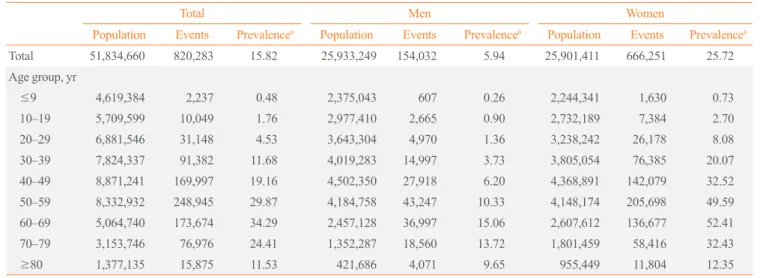
The prevalence of thyroid nodules according to sex and age group in 2015 is shown in Table 1. The number of patients with thy- roid nodules was 0.82 million (0.15 million men and 0.66 mil- lion women). The prevalence of thyroid nodules was 15.82/1,000 population in Korea in 2015. Their prevalence among men and women was 5.94/1,000 population and 25.72/1,000 population in 2015, respectively. The prevalence of thyroid nodules was the greatest in the 60 to 69 years age group among both men (15.06/
1,000 population) and women (52.41/1,000 population).
In total, the number of newly diagnosed patients with thyroid nodules steadily increased from 208,200 in 2006 to 458,500 in 2012, and then decreased to 325,400 in 2015 (Fig. 1). This cor- responded to 4.36, 9.49, and 6.79 cases/1,000 population among NHIS beneficiaries in 2006, 2012, and 2015, respectively. Among men, the number of newly diagnosed patients with thyroid nod- ules steadily increased from 40,200 in 2006 to 100,200 in 2012, and then decreased to 80,000 in 2015. Among women, the num- ber of newly diagnosed patients with thyroid nodules steadily increased from 168,000 in 2006 to 358,300 in 2012, and then decreased to 245,400 in 2015.
Prevalence and annual incidence of hypothyroidism in patients taking thyroid hormone in Korea
The prevalence of hypothyroidism in patients taking thyroid hormone according to sex and age group in 2015 is shown in
Fig. 1. Annual incidence of thyroid nodules in 2006 to 2015.
20
15
10
5
Incidence (per population 1,000/year) 0
Year
2006 2007 2008 2009 2010 2011 2012 2013 2014 2015 Thyroid nodules
Total MenWomen
Table 1. Prevalence of Thyroid Nodules in 2015
Total Men Women
Population Events Prevalencea Population Events Prevalencea Population Events Prevalencea
Total 51,834,660 820,283 15.82 25,933,249 154,032 5.94 25,901,411 666,251 25.72
Age group, yr
≤9 4,619,384 2,237 0.48 2,375,043 607 0.26 2,244,341 1,630 0.73
10–19 5,709,599 10,049 1.76 2,977,410 2,665 0.90 2,732,189 7,384 2.70
20–29 6,881,546 31,148 4.53 3,643,304 4,970 1.36 3,238,242 26,178 8.08
30–39 7,824,337 91,382 11.68 4,019,283 14,997 3.73 3,805,054 76,385 20.07
40–49 8,871,241 169,997 19.16 4,502,350 27,918 6.20 4,368,891 142,079 32.52
50–59 8,332,932 248,945 29.87 4,184,758 43,247 10.33 4,148,174 205,698 49.59
60–69 5,064,740 173,674 34.29 2,457,128 36,997 15.06 2,607,612 136,677 52.41
70–79 3,153,746 76,976 24.41 1,352,287 18,560 13.72 1,801,459 58,416 32.43
≥80 1,377,135 15,875 11.53 421,686 4,071 9.65 955,449 11,804 12.35
aPrevalence was calculated by dividing the number of prevalent cases by the total population and presented per 1,000 population.
Fig. 2. Annual incidence of hypothyroidism in patients taking thy- roid hormone in 2006 to 2015.
4
3
2
1
Incidence (per population 1,000/year) 0
Year
2006 2007 2008 2009 2010 2011 2012 2013 2014 2015 Hypothyroidism in patients taking thyroid hormone
Total MenWomen
Table 2. The number of patients who had hypothyroidism and were taking thyroid hormone was 0.82 million (0.13 million men and 0.69 million women). The prevalence of hypothyroid- ism in patients taking thyroid hormone was 15.94/1,000 popula- tion in Korea in 2015. Its prevalence among men and women was 5.15/1,000 population and 26.75/1,000 population, respec- tively. The prevalence of hypothyroidism in patients taking thy- roid hormone was the greatest in the 70 to 79 years age group (13.9/1,000 population) among men, and in the 60 to 69 years age group (55.75/1,000 population) among women.
In total, the number of newly diagnosed hypothyroidism pa- tients treated with thyroid hormone steadily increased from 73,300 in 2006 to 110,500 in 2012, and then decreased to 88,600 in 2015 (Fig. 2). This corresponded to 1.53, 2.21, and 1.76 cases/1,000 population among NHIS beneficiaries in 2006, 2012, and 2015, respectively. Among men, the number of newly diagnosed hy- pothyroidism patients treated with thyroid hormone steadily in- creased from 10,600 in 2006 to 20,000 in 2013, and then decre- ased to 17,800 in 2015. Among women, the number of those pa- tients steadily increased from 62,600 in 2006 to 90,500 in 2012, and then decreased to 70,700 in 2015.
Prevalence and annual incidence of hyperthyroidism in patients undergoing treatment in Korea
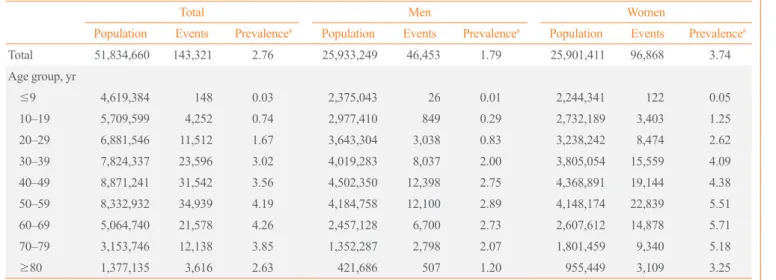
The prevalence of hyperthyroidism in patients undergoing treat- ment according to sex and age groups in 2015 is shown in Table 3. The number of patients who had hyperthyroidism and were undergoing treatment was 0.14 million (46,500 men and 96,900 women). The prevalence of hyperthyroidism in patients under-
going treatment was 2.76/1,000 population in Korea in 2015. Its prevalence among men and women was 1.79/1,000 population and 3.74/1,000 population, respectively. The prevalence of hy- perthyroidism in patients undergoing treatment was greatest in the 50 to 59 years age group (2.89/1,000 population) among men, and the 60 to 69 years age group (5.71/1,000 population) among women.
In total, the number of patients newly diagnosed with hyper- thyroidism who were undergoing treatment slightly increased from 29,900 in 2006 to 32,400 in 2012, and then decreased to 28,200 in 2015 (Fig. 3). This corresponded to 0.62, 0.64, and 0.55 cases/1,000 population among NHIS beneficiaries in 2006, 2012, and 2015, respectively. Among men, the number of newly diagnosed hyperthyroidism patients who were undergoing treat- ment slightly increased from 7,900 in 2006 to 9,000 in 2012, Table 2. Prevalence of Hypothyroidism in Patients Taking Thyroid Hormone in 2015
Total Men Women
Population Events Prevalencea Population Events Prevalencea Population Events Prevalencea
Total 51,834,660 826,258 15.94 25,933,249 133,515 5.15 25,901,411 692,743 26.75
Age group, yr
≤9 4,619,384 5,371 1.16 2,375,043 2,657 1.12 2,244,341 2,714 1.21
10–19 5,709,599 6,504 1.14 2,977,410 1,822 0.61 2,732,189 4,682 1.71
20–29 6,881,546 20,853 3.03 3,643,304 3,149 0.86 3,238,242 17,704 5.47
30–39 7,824,337 96,121 12.28 4,019,283 12,058 3.00 3,805,054 84,063 22.09
40–49 8,871,241 164,334 18.52 4,502,350 25,809 5.73 4,368,891 138,525 31.71
50–59 8,332,932 234,732 28.17 4,184,758 34,698 8.29 4,148,174 200,034 48.22
60–69 5,064,740 174,322 34.42 2,457,128 28,939 11.78 2,607,612 145,383 55.75
70–79 3,153,746 96,687 30.66 1,352,287 18,802 13.90 1,801,459 77,885 43.23
≥80 1,377,135 27,334 19.85 421,686 5,581 13.23 955,449 21,753 22.77
aPrevalence was calculated by dividing the number of prevalent cases by the total population and presented per 1,000 population.
and then decreased to 8,200 in 2015. Among women, the num- ber of those patients slightly increased from 21,900 in 2006 to 23,300 in 2012, and then decreased to 19,800 in 2015.
Changes in the prescription patterns of antithyroid drugs in patients with hyperthyroidism
The use of different types of antithyroid drugs in patients with hyperthyroidism is illustrated in Fig. 4. PTU was the most com- monly used drug for patients with hyperthyroidism before 2009, but MMI overtook PTU in 2010. Among 30,000 patients with hyperthyroidism in 2006, 65.8% of all prescriptions for antithy- roid drugs were PTU, while MMI was used only in 30% of pa- tients. The use of MMI continuously increased to 74.4% of total
antithyroid drug prescriptions in 2015, and it became the most frequently prescribed antithyroid drug in Korea. In contrast, the use of PTU steadily decreased to 22.3% in 2015.
DISCUSSION
This nation-wide cross-sectional study investigated the preva- lence and annual incidence of thyroid nodules, hypothyroidism, and hyperthyroidism in Korea using the NHI database after ex- cluding of subjects with thyroid cancer. The prevalence of thy- roid nodules, hypothyroidism in patients taking thyroid hormone, and hyperthyroidism in patients undergoing treatment was 15.82/
1,000 population, 15.94/1,000 population, and 2.76/1,000 popu- Fig. 3. Annual incidence of hyperthyroidism in patients undergoing
treatment in 2006 to 2015.
1.0 0.8 0.6 0.4 0.2 Incidence (per population 1,000/year) 0
Year
2006 2007 2008 2009 2010 2011 2012 2013 2014 2015 Hyperthyroidism in patients undergoing treatment
Total Men Women
Fig. 4. Changes in the prescription patterns of antithyroid drug in patients with hyperthyroidism. CAMZ, carbimazole; MMI, me- thimazole; PTU, propylthiouracil.
The use of antithyroid drug
100 80 60 40 20 Antithyroid drug use (%) 0
Year
2006 2007 2008 2009 2010 2011 2012 2013 2014 2015
CAMZ MMI PTU
Table 3. Prevalence of Hyperthyroidism in Patients Undergoing Treatment in 2015
Total Men Women
Population Events Prevalencea Population Events Prevalencea Population Events Prevalencea
Total 51,834,660 143,321 2.76 25,933,249 46,453 1.79 25,901,411 96,868 3.74
Age group, yr
≤9 4,619,384 148 0.03 2,375,043 26 0.01 2,244,341 122 0.05
10–19 5,709,599 4,252 0.74 2,977,410 849 0.29 2,732,189 3,403 1.25
20–29 6,881,546 11,512 1.67 3,643,304 3,038 0.83 3,238,242 8,474 2.62
30–39 7,824,337 23,596 3.02 4,019,283 8,037 2.00 3,805,054 15,559 4.09
40–49 8,871,241 31,542 3.56 4,502,350 12,398 2.75 4,368,891 19,144 4.38
50–59 8,332,932 34,939 4.19 4,184,758 12,100 2.89 4,148,174 22,839 5.51
60–69 5,064,740 21,578 4.26 2,457,128 6,700 2.73 2,607,612 14,878 5.71
70–79 3,153,746 12,138 3.85 1,352,287 2,798 2.07 1,801,459 9,340 5.18
≥80 1,377,135 3,616 2.63 421,686 507 1.20 955,449 3,109 3.25
aPrevalence was calculated by dividing the number of prevalent cases by the total population and presented per 1,000 population.
lation in Korea in 2015, respectively. All these diseases were more prevalent among women than among men. In total, the number of incident cases of these three thyroid diseases steadily increased from 2006 to 2012, and then decreased through 2015.
The incidence of thyroid nodules, hypothyroidism in patients taking thyroid hormone, and hyperthyroidism in patients under- going treatment was 6.79/1,000 population, 1.76/1,000 popula- tion, and 0.55/1,000 population in Korea in 2015. The use of MMI continuously increased from 33% of total antithyroid drug prescriptions in 2006 to 74.4% in 2015, and it became the most frequently prescribed antithyroid drug in Korea, while the use of PTU continuously decreased.
Several studies of Korean subjects with thyroid nodules who underwent health checkups have been reported [4,9-11]. The prevalence of thyroid nodules was 14% to 29% among men and 28% to 42% among women [4,9-11]. However, those studies could not reflect the current state of the population and clinical practice, because the examinees of health checkup might be un- usually interested in their health and have a relatively high prev- alence of thyroid nodules. In the current study, the prevalence of thyroid nodules among men and women was 5.94/1,000 popu- lation and 25.72/1,000 population in 2015, respectively. The prevalence of thyroid nodules was the greatest in the 60 to 69 years age group among both men (15.06/1,000 population) and women (52.41/1,000 population).
In the current study, 5.15/1,000 population among men and 26.75/1,000 population among women took thyroid hormone due to hypothyroidism. Several studies have investigated the prevalence and incidence of hypothyroidism in Korea [16,17,19].
A previous study using claims data provided by the Health In- surance Review and Assessment Service (HIRA) reported that the prevalence of hypothyroidism was 14.28/1,000 population in Korea in 2015 [17]. Another cohort study reported that the prevalence of subclinical hypothyroidism in the Ansung cohort and Korean Longitudinal Study on Health and Aging Study was 11.7% and 17.3%, respectively [19]. Recently, a study investi- gated the prevalence of hypothyroidism and hyperthyroidism using the Korea National Health and Nutrition Examination Sur- vey VI (KNHANES VI, 2013 to 2015) by applying the refer- ence interval of serum thyroid stimulating hormone in the Kore- an reference population [16]. The study reported that the preva- lence of overt and subclinical hypothyroidism was 0.73% and 3.10%, respectively [16]. However, the study could not reflect the actual clinical prevalence of the disease, because the authors evaluated the prevalence of the disease after excluding patients with a prior history of thyroid disease or taking medicine that
could influence thyroid function [16].
The prevalence of hyperthyroidism in patients undergoing treatment was 1.79/1,000 population among men and 3.74/1,000 population among women in this study. The prevalence of hy- perthyroidism reported by previous studies from Korea was sim- ilar to that of other countries [8,14]. In a previous study published in 2013 using the HIRA database, the prevalence of hyperthy- roidism was 3.40/1,000 population (2.09 among men and 4.70 among women), and the incidence of hyperthyroidism was 0.72/
1,000 population (0.40 among men and 1.03 among women) [18]. The study using the KNHANES VI reported that the prev- alence of overt and subclinical hyperthyroidism in the disease- free population was 0.54% and 2.98%, respectively [16].
The number of incident cases of thyroid nodules, hypothy- roidism, and hyperthyroidism steadily increased from 2006 to 2012, and then decreased to 2015. In 2010, the Korean Thyroid Association (KTA) presented revised guidelines for the diagno- sis and management of thyroid nodules and cancer and size cri- teria of thyroid nodules for applying fine-needle aspiration cy- tology (FNAC) based on the risk factors for thyroid cancer [21].
They recommended that FNAC should be performed in nodules larger than 5 mm, even if in patients at a high risk for thyroid cancer or with malignant features on neck USG [21]. For these reasons, physicians might have started to perform examinations less frequently, not only for thyroid nodules and cancer, but also for thyroid dysfunction. Ahn and Welch [22] reported that the number of operations for thyroid cancer decreased after screen- ing for thyroid cancer with USG was discouraged in March 2014.
However, the current study showed that the incidence of thyroid nodules, hypothyroidism, and hyperthyroidism decreased start- ing in 2013.
Recently, MMI became the most frequently prescribed anti- thyroid drug among the three types of antithyroid drugs (PTU, MMI, and CAMZ). PTU was the most commonly used drug for patients with hyperthyroidism before 2009, but MMI overtook PTU in 2010. The U.S. Food and Drug Administration added a new boxed warning to the label for PTU about severe liver inju- ry in 2010, because PTU can lead to potentially fatal fulminant hepatic necrosis [23-25]. The American Thyroid Association and American Association of Clinical Endocrinologists guide- lines, as well as the KTA guidelines, recommended using MMI to treat hyperthyroidism, except within the first trimester of pregnancy and in patients experiencing thyrotoxic crisis [25,26].
For these reasons, the trends in physician’s prescriptions changed and MMI became the most frequently prescribed antithyroid drug in 2015.
This retrospective cohort study has several limitations. Be- cause of its population-based design, this study could be subject to several biases, including coding bias, selection bias, and the effects of confounding factors. A possible discrepancy existed between the actual diagnosis and claim data because the NHIS database depends on the diagnostic code and prescription sub- mitted on the physician’s claim. In addition, the NHIS database does not contain information about prescriptions not covered through insurance. Data from thyroid function tests were not available in this study. We were not able to include subjects who had hypothyroidism and did not receive medication or those with hyperthyroidism who did not receive treatment. We could not evaluate the causative disease of hypothyroidism and hyper- thyroidism. We excluded subjects diagnosed with thyroid can- cer, even if they had been treated for thyroid dysfunction or had thyroid nodules. This could have led us to underestimate the prevalence and incidence of these thyroid diseases. Neverthe- less, this was the first study of the prevalence and annual inci- dence of thyroid nodules in the entire Korean population. We investigated the prevalence and annual incidence of hypothy- roidism and hyperthyroidism, taking into account recent chang- es and including the current status of patients receiving treatment.
In conclusion, the prevalence of thyroid nodules, hypothy- roidism in patients taking thyroid hormone, and hyperthyroid- ism in patients undergoing treatment was 15.82/1,000 popula- tion, 15.94/1,000 population, and 2.76/1,000 population, respec- tively, in Korea in 2015 using the NHI database after excluding subjects with thyroid cancer. All these diseases were more prev- alent among women than among men. The number of incident cases of these thyroid diseases steadily increased from 2006 to 2012, and then decreased through 2015. The incidence of thy- roid nodules, hypothyroidism in patients taking thyroid hormone, and hyperthyroidism in patients undergoing treatment was 6.79/
1,000 population, 1.76/1,000 population, and 0.55/1,000 popu- lation in Korea in 2015. MMI is now the most frequently pre- scribed antithyroid drug in Korea.
CONFLICTS OF INTEREST
No potential conflict of interest relevant to this article was re- ported.
ACKNOWLEDGMENTS
This work was supported by the Korean Endocrine Society of EnM Research Award 2017.
AUTHOR CONTRIBUTIONS
Conception and design: W.Y.L., H.K. Development of method- ology: H.K., J.J., K.D.H., Y.G.P. Acquisition of data (provided animals, acquired and managed patients, provided facilities, etc.): J.J., K.D.H., Y.G.P. Analysis and interpretation of data (e.g., statistical analysis, biostatistics, computational analysis):
J.J., K.D.H., Y.G.P. Writing, review, and/or revision of the man- uscript: H.K., J.H.C., D.Y.L., J.M.H. Administrative, technical, or material support (i.e., reporting or organizing data, construct- ing databases): K.D.H., H.K. Study supervision: S.E.P., E.J.R., W.Y.L.
ORCID
Hyemi Kwon https://orcid.org/0000-0003-4257-3133 Eun-Jung Rhee https://orcid.org/0000-0002-6108-7758 Won-Young Lee https://orcid.org/0000-0002-1082-7592
REFERENCES
1. Chaker L, Bianco AC, Jonklaas J, Peeters RP. Hypothyroid- ism. Lancet 2017;390:1550-62.
2. De Leo S, Lee SY, Braverman LE. Hyperthyroidism. Lancet 2016;388:906-18.
3. Mitchell J, Parangi S. The thyroid incidentaloma: an in- creasingly frequent consequence of radiologic imaging. Se- min Ultrasound CT MR 2005;26:37-46.
4. Moon JH, Hyun MK, Lee JY, Shim JI, Kim TH, Choi HS, et al. Prevalence of thyroid nodules and their associated clini- cal parameters: a large-scale, multicenter-based health checkup study. Korean J Intern Med 2017 Jul 7 [Epub].
https://doi.org/10.3904/kjim.2015.273.
5. Shin J, Kim MH, Yoon KH, Kang MI, Cha BY, Lim DJ. Re- lationship between metabolic syndrome and thyroid nodules in healthy Koreans. Korean J Intern Med 2016;31:98-105.
6. Liu Y, Lin Z, Sheng C, Zhu Y, Huang Y, Zhong N, et al. The prevalence of thyroid nodules in northwest China and its cor- relation with metabolic parameters and uric acid. Oncotarget 2017;8:41555-62.
7. Guo H, Sun M, He W, Chen H, Li W, Tang J, et al. The prevalence of thyroid nodules and its relationship with meta- bolic parameters in a Chinese community-based population aged over 40 years. Endocrine 2014;45:230-5.
8. Hollowell JG, Staehling NW, Flanders WD, Hannon WH, Gunter EW, Spencer CA, et al. Serum TSH, T(4), and thy-
roid antibodies in the United States population (1988 to 1994): National Health and Nutrition Examination Survey (NHANES III). J Clin Endocrinol Metab 2002;87:489-99.
9. Suk JH, Kim TY, Kim MK, Kim WB, Kim HK, Jeon SH, et al. Prevalence of ultrasonographically-detected thyroid nod- ules in adults without previous history of thyroid disease. J Korean Endocr Soc 2006;21:389-93.
10. Kim WJ, Kim JH, Park DW, Lee CB, Park YS, Kim DS, et al. Prevalence of thyroid nodules detected by ultrasonogra- phy in adults for health check-ups and analysis of fine needle aspiration cytology. J Korean Endocr Soc 2008;23:413-9.
11. Kim JH, Park SJ, Kim SE, Lee KH, Cho IK, Jang SI, et al.
Prevalence of thyroid nodules detected by ultrasonography in adult men attending health check-ups. J Korean Endocr Soc 2007;22:112-7.
12. Peeters RP. Subclinical hypothyroidism. N Engl J Med 2017;376:2556-65.
13. Smith TJ, Hegedus L. Graves’ disease. N Engl J Med 2016;
375:1552-65.
14. Garmendia Madariaga A, Santos Palacios S, Guillen-Grima F, Galofre JC. The incidence and prevalence of thyroid dys- function in Europe: a meta-analysis. J Clin Endocrinol Metab 2014;99:923-31.
15. Asvold BO, Vatten LJ, Bjoro T. Changes in the prevalence of hypothyroidism: the HUNT Study in Norway. Eur J En- docrinol 2013;169:613-20.
16. Kim WG, Kim WB, Woo G, Kim H, Cho Y, Kim TY, et al.
Thyroid stimulating hormone reference range and preva- lence of thyroid dysfunction in the Korean population: Ko- rea National Health and Nutrition Examination Survey 2013 to 2015. Endocrinol Metab (Seoul) 2017;32:106-14.
17. Seo GH, Chung JH. Incidence and prevalence of overt hypo- thyroidism and causative diseases in Korea as determined using claims data provided by the Health Insurance Review
and Assessment Service. Endocrinol Metab (Seoul) 2015;
30:288-96.
18. Seo GH, Kim SW, Chung JH. Incidence & prevalence of hyperthyroidism and preference for therapeutic modalities in Korea. J Korean Thyroid Assoc 2013;6:56-63.
19. Chang MY, Han DH, Moon IJ, Kim ST, Kim DY, Lee CH, et al. Assessment of allergic rhinitis websites in Korea. Clin Exp Otorhinolaryngol 2010;3:32-6.
20. Seong SC, Kim YY, Khang YH, Park JH, Kang HJ, Lee H, et al. Data resource profile: the National Health Information database of the National Health Insurance Service in South Korea. Int J Epidemiol 2017;46:799-800.
21. Yi KH, Park YJ, Koong SS, Kim JH, Na DG, Ryu JS, et al.
Revised Korean Thyroid Association management guide- lines for patients with thyroid nodules and thyroid cancer.
Endocrinol Metab 2010;25:270-97.
22. Ahn HS, Welch HG. South Korea’s thyroid-cancer “epidem- ic”: turning the tide. N Engl J Med 2015;373:2389-90.
23. Rivkees SA, Mattison DR. Ending propylthiouracil-induced liver failure in children. N Engl J Med 2009;360:1574-5.
24. Bahn RS, Burch HS, Cooper DS, Garber JR, Greenlee CM, Klein IL, et al. The role of propylthiouracil in the manage- ment of Graves’ disease in adults: report of a meeting jointly sponsored by the American Thyroid Association and the Food and Drug Administration. Thyroid 2009;19:673-4.
25. Bahn Chair RS, Burch HB, Cooper DS, Garber JR, Green- lee MC, Klein I, et al. Hyperthyroidism and other causes of thyrotoxicosis: management guidelines of the American Thyroid Association and American Association of Clinical Endocrinologists. Thyroid 2011;21:593-646.
26. Moon JH, Yi KH. The diagnosis and management of hyper- thyroidism in Korea: consensus report of the Korean Thy- roid Association. Endocrinol Metab (Seoul) 2013;28:275-9.