Endocrinol Metab 2017;32:90-98 https://doi.org/10.3803/EnM.2017.32.1.90 pISSN 2093-596X · eISSN 2093-5978
Original Article
Development of Clinical Data Mart of HMG-CoA Reductase Inhibitor for Varied Clinical Research
Hun-Sung Kim1,2,*, Hyunah Kim3,*, Yoo Jin Jeong1, Tong Min Kim1, So Jung Yang1, Sun Jung Baik1, Seung-Hwan Lee2, Jae Hyoung Cho2, In Young Choi1, Kun-Ho Yoon1,2
1Department of Medical Informatics, College of Medicine, The Catholic University of Korea; 2Division of Endocrinology and Metabolism, Department of Internal Medicine, Seoul St. Mary’s Hospital, College of Medicine, The Catholic University of Korea; 3College of Pharmacy, Sookmyung Women’s University, Seoul, Korea
Background: The increasing use of electronic medical record (EMR) systems for documenting clinical medical data has led to EMR data being increasingly accessed for clinical trials. In this study, a database of patients who were prescribed statins for the first time was developed using EMR data. A clinical data mart (CDM) was developed for cohort study researchers.
Methods: Seoul St. Mary’s Hospital implemented a clinical data warehouse (CDW) of data for ~2.8 million patients, 47 million pre- scription events, and laboratory results for 150 million cases. We developed a research database from a subset of the data on the basis of a study protocol. Data for patients who were prescribed a statin for the first time (between the period from January 1, 2009 to De- cember 31, 2015), including personal data, laboratory data, diagnoses, and medications, were extracted.
Results: We extracted initial clinical data of statin from a CDW that was established to support clinical studies; the data was refined through a data quality management process. Data for 21,368 patients who were prescribed statins for the first time were extracted.
We extracted data every 3 months for a period of 1 year. A total of 17 different statins were extracted. It was found that statins were first prescribed by the endocrinology department in most cases (69%, 14,865/21,368).
Conclusion: Study researchers can use our CDM for statins. Our EMR data for statins is useful for investigating the effectiveness of treatments and exploring new information on statins. Using EMR is advantageous for compiling an adequate study cohort in a short period.
Keywords: Electronic health records; Clinical data mart; Hydroxymethylglutaryl-CoA reductase inhibitors; Clinical data warehouse
Received: 9 November 2016, Revised: 2 January 2017, Accepted: 6 January 2017
Corresponding authors: Kun-Ho Yoon
Division of Endocrinology and Metabolism, Department of Internal Medicine, Seoul St. Mary’s Hospital, College of Medicine, The Catholic University of Korea, 222 Banpo-daero, Seocho-gu, Seoul 06591, Korea
Tel: +82-2-2258-8262, Fax:+82-2-2258-8297, E-mail: [email protected] In Young Choi
Department of Medical Informatics, College of Medicine, The Catholic University of Korea, 222 Banpo-daero, Seocho-gu, Seoul 06591, Korea Tel: +82-2-2258-8262, Fax: 82-2-2258-8297, E-mail: [email protected]
*These authors contributed equally to this work.
Copyright © 2017 Korean Endocrine Society
This is an Open Access article distributed under the terms of the Creative Com- mons Attribution Non-Commercial License (http://creativecommons.org/
licenses/by-nc/4.0/) which permits unrestricted non-commercial use, distribu- tion, and reproduction in any medium, provided the original work is properly cited.
pISSN 2093-596X · eISSN 2093-5978
INTRODUCTION
Recently, there has been a rapid increase in the use of electronic medical records (EMRs). These computerized database (DB) system records eliminate the need for hand writing medical in- formation, such as symptoms, diagnoses, and clinical results, on paper [1]. Concerns exist about the use of EMR for clinical re- search owing to a lack of random sampling and subsequent gen- eralizability [2]. However, several recent reports have presented the advantages of EMR [3-6]. EMR data are systematically managed and easily accessed, enabling the ability to collect in- formation about a patient’s current medical, past medical, fami- ly, and therapeutic histories. EMR data also include interdisci- plinary clinical treatments and prescriptions from other depart- ments within the same clinical center. With the increasing use of EMR systems for documenting clinical medical data, clinical trials have also increasingly accessed EMR data [7-9].
Randomized controlled trials (RCTs), in which medical inter- ventions are conducted in a targeted patient population, are pre- ferred in clinical trials when testing the efficacy and effective- ness of a drug or treatment, or when documenting the progres- sion of a disease. Strict standards are generally applied to par- ticipant selection for RCTs to ensure the validity of the results.
However, RCTs are expensive and time-intensive; consequent- ly, study enrollment is often limited. EMR-based studies are similar in structure to a cohort study; however, the use of EMR data in studies allows for quick and simple extraction of large amounts of data that were collected over long periods of time.
This capability will become a greater advantage as more EMR data are accumulated over time [10-12]. Therefore, EMR-based clinical research requires a standardized clinical data mart (CDM) that various researchers can employ to readily extract necessary data depending on their diverse research objectives.
In this study, 3-hydroxy-3-methylglutaryl-coenzyme A reduc- tase inhibitor (statin) was selected. It is the predominantly pre- scribed statin for preventing cardiovascular disorders [13].
Statins are used to prevent cardiovascular disease by lowering low density lipoprotein cholesterol (LDL-C) and triglyceride (TG) levels and increasing high density lipoprotein cholesterol (HDL-C) levels [14,15]. Several types of statins exist on the market with differing efficacies, and numerous clinical trials have compared their respective effects [14,15]. The primary purpose of this study was to develop a clinical statin data mart to address various purposes, such as assessments of drug effica- cy and safety. We intended to aggregate a large amount of data on patients who were prescribed a statin for the first time to en-
able researchers to conduct their relevant studies. By establish- ing a CDM that includes patient personal data, medical history, medication history, and other patient information relating to statins, we strived to facilitate rapid and effective access to di- verse patient information and data. We furthermore strived to open a CDM for authorized researchers and other users to share and enhance study results through open technology.
METHODS
Clinical data warehouse
Directly extracting research data via a query from the EMR sys- tem can impact the performance of the system for routine hospi- tal use. A clinical data warehouse (CDW) provides numerous benefits to researchers for quality data collection and decision- making capabilities through quick and efficient access to patient information and links to multiple operational data sources. Fur- thermore, it can be used to discover disease relationships and drugs in addition to repositioning drugs by combining different data sources and validating the consistency of information.
Therefore, we established the study dataset to include diagnosis and laboratory data based on a CDW system [16]. The CDW system of Seoul St. Mary’s Hospital is currently comprised of 30 tables that include all clinical, prescription, laboratory, radi- ology, pathology, and other information of all patients at the hospital since 1997. Currently, data exist in the system for ap- proximately 2.8 million patients, 47 million medication pre- scription events, and laboratory results for 150 million cases. Of the 2.2 billion total records, we developed a research DB from a subset of the data based on a study protocol. It additionally pro- vides comprehensive views of clinical data for specific purposes [17,18].
Extraction of the study sample
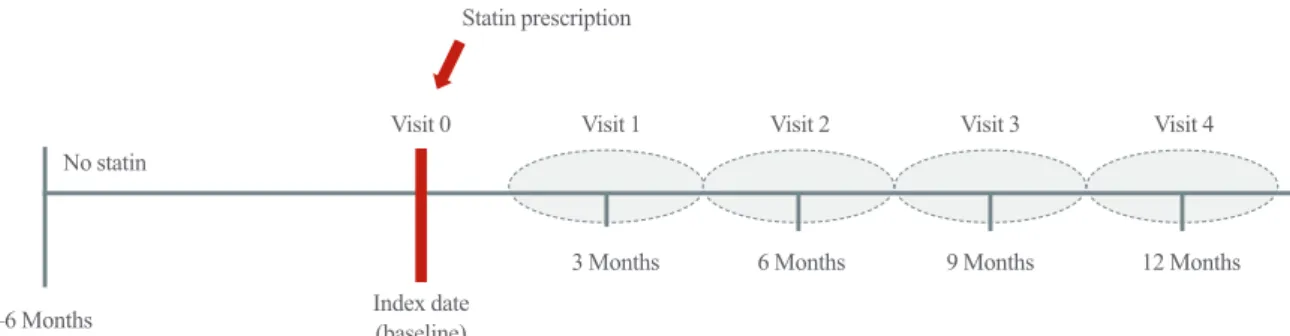
Data for patients who were prescribed a statin for the first time at Seoul St. Mary’s Hospital between January 1, 2009 and De- cember 31, 2015 were extracted from the CDW. Cases were identified as those who did not have a statin prescription for at least six months before a statin was initially prescribed. The date on which the initial statin prescription occurred was de- fined as visit 0 (index date, baseline) (Fig. 1). Visit 1 (an aver- age of 3 months later) was defined as the next occurrence of a laboratory test and subsequent renewal of the statin prescription within 45 to 135 days of the baseline. Visit 2 was defined as the subsequent visit that occurred within 136 to 225 days after the baseline (an average of 6 months later). Visit 3 was defined as
226 to 315 days after the baseline (an average of 9 months lat- er), and visit 4 was defined as 316 to 405 days after the baseline (an average of 1 year later). Cases were checked when the pre- scription changed to a different statin type or the statin prescrip- tion was suspended during the study period. When the patients visited the hospital or had a blood test performed more than once within one period of a visit, the test results of the dates closest to the 91th, 182th, 273th, and 365th day were retrieved.
This study covered all statin types that are prescribed at Seoul
St. Mary’s Hospital. According to American College of Cardiol- ogy/American Heart Association guidelines [15], we classified statins based on intensity, type, and dose. The statin types and dosages are as follows: atorvastatin (10, 20, and 40 mg), fluvas- tatin (40 and 80 mg), pitavastatin (2 and 4 mg), pravastatin (10, 20, and 40 mg), rosuvastatin (5, 10, and 20 mg), simvastatin (20 and 40 mg), and simvastatin plus ezetimibe (10/10 and 20/10 mg). The combination statins and other drugs with other effects were excluded from the study (atorvastatin plus amlodipine or
Statin prescription
Visit 0 Visit 1 Visit 2 Visit 3 Visit 4
3 Months 6 Months 9 Months 12 Months
–6 Months Index date
(baseline)
User ID User password Registration date
Patient ID Birth date AgeSex Height Weight
Systolic blood pressure Diastolic blood pressure Statin first department Statin first prescription code Statin first date
Statin first period Statin latest department Statin latest prescription code Statin latest dage
Statin latest period Diagnosis code
Diagnosis name
Laboratory code Laboratory name
Prescription code Prescription name
Patient ID Diagnosis code Diagnosis exist First diagnosis date
Patient ID Laboratory code Laboratory date Laboratory value
Patient ID Prescription code Prescription exist
Patient ID Calculation date Target LDL-C value Risk level Fig. 1. Design of clinical data mart for clinical trials on statins.
Fig. 2. Entity relationship diagram. ID, identification; LDL-C, low density lipoprotein cholesterol.
No statin
Users
Patient information
Diagnosis code Laboratory code
Prescription code
Diagnosis Laboratory
Prescription Calculation
pravastatin plus fenofibrate).
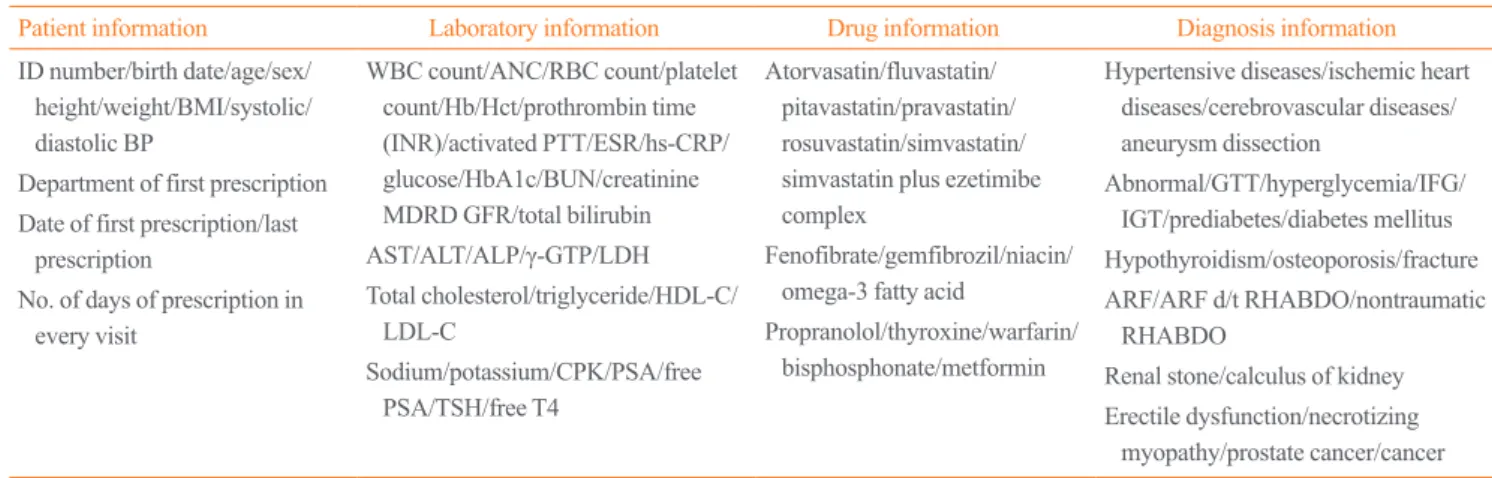
Patient data were extracted, including date of birth, age (when first prescribed statins), sex, department in which the statins were first prescribed, first statin prescription date, days of pre- scription, etc. Besides total cholesterol, TG, HDL-C, LDL-C, which are indicators relevant to hyperlipidemia, blood tests were also covered in this study, such as blood urea nitrogen, creati- nine, aspartate aminotransferase/alanine aminotransferase (AST/
ALT), hemoglobin/hematocrit, glycated hemoglobin, alkaline phosphatase, high-sensitivity C-reactive protein, γ-glutamyl transpeptidase, thyroid function test (thyroid stimulating hor- mone, free thyroxine), and others. In modeling the DB, we struc- turalized relations between objects of unique features compris- ing it (Fig. 2).
In addition to hyperlipidemia, various diseases, including car- diovascular disorders, diabetes, and others, have been recently reported as relevant to statins; thus, they were included. More- over, to study statin side effects, consideration was given to whether a patient used fenofibrate, omega-3 fatty acids, pro- pranolol, thyroxine, warfarin, nicotinic acid, etc., which are known to affect hepatotoxicity.
Privacy protection
This study was a retrospective cohort study using EMR data re- tained by one hospital. All files of extracted data were encoded to prevent personal identification of patients during the extrac- tion process. Only one managing researcher was allowed to ac- cess the data; observers and analysts received the data with all personally identifying patient information deleted. Thus, they were unable to identify the actual patient numbers. Data utilized in this study did not include patient’s personal information, and there was no risk of physical or psychological damage to the pa- tient subject. Because the data were encoded and anonymized, and because the study was a retrospective cohort type, this study did not affect the patient subjects’ rights and welfare. Therefore, informed consent was not required. This study was approved by the Institutional Review Board of the Catholic University of Korea.
RESULTS
Establishing the statin data mart to support clinical studies
We employed initial clinical data of statin obtained from a CDW that was established to support clinical studies. Through a data quality management (DQM) process, the initial clinical
data were refined. Because data was extracted from the EMRs of patients, there were many duplicates and errors. For example, the most frequent case was the inclusion of letters or inequality in the extracted clinical laboratory scores field. We performed pre-processing work and DQM operations on these data succes- sively. As part of the DQM, abnormal data (redundant data, out- of-range data, meaningless data, null space, etc.) were identified using clinical judgments as well as statistical methods. The ab- normal data were re-confirmed by direct chart review. This en- abled further extraction of patient data in accordance with the objective of each clinical study and the use of an optimized DB.
In this study, clinical information of patients who were pre- scribed statins for the first time was extracted from the CDW. A data mart for analysis appropriate to the study objective was es- tablished, and relevant DB information was obtained. Various structured or encoded clinical information could be automati- cally incorporated into the DB. However, unstructured free text content, such as patient height and weight, was manually input- ted by direct chart review. To enhance the reliability of the data, problematic values were reviewed and compared with the origi- nal data. A data description table was developed (Fig. 3). Per- sonal identification information (name, social security number, etc.) was not included when extracting the requisite clinical data. Patient numbers were collected anonymously during the data collection.
Statin data mart composition
The data included patient personal information, such as height, weight, age, sex, etc. Patient laboratory results included glucose levels, AST/ALT values, and others, as shown in Table 1 for the baseline, visit 1 (an average of 3 months later), visit 2 (an aver- age of 6 months later), visit 3 (an average of 9 months later), and visit 4 (an average of 12 months later) (Fig. 1). The pres- ence of a diagnosis, such as hypertension, diabetes mellitus, etc., and the date when the diagnosis was first provided were to- gether extracted. Accordingly, it was possible to distinguish whether certain diseases occurred before or after the first statin prescription and how soon the diseases occurred after the first statin prescription. Additionally extracted were various medica- tions that were prescribed besides statins or those that could in- teract with statins.
Baseline characteristics of statin data mart
Data were extracted of a total of 21,368 patients who were pre- scribed statins for the first time at the hospital over 7 years, from January 2009 to December 2015 (Fig. 4). The percentage of
Fig. 3. Example of data table specification.
Table 1. Extraction of Data Description Table of Clinical Research Data
Patient information Laboratory information Drug information Diagnosis information
ID number/birth date/age/sex/
height/weight/BMI/systolic/
diastolic BP
Department of first prescription Date of first prescription/last
prescription
No. of days of prescription in every visit
WBC count/ANC/RBC count/platelet count/Hb/Hct/prothrombin time (INR)/activated PTT/ESR/hs-CRP/
glucose/HbA1c/BUN/creatinine MDRD GFR/total bilirubin AST/ALT/ALP/γ-GTP/LDH Total cholesterol/triglyceride/HDL-C/
LDL-C
Sodium/potassium/CPK/PSA/free PSA/TSH/free T4
Atorvasatin/fluvastatin/
pitavastatin/pravastatin/
rosuvastatin/simvastatin/
simvastatin plus ezetimibe complex
Fenofibrate/gemfibrozil/niacin/
omega-3 fatty acid
Propranolol/thyroxine/warfarin/
bisphosphonate/metformin
Hypertensive diseases/ischemic heart diseases/cerebrovascular diseases/
aneurysm dissection
Abnormal/GTT/hyperglycemia/IFG/
IGT/prediabetes/diabetes mellitus Hypothyroidism/osteoporosis/fracture ARF/ARF d/t RHABDO/nontraumatic
RHABDO
Renal stone/calculus of kidney Erectile dysfunction/necrotizing
myopathy/prostate cancer/cancer ID, identification; BMI, body mass index; BP, blood pressure; WBC, white blood cell; ANC, absolute neutrophil count; RBC, red blood cell; Hb, hemo- globin; Hct, hematocrit; INR, international normalized ratio; PTT, partial thromboplastin time; ESR, erythrocyte sedimentation rate; hs-CRP, high-sensi- tivity C-reactive protein; HbA1c, glycated hemoglobin; BUN, blood urea nitrogen; MDRD GFR, modification of diet in renal disease glomerular filtra- tion rate; AST, aspartate aminotransferase; ALT, alanine aminotransferase; ALP, alkaline phosphatase; γ-GTP, γ-glutamyl transpeptidase; LDH, lactate dehydrogenase; HDL-C, high density lipoprotein cholesterol; LDL-C, low density lipoprotein cholesterol; CPK, creatine phosphokinase; PSA, prostate- specific antigen; TSH, thyroid stimulating hormone; free T4, free thyroxine; GTT, glucose tolerance test; IFG, impaired fasting glucose; IGT, impaired glucose tolerance; ARF, acute renal failure; d/t, due to; RHABDO, rhabdomyolysis.
males was 44.2% (9,439/21,368); the percentage of females was 55.8% (11,929/21,368). The mean age was 63±12 years. A total of 17 different statins were extracted. Atorvastatin (10 mg;
21.0%, 4,490/21,368) and rosuvastatin (10 mg; 20.4%, 4,364/
21,368) were the most commonly prescribed, followed by sim- vastatin (20 mg; 11.7%, 2,493/21,368) and pitavastatin (2 mg;
11.1%, 2,364/21,368). Statins were most often first prescribed by the endocrinology department (69.6%, 14,865/21,368), fol-
lowed by cardiology (13.0%, 2,770/21,368) and neurology (3.9%, 832/21,368).
DISCUSSION
We selected statins that were initially prescribed when address- ing hyperlipidemia. We established a clinical DB using the data of patients who were prescribed statins for the first time at Seoul St. Mary’s Hospital. Subjects of EMR clinical data extraction for the statin study were defined; thus, this CDM included the patient personal information, diagnosis information, etc. Clini- cal researchers can conduct diverse, appropriate, and optimal EMR-based large-scaled retrospective cohort studies using this data depending on their study purposes.
Through a year of laboratory follow-up testing, researchers can analyze effects of statins, such as LDL-C lowering effects, and they can conduct basic research about guidelines for each statin. By including various illnesses and diseases, a risk model of occurrences [19] of cardiovascular disorders [20] can be de- veloped. Moreover, research on recent issues, such as correla-
tions between statins and occurrences of diabetes [21] or can- cers [22], can be quickly and easily conducted. Researchers can perform assessments and analyses of economic efficiency [23]
regarding statins and comparison analyses of diverse adverse drug effects [24]. It is expected that analysis of effects of statins and the causes of disease occurrences will be possible by using a Bayesian network. Cost effectiveness, which depends on the different patient ages, risk types, and risks of side effects, can also be analyzed. Effects of statins that can be evaluated as out- comes include the rate of LDL-C lowering and contraction of cardiovascular disorders [13].
Various studies using the CDM have been conducted [25].
Prescription rates of each department have been analyzed along with prescription patterns [26]. In a previous study, cardiologists were determined to be the most frequent prescribers of statins [26]. However, our study showed that the initial prescription of a statin was most commonly provided by an endocrinologist.
This may be because the endocrinologist prescribes statins for preventing cardiovascular disease. The validity of statin studies using EMR data has been proved [13]. Various studies can thus Fig. 4. Areas of focus in the 21,368 patients examined: (A) sex, (B) age, (C) type of statin, and (D) department.
44.2%Male Female
55.8%
Sixties 32.0%
Thirties
2.7% Teenagers or twenties 0.6%
Seventies 23.6%
Fifties 22.1%
Fourties 9.8%
eightiesOver 9.1%
Atorvastatin 27%
Rosuvastatin Simvastatin 24%
13%
Pravastatin 12%
Pitavastatin 12%
Fluvastatin Simvastatin 2%
puls ezetimibe 10%
Endocrinology 70%
Cardiology 13%
Neurology 4%
Gastroenterology 2%
Nephrology 2%
Hematology 2%
Etcetera 8%
A
C
B
D
be conducted, such as those on different side effects that depend on different types/volumes of statins, actual statin prescription examples and problems, development of programs to predict clinical aspects, research on various cases that cannot be con- ducted with RCT, and rapid studies on rare side effects.
CDM development has become possible because of the dis- semination of EMR. Accordingly, clinical studies that use a CDM have various advantages [2,27,28]. EMR data can pro- vide information that is not available with traditional paper medical records, including information about the various treat- ments for each patient. Extensive quantities of medical data can be easily and quickly extracted by EMR [2]. The use of EMR addresses the disadvantages of both cohort studies (follow-up costs, long study periods, and maintenance of consistency dur- ing the study period) and RCTs (loss of follow-up, changes in treatment, long study periods, and expenses). The investigator has direct access to the EMR system and can quickly verify a hypothesis by sampling variables from the system that are based on the hypothesis. As additional varied data are accumulated, studies regarding cause-and-effect relationships of rare factors become possible.
Furthermore, the additional advantage exists of increasing the generalizability of the results. In this study, we believed it was necessary to organize such diverse data by standardizing them.
We thus strived to establish a CDM under a systematic plan from the beginning. Moreover, it is possible to develop a multi- center integration data mart to enable researchers of other hos- pitals to add their statin data to our data mart. We therefore em- ployed a standard protocol. Consequently, clinical research us- ing our CDM has many benefits. It can save time and labor compared with conventional clinical studies, which is the most important aspect. This is because it can help preview results be- fore conventional long-term studies and can thus benefit clinical researchers. A large amount of clinical data can be collected within a short period. Unlike conventional clinical studies that often extrapolate results of the entire population on the basis of a small sample size, in EMR analysis, the amount of data can be significantly larger, thereby offsetting other limitations.
Previous research on the use of EMR data focused primarily on its convenience and ease of access [2,27,28]. However, with the recent accumulation of extensive data in EMR systems, these data can be used in clinical studies. EMR data can be used to determine the efficacy of medications that are currently avail- able. Owing to the ability of inexpensively extracting large quantities of data in a short period, EMR systems will become more valuable for research in the future. Moreover, previously
unknown information that clinical researchers did not predict in the study planning process may come to light. Therefore, it seems that EMR systems may lead to new knowledge and theo- ries.
Despite these strengths of the EMR system, EMR-based clini- cal research has certain limitations. First, some possible cofac- tors and confounders cannot be accessed from the DB, includ- ing compliance with medication prescription, and the severity of potential diseases. However, an EMR-based trial is a reflec- tion of actual practice relating to statin use. A researcher has a standardized study plan that is identified early to minimize con- founding factors, which can have a significant impact on the re- sults. Second, our data mart was conducted over a short period of 12 months in a single center. With an increase in the amount of clinical or biochemical data and its intensified variation, ad- ditional biochemical variables can become available that would identify patients who respond well to a statin compared to those who do not. To accomplish this, additional data in the EMR and a longer period study are necessary.
As EMR have been widely implemented in hospitals in Ko- rea, we expect a drastic increase in the analysis of accumulated EMR data. To obtain clinically significant data from the data analyzed from large hospitals, a CDW can be an important tool.
Standardization of statin prescription can be possible by effec- tively verifying effects of each statin through various studies us- ing CDM, and collecting domestic data will contribute to ground-based prescription and clinical and health research.
Moreover, establishing data and developing algorithms can be- come foundational to Korean guidelines of dyslipidemia. Clear- ly, CDM cannot replace RCT. Nonetheless, CDM research in which rapid data extraction is possible can help establish direc- tions of RCT research. New directions of RCT can be roughly established through CDM research prior to RCT. With the ad- vent of technology, we expect that the use of EMR can poten- tially lead to various types of clinical research.
CONFLICTS OF INTEREST
No potential conflict of interest relevant to this article was re- ported.
ACKNOWLEDGMENTS
This research was supported by a grant of the Korea Health Technology R&D Project through the Korea Health Industry De- velopment Institute (KHIDI), funded by the Ministry of Health
and Welfare, Republic of Korea (grant number: HC15C1362).
ORCID
Hun-Sung Kim http://orcid.org/0000-0002-7002-7300
REFERENCES
1. Blumenthal D, Tavenner M. The “meaningful use” regula- tion for electronic health records. N Engl J Med 2010;363:
501-4.
2. Aaronson JW, Murphy-Cullen CL, Chop WM, Frey RD.
Electronic medical records: the family practice resident per- spective. Fam Med 2001;33:128-32.
3. Makoul G, Curry RH, Tang PC. The use of electronic medi- cal records: communication patterns in outpatient encoun- ters. J Am Med Inform Assoc 2001;8:610-5.
4. Chen C, Garrido T, Chock D, Okawa G, Liang L. The Kai- ser Permanente Electronic Health Record: transforming and streamlining modalities of care. Health Aff (Millwood) 2009;
28:323-33.
5. Christensen T, Grimsmo A. Expectations for the next gener- ation of electronic patient records in primary care: a triangu- lated study. Inform Prim Care 2008;16:21-8.
6. Callen JL, Bevis M, McIntosh JH. Patients’ perceptions of general practitioners using computers during the patient- doctor consultation. HIM J 2005;34:8-12.
7. Yoon D, Park MY, Choi NK, Park BJ, Kim JH, Park RW.
Detection of adverse drug reaction signals using an elec- tronic health records database: Comparison of the Laborato- ry Extreme Abnormality Ratio (CLEAR) algorithm. Clin Pharmacol Ther 2012;91:467-74.
8. Park MY, Yoon D, Lee K, Kang SY, Park I, Lee SH, et al. A novel algorithm for detection of adverse drug reaction sig- nals using a hospital electronic medical record database.
Pharmacoepidemiol Drug Saf 2011;20:598-607.
9. Schneeweiss S. A basic study design for expedited safety signal evaluation based on electronic healthcare data. Phar- macoepidemiol Drug Saf 2010;19:858-68.
10. Waller PC, Coulson RA, Wood SM. Regulatory pharmaco- vigilance in the United Kingdom: current principles and practice. Pharmacoepidemiol Drug Saf 1996;5:363-75.
11. Hauben M, Patadia V, Gerrits C, Walsh L, Reich L. Data mining in pharmacovigilance: the need for a balanced per- spective. Drug Saf 2005;28:835-42.
12. Waller PC, Evans SJ. A model for the future conduct of phar-
macovigilance. Pharmacoepidemiol Drug Saf 2003;12:17- 29.
13. Kim HS, Lee H, Park B, Park S, Kim H, Lee SH, et al.
Comparative analysis of the efficacy of low- and moderate- intensity statins in Korea. Int J Clin Pharmacol Ther 2016;
54:864-71.
14. National Cholesterol Education Program (NCEP) Expert Panel on Detection, Evaluation, and Treatment of High Blood Cholesterol in Adults (Adult Treatment Panel III).
Third report of the National Cholesterol Education Program (NCEP) Expert Panel on Detection, Evaluation, and Treat- ment of High Blood Cholesterol in Adults (Adult Treatment Panel III) final report. Circulation 2002;106:3143-421.
15. Stone NJ, Robinson JG, Lichtenstein AH, Bairey Merz CN, Blum CB, Eckel RH, et al. 2013 ACC/AHA guideline on the treatment of blood cholesterol to reduce atherosclerotic cardiovascular risk in adults: a report of the American Col- lege of Cardiology/American Heart Association Task Force on Practice Guidelines. Circulation 2014;129:S1-45.
16. Harrison JH Jr. Introduction to the mining of clinical data.
Clin Lab Med 2008;28:1-7.
17. Choi IY, Park S, Park B, Chung BH, Kim CS, Lee HM, et al. Development of prostate cancer research database with the clinical data warehouse technology for direct linkage with electronic medical record system. Prostate Int 2013;1:
59-64.
18. de Mul M, Alons P, van der Velde P, Konings I, Bakker J, Hazelzet J. Development of a clinical data warehouse from an intensive care clinical information system. Comput Methods Programs Biomed 2012;105:22-30.
19. Lee YH, Bang H, Kim DJ. How to establish clinical predic- tion models. Endocrinol Metab (Seoul) 2016;31:38-44.
20. Ryan RP, McManus RJ, Mant J, Macleod JA, Hobbs FD.
Statins in heart failure: retrospective cohort study using rou- tine primary care data. Ann Med 2009;41:490-6.
21. Cho Y, Choe E, Lee YH, Seo JW, Choi Y, Yun Y, et al. Risk of diabetes in patients treated with HMG-CoA reductase in- hibitors. Metabolism 2015;64:482-8.
22. Marelli C, Gunnarsson C, Ross S, Haas S, Stroup DF, Cload P, et al. Statins and risk of cancer: a retrospective cohort analysis of 45,857 matched pairs from an electronic medical records database of 11 million adult Americans. J Am Coll Cardiol 2011;58:530-7.
23. Ohsfeldt RL, Gandhi SK, Fox KM, McKenney JM. Statin cost-effectiveness comparisons using real-world effective- ness data: formulary implications. Value Health 2008;11:
1061-9.
24. Kim HS, Lee SH, Kim H, Lee SH, Cho JH, Lee H, et al.
Statin-related aminotransferase elevation according to base- line aminotransferases level in real practice in Korea. J Clin Pharm Ther 2016;41:266-72.
25. Jones PH, Nair R, Thakker KM. Prevalence of dyslipidemia and lipid goal attainment in statin-treated subjects from 3 data sources: a retrospective analysis. J Am Heart Assoc 2012;1:e001800.
26. Kim HS, Kim H, Lee H, Park B, Park S, Lee SH, et al.
Analysis and comparison of statin prescription patterns and
outcomes according to clinical department. J Clin Pharm Ther 2016;41:70-7.
27. Hippisley-Cox J, Pringle M, Cater R, Wynn A, Hammersley V, Coupland C, et al. The electronic patient record in prima- ry care: regression or progression? A cross sectional study.
BMJ 2003;326:1439-43.
28. El-Kareh R, Gandhi TK, Poon EG, Newmark LP, Ungar J, Lipsitz S, et al. Trends in primary care clinician perceptions of a new electronic health record. J Gen Intern Med 2009;
24:464-8.