건강보험 급여화 전후, 청소년의 치면열구전색경험과 사회경제적요인의 연관성
최진선, 박덕영, 정세환
강릉원주대학교 예방치학교실 및 구강과학연구소
The relationship between pit and fissure sealant (PFS) experience and the socio-economic factors of adolescents before and after coverage by National Health Insurance (NHI)
Jin-Sun Choi, Deok-Young Park, Se-Hwan Jung
Department of Preventive and Public Health Dentistry, College of Dentistry, Gangneung-Wonju National University, Research Institute of Oral Science, Gangneung, Korea
Copyright © 2017 by Journal of Korean Academy of Oral Health
This is an open-access article distributed under the terms of the Creative Commons Attribution Non-Commercial License (http://creativecommons.org/licenses/by-nc/4.0/), which permits unrestricted non-commercial use, distribution, and reproduction in any medium, provided the original work is properly cited.
Objectives: The purpose of this study was to review the relationship between pit and fissure sealant (PFS) experience and the socio-economic factors of adolescents before and after coverage by National Health Insurance (NHI).
Methods: Our sources were the Korea Youth Risk Behavior Web-based Surveys from 2008 and 2014.
The variables used were PFS experience, demographic factors, socio-economic factors, and oral health-related behaviors.
Results: PFS experience was higher in 2014 than in 2008. The relationship between PFS experience and socio-economic factors was significant in both 2008 and 2014. Although the inequity of PFS experi- ence among adolescents was reduced as PFS was included in NHI coverage, a disparity still exists.
Conclusions: Even after NHI coverage included PFS, the policies to reduce the inequity of PFS experi- ences among adolescents should be further devised. In addition, a longitudinal study is recommended to determine the relationship between PFS experience and various socio-economic or behavioral fac- tors.
Key Words: Korea youth risk behavior web-based survey, National Health Insurance, Pit and fissure sealant, Socio-economic factors
Received: March 13, 2017 Revised: April 17, 2017 Accepted: April 23, 2017
Corresponding Author: Jin-Sun Choi Department of Preventive and Public Health Dentistry, College of Dentistry, Gangneung-Wonju National University, Research Institute of Oral Science, 7 Jukheon-gil, Gangneung 25457, Korea Tel: +82-33-640-2794
Fax: +82-33-640-6410 E-mail: [email protected]
JKAOH is available at http://www.jkaoh.org pISSN 1225-388X / eISSN 2093-7784
서 론
우리나라의 12세 청소년에서 우식증을 경험한 영구치아 수는 2000년에 3.3개
1)에서 2012년에 1.8개
2)로 감소하였다. 그러나 경 제협력개발기구(OECD) 가입 국가들의 평균이 2006년에 1.6개
3)인 것과 비교하면 우리나라 청소년에서 치아우식증은 여전히 우
려되는 수준이다. Han 등
4)의 연구에 의하면 우리나라의 12세에서
우식증을 경험한 치면의 91.8%가 소와
ㆍ열구면 이어서 청소년기
에서의 우식증 경험을 효과적으로 줄이기 위해서는 소와
ㆍ열구면
에 발생하는 우식증을 효과적으로 예방할 필요성이 있었다. 따라
서 우리나라 정부에서는 아동
ㆍ청소년들의 소와
ㆍ열구면 우식증
을 효과적으로 예방하고자 2002년부터 시
ㆍ군
ㆍ구 보건소를 통해
20여만명의 농어촌 초등학생에게 치면열구전색을 무료로 제공하 는 사업을 시작하였다. 이후 도시 거주 취약계층의 초등학생에게 까지 그 범위가 확대 되었으며
5), 2009년 12월에는 만 6세-14세까 지 제1대구치를 대상으로 국민건강보험 급여항목에 포함되는 것 으로 발전하였다. 2012년 10월에는 제2대구치가 추가로 보장되 었고 2013년 7월에는 만 18세 이하로까지 보장연령이 확대되었 다
6).
이렇듯 국민건강보험 급여화가 치면열구전색의 보장가능 대 상과 범위를 대폭 확대하였음에도 불구하고 본인부담비율이 30%
로 적용됨에 따라 의료급여 대상에 포함되지 못하는 취약계층에게 는 상당한 장애요인으로 작용하여 이들의 치면열구전색 수혜율은 오히려 저하될 것으로 추정된다. Choi 등
7)은 급여화 전인 2008년 도와 급여화 후인 2012년도의 치면열구전색 공급량을 비교 검토 한 결과 치과의사 수가 적은 지역의 치면열구전색 공급량이 급여 화 전보다 감소하였음을 보고한 바 있다. Lee 등
8)은 치면열구전색 의 건강보험급여화 이후에 대도시 및 중소도시 보다 읍
ㆍ면 지역 에서 전색보유 비율이 상대적으로 낮은 것을 확인한바 있다. 또한 급여화 이후 정부주도의 치면열구전색 사업이 급속히 축소 또는 폐지되어
9)취약계층의 치면열구전색 공급이 감소함으로써 이러한 추정의 현실 가능성을 뒷받침하고 있다. 그러나 국민건강보험 급 여화가 보다 확대된 2013년 이후 우리나라의 청소년에서 사회경 제적 요인에 따른 치면열구전색 수혜의 차이에 대한 연구가 수행 된 바가 없어 취약계층 청소년에서 여전히 불리할 것이라는 추정 을 확인할 수 없는 실정이다.
한편 치과의료 이용은 성별, 직업, 연간세대소득 등 인구사회 학적 특성과 직접적인 연관성을 보이며
10), 특히 진단 및 예방목적 치과의료 이용은 여타의 치과의료 이용에 비해 사회경제적 요인과 더욱 밀접한 연관성을 갖는다고 알려져 있다
11). Murakami 등
12)은 남성의 예방목적 치과의료이용과 소득의 연관성을 확인 하였고, Polk 등
13)은 사회경제적인 요인이 나쁠수록 치면열구전색 경험율 이 낮다는 것을 확인하였다. 그러나 급여화 이후 우리나라 청소년 에서 치면열구전색과 사회경제적 요인과의 연관성에 대한 연구가 수행된 바 없다.
우리나라의 질병관리본부에서 교육부와 보건복지부의 협력을 얻어 2005년부터 매년 7만명 이상의 중
ㆍ고등학생으로부터 수집
한 청소년건강행태온라인조사 자료
14)는 지난 1년간의 치면열구전 색 경험 여부를 묻는 항목과 더불어 다양한 인구사회학적 특성이 함께 포함되어 있어 우리나라 청소년에서 치면열구전색 경험과 사 회경제적 요인과의 연관성을 파악할 수 있는 적절한 자료원으로 파악된다. 따라서 본 연구는 2008년과 2014년도 청소년건강행태 온라인 조사 자료를 이용하여 치면열구전색 급여화 전후의 우리나 라 청소년의 연간 치면열구전색 경험과 사회경제적 요인과의 연관 성을 파악함으로써 급여화에 따른 치면열구전색 이용의 형평성을 검토하기 위한 기초자료로써 활용하고자 한다.
연구대상 및 방법
1. 연구대상
본 연구는 제4차(2008년)와 제10차(2014년) 청소년온라인행 태조사자료를 분석대상으로 삼았고 이용절차에 따라 청소년건강 행태온라인조사 홈페이지를 통해 원시자료를 제공 받았다. 청소년 건강행태온라인조사는 질병관리본부의 주관아래 교육부와 보건 복지부의 공동협력으로 2005년부터 매년 중학교 1학년생부터 고 등학교 3학년생까지를 대상으로 수행되는 익명성 자기기입식 온 라인조사이고
15), 본 조사의 대상은 해당년도 전국 중
ㆍ고등학교 재학생으로 정의되었으며 층화집락추출법을 이용하여 표본이 추 출되었다. 본 조사는 전국 중
ㆍ고등학교 재학생을 대상으로 2008 년 9월 1일부터 9월 30일까지와 2014년 6월 2일부터 6월 30일까 지 시행되었고, 각각 75,238명(응답률 95.1%)과 72,060명(응답률 97.2%)이 참여하였다.
2. 변수선정
15)청소년건강행태온라인조사의 조사내용으로는 흡연, 음주, 신 체활동, 식생활, 비만 및 체중조절, 정신건강, 손상 및 안전의식, 구 강건강, 개인위생, 약물, 성 행태, 아토피
ㆍ천식, 인터넷 중독, 건강 형평성 등 15개 영역에 125개 설문문항으로 구성되어 있다. 구강 건강 영역에는 하루 동안 칫솔질 횟수, 학교에서 점심식사 후 칫솔 질 실천 여부, 불소치약사용 여부, 구강용품사용 여부, 실란트(치 아홈메우기)경험 여부, 스케일링경험 여부, 구강증상경험 여부, 학 교에서 구강교육경험 여부 등의 8개 문항이 포함되어 있다.
Table 1. The variables in this study
Classification Categories Variables
Dependent variable Dental care utilization factors Experienced pit and fissure sealing during recent one year
Yes, No
Independent variable Demographic factors Gender Male, Female
Grade 1st-3rd graders of middle school,
1st-3rd graders of high school Socio-economic factors Father’s education status
Mother’s education status
≥College, High school,
≤Middle school, Don’t know, No response
Subjective households-economic status High, Middle, Low Oral health related behaviors factors Daily tooth brushing frequency ≥3, 1-2, No
Oral health education experience in school Yes, No
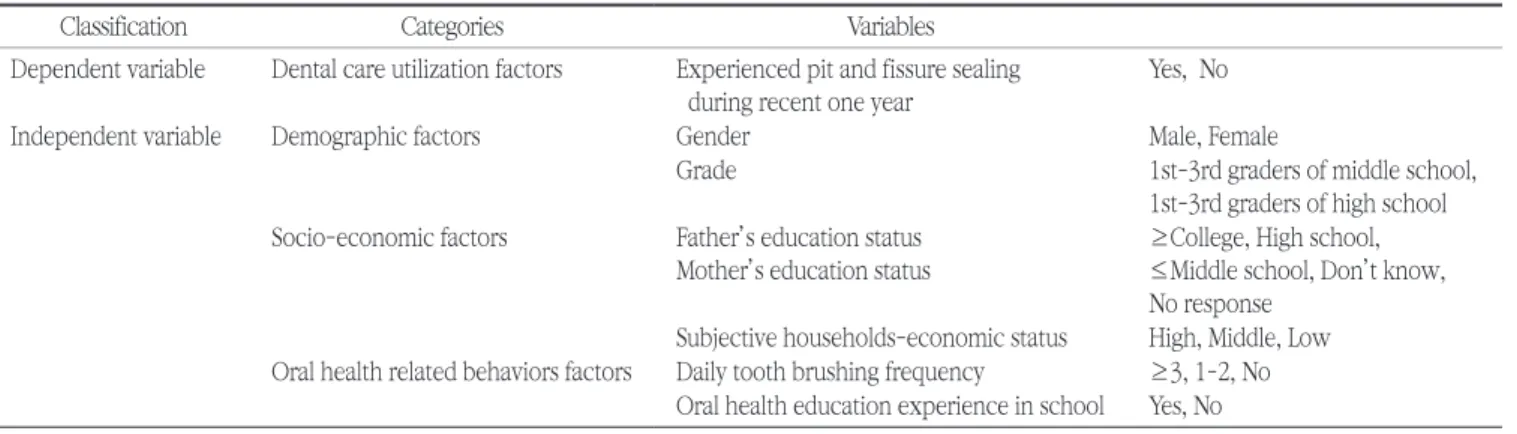
본 연구에서는 구강건강 영역의 8개 문항 중에서 연간 치면열 구전색경험 여부를 종속변수로 선정하였고, 인구학적 요인(성별, 학년), 사회경제적 요인(아버지학력, 어머니학력, 주관적 가정경제 상태) 및 구강건강관련행동 요인(일일 칫솔질, 학교에서 구강교육 경험)을 독립변수에 포함시켰다(Table 1).
3. 변수변환
주관적 가정경제상태는 상, 중상, 중, 중하, 하로 분류된 5점 척도를 상(상, 중상) 중(중), 하(중하, 하)로, 일일 칫솔질은 안함, 1-2회, 3회 이상으로 변수를 변환하여 분석하였다. 성별, 학년, 부
모의 학력수준, 학교에서 구강교육경험 여부는 변수변환 없이 기 존의 변수 범주를 분석에 사용하였다.
4. 분석방법
통계분석은 STATA 13.0 (Copyright Stata Corp LP, USA) 통 계패키지를 이용하였다. 연간 치면열구전색 경험 여부와 관련 요 인들과의 통계적 유의성을 확인하기 위해 복합표본 카이제곱검 정(Chi-square test) 및 Fisher의 정확도 검정(Fisher’s exact test) 을 실시하였다. 복합표본 다중로지스틱 회귀모형(Multi-variate logistic regression model)을 이용하여 연간 치면열구전색 경험
Table 2. The distribution of subjects who have experienced pit and fissure sealing (PFS) during recent one year in 2008 and 2014 year
Classification2008 year 2014 year
N Subjects experienced PFS
N Subjects experienced PFS
N Wt%† P-value N Wt%† P-value
Total 75,238 16,001 21.5 72,060 19,487 26.9
Demographic factors
Gender <0.001 <0.001
Male 39,278 7,563 19.5 36,470 8,780 24.1
Female 35,960 8,438 23.7 35,590 10,707 30.0
Grade <0.001 <0.001
1st graders of Middle school 13,037 3,259 25.6 11,661 3,640 31.5
2nd graders of Middle school 13,056 3,259 21.1 12,275 3,528 29.2
3rd graders of Middle school 12,850 2,743 22.0 12,220 3,340 27.2
1st graders of High school 12,720 2,718 21.3 11,824 3,112 26.3
2nd graders of High school 12,375 2,436 19.9 12,152 3,028 24.5
3rd graders of High school 11,200 2,006 17.4 11,928 2,839 23.5
Socio-economic factors Father’s education status
≥College 27,838 6,698 24.2 <0.001 33,794 9,963 29.3 <0.001
High school 28,435 5,797 20.5 21,483 5,551 25.6
≤Middle school 5,496 990 17.2 2,118 507 23.2
Don't know 8,035 1,443 17.9 11,630 2,706 23.1
No response 5,434 1,073 20.2 3,035 760 24.4
Mother’s education status <0.001 <0.001
≥College 19,341 4,838 25.3 28,668 8,536 29.6
High school 36,511 7,647 21.1 27,391 7,223 26.1
≤Middle school 5,628 989 17.0 1,845 449 24.6
Don't know 8,746 1,609 18.7 11,200 2,603 22.9
No response 5,012 918 18.3 2,956 676 22.3
Subjective households-economic status <0.001 <0.001
High 20,801 5,264 25.7 23,945 7,197 30.0
Middle 35,770 7,433 20.9 35,040 9,221 26.0
Low 18,667 3,304 17.5 13,075 3,069 23.1
Oral health related behaviors factors
Daily toothbrushing frequencies <0.001 <0.001
≥3 61,819 13,828 22.5 37,152 10,591 28.3
1-2 12,652 2,062 16.5 34,219 8,750 25.5
No 767 111 15.5 689 146 21.6
Oral health education experience in school <0.001 <0.001
Yes 15,754 4,412 28.2 17,314 6,010 34.7
No 59,484 11,589 19.8 54,746 13,477 24.5
The data were analysed by Chi-square test or Fisher’s exact test.
†Weighted value.
여부와 사회경제적 요인과의 연관성을 확인하고 승산비(Odds Ratios, OR)와 95% 신뢰수준(Confidence Intervals, CI)을 산출하 여 제시하였다.
연구 성적
1. 연도별 청소년의 연간 치면열구전색 경험과 관련요인들과의 이변량 분석
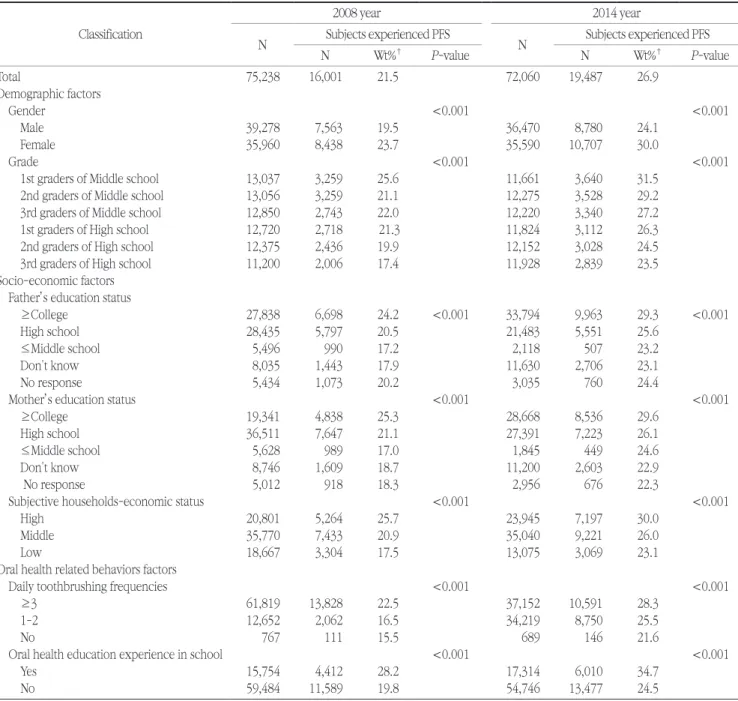
연도별 청소년의 연간 치면열구전색 경험과 관련요인들과의 통계적 유의성을 확인하기 위해 복합표본 카이제곱검정 및 Fisher 의 정확한 검정을 실시한 결과는 Table 2와 같다.
청소년의 연간 치면열구전색 경험률은 2008년에 비해 2014 년에 5.4% 증가하였고, 2008년과 2014년 분석에서 연간 치면열 구전색 경험과 관련요인들과의 이변량 분석 결과는 유사한 경향을 보였다(Table 2). 여학생이 남학생 보다 높았고, 학년이 올라감에 따라 낮았다(P<0.001). 부모의 학력수준과 주관적 가정경제상태 가 높을수록 연간 치면열구전색 경험율이 높았다(P<0.001). 하루 칫솔질 횟수가 많을수록, 구강보건교육의 경험이 있는 경우에 연 간 치면열구전색 경험율이 높았다(P<0.001).
2. 다중로지스틱 회귀모형을 이용한 청소년의 연간 치면열구 전색경험과 사회경제적지위의 연관성 분석
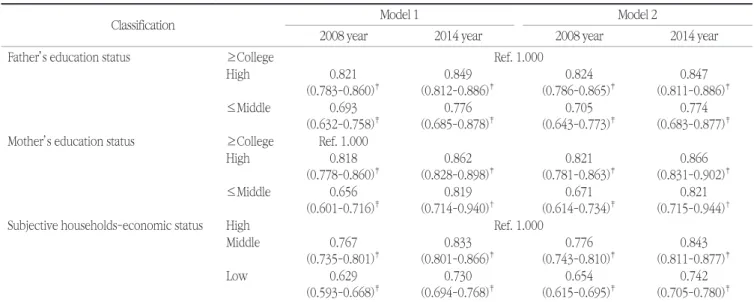
복합표본 다중로지스틱 회귀모형을 이용한 청소년의 연간 치면열구전색 경험과 사회경제적 요인과의 연관성 분석 결과는 Table 3과 같다.
2008년과 2014년 모두에서 성별, 학년 등의 인구학적 요인을 보정한 경우(Model 1)에 부모의 학력수준과 주관적 가정경제상태
가 낮아질수록 연간 치면열구전색 경험이 줄어드는 통계적 유의 성이 유지되었다. 그리고 하루 칫솔질 횟수, 학교에서 구강보건교 육 경험 등의 구강건강행동 요인을 추가로 보정한 경우(Model 2) 에도 유의성의 강도가 다소 약화되었지만 연간 치면열구전색 경험 과 사회경제적 요인과의 연관성은 여전히 유지되었다. 한편, 2008 년에 비해 2014년의 OR값의 변화 폭이 감소하는 것으로 보아 청 소년의 치면열구전색 이용 불평등이 다소 완화되었음을 확인할 수 있었다.
고 안
치면열구전색은 교합면 우식증 예방의 대표적인 방법으로써 우리나라에서 2000년대 초반에 농어촌 아동
ㆍ청소년에서 급증하 던 치아우식증 예방을 위해 보건소를 통해 구강보건사업 형태로 활용되기 시작하였다. 이후 2009년 12월에는 건강보험급여 항목 에 치면열구전색이 포함됨으로써 보편적인 우식증 예방법으로 자 리 잡게 되었다.
우리나라에서 치면열구전색 경험율은 국민구강건강실태조사 및 국민건강영양조사 과정에 개별 구강검사를 통해 얻은 자료를 이용하여 산출할 수 있다. 그런데 개별 구강검사를 통해서 치면열 구전색의 존재 여부를 판단한 이들 조사에서 얻은 결과로는 어느 시기에 전색시술을 받았는지의 여부를 파악할 수 없어 치면열구전 색 급여화 전 후의 변화양상을 파악하기 어렵다. 따라서 이번 연구 에서는 “최근 1년간 치면열구전색 경험 여부”를 설문조사함으로 써 전색시기를 파악할 수 있는 청소년건강행태 온라인조사 자료를 이용하여 건강보험 급여화에 따른 우리나라 청소년의 치면열구전 색 경험율의 변화를 확인하고 치면열구전색 경험과 사회경제적 요
Table 3. Odds ratios of PFS experience during recent one year among groups categorized by socio-economic factors
OR (95% CI)Classification Model 1 Model 2
2008 year 2014 year 2008 year 2014 year
Father’s education status ≥College Ref. 1.000
High 0.821
(0.783-0.860)‡
0.849 (0.812-0.886)‡
0.824 (0.786-0.865)‡
0.847 (0.811-0.886)‡
≤Middle 0.693
(0.632-0.758)‡
0.776 (0.685-0.878)‡
0.705 (0.643-0.773)‡
0.774 (0.683-0.877)‡ Mother’s education status ≥College Ref. 1.000
High 0.818
(0.778-0.860)‡
0.862 (0.828-0.898)‡
0.821 (0.781-0.863)‡
0.866 (0.831-0.902)‡
≤Middle 0.656
(0.601-0.716)‡
0.819 (0.714-0.940)†
0.671 (0.614-0.734)‡
0.821 (0.715-0.944)†
Subjective households-economic status High Ref. 1.000
Middle 0.767
(0.735-0.801)‡
0.833 (0.801-0.866)‡
0.776 (0.743-0.810)‡
0.843 (0.811-0.877)‡
Low 0.629
(0.593-0.668)‡
0.730 (0.694-0.768)‡
0.654 (0.615-0.695)‡
0.742 (0.705-0.780)‡ The data were analysed by Complex Samples Logistic Regression.
*P<0.05, †P<0.01, ‡P<0.001.
Model 1: Adjusting for Gender and Grade.
Model 2: Adjusting for Gender, Grade, Daily toothbrushing, Oral health education experience in school.
인과의 연관성을 파악하고자 하였다.
먼저 연간 치면열구전색 경험율은 치면열구전색 급여화 전인 2008년에 비해 2014년에 5.4% 증가한 것으로 나타나서 2009년 도 건강보험 급여화에 따른 일부 성과를 확인할 수 있었다. 그러나 Okunseri 등
16)이 미국 위스콘신 주에서 메디케이드(Medicaid)에 의한 취약계층 아동
ㆍ청소년의 치과의료 보장 확대이후 제1대구 치 치면열구전색 이용율이 불과 1년 사이에 3%에서 11%로 약 8%
증가하였다는 보고와 비교하면 상대적으로 미흡한 수준이었다. 이 렇듯 치면열구전색 급여화에 따른 이용률의 증가가 기대에 미치지 못한 주된 이유로는 예방항목임에도 본인부담비율이 30%로 비교 적 높게 책정되었기 때문으로 추정된다.
학년에 따른 연간 치면열구전색경험율은 학년이 올라감에 따 라 낮아진 것을 확인하였는데, 이와 같은 결과는 치면열구전색 경험율이 6-9세까지 점차 증가하다 11-14세까지 점차 감소하는 Cheon 등
17)의 연구와 9-12세의 제1대구치 치면열구전색 빈도가 연령이 증가할수록 감소하는 Choi 등
18)의 연구와 유사하였다. 초 등학교 고학년 이후부터 학년이 올라갈수록 연간 치면열구전색 경 험율이 낮아지는 이유는 연령이 올라감에 따라 이미 전색을 받았 거나 치아우식경험율이 높아져서 전색대상 치아 수가 줄어드는 것 과도 연관이 있겠지만, 청소년 시기의 과중한 학업부담과의 연관 성을 고려해 볼 수 있겠다. Ahn 등
19)의 연구에서 우리나라 청소년 의 미충족 치과의료의 원인 중 “학교를 비울 수 없어서”가 가장 높 게 나타났듯이, 우리나라 중
ㆍ고등학생은 과중한 학업부담으로 인 해 치과의료기관을 방문할 수 있는 시간이 매우 제한적이기 때문 이다. 따라서 우리나라에서 중
ㆍ고등학생의 치면열구전색 이용률 을 증가시키기 위한 방안으로써 학생구강검진제도와 연계하여 치 면열구전색을 의무화하는 것을 검토해볼 필요성이 있다.
성별에 따른 치면열구전색 경험율은 2008년과 2014년 모두 에서 여학생이 남학생 보다 높았다. Kim
20)은 남성과 여성의 청소 년 간의 건강행동 예측 요인이 다소 다른 양상을 보인다고 설명하 였고, Levin 등
21)은 11, 13, 15세 연령에서 칫솔질 횟수가 성별에 따라 차이가 있다고 보고되었다. 또한 Lee 등
22)의 연구에서는 성 별에 따라 구강건강관련 행동군집의 분포에 차이가 있음을 밝힌바 있다. 건강관련 행태에 따른 성별의 차이는 본 연구와 같이 기존연 구에서도 유사하게 밝혀진 바 있으며, 구강건강행태에 따라 성별 차이가 발생하는 요인을 검증하기 위한 후속 연구를 계획할 필요 성이 있다.
연간 치면열구전색 경험율은 2008년과 2014년 모두에서 부 모의 학력과 주관적 가정경제상태가 높을수록 높았다. 이는 Al Agili 등
23,24)의 연구에서 치면열구전색경험이 부모의 학력과 가구 소득과 연관성이 있다는 결과와 유사하였고, Levin 등
25)의 연구에 서 가정환경이 청소년의 구강건강 증진에 중심적인 역할을 한다는 주장을 뒷받침하는 결과였다. 그리고 하루 칫솔질 횟수가 많을수 록, 구강보건교육의 경험이 있는 경우에 연간 치면열구전색 경험 율이 높았다. 이는 긍정적인 구강보건행태가 치면열구전색 이용에 긍정적인 영향을 미칠 수 있을 가능성을 시사한다.
성별, 학년 등의 인구학적 요인을 보정한 모형(Model 1)과 하
루 칫솔질 횟수, 학교에서 구강보건교육 경험 등의 구강건강행동 요인을 추가로 보정한 모형(Model 2) 모두에서 연간 치면열구전 색 경험과 사회경제적 요인과의 연관성은 유지되었다. 이 결과는 Al Agili
26)의 연구에서 교육수준이 높은 부모의 자녀에게서 치면열 구전색 경험율이 더 높은 것과 일치하였고, Kim 등
27)의 연구에서 확인되었던 부모의 교육수준에 따라 성인이 된 이후의 구강건강상 태에 불평등을 초래하는 요인으로써 치면열구전색 경험을 검토해 볼 필요성을 제기하였다. 그리고 2008년에 비해 2014년에 사회경 제적 요인과 치면열구전색과의 연관성이 다소 약화되긴 했으나 여 전히 유지되고 있어서 사회
ㆍ경제적 지위가 낮은 부모에 대한 교 육적 개입
28)과 일부 국한된 지역에서만 시행중인 학생 및 저소득 층 아동에게 구강검진 및 예방진료 등의 치과의료서비스를 제공하 는 ‘학생 및 아동 치과주치의 사업
29)’을 전국적으로 확대할 필요성 이 있다고 사료된다.
본 연구결과를 통해 치면열구전색 경험율이 증가되고 있다는 것을 확인하였지만, Makhija 등
30)연구에 의하면 전색제가 탈락한 치아에서 우식이 생길 위험이 높다고 보고한바 있으므로 무분별하 게 치아를 전색하기 보다는 치면열구전색의 유지력을 고려한 대상 치아를 선별해야 하며 사후관리도 중요하다고 사료된다.
본 연구는 횡단면 연구에 국한되어 있어 연간 치면열구전색 경 험과 사회경제적인 요인 간의 관련성은 파악하였지만 인과관계를 파악하는데 제한점이 있었고, 청소년온라인행태자료의 연도별 변 수종류가 상이하여 매칭 할 수 없는 변수를 제외했다는 점에서 그 한계점이 있었다. 그럼에도 불구하고 건강보험 급여화 전후에 치 면열구전색경험과 사회경제적 요인의 연관성이 지속되고 있고, 치 면열구전색경험과 구강건강관련행동 사이에 유의한 연관성이 있 음을 확인한 연구로써 의의가 있다. 향후 청소년기의 치면열구전 색경험과 사회경제적요인과의 인과성을 검토할 수 있는 종적연구 가 필요하다고 사료된다.
결 론
본 연구는 2008년과 2014년도 청소년건강행태온라인 조사 자료를 이용하여 전국 중
ㆍ고등학교 재학생을 대상으로 치면열구 전색 급여화 전
ㆍ후의 연간 치면열구전색 경험실태를 파악하고 사 회경제적 요인과의 연관성을 분석하여 다음과 같은 결론을 얻었 다.
1. 연간 치면열구전색 경험율은 2008년에 21.5%, 2014년에 26.9%로 약 5.4% 증가하였다. 여학생이 남학생 보다 4-6% 높았 고, 중학생이 고등학생보다 3-5%높았다. 부모의 학력수준과 주관 적 가정경제상태가 높을수록 높았으며(P<0.001), 하루 칫솔질 횟 수가 많을수록 구강보건교육의 경험이 있을 때 높았다(P<0.001).
2. 2008년과 2014년도 모두에서 인구사회학적 요인을 보정한
모형(Model 1)과 추가로 구강건강관련행동 요인을 보정한 모형
(Model 2)에서 연간 치면열구전색경험과 사회경제적 요인 사이의
연관성을 확인하였고, 건강보험 급여화 이후 치면열구전색 경험율
의 불평등 격차는 완화되었으나 여전히 존재하였다.
우리나라 청소년의 치면열구전색경험 불평등은 건강보험 급 여화 이후에 다소 완화되었지만 여전히 존재하고 있어 이를 해소 할 수 있는 정책마련이 요구되었다. 또한 향후 청소년기의 치면열 구전색경험과 사회경제적요인과의 인과성을 검토할 수 있는 종적 연구가 필요하다고 사료된다.
References
1. Ministry of Health & Welfare. 2000 Korean National Oral Health Survey. Seoul: Ministry of Health & Welfare;2001:193.
2. Ministry of Health & Welfare. 2012 Korean National Oral Health Survey. Seoul: Ministry of Health & Welfare;2013:309.
3. OECD. Health at a Glance 2009-OECD INDICATORS. Paris:OECD;
2009:35.
4. Han SY, Sung SH, Kim DK. A study on the analysis of caries preven- tive effectiveness on occlusal pit and fissure sealing. J Korean Acad Oral Health 1995;19:51-64.
5. Jung SH. chpater 10 Oral health policy and program on Korea:New Dental Public Health. 1th ed. Seoul:Kommonsa;2012:191-238.
6. Korea ministry of government legislation. Legislation search, Con- cerning standard of medical care expenses on national Health In- surance [Internet]. [cited 2015 Feb 08]. Available from: http://www.
law.go.kr/
7. Choi JS, Ma DS, Jung SH, Cho EP, Park DY. Changes in the amount of pit and fissure sealants supplied in Korea after inclusion in the National Health Insurance coverage. J Korean Acad Oral Health 2015;39:69-77.
8. Lee YH, Kwon HK, Kim BI. The dental caries experience of Ko- rean in 2000 by tooth and surface type. J Korean Acad Oral Health 2004;28:315-323.
9. Ministry of Health & Welfare. 2010 oral health services manual.
Seoul: Ministry of Health & Welfare;2010:3-194.
10. Lee HS. A study of dental health behavior in Chollabuk-do Republic of Korea-a path analysis of the utilization of dental services. J Ko- rean Acad Oral Health 1993;17:121-134.
11. Lee HS. Children’s dental visits in relation to their mothers’ socio- economic factors and dental health behaviors. J Korean Acad Oral Health 1997;21:87-105.
12. Murakami K, Aida J, Ohkubo T, Hashimoto H. Income-related inequalities in preventive and curative dental care use among working-age Japanese adults in urban areas: a cross-sectional study BMC Oral Health 2014;14:117-125.
13. Polk DE, Weyant RJ, Manz MC. Socioeconomic factors in adoles- cents’ oral health: are they mediated by oral hygiene behaviors or preventive interventions?. Community Dent Oral Epidemiol 2010;
38:1-9.
14. Korea centers for disease control and prevention. The 2014 Korea Youth Risk Behavior Web-based Survey(KYRBS). Cheongju: Korea centers for disease control and prevention;2014:3-10.
15. Korea centers for disease control and prevention. The raw data manual on Korea Youth Risk Behavior Web-based Survey(KYRBS).
Cheongju: Korea centers for disease control and preven- tion;2014:128-131.
16. Okunseri C, Okunseri E, Garcia RI, Gonzalez C, Visotcky A, Szabo A.
Impact of Wisconsin medicaid policy change on dental sealant uti- lization. Health Serv Res. 2016 Dec 12 [Epub]. DOI:10.1111/1475- 6773.12627.
17. Cheon GT, Song HJ, Lyoo YJ, Kim IS, Shin SC, Cho JW. The supplies of pit and fissure sealants for Korean children and adolescents in 2003. J Korean Acad Oral Health 2006;30:204-211.
18. Choi JS, Park DY. Comparison of supplied amount of pit and fissure sealing on the first permanent molars by age and disparity of dental accessibility using National Health Insurance data. J Korean Acad Oral Health 2016;40:171-177.
19. Ahn ES, Han JH. Measure of unmet dental care needs among Ko- rean adolescent. J Dent Hyg Sci 2015;15:91-97.
20. Kim WK. Predictors of health behaviors among male and female youth in Korea. Korean Journal of Youth Studies 2015;22:131-154.
21. Levin KA, Currie C. Inequalities in toothbrushing among adoles- cents in Scotland 1998-2006. Health Educ Res 2009;24:87-97.
22. Lee HR, Ma DS, Park DY, Jung SH. Clusters of oral health-related behaviors by gender and their relationship with psychosocial fac- tors for adolescents in Gangneung. J Korean Acad Oral Health 2013;37:241-247.
23. Al Agili DE, Griffin SO. Effect of family income on the relation- ship between parental education and sealant prevalence, National health and nutrition examination survey, 2005-2010. Prev Chronic Dis. 2015 Aug 27 [Epub]138. DOI: 10.5888/pcd12.150037.
24. Al Agili DE, Niazy HA, Pass MA. Prevalence and socioeconomic determinants of dental sealant use among schoolchildren in Saudi Arabia. East Mediterr Health J 2012;18:1209-1216.
25. Levin KA, Currie C. Adolescent toothbrushing and the home envi- ronment: sociodemographic factors, family relationships and meal- time routines and disorganisation. Community Dent Oral Epidemiol 2010;38:10-18.
26. Al Agili DE, Griffin SO. Effect of family income on the relation- ship between parental education and sealant prevalence, National health and nutrition examination survey 2005-2010. Prev Chronic Dis. 2015 Aug 27;12[Epub]138. DOI:10.5888/pcd12.150037.
27. Kim JH, Lee MH, Kim HY. Influences of parental education level on oral health. Journal of the Korea Academia-Industrial cooperation Society 2015;16:1182-1188.
28. Kaur B. Evaluation of parental awareness regarding their child’s oral hygiene Indian. J Dent Res 2009;20:463-465.
29. Seoul metropolitan government. The manual on the continuous dental care program for student and child. Seoul:Seoul metropoli- tan government.;2015;5.
30. Makhija SK, Childers NK, Lauten J, Dorantes CE, Chafin T, Dasanay- ake AP. Evaluation of initial caries score and caries incidence in a public health sealant program: a retrospective study. Pediatr Dent 2006;28:420-424.