2009, Vol. 53, No. 2
Printed in the Republic of Korea
O
O O
H O
R1 R2 + R3 + H2N NH2
X DCM, Reflux
1.5-3.5 h
N N R3
R1 O R2O
X H
X= O, S. H
Scheme 1
Physical Properties of Indion 190 resin: macroporous resin, styrene DVB matrix, SO3- functional group, particle size range 0.42-1.2, Max. Operating temp. 150 oC, total exchange capacity 4.7 meq/g. Some of these properties are similar to the properties of Amberlyst 15.
단 신
Indion 190 수지: 편리한 친환경적인 재생 촉매를 이용한 효과적인 3, 4-Dihydropyrimidin-2(1H)-one의 one-pot합성
Atul Chaskar*, Farhat Jaffer, Bhushan Langi, Sampat Yewale, and Akalpita Bodkhe C. K. Thakur research centre, Navi Mumbai, Maharashtra, India-410206
(2008. 8. 8 접수)
Indion 190 Resin: A Green and Recyclable Catalyst for Facile and Efficient One-pot Synthesis of 3, 4-Dihydropyrimidin-2(1H)-one
Atul Chaskar*, Farhat Jaffer, Bhushan Langi, Sampat Yewale, and Akalpita Bodkhe C. K. Thakur research centre, Navi Mumbai, Maharashtra, India-410206
(Received August 8, 2008)
주제어: Biginelli 반응, Indion 190 수지, 아세토아세트산에틸, 요소, 3,4-dihydropyrimidin-2(1H)-ones, 다성분 반응
Keywords: Biginelli reaction, Indion 190 resin, ethyl acetoacetate, urea, 3,4-dihydropyrimidin-2(1H)-ones, multicomponent reaction
Recently Multi-component reactions (MCR’s) are governing importance due to its wide variety of applications in organic and medicinal chemi- stry.1 MCR’s involves the reaction between three or more reactants in single reaction vessel to form new products, which essentially contain part of all starting materials.1 MCR’s are diversity oriented efficient and speedy reactions, due to which they have received tremendous attention in the drug discovery process.2 One of the MCR’s of current interest is the venerable Biginelli dihydropyr-
imidine synthesis.3 Today 3,4-dihydropyrimidin- 2(1H)-ones (DHPM) and its derivatives have re- ceived considerable amount of attention due to its wide spectra of biological activities. Hence sev- eral attempts have been made to synthesize the DHPM (Scheme 1).
In the attempt to prepare DHPM different types of acidic catalyst such as H2SO4,5 BF3․EtOH/
CuCl,6 LaCl3․7H2O with catalytic concentrated HCl,7 CeCl3․7H2O,8 InCl3,9 Heteropolyacids,10 BiCl3,11 Cu(OTf)2,12 TMSCl,13 LiClO4,14 LiBr,15
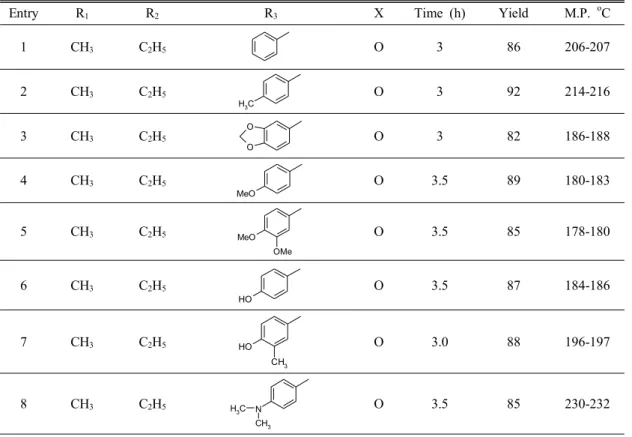
Table 1. Indion 190 resin catalysed synthesis of Dihydropyrimidinones.
Entry R1 R2 R3 X Time (h) Yield M.P. oC
1 CH3 C2H5 O 3 86 206-207
2 CH3 C2H5
C H3
O 3 92 214-216
3 CH3 C2H5
O
O O 3 82 186-188
4 CH3 C2H5
MeO
O 3.5 89 180-183
5 CH3 C2H5 MeO
OMe
O 3.5 85 178-180
6 CH3 C2H5
O H
O 3.5 87 184-186
7 CH3 C2H5 HO
CH3
O 3.0 88 196-197
8 CH3 C2H5 N
CH3 C
H3 O 3.5 85 230-232
InBr3,16 Phenyl Pyruvic acid,17 FeCl3․6H2O/HCl,18 TMSI19 and CdCl220 have been used. Many of the above catalyst used are not ecofriendly and cause the problem during disposal. Further the methods used for synthesis of DHPM requires long reaction times, strong acidic condition, vigorous reaction conditions (high temperature) and they are difficult to handle on a large scale. The development of eco-friendly and recyclable catalytic system for Biginelli reaction is an active research area, in order to improve the reaction condition and yield.
Hence we initiated the preparation of DHPM, by keeping in mind the development of green metho- dology and successfully attempted a single step efficient chemical method by using green catalyst, under mild condition.
Here in, we report a simple efficient and effec- tive protocol for the synthesis of 3,4-dihydropyr- imidin-2(1H)-ones by one pot three component cyclocondensation reaction of 1,3 dicarbonyl
compound (ethyl acetoacetate), aromatic aldehyde and urea using Indion 190 resin as a recyclable catalyst. An aldehydes, ethyl acetoacetate and urea in dichloromethane were stirred at reflux temperature in presence of Indion 190 resin. The reaction progress was monitored by TLC. After the completion of reaction, the reaction mixture and resin were separated by filtration. The solvent was removed under reduced pressure and the solid obtained was purified by recrystallisation from methanol. Isolated resin was washed with water, activated and reused for subsequent reaction.
Physical and spectral data of known compounds are in agreement with those reported in the literature.20
A broad range of structurally diverse aromatic and heterocyclic aldehydes have been used in this condensation (Table 1).α, β unsaturated aldehyde react selectively with aldehyde functional group whereas acid sensitive heterocyclic aldehydes ex
Entry R1 R2 R3 X Time (h) Yield M.P. oC
9 CH3 C2H5 N
CH3 C
H3 S 3.0 90 248-250
10 CH3 C2H5 F
Br
O 2.0 85 199-200
11 CH3 C2H5
F
S 2.0 89 156-158
12 CH3 C2H5
O2N O 1.5 84 207-208
13 CH3 C2H5
CH CH
O 3.0 81 227-230
14 CH3 C2H5
S O 2.0 85 202-203
15 CH3 C2H5
O O 2.0 87 210-212
16 CH3 C2H5 N
H
O 3.0 82 181-183
17 CH3 C2H5
N
O 2.0 89 193-194
18 CH3 C2H5
N
S 2.0 86 167-169
19 CH3 C2H5 N
H
O 3.0 79 213-215
20 CH3 C2H5
N
O 2.5 89 246-248
21 CH3 C2H5
N
N O 2.0 90 256-257
22 CH3 C2H5
N
N S 2.5 88 242-243
23 CH3 C2H5 O 1.5 92 182-185
24 CH3 C2H5
O O
OH
O 3.0 76 278-279
25 CH3 C2H5
O O
OH
S 3.0 77 262-264
26 CH3 C2H5 (CH3)2CH O 3.5 82 193
clusively gave dihydropyrimidones in high yield.
We found that electron donating or withdrawing group on aromatic aldehydes gave almost good to excellent yield. Therefore the method can be use for wide range of reactants with different func- tional group. We have synthesized some novel compounds containing quinoline, pyrimidine, in- dole and coumarin units.
In conclusion, we have developed a simple, ef- ficient and ecofriendly procedure for the synthesis of dihydropyrimidin-2(1H)-ones by condensation of ethyl acetoacetate, aldehydes and urea in pres- ence of inexpensive and recyclable catalyst Indion 190 resin at mild reaction conditions.
General Experimental Section
All commercial reagents are used as received without purification, and all solvents were reagent grade. The reaction mixture was stirred magneti- cally in a round bottom flask and was monitored by TLC using on 0.25 mm E-Merck silica gel 60 F254 precoated glass plates, which were visualized with UV light, and then developed by using silica gel 60-120 mesh. Melting points were taken in open capillaries. The IR spectra were recorded on a Perkin-Elmer 257 spectrometer using KBr discs.
1H NMR and 13C NMR spectra in DMSO-d6 were recorded on VXR-300 MHz using TMS as internal standard.
General Procedure
A mixture of an aldehyde (10 mmol), ethyl ace- toacetate (10 mmol), urea or thiourea (15 mmol) and Indion 190 resin (2 gm) in dichloromethane (5 ml) was stirred at reflux temperature for the appro- priate time (1.5-3.5 hr). After completion of the re- action, as indicated by TLC, the solvent was re- moved under reduced pressure. The residue was washed with water and recrystallised from methanol.
Analytical and Spectral data for selected com- pounds.
5-Ethoxycarbonyl-4-(3-1H-Indole)-6-methyl-3, 4-dihydropyrimidin-2 (1H)–one (19)
IR (KBr): 3417, 3356, 3240, 2978, 1702, 1653,
1538, 1187, 1085, 870 cm-1
1H NMR DMSO-d6 (δ-ppm): 9.17 (s, 1H, NH), 7.04 (s, 1H, NH), 8.48 (s, 1H, NH), 7.76 (s, 1H), 7.18-7.34 (m, 4H), 5.23 (d, 1H, J = 3.7 Hz), 3.97 (q, 2H, J = 7.2 Hz), 2.24 (s, 3H), 1.15 (t, 3H, J = 7.2 Hz)
13C NMR DMSO-d6 (δ-ppm): 172.10, 155.25, 152.90, 136.90, 127.30, 123.20, 121.80, 119.10, 118.90, 111.15, 106.90, 104.35, 60.10, 34.15, 14.90, 13.90.
Elem. Anal. Calcd: C, 64.20 ; H, 5.72 ; N, 14.04 ; O, 16.04. Found : C, 63.89 ; H, 5.93 ; N, 14.37 ; O, 16.09.
5-Ethoxycarbonyl-4-(3-quinoline)-6-methyl-3, 4-dihydropyrimidin-2 (1H)–one (20)
IR (KBr): 3408, 3365, 3280, 1698, 1640, 1513, 1227, 779 cm-1
1H NMR DMSO-d6 (δ-ppm): 9.25 (s, 1H, NH), 7.73 (s, 1H, NH), 8.32 (s, 1H), 7.63-7.79 (m, 4H), 7.80 (s, 1H), 5.12 (d, 1H, J = 2.8 Hz), 4.11 (q, 2H, J = 7.5 Hz), 2.28 (s, 3H), 1.09 (t, 3H, J = 7.5 Hz)
13C NMR DMSO-d6 (δ-ppm): 172.50, 155.25, 153.35, 148.10, 147.15, 135.05, 135.05, 129.10, 127.30, 126.45, 126.10, 104.50, 60.10, 53.00, 14.90, 13.90.
Elem. Anal. Calcd: C, 65.58 ; H, 5.50 ; N, 13.50 ; O, 15.42. Found : C, 65.63 ; H, 5.61 ; N, 13.42 ; O, 15.37.
5-Ethoxycarbonyl-4-(2-pyrimidine)-6-methyl- 3,4-dihydropyrimidin-2(1H)–one (21)
IR (KBr): 3413, 3385, 3245, 2965, 1709, 1658, 1540, 1235, 1090, 780 cm-1
1H NMR DMSO-d6 (δ-ppm): 9.20 (s,1H, NH), 7.65 (s, 1H, NH), 8.42 (d, 2H, J = 7.5 Hz), 7.38(t, 1H, J = 7.5 Hz), 5.10(d, 1H, J = 3.5 Hz), 4.02 (q, 2H, J = 7.0 Hz), 2.23 (s, 3H), 1.11 (t, 3H, J = 7.0 Hz).
13C NMR DMSO-d6 (δ-ppm): 172.60, 168.70, 157.20, 155.85, 153.85, 119.90, 104.20, 60.10, 56.10, 15.15, 13.90
Elem. Anal. Calcd: C, 54.96 ; H, 5.38 ; N, 21.36 ; O, 18.30. Found : C, 54.84 ; H, 5.29 ; N, 22.04 ; O, 18.75.
5-Ethoxycarbonyl-4-(4-hydroxyl–2H(1)-ben- zopyran-2-one-3-yl)-6-methyl-3,4-dihydropyr- imidin-2(1H)–one (24)
IR (KBr): 3389, 3240, 2943, 1721, 1705, 1619, 1562, 1235, 1123, 810 cm-1
1H NMR DMSO-d6 (δ-ppm): 11.85 (s, 1H, OH), 9.80 (s, 1H, NH), 7.69(s, 1H, NH), 7.30-7.80 (m, 4H), 4.85 (d, 1H, J = 3.5 Hz), 4.23 (q, 2H, J = 6.8 Hz), 2.35 (s, 3H), 1.21 (t, 3H, J = 6.8 Hz)
13C NMR DMSO-d6 (δ-ppm): 172.50, 171.20, 164.15, 155.10, 153.60, 152.20, 131.15, 129.80, 122.30, 121.10, 117.80, 116.25, 94.50, 60.20, 43.25, 15.15, 14.15
Elem. Anal. Calcd: C, 59.30 ; H, 4.68 ; N, 8.14 ; O, 27.88. Found : C, 59.24 ; H, 4.76 ; N, 8.07 ; O, 28.01.
Acknowledgments. The authors are grateful to Ion Exchange (India) Ltd, Mumbai for providing gift samples of Indion 190 resin and University Grant Commission, New Delhi for financial support.
The authors are thankful to Dr. S.T. Gadade, Principal, C. K. Thakur College for providing lab- oratory and other facilities.
REFERENCES
1. a) Ugi, I.; Domling, A.; Horl, W. Multicomponent Reactions in Organic Chemistry. Endeavour 1994, 18, 115. b) Armstrong, R. W.; Comb, A. P.;
Tempest, P. A.; Brown, S. D.; Keating, T. A. Acc.
Chem. Res. 1996, 29, 123. c) Tietze, L. F.; Lieb, M.
E. Curr. Opin. Chem. Biol. 1998, 2, 363. d) Dax, S.
L.; McNally, J. J.; Youngman, M. A. Curr. Med.
Chem. 1999, 6, 255.
2. Schreiber, S. L. Science. 2000, 287, 1964.
3. a) Biginelli, P. Gazz. Chim. Ital. 1893, 23, 360. b) Kappe, C. O. Tetrahedron. 1993, 49, 6937.
4. a) Atwal, K. S.; Swanson, B. N.; Unger, S. E.;
Floyd, D. M.; Moreland, S.; Hedberg, A.; O’Reilly, B. C. J. Med. Chem. 1991, 34, 806. b) Kappe, C.O.
Eur. J. Med. Chem. 2000, 35, 1043. c) Rovnyak, G.C.; Kimball, S. D.; Beyer, B.; Cucinotta, G.;
Dimareo, J.; Gougoutas, D.J.; Moreland, S. J. J.
Med. Chem. 1995, 38, 119. d) Rovnyak, G.C.;
Atwal, K. S.; Hedberg, A.; Kimball, S. D.; Moreland, S.; Gougoutas, J. Z.; O’Reilly B. C.; Malley, M. F.
J. Med. Chem. 1992, 35, 3254. e) Mayer, T.U.;
Kapoor, T. M.; Haggarty, S. J.; King, R. W.;
Schreiber, S. L.; Mitchison, T. J. Science. 1999, 286, 971.
5. Folkers, K.; Johnson, T.B. J. Am. Chem. Soc. 1933, 55, 2886.
6. Hu, E.H.; Sidler, D.R.; Dolling, U.H. J. Org. Chem.
1998, 63, 3454.
7. Lu, J.; Bai, Y.; Wang, Z.; Yang, Ma, H. Tetrahedron Lett. 2000, 41, 9075.
8. Bose, D. S.; Fatima, L.; Mereyala, H.B. J. Org.
Chem. 2003, 68, 587.
9. Ranu, B. C.; Hajara, A.; Jana, U. J. Org. Chem.
2000, 65, 6270.
10. Rafiee, E.; Jafari, H. Bioorg. Med. Chem. Lett.
2006, 16, 2463.
11. Ramalinga, K.; Vijayalakshmi, P.; Kaimala, T. N. B.
Synlett. 2001, 863.
12. Paraskar, A. S.; Dewkar, G. K.; Sudalai, A.
Tetrahedron Lett. 2003, 44, 3305.
13. Zhu, Y. L.; Huang, S.L.; Pan, Y.J. Eur. J. Org.
Chem. 2005, 2354.
14. Yadav, J.S.; Reddy, B. V. S.; Srinivas, R.;
Venugopal, C.; Ramalingam, T. Synthesis. 2001, 9, 1341.
15. Maiti, G.; Kundua, P.; Guin, C. Tetrahedron Lett.
2003, 44, 2757.
16. Fu, N. Y.; Yuan, Y. F.; Cao, Z.; Wang, S.W.; Wang, J.T.; Peppe, C. Tetrahedron. 2002, 58, 4801.
17. Abelman, M.M.; Smith, S. C.; James, D. R.
Tetrahedron Lett. 2003, 44, 4559.
18. Lu, J.; Ma, H. Synlett. 2000, 63.
19. Sabitha, G.; Reddy, G. S.K.; Reddy, Ch. S.; Yadav, J. S. Synlett. 2003, 858.
20. a) Narsaiah, A. V.; Basak ,A. K.; Nagaiah, K.
Synthesis. 2004, 1253.
b) Rodriguez-Dominguez, J.C.; Bernardi,D.; Kirsch, G. Tetrahedron Lett. 2007, 48, 5777.