ABSTRACT
Background: Little is known about the surgical discipline in North Korea from the
perspective of the outside world. This study aimed to examine the disease entities covered by articles published in the major medical journal in North Korea, “Surgery.”
Methods: Content and frequency analyses of 2,132 articles published in “Surgery” from 2006 to 2017 were conducted. Two medical doctors who majored in surgery and anesthesiology perused the articles and compiled the diseases being elucidated in each article. The diseases described in each article were stratified into 13 surgical subspecialties.
Results: Articles from “Surgery,” similar to articles from the Western surgical community, also covered a wide variety of surgical diseases from different subspecialties, and the number of publications continued to grow consistently. Moreover, a number of studies focused on the fields of orthopedics and general surgery dealing with benign diseases. Some articles focused on minimally invasive surgeries using laparoscopy.
Conclusion: The studies published in the North Korean journal “Surgery” encompass various clinical areas, but their quality is unclear.
Keywords: North Korea; Surgery; Medical Research
INTRODUCTION
Medical research in developed countries is relatively straightforward and manageable and is accomplished with a large sample size due to the abundance and accuracy of data.
Conversely, conducting research in low- and middle-income countries or in countries closed for political reasons tends to be tedious due to insufficient data and the difficulty in accessing information. North Korea is the most inaccessible country for researchers worldwide;
hence, there is substantially little empirical data about the medical status of the country.1,2 Researchers studying North Korea's health and medical status have used official publications
Original Article
Received: Jul 24, 2020 Accepted: Nov 11, 2020 Address for Correspondence:
Shin Ha, MPH, PhD
Association of Healthcare for Korean Unification, 50-1 Yonsei-ro, Seodaemun-gu, Seoul 03722, Korea.
E-mail: [email protected]
© 2021 The Korean Academy of Medical Sciences.
This is an Open Access article distributed under the terms of the Creative Commons Attribution Non-Commercial License (https://
creativecommons.org/licenses/by-nc/4.0/) which permits unrestricted non-commercial use, distribution, and reproduction in any medium, provided the original work is properly cited.
ORCID iDs Yo Han Lee
https://orcid.org/0000-0002-9631-9969 Namkee Oh
https://orcid.org/0000-0002-6594-8973 Hyerim Kim
https://orcid.org/0000-0001-6517-1634 Shin Ha
https://orcid.org/0000-0002-1454-731X Funding
This research was supported by the Ministry of Unification of the Republic of Korea (2018).
Yo Han Lee ,1,2 Namkee Oh ,3 Hyerim Kim ,4 and Shin Ha 5,6
1 Graduate School of Public Health, Ajou University, Suwon, Korea
2Ajou Institute of Korean Unification and Health Care, Suwon, Korea
3Department of Surgery, Samsung Medical Center, Seoul, Korea
4 Department of Anesthesiology and Pain Medicine, Seoul Metropolitan Government-Seoul National University Boramae Medical Center, Seoul, Korea
5Department of Academic Affairs, Korea University College of Medicine, Seoul, Korea
6Association of Healthcare for Korean Unification, Seoul, Korea
Characteristics and Distribution of Surgical Diseases in North Korean Research Papers Published between 2006 and 2017
Global Health
Disclosure
The authors have no potential conflicts of interest to disclose.
Author Contributions
Conceptualization: Lee YH, Ha S. Formal analysis: Oh N, Kim H, Ha S. Funding acquisition: Ha S. Methodology: Oh N, Kim H, Ha S. Project administration: Ha S. Software:
Ha S. Supervision: Ha S. Validation: Oh N, Kim H, Ha S. Writing -original draft: Lee YH. Writing - review & editing: Lee YH, Ha S.
from the South Korean government, some medical science books published in North Korea, testimonies from North Korean defectors, and reports published by international organizations.3-7
However, recently, many South Korean researchers have attempted to determine the reality of public health in North Korea and the characteristics of its health care policies and discuss these issues in academic circles by analyzing academic journals published in North Korea.6 Notably, there have been many studies on how the North Korean medical community deals with infectious diseases, a major burden in the North Korean population, how healthcare priorities have recently changed, what level of medical science has been reached in North Korea, and how medical terminologies differ between North Korea and South Korea.8-15 The predominant advantages of these studies were based on the premise that the empirical data on North Korean medical care were obtained from its own perspective, and this study was distinguished from previous studies that relied on several estimates or limited secondary data. These studies were possible because the North Korean government publishes at least 10 medical journals regularly, and the South Korean government imports them and makes them conditionally available to the public.9
Research based on North Korean medical journals has started to increase. There are several subjects and areas warranting research. One of them is surgical science. Surgery is a key medical discipline and has a long history of dramatically improving patients' lives. Recently, a short report was published by an external visitor who recently had an experience with neurosurgery in North Korea, and some studies on the characteristics of surgical terminology in North Korea were conducted.11,12,16 These recent studies have contributed to uncovering the features of the surgical discipline in North Korea. Nevertheless, the surgical field in North Korea is largely unknown at present, mainly in terms of which disease entities are being treated and which operations are being performed. This study aimed to elucidate the diseases treated by the surgical community in North Korea by analyzing all articles published in “Surgery,” one of North Korea's major medical journals.
METHODS
This study targeted articles published in the North Korean medical journal “Surgery.” “Surgery”
has an extensive 40-year history and currently publishes issues four times a year.7 The North Korean information center (https://unibook.unikorea.go.kr), an affiliate of the Ministry of Unification of South Korea, allows the general public access to 10 medical journals published in North Korea, including “Surgery.” Since “Surgery” was made available in 2006, we acquired a total of 2,868 articles from 2006 (1st issue) to 2017 (4th issue). Of these, 2,132 articles, excluding those not classified as surgical studies, were selected as the final study materials.
The excluded articles described research studies on internal medicine, basic medicine, and other medical disciplines.
This study employed content and frequency analyses. Content analysis is a method for analyzing various types of records, such as interviews, discourses, speeches, and published documents.17,18 The frequency analysis used for evaluating research trends is a method of classifying research categories, extracting papers corresponding to the categories, and examining the time-series of the number.19,20
Two medical doctors who majored in surgery and anesthesiology perused all included articles and used an Excel spreadsheet to input the following data: publication year, disease, and surgical subspecialty. The constructed data were cross-checked by these two doctors and the other authors and finally confirmed.
When a discrepancy in disease entities was found in one article, each doctor re-read the article and selected a representative disease through a consensus. Each article was classified according to the major classification codes of the 10th revision of the International Statistical Classification of Diseases and Related Health Problems (ICD-10).21 The classification of surgical subspecialties was based on the systematic classification presented in Sabiston Textbook of Surgery (20th edition), the most authoritative textbook on surgery.22 In the orthopedic field, classification according to the involved joint was used with reference to Campbell's Operative Orthopaedics (13th edition).23 All articles were classified according to a total of 13 subspecialties.
Ethics statement
This study was based on a literature analysis; therefore, informed consent or approval by an Institutional Review Board was not required.
RESULTS
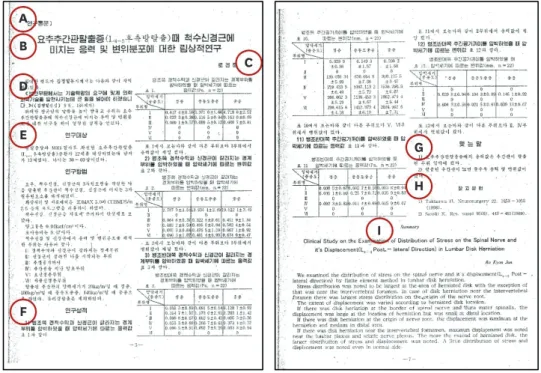
Most of the articles had identical structures, as presented in Fig. 1. Of the studies on the 13 surgical subspecialties, orthopedic studies were the most common, accounting for 36%
of the total articles. Subsequently, articles on general surgery dealing with burns, shock, wounds, and peritonitis accounted for 17% of the total articles. Studies on gastrointestinal and thoracic surgery accounted for 15% and 12% of the total articles, respectively (Fig. 2).
A
B C
G H I D
E
F
Fig. 1. Typical structure of an article published in “Surgery.” (A) Type of articles, (B) title, (C) author, (D) introduction, (E) materials and methods, (F) results, (G) conclusion and discussion, (H) references, (I) summary in English.
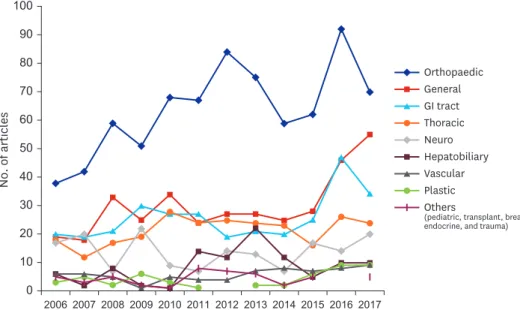
Fig. 3 shows the number of publications for each surgical subspecialty over the 12-year period. While the number of articles on orthopedic and general surgery increased overall, the number of articles on other subspecialties showed minimal variations. Articles on all subspecialties have been published steadily for 12 years.
Table 1 shows the results of matching the major diseases covered by each article to ICD-10 chapter codes according to subspecialty. Although there were differences in the number of studies, studies on surgery were conducted for all disease groups. There were 522 articles dealing with injury, accounting for approximately a quarter of the total articles, and there were 322 articles dealing with musculoskeletal disorders. Most of the studies in these two disease groups were orthopedic studies. There were 346 studies on surgery for digestive
Orthopaedic, 767
General, 361 GI tract, 310
Thoracic, 256 Neuro, 167 Hepatobiliary, 104
Vascular, 75Plastic, 48 Others, 39
(pediatric, transplant, breast, endocrine, and trauma)
Fig. 2. Distribution of articles published during 2006–2017 in “Surgery” according to 13 surgical subspecialties.
GI = gastrointestinal.
100 90 80 70 60 50 40 30 20 10 0
No. of articles
2017 2016 2015 2014 2013 2012 2011 2010 2009 2008 2007 2006
Orthopaedic General GI tract Thoracic Neuro Hepatobiliary Vascular Plastic Others
(pediatric, transplant, breast, endocrine, and trauma)
Fig. 3. Trend of the number of articles published during 2006–2017 in “Surgery” according to 13 surgical subspecialties.
GI = gastrointestinal.
diseases, and more than half of these focused on diseases affecting the gastrointestinal tract.
Studies on neoplastic surgery accounted for approximately 10% of all articles; half of these focused on gastrointestinal neoplasms. There were 167 studies involving heart, brain, and lung surgeries.
DISCUSSION
By analyzing the papers published in the North Korean medical journal “Surgery” over a 12-year period, this study sheds light on surgical research in North Korea. This study confirms that there are various surgical subspecialties that are independent of each other in North Korea and that surgeries are being performed in all subspecialties, and studies on these surgical subspecialties are continuously being published. There have been many studies in the fields of orthopedic surgery and general surgery dealing with benign diseases.
Fluctuations were not noted in the number of articles published according to year.
Orthopedic studies accounted for as much as 36% of the total studies, and most studies addressed joint surgery rather than fractures. The surgical sites were the wrist, elbow, ankle, shoulder, hand, hip, knee, knee, spine, and others, and there were 147 studies focusing on the spine (6.9% of the total studies). As pathologic conditions related to the musculoskeletal system, such as fracture and arthritis, are easily diagnosed by physical examination and simple radiography, it is possible to conclude that articles about orthopedic surgery are prominently published. Since it is difficult to expect ordinary North Koreans to undergo orthopedic surgeries such as joint surgery,24 it is presumed that these operations are probably performed in hospitals in Pyongyang. The number of studies on benign diseases, such as fractures, anal diseases, burns, injuries, and inflammatory diseases, was significantly higher than those on malignant tumors. This may be because benign diseases have a relatively high prevalence and are easier to diagnose and treat. To accurately diagnose cancer, hematological examination and imaging studies must first be performed, and biopsy and pathological tests for confirmation should be conducted. In North Korea, presumptively, human resources, economic resources, and infrastructure required to accomplish this are insufficient.25 Table 1. Main diseases covered by articles published during 2006–2017 in “Surgery” according to 13 surgical subspecialties
ICD-10 chapter code Orthopaedic General GI tract Thoracic Neuro Hepatobiliary Vascular Plastic Othersa Total
A, infectious 8 3 2 1 2 16
B, infectious 1 1 1 3
C, neoplasm 4 11 99 21 13 44 2 18 212
D, hematologic 7 10 6 10 3 5 41
E, endocrine and metabolic 2 1 1 1 5
G, nervous 5 2 12 1 1 21
I, circulatory 5 4 2 73 29 1 53 167
J, respiratory 3 41 44
K, digestive 3 99 180 13 47 4 346
L, skin 2 10 1 4 17
M, musculoskeletal 303 1 1 2 15 322
N, genitourinary 2 2 1 6 11
P, perinatal condition 8 8
Q, congenital condition 14 1 5 59 1 3 2 10 95
S, injury 332 95 5 7 62 2 3 15 1 522
Not elsewhere 91 114 6 25 22 6 10 24 4 302
Total 767 361 310 256 167 104 70 48 49 2,132
ICD-10 = 10th revision of the International Statistical Classification of Diseases and Related Health Problems, GI = gastrointestinal.
aPediatric, transplant, breast, endocrine, and trauma.
In the field of oncologic surgery, there are innumerable studies on stomach cancer and colon cancer, but hardly any research has been performed about hepatocellular carcinoma and pancreatic cancer. Stomach and colon cancers cause symptoms such as bloody stools, anemia, indigestion, constipation, and gastrointestinal obstruction, whereas liver and pancreatic cancers do not necessarily cause such symptoms. North Korea has a high prevalence of hepatocellular carcinoma due to hepatitis B, but few studies have investigated hepatocellular carcinoma.26 Furthermore, patients present with advanced disease at the time of diagnosis, and thus, surgery cannot be performed; this precludes further investigations and studies that can be published in surgical journals.
Studies on gastrointestinal surgery covered surgical diseases of the upper digestive tract, such as gastroduodenal ulcer, gastric cancer, and gastrointestinal stromal tumor, and various benign and malignant diseases of the lower digestive tract, such as appendicitis, anal disease, and colorectal cancer. In the case of gastric cancer, the standard surgical methods, total gastrectomy and partial gastrectomy, were covered, and the technical details of each surgical procedure were described. However, articles focusing on endoscopic mucosal resection or endoscopic submucosal dissection were not found in the North Korean journal “Surgery”;
these are the standard treatments of choice for early gastric cancer in developed conturies.27 Most studies on appendectomy referred to laparoscopic surgery and included information on reducing surgical site infection and the detailed procedure performed during surgery.
There have been numerous papers on benign diseases of the anus, such as fissure, fistula, and hemorrhoids, which included details on surgical methods, treatment outcomes, and complications. In colorectal cancer, some studies delved into the concept of oncologic surgery, which emphasized the importance of sufficient resection margins and adequate lymph node dissection in improving the survival of patients. Since colorectal cancer surgery using laparoscopy was first introduced in a published paper in 2013, the concept of minimally invasive surgery seems to have been established in colorectal cancer surgery. In general, standard therapy comprised chemotherapy and radiotherapy combined with surgery for some cancers. However, in the treatment of rectal cancer, chemotherapy and radiotherapy are the standard treatments; however, there has been no research on this aspect in “Surgery,”
and thus, confirming whether a multidisciplinary approach to rectal cancer treatment was available was not possible.28-30 Cholecystectomy using laparoscopic techniques is the standard method, and articles discussing this were found in “Surgery.” It is generally known that surgery for a pancreatic tumor requires a highly technical approach, and studies on pancreaticoduodenectomy and distal pancreatectomy have also been published in “Surgery.”
It is encouraging that studies dealing with minimally invasive surgery have been published.
Since the concept of minimally invasive surgery was introduced worldwide since the 1990s, laparoscopic surgery has become a standard procedure in some fields and has recently been performed via robotic surgery.31,32 In “Surgery,” studies on appendectomy, cholecystectomy, and colectomy using laparoscopy have also been published. Generally, laparoscopic surgery requires three or more ports to access the intraabdominal cavity, but studies published in
“Surgery” mention single-port laparoscopic surgery wherein only one hole is made in the navel. There have also been studies on the transurethral resection method on the bladder or prostate through the urethra in urology, although it was finally excluded from the subject of this study, including studies on pituitary gland surgeries (trans-sphenoid approach) in the neurosurgery and otorhinolaryngology areas. Obviously, these points show that the concept of minimally invasive surgery has been established in North Korea.
Articles published in North Korean medical journals generally have the following
characteristics: short length, no abstracts, and minimal number of references. Furthermore, limited description is provided regarding research methodology, and most studies are experimental studies and not randomized controlled studies. Lastly, studies with negative results are difficult to find.9,33 Additionally, North Korean medical articles seem to reveal important features of North Korean medicine. North Korean medicine seeks to integrate medicine that is not fragmented, somewhat different from Western medicine. Therefore, the classification of North Korean medical divisions, the division of Western and traditional medicine, and the division of internal medicine and surgery are not well delineated.
Therefore, North Korean medical journals publish a mix of clinical and basic medical studies in one issue, and internal medicine journals publish surgical studies. “Surgery” also published a number of internal medicine studies and studies from other medical disciplines.
This study has several limitations. First, although a surgeon and anesthesiologist classified articles based on surgical subspecialties, there is still a possibility of misclassification.
Second, since each paper was only 1–2-pages long, it was not possible to understand the details of each operation in depth. This study aimed to show a macroscopic perspective of the surgical discipline in North Korea, but more research is needed to gain a deeper understanding. Third, it was difficult to find North Korean refugee doctors who were surgeons, and thus, this study did not undergo sufficient internal critical review. Therefore, the content of this study was the result of a mechanical analysis from the perspective of outsiders. We are fully aware of these limitations, and we suggest that future studies should involve North Korean doctors and categorize medical subspecialties more accurately.
To our knowledge, this study was the first to extensively review surgical research published in North Korea by analyzing the content of a North Korean surgery journal and showing the general perspectives of surgical research in North Korea. “Surgery” is one of the 10 medical journals published in North Korea and regularly publishes articles. “Surgery,” like Western journals, published articles on several independent subspecialties, and a large number of studies was published in each subspecialty without major disruptions. These studies deal with a variety of diseases and cover minimally invasive surgery using laparoscopic surgery and complex pancreatic surgery, indicating the status of the surgical discipline in North Korea.
This study provides important information for understanding the magnitude and reality of North Korean medicine, including the surgical discipline.
REFERENCES
1. Noble DJ. Public health in Democratic People's Republic of Korea. BMJ Glob Health 2019;4(2):e001440.
PUBMED | CROSSREF
2. Shin BK, Jeon WT. National health priorities under the Kim Jong Un regime in Democratic People's Republic of Korea (DPRK), 2012–2018. BMJ Glob Health 2019;4:e001518.
PUBMED | CROSSREF
3. Watching North Korea. Sci Am 2018;319(5):84.
PUBMED | CROSSREF
4. Kim JE. Nutritional state of children in the Democratic People's Republic of Korea (DPRK): based on the DPRK final report of the national nutrition survey 2012. Pediatr Gastroenterol Hepatol Nutr 2014;17(3):135-9.
PUBMED | CROSSREF
5. Grundy J, Biggs BA, Hipgrave DB. Public health and international partnerships in the Democratic People's Republic of Korea. PLoS Med 2015;12(12):e1001929.
PUBMED | CROSSREF
6. Shin HY, Sung SH, Choi SY, Ahn HS, Jeon JE, Lee DY. An analysis of trends in medical journal articles of botanical drugs in North Korea. Health Soc Welf Rev 2017;37(4):535-63.
CROSSREF
7. Cho KS. Infant/child mortality and humanitarian aids to North Korea. Health Soc Welf Rev 2016;36(3):485-515.
CROSSREF
8. Yoon HJ, Woo SH, Kim D, Um JH, Park SH, Seo AR. Changes in medical research trends of North Korea after economic sanctions: a PRISMA-compliant systematic literature review of North Korean medical journals. Medicine (Baltimore) 2019;98(29):e16500.
PUBMED | CROSSREF
9. Ha S, Yoon SJ, Chun BC, Kim KJ, Roh SY, Lee EJ, et al. Bibliographical characteristics of North Korean medical journals and articles. J Korean Med Sci 2018;33(27):e185.
PUBMED | CROSSREF
10. Hong ST. North Korean medical journals in the Galapagos. J Korean Med Sci 2018;33(27):e209.
PUBMED | CROSSREF
11. Hur K, Park DE, Oh HK, Yang HH, Ko D, Kim MH, et al. Discrepancies in general surgery medical terminology between South and North Korea. Korean J Med Educ 2018;30(1):51-6.
PUBMED | CROSSREF
12. Ko D, Oh HK, Jo J, Yang HH, Kim MH, Kim MJ, et al. Discrepancy of medical terminology regarding colorectal surgery between South and North Korea. Ann Coloproctol 2018;34(5):248-52.
PUBMED | CROSSREF
13. Ro DY, Kim DH, Park SH. North Korea must be global scale cohort, not a Galapagos in the medical research field. Asian Pac J Cancer Prev 2019;20(9):2789-94.
PUBMED | CROSSREF
14. Lee CJ, Lee S, Kim HJ, Kang YA. Towards understanding tuberculosis-related issues in North Korea: a narrative review of North Korean literature. Tuberc Respir Dis (Seoul) 2020;83(3):201-10.
PUBMED | CROSSREF
15. Park DH, Choi MH, Lim AY, Shin HY. An analysis of infectious disease research trends in medical journals from North Korea. J Prev Med Public Health 2018;51(2):109-20.
PUBMED | CROSSREF
16. Park KB, Roh YH, Lee-Park O, Park S. History of neurosurgery in Democratic People's Republic of Korea.
World Neurosurg 2015;84(3):855-9.
PUBMED | CROSSREF
17. Ferreira Ido R, Vosgerau DS, Moyses SJ, Moyses ST. Normative measures of the health in the school program: content analysis associated with ATLAS TI software. Cien Saude Colet 2012;17:3385-98.
PUBMED | CROSSREF
18. Soratto J, Pires DEP, Friese S. Thematic content analysis using ATLAS.ti software: potentialities for researchs in health. Rev Bras Enferm 2020;73(3):e20190250.
PUBMED | CROSSREF
19. Lee JT, Cho SA. Biomechanical evaluation of laser-etched Ti implant surfaces vs. chemically modified SLA Ti implant surfaces: removal torque and resonance frequency analysis in rabbit tibias. J Mech Behav Biomed Mater 2016;61:299-307.
PUBMED | CROSSREF
20. Canonica GW, Caria M, Venuti D, Cipro G, Ciprandi G, Bagnasco M. T cell activation through different membrane structures (T3/Ti, T11, T44) and frequency analysis of proliferating and interleukin-2 producer T lymphocyte precursors in aged individuals. Mech Ageing Dev 1988;42(1):27-35.
PUBMED | CROSSREF
21. Goyal A, Gluckman TJ, Tcheng JE. What's in a name? the new ICD-10 (10th revision of the International Statistical Classification of Diseases and Related Health Problems) codes and type 2 myocardial infarction. Circulation 2017;136(13):1180-2.
PUBMED | CROSSREF
22. Sabiston DC, Townsend CM. Sabiston Textbook of Surgery: the Biological Basis of Modern Surgical Practice.
Philadelphia, PA: Elsevier Saunders; 2012.
23. Canale ST, Azar FM, Beaty JH, Campbell WC. Campbell's Operative Orthopaedics. Philadelphia, PA: Elsevier; 2017.
24. Yim ES, VanRooyen MJ. Health and disaster diplomacy in North Korea: ensuring access and accountability in complex political environment. Prehosp Disaster Med 2009;24(4):294-6.
PUBMED | CROSSREF
25. Horton R. Offline: North Korea-the case for health diplomacy. Lancet 2017;390(10099):1016.
PUBMED | CROSSREF
26. Lee AU, Linton H, Kilsby M, Hilmers DC. A program to treat hepatitis B in North Korea: a model of antiviral therapy in a resource-poor setting. Gut Liver 2018;12(6):615-22.
PUBMED | CROSSREF
27. Podboy A, Kolahi KS, Friedland S, Louie CY. Endoscopic submucosal dissection is associated with less pathologic uncertainty than endoscopic mucosal resection in diagnosing and staging Barrett's-related neoplasia. Dig Endosc 2020;32(3):346-54.
PUBMED | CROSSREF
28. Ferrell B, Sun V, Hurria A, Cristea M, Raz DJ, Kim JY, et al. Interdisciplinary palliative care for patients with lung cancer. J Pain Symptom Manage 2015;50(6):758-67.
PUBMED | CROSSREF
29. Emons G, Steiner E, Vordermark D, Uleer C, Bock N, Paradies K, et al. Interdisciplinary diagnosis, therapy and follow-up of patients with endometrial cancer. guideline (S3-level, AWMF registry number 032/034-OL, April 2018) - part 2 with recommendations on the therapy and follow-up of endometrial cancer, palliative care, psycho-oncological/psychosocial care/rehabilitation/patient information and healthcare facilities. Geburtshilfe Frauenheilkd 2018;78(11):1089-109.
PUBMED | CROSSREF
30. Badea M, Baroş A, Bohîlţea RE, Julea IE, Furtunescu FL, Istrate-Ofiţeru AM, et al. Modern interdisciplinary monitoring of cervical cancer risk. Rom J Morphol Embryol 2019;60(2):469-78.
PUBMED
31. Harrell AG, Heniford BT. Minimally invasive abdominal surgery: lux et veritas past, present, and future.
Am J Surg 2005;190(2):239-43.
PUBMED | CROSSREF
32. Antoniou SA, Antoniou GA, Antoniou AI, Granderath FA. Past, present, and future of minimally invasive abdominal surgery. JSLS 2015;19(3):e2015.00052.
PUBMED | CROSSREF
33. Kim SG, Kim KJ, Ha S, Kim YH. A peek into the Galapagos of the medical research field. Lancet 2016;388(10063):2989-90.
PUBMED | CROSSREF