INTRODUCTION
Approximately 3,000 North Korean refugees settle in South Korea annually and, as of 2016, the total number of North Ko- rean refugees or former refugees residing in South Korea ex- ceeded 30,000 [1]. In the past, the vast majority of North Ko- rean refugees were men seeking political asylum; however, the numbers of North Korean women and children seeking refuge have been increasing [2]. Recent statistics indicate that approximately 40% of all North Korean refugees in Korea are 10–29 years old [1].
North Korean adolescent refugees have often been exposed to and traumatized by terrible events in their life in North Ko- rea, during their escape, and/or while settling in South Korea.
In North Korea, many of them experienced malnutrition and physical or sexual violence [3]. During the escape, they en-
dured the fear of being caught and imprisoned [4]. Since they entered South Korea, these adolescents have faced difficul- ties in adjusting to and dealing with culture shock, prejudice and discrimination, and poverty, and, consequently, their school dropout rates are high [4]. A considerable number of previous studies [5,6] found that these adolescents have men- tal health problems, including depression, post-traumatic stress disorder, anxiety, and other emotional and behavioral problems. Moreover, North Korean adolescent refugees have higher rates of suicidal ideation [7] compared to South Kore- an adolescents. Therefore, the mental health of North Korean adolescent refugees needs to be given greater clinical attention.
One previous study [8] reported that 34% of people with suicidal ideations devise suicide plans and 72% of those who make such plans attempt suicide. Therefore, it is important to develop interventions to prevent suicidal behaviors. As the number of North Korean adolescent refugees in South Korea is increasing annually, it is important to investigate this group and the factors related to their suicide attempts. One recent
This is an Open Access article distributed under the terms of the Creative Commons Attribution Non-Commercial License (https://creativecommons.org/licenses/by-nc/4.0) which permits unrestricted non-commercial use, distribution, and reproduction in any medium, provided the original work is properly cited.
Suicide Attempts and Contributing Factors among South and North Korean-Family Youth Using the Korean Youth Risk Behavior Web-based Survey
Soo Jung Rim
1,2, Min Geu Lee
1, and Subin Park
11
Department of Research Planning, Mental Health Research Institute, National Center for Mental Health, Seoul, Korea
2
Department of Psychology, Graduate School, Seoul National University, Seoul, Korea
Objectives: There is an increasing number of North Korean adolescents in South Korea. These adolescents need clinical attention as they experience a high risk of suicidal behavior because of the childhood adversity and acculturative challenges that they face before and after arriving in South Korea. This study assessed the risk of suicide attempts among North Korean adolescents compared to South Korean ad- olescents, and investigated the contributing factors for each group.
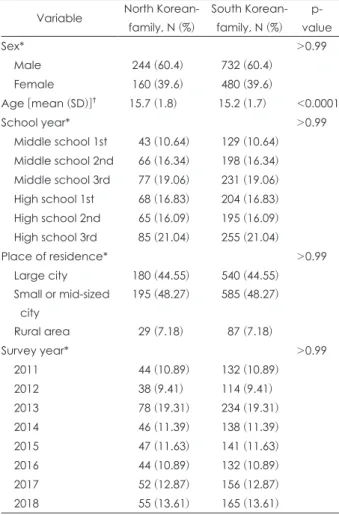
Methods: We used data from the Korean Youth Risk Behavior Web-Based Survey (KYRBS) spanning 2011 to 2018, in which 404 adoles- cents had a father and/or mother who was a North Korean native. Data on 1,212 propensity-matched South Korean adolescents were ex- tracted from the 2011 to 2018 KYRBS. Prevalence was calculated and compared by group. Separate odds ratios were calculated by group.
Results: The North Korean group had a significantly higher suicide attempt rate [unadjusted odds ratio (OR)=8.27; adjusted OR=8.45].
Multivariate analysis indicated that having a low or high socioeconomic status and depressive symptoms were significantly associated with suicide attempts in North Korean adolescents, while being female, having a high socioeconomic status, alcohol use, and depressive symp- toms were significantly related to suicide attempts in South Korean adolescents.
Conclusion: The results found similarities and differences in the factors associated with the likelihood of suicide attempts in the two groups. From these results, different approaches are needed when planning interventions for each group.
Key Words: North Korean-family; Adolescent; Suicide attempt; Contributing factors; KYRBS.
Received: October 17, 2019 / Revision: November 14, 2019 / Accepted: November 21, 2019
Address for correspondence: Subin Park, Department of Research Planning, Mental Health Research Institute, National Center for Mental Health, 127 Yongmasan-ro, Gwangjin-gu, Seoul 04933, Korea
Tel: +82-2-2-2204-0108, Fax: +82-2-2204-0362, E-mail: [email protected]