Determinants of Adoption and Use of Open Access
Publishing by Academic Staff in Nigeria Universities
Open Access
Accepted date: November 7, 2016 Received date: December 10, 2015
*Corresponding Author:Musediq Tunji Bashorun Doctor
Department of Library and Information Studies University of Botswana, Gaborone E-mail: [email protected]
All JISTaP content is Open Access, meaning it is accessible online to everyone, without fee and authors’ permission. All JISTaP content is published and distributed under the terms of the Creative Commons Attribution License (http:/ creativecommons. org/licenses/by/3.0/). Under this license, authors reserve the copyright for their content; however, they permit anyone to unrestrictedly use, distribute, and reproduce the content in any medium as far as the original authors and source are cited. For any reuse, redistribution, or reproduction of a work, users must clarify the license terms under which the work was produced. ABSTRACT
The emergence of the World Wide Web (WWW) has changed the scholarly publishing system. Today, Open Access (OA) scholarly publishing offers free access and wide dissemination for research findings anytime and anywhere as an additional value for scholarly content. Despite the potentials of OA publishing, its adoption and use is still low. This paper determines factors influencing the adoption and use of OA publishing by academic staff in universities in Nigeria using an adapted Unified Theory of Acceptance and Use Technology (UTAUT). The study applies methodolog-ical triangulation by combining quantitative and qualitative approaches. The empirmethodolog-ical data were collected from 317 academic staff in universities in southwest Nigeria. The questionnaire forms were analyzed using the Statistical Pack-age for Social Sciences (IBM-SPSS) 19.0 version to generate descriptive statistics, Analysis of Variance, and Hierarchical Multiple Regression. Thematically, analysis also applies to the interviews. The results show that awareness, attitude, performance expectancy, Internet self-efficacy, and facilitating conditions significantly influenced the adoption and use of OA publishing. The study also reveals that due to lack of OA policy, most of the respondents did not know about OA. The findings further establish that all predictors and moderating variables jointly contributed 64.4% total variance towards the adoption and use of OA publishing. One of the implications of this study is that there is a need for adequate facilities to support adoption and use of OA publishing. The findings inform the proposed framework for improving and evaluating the adoption and use of OA publishing. The findings also have theoretical, societal, and methodological significance to all stakeholders.
Keywords: Adoption and Use, Open Access Publishing, World Wide Web, University, UTAUT, Nigeria
Musediq Tunji Bashorun *
Department of Library and Information Studies University of Botswana, Gaborone E-mail: [email protected]
Peter M. Sebina
Department of Information Studies University of Botswana, Gaborone E-mail: [email protected]
Priti Jain
Department of Library and Information Studies University of Botswana, Gaborone E-mail: [email protected]
Trywell Kalusopa
Department of Information Studies University of Zululand, South Africa E-mail: [email protected]
Journal of Information Science Theory and Practice J Inf Sci Theory Pract 4(4): 49-63 2016 http://dx.doi.org/10.1633/JISTaP.2016.4.3.3 eISSN : 2287-4577 pISSN : 2287-9099
1. INTRODUCTION
The world has become a global village as a result of Internet development. This has caused transformation in many phases especially in scientific journal pub-lishing. For instance, the first stage experienced the rapid shift from print-only journals to parallel print and electronic publishing (Tenopir & King, 2000). The next stage of transformation is the granting of access to publications without any barriers imposed by toll access (subscriptions). This is referred to as open ac-cess (OA) (Willinsky, 2005). Scholarly communication benefits massively in making scholarly content freely accessible and equally has enjoyed wide dissemination of research findings without any restriction via the In-ternet. According to Budapest Open Access Initiatives (BOAI), ‘Open Access’ means
free availability on public Internet, permitting any users to read, download, copy, distribute, print, search, or link to the full texts of these articles, crawl them for indexing, pass them as data to software, or use them for any other lawful purpose, without financial, legal, or technical barriers other than those inseparable from gaining access to the Internet itself. (BOAI, 2002, p. 1)
Hence, open access publishing can be defined as a publication that is digital, online, and free of charge, free of copyright and without any barrier at the point of consumption by the user. There are enormous ben-efits of OA publishing to academics and other stake-holders. For example, it promotes collaborative work among scholars; bridges the digital gap between devel-oped and developing countries; promotes accessibility and visibility of research findings; improves the econ-omy by making research outputs available to users; and enriches both academics’ and universities’ profiles through provision of access without any barriers (Jain, 2012; Bashorun et al., 2013).
Despite these huge benefits, the adoption and use of OA publishing by academic staff in Nigeria still re-mains low (Gbaje, 2010; Oluwasemilore, 2013). Most scholarly findings are published in local journals that remain less accessible and are poorly visible to users. This has implications on the research findings ema-nating from researchers and scholars in Africa and Ni-geria in particular. Many academics are indisposed to embrace OA publishing because of insufficient
aware-ness of OA initiatives (Bashorun, 2014).
Studies like Dulle, 2010; Gbaje, 2010; Okoye & Ejikeme, 2011; Emorjorho, Ivwighregwta, & Onori-ode 2012; and Obuh, 2013 report several factors that have contributed to the low adoption and use of OA publishing in Nigerian universities. Dulle (2010) re-ported that researcher self-efficacy and lack of Internet skills were part of factors that hindered acceptance and use of OA publishing in Tanzania. Obuh and Bozimo (2012) and Gbaje (2010) posited that lack of awareness of OA journals was responsible for the low adoption and use of OA publishing, while Emojorho et al. (2012) emphasized inadequate facilitating con-ditions as an obstacle to the adoption and use of OA publishing. OA publishing is still in its infancy in most developing countries like Nigeria, where poor infra-structural facilities have been established as the bane to its development and adoption (Okoye & Ejikeme, 2011). Obuh (2013) accentuated the fact that attitude has affected the acceptance and use of OA publishing. None of these studies investigated the relationship among factors that influence the adoption and use of OA publishing using the Unified Theory of Accep-tance and Use of Technology (UTAUT) model. Hence, this study seeks to determine factors that influence the adoption and use of OA publishing among academic staff in order to suggest a framework for improvement in its adoption and use. The UTAUT model was con-sidered because it has the highest explanatory power of 69% (Venkatesh et al., 2003). It is also more robust and expansive than any of the technology acceptance models. The findings reported in this article are part of a doctoral study titled “Developing a framework for the adoption and use of open access publishing in Ni-geria Universities.” The objectives of the study will be discussed in the next section.
2. OBJECTIVES OF THE STUDY
The main objective of this study was to investigate the adoption and use of OA publishing by academic staff in selected universities in southwest Nigeria, with a view to developing a framework. The following were the specific objectives:
1. Identify factors that influence the adoption and use of OA publishing by academic staff in
select-ed universities
2. Determine the level of university management support towards the adoption and use of OA publishing by academic staff
3. Establish relationships among factors that influ-ence the adoption and use of OA publishing 4. Determine the joint contribution of factors
influ-encing the adoption and use of OA publishing 5. Suggest a suitable framework that can facilitate
the adoption and use of OA publishing by aca-demic staff in universities in Nigeria.
3. HYPOTHESIS OF THE STUDY
The following null hypothesis was tested in the study at a 0.05 level of significance.
Ho: There is no significant relationship between
in-dependent variables (awareness, attitude, performance expectancy, effort expectancy, Internet self-efficacy, and facilitating conditions) and adoption and use of OA publishing.
4. LITERATURE REVIEW
Over the past years, adoption and use of open ac-cess (OA) publishing has been a central concern in developed countries with few studies focusing on de-veloping countries. Most studies have been designed at studying the number of factors related to adoption and use of OA publishing and their vital role to scholarly publishing. Therefore, the need to review literature in order to identify the gap and guard against duplication of effort in research is essential. This review also gives the researcher an opportunity to relate the current findings to previous studies.
The OA concept is gaining ground but is yet to be widely known among academics and researchers from various scholarly communities and research disci-plines. The adoption and use of OA publishing relies on the researcher being well informed of this mode of scholarly publishing. However, users of information gain from OA initiatives without prior knowledge of this mode of scholarly publishing (Fullard, 2007). This is possible when users by accident gain access to both free and subscribed content while searching
for information on the Internet (Dulle, 2010). It is es-sential that prior knowledge of this mode of scholarly publishing is known to users. This situation propels the need by many researchers to address the issue of awareness before determining the adoption and use of OA publishing. Awareness plays a vital role and is one of the pre-requisite conditions for successive adop-tion and use of OA publishing unless an individual uses it unknowingly. According to Dinev et al. (2005, p. 41), “awareness raises consciousness and knowl-edge about a certain technology and its personal and social benefits.” This suggests that awareness is a key determinant of user attitude and behaviour towards technology. Similarly, for successful adoption and use of OA publishing in scholarly community, awareness has also been recognized as one of the crucial factors that determine the adoption and use of this mode of scholarly communication (Warlick et al., 2006). Sever-al approaches have been used in anSever-alyzing academics’ adoption and use of OA publishing. In this section some of the earlier and relevant studies in OA publish-ing are briefly discussed.
Utulu and Bolarinwa (2009) investigated the adop-tion of OA initiatives by academics from Universities of Ibadan and Lagos. It was reported that lack of un-derstanding of the OA concept and the inability to identify appropriate OA journals were observed as part of the contributory factors for its low adoption and use. Emojorho et al. (2012) examined the level of awareness of OA scholarly publication among lectur-ers at the Univlectur-ersity of Benin in Nigeria. The findings showed that only 86% of the respondents were aware of OA while only 58% of the respondents were fa-miliar with OA institutional repositories, while 73% lack knowledge of OA journals. Similarly, Obuh and Bozimo (2012) examined awareness and use of OA scholarly publications by 141 lecturers in fourteen uni-versities in southern Nigeria. The researchers reported that there were indications of a fairly high degree of awareness of OA publication among lecturers in uni-versities in the southern part of Nigeria, yet the level of adoption and use of OA publishing is low. The main principle of OA is to maximise access to information in order to promote wide dissemination of knowledge to users. A study carried out by Alemu (2009) exam-ined the role of OA in fostering knowledge sharing and collaboration in Ethiopia. The findings revealed
that respondents in the study had very low awareness of the OA concept and this mode of scholarly publish-ing was yet to be practiced in the institutions under study. In addition, Dulle (2010) focused on assessment of the adoption of OA in terms of access and dissem-ination of scholarly information in research activities. The findings showed that 72.1% of researchers com-pared to 90.5% of policy makers in Tanzania’s public universities were aware of OA.
Attitude is an individual’s overall affective reaction to using a system (Venkatesh et al., 2003). Several studies (Chau & Hu, 2002; Louho et al., 2006) have established that individuals’ attitude towards tech-nology had a strong effect on adoption and use in-tention. Chau and Hu (2002) in a study of physicians’ behavioural intent in using computers pointed out that the attitudes towards computers are important for technology acceptance decisions. In the same vein, Obuh (2013) examined researchers’ attitudes towards use of OA publications in order to determine the posi-tion of Library and Informaposi-tion Science (LIS) lecturers in southern Nigeria. It was acknowledged that both junior and senior lecturers exhibited high positive atti-tude towards adoption and usage of OA publications. However, this has not translated into actual use of OA publishing. For the successful adoption and accep-tance of OA publishing the Internet is required, which serves as a platform for OA publishing. The Internet is an instrument used for searching, retrieving, and disseminating information across the globe (Adeogun, 2003). Internet self-efficacy is essential for adoption and use of OA publishing. According to Bandura (1986) the concept of self-efficacy involves peoples’ judgment of their capabilities to organise and execute courses of action required to attain designated types of performances. Internet self-efficacy refers to “what individuals believe they can do with the Internet skills they possess” (Hsu et al., 2004, p. 768). In support of this claim, Gbaje (2010) stated that unless researchers demonstrate specific skills for using the Internet in accessing and disseminating research findings, they may not benefit from OA publishing. Dulle and Min-ishi-Majanja (2011) stressed that Internet self-efficacy influences individual decisions towards OA adoption and usage behaviours. It can be apparently concluded that academic staff in universities need to develop In-ternet skills for them to embrace and use OA
publish-ing. Members of university management are expected to give adequate support to academics by providing facilitating conditions that will motivate them to adop-tion and use of OA publishing in their scholarly works. There are different models that have been proposed to address the issue of adoption and use of technology or technologically based systems like OA publishing. The technology acceptance models include: Theory of Reasoned Action (TRA); Theory of Planned Behaviour (TPB); Decomposed Theory of Planned Behaviour (DTPB); Motivational Model (MM); Technology Acceptance Model (TAM); Technology Acceptance Model (TAM2); Combined TAM and TPB (C-TAM-TPB); Social Cognitive Theory (SCT); Model of PC Utilization (MPCU); Innovation Diffusion Theory (IDT); and the Unified Theory of Acceptance and Use of Technology (UTAUT) (Venkatesh et al, 2003; Wu et al., 2007; Jayasingh & Eze, 2010). These models appear to be widely embraced among information system re-searchers. OA publishing is a technology driven system and the UTAUT model is the most suitable for analysis of the present study because it has the highest predictive power (69%). The UTAUT model posits that a user’s adoption of a new system is determined by that user’s behavioural intention to use the system, which in turn determines the actual behavioural use of the system. The model is one of the more recent theories established by Venkatesh et al. (2003). It has four core determinants of intention and actual usage behaviour. The four core determinants are: performance expectancy, effort ex-pectancy, social influence, and facilitating conditions. In this study, social influence was not considered im-portant at this developmental stage because the OA initiative has not been adequately embraced. Despite various approaches used in analyzing academics’ adop-tion and use of OA publishing, none of the studies uses the UTAUT model in the context of OA publishing.
5. METHODOLOGY
This study used the quantitative method of a survey approach for data collection. The semi-structured questionnaire was used as data collection instrument. Three universities of various ownership levels in Nige-ria were purposively selected. Federal universities were represented by University of Ibadan, state universities
represented by Adekunle Ajasin University, and private universities represented by Babcock University. The availability of functional Internet facilities was used as a criterion for the selected universities. This is neces-sary because Gbaje (2010) established that the Internet is the platform for OA publishing.
Participants were randomly selected from the three universities by using the lottery method. This was to avail equal opportunities to all potential participants in the study. A self-administered questionnaire was dis-tributed to 337 participants selected from a population of 2,362 academic staff from the selected universities. Interviews were conducted with four universities’ man-agement staff members that understand and imple-ment university policies on scholarly communication.
6. DATA COLLECTION INSTRUMENT
A questionnaire and interview format were used to gather data from the respondents. The choice of a questionnaire was informed by its prevalent use in most studies on scholarly communication. The items from the questionnaire were adapted from various related studies (Venkatesh et al., 2003; Dulle, 2010; Mammo & Ngulube, 2013; Obuh, 2013).
The survey questionnaire consisted of four pages containing 61 items. The questionnaire was designed under nine different headings and harmonized in one single questionnaire that contained ten sections (A to J). Section A required demographic information of the participants: age, gender, work experience, ed-ucational qualification, position, and discipline, and covered items 1-7. Section B contained items on level of adoption and use of OA publishing, covering items 8 17. Section C contained awareness of OA and had items 18 25. Section D contained attitude towards OA (ATOA) and covered items 26 31.
Section E elicited information on Internet self effica-cy (ISE) beliefs using the generalized self efficaeffica-cy scale (GSS) developed by Stanley et al. (2002) and covered items 32 36. Section F contained effort expectancy (EE) with items 37 42; Section G contained performance expectancy (PE) and covered items 43-48. Lastly, Section H contained facilitating conditions (FCs) and covered items 49–54. Section I contained behavioural intention to use (BIU) with items 55-57, and Section
J contained an open questions on important factors of adoption and use with items 58-61. De Vaus (1991) states that closed questions are easier to code and rec-ommended exhaustive alternative responses. Items in the questionnaire were rated on a 4-point Likert scale with end points of 4 “Strongly agree” and 1 “Strongly disagree”; the two mid-points were 3 ‘‘Agree” and 2 “Disagree.” The questionnaire was validated and pre-tested on part of the population which was exempted from participation in the study. The researcher as-sumed that most questions were based on previous empirical studies and that they had been validated. Quantitative data (questionnaire) collected were coded and analyzed using Statistical Package for Social Sci-ences (IBM-SPSS) version 19.0 while qualitative data (interviews) were thematically analysed.
7. RESULTS
Demography of the Participants
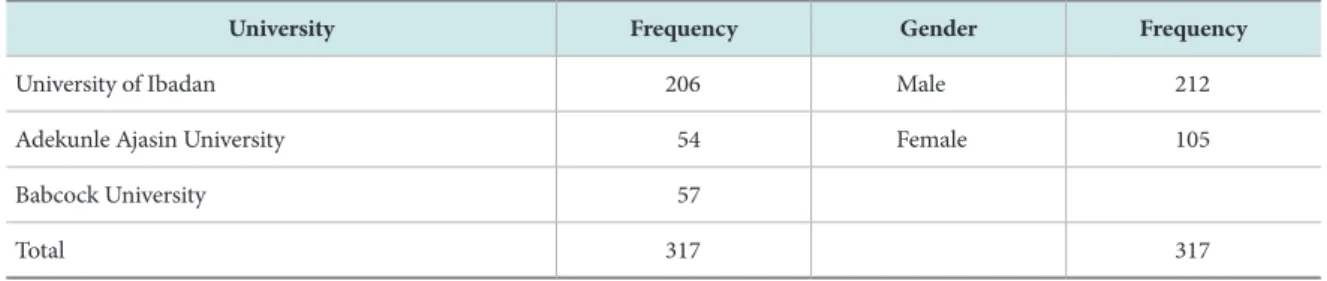
The demographic information of the academic staff that participated in the survey is shown in Table 1.
As shown in Table 1, the majority of participants (206) were from the University of Ibadan and 57 were from Babcock University, while 54 were from Adekun-le Ajasin University. Of 317, 212 of the participants were male while 105 were female.
Objective 1: The objective sought to identify factors
that influence the adoption and use of OA publishing by academic staff in selected universities.
Table 2 shows that each of the independent variables (factors) made a significant contribution to the pre-diction of adoption and use of OA publishing. Effort expectancy made an insignificant contribution but has a positive relationship with adoption and use of OA publishing. As regards the magnitude of contribution, attitude towards OA publishing made the most signif-icant contribution (Beta = .407, t = 8.774, p < 0.05) to the prediction of adoption and use of OA publishing. This is followed by awareness, with value Beta = .367, t = 8.361, p < 0.05. Next is the performance expectancy that made significant contribution (Beta = .149, t = 2.878, p < 0.05). Also, facilitating conditions (Beta = .127, t = 2,505, p < 0.05) made significant contribu-tion to the prediccontribu-tion. Moreover, other factors made significant contribution in the following order:
Inter-net self-efficacy (Beta=-.114, t= -2.564, p<0.05), and behavioural intention (Beta = -.070, t = -2.001, p < 0.05) with negative relationship. This implies that the lower the relationship of both Internet self-efficacy and behavioural intention, the better the adoption and use of OA publishing. Effort expectancy (Beta = .005, t =.082, p > 0.05) made an insignificant contribution to the prediction of adoption and use of OA publishing. Thus, the higher the beta value the greater the influ-ence of the predictor variable on the criterion (adoption and use of OA publishing). This suggests that all the factors (awareness, attitude, performance expectancy, effort expectancy, Internet self-efficacy, and facilitat-ing conditions) have an established relationship with
adoption and use of OA publishing. Also, all predictors are a good measure for the adoption and use of OA publishing. Hence, it was identified that awareness, attitude, performance expectancy, effort expectancy, Internet self-efficacy, and facilitating conditions influ-enced the adoption and use of OA publishing.
Objective 2: The second objective sought to
estab-lish relationships among factors that influence the adoption and use of OA publishing.
Multiple Regression (MR) analysis was used to address the hypotheses and relationships among the influencing factors that contribute to the adoption and use of OA publishing. According to Swanson and Holton (2005, p. 118), MR has been used widely in Table 1. Background of the Participants
University Frequency Gender Frequency
University of Ibadan 206 Male 212
Adekunle Ajasin University 54 Female 105
Babcock University 57
Total 317 317
Source: Field Data, 2015
Table 2. Determinants of the Adoption and Use of OA Publishing (N=317) Model
Unstandardized
Coefficient StandardizedCoefficient t Significant
Beta(B) Std. Error Beta(B)
Constant 3.451 1.452 5.821 .000
Awareness of OA Publishing .473 .057 .367 8.361 .000
Attitude towards OA Publishing .638 .073 .407 8.774 .000
Performance Expectancy .208 .072 .149 2.878 .004 Effort Expectancy .007 .081 .005 .082 .935* Internet self-efficacy -.196 .076 -.114 -2.564 .011 Facilitating conditions .169 .068 .127 2.505 .013 Behavioural intention -.151 .075 -.070 -2.001 .046 Significant level at p<0.05
organisational research to “predict and explain” the concerns of research questions in a survey instrument. Although simultaneous, step-wise, and hierarchical tests are available methods of multiple regression for analysis of data, this study used the hierarchical meth-od because it is a theory-driven research.
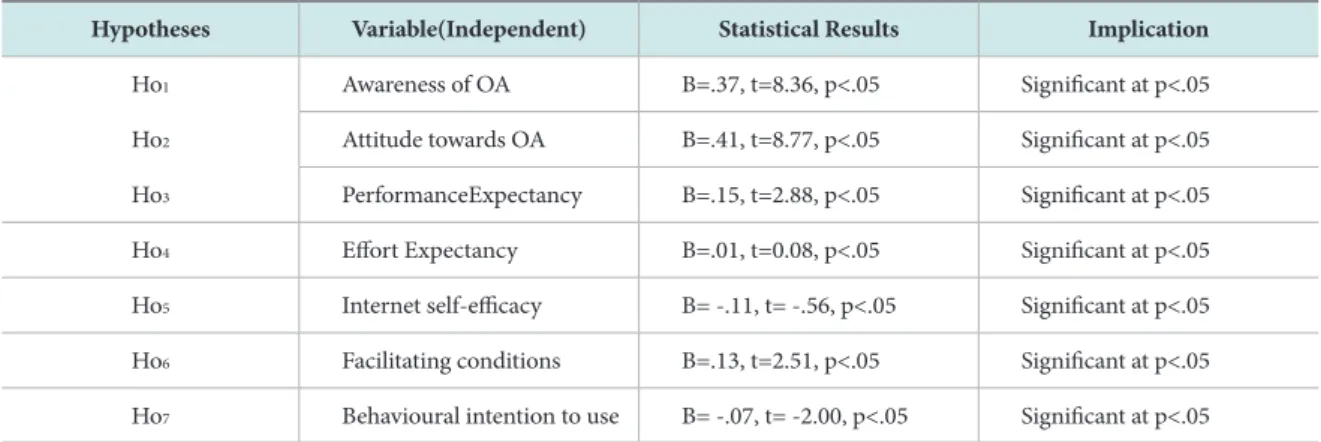
Table 3 shows that there are relationships among variables and adoption and use of OA publishing. This suggests that independent variables of the study have strong relationships with dependent variables which are significant and strongly influence the adoption and use of OA publishing. Hence, it can be deduced from the findings that awareness, attitude, performance expectancy, effort expectancy, Internet self-efficacy, and facilitating conditions are determinants of the adoption and use of OA publishing. Also, behavioural
intention to use has a significant relationship with the adoption and use of OA publishing.
Objective 3: The third objective sought to determine
the joint contributions of the factors influencing the adoption and use of OA publishing.
Table 4. Hierarchical Regression Showing Joint Con-tributions of Independent Variables to Adoption and Use of OA Publishing
Table 4 shows that awareness, attitude, performance expectancy, effort expectancy, Internet self-efficacy, fa-cilitating conditions, and behavioural intention jointly accounted for 62% (R2 = .620) of the total variance in
OA publishing adoption and use by academic staff and it was significant (p <.05). The moderating variables accounted for an additional 2.3% (R2 =.023) and is also
significant at (p < .05). Hence, it can be concluded that
Table 3. Summary of Hypotheses (Hierarchical Multiple Regression Analysis) (N=317)
Hypotheses Variable(Independent) Statistical Results Implication
Ho1 Awareness of OA B=.37, t=8.36, p<.05 Significant at p<.05
Ho2 Attitude towards OA B=.41, t=8.77, p<.05 Significant at p<.05
Ho3 PerformanceExpectancy B=.15, t=2.88, p<.05 Significant at p<.05
Ho4 Effort Expectancy B=.01, t=0.08, p<.05 Significant at p<.05
Ho5 Internet self-efficacy B= -.11, t= -.56, p<.05 Significant at p<.05
Ho6 Facilitating conditions B=.13, t=2.51, p<.05 Significant at p<.05
Ho7 Behavioural intention to use B= -.07, t= -2.00, p<.05 Significant at p<.05
Dependent variable: Adoption and use of OA Publishing Level of Sig. at p<0.05
Table 4. Hierarchical Multiple Regression Showing Joint between Independent Variables and Dependent Variable(Adoption and Use of OA Publishing)
Model SquaresSum of Df SquareMean F Sig. R R2 R2Change Implication
1. Regression Residual Total 3924.656 2401.836 6326.492 7 309 316 560.665 7.773 72.130 .000a .788 .620 .620 Significant 2. Regression Residual Total 4071.636 2254.856 6326.492 21 295 316 193.887 7.644 25.366 .000b .802 .644 .023 (.165) Significant Level of Sig. at p<0.05
influencing factors predict 62% (R2 = .620) of adoption
and use of OA publishing.
Objective 4: The fourth research objective sought to
investigate the level of university management support for OA publishing. To meet this objective, interviews were conducted on university management staff of the selected universities as shown below.
The findings revealed that most respondents did not know if there is any policy that supports OA adoption and use by academics in the targeted universities. One of the respondents observed that:
Lack of OA legal framework is an issue affecting us (academic staff). If the university endeavours to formulate an OA policy, it will encourage many academics like ours (lecturers) to increase adoption and use of OA publication as we will do more of OA publishing to showcase our scholarly research findings. However, if the university does not provide an enabling environment, it becomes impossible for many academics. The university should fulfil their part by playing the role that will enhance the adop-tion and use of OA publishing.
Another respondent acknowledged the need of OA and stated that:
At the moment, there is no written policy that sup-ports OA adoption and use by academic staff in my university (University of ...). Additionally, a plan is in the pipe- line on OA legal framework and the university librarians and academic staff from the Faculty of Law has been mandated to be part of the anticipated OA legal framework committee. If the framework has been put into place to support the adoption and use of OA, it would have boosted the morale of academic staff by increasing the adoption and use of OA publishing.
Similarly, another respondent from the third univer-sity stated that:
...we need an OA policy. The university management needs to introduce policies that would support and assist the adoption and use of OA publishing in the university community in Nigeria. Academics require some level of support from the Annual Promotion Committee (APC). It seems the lack of a written policy for OA publishing leads to rejection by the promotion committee.
Comments made by university management staff of the three universities suggest that there was no OA
policy in any of the selected universities. These findings affirmed the general comments of respondents in the questionnaire that they did not have any knowledge of the existence of an OA policy in their universities. This suggests that the perceived fear of rejection by academ-ic staff could have been totally eradacadem-icated if universities could put in place an OA publishing policy.
Furthermore, insights from the respondents suggest that university management’s support for the adop-tion and use of OA publishing could be of significant help to academics in universities in Nigeria. In other words, the university management’s role with respect to supporting academic staff ’s adoption and use of OA publishing is a key to successful free access to OA publications as well as wide dissemination of research. Having an OA publishing policy in place will motivate academics and alleviate the perceived fear of rejection of OA publication by the university promotion com-mittee. This will increase adoption and use of OA pub-lishing by academic staff.
Objective 5: The fifth objective sought to develop a
suitable framework that can facilitate the adoption and use of OA publishing by academic staff in universities in Nigeria.
The findings of this study guide the proposed frame-work that is based on the existing theory—the Unified Theory of Acceptance and Use of Technology. This framework will facilitate and enhance the academic staff adoption and use of OA publishing.
A framework is described as a set of broad ideas and principles taken from the result of empirical findings and relevant literature, and one can be used to struc-ture a subsequent presentation (Reichel & Ramey, 1987). According to Dix (2007, p. 116), a framework is “a general structure that provides an overarching set of concepts and processes.” At times, a framework may reflect a model or guide the development of a model or a number of models.
The graphical representation of the proposed framework illustrates the pattern and structure of links among the set of measured variables. It serves as a research device intended to assist a researcher in developing awareness and understanding of the state of adoption and use of OA publishing in Nigeria uni-versities. It also communicates research findings and recommendations for the purpose of effective imple-mentation and promotion of rapid adoption and use
of OA publishing among the stakeholders, as shown in Figure 1.
In the investigation, the adoption and use of OA publishing was taken as the dependent variable, and awareness, attitude, performance expectancy, effort ex-pectancy, Internet self-efficacy, and facilitating condi-tions were taken as independent variables, behavioural intention to use taken as an intervening variable. The researcher used a regression analysis to establish the relationship and existence of influence between the measured variables. Factors that influenced the adop-tion and use of OA publishing and their relaadop-tionships,
based on what was explained in previous sections, are presented as Ho1 to Ho7 below.
Awareness
The knowledge or perception of a situation or fact is paramount in any decision to adopt and use new innovation. OA publishing is a new concept that needs to be known before accepting or using this technology based system. According to present and previous stud-ies (Chritian, 2008; Obuh & Bozimo, 2012), awareness plays a vital role and is a key factor influencing the adoption and use of OA publishing (see Ho1)
Ho1: There is no significant relationship between
awareness and adoption and use of OA publishing Attitude
Attitude can be described as a way of thinking or feeling about something either negatively or positively. Attitude towards adoption and use of OA publishing plays an essential role. Academic staff that develop a positive attitude towards adoption and use of OA publishing will embrace and use it to perform a giv-en task. The findings of currgiv-ent and previous studies (Wickham, 2011; Khalli & Singh, 2012) established that attitude is a determinant in adoption and use of OA publications. Attitude towards OA publishing is a factor influencing the adoption and use of OA publish-ing and has relationships with other variables (factors). This was established by testing the hypothesis as pre-sented in Ho2 below:
Ho2: There is no significant relationship between
at-titude and adoption and use of OA publishing Performance Expectancy
Performance expectancy concerns the degree to which a person believes that using OA publishing would improve his or her performance. The current finding was in congruence with previous studies (Al-Qeisi, 2009; Dulle, 2010).
Ho3: There is no significant relationship between
performance expectancy and adoption and use of OA publishing.
Effort Expectancy
Effort expectancy is defined as the degree to which a person believes that using OA publishing would help achieve a set target. The findings revealed that the in-fluence of effort expectancy is not significant. Hence, the findings are not opposing the previous findings (Louho et al., 2006; Butler & Richardson, 2008) which report a high proportion of the respondents to have significantly expressed less effort expectancy towards the usage of new technologies.
Ho4: There is no significant relationship between
ef-fort expectancy and adoption and use of OA publish-ing.
Internet Self-Efficacy
According to Bandura (1997) self-efficacy is a
per-sonal judgments of one’s capabilities to organize and execute courses of action to attain designated goals, and Bandura sought to assess its level, generality, and strength across activities and contexts (Schunk, 1991). Internet self-efficacy is personal self-assurance of hav-ing capability to use the Internet to achieve specific tasks. Gbaje 2010 established that the Internet is a plat-form for OA publishing. The present findings support Dulle (2010) in that Internet self-efficacy has signifi-cant influence on adoption and use of OA publishing. Besides, both Internet usage skills and self-efficacy have been conceded as key determinants for the effec-tive exploitation of information in the digital environ-ment (Waldman, 2003; White & Gendall, 2005).
Ho5: There is no significant relationship between
Internet self-efficacy and adoption and use of OA pub-lishing.
Facilitating Conditions
According to the current study and previous stud-ies (Okoye & Ejikeme, 2011) the role of facilitating conditions in adoption and use of OA publishing is very crucial. Facilitating conditions refer to factors like funding training on ICTs and the Internet, technical support, Internet facilities, and regular electric power that are essential for the successful adoption and use of OA publishing (Christian, 2008; Fatunde, 2008; Njoku, 2016). The current findings corroborate results from previous studies (Dulle et al., 2011; Zhou et al., 2010) that facilitating conditions have significant influence on adoption and use of OA publishing.
Ho6: There is no significant relationship between
facilitating conditions and adoption and use of OA publishing.
Behavioural Intention
Behaviour intention is defined as a person’s per-ceived likelihood or subjective probability that he or she will adopt and use OA publishing. Showing only intention to use might not translate to actual usage of OA publishing.
Ho7: There is a significant relationship between
be-havioural intention and adoption and use of OA pub-lishing.
OA Legal Policy
inter-views revealed that none of the sampled universities has a policy on OA publishing and this has created a perceived problem of rejection of OA publications for promotion and tenure by the constituted University Promotion Committee.
There is a need to establish a policy that will promote acceptance and use of OA publishing by academics. This implementation is possible by incorporating an OA publishing policy into the existing one regarding subscription-based journals. The university author-ity should ensure that for appointment, promotion, and tenure, OA peer reviewed publications should be considered and given equal treatment as toll-accessed publications. If necessary, precautions should be taken with a better understanding of the relationships that exist among the variables in Figure 1 so that the prob-lem of low adoption and use of OA publishing will be solved. Hence, the visibility and accessibility of re-search findings will significantly improve the adoption and use of OA publishing.
8. EXPLANATION OF THE FRAMEWORK
The proposed conceptual framework in Figure 1 an-alysed the interactions between independent variables (awareness, attitude, performance expectancy, effort expectancy, Internet self-efficacy, facilitating condi-tions) and OA policy interacts with the behavioural intention that serves as a mediating variable and influ-ences the adoption and use of OA publishing. Specifi-cally, the model analyzed the key variable connections as shown in Figure 1 and provided a useful viewpoint for examining variables that influenced the adoption and use of OA publishing by academic staff. With the exception of facilitating conditions, behavioural inten-tion mediates the involvement of all independent vari-ables that influence adoption and use of OA publishing by academics. This proposed framework (see Figure 1) will assist the researcher to figure out how the in-teractions between independent variables influenced the level of adoption and use of OA publishing. These variables are theoretically associated with the adoption and use of OA publishing. The independent variables are explained as predictors that influence adoption and use of OA publishing (dependent variable). Fur-thermore, these factors are multi-dimensional and
interact with each other. These interactions can play a significant role in the decisions of academic staff either to use or reject OA publishing.
The support for OA publishing will influence facili-tating conditions, and this in turn influences Internet self-efficacy because the development of self-efficacy depends on Internet facilities with high Internet band-width. This will in turn interact with effort expectancy as a result of self-confidence in the ability to use the Internet with less difficulty. This chain of interactions influences and induces academics to embrace the OA system because of its benefits to aid job performance (performance expectancy) for the set target. The per-formance expectancy in turn influences the ability to achieve the set target with little effort (effort expec-tancy) and impacts the development of the right (pos-itive) attitude by academic staff. This will attract an OA campaign which leads to OA awareness, and later influences the formulation of OA policies. Further, an OA policy will trigger and enhance the adoption and use of OA publishing by academic staff.
Academic staff that benefit from the adoption and use of OA publishing will inevitably influence univer-sity management to formulate an OA policy that will promote awareness of OA. This in turn will drive the need to intensify more efforts in the OA campaign, with a focus on its benefits that can inform the devel-opment of positive attitudes towards OA by academic staff. This chain of interactions influences perfor-mance expectancy of academic staff, having realized the benefits of OA to enhance performance on the set target. Further interactions attract academics to use OA, since it requires little effort (effort expectancy) to deliver on the set target. This also encourages aca-demic staff to develop Internet self-efficacy through an enlivened environment (facilitating conditions) that supports OA publishing. These chains of interactions drive more support for OA that will finally lead to the adoption and use of OA publishing. Additionally, each independent variable (OA policy, awareness, attitude, performance expectancy, effort expectancy, Internet self-efficacy) has a direct influence on intention to use OA publishing as indicated by the arrow, and intention to use has direct influence on the actual use of OA publishing. Finally, following each step thoroughly will lead to successful adoption and use of OA publishing (outcome) as shown in Figure 1.
Justification for the Framework
The rationale for this proposed framework are as follows:
• The adoption and use of OA publishing by aca-demics in most universities witnesses a high con-sumption of OA publications but low patronage of OA publishing outlets;
• Persistence of serial and permission crises in aca-demic libraries;
• Low access and poor visibility of research findings in Africa and Nigeria in particular, and
• Lack of OA policy to encourage the adoption and use of OA publishing by academic staff in universi-ties in Nigeria.
The above justification calls for the development of a framework that assists users to have wider access to information, especially research findings; also, to help stakeholders to appreciate, embrace, and evaluate OA publishing.
9. LIMITATIONS
This study focused on lecturers and librarians (ac-ademics) only. The present study used data collection instruments such as a questionnaire and structured interviews for data gathering on the adoption and use of OA publishing.
10. SIGNIFICANCE OF THE STUDY
The significance of this study is three-fold: first, the-oretical significance—it adds to the existing literature. Rindova (2011) asserts that the vital reason to conduct a scholarly guided study is to contribute to a theory or develop one. Therefore, this study successfully contrib-utes to theory by identifying new constructs (aware-ness, attitude, and Internet self-efficacy) to the existing variables of the UTAUT. Second is the societal signif-icance: The study promotes adoption and use of OA publishing, which can facilitate access and wide visi-bility of research findings to all stakeholders (lecturers, librarians, researchers, and industrialists). Third, it will minimise the persistent serial crisis (shortage of reading materials) in academic libraries. Furthermore, it adds value to the methodological approach by
com-bining quantitative and qualitative techniques. This paper also contributes a framework that improves ac-ademics’ and other stakeholders’ adoption and use of OA publishing.
11. CONCLUSIONS
The use of OA publishing is still in its infancy and more research is required to update its evolving nature. Open access publishing proffers a new scholarly com-munication model to scholars, researchers, academics, students, and other stakeholders. However, there are various factors that influence the adoption and use of OA publishing. The present study concludes that awareness, attitude, performance expectancy, Internet self-efficacy, and facilitating conditions are determi-nants of the adoption and use of OA publishing. The findings also revealed that universities did not have OA policies to motivate academics’ adoption and use of OA and to alleviate the perceived fear of rejection of OA publications for promotion.
The results show that there are relationships between predictors (awareness, attitude, performance expec-tancy, effort expecexpec-tancy, Internet self-efficacy, and facilitating conditions) and adoption and use of OA publishing. Predictors (factors) that potentially influ-ence the successful adoption and use of OA publishing need to be taken into account by university authorities while embracing and using OA publishing. Also, fac-tors that influence adoption and use of OA publishing are explored and presented as a framework.
This study established that all predictors (factors) of OA made a contribution of 62% towards the adoption of OA publishing. The findings imply that all predic-tors (facpredic-tors) jointly influence the adoption and use of OA publishing.
12. RECOMMENDATIONS
OA Awareness
Based on the findings, the following recommenda-tions are made: It is recommended that universities should increase OA awareness by assigning reference librarians or scholarly communication officers to pro-vide access to OA publications. Also, libraries should
organise OA monthly awareness programmes. Adequate Facilities
The universities should strengthen the existing ICT facilities by providing/ensuring regular power supply and upgrading Internet bandwidth as well as more funds.
Training
To understand and adopt OA publishing effectively, regular training is essential for academic staff. Uni-versities should organise refresher courses for staff on ICTs and Internet searching and for training newly recruited staff. In summary, universities should ensure that all factors leading to successful adoption and use of OA publishing by academic staff are enhanced. OA Publishing Policy
Universities should formulate an OA legal frame-work that will alleviate academic staff’s fears of rejec-tion of OA publicarejec-tions for promorejec-tion and tenure. This can be achieved by ensuring that OA peer reviewed publications are given equal treatment as toll-accessed printed journals.
ACKNOWLEDGEMENTS
The authors are grateful to all participants in this study for their invaluable contributions. We are equally appreciative to the editor and the anonymous review-ers for their supportive and expert comments.
REFERENCES
Adeogun, M. (2003). The digital divide and university education systems in Sub Saharan Africa. African
Journal of Library Archives and Information Science, 13(1), 11- 20.
Al-Qeisi, K. I. (2009). Analyzing the use of UTAUT
model in explaining an online behaviour: Internet banking adoption (Unpublished Ph.D. thesis).
Brunel University. Retrieved from http://bura. brunel.ac.uk/bitstream/ 2438/1/kholoudThesis.pdf. Bandura, A. (1986). Social foundations of thought and
action: A social cognitive theory. Englewood Cliffs,
NJ: Prentice–Hall.
Bandura, A. (1997). Self-efficacy: The exercise of control. New York: Freeman.
Bashorun, M. T. (2014). Awareness and attitude of aca-demic staff towards adoption of open access, pub-lishing in University of Ilorin Nigeria. Proceedings
of the 2nd Open Access National Conference, Game City Gaborone, Botswana, November 6-7.
Bashorun, M. T., Jain, P., Sebina, P. M., & Kalusopa, T. (2013). Open Access Publishing: A catalyst for scholarly research publication. European Journal of
Academic Research, 1(2), 84-89.
Budapest Open Access Initiative. BOAI. (2002). Re-trieved from http://www.soros.org/openaccess/ read.shtml.
Butler, J., & Richardson, K. (2008). The perceived ease of use of iBrainz technology in property law and taxation law. Studies in Learning, Evaluation In -novation and Development, 5(1), 81-98. Retrieved
from http://sleid.cqu.edu.au.
Chau, P. Y. K., & Hu, P. J. (2002). Examining a model of information technology acceptance by individ-ual professionals: An exploratory study. Journal of
Management Information Systems, 18(4), 191-229.
Christian, G. M. (2008). Issues and challenges to the development of open access institutional repos-itories in academic and research institutions in Nigeria. A paper prepared for the International Development Research Centre (IDRC). Re-trieved from http://idlbnc.idrc.ca/dspace/han-dle/123456789/36986/1/127792.pdf.
De Vaus, D. A. (1991). Surveys in social research. 3rd ed.
Sydney, Australia: Allen & Unwin.
Dinev, T., Hu, Q., & Goo, J. (2005). User behaviour toward preventive technologies –examining cross-cultural differences between the United States and South Korea. Proceedings of the 13th
Annual Cross-Cultural Research in Information Sys-tems Conference (CCRIS 2005), Las Vegas, USA.
Dix, K. L. (2007). DBRIEF: A research paradigm for ICT adoption. International Education Journal,
8(2), 113-124.
Dulle, F. W., & Minishi-Majanja, M. K. (2011). The suitability of the Unified Theory of Acceptance and Use of Technology (UTAUT) model in open access adoption studies. Information Development, 27(1), 32–45.
Dulle, F. W., Minishi-Majanja, M. K., & Cloete, L. M. (2010). Factors influencing the adoption of open access scholarly communication in Tanzanian public universities. World Library and Informa -tion Congress: 76th IFLA General Conference and Assembly, Gothenburg, Sweden, August 10-15.
Re-trieved from http: //www.Ifla.org/en/ifla76.
Dulle, F. W. (2010). An analysis of open access scholarly
communication in Tanzanian public universities
(Ph.D. thesis in Information Science). University of South Africa. Retrieved from http://www.tzonline. org/pdf/thesis_dulle_f-1.pdf.
Emojorho, D., Ivwighregweta, O., & Onoriode, K. O. (2012). Awareness of open access scholarly pub-lication among lecturers in university of Benin, Benin City, Edo State, Nigeria. Journal of Research
in Education and Society, 3(1), 1-11.
Fatunde, T. (2008). Nigeria: Poor electricity supply hits ICT growth. University World News (African Edi-tion). Retrieved from http://www.universityworld-news.com/article.php?story=20080424153055598. Gbaje, E. S. (2010). Open access journal publishing in
Ahmadu Bello University Zaria, Nigeria. Paper
pre-sented at the 76th IFLA General Conference and Assembly, August 10-15.
Hsu, M. H., Chiu, C. M., & Ju, T. L. (2004). Determi-nants of continued use of the WWW: An integra-tion of two theoretical models. Industrial
Manage-ment & Data System, 104(9), 766-755.
Jain, P. (2012, May). Promoting open access to research in Academic libraries: Development and Initiatives.
Library Philosophy and Practice. Retrieved from
http://www.webpages.uidaho.edu/~mbolin/jain. pdf.
Jayasingh, S., & Eze, U. C. (2010). The role of mod-erating factors in mobile coupon adoption: An extended TAM perspective. Communications of the
IBIMA, 1-13.
Khalili, L. & Singh, D. (2012). Factors influencing ac-ceptance of open access publishing among medical researchers in Iran. Libri, 62(4), 336-354.
Louho, R., Kallioja, M., & Oittinen, P. (2006). Factors affecting the use of hybrid media applications.
Graphic Arts in Finland, 35(3), 11-21.
Mammo. Y., & Ngulube, P. (2013). Academics’ use and attitude towards open access in selected higher learning institutions of Ethiopia. Information De
-velopment, 31. doi: 10.1177/0266666913500977.
Njoku, A. O. (2016). An examination of the challenges of power supply in Nigeria in post-privatization era, 2013-2016. Asian Journal of Basic and Applied
Sciences, 3(1), 34-44.
Obuh, A. O. (2013). Attitude towards the use of open access scholarly publications: The position of LIS lecturers in Southern Nigeria. The Social Sciences,
8(2), 153-159.
Obuh, A. O., & Bozimo, D. O. (2012). Awareness and use of open access scholarly LIS 60 lecturers in Southern Nigeria. International Journal of Library
Science, 1(4), 54-60. Retrieved from http://article.
sapub.org/10.5923.j.library.20120104.02.html. Okoye, M., & Ejikeme, A. (2011). Open access,
institu-tional repositories and scholarly publishing: The role of librarians in Southeast Nigeria. Library Phi -losophy and Practice. Retrieved from http://unllib.
unl.edu/LPP/okoye-ejikeme.htm.
Oluwasemilore, I. A. (2013). Issues and challenges in the development of open access publishing and scholarly communication in Nigeria. Retrieved from http://digitalscholarship.unlv.edu/cgi/view-content.cgi?article=1004&context=aaas_pacific_ conf.
Rindova, V. (2011). Moving from ideas to a theoretical contribution: comments on the process of devel-oping theory in organizational research. Journal of
Supply Chain Management, 47, 19-21. doi: 10.1111/
j.1745-493X.2011.03221.x.
Reichel, M., & Ramey, P. (1987). Conceptual frameworks
for bibliographies education: Theory to practice.
Lit-tleton, CO: Libraries Unlimited.
Schunk, D. H. (1991). Self-efficacy and academic moti-vation. Educational Psychologist, 26, 207-231. Swanson, R. A., & Holton, E. F. (2005). Research in or
-ganizations: Foundations and methods of inquiry.
3rd ed. San Francisco, CA: Berrett-Koehler.
Stanley, A.S., Nory, D. M., Hopko, D. R., Beck, J. G., Averill, P.A., & Swann, A. C. (2002). Measures of self-efficacy and optimism in older adults with generalized anxiety. Assessment, 9, 70-81
Tenopir, C., & King, D. W. (2000). Towards electronic
journals: Realities for scientist, librarians and pub-lishers. Washington, D.C.: Special Libraries
Associ-ation.
ini-tiatives adoption by Nigerian academics. Library
Review, 58(9), 660-669.
Venkatesh, V., Morris, M., Davis, G. B., & Davis, F. D. (2003). User acceptance of information technolo-gy: Towards a unified view. MIS Quarterly, 27(3), 425-478.
Waldman, M. (2003). Freshmen’s use of library elec-tronic resources and self-efficacy. Information
Research, 8(2). Retrieved from http://informationr.
net/ir/82/paper150.html.
White, B., & Gendall, R. (2005). Barriers to the use of digital information by university researchers. New
Zealand Library & Information Management Jour-nal 50(1), 11-24.
Wickham, J. (2011). Unlocking attitudes to open access–survey results. Retrieved from http://rsp- project.wordpress.com/2011/12/02/unlocking-atti-tudes-to-open-access-survey-results.
Willinsky, J. (2005). The access principle: The case for
open access to research and scholarship. Cambridge,
MA: MIT Press.
Wu, Y., Tao, Y., & Yang, P. (2007). Using UTAUT to ex-plore the behaviour of 3G mobile communication users. Proceedings of the 2007 IEEE International
Conference on Industrial Engineering and Engineer-ing Management, SEngineer-ingapore, December 2-4 (pp.
199-203).
Zhou, T., Lu, Y. B., & Wang, B. (2010). Integrating TTF and UTAUT to explain mobile banking user adop-tion. Computers in Human Behaviour, 26(4), 760-767.