- 126 -
KISEP Original Articles J Rhinol 4((((2)))), 1997
Local Production of IgE in Nasal Polyp*
Chung Hyun Cho, M.D., Tae Young Jang, M.D., Young Seok Yun, M.D.
and Dong Hak Jung, M.D.
ABSTRACT
Among the several possible etiologic factors for the development of nasal polyp, localized nasal allergy had been insisted to be one of the major factors. This study aims to explore the existence of local production of IgE within nasal polyp, which can be the indirect evidence of localized nasal allergy. Fifty-two patients, who underwent nasal polypectomies between April 1993 and December 1995, were selected. The levels of total IgE and specific IgE of serum and polyp fluids were assessed. By using Donovan’s equation, the percentage of local production of IgE in nasal polyp were calculated. Local production of total IgE was demonstrated in 18 cases of 28 polyp patient group (64.3%). Local production of specific IgE for Dermatophagoides pter- onyssinus and Dermatophagoides farinae were demonstrated in 6 cases of 24 polyp patient group (25%). These results suggest the existence of local production of IgE in nasal polyp.
KEY WORDS:Nasal polyp·IgE.
INTRODUCTION
Nasal polyp is a common disease in ENT department1) and many theories on pathophysiology have been suggested since its discovery, but there is no certain progress till now.2)3) Ho- wever, they show a common view in that mucosal irritation such as allergic rhinitis and chronic sinusitis contributes to ge- nerating nasal polyp.
Meanwhile, it has been suggested that there is a possibility of localized allergy confined to nasal mucosa for those pati- ents having nasal polyp or allergic rhinitis, who showed neg- ative reaction to IgE-mediated type I hypersensitivity test such as skin test and serum IgE test.2-8)
Hence, the authors tried to investigate the possibility of lo- cal production of IgE in the nasal polyp, which can be the indirect evidence of the localized nasal allergy.
MATERIALS AND METHODS
MaterialsThis study was conducted to fifty-two patients who had
underwent nasal polypectomies at Inha University Hospital between April 1993 and December 1995, whose average age was 35.2 years (range:13-68 years) and male to female ra- tio was 32:20 (Table 1).
Methods
To find out generation of localized IgE in nasal polyp, of 52 nasal polyp patients, following procedures were performed.
Nasal polyps taken during operation were washed out and st- ored in the deep freezer at -70℃. They were melted and taken out 2 grams, then minced. Buffer solution of 2 ml was added to the tissues, so that tissue versus buffer could be 1:1. Ten mM Na-phosphate of pH 8.0 which was added to 0.15 M NaCl was used as buffer.9) To homogenize this, Potter homo- genizer was used until the tissues were invisible to naked eyes.
It was centrifuged at 4℃ for 10 minutes under 10,000 rpm to separate supernatant only. Hereinafter this supernatant is ref- erred to as polyp fluid.
With PRIST (Pharmacia, Sweden), total IgE was measured in polyp fluid and serum of twenty-eight patients. To measure specific IgE, RAST was performed for the specific antigen, Dermatophagoides pteronyssinus (Dp) and Dermatophagoi- des farinae (Df), in polyp fluid and serum of remaining twe- nty-four patients. Phadebas method was used and the results were assorted from 0 to 4 class. To remove nonspecific reac- tion, test results more than 2 class were regarded as positive.
The amount of albumin in polyp fluid and serum was meas- ured with BCG (Brome Cresole Green) method and amount of α2-macroglobulin with rate nephelometry.
*This study was supported by grants from Inha University 1996.
Department of Otorhinolaryngology, College of Medicine, Inha University, Inchon, Korea
Address correspondence and reprint requests to Chung-Hyun Cho, M.D., Department of Otolaryngology, College of Medicine, Inha University, 7-206, 3rd St. Shinheung-dong, Choong-gu, Inchon 400-103, Korea
Tel:82-32-890-2420, Fax:82-32-890-2430 Accepted for publication on September 14, 1997
Cho et al:IgE Production in Nasal Polyp / 127
It has been known that some of the IgE in nasal polyp res- ults from simple diffusion of serum IgE.4) To obtain the real amount of IgE of the nasal polyp, the following Donovan’s formula was used.5) This was applied in that albumin and α2- macroglobulin in nasal polyp were accordance with a simple diffusion from serum without metabolism.4)
Locally produced IgE
P alb:albumin in polyp fluid S alb:albumin in serum
Pα2:α2-macroglobulin in polyp fluid Sα2:α2-macroglobulin in serum
RESULTS
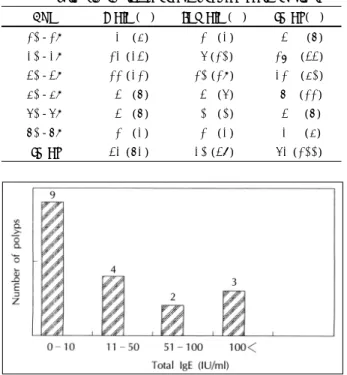
Total IgEAfter calculating total IgE diffused from serum to nasal polyp by Donovan’s equation, total IgE level in 18 polyp pa- tients showed higher than serum. That is, there was the local production of total IgE in 64.3%. As for distribution of the local production of total IgE, less than 10 IU/ml was 50%, 11-50 IU/ml was 22%, 51-100 IU/ml was 11% and more than 100 IU/ml was 17% (Fig. 1).
Specific IgE
Polyp fluid RAST for D. pteronyssinus showed higher as much as 2 class than serum in 25% (6/24). That is, there was local production of specific IgE in 25% (Table 2).
As a result of the same performance for specific antigen, D.
farinae, there was local production of specific IgE in 25%
(6/24) (Table 2).
DISCUSSION
The etiology and pathophysiology of nasal polyp are poorly understood. Since it is frequently accompanied with systemic diseases, nasal polyp was regarded as localized expression of systemic diseases such as perennial rhinitis, cystic fibrosis, aspirin intolerance and Katagener’s syndrome.10)11) Meanwhile, some tried to explain that the main cause of nasal polyp was viral disease, abnormality of autonomic nervous system or ca- rbohydrate metabolism,10) however, none of them is sufficient to prove the developmental mechanism of nasal polyp.
It was gradually concerned that chronic sinusitis or allergic rhinitis irritated nasal mucosa chronically, and the nasal polyp was a result of such a chronic irritation. Accordingly allergic rhinitis was considered as a main cause of nasal polyp and many studies supporting such a hypothesis have been repo- rted.11)12)
Since 1970, there have been so much efforts to explain the cause of nasal polyp as localized allergy confined to nasal mu- cosa. Small et al.13) conducted to the patients with allergic rhinitis several tests such as skin test, RAST for serum and nasal secretion. They found that a group of patients with all- ergic rhinitis showed negative response in skin test and serum RAST. These patients were proved to be clinically allergic by nasal provocation. These findings suggested either the low sensitivity of the skin test, or localized allergy confined to nasal mucosa. Ali et al.14) used immunohistochemistry and found out the existence of the cells generating IgE in nasal mucosa, suggesting the possibility that nasal mucosa itself can generate IgE.
To explore the local production of IgE in nasal polyp, Do- novan et al.5) measured IgE level from serum and polyp fluid.
Obtaining the amount of IgE diffused from serum using the
Table 1. Distribution of sex and age in polyp patients group Age Male (%) Female (%) Total (%) 10-19 2 (4) 1 (2) 3 (6) 20-29 12 (23) 5 (10) 17 (33) 30-39 11 (21) 10 (19) 21 (40) 40-49 3 (6) 3 (5) 6 (11) 50-59 3 (6) 0 (0) 3 (6) 60-69 1 (2) 1 (2) 2 (4) Total 32 (62) 20 (38) 52 (100)
P alb S alb+
Pα2
Sα2
=Tissue IgE-
2 ×Serum IgE
Table 2. RAST values of 24 polyp specimens
RAST D. pteronyssinus (%) D. farinae (%) 0 class 13 (54.2) 13 (54.2) 1 class 5 (20.8) 5 (20.8)
≥2 class 6 (25.0) 6 (25.0) Total 24 (100) 24 (100)
Fig. 1. Total IgE in nasal polyps (n=18).
128 / J Rhinol 4(2), 1997
albumin and α2-macroglobulin indirectly, the amount of lo- cally produced IgE was calculated by subtracting the diffused IgE from the amount of IgE of polyp fluid. He used a feature that albumin and α2-macroglobulin in nasal polyp are stem- med from simple diffusion without metabolism as albumin and α2-macroglobulin are immunologically non-reactive.
While both albumin and α2-macroglobulin were used for the calculation of non-specific IgE by Donovan’s equation, only albumin was used for the specific IgE in this study. Si- nce amount of α2-macroglobulin in nasal polyp was very small, we assumed that there would not be much difference. With this method, local production of total IgE in nasal polyp was 64.3%. Considering dilution of polyp fluid with buffer solu- tion, it is possible that polyp tissues have much higher level of IgE.
To investigate local production of specific IgE in nasal po- lyp, specific IgE in serum and polyp fluid was measured by RAST for two most common specific antigens, D. pteronyss- inus and D. farinae. Simply diffused specific IgE was excluded by calculating with Donovan’s equation. While local produ- ction of specific IgE was demonstrated in 25% for both D.
pteronyssinus and D. farinae in this study, in other studies examining the local production of specific IgE in polyp tissues, Yaremchuk et al.8) reports 60%, and Small et al.7) 56%. We have 2 cases showing positive in skin test and serum RAST but negative in polyp fluid RAST. It is assumed that false positive reaction of skin test and RAST or parenteral immun- ization might be attributed to such results.15)
CONCLUSION
The generation of total IgE and specific IgE in nasal polyp was found. It suggest the possibility of localized allergy con- fined to the nasal mucosa. Further immunohisto-chemical study for detection of localized specific IgE in polyp tissue will be
the stronger evidence of localized mucosal allergy.
REFERENCES
1) Hyun KS, Kim JB, Kim H, Kim CH. Immunohistological study of nasal polyp. Korean J Otolaryngol 1989;32(3):472-7.
2) Huggins KG, Brostoff J. Local production of specific IgE anti- bodies in allergic-rhinitis patients with negative skin test. Lancet 1975;26:148-50.
3) Small P, Frenkiel S, Black M. Multifactorial etiology of nasal po- lyps. Ann Allergy 1981;46:317-20.
4) Chandra RK, Abrol BM. Immunopathology of nasal polyp. J Lar- yngol Otol 1974;88(10):1019-24.
5) Donovan R, Johansson SGO, Bennich H, Soothill JF. Immunoglo- bulins in nasal polyp fluid. Int Arch Allergy 1970;37:154-66.
6) Frenkiel S, Chagnon F, Small P, Rochon L, Cohen C, Black M. The immunological basis of nasal polyp formation. J Otolaryngol 1985;
14:89-91.
7) Small P, Barrett D, Frenkiel S, Rochon L, Cohen C, Black M. Lo- cal specific IgE production in nasal polyps associated with negative skin test and serum RAST. Ann Allergy 1985;55:736-9.
8) Yaremchuk K, McCullough J, Ownby DR. Immunologic evaluation of nasal polyps. Am J Rhinol 1991;5:19-23.
9) Giovanni DS, John J. Immunochemical techniques. 1st ed. Acade- mic press 1985:116.
10) Perkins JA, Blakeslee DB, Andrade P. Nasal polyps: a manifesta- tion of allergy? Otolaryngol Head Neck Surg 1989;101(6):641-5.
11) Settipane GA. Rhinitis. In: Nasal polyp, 2nd ed. Oceanside publi- cation, 1991:173-83.
12) Bunnag C, Pacharee P, Vipulakom P, Siriyananda C. A study of al- lergic factor in nasal polyps patients. Ann Allergy 1983;50:126-32.
13) Small P, Barrett D, Frenkiel S, Rochon L, Cohen C, Black M. Me- asurement of antigen-specific IgE in nasal secretions of patients with perennial rhinitis. Ann Allergy 1985;55:68-71.
14) Ali M, Mesa-Tejada R, Fayemi AO, Nalebuff DJ, Connell JT. Lo- calization of IgE in tissues by an immunoperoxydase technique.
Arch Pathol Lab Med 1979;103:274-5.
15) Miadonna A, Legieri E, Tedeschi A, Zanussi C. Clinical significa- nce of specific IgE determination on nasal secretion. Clin Allergy 1983;13:155-64.