CASE REPORT
JMBSJournal of Metabolic and Bariatric Surgery J Metab Bariatr Surg 2013;2(1):15-19
Received: June 5, 2013, Revised: June 10, 2013, Accepted: June 12, 2013
Corresponding author: Hyuk-Joon Lee, 101 Daehakro, Jongno-gu, Seoul 110-744, Korea
Department of Surgery and Cancer Research Institute, Seoul National University College of Medicine Tel: 82-2-2072-1957, Fax: 82-2-766-3975, E-mail: [email protected]
Copyright © 2013, The Korean Society for Metabolic and Bariatric Surgery
Laparoscopic Sleeve Gastrectomy for Super Obese Patient: A Case Report
Departments of 1Surgery, 2Food Service and Nutritional Care, 3Internal Medicine, Seoul National University Hospital, 4Cancer Research Institute, Seoul National University, Seoul, Korea
Yoon-Hye Kwon1, Kyung-Goo Lee1, Seung-Young Oh1, Sebastianus Kwon1, Mi Young Jang2, Young Min Cho3, Han-Kwang Yang1,4, Hyuk-Joon Lee1,4
We performed a laparoscopic sleeve gastrectomy (LSG) on a 20-year-old man with a body weight of 223 kg and a body mass index (BMI) of 74.5 kg/m2, who may be the heaviest patient receiving LSG in Korea in the literature. No perioperative complications were encountered. During 12 months follow up, he had lost 80.2 kg and became 142.8 kg with BMI of 47.6 kg/m2 (EWL=54.5%). Technical details and challenging aspects of this operation are presented.
Key Words: Bariatric surgery, Laparoscopic sleeve gastrectomy, Super-obese
INTRODUCTION
The global obesity epidemic is expanding at an alarming pace in all age groups(1) and the prevalence of morbid obesity [severe/grade III; body mass index (BMI) >40 kg/m2] and super-obesity (grade IV; BMI>50 kg/m2) are increasing at an even higher rate than obesity (BMI>30 kg/m2) in general.(2) Morbid obesity in adolescents is also becoming a major medical and societal problem in many countries.(3) Prevention and non-operative management should be considered as primary strategies in these patients, however most of them fail to achieve long-term weight loss, especially in super-obese patients.(4) Therefore sur- gical intervention is becoming more important in obesity management.
Laparoscopic sleeve gastrectomy (LSG), a derivative of the Magenstrasse and Mill operation, was first described by
Hess and Marceau as a part of the biliopancreatic diver- sion-duodenal switch operation.(5) Since then, sleeve gas- trectomy was proposed as a potential single-step treat- ment for morbid obesity by several authors.(6) Currently, it is widely practiced as a primary operative intervention for the treatment of morbid obesity.
Surgical intervention and anesthesia for super-obese patients pose many additional challenges. We experienced a super-obese case with BMI 74.5 kg/m2 who underwent a LSG, who may be the heaviest patient have undergone a LSG in Korea in the literature.
CASE REPORT
A 20-year-old male was referred to our obesity center with super-obesity in May 2012. He was 173 cm tall and weighed 223 kg, with a BMI of 74.5 kg/m2 at initial
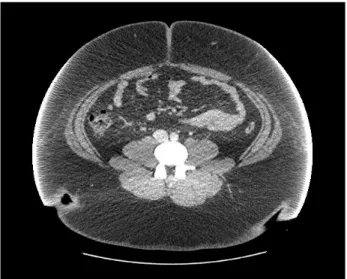
Fig. 3. The position of the ports : the first trocar was inserted with zero degree laparoscope. Four other trocars were inserted with 30-degree laparoscope. The stomach was stapled up to the His angle and two additional ports were inserted to make optimal Fig. 1. Preoperative abdominal CT showed severe obesity with
visceral to subcutaneous fat ratio of 0.16.
evaluation. At 1 year of age, he weighed 18 kg and over 100 kg at 12 years of age. Before admission, we restricted him eating energy dense snacks and he has little decrease in body weight from 223 kg to 220 kg. He had no other underlying disease and was not on any medications. He had no symptoms of cardiac, hepatic or renal disease and he had no family history of diabetes mellitus, vascular disease, or cancer. He was consulted to the department of cardio- logy, neuropsychiatry and anesthesiology. Metabolic, neu- rologic and psychological evaluations including eating disorders, mood, psychosis, substance abuse, and family environment were performed, and the results showed no
abnormalities. Physical examination revealed no evidence of cardiac, pulmonary, renal or hepatic disease. He had acanthosis nigricans on his axillae and neck. His pre- operative laboratory data showed no abnormal findings.
Electrocardiogram showed normal sinus rhythm. Brain MRI was performed to evaluate whether he has brain lesion causing obesity and it showed a structurally normal pituitary, sella and hypothalamus. Esophagogastroduo- denoscopy showed only chronic gastritis. Abdominal CT revealed severe obesity with visceral to subcutaneous fat ratio of 0.16 (Fig. 1, V/S ratio=visceral fat/subcutaneous fat).
On 20th June, 2012, the patient received a LSG. The patient was placed in a 30o reverse Trendelenburg position under general anesthesia following endotracheal intu- bation (Fig. 2). An arterial line was placed using ultraso- nography because of thick subcutaneous fat that inter- rupted palpation of his arterial pulse. For the insertion of urinary catheter, an assistant was needed to find urethra orifice because his penis was buried under excess skin and fat. For a safe entry into the abdominal cavity in this super
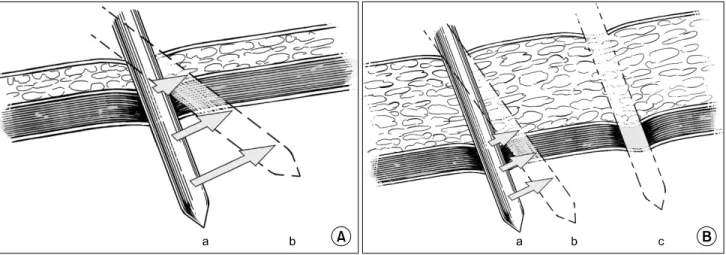
Fig. 4. (A) Laparoscopic trocar insertion in non-obese patient a. The operator could shift the position of trocar tip b with either pushing or pulling the handle of trocars. (B) Laparoscopic trocar insertion in super-obese patient a. Trocar tip movement is restricted b by thick subcutaneous tissue, compared to non-obese patient. With additional port c laparoscopic instrument could reach optimal site.
obese patient, the first trocar was inserted in the left upper quadrant, just below the costal margin, with a zero degree laparoscope (Fig. 3; port 1). Pneumoperitoneum was established with CO2. In general, peak pressure of 12 mmHg is enough to make sufficient inflation for laparo- scopic surgery, but in this case we had to raise peak pres- sure up to 15 mmHg for optimal operative field. After the pneumoperitoneum was made, the laparoscope was chang- ed to a 30o scope. Four other ports were placed (Fig. 3; port 2, 3, 4, 5). The greater curvature of the stomach was freed up to the His angle with the bipolar electrocautery (LigaSureTM COVIDIEN). A gastroscope was passed into the stomach in contact with the lesser curvature for bougi- nation. The stomach was stapled parallel to the gastrosco- pe using seven 60 mm staple loads (Endo GIATM COVIDIEN) starting 3 cm proximal to the pylorus and carried up to the His angle along the lesser curve. The thickness of his subcutaneous fat interrupted manipulation of the ports beyond a certain angle and safe tissue handling (Fig. 4A, B), therefore two additional ports were inserted to improve the angle of approach for graspers (Fig. 3; port 6, 7). The staple line was assessed for leaks with air insufflation and no leak was observed. The resected stomach was extracted from the peritoneal cavity via the RUQ port site extension.
A Jackson-Pratt drain was inserted around the staple-line of the gastric tube through the LUQ port site. After surgery, he was transferred to the intensive care unit to avoid the
possibility of an emergent re-intubation, he had a planned extubation on 1st postoperative day morning.
His post-operative hospital course was uneventful He started sips of water on 4th post-operative day, and he started a full liquid diet (energy 1,000 kcal, protein 90 g) on 5th post-operative day. The patient was discharged on 8th post-operative day without any complication. We recom- mended him to maintain a full liquid diet and proceed to a soft bland diet after two weeks. At 1 month follow-up, the patient was well and weighed 195.6 kg. At 12 month follow-up, he weighed 142.8 kg (BMI 47.6 kg/m2) with excess weight loss (EWL) of 54.5 % [EWL=100×Weight lost/(Initial weight - Ideal body weight)]. Laboratory studies show no signs of malnutrition or vitamin deficiency.
DISCUSSION
The number of patients with obesity and morbid obesity continues to increase and surgical intervention is becom- ing more important in obesity management. But anesthesia and surgery for these super-obese patients has many problems, especially large amount of abdominal fat which may make trocar or needle placement more cumbersome.
Therefore, we present our experience that would ease the management and improve outcomes of the morbidly obese patient presenting for bariatric surgery.
The initial entry into the peritoneal cavity was obtained
in the left subcostal region using a 12 mm bladeless optical trocar. In morbidly obese individuals, the umbilicus is often significantly displaced inferiorly and visualization of the His angle region - a critical point in LSG, is particularly poor. Using a 0 degree 10 mm scope inside the trocar, the port is placed in a stepwise and controlled fashion through the abdominal wall, providing direct visualization of the different planes of the abdominal wall that are being dissected. Left upper quadrant subcostal region is a safe location for this technique as the greater omentum reliably covers and protects any underlying viscera. This position also provides a direct view of the His angle region. In this patient, the excessively thick abdominal wall resulted in somewhat decreased tactile sensation of different layers being dissected during the trocar placement. We recom- mend the left subcostal area as the initial entry site in weight loss operations in morbidly or super obese patients.
(Fig. 3; port 1) (7)
In laparoscopic operation, the operator can normally shift the position of trocar tip by angulating trocars via graspers (Fig. 4A, B). But in this case, the patient was super obese with large amount of abdominal fat that disrupted to manipulate with the trocar. Therefore, we inserted two additional ports to staple the stomach up to the His angle (Fig. 3; port 6, 7). Manipulating the laparoscopic instru- ment may be hampered by thick subcutaneous tissue during laparoscopic operation, especially in super obese patient. And in that case, we want to emphasize that the operator should not hesitate to make additional trocar insertion for secure and smooth procedure.
A 9 mm gastroscope was placed during the gastric resection as a bougie, because it has advantages of flexi- bility which enables to introduce the pylorus easily and of direct visualization of the staple line to check the bleeding or leakage, compared to conventional bougie.
At 12 month follow-up, this patient showed EWL of 54.5% without any complications, such as malnutrition, vitamin deficiency or gastroesphageal reflux. Although the long term follow-up data is needed to assess the definite effectiveness of LSG, our data showed a good mid-term outcome of LSG in super-obese patient.
The patient in this case suffered from a morbid obesity
and weighed over 100 kg at 12 years old, he finally received LSG several years after being an adult. Current guidelines (8) suggest that to qualify for bariatric surgery among the pediatric population, a patient must be morbidly obese, as defined by a BMI of at least 40 with coexisting medical conditions or at least 50 otherwise; have reached physical maturity; have evidence of emotional and cognitive matu- rity; and have been unable to achieve weight loss with all other methods. These guidelines have been criticized as being too conservative, and the harm of waiting is greater than the benefit that could be achieved in patients who continue to gain weight and experience exacerbation of their comorbidities.(9) Inge et al.(4) proposed that bariatric surgery during adolescence, in individuals with childhood onset obesity, is a more effective treatment than delaying the surgery until adulthood. A recent meta-analysis(10) supported that bariatric surgery is a good solution for morbid obesity in adolescents, since patients seem to keep weight off and concomitant metabolic conditions resolve.
New criteria for surgical treatment of morbid obesity could be considered for morbidly obese adolescents, where the adolescent is physically incapacitated and socially and psychologically disadvantaged. Age or skeletal maturity should not be used to limit their opportunity for long-term weight loss and improvement in their quality of life through surgery.
REFERENCES
1. Lobstein T, Baur L, Uauy R; IASO International Obesity TaskForce.
Obesity in children and young people: a crisis in public health.
Obes Rev 2004;5(Suppl 1):4-104.
2. Sturm R. Increases in morbid obesity in the USA: 2000-2005.
Public Health 2007;121:492-496.
3. No JH, Kim Z, Kim YJ, Cho SW, Choi DH, Hur KY, Kim JJ. Initial experience of laparoscopic sleeve gastrectomy in morbidly obese patients. J Korean Surg Soc 2010;79:460-466.
4. Inge TH, Xanthakos SA, Zeller MH. Bariatric surgery for pediatric extreme obesity: now or later? Int J Obes (Lond) 2007;31:1-14.
5. Marceau P, Biron S, St Georges R, Duclos M, Potvin M, Bourque RA. Biliopancreatic diversion with gastrectomy as surgical treat- ment of morbid obesity. Obes Surg 1991;1:381-387.
6. Arias E, Martínez PR, Ka Ming Li V, Szomstein S, Rosenthal RJ.
Mid-term follow-up after sleeve gastrectomy as a final approach for morbid obesity. Obes Surg 2009;19:544-548.
7. Agarwala N, Liu CY. Safe entry techniques during laparoscopy:
view of 918 procedures. J Minim Invasive Gynecol 2005;12:
55-61.
8. August GP, Caprio S, Fennoy I, Freemark M, Kaufman FR, Lustig RH, Silverstein JH, Speiser PW, Styne DM, Montori VM. Endocrine Society. Prevention and treatment of pediatric obesity: an endo- crine society clinical practice guideline based on expert opinion.
J Clin Endocrinol Metab 2008;93:4576-4599.
9. Garcia VF, DeMaria EJ. Adolescent bariatric surgery: treatment delayed, treatment denied, a crisis invited. Obes Surg 2006;16:
1-4.
10. Treadwell JR, Sun F, Schoelles K. Systematic review and meta- analysis of bariatric surgery for pediatric obesity. Ann Surg 2008;248:763-776.