Received on November 23, 2016. Revised on December 9, 2016. Accepted on December 9, 2016 Correspondence to: Hyung Hoi Kim
Biomedical Research Institute, Pusan National Univestiy Hospital Clinical Trial Center (CTC), Department of Laboratory Medicine and BioMedical Informatics Unit Pusan National University School of Medicine, 1-10 Ami-dong, Seo-gu, Busan 49241, Korea
Tel: 82-51-240-7418, Fax: 82-51-247-6560, E-mail: [email protected]
This work was supported by a 2-year Research Grant of Pusan National University.
Vol. 27, No. 3, 237-246, December 2016
https://doi.org/10.17945/kjbt.2016.27.3.237
Original Article
단일 3차 병원에서 외상환자와 비-외상환자의 대량수혈 분석
김혜림1,2ㆍ유동원1,2ㆍ신경화1,2ㆍ이현지2,3ㆍ김형회1,2,4
부산대학교병원 진단검사의학과1, 부산대학교 의학전문대학원 진단검사의학교실2, 양산부산대학교병원 진단검사의학과3, 부산대학교병원 의생명연구원4
Analysis of Massive Transfusion for Trauma Patients and Non-Trauma Patients in a Tertiary Hospital
Hyerim Kim1,2, Dong-Won Yoo1,2, Kyung-Hwa Shin1,2, Hyun-Ji Lee2,3, Hyung Hoi Kim1,2,4
Department of Laboratory Medicine, Pusan National University Hospital1, Busan, Department of Laboratory Medicine, School of Medicine, Pusan National University2, Department of Laboratory Medicine, Pusan National University Yangsan Hospital3, Yangsan, Medical Research Institute, Pusan National University Hospital4, Busan, Korea
Background: Management of patients with massive hemorrhage often requires the massive blood transfusions. However, few studies have investigated the effects of massive transfusions on non-traumatic patients. Therefore, this study analyzed mortality and descriptive data for patients receiving massive transfusion, including non-trauma patients and trauma patients.
Methods: We reviewed a retrospective audit of massive transfusions to investigate the major causes, patient characteristics, ratio of the blood components, and the mortality of massively transfused patients. The analysis was performed using electronic medical records collected from January 2010 to December 2013. Patients who had received a massive transfusion (≥10 units of RBCs within 24-hours) were categorized into trauma and non-trauma patients. We calculated the ratio of blood components and investigated the relationship between ratio and mortality.
Descriptive statistics were used to characterize the patients and the indications.
Results: A total of 532 massive transfusions were performed, including 187 trauma and 345 non-trauma patients.
The overall mortality rate was 32.0%, encompassing 36.4% of the trauma patients and 29.6% of the non-trauma patients. The mortality in trauma patients was significantly reduced (P<0.001) within the first 48-hours compared with that in non-trauma patients, which was due to the high FFP: RBC ratio transfusion. The annual FFP: RBC ratio in trauma patients showed an increasing trend. Non-trauma patients showed no relationship between mortality and procedure indication/blood component ratio.
Conclusion: We report clinical data pertaining to massive transfusions. Annual increasing FFP: RBC ratio in trauma patients was associated with a decreasing mortality. Non-trauma patients showed heterogeneous charac- teristics and a lower FFP: RBC ratio than trauma patients. (Korean J Blood Transfus 2016;27:237-246) Key words: Massive hemorrhage, Massive transfusion, Trauma, Non-trauma, Mortality
Introduction
Massive hemorrhage is a significant challenge for all clinicians, and interdisciplinary therapeutic ap- proaches to their treatment must be decided within a limited time frame. Massive transfusion, which has historically been defined as the replacement of blood by the transfusion of 10 units of red blood cells (RBC) in 24 hours, had been conducted in cases of massive and uncontrolled hemorrhage.
In the 1970s, massive transfusion was associated with mortality rates of more than 90%, but advances in care have led to a dramatic decrease in mortality to 30%∼70%.1) Massive hemorrhage is a common complication in some clinical settings. In traumatic injury, hemorrhage is one of the leading causes of morbidity, and it is responsible for almost 50% and up to 80% of deaths occurring within 24 hours of injury and deaths during operation, respectively.
Moreover, cardiovascular procedures frequently re- sults in massive bleeding,2) and postpartum hemor- rhage events could occur after delivery.3) In these situations, supporting blood components while con- trolling massive hemorrhage is critical. However, the majority of literature has focused on massive trans- fusion due to traumatic hemorrhage, while there is little information available regarding massive trans- fusion in other situations.
There has been recent concern regarding the exce- ssive application of massive transfusion in non-trau- ma patients who do not ultimately require massive transfusion.4) However, there are virtually lack data available on massively transfused non-trauma patients.
To address the paucity of data regarding massive transfusion for non-trauma patients, we reviewed all
cases of massive transfusion, regardless of trauma relation. Specifically, we collected massive trans- fusion data regarding both trauma and non-trauma cases and evaluated the clinical characteristics of pa- tients in both groups. In addition, associations be- tween in-hospital mortality and baseline risk factors, procedural risk factors, and transfused blood compo- nent ratio were assessed.
Materials and Methods
1. Study design
This retrospective study was based on data ac- quired from a tertiary referral hospital that has 1,104 beds and used over 20,000 RBC units per year, from January 2010 to December 2013. Over 500 patients who were given ≥10 red blood cell units within 24 hours, including all massively transfused patients categorized as both trauma and non-trauma. We identified trauma patients as those with a potentially severe physical injury caused by an external source (falling, automobile crash, knife wound, etc.) that re- quired emergency medical intervention to prevent loss of life or limb or substantial, permanent phys- ical impairment. Non-trauma patients were identi- fied as those who suffered moderate or minor in- juries, as well as heart attacks, strokes, other internal conditions such as chronic infectious diseases or sur- gical procedures.
2. TASH scoring system
The Trauma-Associated Severe Hemorrhage (TASH) score is recognized as an easy-to-calculate and valid scoring system to predict an individual’s probability
Fig. 1. The number of patients for each trauma or FFP: RBC ratio subgroup. The patients who received at least a ratio of 1:1.0 were categorized as the high ratio group and other patients who received a trans- fusion ratio of 1:1.0 or less were categorized as a low ratio group.
Abbreviations: RBC, red blood cells; FFP, fresh frozen plasma.
for massive transfusion and thus ongoing life-threat- ening hemorrhage at a very early stage after severe injury. The TASH scoring system uses seven in- dependent variables to identify patients who will re- quire a massive transfusion.5) These include blood pressure, gender, hemoglobin, focused abdominal sonography for trauma, pulse, base excess, and ex- tremity or pelvic fractures and are weighted. Overall, 16 scores need to be summed to calculate the total score with a possible range of scores from 0 to 23.
Recently, a threshold of 18 points as cut off, which corresponded to a 50% probability of massive trans- fusion in trauma patients.6)
3. Ratio of transfused blood compo- nents
Each transfusion requirement for fresh frozen plas- ma (FFP), platelets (PLT) and RBCs in the massive transfusion were used to determine the FFP: RBC or PLT: RBC ratio. As this was a continuous varia- ble, a specific cut point was required to categorize patients into the comparison groups. Those patients who received at least a ratio of 1:1.0 were catego- rized as the high ratio group. Patients who received a transfusion ratio of 1:1.0 or less were categorized as the low ratio group.
4. Surgical procedure categorization
The surgical procedure is a reliable predictor of massive transfusion and mortality; thus, it was im- portant to adjust for this variable when assessing the relationship between massive transfusion and out- come. We categorized patient procedures based on 231 clinically meaningful categories by using the clinical classification software (CCS) procedures for
ICD-9-CM developed by the Agency for Healthcare Research and Quality.7) We then aggregated the identified CCS categories into one of the following 16 procedure categories: nervous, endocrine, eye, ear, nose, respiratory, cardiovascular, hemic and lymphatic, digestive, urinary, male genital, female genital, obstetrical, musculoskeletal, integumentary, and miscellaneous procedures. Since some of the 16 procedure categories of the patients had low fre- quencies (n<8), we combined them into a single group in this study to simplify the table.
5. Statistical methods
For each of the outcomes, the proportion of patients
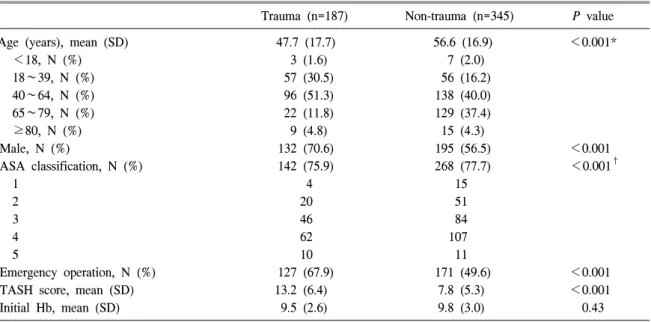
Table 1. Characteristics in massively transfused episodes (n=532)
Trauma (n=187) Non-trauma (n=345) P value
Age (years), mean (SD) 47.7 (17.7) 56.6 (16.9) <0.001*
<18, N (%) 3 (1.6) 7 (2.0)
18∼39, N (%) 57 (30.5) 56 (16.2)
40∼64, N (%) 96 (51.3) 138 (40.0)
65∼79, N (%) 22 (11.8) 129 (37.4)
≥80, N (%) 9 (4.8) 15 (4.3)
Male, N (%) 132 (70.6) 195 (56.5) <0.001
ASA classification, N (%) 142 (75.9) 268 (77.7) <0.001†
1 4 15
2 20 51
3 46 84
4 62 107
5 10 11
Emergency operation, N (%) 127 (67.9) 171 (49.6) <0.001
TASH score, mean (SD) 13.2 (6.4) 7.8 (5.3) <0.001
Initial Hb, mean (SD) 9.5 (2.6) 9.8 (3.0) 0.43
*P values based on the Mann-Whitney test; †P values based on one way ANOVA.
Abbreviations: SD, standard deviation; ASA, american society of anesthesiologists; TASH, trauma-associated severe hemorrhage score; Hb, hemoglobin.
experiencing the outcome and its associated 95% bi- nomial exact confidence interval (CI) were esti- mated. A two-sided P value of <0.05 was consid- ered to be statistically significant. Continuous, nor- mally distributed data were reported as the means (standard deviation [SD]). The univariate association between RBC usage, FFP or PLT to RBC ratio and mortality was performed using the chi-square test, while the Mann-Whitney U or ANOVA was used to identify differences between ranked ordinal data.
Statistical analysis was performed using the Statisti- cal Package for Social Sciences version 22.0 (SPSS Inc., Chicago, IL, USA).
Results
From 2010 to 2013, 499 patients received a total of 532 episodes of massive transfusion totaling 23,741 blood components. The mean age was 53.5 years, and the study population consisted of 322 men and 177 women. The overall in-hospital mortality was 32.0% and the 48 hr-mortality was 11.9%. Cases were divided into several subgroups, including trau- ma, death, and FFP: RBC ratio (Fig. 1). Each graph is divided into death and survivor patients, and each cell shows the number of patients.
1. Demographics of massively trans- fused patients
Among 532 massive transfusion cases, 187 (35.2%) were due to traumatic injuries and 345 (64.8%) were due to non-traumatic indications. Baseline demogra- phic data comparing trauma with non-trauma in the massive transfusion group are presented in Table 1.
Statistical analysis of age, gender, anesthesia level, elective or emergency operation, TASH score, and initial hemoglobin (Hb) level was conducted. There were differences between groups, with the trauma group having a relatively younger age, higher male portion, more frequent emergent operations, and higher TASH score. A total 409 operations were conducted, 298 of which were conducted as emerge- ncies. Based on the American Society of Anesthe- siologists (ASA) physical status, 50.7% (72 of 142) of the trauma and 44.0% (118 of 268) in non-trauma for whom general anesthesia was implicated were greater than class four. General anesthesia was per- formed more frequently in the trauma group (P<0.001), possibly because more patients in the non-trauma group were too sick to undergo surgery.
2. Mortality and blood usage between trauma and non-trauma groups
There was no difference in overall mortality be- tween the trauma and non-trauma groups; however, a difference in early mortality existed between the two groups. Specifically, the mortality within 12 hours in trauma patients (17.8%) was higher than that in non-trauma patients (9.2%), which was sim- ilar to the 2 day mortality of massively transfused
patients (P<0.001). The number of RBC transfu- Table 2. Mean units and ratios of transfused products and mortality in trauma and non-trauma patients MortalityRBC (units)FFP/RBC ratioPLT/RBC ratio TraumaNon-trauma P valueTraumaNon-traumaTraumaNon-traumaTraumaNon-trauma N (%)N (%) Total18734520.216.70.740.590.610.77 Survivor119243 17.716.10.750.580.670.81 †12 hr mortality34 (17.8)32 (9.2)<0.00123.719.30.750.580.310.32 † 48 hr mortality47 (24.6)64 (18.5)<0.00126.619.00.740.60.40.44 † In-hospital mortality*68 (36.4)102 (29.6)0.11924.418.10.710.630.510.67 201021/57 (36.8)21/115 (18.3)18.116.20.620.490.470.58 201120/44 (45.5)19/73 (26.0)20.918.80.720.570.770.77 201215/37 (40.5)30/86 (34.9)22.816.90.830.700.650.94 201312/39 (24.5)32/71 (45.1)19.915.20.820.640.600.87 ‡‡‡‡‡‡ P value0.2340.2620.1720.0540.5560.724 † *Mortality indicates number of expired patients/number of massively transfused patients (%); P value determined by a chi-squared test of mortality between trauma ‡ and non-trauma patients; P value based on chi-squared tests of survivor and non-survivor between trauma subgroups using trauma-weight cases. Abbreviations: RBC, red blood cell; FFP, fresh frozen plasma; PLT, platelet; hr, hour.
Fig. 2. Annual mortality (A) and FFP: RBC ratio (B) for early (within 2 days) mortality. (A) Mortality of trauma patients was higher than that of non-traumatic patient, except for 2013. (B) Annual FFP:RBC ratio in trauma patients showed an increasing trend.
Abbreviations: See Fig. 1 for FFP, RBC and T_12h_M, 12 hours-mortality of trauma; N_12h_M, 12 hours- mortality of non-trauma; T_48h_M, 48 hours-mortality of trauma; N_48h_M, 48 hours-mortality of non-trauma;
T_12h_FR, FFP:RBC ratio of trauma patients who died within 12 hours; N_12h_FR, FFP:RBC ratio of non-trauma patients who died within 12 hours; T_48h_FR, FFP:RBC ratio of trauma patients who died within 48 hours; N_48h_FR, FFP:RBC ratio of non-trauma patients who died within 48 hours.
sions in patients who expired in admission (20.6 [12.9]) was univariably greater than in patients who survived (16.7 [8.5], P<0.001).
Comparison of trauma patients and non-trauma patients revealed a difference in transfused RBC units, with an average of 20.2 units being observed in trauma- and 16.7 units in non-trauma patients (Table 2). Massively transfused trauma patients re- ceived FFP: RBC and PLT: RBC at 0.74:1 and 0.61:1, respectively. Although the appropriate prod- uct ratio for non-trauma patients is unclear, our transfusion ratio is similar to the protocol goal of 1:1:1 (FFP: RBC: PLT), which was developed based on data pertaining to trauma patients.8) We didn’t faithfully carry out the guidance, even though better ratio was shown in trauma patients.
3. Mortality with FFP: RBC ratio in trauma patients
The trend of early mortality in trauma patients has decreased since 2012; however, the FFP: RBC ratio has increased with time (Fig. 2). There were no dif- ferences in the annual mean TASH score in the trau- ma and non-trauma groups (9.29 [6.4], P>0.05).
According to the blood component ratio, two groups, a low and high ratio, were similar in age, gender, and overall mortality, but trauma sustained, mean TASH score, and average RBC usage was different (data not shown). Although no statistical differences in mortality were observed between those who re- ceived a high FFP: RBC ratio versus those who had a low FFP: RBC ratio, the group with the high FFP:
Table 3. Blood transfusion requirements according to disease categories (n=532)
Procedure Total patients Trauma patients RBC FFP/RBC
ratio
PLT/RBC ratio N Mortality (%) N Mortality (%) Mean units
Cardiovascular 224 32.1 34 29.4 17.3 0.57 0.87
Musculoskeletal 94 10.6 53 13.2 16.5 0.62 0.57
Digestive 63 41.3 33 45.5 23.6 0.74 0.65
Obstetrical 31 3.2 3 0.0 21.0 0.78 0.74
Thoracic 23 43.5 16 50.0 22.6 0.78 0.58
Nervous 21 47.6 19 52.6 15.0 0.70 0.58
Others* 18 5.6 7 0.0 17.2 0.73 0.52
Non-procedure 58 69.0 22 81.8 14.3 0.68 0.58
*A group of orthopedics, neurosurgery, urology, otolaryngology, plastics, and gynecology.
Abbreviations: RBC, red blood cell; FFP, fresh frozen plasma; PLT, platelet.
RBC ratio had a reduced blood transfusion require- ment (P<0.001). Moreover, the high FFP: RBC ra- tio group had low average RBC usage instead of a high mean TASH score.
4. Blood transfusion requirement ac- cording to surgical procedure ca- tegories
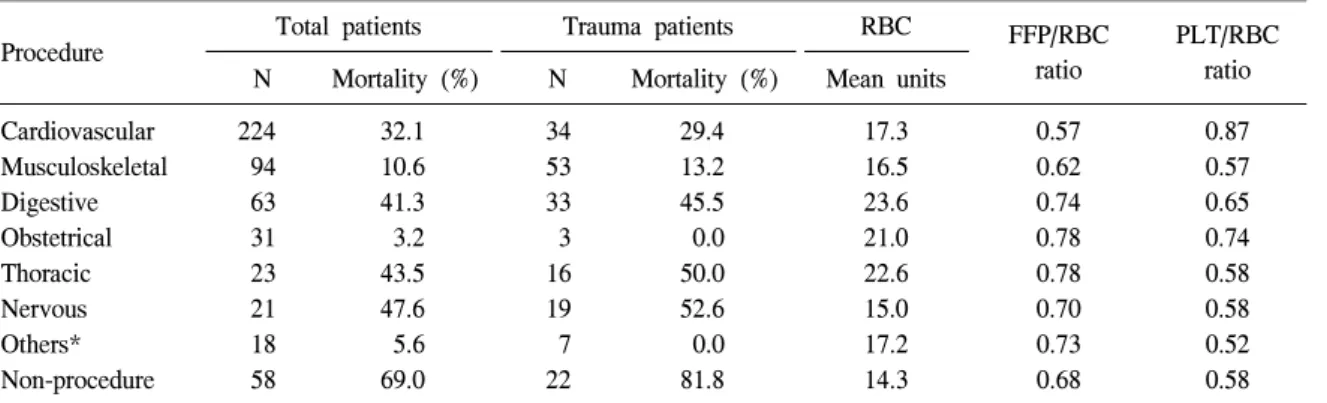
According to CCS categories, the individual diag- nostic categories were 42.1% of cardiovascular pro- cedures, 17.7% of musculoskeletal operations, 11.8%
of gastrointestinal operations, and 5.8% of obstetri- cal complications. The cardiovascular procedural category included many non-trauma cases (84.8%) and the mean age was older than that of trauma patients. The significant high mortality in several categories disappeared after a partial correlation con- trolling for age. The categories with a lower pro- portion (below 50%) of traumatic patients showed higher mortality than traumatic patients, except for the non-procedure category (Table 3). These results
could be explained by a large proportion of the cate- gories showing high mortality.
Discussion
As massive hemorrhage is a highly emergent sit- uation that can be life-threatening, many patients who received massive transfusion sustained an over- all mortality rate of 32.0%. Mortality rate ranged was lowest (3.2%) for the obstetrical procedure and highest (69.0%) for patients with severe illnesses that could not undergo surgery. Previous studies of massive blood transfusions have mostly been based on trauma patients. For example, there are several clinical scoring systems that can predict the im- plications of receiving a massive blood transfusion in trauma patients, or known risk factors for prog- nosis such as the FFP:RBC ratio or sex.1,5,8) However, other large numbers of massively transfused patients are admitted due to massive non-traumatic hemo- rrhage.3,9) Therefore, there are clinical limitations to
applying massive transfusion scoring systems such as the TASH score to non-trauma patients. In this study, the results showed a surprisingly low TASH score in both trauma and non-trauma patients, with a mean (SD) 13.2 (6.4) in trauma patients and 7.8 (5.3) in non-trauma patients. These discrepancies in- dicate that the predictive scoring system could not be utilized in our clinical situation. According to the TASH score definition, our patients may have re- ceived over-activation of massive transfusion, espe- cially non-trauma patients. TASH score is selec- tively studied in some trauma cases, and the above definition may not reflect the acute resuscitative phase of treatment or non-trauma cases appropri- ately.5,6) The relationship between blood loss and ad- ministered blood volume will be most direct for a large number of RBC units. Use of the blood com- ponent during massive transfusion in the expired group was significantly higher than in the survivor group. This might be explained by survivors sustain- ing relatively mild blood loss relative to expired pa- tients (data not shown, P<0.001).
Although most patients were massively transfused with a low FFP: RBC ratio and low PLT: RBC ratio, there was no significant difference between blood component ratio and mortality, which is contrary to the results of previous studies.10) Unexpectedly, non-trauma patients showed low FFP: RBC ratio and an even higher mean age than trauma patients.
Overall usage of blood components during massive transfusion in the high FFP: RBC ratio group was significantly lower than in the low FFP: RBC ratio group. The hospital blood bank and physician hy- pothesized that a fixed blood component ratio would help reduce utilization of the overall blood com-
ponent. For our trauma department, education re- garding the implications of using a 1:1:1 ratio in massive transfusion started to improve the mortality of massively transfused patients from 2011.8) Thereby, we report a trend of decreasing mortality in trauma patients although non-trauma patients do not have company with inconstant policies on FFP: RBC ratio for non-trauma patients. These findings are supported by those of previous clinical studies that have pro- vided evidence that a higher ratio of FFP: RBC is associated with an improved outcome.11)
The results of this study demonstrate the impor- tance of education regarding a high ratio of FFP:
RBC in the case of massive transfusion. Further- more, efficient massive transfusion protocols must be established to control problems that occur in mas- sive transfusions such as inconstant blood usage or component ratio, regardless of disease categories or trauma. Some known massive transfusion protocols have confirmed that the use of massive transfusion protocol is directly correlated with improved mortal- ity and reduced number of complications in clin- ically injured patients who receive Rh-O pack RBC and subsequent laboratory tests.12-14) The first goal of the protocol is to improve mortality and reduce blood usage by establishing appropriate implication timing of massive transfusion.
In future studies, we will evaluate the implications of a standardized massive transfusion protocol in our hospital. After several years, we hope to report the appropriations and usefulness of a massive trans- fusion protocol in a tertiary referral hospital.15)
요 약
배경: 대량출혈 환자의 처치시 대량수혈을 필 요로 하는 경우가 종종 있다. 하지만 외상환자에 비해 비-외상환자의 대량수혈 연구는 드물게 보 고되어 있다. 본 연구에서는 대량수혈을 받은 비- 외상환자와 외상환자를 포함하여 사망률과 설명 적 데이터를 분석하였다.
방법: 대량수혈을 받은 환자들의 주요 원인, 환 자 특성, 혈액제제비 및 사망률 등을 살펴보기 위 해 후향적으로 대량수혈 사례를 검토했다. 2010년 1월부터 2013년 12월까지의 전자의무기록을 이 용하였다. 대량수혈(24시간 내에 ≥10단위 적혈 구제제 수혈) 환자를 외상환자와 비-외상환자로 분류하였다. 혈액제제비를 구하고, 비와 사망률의 상관관계를 확인하였다. 환자 특성과 대량수혈의 적응증에 대해서는 기술적 통계를 사용하였다.
결과: 총 532건의 대량수혈을 수행하였고, 이는 187건의 외상환자와 345건의 비-외상환자로 구분 되었다. 전체 사망률은 32.0%였고, 외상환자군은 36.4%, 비-외상환자에서는 29.6%의 사망률을 보 였다. 외상환자군에서 높은 신선동결혈장:적혈구 비로 수혈 받은 환자의 48시간 이내 사망률이 유 의하게 낮았으며, 연간 신선동결혈장:적혈구 비 는 증가하는 경향을 보였다. 비-외상환자군은 혈 액제제비나 적응증이 사망률과 상관관계를 보이 지 않았다.
결론: 외상환자군에서 연간 경향을 보면 신선 동결혈장:적혈구 비가 증가하면서 외상환자의 사 망률이 감소하는 경향을 보였다. 비-외상환자군 은 이질성을 보이며 외상환자군에 비해 낮은 신선 동결혈장:적혈구 비를 보였다.
References
1. Kauvar DS, Lefering R, Wade CE. Impact of hemorrhage on trauma outcome: an overview of epidemiology, clinical presentations, and the- rapeutic considerations. J Trauma 2006;60(S):s3-11 2. Rose AH, Kotzé A, Doolan D, Norfolk DR, Bellamy MC. Massive transfusion--evaluation of current clinical practice and outcome in two large teaching hospital trusts in Northern England. Vox Sang 2009;97:247-53
3. Burtelow M, Riley E, Druzin M, Fontaine M, Viele M, Goodnough LT. How we treat: mana- gement of life-threatening primary postpartum hemorrhage with a standardized massive tran- sfusion protocol. Transfusion 2007;47:1564-72 4. Pepe PE, Potkin RT, Reus DH, Hudson LD,
Carrico CJ. Clinical predictors of the adult respiratory distress syndrome. Am J Surg 1982;144:124-30
5. Yücel N, Lefering R, Maegele M, Vorweg M, Tjardes T, Ruchholtz S, et al. Trauma Asso- ciated Severe Hemorrhage (TASH)-Score: pro- bability of mass transfusion as surrogate for life threatening hemorrhage after multiple tra- uma. J Trauma 2006;60:1228-36; discussion 1236-7 6. Maegele M, Lefering R, Wafaisade A, Theo- dorou P, Wutzler S, Fischer P, et al. Reva- lidation and update of the TASH-Score: a scoring system to predict the probability for massive transfusion as a surrogate for life-th- reatening haemorrhage after severe injury. Vox Sang 2011;100:231-8
7. Rockville, MD. Hcup ccs homepage on Agency for Healthcare Research and Quality. Heal- thcare Cost and Utilization Project (HCUP).
http://www.hcup-us.ahrq.gov/toolssoftware/
ccs/ccs.jsp [Online] (last visited on 15 November 2016).
8. Borgman MA, Spinella PC, Perkins JG, Gra- thwohl KW, Repine T, Beekley AC, et al. The ratio of blood products transfused affects mo- rtality in patients receiving massive transfusions at a combat support hospital. J Trauma 2007;
63:805-13
9. You KY, Kim JY, Choi SH, Yoon YH, Lim CS, Park SM. Prediction of massive blood trans- fusion at emergency department in non-trauma patients. Korean J Blood Transfus 2013;24:275-85 10. Sperry JL, Ochoa JB, Gunn SR, Alarcon LH,
Minei JP, Cuschieri J, et al. An FFP:PRBC transfusion ratio >/=1:1.5 is associated with a lower risk of mortality after massive trans- fusion. J Trauma 2008;65:986-93
11. Choi GR, Choi SJ, Kim S, Kim HO. An ana- lytical study for cases associated with massive blood transfusion at a tertiary referral hospital.
Korean J Blood Transfus 2014;25:123-31 12. Young PP, Cotton BA, Goodnough LT. Massive
transfusion protocols for patients with substa- ntial hemorrhage. Transfus Med Rev 2011;25:
293-303
13. Sinha R, Roxby D, Bersten A. Experience with a massive transfusion protocol in the manage- ment of massive haemorrhage. Transfus Med 2013;23:108-13
14. Horst J, Leonard JC, Vogel A, Jacobs R, Spinella PC. A survey of US and Canadian hospitals' paediatric massive transfusion protocol policies.
Transfus Med 2016;26:49-56
15. Lee HT, Park PW, Seo YH, Ahn JY, Seo JY, Jeong JH, et al. Massive transfusion protocols for pediatric patients. Lab Med Online 2016;
6:60-3