© Copyright The Korean Academy of Asthma, Allergy and Clinical Immunology • The Korean Academy of Pediatric Allergy and Respiratory Disease
278 http://e-aair.org INTRODUCTION
Levodropropizine is commonly used as an antitussive drug for acute and chronic cough.1 It is a non-opioid agent with pe- ripheral antitussive action via the modulation of sensory neu- ropeptide levels in the respiratory tract.2 Thus, levodropropi- zine has fewer sedative effects and a more tolerable profile than opioid antitussives. Common adverse effects of levodropropi- zine are somnolence, vomiting, epigastric pain, and diarrhea.3 Here, we report on 3 cases of levodropropizine-induced ana- phylaxis and reviewed levodropropizine-induced adverse drug reactions (ADRs) using Korea’s national wide pharmacovigi- lance data from January 2011 to June 2015.
CASE REPORT
The first case was a 67-year-old male referred to the emergen- cy department due to anaphylaxis after taking cough suppres- sants, including acetaminophen, pseudoephedrine, theobro- mine, and levodropropizine. On arrival, he was unconscious and his blood pressure was 60/40 mmHg. He received emer- gency care for anaphylaxis and recovered. To identify the cul-
prit drug, an allergic workup was performed in the outpatient clinic 2 weeks later. The results of skin prick tests (SPTs) using the drugs administered were negative, except for levodropropi- zine. SPTs performed using levodropropizine diluents induced a positive reaction (allergen/histamine [A/H] ratio of 3+ at 1 mg/mL). The second case was a 40-year-old female transferred to our hospital for the emergency management of anaphylaxis.
She experienced loss of consciousness within 10 minutes after taking cold medications, including amoxicillin/clavulanic acid, mosapride, acetaminophen, and levodropropizine. She had had a similar experience 3 years earlier after taking cold medi- cations. The results of serum-specific immunoglobulin E (IgE) to amoxicilloyl and SPTs using amoxicillin diluents were nega- tive. Thus, we planned oral provocation tests (OPTs) to identify
Levodropropizine-Induced Anaphylaxis: Case Series and Literature Review
Jae-Won Song,
1Young-Sook Jang,
1Moon-Chan Jung,
1Joo-Hee Kim,
1* Jeong-Hee Choi,
2Sunghoon Park,
1Yong Il Hwang,
1Seung Hun Jang,
1Ki-Suck Jung
11 Division of Pulmonary, Allergy, and Critical Care Medicine, Department of Medicine, Hallym University Sacred Heart Hospital, Hallym University College of Medicine, Anyang, Korea
2 Division of Pulmonary, Allergy, and Critical Care Medicine, Department of Medicine, Hallym University Dongtan Sacred Heart Hospital, Hallym University College of Medicine, Hwaseong, Korea
This is an Open Access article distributed under the terms of the Creative Commons Attribution Non-Commercial License (http://creativecommons.org/licenses/by-nc/4.0/) which permits unrestricted non-commercial use, distribution, and reproduction in any medium, provided the original work is properly cited.
Levodropropizine is commonly used as an antitussive drug for acute and chronic cough. It is a non-opioid agent with peripheral antitussive action via the modulation of sensory neuropeptide levels in the airways. Thus, levodropropizine has a more tolerable profile than opioid antitussives. However, we experienced 3 cases of levodropropizine-induced anaphylaxis. Three patients commonly presented with generalized urticaria, dyspnea, and col- lapse after taking cold medication including levodropropizine. To find out the culprit drug, we performed skin tests, oral provocation tests (OPTs), and basophil activation tests (BATs). Two patients were confirmed as having levodropropizine-induced anaphylaxis by OPTs, and one of them showed positive to skin prick tests (SPTs). The other patient was confirmed by skin tests and BATs. When we analyzed pharmacovigilance data related to le- vodropropizine collected for 5 years, most cases (78.9%) had allergic reactions, such as rash, urticaria, angioedema, and anaphylaxis. Therefore, physicians should consider that levodropropizine can be a culprit drug, when anaphylaxis occurs after taking anti-cough or common cold medication.
Key Words: Anaphylaxis; antitussive agents; drug-related side effects and adverse reactions
Correspondence to: Joo-Hee Kim, MD, Division of Pulmonary, Allergy, and Critical Care Medicine, Department of Medicine, Hallym University Sacred Heart Hospital, Hallym University College of Medicine, 22 Gwanpyeong-ro 170-beon-gil, Dongan-gu, Anyang 14068, Korea.
Tel: +82-31-380-3719; Fax: +82-31-380-3973; E-mail: [email protected] Received: June 22, 2016; Revised: October 17, 2016; Accepted: October 23, 2016
•There are no financial or other issues that might lead to conflict of interest.
Letter to the Editor
Allergy Asthma Immunol Res. 2017 May;9(3):278-280.
https://doi.org/10.4168/aair.2017.9.3.278 pISSN 2092-7355 • eISSN 2092-7363
Three Cases of Levodropropizine-Induced Anaphylaxis
Allergy Asthma Immunol Res. 2017 May;9(3):278-280. https://doi.org/10.4168/aair.2017.9.3.278 AAIR
http://e-aair.org 279 the culprit drugs in these 2 patients, and the results of OPTs us-
ing the administered drugs (acetaminophen, pseudoephed- rine, and theobromine in patient 1; amoxicillin/clavulanic acid, mosapride, and acetaminophen in patient 2) were negative.
However, after taking 30 mg of levodropropizine, both patients showed generalized urticaria, itching, and dyspnea within 30 minutes. The third case was a 22-year-old female who visited the outpatient clinic for a workup of past anaphylaxis events.
When she was 10 years old, she experienced generalized urti- caria, angioedema, mild dyspnea, and faintness 15-20 minutes after taking cold medications, including deoxyribonuclease, ac- etaminophen, cetirizine, pseudoephedrine, ambroxol, cefaclor, and levodropropizine. She experienced 2 similar events. Acet- aminophen and levodropropizine were commonly included in the previous 3 events. We performed SPTs and intradermal tests (IDTs) with acetaminophen, levodropropizine, and cefa- clor. The results of SPTs and IDTs for cefaclor and acetamino- phen as well as specific IgE to cefaclor were all negative. How- ever, the IDT using levodropropizine induced a positive re- sponse (A/H ratio of 3+ at 0.1 mg/mL). To confirm the diagno- sis of anaphylaxis due to levodropropizine, we planned BATs instead of OPTs, according to the previously described meth- od.4 We found a significant up-regulation of CD63 expression after stimulation with levodropropizine (Figure). The OPTs were negative for cefaclor and acetaminophen in this patient.
Based on the SPT and BAT results, we confirmed levodropropi- zine-induced anaphylaxis.
Levodropropizine-induced ADRs using pharmacovigilance data Pharmacovigilance data about levodropropizine were collect- ed from the Korea Institute of Drug Safety-Korea Adverse Event Reporting System (KIDS-KAERS) database of the Korea Insti-
tute of Drug Safety and Risk Management (Ministry of Food and Drug Safety) for 5 years (January 2011-June 2015). ADRs that were classified as certain or probable/likely were selected, and patients taking levodropropizine as a concomitant drug were excluded from the analysis. There were 162 ADR reports (from 102 persons) related to levodropropizine. A total of 38 re- ports (25 persons) considered having causal relationships were chosen for analysis (Table 1). The median age was 48.5 years (range 0-67 years), and 40.0% of the patients were male. The most common ADR was rash (26.3%), followed by urticaria (23.7%), angioedema (13.2%), rash acneform (7.9%), and ana- phylaxis (5.3%). Non-immunologic reactions such as neuropa- thy, headache, and palmar-plantar erythrodysesthesia, were also reported.
DISCUSSION
Levodropropizine is a frequently used antitussive drug be- Table 1. Clinical manifestations of ADRs to levodropropizine in KIDS-KAERS
Characteristics Value
Age (yr), median (IQR) 48.5 (31.2-52.0)
M:F 10:15
Reporting personnel
Doctors 17 (44.7)
Nurses 7 (18.4)
Pharmacists 7 (18.4)
Not identified 7 (18.4)
WHO-UMC causality assessment
Certain 14 (36.8)
Probable/likely 24 (63.2)
Serious adverse reactions 3 (7.8)
Challenge results reproduced 2 (5.2)
Clinical manifestation
Abdominal pain 1 (2.6)
Anaphylaxis 2 (5.3)
Angioedema 5 (13.2)
Headache 1 (2.6)
Heartburn 1 (2.6)
Itching 1 (2.6)
Nausea 1 (2.6)
Neuropathy 1 (2.6)
Neuropathy peripheral 1 (2.6)
Palmar-plantar erythrodysanesthesia 1 (2.6)
Rash 10 (26.3)
Rash acneform 3 (7.9)
Urticaria 9 (23.7)
Vomiting 1 (2.6)
Values are presented as number (%).
ADR, adverse drug reactions; KIDS-KAERS, Korea Institute of Drug Safety-Ko- rea Adverse Event Reporting System; IQR, interquartile range; M, male; F, fe- male; WHO-UMC, World Health Organization-Uppsala Monitoring Center.
Figure. Expression of CD63 on basophils induced by levodropropizine in the pa- tient and controls. Controls consisted of 1 atopic and 1 non-atopic individuals.
SI indicates stimulation index (percentage of basophils activated by the drug di- vided by the percentage of activated basophils in the negative controls). SI, stimulation index (percentage of basophils activated by the drug divided by the percentage of activated basophils in the negative controls).
CD63 (SI)
10-7 10-5 10-3 10-1 100 Levodropropizine (mg/mL)
4.0 3.5 3.0 2.5 2.0 1.5 1.0 0.5 0
Patient 3 Atopic control Non atopic control
Song et al.
Allergy Asthma Immunol Res. 2017 May;9(3):278-280. https://doi.org/10.4168/aair.2017.9.3.278 Volume 9, Number 3, May 2017
280 http://e-aair.org
cause it has fewer side effects than centrally acting opioid anti- tussives. However, we experienced 3 cases of anaphylaxis caused by levodropropizine.
Pharmacovigilance data related to levodropropizine showed that ADRs occurred in young age. Rash or urticaria developed in infants and a 7-year-old child. Most cases were immunologi- cal drug adverse reactions. Cutaneous manifestation was most common. IgE-mediated reactions, such as urticaria, angioede- ma, and anaphylaxis, accounted for 44.7% in all cases. The da- tabase was a self-reported system that may have underestimat- ed the true incidence of ADRs caused by this drug. Although we could not estimate the incidence of levodropropizine-induced allergic reactions, these reactions may happen not infrequently and physicians pay attention to allergic reactions to levodro- propizine in all ages.
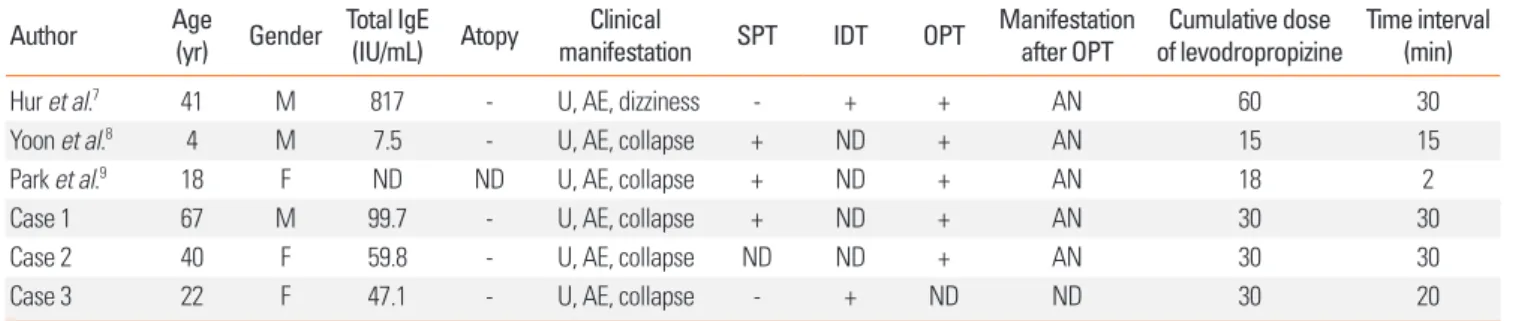
The mechanism of levodropropizine-induced allergic reac- tions has not been fully evaluated; however, because it is a small molecule, it may be conjugated to a carrier protein, in- ducing an IgE immune response.5 Two of the cases described here showed positive SPT or IDT responses, suggesting IgE- mediated reactions. Moreover, in the third case, BATs showed significant up-regulation of the basophil activation marker, CD63 after stimulation with levodropropizine in a dose-depen- dent manner. In our cases, patients experienced moderate to severe degree of anaphylaxis caused by levodropropizine,6 and literature review shows additional 3 cases of anaphylaxis (Table 2).7-9 The mechanism of severe anaphylaxis development after levodropropizine ingestion has not been determined; however, an IgE-mediated reaction, as well as direct basophil or mast cell activation, may be involved.
Levodropropizine is frequently co-prescribed with NSAIDs or antibiotics in respiratory tract infections, as in our cases.
NSAIDs and antibiotics are well-known drugs to cause allergic reactions commonly. Therefore, in previous cases,7-9 identifica- tion of the culprit drug was confirmed through open-label OPTs to exclude NSAIDs or antibiotics with having a risk of elic- iting an anaphylaxis. However, in most reported cases, IDTs showed positive reactions, suggesting that skin tests could be a reliable method. Moreover, in our third case, we confirmed the
identification of culprit drug using BATs without performing potentially dangerous drug challenge tests.
In conclusion, we reported on 3 cases of anaphylaxis due to levodropropizine, which were confirmed by SPTs, OPTs, and BATs. Clinicians should keep in mind that levodropropizine can be a culprit drug when anaphylaxis occurs after taking anti- cough or common cold medication.
ACKNOWLEDGMENTS
This research was supported by a grant from the Ministry of Food and Drug Safety to operation of the regional pharmaco- vigilance center in 2016.
REFERENCES
1. De Blasio F, Virchow JC, Polverino M, Zanasi A, Behrakis PK, Kilinç G, et al. Cough management: a practical approach. Cough 2011;7:7.
2. Zanasi A, Lanata L, Fontana G, Saibene F, Dicpinigaitis P, De Blasio F. Levodropropizine for treating cough in adult and children: a me- ta-analysis of published studies. Multidiscip Respir Med 2015;10:
19.
3. Luporini G, Barni S, Marchi E, Daffonchio L. Efficacy and safety of levodropropizine and dihydrocodeine on nonproductive cough in primary and metastatic lung cancer. Eur Respir J 1998;12:97-101.
4. Kim SY, Kim JH, Jang YS, Choi JH, Park S, Hwang YI, et al. The ba- sophil activation test is safe and useful for confirming drug-in- duced anaphylaxis. Allergy Asthma Immunol Res 2016;8:541-4.
5. Baldo BA. IgE and drug allergy: antibody recognition of ‘small’
molecules of widely varying structures and activities. Antibodies (Basel) 2014;3:56-91.
6. Ye YM, Kim MK, Kang HR, Kim TB, Sohn SW, Koh YI, et al. Predic- tors of the severity and serious outcomes of anaphylaxis in Korean adults: a multicenter retrospective case study. Allergy Asthma Im- munol Res 2015;7:22-9.
7. Hur GY, Lee SY, Shim JJ, Park HS, Kang KH. An anaphylactic reac- tion caused by levodropropizine. Allergy 2010;65:409-10.
8. Yoon K, Kim SH, Ahn Y. A case of levodropropizine-induced ana- phylaxis. Korean J Asthma Allergy Clin Immunol 2011;31:219-22.
9. Park KH, Yun IS, Choi SY, Lee JH, Hong CS, Park JW. A case of im- munoglobulin E mediated anaphylaxis to levodropropizine. Yon- sei Med J 2013;54:262-4.
Table 2. Characteristics of reported cases of levodropropizine-induced anaphylaxis in Korea
Author Age
(yr) Gender Total IgE (IU/mL) Atopy Clinical
manifestation SPT IDT OPT Manifestation after OPT Cumulative dose
of levodropropizine Time interval (min)
Hur et al.7 41 M 817 - U, AE, dizziness - + + AN 60 30
Yoon et al.8 4 M 7.5 - U, AE, collapse + ND + AN 15 15
Park et al.9 18 F ND ND U, AE, collapse + ND + AN 18 2
Case 1 67 M 99.7 - U, AE, collapse + ND + AN 30 30
Case 2 40 F 59.8 - U, AE, collapse ND ND + AN 30 30
Case 3 22 F 47.1 - U, AE, collapse - + ND ND 30 20
IgE, immunoglobulin E; SPT, skin prick test; IDT, intradermal test; OPT, oral provocation test; U, urticarial; AE, angioedema; AN, anaphylaxis; M, male; F, female; ND, not done.