ISSN (print) 1226-8496 ISSN (online) 2288-3819
Sevoflurane Insufflation Sedation for the Dental Treatment of a Patient with Pulmonary Arterial Hypertension : A Case Report
Seongin Chi1, Seungoh Kim2
1
Department of Pediatric Dentistry, College of Dentistry, Dankook University
2
Department of Dental Anesthesiology, College of Dentistry, Dankook University
Pulmonary arterial hypertension (PAH) is a common complication of Congenital heart defects (CHD) with left-to-right shunts, and PAH with increased pulmonary vascular resistance (PVR) is associated with consider- able morbidity and mortality. General anesthesia (GA) can be life-threatening in patients with PAH, because the positive pressure ventilation during GA increases pulmonary arterial pressure and decreases pulmonary blood flow. This may also lead to hypoxia. Therefore, spontaneous ventilation may be safer than positive pres- sure ventilation in patients with PAH.
A five-year-old male child, weighing 11 kg, with medical history showing a total correction of Tetralogy of Fallot (TOF) in 2009 and ongoing treatment with hypertension (HTN) medicine since 2007, visited the Dankook University Dental Hospital. He had multiple dental caries, and the treatment was completed under sevoflurane insufflation sedation via nasal cannula. The patient remained sedated throughout the operation while maintaining normal vital signs and spontaneous respiration.
In conclusion, sevoflurane insufflation sedation may be a safer alternative to GA for the dental treatment of patients with PAH.
Key words :
Insufflation sedation, Nasal cannula, Pulmonary arterial hypertension, Sevoflurane, Spontaneous ventilation
Abstract
Corresponding author : Seungoh Kim
Department of Dental Anesthesiology, College of Dentistry, Dankook University, 119, Dandae-ro, Dongnam-gu, Cheonan-si, Chungcheongnam-do, 330-714, Republic of Korea
Tel: +82-41-550-1863 / Fax: +82-41-550-1863 / E-mail: [email protected]
Received November 20, 2014 / Revised November 28, 2014 / Accepted November 29, 2014
Ⅰ. Introduction
Pulmonary arterial hypertension (PAH) is a common complication in patients with congenital heart defects (CHD)
1). Patients with PAH have reported markedly in- creased morbidity and mortality during general anesthe- sia (GA) and surgery, compared to normal patients
2,3). Patients with PAH have higher risk of perioperative
complications, such as right ventricular (RV) failure and
systemic hypotension
4). Since GA poses high risk to PAH
patients, more suitable anesthetic management is need-
ed for these patients. In recent years, some studies have
suggested sevoflurane inhalation or insufflation sedation
as an alternative sedation method
5-8). We present a case
of sevoflurane insufflation sedation for dental treatment
in a five-year-old child with PAH.
Ⅱ. Case report
A five-year-old male child with multiple dental caries was referred from local clinic due to his low body weight (11 kg) in January 2013. He was born with congenital heart defects (CHD) - heart with mass, tetralogy of fal- lot (TOF), large ventricular septal defects (VSD) and left ventricle (LV) to right atrium (RA) shunt - in December 2006. He underwent palliative operation of right modified blalock-taussing shunt (RMBT) in January 2007 and total correction operation in April 2009. He was diagnosed with hypertension (HTN) in 2007 and has been receiving inpatient care and hyper- tension medication ever since. He was diagnosed with tuberous sclerosis in January 2007 and has been receiv- ing antiepileptic drug (AED).
The patient’ s chief complaint was multiple dental caries. Results from the clinical and radiographic exami- nation showed dental caries on #54, 55, 65, 74, 75, 84 and 85. Operation under sevoflurane insufflation seda- tion was planned in consideration of the patient’ s med- ical history and to lower the risk of possible complica- tions. The chest radiograph taken before the operation showed enlarged heart size and increased pulmonary vasculature (Fig. 1), confirming the previous diagnosis of CHD with left to right shunt.
Before the treatment, his parents’consent was ac- quired after the explanation of the entire sedation process was provided. Treatment was performed twice:
Amoxicillin, 650 G, oral, administered 1 hour prior to each dental treatment as a prophylaxis to bacterial in- fection, and 8 vol% inspired sevoflurane gas adminis- tered using a full facial mask. After achieving loss of consciousness, the facial mask was substituted with a nasal cannula (Softech BI-FLO
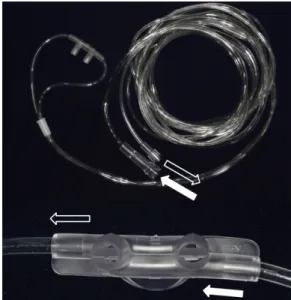
�Cannula 1844, Teleflex Inc., Pennslvania, USA)(Fig. 2). This nasal cannula is composed of two parts, where one supplies the oxygen and sevoflurane and the other detects expired gas of the patient (Fig. 3). Sevoflurane vaporizer was set to deliver 100% oxygen at gas flow of 2.0 L/min. End-tidal sevoflurane concentration as well as patient’ s respiration through capnography line of the nasal cannula was mon- itored throughout sevoflurane insufflation sedation.
Fig. 1. Chest radiograph. Enlarged heart size and increased pulmonary vasculature, confirming the previous diagnosis of congenital heart defect with left to right shunt.
Fig. 2. Patients with nasal cannula and sensor of S/5 EntropyTMModule.
Fig. 3. Nasal cannula. Solid arrow indicates direction of delivering oxy- gen and sevoflurane gas, hollow arrow indicates direction of detecting expired gas of the patient.
Inspired sevoflurane gas concentration was adjusted to maintain end-tidal sevoflurane concentration in the range of 1 to 1.5 vol%. Then, sedation depth was moni- tored using S/5 Entropy
TMModule (Datex-Ohmeda Division, Instrumentarium Corporation, Helsinki, Finland)(Fig. 2). The patient was sedated throughout the operation while maintaining normal vital signs and spontaneous respiration. After completion of the dental treatment, sevoflurane was discontinued. The patient gained consciousness less than 5 minutes after discon- tinuation of sevoflurane. He was discharged from the hospital on the same day without any complications. All procedures during operation were performed under su- pervision of an anesthesiologist and were monitored ap- plying the same standard as for GA. At the 3-months follow-up, the patient did not show any PAH-related complication and was referred back to the local clinic for further follow-up.
Ⅲ. Discussion
PAH is a complication of CHD with VSD and is associ- ated with significant perioperative risk for major compli- cations, such as RV failure and systemic hypotension
1,9). PAH with increased pulmonary vascular resistance (PVR) is associated with considerable morbidity and mortality. An analysis on 156 children (median age 4.0 years) with PAH who had undergone noncardiac surgery demonstrated outcome of 1.17% cardiac arrest and 0.78% death
10). Another analysis on 92,881 children younger than 18 years old who had perioperative caridi- ac arrest at a tertiary referral center found that all chil- dren undergoing noncardiac surgery or procedure demonstrated 0.029% cardiac arrest and 0.016%
death
11).
General anesthesia causes decreases in functional residual capacity (FRC) and increases the chances of uneven distribution of ventilation. This may lead to a cascade of symptoms of ventilation-perfusion (V/Q) mis- match, hypoxia, hypoxic pulmonary vasoconstriction (HPV) and ultimately exacerbation of pulmonary hyper- tension
12). Furthermore, increased PVR may lead to de- creased RV function. Finally, RV failure can result in systemic hypotension
2,4,9,13). Positive pressure ventilation during GA in PAH patients has high risk and should be conducted under the presence of well-trained profession- al anesthesiologist and with extra care.
In addition, airway instrumentation during GA can
trigger a rapid increase in PVR
8). Tracheal intubation has been reported to precipitate pulmonary hypertensive crisis and death in critically ill adult patients with se- vere PAH
14,15).
In other words, if possible, deep sedation may be safer than general anesthesia using positive pressure ventila- tion for patients with PAH. The patient in this case was born with CHD of large VSD and LV-RA shunt and had been taking HTN medication since 2007. For reasons stated above, the dental treatment was planned to be completed under deep sedation.
In numerous recent articles, sevoflurane inhalation and insufflation sedations have been suggested as new sedation methods
5-8,16). Sevoflurane has low blood-gas partition coefficient, which allows rapid induction and emergence
17). This characteristic is suitable in outpatient procedures. In general, sevoflurane is associated with clinical pulmonary vasodilation and is an accepted com- ponent of a balanced anesthetic technique in patients with PAH
2). Especially, most of the previous reports on sevoflurane inhalation and/or insufflation sedations were conducted on premature or preterm infants, to whom general anesthesia imposes higher risk
7,8,16). Therefore, sevoflurane inhalation and insufflation sedations can be used safely even in high-risk patient groups. In addition, the sedation depth can be easily controlled using inhala- tion and insufflation sedation, and they have auto-regu- lation effect, which also enables safer sedation
18).
Friesen RH and Alswang M stated, when sponta- neous ventilation through the natural airway is used, end-tidal CO
2should be monitored via nasal cannu- lae
19,20). In this case, the nasal cannula connected to capnograph was used, as previously described by Kim, et al.
6). This type of nasal cannula not only delivers sevoflurane gas, but also allows monitoring of respiration gases (oxygen, carbon dioxide and sevoflurane). It also takes up less space on patient’ s face and allows wider access for the dental treatment (Fig. 2).
The procedural sedation was conducted with special
attention to over-sedation, because over-sedation is as-
sociated with hypercarbia, hypoxemia and airway ob-
struction in patients managed with a natural airway and
spontaneous ventilation
19,21). Hypercarbia, hypoxemia
and airway obstruction can trigger a rapid increase in
PVR. As the appropriate dose of sevoflurane to achieve
appropriate sedation depth varies per person, sedation
depth was monitored by acquiring the electroencephalo-
graph (EEG) and frontal electromyography (FEMG) sig-
nals using S/5 Entropy
TMModule to prevent over-seda- tion and maintain proper sedation depth.
Ⅳ. Summary
This successful case of dental treatment in a patient with PAH through sevoflurane insufflation sedation has shown that sevoflurane insufflation sedation can be used effectively and safely in PAH patients and opened doors to sevoflurane sedation in high risk patients. Deep seda- tion by sevoflurane insufflation may be used as alterna- tive method of GA in the field of cardiopulmonary dys- function and in high-risk patients.
Acknowledgements
The authors extend our heartfelt gratitude to Eunji Lee for her hidden hard work.
References
1. Levine DJ : Diagnosis and management of pul- monary arterial hypertension: implications for respi- ratory care. Respir Care, 51:368-381, 2006.
2. Friesen RH, Williams GD : Anesthetic management of children with pulmonary arterial hypertension.
Paediatr Anaesth, 18:208-216, 2008.
3. Hill NS, Roberts KR, Preston IR : Postoperative pulmonary hypertension: etiology and treatment of a dangerous complication. Respir Care, 54:958-968, 2009.
4. Pritts CD, Pearl RG : Anesthesia for patients with pulmonary hypertension. Curr Opin Anaesthesiol, 23:411-6, 2010.
5. Kim SO, Kim YJ, Koo YS, Shin TJ : Deep sedation with sevoflurane insufflated via a nasal cannula in uncooperative child undergoing the repair of dental injury. Am J Emerg Med, 31:894e1-894e3, 2013.
6. Kim SO, Kim YJ, Shin TJ, et al. : Deep sedation with sevoflurane inhalation via a nasal hood for brief procedure in pediatric patients. Pediatr Emerg Care, 29:926-928, 2013.
7. Sury MRJ, Harker H, Thomas ML : Sevoflurane sedation in infants undergoing MRI: a preliminary report. Paediatr Anaesth, 15:16-22, 2005.
8. Yu L, Sun H, Yang B et al. : Comparison of effective inspired concentration of sevoflurane in preterm infants with different postconceptual ages. Paediatr
Anaesth, 21:148-152, 2011.
9. Fischer LG, Van Aken H, B ü rkle H : Management of pulmonary hypertension: physiological and phar- macological considerations for anesthesiologists.
Anesth Analg, 96:1603-1616, 2003.
10. Carmosino MJ, Friesen RH, Ivy DD et al. : Perioperative complications in children with pul- monary hypertension under going noncardiac surgery or cardiac catheterization. Anesth Analg, 104:521-527, 2007.
11. Flick RP, Sprung J, Warner DO et al. : Perioper- ative cardiac arrests in children between 1988 and 2005 at a tertiary referral center. Anesthesiology, 106:226-237, 2007.
12. Miller RD : Miller’ s anesthesia, 7th ed. Churchill Livingstone Inc., Philadelphia, 361-392, 2010.
13. Forrest P : Anaesthesia and right ventricular fail- ure. Anaesth Intensive Care, 37:370-385, 2009.
14. H ö hn L, Schweizer A, Licker M et al. : Circulatory failure after anesthesia induction in a patient with severe primary pulmonary hypertension.
Anesthesiology, 91:1943-1945, 1999.
15. H ö hn L, Licker M : Extreme pulmonary hyperten- sion and anesthesia induction. Anesthesiology 93:
903-904, 2000.
16. De Sanctis Briggs V : Magnetic resonance imaging under sedation in newborns and infants: a study of 640 cases using sevoflurane. Paediatr Anaesth, 15:
9-15, 2005.
17. Smith I, Nathanson M, White PF : Sevoflurane - a long-awaited volatile anaesthetic. Br J Anaesth, 76:
435-445, 1996.
18. Conscious sedation with sevoflurane, Anaesthesia tutorial of the week 188, 2010.
19. Friesen RH, Alswang M : Changes in carbon dioxide tension and oxygen saturation during deep sedation for paediatric cardiac catheterization. Paediatr Anaesth, 6:15-20, 1996.
20. Friesen RH, Alswang M : End-tidal PCO
2monitor- ing via nasal cannulae in pediatric patients: accura- cy and sources of error. J Clin Monit, 12:155-159, 1996.
21. Motas D, McDermott NB, Vansickle T, Friesen RH :
Depth of consciousness and deep sedation attained
in children as administered by nonanaesthesiologists
in a children’ s hospital. Pediatr Anesth, 14:256-60,
2004.
주요어: 경비캐눌라, 세보플루란, 자발호흡, 폐동맥고혈압, 흡입진정
폐동맥 고혈압 환자의 치과치료에서 세보플루란 흡입 진정의 사용 : 증례보고
지성인
1∙김승오
21