新疆紫草와 內蒙紫草의 형태, 분포 및 분류학적 검토
송준호#, 최고야, 양선규, 문병철*
한국한의학연구원 한약자원연구센터
Morphological Characteristics, Distribution and Taxonomic Consideration of the
Arnebia euchroma
andA. guttata
Jun-Ho Song
#, Goya Choi, Sungyu Yang, Byeong Cheol Moon
*Herbal Medicine Resources Research Center, Korea Institute of Oriental Medicine, Naju 58245, Republic of Korea
ABSTRACT
Objective : Arnebiae Radix, the roots of
Arnebia euchroma(Royle) Johnst. or
A. guttataBunge, is a well-known traditional herbal medicine in East Asia. In the Korean Pharmacopoeia, three authentic species, including two
Arnebiaand
Lithospermum erythrorhizonSieb. et Zucc. have recognized as a Lithospermi Radix. But, the morphological and taxonomic information of two authentic
Arnebiaspecies lacks date since their distribution and difficulty of accessing the natural habitats.
Methods : A full description of the external morphological characteristics of vegetative and reproductive organs in the original plants was carried out using digital calipers and stereoscope. For providing their taxonomic and nomenclatural synonyms, we reviewed various plant checklists and taxonomic literature.
Results : This study provides taxonomic information of
A. euchromaand
A. guttatabased on a morphological examination of authentic plant individuals and field observations. Detailed descriptions of the two
Arnebiaspecies, major quantitative and qualitative characteristics, nomenclatural reviews, distribution maps, and lists of voucher specimens examined are provided. The shape of leaves, root length, stem number, calyx length and pubescence as well as corolla color were useful characteristics for identification. Moreover, we confirmed that
A. euchromaand
A. guttataare clearly heterostylous species.
Conclusion : Our research provides valuable basic information that could be used as quality control for distinguishing between Arnebiae Radix and its adulterants. These results will help in the understanding of authentic plants and also provide the verified materials and voucher information.
1)
Key words : Arnebiae Radix, Lithospermi Radix,
Arnebia euchroma(Royle) Johnst.,
Arnebia guttataBunge,
Arnebia tibetanaKurz., Stereoscope, Descriptions
Ⅰ. 서 론
紫草는 淸熱凉血, 活血解毒, 透疹消斑하는 효능으로 血熱 毒盛, 斑疹紫黑, 麻疹不透, 瘡瘍, 濕疹, 水火燙傷 등에 응용되는 약재이다. 본 약재는 대한민국약전
1), 조선민주주의인민공화국
약전
2), 중화인민공화국약전
3), 대만중약전
4), 일본약국방
5)의 동북아 5개국 약전에 모두 수재되어 있으며, 그 기원을 지치과 (紫草科: Boraginaceae)에 속하는 지치(
Lithospermum erythrorhizonSiebold et Zuccarini), 新疆紫草(
Arnebia euchromaJohnst.) 또는 內蒙紫草(
Arnebia guttataBunge)
*Corresponding author : Byeong Cheol Moon, Herbal Medicine Resources Research Center, Korea Institute of Oriental Medicine, Naju 58245, Republic of Korea.
·Tel : +82-61-338-7100 ·Fax : +82-61-338-7134 ·E-mail : [email protected]
# First author : Jun-Ho Song, Herbal Medicine Resources Research Center, Korea Institute of Oriental Medicine, Naju 58245, Republic of Korea.
·Tel : +82-61-338-7117 ·Fax : +82-61-338-7135 ·E-mail : [email protected]
·Received : 02 October 2019 ·Revised : 30 October 2019 ·Accepted : 30 November 2019
의 뿌리로 정의하고 있다. 다만, 북한과 일본 약전에는 생약명 Lithospermi Radix로 지치 한 종만을 기원으로 정의하고 있 으며
2,5), 중국과 대만에서는 新疆紫草와 內蒙紫草 두 종만을 생약명 Arnebiae Radix로 규정하고, 지치는 공정서에 수재 되어 있지 않다
3,4). 대한민국 약전에는 新疆紫草, 內蒙紫草와 지치 세 종을 모두 포함하여 紫草의 기원으로 정의하고 있다
1).
紫草의 약리작용으로는 지치 뿌리에서 항암
6-10), 항산화
11,12)
, 항인플루엔자
13), 항염
14), 항알러지
15)작용 등의 연구결
과가 보고된 바 있고, 新疆紫草의 뿌리에서는 지치와 유사한 약리작용인 항암
16-18), 항산화
19)를 비롯해 항미생물
20-22), 상처
치료
23-25), 항균
26,27)등의 다양한 작용 및 효능에 대한 연구가
이루어진 바 있다.
인접 국가에서는 이와 같이 다양한 약리 활성을 지닌 紫草의 기원종으로 新疆紫草와 內蒙紫草만을 정의하고 있지만, 우리 나라에서는 지치를 포함한 세 가지 약재를 모두 인정함으로써 세 종의 약재가 모두 유통되고 있다. 특히 지치는 국내에 자 생하는 종으로 전도에 걸쳐 분포하고 있으며
28), 제천, 단양, 진도, 정선 등지에서 약재로 재배되고 있는 것으로 보고된 바 있다
29). 한편, 지치를 제외한 新疆紫草, 內蒙紫草는 국내 미 분포 분류군으로 전량 수입에 의존하고 있다.
紫草의 기원종 중 국내 분류군인 지치에 대한 연구로는 분류 학적, 생태학적 접근을 통한 형태학적 분류 및 분포
28), 자생 지의 생태학적 특성
30), 화분 분류학적 연구
31)등의 다양한 분야 에서 수행된 바 있어, 감별을 위한 기초자료로 활용되고 있다.
하지만, 新疆紫草와 內蒙紫草는 중국식물지에 제시된 단순기
재
32)뿐 자세한 형태학적 형질 및 분류학적 논의, 해당 분류 군의 화상자료 등의 부재로 인해 기원종 자체에 대한 정보가 매우 부족한 실정이다. 또한, 국내 식물 표본관에는 해당 분 류군의 학명 및 실체가 검증된 확증표본이 부재하여 현재 수 입되고 있는 유통약재에 대한 품질검증 및 추가 형질 연구에 어려움이 있다.
따라서, 본 연구에서는 키르기스스탄 및 중국 신장 부근 현지 조사를 통해 국내 미분포 紫草 기원종인 新疆紫草와 內蒙紫草의 외부 형태학적 형질을 자세히 관찰하고 기재하며, 분류학적, 명명법적 이명을 제시함과 동시에 생태 사진 및 확증 표본 이 미지와 해당 정보를 제공하는데 그 의의가 있다.
Ⅱ. 재료 및 방법
1. 재료
본 연구에는 2019년 7월 4일∼7월 15일 간 키르기스스탄 중·동부지역 현지조사를 통해 수집된 식물체 중 개화기에 완 전 성숙한 新疆紫草와 內蒙紫草 개체들을 선별하여 동정 후 연구에 사용하였다. 관찰 및 측정에 사용된 식물체는 확증표 본으로 제작하여 한국한의학연구원 한약표준표본관(표본관 코드 KIOM)에 보관하였다(Table 1). 형질 측정 및 관찰에 이 용한 개체로 新疆紫草는 1개 지역 20개체 이상, 內蒙紫草는 2개 지역 각 10개체 이상 총 40개체 이상을 관찰하였다.
Scientific Name
(Korean name) Collection site Collection date Collection number
Kyrgyzstan, Issyk-Kul Region, Jeti-Ögüz District, Uzonggu Kuush 2019. 07. 09. SJH_KIOM-2019-85 Arnebia euchroma
(신강자초)
Kyrgyzstan, Issyk-Kul Region, Ak-Suu District, Engilchek 2019. 07. 06. SJH_KIOM-2019-45 Arnebia guttata
(내몽자초)
Kyrgyzstan, Issyk-Kul Region, Jeti-Ögüz District, Uzonggu Kuush 2019. 07. 09. SJH_KIOM-2019-82 Table 1. Information of plant materials used in this study.
2. 방법
분류군 식별을 위해서 일차적으로 원기재문을 참조하였고
33-35)
, 해당 분류군이 자생하는 국가의 식물상
32,36,37)에서 제
시한 분류군의 특징과 분포를 바탕으로 동정 및 분류 후, 각 기관 별로 정량 및 정성적 형질을 자세히 관찰·기재하였다 (Table 2). 정량적 형질은 디지털 캘리퍼스(digital calipers;
CD-15CP, Mitutoyo, Kawasaki, Japan)를 이용하여 측정 하였으며, 최소값-(평균값)-최대값으로 제시하였다. 정성적 형질 중 표면 모용의 형질은 실체현미경(ST; Olympus SZX16, Olympus, Tokyo, Japan)을 이용하여 관찰하였다.
기재에 사용된 용어는 한국속식물지
38)를 참조하였다.
Ⅲ. 결 과
1. 외부형태학적 형질 관찰
紫草 약전 기원종 두 분류군에 대한 외부형태학적 형질(정 량적 형질 및 정성적 형질), 지리적 분포 및 분류학적 고찰에 대한 내용을 정리하였다.
1) 新疆紫草 -
Arnebia euchroma
(Royle) Johnst., Contr. Gray Herb. 73: 49, 1924 (Fig. 1, Table 2).Ÿ
Lithospermum euchromonRoyle, Ill. Bot. Himal.
Mts. 1: 305, 1839;
Macrotomia euchroma(Royle) Paulsen, Bot. Tidsskr. 27: 216, 1906.
Ÿ
Macrotomia perennisBoiss., Fl. Orient. 4: 212,
1875.
Ÿ
Macrotomia oginoiKitam., Acta Phytotax. Geobot.
19: 104, 1963.
Ÿ
Arnebia euchromavar.
grandisKazmi, J. Arnold Arbor. 51(2): 488, 1970.
다년생 초본으로, 양성화주이며, 키 22-35 ㎝이다. 뿌리는 땅 속 깊이 뿌리내리고, 비교적 단단하며, 갈색의 코르크층 (겉껍질)이 다수의 층으로 구성되어 세로로 쉽게 벗겨지고, 길이는 62 ㎝에 달하며, 지름 0.6-1.5 ㎝이다. 코르크층을 벗겨내면 3-5가닥의 진한 자색 또는 적색의 색소를 함유한 주근이 서로 엉켜있다. 줄기는 대개 1개, 드물게 2개이고, 직립 하며, 진녹색이고, 상부에서 일부 분지하며, 원통형이고, 지름 2.5-5.1 ㎜, 세로로 홈이 지며, 속이 차 있고, 표면에 2-5 ㎜ 길이의 백색 강모가 밀생하며, 기부에는 마른 전년도의 근생 엽이 남아 있다. 잎은 근생 및 경생하고, 호생하며, 엽병은 기 부에서 넓어져 엽초로 되고, 탁엽은 없다. 근생엽은 로제트상 으로 달리며, 개화 시 숙존한다. 근생엽의 엽병은 거의 없고, 엽신은 선상 피침형이며, 5-21×0.3-1.8 ㎝, 엽선은 예두 또는 점첨두, 엽저는 포처럼 줄기를 감싸고, 엽연은 전연이며, 상면은 녹색, 하면은 연녹색이고, 양면에 백색 내지 황색의 압착된 강모가 밀생한다. 경생엽은 피침형 내지 피침상 난형 으로, 3.5-9.2×0.6-1.3 ㎝이며, 예두 또는 점첨두이고, 엽 연은 전연이며, 양면에 백색 내지 황색의 압착된 강모가 밀생 한다. 화서는 취산형화서이고, 정생하며, 직립하고, 다수의 꽃이 밀집하며, 지름 3.3-5.2 ㎝이다. 포는 피침형이다. 꽃은 이화주성으로, 장주화와 단주화로 구분되고, 방사상칭이며, 지름 0.6-1.2 ㎝이다. 악은 합판악으로, 악편은 선형이고, 1.6-2.1 ㎝×1.0-2.4 ㎝, 선단은 예두, 잔털거치연이며, 양 면에 황색 내지 연황색 강모가 밀생한다. 화관은 합판화관으로, 자색 내지 진자색, 드물게 연황색이고, 분상이며, 안쪽 면은 무모, 바깥쪽 면에는 단모가 밀생하고, 화관 통부는 길이 1.0-1.6 ㎝, 화관 열편은 난형으로, 길이 2.4-6.6 ㎜이다.
약은 타원상으로, 길이 1.5-3.1 ㎜이며, 화사는 가늘고, 길이 1.0-2.5 ㎜이다. 화주의 선단은 2열하며, 실 모양이고, 길이 0.6-1.6 ㎝이며, 주두는 2개이고, 도피침상 난형 내지 도피 침형으로, 길이 0.5-1.6 ㎜이다.
Ÿ 개화기 및 결실기: 6-9월.
Ÿ 서식처 : 2500 m 이상 고산의 암석지, 산악건조지대, 사막지대.
Ÿ 분포 : 네팔, 러시아, 아프가니스탄, 우즈베키스탄, 인도 북서부, 중국 신장 위구르 자치구, 티베트 자치구, 카자흐스탄, 키르기스스탄, 타지키스탄, 투르크 메니스탄, 파키스탄(Fig. 3A).
Ÿ 관찰 표본: KIOM201901022414~KIOM201901022425 (Fig. 4A-B).
Ÿ https://boncho.kiom.re.kr/herbarium/specimen.p hp?id=21718 ~ https://boncho.kiom.re.kr/herbarium/
specimen.php?id=21729
Fig. 1. Photographs of morphology of the Arnebia euchroma. A.
Habit. B. Inflorescence. C. Basal and stem leaves. D. Corolla. E.
Calyx. F. Root with cork. G. Root without cork. H-I. Transverse section of root.
2) 內蒙紫草 -
Arnebia guttata
Bunge, Index Seminum (St. Petersburg) 1840: 7, 1840 (Fig. 2, Table 2).Ÿ
Arnebia tibetanaKurz., J. Asiat. Soc. Bengal, Pt. 2, Nat. Hist. 43(2): 189, 1874.
Ÿ
Arnebia thomsoniiC.B. Clarke, Fl. Brit. India 4(10):
176, 1883.
Ÿ
Macrotomia guttata(Bunge) Farrer, English Rock Garden 1: 469, 1919;
Lithospermum guttatum(Bunge) I.M. Johnst., J. Arnold Arbor. 33(4): 330, 1952.
다년생 또는 이년생 초본으로, 양성화주이고, 키 10-29 ㎝ 이다. 뿌리는 비교적 단단하며, 갈색의 코르크층(겉껍질)이 다수의 층으로 구성되어 세로로 쉽게 벗겨지고, 길이는 19 ㎝에 달하며, 지름 0.5-1.2 ㎝이다. 코르크층을 벗겨내면 주로 3 가닥의 진한 자색 또는 적색의 색소를 함유한 주근이 나선형 으로 서로 엉켜있다. 줄기는 2 내지 5개이고, 직립하며, 진녹 색이고, 하부 및 중부에서 다수 분지하며, 원통형이고, 지름 1.1-2.7 ㎜, 세로로 얕게 홈이 지며, 속이 차 있고, 표면에 2-3 ㎜ 길이의 백색 강모가 밀생한다. 잎은 근생 및 경생하고, 호생하며, 엽병은 기부에서 넓어져 엽초로 되고, 탁엽은 없다.
근생엽의 엽병은 거의 없고, 엽신은 선형 내지 도피침형 또는
주걱형이며, 1.5-6.3×0.1-0.7 ㎝, 엽선은 둔두, 엽저는 포
처럼 줄기를 약하게 감싸고, 엽연은 전연이며, 상면은 녹색,
하면은 연녹색이고, 양면에 백색의 강모가 밀생한다. 강모의
하부는 디스크형으로 부풀어 있다. 경생엽은 선형 내지 주걱형 으로, 1.3-5.2×0.2-0.7 ㎝이며, 둔두이고, 엽연은 전연이며, 양면에 백색의 강모가 밀생한다. 화서는 취산형화서이고, 정생 또는 액생하며, 직립하고, 다수의 꽃이 밀집하며, 지름 1.9-9.7 ㎝이다. 포는 선형 또는 선상 피침형이다. 꽃은 이화 주성으로, 장주화와 단주화로 구분되고, 방사상칭이며, 지름 0.6-1.0 ㎝이다. 악은 합판악으로, 악편은 선형이고, 0.6- 1.0 ㎝×0.5-1.2 ㎜, 선단은 예두, 잔털거치연이며, 양면에 길이가 비교적 긴 백색 강모가 밀생한다. 화관은 합판화관으로, 황색 내지 연황색이고, 분상이다. 화관 통부는 길이 1.1-1.7 ㎝ 이며, 안쪽 면은 무모, 바깥쪽 면에는 백색 단모가 산생하고, 화관 열편은 광난형 내지 아원형으로, 길이 2.9-5.6 ㎜, 뒤로 졎혀지며, 표면에 진자색 내지 갈색의 반점이 있거나 없으며, 양면 모두 무모이나 가장자리에 단모가 산생한다. 약은 타원 상으로, 길이 1.9-2.8 ㎜이며, 화사는 가늘고, 길이 0.3-0.9
㎜이다. 화주의 선단은 2열하거나 갈리지 않고, 실 모양이고, 길이 0.5-1.5 ㎝이며, 주두는 2개이거나 1개이며, 단구형 내지 신장형으로, 길이 0.2-0.6 ㎜이다.
Ÿ 개화기 및 결실기: 6-10월.
Ÿ 서식처 : 2500 m 이상 고산의 암석지, 산악건조지대, 사막 지대.
Ÿ 분포 : 러시아, 몽골, 아프가니스탄, 우즈베키스탄, 인도 북서부, 중국 간쑤성 서부, 내몽골 자치구, 닝샤 후 이족 자치구, 신장 위구르 자치구, 티베트 자치구, 허베이성, 카자흐스탄, 키르기스스탄, 타지키스탄, 투르크메니스탄, 파키스탄(Fig. 3B).
Ÿ 관찰 표본 : KIOM201901022426~KIOM201901022438 (Fig. 4C-D).
Ÿ https://boncho.kiom.re.kr/herbarium/specimen.php
?id=21730 ~ https://boncho.kiom.re.kr/herbarium/
specimen.php?id=21742
Fig. 2. Photographs of morphology of the Arnebia guttata. A. Habit.
B. Inflorescence. C. Basal and stem leaves. D. Corolla. E. Calyx. F.
Root with cork. G. Root without cork. H. Transverse section of root.
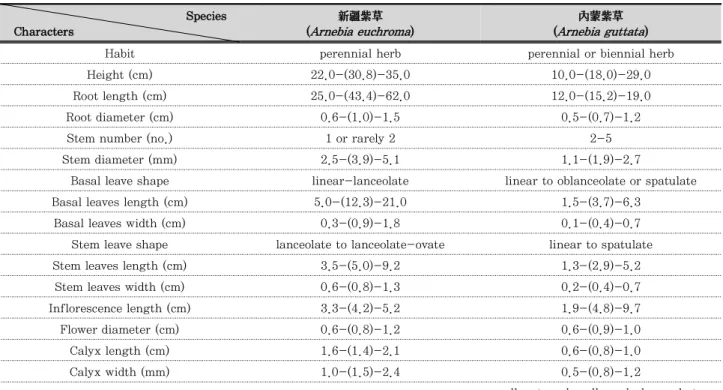
Species Characters
新疆紫草 (Arnebia euchroma)
內蒙紫草 (Arnebia guttata)
Habit perennial herb perennial or biennial herb
Height (cm) 22.0-(30.8)-35.0 10.0-(18.0)-29.0
Root length (cm) 25.0-(43.4)-62.0 12.0-(15.2)-19.0
Root diameter (cm) 0.6-(1.0)-1.5 0.5-(0.7)-1.2
Stem number (no.) 1 or rarely 2 2-5
Stem diameter (mm) 2.5-(3.9)-5.1 1.1-(1.9)-2.7
Basal leave shape linear-lanceolate linear to oblanceolate or spatulate
Basal leaves length (cm) 5.0-(12.3)-21.0 1.5-(3.7)-6.3
Basal leaves width (cm) 0.3-(0.9)-1.8 0.1-(0.4)-0.7
Stem leave shape lanceolate to lanceolate-ovate linear to spatulate
Stem leaves length (cm) 3.5-(5.0)-9.2 1.3-(2.9)-5.2
Stem leaves width (cm) 0.6-(0.8)-1.3 0.2-(0.4)-0.7
Inflorescence length (cm) 3.3-(4.2)-5.2 1.9-(4.8)-9.7
Flower diameter (cm) 0.6-(0.8)-1.2 0.6-(0.9)-1.0
Calyx length (cm) 1.6-(1.4)-2.1 0.6-(0.8)-1.0
Calyx width (mm) 1.0-(1.5)-2.4 0.5-(0.8)-1.2
Corolla color purple to dark purple, rarely pale yellow yellow to pale yellow, dark purple to brownish spotted or not
Table 2. Comparison of major morphological characters between Arnebia euchroma and A. guttata. Quantitative characters: Minimum- (mean)-maximum.
Species Characters
新疆紫草 (Arnebia euchroma)
內蒙紫草 (Arnebia guttata)
Corolla tube length (cm) 1.0-(1.2)-1.6 1.1-(1.3)-1.7
Corolla lobe length (mm) 2.4-(4.4)-6.6 2.9-(4.1)-5.6
Anther length (mm) 1.5-(2.4)-3.1 1.9-(2.4)-2.8
Filament length (mm) 1.0-(1.5)-2.5 0.3-(0.5)-0.9
Style apex 2-lobed entire or 2-lobed
Style length (cm) 0.6-(1.0)-1.6 0.5-(1.0)-1.5
Stigma number (no.) 2 1 or 2
Stigma shape oblanceolate-ovate to oblanceolate oblate or reniform
Stigma length (mm) 0.5-(1.0)-1.6 0.2-(0.4)-0.6
Fig. 3. Distribution maps and collection sites of the studied species. A. Arnebia euchroma. B. Arnebia guttata. Red and blue dots show the collection sites each species.
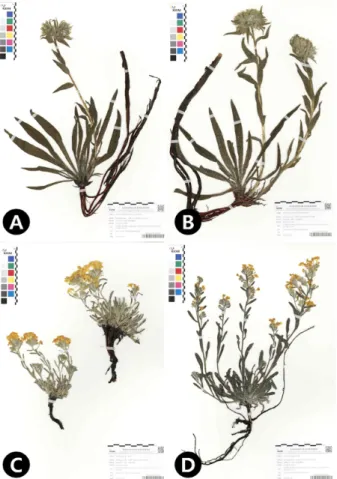
Fig. 4. Specimens of the Arnebia species. A. A. euchroma (KIOM201901022420). B. A. euchroma (KIOM201901022424). C.
A. guttata (KIOM201901022429). D. A. guttata (KIOM201901022432).
Ⅳ. 고 찰
약재 자체 대한 외부형태관찰 및 감별 기준을 마련하는 것은 정품 이외의 것을 배제하기 위해 필수적인 일이다. 한편, 약 재의 기원이 되는 식물체의 형태학적, 분류학적 정보는 약재에 대한 이해와 더불어 약재 감별 이전에 필요한 주요 기초자료 이다. 이에 本草鑑別圖鑑에는 약재의 형태뿐만 아니라 기원식 물의 형태, 식물검색표 등의 정보를 함께 제공함으로써 한약 자원에 대한 이해를 높이고 있다
39-41).
본 연구 재료인 新疆紫草와 內蒙紫草는 대한민국약전에 수 재되어 있는 약재이지만
1), 국내에는 분포하지 않아 전량 수입에 의존하고 있는 실정이다. 특히, 新疆紫草의 경우 중국 3성을 비롯한 동북아 인근에는 분포하지 않는 종으로 해당 종에 대한 정보가 매우 부족한 실정이다. 이에 본 연구를 통해 紫草의 국내 미분포 약전 기원종인 新疆紫草와 內蒙紫草 식물체의 외부 형태학적 형질, 지리적 분포, 분류학적 및 명명법적 이명 등을 제시함과 동시에 확증표본 정보를 제공함으로써 유통약재의 품질검증, 추가 연구에 활용될 수 있도록 하였다.
新疆紫草와 內蒙紫草는 모두 지치과(Boraginaceae),
Arnebia속에 속하는 종으로 식물체의 크기, 꽃잎의 색 등의
특징으로 개화 시 매우 쉽게 구분된다. 하지만 약재 사용 부
위인 뿌리의 경우, 건조 및 절단 등의 2차 가공이 이루어지고,
이에 따라 그 크기와 색 등이 유사하게 되어, 유통 상태에서는
구별이 어렵게 된다. 따라서 약재부위에 대한 감별 기준을 마
련하기 위해 본 연구에 사용된 확증 표본 시료와 확보 가능한
동속이종(同屬異種) 및 국내에 유통되는 약재 중 국외에서 수
입되어 유통되고 있는 유통 약재 시료(新疆紫草, 內蒙紫草)의
외부형태, 미세형태 및 비교 해부학적 감별 연구가 수행되어야 할 것이다.
중국식물지 내
Arnebia속 기재에는 본 속에 해당하는 식물 체가 異柱花性(distyly, heterostyly)을 갖는 것으로 제시되어 있다
32). 동속이종인
A. szechenyi의 생태학적 연구 역시 長 柱花(pin, long-styled flowers)와 短柱花(thrum, short- styled flowers)의 두 가지 형태로 구별되며, 화주의 길이 차 이를 제시하고 있다
42,43). 본 연구에서도 新疆紫草와 內蒙紫草 두 종 모두에서 두 가지 형태의 화주 길이를 갖는 長柱花와 短 柱花를 확인할 수 있었다. 추후 이들 長柱花, 短柱花의 화주 길이 차이뿐만 아니라 화부 기관 및 화분의 크기, 형태 등의 미세형태학적 형질의 차이를 밝힐 필요가 있겠다.
新疆紫草는 1839년
Lithospermum euchromon의 학명으로 최초로 기재된 이래
Macrotomia속으로의 전이를 거쳐 현재의
Arnebia euchroma의 학명으로 통용되고 있다. 하지만, 일부 문헌에서는
Macrotomia속으로 본 종을 인식하고 있어 紫草 기원종 학명 인식에 대한 혼란이 있다
36). 최근의 분자계통학 적 연구에서는 본 종과 內蒙紫草를 포함한 일부분류군이 單系 統群(monophyly)을 나타내
Arnebia속으로의 인식을 지지하 고 있다
44). 따라서 新疆紫草는 대한민국약전을 비롯한 동북아 공정서에 모두 올바른 학명으로 수재되어 있으며
1-5),
L.euchromon
,
M. euchroma의 학명은 命名法的 異名 (nomenclature synonyms)으로 정리된다. 기원종 학명의 인식 혼란을 막기 위해 대한민국약전, 한약재관능검사해설서 등 한 약(생약)재에 대한 정보를 제공할 시 동일 종으로, 동일한 種 小名(species epithet)을 갖는 命名法的 異名을 제시하는 것을 제안한다.
內蒙紫草는 다양한 문헌에서
A. guttata의 학명으로 인식 되고 있다
42-44). 중국식물지에서 역시 본 학명으로 분류군을 인식하고 있지만,
A. guttata는 주로 러시아와 몽골에 분포 하며, 分類學的 異名(taxonomic synonym)으로 처리된
A.tibetana
의 경우, 특히 新疆維吾爾自治區(Xinjiang) 및 西藏 自治區(Xizang) 인근에 제한적으로 분포하는 것으로 나타나 지리적 격리에 따른 亞種(subspecies)으로 처리될 수 있음을 제안하고 있다
32). 실제 키르기스스탄에서는 현지에 자생하는 분류군을
A. guttata와는 다른 종인
A. tibetana로 인식하고 있다
45). 현지 연구진과의 논의에서도 다년생, 이년생의 습성 차이와 지리적 분포, 일부 형태적 형질 차이로 키르기스스탄에 자생하는 개체를 종 수준의
A. tibetana로 인식함을 제안 받 았다(Dr. Lazkov, personal communication). 본 연구에서는 다양한 문헌에서 일반적으로 인식하고 있는 內蒙紫草의 학명, 즉
A. guttata로 인식하여 형질 기재를 수행하였으나, 추후 생식기관(화부, 화분, 열매, 종자 등)의 비교 형태, 유전자 및 유전체 비교 분석 등의 연구를 통해
A. guttata와
A.tibetana
의 종의 한계 설정에 대해 재고할 필요가 있음을 확인 하였다. 특히, 다각적 형질 비교 연구를 통해
A. tibetana의 정확한 분류학적 위치(內蒙紫草의 분류학적 이명으로의 인식, 內蒙紫草의 종하 분류군인 아종으로의 인식 또는 內蒙紫草와는 다른 별개의 독립된 종으로 인식)를 설정해야 紫草 기원종으 로서의 위치를 재정립할 수 있을 것이다. 한편,
A. guttata와
A. tibetana의 이화학적, 분리·분석학적 연구를 통해 이들의 구성 성분에 대한 비교·분석이 수행될 필요가 있겠다.
본 연구에서는 화관 색 등 기존 문헌에 제시된 감별형질 이 외에 추가적으로 확인된 감별기준을 포함하여 기원종에 대한 새로운 감별기준을 제시하였다.
[紫草 기원종 新疆紫草, 內蒙紫草의 외부형태 감별기준]
1. 화관은 자색 내지 진자색, 드물게 연황색이고, 악편은 길이 1.6-2.1 ㎝으로 양면에 길이가 비교적 짧은 황색 내지 연황색 강모가 밀생한다. 엽신은 선상 피침형 내지 피침상 난형이며, 엽선은 예두 또는 점첨두이다. 줄기는 대개 1개, 드물게 2개 로 상부에서 일부 분지하고, 뿌리의 길이는 25-62 ㎝이다.
新疆紫草 (Arnebia euchroma)
1. 화관은 황색 내지 연황색이고, 악편은 길이 0.6-1.0 ㎝으로 양면에 길이가 비교적 긴 백색 강모가 밀생한다. 엽신은 선형 내지 도피침형 또는 주걱형이며, 엽선은 둔두 이다. 줄기는 2 내지 5개로 하부 및 중부에서 다수 분지하고, 뿌리의 길이는 12-19 ㎝이다.
內蒙紫草 (Arnebia guttata)
Ⅴ. 결 론
紫草(Arnebiae Radix)의 국내 미분포 기원종인 新疆紫草와 內蒙紫草 식물의 형태학적, 분류학적 정보를 제공하고자 하였다.
1. 新疆紫草와 內蒙紫草 식물체의 외부 형태학적 형질을 자세히 관찰하고 기재하였으며, 특히 식물체의 크기, 뿌리 의 길이, 줄기의 개수, 엽신 및 엽선의 형태, 악편 길이, 화관 색 등의 형질은 두 종의 주요 감별기준으로 확인되 었다.
2. 두 종의 분류학적, 명명법적 이명을 정리하였으며, 특히 현재 인식되고 있는 內蒙紫草의 학명
Arnebia guttata와 분류학적 이명인
A. tibetana의 분류학적 한계 설정 및 분류학적 위치 재고의 필요성을 제안하였다.
3. 감별 및 종 동정을 위한 新疆紫草, 內蒙紫草 식물체 각 기관 별 생태사진을 제시하였으며, 검증된 확증 표본 및 시료 정보를 제공함으로써 유통약재 품질 검증 및 추가 연구를 위한 기초자료로 제시하였다.
감사의 글
본 연구는 한국한의학연구원 주요 사업인 ‘한약표준자원 활 용기술 개발’ 과제(KSN1911420)의 지원에 의해 수행되었습 니다. 본 연구 수행에 필요한 표본을 제공해주신 한국한의학 연구원 한약표준표본관(표본관 코드 KIOM)께 감사드립니다.
References