■투 고 : 2010년 7월 22일, 수 정 : 2010년 8월 14일, 채 택 : 2010년 8월 16일
■교신저자 : 김미기, 전라북도 익산시 원광대학로 77번지 원광대학교 익산한방병원 소아과 (Tel : 063-859-1114, Fax : 063-841-0033, E-mail : [email protected])
수도권 지역 초등학생의 건강기능식품 및 한약 복용 실태에 대한 연구
김미기․정지호․신권성․*이동엽․이해자․박은정
원광대학교 한의과대학 소아과학교실
*원광대학교 한의학전문대학원 제3의학과 동서협진한의학교실
Abstract
The Study on Consumption of Health Supplements and Herbal Medicines by Elementary School Students in Gyeonggi-do
Kim Mi Ki, Jung Ji Ho, Shin Kwon Sung, *John Dongyeop Lee, Lee Hai Ja, Park Eun Jung Department of Pediatrics, College of Oriental Medicine, Wonkwang University
*Department of Third Medicine, Professional Graduate School of Oriental Medicine, Wonkwang University Objectives
The purpose of this study is to get the basic information about the actual amount of consumption of the Health supplements and Herbal Medicines. Also, we investigated the consumption differences according to the regions.
Methods
500 questionnaires were handed out to parents of elementary students in O O, Gyeonggi-do province, and 331 questionnaires were collected and evaluated for this study.
Results
Among the 331 students, 58.4% were female, and 41.6% were male. The percentages of the subjects consuming health supplements and herbal medicines were 67.4% and 59.2% respectively. The maximum period of taking the health supplements were from 1 month to 6 month (49.5%), and the maximum period of taking the herbal medicine was within one month (55.6%). The total cost of the health supplements was less than 100,000won (43.7%), which was the most common while herbal medicine cost was between 100,000won and 200,000won (40.6%). The most common age of consuming the health supplements and herbal medicine for the first time was six to ten years old (47.3%); the case of herbal medicine was one to six years old (64.0%). Most of people purchased health supplements from pharmacy (48.0%), and purchased the herbal medicine from the oriental medical clinic (61.8%). Among those people who purchased health supplements, they bought nutritional supplements (82.8%), red ginseng or ginseng products (43.4%), plum extract products (10.9%), and chlorella products (6.8%). The reason for consuming health supplements was to be healthier even though there is no ongoing illness (47.1%), which was the most common reason. The reason for consuming herbal medicine was to cure weakness (39.3%). For the responses about effectiveness after taking medications, people thought herbal medicine seemed to be more effective compare to health supplements (72.3%, 63% respectively). Only 1.4%
of the subjects consuming the health supplements showed adverse effects while herbal medicine showed 4.6%.
The most common adverse effects were 'general reaction' caused by the health supplements and dermatologic problems caused by the herbal medications.
Conclusions
Among 331 subjects, the percentage of consuming the health supplements (67.4%) was higher than the Herbal
Medicine (59.2%). The total consuming cost of the herbal medications was higher than general health supplements.
Also, the maximum period of consuming the health supplements was longer than herbal medications.
Therefore, it is shown that herbal medications have no price competitiveness compare to health supplements.
The age of using the herbal medicine for the first time was younger than the health supplements. Even though many people can purchase both health supplements and herbal medication from pharmacies and local oriental medical clinic, it is also shown that some people thought that the health supplements should be purchased from oriental medical hospital (13.9%). The most commonly taken forms of the health supplement was nutrition-supplying products, and the second common health supplements were ginseng and red ginseng. The health supplements were commonly consumed for preventing illness and for maintaining healthy life rather than for cure diseases. On the other hand, the herbal medicine was more commonly consumed to be taller or to treat diseases. More than half of the entire people replied as 'satisfied' for their purchase. Some adverse effects and general reaction were common with the subjects consuming health supplements while dermatological adverse reaction was common with the subjects consuming herbal medications.
Key words : Herbal Medicine, Health Functional Foods, Elementary school students
Ⅰ. 緖 論
건강기능식품 시장은 그동안 중장년층 중심이었으 나 최근 어린이가 중요한 소비자 군으로 주목받게 되 었다. 맞벌이 부부의 증가에 따라 자녀의 패스트푸드 섭취와 외식 빈도가 늘어나고 열량이 높은 간식을 섭 취하는 등 바람직하지 않은 식습관이 늘어나면서, 이 를 보충하기 위해 건강기능식품에 대한 의존도가 높아 지고 있다
1,2). 기능성에 대한 소비자의 수요 증가로, 2010년 식약청에서는 다양한 기능성 제품이 개발되어 판매될 수 있도록 지속적으로 건강기능식품 산업발전 을 위한 지원정책을 추진할 계획이라고 밝혔다
3). 빠르 게 증가하고 있는 건강기능식품 산업시장에 비해, 한 약의 소비 형태는 어떠한지, 어떻게 변해가고 있는지 알아보고자 본 연구를 실시하였다.
소아, 청소년의 건강기능식품 소비에 관한 논문에서
1,2,4-7)
건강기능식품 섭취 비율은 매년 높아지는 경향이
있으며, 식약청에서 최근 발표한 건강기능식품 판매액 도 매년 증가 추세이다
3). 소아의 한약 소비에 관련된 연구는 안
8)의 연구가 있으며, 건강기능식품과 한약 소 비를 함께 연구한 것은 김
9)의 연구가 있다.
본 연구는, 지방 소재 2개 초등학교를 대상으로 범 위를 한정하여 결과를 일반화하기 어려웠던 지난 연구 의 한계를 보완하기 위해 수도권 지역에 위치한 초등 학교 1개를 선정하여 실시하였다. 또한 김
9)의 연구에 서, ‘가격이 저렴해서’ 건강기능식품을 선호한다는 응 답률이 매우 높았고, 한약 비복용군의 이유로 ‘가격이 부담스러워서’를 많이 응답하여 소비자가 느끼는 한약
의 가격대가 높다는 것을 알 수 있었다. 이를 바탕으로 점점 고가화 되고 있는 건강기능식품과 비교해 실제로 한약 소비 비용이 높은 것인지, 아니면 한약은 비싸다 는 오해에서 비롯된 것인지 알아보기 위해 각각의 소 비 기간과 비용, 장소 등을 함께 알아보아 그 결과를 얻었기에 보고하는 바이다.
Ⅱ. 對象 및 方法
1. 대상
2010년 6월 19일부터 6월 24일까지 경기도 ○○시에 소재한 한 개 초등학교 학생의 학부모를 대상으로 설문 지 500부를 배포한 후 회수된 331명을 분석하였다.
2. 설문지 작성
설문지의 내용은 건강기능식품과 한약의 복용률, 복 용 기간, 복용 비용, 처음 복용한 나이, 구입처, 구입한 건강기능식품의 종류, 복용 이유, 효과, 부작용 등을 조 사하였고, 설문지 작성은 학부모가 하도록 하였다.
3. 통계분석
본 연구를 수행하는데 있어서 회수된 자료 중 무성의 한 반응을 보인 응답자는 통계처리에서 제외시켰으며 여기서 사용된 구체적인 실증분석방법은 다음과 같다.
조사대상자의 일반적인 특성을 알아보기 위하여 빈
도분석(Frequency Analysis)을 실시하였고 범주형 자료
에서 비모수 기법인 경우 교차분석
(p)을 실시하여
Number %
Gender Male 132 41.6
Female 185 58.4
Grade
1st 54 16.4
2nd 41 12.4
3rd 79 23.9
4th 84 21.8
5th 84 25.5
6th 0 0
Uptake Health functional foods 223 67.4
Herbal medicine 196 59.2
Total 100.0
Table 1. The Characteristics of Elementary School Students and Uptake Ratio.
Health Functional Foods Number(%) The Age Herbal Medicine Number(%)
7(3.2) To birth - one year 8(4.1)
92(41.4) one year - six years 126(64.0)
105(47.3) six years - ten years 57(28.9)
18(8.1) over ten years old 6(3.0)
222(100) total 197(100)
Table 2. The Age of First Time Health Functional Foods and Herbal Medicine Use.
Health Functional Foods Number(%) Period Herbal Medicine Number(%)
32(14.4%) within a month 109(55.6%)
110(49.5%) one month - six months 69(35.2%)
44(19.8%) six months - one year 10(5.1%)
20(9.0%) one year - two years 2(1.0%)
16(7.2%) more than two years 6(3.1%)
Total Cost
97(43.7%) less than 100,000\ 42(21.3%)
65(29.3%) 100,000\ - 200,000\ 80(40.6%)
44(19.8%) 200,000\ - 500,000\ 59(29.9%)
8(3.6%) 500,000\ - 1,000,000\ 10(5.1%)
8(3.6%) more than 1,000,000\ 6(3.0%)
222(100.0%) total 197(100.0%)
Table 3. The Period and Total Cost of Consumption between the Health Functional Group and Herbal Medicine Group.
집단 간의 차이를 살펴보았다. 본 연구의 실증분석은 모두 유의수준 p<.05에서 검증하였으며, 통계처리는 SPSSWIN 12.0 프로그램을 사용하여 분석하였다.
Ⅲ. 硏究結果
1. 일반 특징과 복용률 비교
총 331명 중 성별은 여자가 58.4%, 남자 41.6%였고, 자녀의 학년으로는 6학년은 없었고, 5학년이 25.5%, 4 학년이 21.8%, 3학년이 23.9%, 2학년이 12.4%, 1학년 이 16.4% 로 고른 분포를 보였다.
전체 대상자 중 건강기능식품 복용률(현재 복용 및 복용 경험 포함)은 67.4%로 나타났고, 한약 복용률은 59.2%로 나타났다(Table 1).
2. 처음 복용한 나이 비교
건강기능식품 복용군이 처음 건강기능식품을 복용한
나이는 만 6세~10세 이전이 47.3%로 가장 많았으며,
한약 복용군은 만 1세~6세 이전이 가장 많은 64.0%로
한약 복용군이 첫 복용 경험 나이가 더 이른 것으로
나타났다(Table 2).
Place Effect Number(%)
Health Functional Foods
Drug store 107(48.0%)
Oriental Medical clinic, Hospital 31(13.9%)
Local Clinic, Hospital 2(0.9%)
Mart or Department store 36(16.1%)
etc. 47(21.1%)
Total 223(100.00%)
Herbal Medicine
Drug store or Herbal Medicine shop 18(9.4%)
Local Oriental Medical clinic 118(61.8%)
Pediatrics specialised Oriental Medical Clinic 46(24.1%)
Oriental Medical Hospital 7(3.7%)
etc. 2(1.0%)
Total 191(100.00%)
Table 4. The Place of Purchase
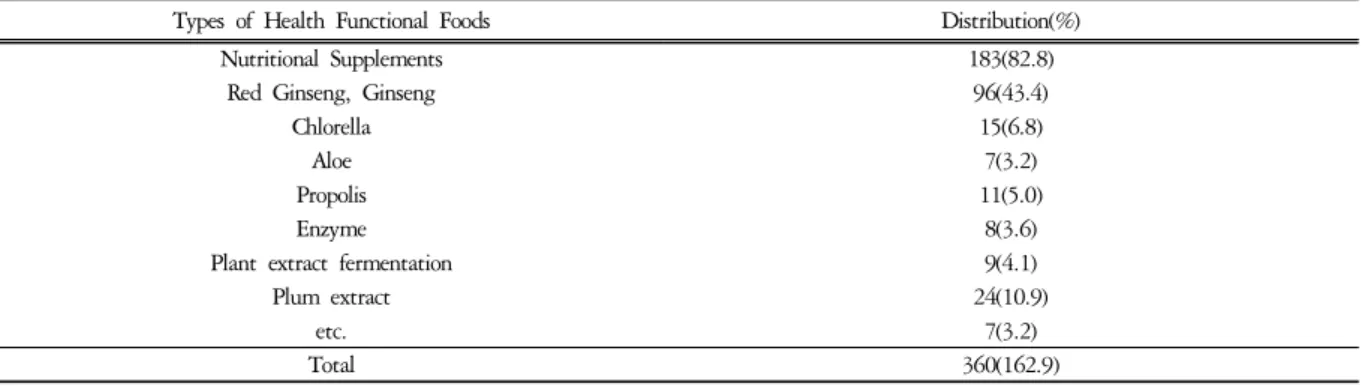
Types of Health Functional Foods Distribution(%)
Nutritional Supplements 183(82.8)
Red Ginseng, Ginseng 96(43.4)
Chlorella 15(6.8)
Aloe 7(3.2)
Propolis 11(5.0)
Enzyme 8(3.6)
Plant extract fermentation 9(4.1)
Plum extract 24(10.9)
etc. 7(3.2)
Total 360(162.9)
Table 5. Health Functional Food Items Devided by Children's Intake Frequency.
3. 복용 기간과 비용 비교
건강기능식품 복용군에서 자녀가 건강 기능 식품을 복용한 최대 기간에 대한 질문에, 1개월~6개월 이내 가 49.5%로 가장 많았고, 한약 복용군에서는 1개월 이 내가 55.6%로 가장 많아 건강기능식품을 더 장기간 복 용하는 것으로 나타났다.
각각 경험군에게 구입에 든 총 비용을 질문한 결과, 건강기능식품의 경우 10만원 미만이 43.7%로 가장 많 았고, 한약은 10만원 이상 20만원 미만이 40.6%로 가 장 많았다(Table 3).
4. 구입처
건강기능식품을 복용한 군은 약국에서 구입한 경우 가 가장 많았으며(48.0%), 한약 복용군은 일반 한의원 에서 구입한 경우가 61.8%로 가장 많았다. 건강기능식 품 구입처의 기타 응답으로는 인터넷, 생식원, 건강기 능식품 전문점 등이 있었다(Table 4).
5. 복용한 건강기능식품의 종류
복용한 건강기능식품의 종류로는 영양보충용 제품이
가장 많은 82.8%였으며, 그 다음으로 홍삼 인삼제품 (43.4%), 매실추출물 제품(10.9%), 클로렐라제품(6.8%) 순이었다(Table 5).
6. 복용하게 된 이유
한약과 건강기능식품을 구입하게 된 가장 큰 이유 를 질문한 결과 건강기능식품은 ‘별 문제는 없지만 건 강을 위해서’가 47.1%, ‘성장(키)을 위해서’ 23.3%, ‘잔 병에 자주 걸리는 등 허약해서’가 19.7%였고 한약의 경우는 ‘잔병에 자주 걸리는 등 허약해서’(39.3%), ‘질 병 치료를 위해서’(29.6%), ‘성장(키)을 위해서’(14.8%) 순이었다(Table 6).
7. 복용 후 효과 및 부작용
효과면에서 건강기능식품 복용군은 응답자의 58.8%
가 효과가 ‘있는 편’, 4.2%가 ‘매우 있음’이라고 답하고 한약 복용군이 66.7%가 ‘있는 편’, 5.6%가 ‘매우 높음’이 라고 답해 비율이 조금 더 높았다(Table 7).
복용 후에 건강기능식품 복용군의 98.6%, 한약 복용
군의 95.4%가 부작용이 없어 두 군 모두 거의 없는 것으
Variables Distribution(%)
Reasons For using Herbal
medicine
Weakness (frequent illness) 77(39.3)
In order to grow taller 29(14.8)
Poor appetite 19(9.7)
Be smarter 1(0.5)
Medical cure (ex.common cold, headache..) 58(29.6)
etc. 12(6.1)
Total 196(100)
Reasons on using Health
functional foods
To be healthy (no illness) 105(47.1)
In order to grow taller 52(23.3)
Poor appetite 7(3.1)
Be smarter 3(1.3)
Weakness (frequent illness) 44(19.7)
Medical cure (ex.common cold, headache..) 8(3.6)
etc. 4(1.8)
Total 223(100)
Table 6. The Reasons for Using Health Functional Foods and Herbal Medicine.
Health Functional Foods
Side Effect Number(%) Variables Herbal Medicine
Side Effect Number(%)
2(0.9) General reactions 0(0)
1(0.4) Dermal reactions 4(2.1)
1(0.4) Indigestion 3(1.5)
0(0) Heart and Respiration Reactions 0(0)
1(0.4) Neuro-psychic reactions 0(0)
0(0) etc. 2(1.0)
5(2.1) Total 9(4.6)
Table 8. The Side Effects of Herbal Medicine and Health Functional Foods.
Variables Effect Number(%)
Herbal Medicine
No effect 10(5.1)
A little help 44(22.6)
Almost 130(66.7)
Very well 11(5.6)
Total 195(100)
Health Functional foods
No effect 7(3.2)
A little help 73(33.8)
Almost 127(58.8)
Very well 9(4.2)
Total 216(100)
Table 7. The Effects of Herbal Medicine and Health Functional Foods.