Copyright ⓒ the Korean Society for Transplantation, 2016
Optimal Dose of Thymoglobulin for Induction Therapy in High Risk Kidney Transplant Recipients
Yaerim Kim, M.D.
1,2, Seong Sik Kang, M.D.
1,2, Woo Yeong Park, M.D.
1,2, Kyubok Jin, M.D.
1,2, Sung Bae Park, M.D.
1,2, Ui Jun Park, M.D.
2,3, Hyoung Tae Kim, M.D.
2,3and Seungyeup Han, M.D.
1,2Department of Internal Medicine, Keimyung University School of Medicine
1, Keimyung University Kidney Institute
2, Department of Surgery, Keimyung University School of Medicine
3, Daegu, Korea
Background: Thymoglobulin has been used for induction therapy to prevent acute rejection and delayed graft function (DGF) in kidney transplant patients. However, the usual dose of thymoglobulin is considered to be related with frequent infection. We compared the efficacy and safety of low-dose thymoglobulin to high-dose treatment in high risk recipients with kidney transplantation.
Methods: Twenty-one kidney transplant recipients underwent induction treatment with thymoglobulin and were divided into two groups: patients treated with low-dose (<6.0 mg/kg) and high-dose thymoglobulin (≥6.0 mg/kg). All patients showed one or more risk factors for acute rejection or DGF. The risk factors were re-transplantation, recipient or donor age over 60 years, human leukocyte antigen full mismatch, and panel-reactive antibody more than 50%. We compared incidence of acute rejection, infection, hematologic complications, and graft survival between two groups.
Results: The demographic characteristics of the two groups were comparable. Mean follow-up duration was 11.9±4.3 months, and cumulative thymoglobulin dosage was 6.3±1.6 mg/kg. The incidence rates of acute antibody-mediated rejection (AMR), DGF and infectious events as cytomegalovirus disease, or urinary tract infection were not significantly different between the two groups.
Neutropenia occurred more frequently in the high-dose thymoglobulin group, but there was no statistically significant difference.
The rate of graft loss were similar between the two groups.
Conclusions: There were no differences in graft survival, infectious disease, and hematologic problems between the two groups.
We suggest to lower the dose of thymoglobulin to less than 6 mg/kg for prevent acute AMR and DGF in high risk patients.
Key Words: Immunosuppressive agents, Kidney transplantation, Thymoglobulin
중심 단어: 면역억제제, 신장이식, 치모글로불린Received March 8, 2016 Revised May 13, 2016 Accepted May 19, 2016
Corresponding author: Seungyeup Han
Department of Internal Medicine, Keimyung University School of Medicine, 56 Dalseong-ro, Jung-gu, Daegu 41931, Korea
Tel: 82-53-250-7399, Fax: 82-53-253-7976 E-mail: [email protected]
Original Article
INTRODUCTION
Thymoglobulin is one of the most widely used induction immunosuppressant in kidney transplantation. It was better than basiliximab on acute rejection and graft survival rate
by 5 and 10 years follow-up(1,2). Kidney transplantation is the best treatment for chronic kidney disease, and it has been performed increasingly in patients with high risk for acute antibody-mediated rejection (AMR) and delayed graft function (DGF). Brennan et al.(3) presented that thymoglo- bulin is better than basiliximab for high risk patients, re- duced acute rejection rate and severity(3-5). However the usual dose of thymoglobulin (7∼10 mg/kg) may contribute to increase risk of infectious disease or malignancy(6). Even low-dose thymoglobulin reduced risk for acute rejections and maintained better kidney function by 3 and 5 years fol-
J Korean Soc Transplant 2016;30:82-85
http://dx.doi.org/10.4285/jkstn.2016.30.2.82
83
Yaerim Kim, et al: Dose of Thymoglobulin in Kidney Transplantation
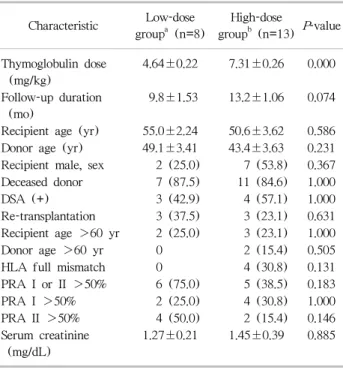
Table 1. Comparison of demographic characteristics by thymoglo- bulin dosage
Characteristic Low-dose group
a(n=8)
High-dose
group
b(n=13) P -value Thymoglobulin dose
(mg/kg)
4.64±0.22 7.31±0.26 0.000
Follow-up duration (mo)
9.8±1.53 13.2±1.06 0.074
Recipient age (yr) 55.0±2.24 50.6±3.62 0.586
Donor age (yr) 49.1±3.41 43.4±3.63 0.231
Recipient male, sex 2 (25.0) 7 (53.8) 0.367
Deceased donor 7 (87.5) 11 (84.6) 1.000
DSA (+) 3 (42.9) 4 (57.1) 1.000
Re-transplantation 3 (37.5) 3 (23.1) 0.631 Recipient age >60 yr 2 (25.0) 3 (23.1) 1.000
Donor age >60 yr 0 2 (15.4) 0.505
HLA full mismatch 0 4 (30.8) 0.131
PRA I or II >50% 6 (75.0) 5 (38.5) 0.183
PRA I >50% 2 (25.0) 4 (30.8) 1.000
PRA II >50% 4 (50.0) 2 (15.4) 0.146
Serum creatinine (mg/dL)
1.27±0.21 1.45±0.39 0.885
Data are presented as mean±SD or number (%).
Abbreviations: DSA, donor specific antibody; HLA, human leuko- cyte antigen; PRA, panel-reactive antibody.
a
Low-dose group: thymoglobulin <6.0 mg/kg;
bHigh-dose group:
thymoglobulin >6.0 mg/kg.
low-up than basiliximab(7). There are some studies to find out efficacy and safety of low-dose thymoglobulin, but there is no consensus for optimal dose, especially for high risk pa- tients yet(7,8). In this study, we suggest the optimal dose of thymoglobulin for high risk patients to prevent acute re- jection or DGF include patients who transplanted from ex- tended criteria donor.
MATERIALS AND METHODS
The report is retrospective study of kidney transplantation performed in Keimyung University Dongsan Medical Center from September 2013 to October 2014. Twenty-six patients received thymoglobulin as induction therapy, 21 have a risk factor for acute AMR or DGF. Minimum follow-up dura- tion was 3 months. The risk factors were defined as re-tran- splantation, donor or recipient age over 60, human leuko- cyte antigen (HLA) full mismatch, panel-reactive antibody (PRA) over 50%. We divided our patients to two groups:
group A, the patients induced with thymoglobulin <6.0 mg/kg (n=8); group B, the patients induced with thymoglo- bulin ≥6.0 mg/kg (n=13) (Table 1). Maintenance immuno- suppressant regimens were tacrolimus, mycophenolate mofe- til, and prednisolone. Calcineurin inhibitor was started with- in 5 days after transplantation. All patients received valgan- ciclovir and trimethoprim/sulfamethoxazole to prevent cyto- megalovirus (CMV) and
Pneumocystis jirovecii
pneumonia infection.We compared the incidence of acute AMR and DGF, CMV infection, urinary tract infection, lymphocele, neu- tropenia, thrombocytopenia, and graft failure. Acute AMR was confirmed by kidney biopsy and DGF was defined as the conditions which require dialysis within first week after transplantation. CMV infection was defined as which re- quire treatment and diagnosed by quantitative polymerase chain reaction. Urinary tract infection was defined as a pos- itive result of culture and needed treatment. Lymphocele was defined as needed drainage after transplantation. Neut- ropenia was defined as leukocyte less than 4,000/mL, thro- mbocytopenia as platelet less than 100,000/mL within 3 weeks after transplantation. Graft loss means that patients need maintenance dialysis.
The statistical analysis was done by SPSS ver. 21.0 (IBM Co., Armonk, NY, USA). Continuous variables were ex- pressed as mean±standard deviation, norminal variables were expressed as number and percentage. Fisher exact test and Mann-Whitney test were used to analyze differences of two groups. This study was approved by the Institutional Review Boards of Keimyung University School of Medicine (2015-11-026).
RESULTS
The baseline demography was similar between two groups.
There were no statistical differences between two groups in the number of both recipient’s and donor’s age over 60 years, and the number of deceased donor. The rate of HLA full mismatch was higher in group B than group A, but there was no statistical significance. Both groups were sim- ilar in the number of patients with PRA >50%, DSA (+).
Re-transplantation rates were similar between two groups;
there was one case of third transplantation in group A. The
84
J Korean Soc TransplantㆍJune 2016ㆍVolume 30ㆍIssue 2
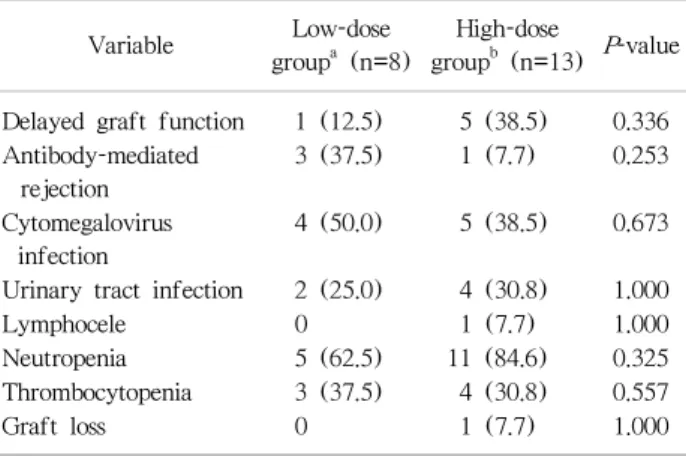
Table 2. Comparison of outcomes between low-dose and high-dose groups
Variable Low-dose
group
a(n=8)
High-dose
group
b(n=13) P -value Delayed graft function 1 (12.5) 5 (38.5) 0.336 Antibody-mediated
rejection
3 (37.5) 1 (7.7) 0.253
Cytomegalovirus infection
4 (50.0) 5 (38.5) 0.673
Urinary tract infection 2 (25.0) 4 (30.8) 1.000
Lymphocele 0 1 (7.7) 1.000
Neutropenia 5 (62.5) 11 (84.6) 0.325
Thrombocytopenia 3 (37.5) 4 (30.8) 0.557
Graft loss 0 1 (7.7) 1.000
Data are presented as number (%).
a
Low-dose group: thymoglobulin <6.0 mg/kg;
bHigh-dose group:
thymoglobulin ≥6.0 mg/kg.
mean values of finally checked serum creatinine between two groups had statistical indifference (Table 1).
Group A presented lower incidence of DGF and higher in the incidence of AMR than group B, but there were no significant differences. There were no differences in CMV infection and urinary tract infection. There were eight cases of CMV gastritis (4 vs. 4), one CMV nephritis (group B).
There were three patients who had presented CMV in- fection twice or more (1 vs. 2). In group A, there was one miliary tuberculosis. In addition, there was one pulmonary tuberculosis with central nervous system tuberculoma in group B. One BK virus infection was presented as BK vir- emia with BK nephropathy that occurred in group A. There was no statistical difference in overall infectious disease be- tween two groups. Lymphocele was occurred only one case which is group B. Hematologic complications including neu- tropenia and thrombocytopenia occurred similarly between two groups. The serious adverse events such as serum sick- ness and delayed cardiopulmonary reaction did not occur in both groups. There was one case of graft loss in group B (Table 2). The cause of graft loss was uncontrolled rejection combined with infection.
DISCUSSION
Among patients with high risk for acute AMR and DGF, thymoglobulin is better than basiliximab in diverse as-
pects(1-5). But basiliximab is preferred to thymoglobulin because full dose thymoglobulin (7∼10 mg/kg) was asso- ciated with higher rates of infectious disease or hematologic complications. In most cases, infection rates were high in full dose thymoglobulin group, so we designed cut off level of thymoglobulin by 6 mg/kg and compared acute AMR, DGF, infection, hematologic complication, and graft surviv- al between two groups(6).
There were no statistical differences in acute AMR and DGF between two groups. Acute rejections were more fre- quent in low-dose thymoglobulin group because there were more patients with high PRA or re-transplantation in group A. DGF were more frequent in group B because there were more cases with extended criteria donors.
Use of thymoglobulin more than 7 mg/kg has been asso- ciated with more frequent infectious complications(6).
Although divided by 6 mg/kg, there were no significant dif- ferences between two groups in this study. CMV infections occurred more frequently in our study irrespective of thy- moglobulin dose, compared to usual incidence. Especially, recurrent CMV infections were more frequent in high-dose thymoglobulin group. It seems to need more intensive pro- phylaxis to prevent CMV infection in the patient treated with thymoglobulin by induction therapy(9).
By using low-dose thymoglobulin, we could not observe differences in acute rejection and graft loss compare to high-dose thymoglobulin. It suggests that low-dose thymo- globulin is not inferior to high-dose on the effect of defend- ing an acute rejection and DGF. We recommend the optimal dose of thymoglobulin to be less than 6 mg/kg.
We recognized that our study has several limitations. The result was seems to be carried out with relatively small num- ber of patients, which limits its statistical power to compare the effect of low-dose thymoglobulin with high-dose thy- moglobulin in high risk patients. In addition, the period for following up the patients’ course were not sufficient. It would be innovative to identify the optimal dose of thymo- globulin if the large study is performed with long term fol- low-up.
CONCLUSION
Low dose thymoglobulin was effective as much as high
85
Yaerim Kim, et al: Dose of Thymoglobulin in Kidney Transplantation
dose for prevention of acute rejection and DGF in high risk patients. The incidences of complications like infection and hematologic problem were not different between two groups. Although we need more study to lower the dose of thymoglobulin, we can suggest that less than 6 mg/kg of thymoglobulin is efficient for prevention of acute rejection and DGF in high risk patients.