• 검색 결과가 없습니다.

$TNF{\alpha}$ Increases the Expression of ${\beta}2$ Adrenergic Receptors in Osteoblasts

N/A
N/A
Protected

Academic year: 2021

Share "$TNF{\alpha}$ Increases the Expression of ${\beta}2$ Adrenergic Receptors in Osteoblasts"

Copied!
6
0
0

로드 중.... (전체 텍스트 보기)

전체 글

(1)

Copyright ⓒ 2011, The Korean Academy of Oral Biology

173

Journal of Oral Biology

TNF α Increases the Expression of β2 Adrenergic Receptors in Osteoblasts

Kyunghwa Baek, Hye-Lim Lee, Hyo Rin Hwang, Hyun-Jung Park, Arang Kwon, Abdul S. Qadir, and Jeong-Hwa Baek*

Department of Molecular Genetics, School of Dentistry and Dental Research Institute, Seoul National University, Seoul 110-749, Korea

(received October 13, 2011 ; revised November 2, 2011 ; accepted November 11, 2011)

Tumor necrosis factor alpha (TNF α) is a multifunctional cytokine that is elevated in inflammatory diseases such as atherosclerosis, diabetes and rheumatoid arthritis. Recent evidence has suggested that β2 adrenergic receptor (β2AR) activation in osteoblasts suppresses osteogenic activity. In the present study, we explored whether TNF α modulates βAR expression in osteoblastic cells and whether this regulation is associated with the inhibition of osteoblast differentiation by TNFα. In the experiments, we used C2C12 cells, MC3T3- E1 cells and primary cultured mouse bone marrow stromal cells. Among the three subtypes of βAR, β2 and β3AR were found in our analysis to be upregulated by TNF α. Moreover, isoproterenol-induced cAMP production was observed to be significantly enhanced in TNF α-primed C2C12 cells, indi- cating that TNF α enhances β2AR signaling in osteoblasts.

TNF α was further found in C2C12 cells to suppress bone morphogenetic protein 2-induced alkaline phosphatase (ALP) activity and the expression of osteogenic marker genes including Runx2, ALP and osteocalcin. Propranolol, a β2AR antagonist, attenuated this TNFα suppression of osteogenic differentiation. TNF α increased the expression of receptor activator of NF- κB ligand (RANKL), an essential osteoclastogenic factor, in C2C12 cells which was again blocked by propranolol. In summary, our data show that TNF α increases β2AR expression in osteoblasts and that a blockade of β2AR attenuates the suppression of osteogenic differentiation and stimulation of RANKL expression by TNF α. These findings imply that a crosstalk between TNFα

and β2AR signaling pathways might occur in osteoblasts to modulate their function.

Key words: TNF α, β2 adrenergic receptor, osteoblasts

Introduction

Mammalian bone is highly innervated with sympathetic nerve fibers. Several neurotransmitters, neuropeptides, and their receptors are detectable in the bone and bone marrow microenvironment, where they locally control the develop- ment and differentiation of osteoblasts and osteoclasts (Togari and Arai, 2008). β2 Adrenergic receptors (AR) are the major adrenergic receptor subtype expressed in osteo- blasts, via which the sympathetic nervous system regulates bone formation and resorption (Feve et al., 1991; El Hadri et al., 1996; Fu et al., 2005). It has been demonstrated that β AR activation suppresses osteoblastic activity and the rate of bone formation (Fu et al., 2005) while enhancing osteoclastic differentiation (Elefteriou et al., 2005).

Tumor necrosis factor alpha (TNF α) is a multifunctional cytokine that regulates various cellular and biological processes such as cell proliferation, differentiation, apoptosis and immune function (Cope et al., 1997). Increased pro- duction of TNF α has been implicated in a number of human diseases involving inflammation, such as rheumatoid arthritis, diabetes and vascular disease (Maini, 1996; Navarro- Gonzalez et al., 2009). During the rheumatoid arthritis patho- logical processes, TNF α is largely produced from inflamed synovium and causes activation and maturation of osteoclasts deviated from bone remodelling cycle, resulting in both local and systemic bone resorption. In addition to direct stimulatory effect on osteoclast precursor cells, TNF also

*Corresponding author: Jeong-Hwa Baek, Department of Molecular Genetics, School of Dentistry, Seoul National University, 28 Yeongun-dong, Jongno-gu, Seoul 110-749, Korea

Tel: +82-2-740-8688; Fax: +82-2-741-3193

E-mail: [email protected]

(2)

enhances osteoclastogenesis through the up-regulation of receptor activator of nuclear factor kappa-B ligand (RANKL) which is an essential cytokine for osteoclast differentiation (Lacey et al., 1998; Zhang et al., 2001; Kim et al., 2002).

TNF α also suppresses the osteoblast differentiation and bone formation partly through NF- κB activation (McMahon and Ueki, 2008; Lee et al., 2010).

It has been reported that β2 AR expression is increased by TNF α in murine 3T3-F442A adipocytes (Hadri et al., 1997). No one study, to our knowledge, has studied the possibility of TNF α regulation on β AR expression and its downstream signaling in association with TNF α inhibition of osteoblastogenesis and TNF α stimulation of osteo- clastogenesis. In the present study, we investigated whether TNF α regulates β AR expression in osteoblasts. We also examined whether the blockade of β AR could reverse TNF α inhibition of osteoblast differentiation and/or TNFα stimulation of RANKL expression.

Materials and Methods

Reagents and antibodies

Alpha modified Eagle’s medium ( αMEM) and Dulbecco's Modified Eagle's Medium (DMEM) were purchased from Hyclone (Logan, UT, USA) and fetal bovine serum (FBS) was from BioWhittaker (Walkersville, MD, USA). Bioactive recombinant human bone morphogenetic protein 2 (BMP2) and TNF α protein were obtained from R&D Systems (Minneapolis, MN, USA). easy-BLUE

TM

for total RNA extraction and StarTaq

TM

polymerase for polymerase chain reaction (PCR) amplification were purchased from iNtRON Biotechnology (Sungnam, Korea). AccuPower RT PreMix for the first-strand cDNA synthesis was purchased from Bioneer (Daejeon, Korea). SYBR premix EX Taq was obtained from TaKaRa (Otsu, Japan). PCR primers were synthesized by Cosmogenetech (Seoul, Korea). Lipofect- AMINE

TM

reagent was purchased from Invitrogen (Carlsbad, CA, USA). Anti- β2 AR antibodies were purchased from Abcam (Cambridge, UK) and goat anti-rabbit HRP-con- jugated antibody was from Santa Cruz (Santa Cruz, CA, USA).

Cell culture

Osteoblastic MC3T3-E1 cells and primary cultured mouse bone marrow stromal cells (bMSCs) were maintained in α- MEM supplemented with 10% FBS. C2C12, a murine mesenchymal precursor cell line, was maintained in DMEM supplemented with 10% FBS. To promote osteogenic differentiation, MC3T3-E1 cells and bMSCs were cultured in osteogenic media (consisting of regular growth media plus 50 µM ascorbic acid and 10 mM β-glycerophosphate), with media replaced every other day. To promote osteogenic differentiation of C2C12, the cells were cultured in DMEM supplemented with 5% FBS and 50 ng/ml of BMP2, with

media replaced every other day.

Preparation of mouse bMSCs

Bone marrow cells were prepared from 5 month-old C57Black/6J mice as follows. Four mice were used for the preparation of bone marrow aspirates. The femora and tibiae were dissected free of soft tissues and kept in cold phosphate-buffered saline on ice. The bones were cut open at both ends and flushed with growth media using a 22- gauge syringe followed by filtration through a 70- µm nylon mesh filter. Bone marrow aspirates were dispersed with a 25-gauge syringe to produce a single cell suspension.

Measurement of intracellular cAMP accumulation C2C12 cells were pretreated or not with 10 ng/ml TNF α for 2 hr and then stimulated with vehicle or isoproterenol (1 µM) for 15 min. The amount of cAMP in cell lysates was determined by the cAMP ELISA kit (R&D Systems, Minneapolis, MN) according to the manufacturer’s instruc- tions.

Reverse transcription-PCR (RT-PCR)

To evaluate mRNA expression, semi-quantitative RT-PCR or quantitative real time PCR was performed. Total RNAs were isolated using easy-BLUE

TM

RNA Extraction Reagents.

cDNA was synthesized from total RNA by using AccuPower RT PreMix and was subsequently used for PCR ampli- fication. Semi-quantitative RT-PCR products were electro- phoresed on 1.2% agarose gel and visualized under UV light by ethidium bromide staining. Mouse genes and their primer sequences for PCR were as follows: β2 AR forward (f) 5’-GCC TGC TGA CCA AGA ATA AGG CC-3’, β2 AR reverse (r) 5’-CCC ATC CTG CTC CAC CT-3’; β3 AR (f) 5’-ATG GCT CCG TGG CCT CAC-3’, β3 AR (r) 5’-CCC AAC GGC CAG TGG CCA GTC AGC G-3’; GAPDH (f) 5’-TCA CCA TCT TCC AGG AGC G-3’ and GAPDH (r) 5’-CTG CTT ACC ACC TTC TTG A-3’. Florescence- based real time PCR was carried out using SYBR premix EX Taq in an AB 7500 Fast Real-Time system (Applied Biosystems; Foster City, CA, USA). The following primers were used for PCR: β2 AR (f) 5’-GGA CAA CCT CAT CCC TAA-3’, β2 AR (r) 5’-AGA GTA GCC GTT CCC ATA-3’; alkaline phosphatase (ALP) (f) 5-CCA ACT CTT TTG TGC CAG AGA-3, ALP (r) 5-GGC TAC ATT GGT GTT GAG CTT TT-3; osteocalcin (OCN) (f) 5-CTG ACA AAG CCT TCA TGT CCA A-3, OCN (r) 5-GCG CCG GAG TCT GTT CAC TA-3; Runx2 (f) 5-TTC TCC AAC CCA CGA ATG CAC-3, Runx2 (r) 5-CAG GTA CGT GTG GTA GTG AGT-3; GAPDH (f) 5-TCA ATG ACA ACT TTG TCA AGC-3 and GAPDH (r) 5-CCA GGG TTT CTT ACT CCT TGG-3. For quantification, GAPDH was used as the reference for normalization of each sample.

Western blot analysis

After appropriate treatments, cells were washed with

(3)

phosphate-buffered saline and scraped into lysis buffer consisting of 10 mM Tris-Cl (pH 7.5), 150 mM NaCl, 1 mM EDTA (pH 8.0), 1% Triton X-100, 0.5% sodium deoxy- cholate, 0.1% SDS, 50 mM sodium fluoride, 0.2 mM sodium orthovanadate, 1 mM PMSF, 1 µg/ml aprotinin, 1 µM leupeptin and 1 µM pepstatin, and sonicated briefly.

Proteins were subjected to SDS-PAGE and subsequently electro-transferred onto a PVDF membrane. The membrane was blocked with 5% nonfat dry milk in Tris-buffered saline containing 0.1% Tween20 and incubated with the indicated primary antibody followed by incubation with HRP- conjugated secondary antibody. Immune complexes were visualized with Supex reagent (Dyne-Bio, Sungnam, Korea) and luminescence was detected in LAS1000 (Fuji PhotoFilm, Tokyo, Japan).

Statistical analysis

The data are presented as means ± SD. The statistical significance of the results was assessed by the Student’s t-test.

A p value < 0.05 was considered statistically significant.

Results

TNF α increases β2 AR expression in osteoblast lineage cells

Since β2 AR is the major AR subtype expressed in osteoblasts, we first evaluated the effect of TNF α on β2 AR gene expression. C2C12 cells are mesenchymal precursor cells which can differentiate into myoblasts and osteoblasts.

MC3T3-E1 cells are pre-osteoblasts. Primary bMSCs are a mixed cell population that contains cells, such as mesen- chymal stem cells and pre-osteoblasts. These cells were

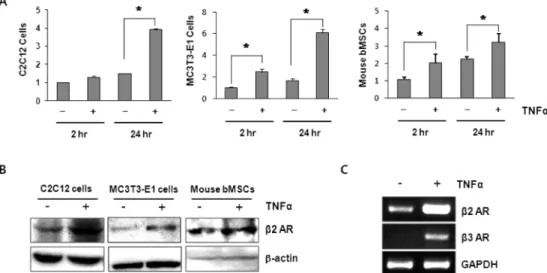
incubated in osteogenic medium and exposed to 10 ng/ml of TNF α for 2 and 24 hr. TNFα led to an increment of β2 AR mRNA expression in all of the cells examined in a time- dependent manner, as quantified by real time PCR (Fig.

1A). To determine whether the transcriptional stimulation of β2 AR expression in response to TNFα was translated into an increase in β2 AR protein expression, we performed western blot analyses. As shown in Fig. 1B, β2 AR protein expression in C2C12 cells, MC3T3-E1 cells and bMSCs increased upon TNF α treatment, similarly to that observed at the mRNA level. These results indicate that TNF α up- regulated β2 AR expression levels in osteoblast lineage cells.

In addition, modulation of β AR expression by TNFα was not limited to the β2 AR subtype. Exposure of C2C12 cells to TNF α slightly increased β3 AR mRNA expression (Fig.

1C). However, β1 AR expression was not detected in C2C12 cells regardless of TNF α treatment (data not shown).

To determine whether TNF α really enhances β AR signaling in osteoblasts, we measured cAMP production that is induced by isoproterenol, a β AR agonist. Isoproterenol significantly increased cellular cAMP level in C2C12 cells.

Priming of C2C12 cells with TNF α for 2 hr further enhanced isoproterenol-induced cAMP production (Fig. 2). These results indicate that TNF α up-regulates β AR down- stream signaling in osteoblasts.

Propranolol partially alleviates TNFα inhibition of osteogenic differentiation

In vitro and in vivo studies have been shown that propranolol, a β AR antagonist, promotes osteogenesis and bone gain, inhibits bone resorption and protects bone from sympathetic nervous system stimulation-induced loss (Takeda et al., 2002; Bonnet et al., 2008; Sato et al., 2010). Therefore,

Fig. 1. TNFα increases the expression levels of β2 adrenergic receptor (β2 AR) in osteoblasts. C2C12, MC3T3-E1 and primary cultured

mouse bone marrow stromal cells (bMSCs) were incubated in osteogenic media in the presence or absence of TNFα (10 ng/ml) for 2 hr (A)

or 24 hr (A-C). β2 AR expression was analyzed by quantitative RT-PCR (A), western blot (B) and semiquantitative RT-PCR (C). β3 AR

expression level was also examined in C2C12 cells (C). (A) Relative transcripts level of β2 AR was normalized to GAPDH. The data

represent the mean ± SD of duplicates. * p < 0.05, statistically significant.

(4)

we hypothesized that TNF α might suppress osteoblast differentiation partially through the up-regulation of β2 AR signaling in osteoblasts and that the deleterious effect of TNF α on the osteoblasts might be attenuated by blockade of β2 AR signaling. We induced osteoblastic differentiation of C2C12 cells by BMP2 treatment for 48 hr in the presence or absence of TNF α, isoproterenol and propranolol. Then, osteoblastic differentiation was evaluated by cytochemical staining of ALP and quantitative RT-PCR analyses of ALP, OCN and Runx2. ALP staining showed that TNF α sup- pressed BMP2-induced ALP activity in C2C12 cells (Fig.

3A). Addition of isoproterenol further decreased TNF α- suppressed ALP activity whereas propranolol slightly attenu- ated TNF α inhibition of ALP activity (Fig. 3A). BMP2 increased mRNA expression of osteoblast differentiation marker genes, such as Runx2, ALP and OCN (Fig. 3B).

TNF α suppressed BMP2 enhancement of the expression of these genes whereas propranolol significantly attenuated the suppressive effect of TNF α (Fig. 3B). However, addition of isoproterenol did not further enhance the suppressive effect of TNF α on osteogenic marker gene expression in C2C12 cells. These results suggest that β AR signaling participates in TNF α suppression of osteogenic differentiation in osteoblasts.

Propranolol blocks TNFα stimulation of RANKL expression in C2C12 cells

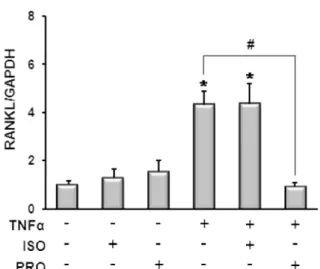
RANKL is highly expressed in immature osteoblasts and its expression is further stimulated by TNF α (Romas et al., 2002). Given that RANKL is essential for the regulation of osteoclastogenesis, we next examined the effect of β AR blockade on TNF α-induced RANKL expression in C2C12 cells. TNF α induced 3.5-fold increase in RANKL mRNA

level (Fig. 4). Propranolol completely blocked TNFα induction of RANKL expression whereas addition of iso- proterenol did not exert any significant effect (Fig. 4).

Isopranolol or propranolol alone did not change the expression level of RANKL. These results suggest that β AR signaling is involved in TNF α induction of RANKL expression.

Fig. 2. TNFα priming enhances isoproterenol-induced cAMP pro- duction. C2C12 cells were pretreated with TNFα (10 ng/ml) for 2 hr and then stimulated with vehicle or isoproterenol (1 µM) for 15 min.

Then, cAMP level was measured with cell lysates using ELISA kit.

The data represent mean ± SD of three independent experiments.

*p < 0.05, compared to vehicle only; #p < 0.05 for indicated com- parison.

Fig. 3. Propranolol partially alleviates TNFα suppression of osteo- genic differentiation. C2C12 cells were cultured in osteogenic medium supplemented with indicated reagents for 48 hr. At the end of culture period, ALP staining (A) and real time PCR (B) were performed to evaluate osteogenic differentiation. The data represent the mean ± SD of duplicates. *p < 0.05, compared to BMP2 only;

#p < 0.05 for indicated comparison. PRO, 10 µM propranolol;

ISO, 1 µM isoproterenol; TNFα, 10 ng/ml; BMP2, 50 ng/ml bone

morphogenetic protein 2.

(5)

Discussion

In the present study, we demonstrated that TNF α up- regulates β2 AR expression and their downstream signaling activity in osteoblasts. Since β2 AR signaling is considered as a negative regulator of osteoblast differentiation, it is questionable whether TNF α-induced up-regulation of this receptor subclass partially mediates TNF α suppression of osteogenic differentiation. Supporting this hypothesis, our results demonstrated that blockade of β AR signaling by propranolol attenuates TNF α suppression of osteogenic dif- ferentiation. Furthermore, propranolol completely pre- vents TNF α induction of RANKL expression in C2C12 cells.

TNF- α led to an increment of β2 AR mRNA and protein expression in C2C12 cells, MC3T3-E1 cells and in primary cultured bMSCs. In accordance with increase in β2 AR expression, TNF α priming enhanced isoproterenol-induced cAMP production. These results indicate that TNF α in- duction of β2 AR expression is functional in osteoblasts.

This is in agreement with the previous finding that TNF α increased β2 AR expression in 3T3-F442A adipocytes (Hadri et al., 1997). In that study, TNFα increased both β2 AR gene transcription and β2 AR mRNA half-life while decreasing β3 AR mRNA expression in 3T3-F442A adipocytes. In current study, however, β3AR mRNA level increased with TNF α treatment in C2C12 cells. β2 AR is the major beta adrenergic receptor subtype expressed in murine osteoblasts (Feve et al., 1991; Collins et al., 1994) whereas β3 AR is considered as a marker of adipose conversion of murine adipocytic cells (Feve et al., 1991; El Hadri et al., 1996). Because the regulation of β3 AR expression by glucocorticoids, cAMP, or phorbol esters has been shown to depend on species (Granneman and Lahners, 1994), we

cannot yet extrapolate the present results to human osteoblasts. But a previous study has also shown that TNF α slightly induced β2 AR expression in human lung cells (Stern and Kunos, 1988), suggesting the possibility that TNF α might up-regulate β2 AR expression in human osteoblasts.

From a different perspective, increased β2 and β3 AR expression in C2C12cells was observed in osteogenic con- dition in current study, suggesting that there might be an additional β AR expression-regulation mechanism influ- enced by osteogenic process.

Although TNF α priming increased isoproterenol-induced cAMP production, addition of isoproterenol did not enhance TNF α suppression of osteogenic differentiation or TNFα stimulation of RANKL production. Furthermore, in the absence of TNF α, isoproterenol alone did not exhibit significant inhibitory effect on osteoblast differentiation in our culture system even when we used higher concentration of isoproterenol than 1 µM (data not shown). However, β AR blockade with propranolol consistently attenuated TNF α suppression of osteogenic differentiation and TNFα stimulation of RANKL production. Because we used in vitro culture system that is deficient of sympathetic innervations, we do not have any idea explaining how β AR blockade diminishes TNF α action in osteoblasts. Our group has previously reported that RANKL, a ligand for RANK which belongs to the same receptor family as TNF receptor, transactivates epidermal growth factor receptors in a ligand- independent manner in osteoclasts (Yi et al., 2008). In addition, another report demonstrated that TNF α trans- activates epidermal growth factor receptors in human tracheal smooth muscle cells (Lee et al., 2007). These reports suggest the possibility that TNF α transactivates β AR and sub- sequently activated downstream signaling of β AR partially mediates TNF α action in osteoblasts. To clarify the role of β2 AR signaling in TNFα action in osteoblasts, further investigation with β2 AR silencing approach is necessary.

In conclusion, our findings demonstrate that TNF α induces β2 AR expression in osteoblast lineage cells and that blockade of β AR attenuates TNFα action in osteoblasts.

Acknowledgements

This research was supported by the Basic Science Research Program through the National Research Foundation of Korea (NRF) funded by the Ministry of Education, Science and Technology (2011-0005938).

References

Bonnet N, Benhamou CL, Malaval L, Goncalves C, Vico L, Eder V, Pichon C, Courteix D. Low dose beta-blocker prevents ovariectomy-induced bone loss in rats without affecting heart functions. J Cell Physiol. 2008;217:819-27.

Fig. 4. Propranolol blocks TNFα stimulation of RANKL expres-

sion. C2C12 cells were cultured in osteogenic medium supple-

mented with the indicated reagents for 48 hr and real time PCR was

performed. The data represent the mean ± SD of three independent

experiments. *p < 0.05, compared to vehicle only; #p < 0.05 for

indicated comparison.

(6)

Collins S, Daniel KW, Rohlfs EM, Ramkumar V, Taylor IL, Gettys TW. Impaired expression and functional activity of the beta 3- and beta 1-adrenergic receptors in adipose tissue of congenitally obese (C57BL/6J ob/ob) mice. Mol Endocrinol.

1994;8:518-27.

Cope AP, Liblau RS, Yang XD, Congia M, Laudanna C, Schreiber RD, Probert L, Kollias G, McDevitt HO. Chronic tumor necrosis factor alters T cell responses by attenuating T cell receptor signaling. J Exp Med. 1997;185:1573-84.

El Hadri K, Feve B, Pairault J. Developmental expression and functional activity of beta 1- and beta 3-adrenoceptors in murine 3T3-F442A differentiating adipocytes. Eur J Pharm- acol. 1996;297:107-19.

Elefteriou F, Ahn JD, Takeda S, Starbuck M, Yang X, Liu X, Kondo H, Richards WG, Bannon TW, Noda M, Clement K, Vaisse C, Karsenty G. Leptin regulation of bone resorption by the sympathetic nervous system and CART. Nature.

2005;434:514-20.

Feve B, Emorine LJ, Lasnier F, Blin N, Baude B, Nahmias C, Strosberg AD, Pairault J. Atypical beta-adrenergic receptor in 3T3-F442A adipocytes. Pharmacological and molecular relationship with the human beta 3-adrenergic receptor. J Biol Chem. 1991;266:20329-36.

Fu L, Patel MS, Bradley A, Wagner EF, Karsenty G. The molecular clock mediates leptin-regulated bone formation.

Cell. 2005;122:803-15.

Granneman JG, Lahners KN. Analysis of human and rodent beta 3-adrenergic receptor messenger ribonucleic acids.

Endocrinology. 1994;135:1025-31.

Hadri KE, Courtalon A, Gauthereau X, Chambaut-Guerin AM, Pairault J, Feve B. Differential regulation by tumor necrosis factor-alpha of beta1-, beta2-, and beta3-adrenoreceptor gene expression in 3T3-F442A adipocytes. J Biol Chem. 1997;272:

24514-21.

Kim SN, Kim YH, Kim GS, Baek JH. Effect of Osteotropic Agents on the Expression of RANKL and OPG in Saos-2 Cells. Int J Oral Biol. 2002;27:15-21.

Lacey DL, Timms E, Tan HL, Kelley MJ, Dunstan CR, Burgess T, Elliott R, Colombero A, Elliott G, Scully S, Hsu H, Sullivan J, Hawkins N, Davy E, Capparelli C, Eli A, Qian YX, Kaufman S, Sarosi I, Shalhoub V, Senaldi G, Guo J, Delaney J, Boyle WJ. Osteoprotegerin ligand is a cytokine that regulates osteoclast differentiation and activation. Cell.

1998;93:165-76.

Lee CW, Lin CC, Lin WN, Liang KC, Luo SF, Wu CB, Wang SW, Yang CM. TNF-alpha induces MMP-9 expression via

activation of Src/EGFR, PDGFR/PI3K/Akt cascade and promotion of NF-kappaB/p300 binding in human tracheal smooth muscle cells. American journal of physiology Lung cellular and molecular physiology. 2007;292:L799-812.

Lee HL, Yi T, Woo KM, Ryoo HM, Kim GS, Baek JH. Msx2 mediates the inhibitory action of TNF-alpha on osteoblast differentiation. Exp Mol Med. 2010;42:437-45.

Maini RN. The role of cytokines in rheumatoid arthritis. The Croonian Lecture 1995. J R Coll Physicians Lond. 1996;30:

344-51.

McMahon MS, Ueki Y. Does anti-TNF-alpha have a role in the treatment of osteoporosis? Bull NYU Hosp Jt Dis.

2008;66:280-1.

Navarro-Gonzalez JF, Jarque A, Muros M, Mora C, Garcia J.

Tumor necrosis factor-alpha as a therapeutic target for diabetic nephropathy. Cytokine Growth Factor Rev. 2009;20:

165-73.

Romas E, Gillespie MT, Martin TJ. Involvement of receptor activator of NFkappaB ligand and tumor necrosis factor- alpha in bone destruction in rheumatoid arthritis. Bone.

2002;30:340-6.

Sato T, Arai M, Goto S, Togari A. Effects of propranolol on bone metabolism in spontaneously hypertensive rats. J Pharmacol Exp Ther. 2010;334:99-105.

Stern L, Kunos G. Synergistic regulation of pulmonary beta- adrenergic receptors by glucocorticoids and interleukin-1. J Biol Chem. 1988;263:15876-9.

Takeda S, Elefteriou F, Levasseur R, Liu X, Zhao L, Parker KL, Armstrong D, Ducy P, Karsenty G. Leptin regulates bone formation via the sympathetic nervous system. Cell.

2002;111:305-17.

Togari A, Arai M. Pharmacological topics of bone metabolism:

the physiological function of the sympathetic nervous system in modulating bone resorption. J Pharmacol Sci. 2008;106:

542-6.

Yi T, Lee HL, Cha JH, Ko SI, Kim HJ, Shin HI, Woo KM, Ryoo HM, Kim GS, Baek JH. Epidermal growth factor receptor regulates osteoclast differentiation and survival through cross-talking with RANK signaling. Journal of cellular physiology. 2008;217:409-22.

Zhang YH, Heulsmann A, Tondravi MM, Mukherjee A, Abu-

Amer Y. Tumor necrosis factor-alpha (TNF) stimulates

RANKL-induced osteoclastogenesis via coupling of TNF

type 1 receptor and RANK signaling pathways. J Biol

Chem. 2001;276:563-8.

수치

Fig. 1. TNFα increases the expression levels of β2 adrenergic receptor (β2 AR) in osteoblasts
Fig. 2. TNFα priming enhances isoproterenol-induced cAMP pro- pro-duction. C2C12 cells were pretreated with TNFα (10 ng/ml) for 2 hr and then stimulated with vehicle or isoproterenol (1 µM) for 15 min.
Fig. 4. Propranolol blocks TNFα stimulation of RANKL expres- expres-sion. C2C12 cells were cultured in osteogenic medium  supple-mented with the indicated reagents for 48 hr and real time PCR was performed

참조

관련 문서

Primary hepatocytes were incubated with T090 for 24 h following Res pretreatment (1 h). Cells were fixed and stained with Oil red O and observed under a microscope. The Oil

The proliferations of MC3T3-E1 cell seeded on pristine PCL scaffold and surface modified scaffolds for 1, 3, and 5 days... ALP activity of the MC3T3-E1 cell seeded

There was a significant increase in new bone formation in the group in which toothash and plaster of Paris and either PRP or fibrin sealants were used, compared with the groups

mRNA expression of osteonectin, Runx2 and BSP(bone sialoprotein) in MC3T3-E1 cells cultured for 24 hours on 4 different titanium surfaces.. The mRNA were analyzed

MC3T3-E1 cell morphorologies on the (a) CP-Ti surface and (b) nano-mesh surface for 20 min culturing time.. MC3T3-E1 cell morphorologies on the (a) CP-Ti surface and

The untreated surfaces and AA plasma treated with 3D-PCL surfaces were also examined for their in vitro pre-osteoblast (MC3T3-E1) cells proliferation and

In the case of inherently conducting polymers like PANI or PPY, the conductivity values of the metal oxide based composites showed wide variations excepting in PPY-ZrO 2 , and

In other words, pomegranate extract has an effect of inhibiting the progression of alveolar bone loss due to periodontal inflammation by reducing the expression of COX-1 and