Antioxidant Effects of Picrasma quassioides and Chamaecyparis obtusa (S. et Z.) ENDL Extracts
Young Tae Jung, In Seon Lee, Key Whang and Mi Hee Yu*
Department of Food Science and Technology, Keimyung University, Daegu, 704-701, Korea
Received November 17, 2011 /Revised January 11, 2012 /Accepted January 13, 2012In our study, we investigated the antioxidant effect of methanol extract from the leaves of Picrasma quassioides (PQ) and Chamaecyparis obtuse (S. et Z.) ENDL (CO). Total polyphenol contents of meth- anol extracts from PQ and CO varied from 138.3 to 367.52 μg/mg and total flavonoid contents var- ied from 8.12 to 46.41 μg/mg. Contents of polyphenol and flavonoid in PQ were found to be ex- tremely high. In addition, the methanol extract of PQ had a higher antioxidant activity in both DPPH (4.79 μg/ml) and ABTS (7.21 μg/ml) compared to other plants (CO). Based on the results of the FRAP assay, PQ showed a value of 8.52 μmol/μg and CO exhibited a value of 1.77 μmol/μg.
The methanol extracts from the leaves of PQ showed the highest radical-scavenging activity in var- ious antioxidant systems.
Key words : Antioxidant, Picrasma quassioides, Chamaecyparis obtuse (S.et Z.) ENDL
*Corresponding author
*Tel:+82-53-580-5538, Fax:+82-53-580-5538
*E-mail : [email protected]
서 론
현대사회로 접어들면서 인간의 수명이 증가됨에 따라 건강 에 대한 관심이 높아지면서 우리 몸의 노화억제와 건강함을 유지하기 위한 기능성 생리활성 물질에 대한 연구가 각 분야 별로 광범위하게 연구 되고 있다[10,38]. 산소에서 유래되는 superoxide, nitric oxide, hydroxyl, peroxyl, alkoxyl, hydro- peroxyl radical 등과 같은 활성산소종(Reactive oxygen spe- cies, ROS)은 세포 내 기관의 정상적인 대사 및 세포질 내 일부 효소들에 의하여 자연적으로 생성되며, 세포 내에 적당량이 존재할 경우 여러 가지 세포반응을 조절할 수 있는 신호분자 가 된다[43]. 하지만 과량으로 존재할 경우 생체에 치명적인 산소독성을 일으키며, 세포막 분해, 단백질 분해, 지질산화, DNA 변성 등을 초래하여 세포의 기능 장애를 유발하고 암을 비롯한 뇌졸중, 파킨슨 병 등의 뇌질환과 심장질환, 동맥경화, 염증, 노화, 자가면역질환 등의 각종 질병을 일으키는 것으로 알려져 있다[43]. 특히 생체막의 구성성분인 불포화지방산을 공격하여 생성되는 과산화 지질의 축적은 생체 기능의 저하나 노화 및 성인병을 유발하는 것으로 알려져 있다[6]. 그러므로 활성 산소를 방어하는 항산화 물질이 이러한 질병의 치료 가 능성 때문에 주목 받고 있으며, 그 중 천연물에서 추출한 천연 항산화제에 관한 연구가 활발하다. 생체 내에는 superoxide dismutase (SOD), catalase, glutathione reductase 등의 항산 화 효소와 tocopherol 등과 같은 천연항산화제가 존재하여 산 소 상해에 대한 방어기능을 하고 있지만[7,24], 과도한 스트레
스에 노출되어 있는 현대인의 복잡한 생활 속에서는 더욱 효 과적인 식이성 항산화제가 요구된다. BHT (Butylated hydrox- ytoluene)와 BHA (Butylated hydroxyanisole)의 합성항산화 제는 우수한 효과와 저렴한 가격 때문에 tocopherol이나 vita- min C 보다 널리 사용되고 있지만, 50 mg/kg/day의 용량 이상에서 지질변화 및 발암독성 때문에 사용이 제한되어 [5,18], 인체에 부작용이 없는 천연식물 추출물이 간접적으로 생체 내 항산화 방어시스템을 증가시키거나 직접적으로 ROS 를 소거시키는 효과가 있다면 그 추출물은 다양한 질병을 예 방하기 위한 기능성 소재로 사용될 수 있을 것이다[23].
페놀 화합물은 식물계에 널리 분포되어 있는 2차 대사산물 의 하나로서, 탄소 수에 따라 페놀산, 탄닌, 플라보노이드 등의 다양한 물질로 나뉠 수 있고 최근에는 다양한 식물을 대상으 로 항산화 활성과 기능성 소재로 연구가 진행되고 있다[46].
페놀화합물의 다양한 항산화력은 그 구조적인 특징과 관련성 이 높은데, 이들은 금속 킬레이트제, 환원제, 활성산소의 소거 제, 사슬전단 황산화제(chain breaking antioxidants) 등으로서 의 역할에 기인하는 것으로 알려져 있다. 그리고 플라보노이 드는 페놀화합물 중에서 자연적으로 생성되는 가장 큰 그룹의 하나로서, anthocyanins, chalcones, aurones, flavones, fla- vonols 및 이들의 유도체 등으로 나눌 수 있다. 현재까지 페놀 화합물 및 플라보노이드의 구조에 따른 항산화 활성과의 상관 성에 대한 연구도 보고되었다[21].
소태나무(Picrasma quassioides)는 쌍떡잎식물 쥐손이풀목
소태나무과의 소교목으로 잎과 줄기의 속껍질에서 소의 태처
럼 지독히 쓴맛이 나는 것에서 유래되었다. 건위․조습․살균
의 효능이 있어 한방에서는 잔가지와 열매를 채취하여 소화불
량․위장염․폐결핵․습진․옹종(癰腫)․개선(疥癬) 등의 증
상에 치료제로 사용하며, 민간에서는 나무 전체를 솥에 넣고 끓인 물을 살충제로 이용한다. 소태나무의 주요성분으로는 quasinoids, tirucallanes, ionone, alkaloids등[31,34]이 알려져 있으며, 소태나무 열매에는 arbutin, phlorin, koaburaside, sy- ringin, citrusin B, cnidioside B, flavaprenin 7,4-diglucoside, phenyl propanoids와 phenolic compound 등[22]이 함유되어 있는 것으로 보고되어 있다. 또한 소태나무과는 항암활성과 면역조절작용[29]을 지니고 있으며, 항고혈압, 항산화, 소염작 용, 해독 작용 등[31]을 가지는 것으로 알려져 있다.
노송나무라고도 불려지는 편백나무(Chamaecyparis obtusa (S. et Z.) ENDL.)는 겉씨식물 구과목 측백나무과의 상록교목으 로서 일본이 원산지이고 국내에서는 주로 제주도 및 남부지방 에서 자생한다. 일반적으로 편백나무의 강한 향은 살균, 탈취, 피부미용, 혈액순환, 감기 등에 효능이 있는 것으로 알려져 있으 며, 주요 구성성분은 monoterpene류와 sesquiterpene류인 것 으로 밝혀져 있다[9,14-16,40,41,44]. 또한 편백의 목재(wood)에 서 얻어진 정유 중에 존재하는 hinokitiol을 포함한 thujaplicin 화합물[12,20,25]은 항균 및 항미생물효과[2,42], 항산화 및 활성 산소 소거효과[2], 식품의 선도유지[13] 및 식물의 발아억제 효 과[17]등 다양한 생리활성을 지니고 있음이 밝혀져 있다.
현재 국내․외적으로 천연물로부터 기능성 성분의 소재를 발굴하기 위한 연구가 활발히 진행되고 있으나, 소태나무에 대한 생리활성에 관한 연구는 아직까지 미진한 편이며, 특히 소태나무 잎에 대한 연구는 거의 없는 실정이다. 따라서 본 연구에서는 소태나무 잎의 항산화 효능을 연구하기 위해 항산 화 효과가 우수한 편백나무 추출물을 이용하여 총 폴리페놀, 플라보노이드 함량 및 free radical 소거 활성 효과들을 비교하 였다.
재료 및 방법
시료 제조
본 실험에서 사용한 소태나무 잎과 편백나무는 대구시 약령 시장에서 건조 상태의 것을 구입하여 사용하였다. 시료는 불 순물을 제거하기 위하여 수세한 후 건조하여 사용하였고, 무 게의 10배량(w/v)의 80% 메탄올을 가하여 24시간 동안 정치 하여 총 3회 반복 추출 하였다. 추출액은 여과지(Whatman No. 3, Whatman International Ltd., Maidstone, England)로 여과한 다음 rotary evaporator (UT-1000, EYELA, Tokyo, Japan)로 55℃에서 농축한 후 동결 건조하여 메탄올 추출물로 사용하였다.
총 폴리페놀 함량
총 폴리페놀 함량은 Folin-Denis법[11]을 응용하여 측정하 였다. 즉 각 메탄올 추출물 시료 1 mg을 증류수 1 ml에 녹이고 10배 희석한 희석액 2 ml에 2배 희석한 Folin시약 2 ml를 첨가
하고 잘 혼합한 후 3분간 방치한 후 10% Na
2CO
32 ml를 넣고 1시간 반응시킨 후 UV/Visible spectrophotometer(UVIKON 922, Kontron, Italy)를 사용하여 700 nm에서 흡광도를 측정하 여 작성한 표준곡선으로부터 함량을 구하였다. 이 때 tannic acid를 이용한 표준곡선은 5,10,25,50,75,100 μg/ml가 되도록 하여 위와 같은 방법으로 700 nm에서 흡광도를 측정하였다.
총 플라보노이드 함량
각 시료 추출물의 총 플라보노이드 함량은 Nieva Moreno [33] 방법을 이용하여 측정하였다. 각 시료 추출물 0.1 ml에 80% ethyl alcohol 0.9 ml, 10% aluminum nitrate 0.1 ml, 1 M potassium acetate 0.1 ml 및 80% ethyl alcohol 4.3 ml를 혼합하여 실온에서 30분간 반응시킨 후 spectrophotometer를 이용하여 415 nm에서 흡광도를 측정하였다. 표준물질로 quercetin을 사용하였으며, 표준물질의 검량선과 비교하여 함 량을 구하였다.
α -α-Diphenyl-β-picrylhydrazyl (DPPH) radical 소거 활성
DPPH radical을 이용한 항산화력은 Blois 방법[4]을 이용하 여 실험하였다. 시료의 free radical 소거 활성은 stable radical 인 α-α-diphenyl-β-picrylhydrazyl (DPPH)에 대한 환원력을 측정한 것으로 99% 메탄올에 각 시료를 녹여 농도별로 희석한 희석액 160 μl와 메탄올에 녹인 0.15 mM DPPH 용액 40 μl를 가하여 실온에 30분 방치한 후 517 nm에서 흡광도를 측정하였 다. 각 시료 추출물의 free radical 소거활성은 시료를 첨가하지 않은 대조구의 흡광도를 1/2로 환원시키는데 필요한 시료의 농도인 RC
50값으로 나타내었다. 이때 활성비교를 위하여 BHA와 ascorbic acid를 사용하였다.
ABTS radical 소거 활성
ABTS radical을 이용한 항산화력 측정은 ABTS+․ cation decolorization assay방법[35]에 의하여 시행되었다. 7 mM 2,2'-azino-bis (3-ethylbenzthiazoline-6-sulfonicacid) (ABTS, Sigma Chemical Co., St. Louis, MO, USA)와 2.45 mM potas- sium persulfate를 최종 농도로 혼합하여 실온인 암소에서 24 시간 동안 방치하여 ABTS+․을 형성시킨 후 96 well에 734 nm에서 흡광도 값이 0.70(±0.02)이 되게 phosphate buffer sal- ine (PBS, pH 4)로 희석하였다. 희석된 용액 180 μl에 sample 20 μl를 가하여 정확히 1분 동안 방치한 후 흡광도를 측정하였 다. 각 시료 추출물과 단일 물질의 유리 라디칼 소거 활성은 시료를 첨가하지 않은 대조구의 흡광도를 1/2로 환원시키는 데 필요한 시료의 농도인 RC
50값으로 나타내었다.
Ferric reducing/antioxidant power (FRAP) 측정
FRAP assay는 Benizie와 Strain 방법[3]을 일부 변형하여
Table 1. Contents of total polyphenols and flavonoids in methanol extracts from
Picrasma quassioides and Chamaecyparis obtusa
(S.et Z.) ENDL
Plant Part used Total polyphenols1 (μg/mg) Total flavonoids2 (μg/mg)
Picrasma quassioides
Leaf 367.52±10.413 46.41±0.32Chamaecyparis obtusa
(S. et Z.) ENDL xylem 138.30±4.40 8.12±1.241Micrograms of total polyphenol content/mg of plants based on tannic acid as standard.
2Micrograms of total flavonoid content/mg of plants based on quercetin acid as standard.
3Each value is mean±S.D. (n≥3).
실시하였다. 반응액은 300 mM acetate buffer (pH 3.6): 10 mM TPTZ (2,4,6-tripyridyl-s-triazine): 20 mM FeCl
3․6H
2O를 10:1:1의 비율로 실험 직전에 만들어 사용하였다. 반응액과 시 료를 혼합하여 4분간 반응시킨 후 593 nm에서 흡광도를 측정 하였다. 시료의 환원력은 0.1~1 mM FeSO
4․7H
2O로 표준곡 선을 작성하여 추출물 1 μg당 Fe
2+μ mole로 표시하였다.
결과 및 고찰
폴리페놀 및 플라보노이드 함량
폴리페놀계 물질들은 식물체에 특수한 색깔을 부여하고 산화 환원반응에서 기질로 작용하며, 한 분자 내에 2개 이상 의 phenolic hydroxyl (OH)기를 가진 방향족 화합물을 가리 키며 플라보노이드와 탄닌이 주성분으로 충치 예방, 고혈압 억제, 항에이즈, 항산화, 항암 등의 다양한 생리활성을 가진 다[45]. 먼저 소태나무 잎 및 편백나무 메탄올 추출물에 존 재하는 총 폴리페놀 및 플라보노이드 함량을 각각 tannic acid, quercetin을 기준 물질로 하여 측정하였다(Table 1). 그 결과, 소태나무 잎 추출물의 총 폴리페놀 함량은 367.52 μg/
mg, 편백나무 추출물은 138.3 μg/mg으로 소태나무 잎에서 높은 폴리페놀 함량을 보였다. 총 플라보노이드 함량은 소 태나무 잎과 편백나무 추출물이 각각 46.41, 8.12 μg/mg으 로 나타났다.
국내산 산채류인 섬고사리와 물엉겅퀴 잎의 총 폴리페놀 함량은 각각 120.69, 130.22 μg/mg이었고, 플라보노이드 함량 은 각각 16.75, 13.3 μg/mg으로 보고되었다[26]. 이 결과와 비 교 했을 때 소태나무 잎 및 편백나무 추출물은 산채류와 유사 하거나 비교적 많은 양의 폴리페놀과 플라보노이드를 함유하 고 있으며, 특히 소태나무 잎 추출물의 폴리페놀 및 플라보노 이드 함량이 매우 높음을 알 수 있었다.
DPPH free radical 소거 활성
DPPH는 짙은 자색을 띄는 비교적 안정한 free radical로서 cystein, glutathione과 같은 아미노산과 ascorbic acid, BHA 등에 의해 환원되어 탈색되므로 다양한 천연소재로부터 항산 화물질을 검색하는데 많이 이용되고 있다. Free radical은 인체 내에서 지질 또는 단백질 등과 결합하여 노화를 일으키기 쉬
운데 페놀성 화합물의 경우 free radical을 환원시키거나 상쇄 시키는 능력이 강해 인체 내에서 free radical 에 의한 노화를 억제하는 척도로 이용할 수 있다[1].
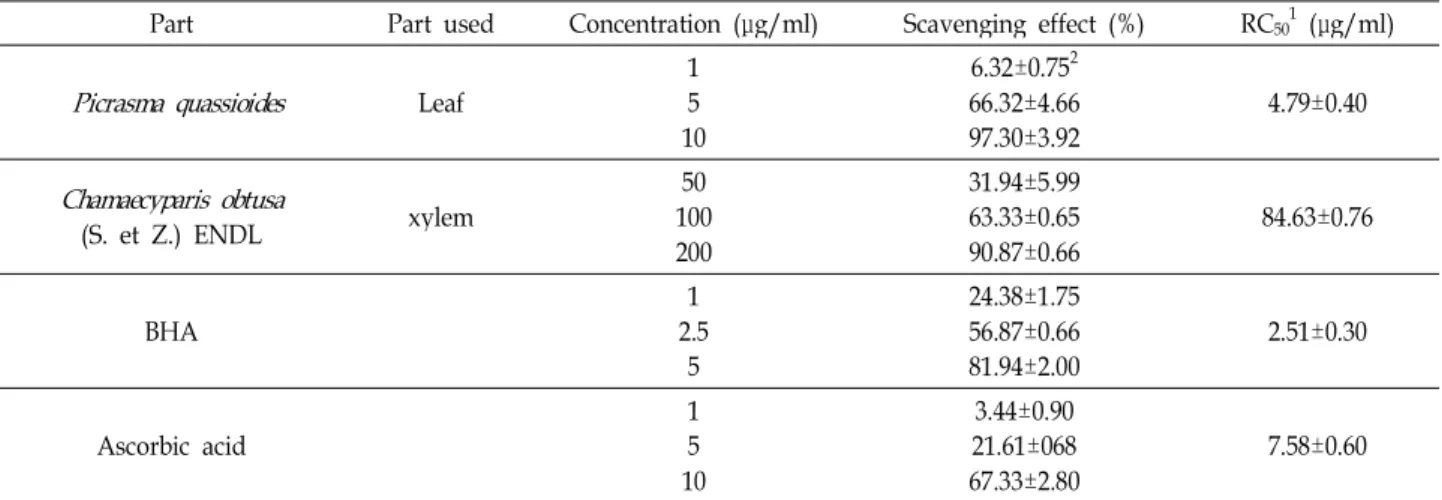
소태나무 잎, 편백나무 추출물과 BHA, Ascorbic acid의 DPPH 소거활성을 농도별로 측정하여 비교한 결과 Table 2와 같이 소태나무 잎은 10 μg/ml에서 97.30%의 소거능을 보였고, 편백나무는 200 μg/ml의 농도에서 90.87%, BHA (5 μg/ ml), Ascorbic acid (10 μg/ml)에서 각각 81%, 67% 정도의 항산화 능을 보여 편백나무와 특히 소태나무 잎에서 우수한 소거활성 능이 있음을 알 수 있었다. 그리고 소태나무 잎 및 편백나무 추출물의 RC
50값은 각각 4.79, 84.63 μg/ml의 값을 나타냈다.
이 등[27]에 의하면 고로쇠나무 잎, 모과나무 잎, 산수유 잎, 배롱나무 꽃, 오동나무 열매의 RC
50값이 각각 39.4, 46, 44.4, 29.6, 27.2 μg/ml이고, Jung 등[19]은 오미자 종자의 메탄올 추출물의 RC
50값을 33.2 μg/ml로 Li 등[28]은 해양균류의 RC
50값을 29-200 μg/ml로 보고 하였다. 따라서 소태나무 잎 추출물의 DPPH 라디칼 소거활성은 다른 식물들에 비해 매우 높은 것으로 생각된다.
ABTS free radical 소거활성
혈장에서 ABTS의 양이온 라디칼의 흡광도가 항산화제에 의에 억제되는 것에 기초하여 개발된 ABTS 라디칼 소거활성 법은 표준물질인 Trolox값과 비교하여 나타낼 수 있으며, in vivo에서의 항산화능 측정뿐만 아니라 in vitro에서도 항산화 능을 측정하기 위한 방법으로 널리 이용되고 있다[30,36,37].
ABTS와 potassium persulfate를 암소에 방치하면 생성되는 ABTS radical (ABTS+
•)은 sample의 항산화력에 의해 ABTS+
•이 소거되어 radical 특유의 색인 청록색이 탈색되는데 이를 흡광도 값으로 나타내어 추출물의 ABTS+
•의 소거활성능을 측정할 수 있다.
소태나무 잎, 편백나무의 ABTS+
•소거활성을 Trolox와 비
교 측정한 결과(Table 3) ABTS+
•소거활성법에서 표준물질로
사용되는 Trolox는 30 μM에서 55.64% 정도의 소거 활성을 보
였고, 소태나무 잎 추출물은 10 μg/ml에서 68.03%, 편백나무
추출물은 100 μg/ml에서 89.41%를 나타내었다. 특히 소태나
무 잎의 RC
50값은 7.21±0.44 μg/ml으로 Trolox의 RC
50값을 μg
/ml으로 환산하면 4.14 μg/ml으로 소태나무 잎은 positive
Table 2. Scavenging effects of BHA, methanol extracts from
Picrasma quassioides and Chamaecyparis obtusa
(S. et Z.) ENDL on α,α-diphenyl-β-picrylhydrazyl radical (DPPH ·)Part Part used Concentration (μg/ml) Scavenging effect (%) RC501 (μg/ml)
Picrasma quassioides
Leaf 1105
6.32±0.752 66.32±4.66
97.30±3.92 4.79±0.40
Chamaecyparis obtusa
(S. et Z.) ENDL xylem 50
100200
31.94±5.99 63.33±0.65
90.87±0.66 84.63±0.76
BHA 1
2.55
24.38±1.75 56.87±0.66
81.94±2.00 2.51±0.30
Ascorbic acid 1
105
3.44±0.90 21.61±068
67.33±2.80 7.58±0.60
1Concentration required for 50% reduction of DPPH· at 30 min after starting the reaction.
2Each value is mean±S.D (n≥3).
Table 3. Scavenging effects of Trolox, methanol extracts from
Picrasma quassioides and Chamaecyparis obtusa
(S. et Z.) ENDL on 2,2'-azi- no-bis (3-ethylbenzthiazoline-6-sulfonic acid) radical (ABTS+∙)Part Concentration (μg/ml) Scavenging effect (%) RC502
(μg/ml)
Picrasma quassioides
(D. DON) BENN
1 06.28±0.433
7.21±0.44
5 34.27±0.99
10 68.03±0.75
Chamaecyparis obtusa
1050 24.06±3.7670.29±4.97 29.89±11.49100 89.41±0.87
Trolox 151 29.08±1.71
28.17±2.10
30 55.64±1.39
60 94.62±0.08
1The Concentration unit of Trolox is the μM.
2Concentration required for 50% reduction of ABTS+∙ at 1 min after starting the reaction.
3Each value is mean±S.D (n≥3).
control로 사용되는 Trolox와도 유사한 ABTS+․ 소거능을 가 지는 것으로 나타났다. 또한 DPPH radical 저해 활성이 ABTS radical 저해 활성보다 높게 나온 경향을 볼 수 있는데 이는 ABTS radical이 DPPH radical보다 좀 더 강력한 산화물질이 기 때문인 것으로 사료된다[8].
Ferric reducing/antioxidant power (FRAP) 측정
FRAP 방법은 비교적 최근 Benzie와 Strain [3]에 의해 개발 된 총 항산화능을 측정하는 방법으로 낮은 pH에서 환원제에 의해 ferric tripyridyltriazine (Fe
3+-TPTZ) 복합체가 ferrous tripyridyltriazine (Fe
2+-TPTZ)으로 환원되는 원리를 이용한 것으로 대부분의 항산화제가 환원력을 가지고 있다는 점에 착안하여 고안된 방법이다. 소태나무 잎, 편백나무 추출물의 FRAP측정 결과를 Fig. 1에 나타내었다. 실험결과 소태나무 잎, 편백나무 추출물이 각각 8.52±0.58 μmol/μg, 1.77±0.74 μmol/
Fig. 1. Total Antioxidant activity of methanol extracts from
Picrasma quassioides and Chamaecyparis obtusa
(S. et Z.) ENDL on ferric reducing/antioxidant power (FRAP) activity. FRAP value is expressed as Fe2+μM concen- tration, obtained from a FeSO4solution having an anti- oxdant capacity equivalent to that of the dilution of the medicinal herbs.μ g으로 소태나무의 잎 추출물의 FRAP의 함량이 매우 높게 나타났다. Sánchez-González 등[39]은 총 폴리페놀 함량과 FRAP value는 높은 상관관계가 있다고 보고하였는데 본 연구 의 결과에서도 비슷한 경향을 나타내었다.
이러한 결과들로부터 소태나무 잎에는 강력한 항산화능을 갖는 phenol 화합물이 다량으로 포함되어 있을 것이라 생각되 며, 향후 소태나무 잎의 항산화 활성을 가지는 단일 com- pound의 분리․정제에 관한 연구가 이루어져야 한다.
감사의 글
이 논문은 2009년 정부(교육과학기술부)의 재원으로 한국 연구재단[NRF-2009-353-F00018] 및 2011년도 2학기 계명대학 교 대학원 학생 학술연구 장학금에 의해 연구되었음에 감사 드립니다.
References
1. An, B. J., J. T. Lee, S. A. Lee, J. H. Kwak, J. M. Park, J.
Y. Lee, and J. H. Son. 2004. Antioxidant effects and applica- tion as natural ingredients of Korean sanguisorbae officina- lis L.
J. Korean Soc. Appl. Biol. Chem
. 47, 244-250.2. Arima, Y., A. Hatanaka, S. Tsukihara, K. Fujimoto, K.
Fukuda, and H. Sakurai. 1997. Scavenging Activities of α-, β- and γ-Thujaplicins against Active Oxygen.
Chem. Pharm.
Bull
. 45, 1881-1886.3. Benzie, I. and J. Strain. 1996. The ferric reducing ability of plasma (FRAP) as a measure of “antioxidant power”: FRAP assay.
Anal. Biochem
. 230, 70-79.4. Blois, M. S. 1958. Antioxtidant activity determination by the use of a stable free radical.
Nature
181, 1199-1200.5. Branen, A. L. 1975. Toxicology and biochemistry of butylated hydroxy anisole and butylated hydroxy toluene.
J. Am. Oil.
Chem. Soc
. 52, 59-63.6. Chance, B., H. Sies, and A. Boveris. 1979. Hydroperoxide metabolism in mammalian organs. 59, 527-605
7. Choi, D. S. and H. Y. Go. 1995. Chemistry of functional food.
pp. 78-79, JI-GU Publish Co. Seoul.
8. Choi, Y. M., M. H. Kim, J. J. Shin, J. M. Park, J. S. Lee, and M. H. Kim. 2003. The antioxidant activities of the some commercial teas.
J. Korea Soc. Food Sci. Nutr
. 32, 723-727.9. Cool, L. G., Z. L. Hu, and E. Zavarin. 1998. Foliage terpe- noids of Chinese
Cupressus
species.Biochem. Syst. Ecol.
26, 899-913.10. Doldberg, I. 1994. Functional Foods. pp. 3-550, Chapman
& Hall Press. NewYork.
11. Folin, O. and W. Denis. 1912. On Phosphotungstic-phosoho- molybdic compounds as colour reagents.
J. Biol. Chem.
12, 239-249.12. Fujimori, K., A. Kaneko, and Y. Kitamori. 1998. Hinokitiol (β-thujaplicin) from the essential oil of hinoki (
Chamaecyparis obtusa
Sieb. et Zucc. Endl.).J. Essent. Oil Res
. 10, 711-712.13. Fukuzawa, R., T. Ito, and T. Matsuda. 1985. Jpn. Kokkyo Koho JP60141244.
14. Hayashi, S., K. Yano, and T. Matsuura. 1964. The mono- terpene constituents of the essential oil from hino- ki(
Chamaecyparis obtusa
Sieb. et Zucc. Endl.).Bull. Chem. Soc.
Japan
37, 474-476.15. Hayashi, S., K. Yano, and T. Matsuura. 1964. The mono- terpene constituents of the essential oil from hinoki (
Chamaecyparis obtusa
Sieb. et Zucc. Endl.).Bull. Chem. Soc.
Japan
37, 680-683.16. Hieda, T., M. Tazaki, Y. Morishita, T. Aoki, and S.
Nagahama. 1996. Sesquiterpene alcohols from
Chamaecyparis obtusa
leaf oil.Phytochemistry
42, 159-162.17. Inamori, Y., K. Nishiguchi, M. Matsuo, H. Tsujibo, K. Baba, and N. Ishida. 1991. Phytogrowth-inhibitory activities of tro- polone and hinokioil.
Chem. Pharm. Bull
. 39, 2378-2381.18. Ito, N., S. Fukushima, A. Hasegawa, M. Shibata, and T.
Ogiso. 1983. Carcinogenecity of butylated hydroxy anisole in F344 rats.
J. Cancer. Inst.
70, 343-347.19. Jung, G. T., I. O. Ju, and J. S. Choi. 2000. The antioxidant, antimicrobial and nitrite scavenging effects of
Schizandra chi- nensis
RUPRECHT (Omija) seed.Korean J. Food Sci. Technol
. 32, 928-935.20. Kanai, H. 1981. Hinoki.
Koryo
134, 111-113.21. Kandaswami, C. and E. J. Middleton. 1994. Free radical scav- enging and anti-oxidant activity of plant flavonoids. pp.
351-376, In: Free radicals in Diagnostic Medicine. In Armstrong, D. (ed.), Plenum Press. New York and London.
22. Kazuko, Y., S. Saori, and A. Shigenobu. 1995.
Phenylpropanoids and other secondary metabolites from fresh fruits of
Picrasma quassioides. Phytochemistry
40, 253-256.23. Kim, S. H., M. J. Chung, H. D. Jang, and S. S. Ham. 2010.
Antioxidant activities of the
Codonopsis lanceolata
extractin vitro
andin vivo
.J. Korean Soc. Food Sci. Nutr.
39, 193-202.24. Kim, T. S., S. J. Kang, and W. C. Park. 1999. Changes in antioxdants and antioxdants enzymes activities of soybean leaves subject to water stress.
J. Korean Soc. Agric. Chem. Biol.
42, 246-251.
25. Koyama, S., Y. Yamaaguchi, S. Tanaka, and J. Motoyoshiya.
1997. A new substance (yoshixol) with an interesting anti- biotic mechanism from wood oil of Japanese traditional tree (Kisohinoki),
Chamaecyparis obtuse. Gen. Pharmac.
28, 797-804.26. Lee, S. O., H. J. Lee, M. H. Yu, H. G. Im, and I. S. Lee.
2005. Total polyphenol contents and antioxidant activities of methanol extracts from vegetables produced in Ullung Island.
Korean J. Food Sci. Technol
. 37, 233-240.27. Lee, S. E., N. S. Seong, J. K. Bang, C. G. Park, J. S. Sung, and J. Song. 2003. antioxidants activitics of Korean medici- nal plants.
Korean J. Medicinal Crop Sci
. 11, 127-134.28. Li, X. F., Y. Li, K. W. Nam, D. S. Kim, H. D. Chio, and B. W. Son. 2002. Screening of radical scavenging activity from the marine-derived fungus.
Korean J. Pharmacogn
. 33, 219-223.29. Luyengi, L., N. Suh, and H. Fong. 1996. A lignan and four terpenoids from Brucea javanica that induce differentiation
초록:소태나무 잎 및 편백나무 추출물의 항산화 효과 정영태․이인선․황 기․유미희*
(계명대학교 식품가공학 전공)
본 실험에서는 소태나무, 편백의 유용자원으로의 이용가능성을 알아보기 위해, 소태나무 잎과 편백 목질부를 분쇄한 후 추출물을 제조하여 이들 각각의 총 폴리페놀 및 플라보노이드의 함량을 측정 후 항산화제로 널리 알려 진 BHA와의 비교측정으로 항산화 활성을 검색해 보았다. 먼저 소태나무 잎, 편백나무의 메탄올 추출물에 존재하 는 총 폴리페놀 및 플라보노이드 함량을 측정한 결과, 소태나무 잎 추출물의 총 폴리페놀 함량은 367.52 μg/mg, 편백나무 추출물의 총 폴리페놀 함량은 138.3 μg/mg으로 편백나무 보다는 소태나무 잎에서 높은 폴리페놀 함량 을 보였다. 총 플라보노이드 함량 역시 소태나무 잎과 편백나무에서 각각 46.41 및 8.12 μg/mg으로 소태나무 잎 에서 플라보노이드 함량이 높게 나타났다. 각 시료의 DPPH 소거 활성을 농도별로 측정한 결과, 10 μg/ml의 농도 에서 소태나무 잎이 97%, 200 μg/ml의 농도에서 편백나무가 90%의 소거능을 보였고, BHA (5 μg/ml)에서 81%
정도의 항산화능을 보였다. 또한 ABTS+
•소거활성을 Trolox와 비교한 결과, ABTS+
•소거활성법에서 표준물질 로 사용되는 Trolox는 60 μM에서 94% 정도의 소거활성을 보였고, 소태나무 잎 추출물은 10 μg/ml에서 68%, 편 백나무는 100 μg/ml에서 89% 정도의 소거활성을 보였다. FRAP 활성 측정결과 소태나무 잎에서 8.52 μmol/μg, 편백나무에서 1.77 μmol/μg 나타났으며 특히 소태나무 잎에서 높은 Fe
2+함량을 나타내어 total polyphenol con- tents과 유사한 경향을 보였다. 따라서 본 연구 결과들로부터 소태나무 잎은 높은 폴리페놀 함량에 기인한 강력한 항산화 작용을 가지는 것으로 생각된다.
with cultured HL-60 promyelocytic leukemia cells.
Phytochemistry
43, 409-412.30. Miller, N. J., C. Rice, and M. J. Davies. 1993. Gopinathan V, Milner A. A novel method for measuring antioxidant ca- pacity and its application to monitoring the antioxidant sta- tus in premature neonates.
Clin. Sci
. 84, 407-412.31. Murae, T., T. Tsuyuki, T. Ikeda, T. Nishihama, and T.
Takahasshi. 1971. Bitter Principles of
Picrasma ailanthoides
PLANCHON, Nigakilactones A, B, C, D, E, and F.Tetrahedron
. 27, 1545-1555.32. Nayfeh, A. 1981. Introduction to perturbed techniques. pp.
365-375, John Weiley & Sone, New York.
33. Nivea, M., A. Sampietro, and M. Vattuone. 2000.
Comparison of the free radical scavenging activity of prop- olis from several relisions of Argentina.
J. Ethnopharmacol
. 71, 109-114.34. Ohmoto, T., T. Nikaido, K. Koike, K. Kohda, and U.
Sankawa. 1988. Inhibition of adenosine 3’,5’-cyclic mono- phosphate phosphodiesterase by alkaloids. II.
Chem Pharm Bull. Tokyo
36, 4588-4592.35. Re, R., N. Pellegrini, A. Proteggente, A. Pnnala, M. Yang, and C. Riceevans. 1999. Antioxidant activity applying an im- proved ABTS radical cation decolorization assay.
Free Radic.
Biol
.Med.
26, 1231-1237.36. Rice, C. A. and N. J. Miller. 1994. Total antioxidant status in plasma and body fluids.
Methods Enzymol
. 234, 279-293.37. Rice, C. A., N. J. Miller, and G. Paganga. 1996. Structure-anti- oxidant activity relations of flavonoids and phenolic acids.
Free Radic. Biol. Med
. 20, 933-956.38. Sadaki, O. 1996. The development of functional foods and materials.
Bioindustry
13, 44-50.39. Sanchez, G. I., E. A. Jimenez, and C. F. Saura. 2005. In vitro, antioxidant activity of coffees brewed using different proce- dures (Italian, espresso and filter).
Food Chem.
90, 133-139.40. Shieh, B., Y. Iizuka, and Y. Matsubara. 1981. Monoterpenoid and sesquiterpenoid constituents of the essential oil of Sugi (Cryptomeria Japonica D.Don.).
Agric. Biol. Chem
. 45, 1497-1499.41. Thomas, A. F. 1965. An analysis of the volatile fraction of hinoki leaf oil.
Perfun. Essent. Oil Rec
. 56, 301-304.42. Trust, T. J. and R. W. Coombs. 1973. Antibacterial activity of beta-thujaplicin
. Can. J. Microbiol
. 19, 1341-1346.43. Valko, M., D. Leibfritz, J. Moncol, M. T. Cronin, M. Mazur, and J. Telser. 2007. Free radical and antioxdants in normal physiological function and human disease.
Int. J. biochem.
Cell. Biol.
39, 44-84.44. Yoshida, A. F., K. Endo, S. Ito, and T. Nozoe. 1967. Chemical constituents in the essential oil of the leaves of
Chamaecyparis taiwanensis. Yakugaku Zasshi
87, 434-439.45. Yoshizawa, S., T. Horiuchi, F. Hirota, Y. Takashi, T. Okuda, and T. Sugimura. 1987. Antitumor promoting activity of (-)-epigallocatechin gallate, the main constituent of tannin in green tea.
Phytother. Res.
1, 44-47.46. Yu, M. H., H. G, Im, H. J. Lee, Y. J. Ji, and I. S. Lee. 2006.
Components and their antioxidant activities of methanol ex- tracts from sarcocarp and seed of Zizyphus jujuba var. in- ermis Rehder.