Antiproliferative Effect of Mistletoe Extract Added Kimchi in Human Lung Carcinoma A549 Cells
Jung-Ha Kil*
Department of Food Science and Nutrition, Pusan National University, Busan 609-735, Korea Received November 14, 2017 /Revised November 17, 2017 /Accepted November 24, 2017
The purpose of this study aimed at examining the antiproliferative effect of kimchi (kimchi B) adding mistletoe extract known as an anticancer function to improve the functions of kimchi. The study in- vestigated the antiproliferative effect through hemocytometer counts and MTT assay, apoptosis in- duction through DAPI staining, and mRNA expression through RT-PCR using human lung carcinoma A549 cells. The standardized kimchi (Kimchi A) was used as a control group. As a result of hemocy- tometer counts and the MTT assay, it was found that kimchi samples inhibited the growth of A549 cells in a concentration-dependent manner. Kimchi B induced apoptosis in A549 cells through DAPI staining. The apoptosis induced by kimchi B was associated with the increase in the expression of pro-apoptotic Bax and with the decrease in the expression of anti-apoptotic Bcl-2 and Bcl-xL. Also, kimchi B influenced the increase in the expression of p21 mRNA, but did not have the effect on the expression of p53 mRNA. In conclusion, the antiproliferative effect of kimchi B was due to apoptosis induced by increasing Bax and decreasing Bcl-2, and increasing p21. The findings will be utilized to develop kimchi with the improved function for the patients having cancer.
Key words : Apoptosis, Bcl-2 family, lung carcinoma A549 cell, mistletoe added functional kimchi, p21
*Corresponding author
*Tel : +82-51-510-1718, Fax : +82-51-583-3648
*E-mail : [email protected]
This is an Open-Access article distributed under the terms of the Creative Commons Attribution Non-Commercial License (http://creativecommons.org/licenses/by-nc/3.0) which permits unrestricted non-commercial use, distribution, and reproduction in any medium, provided the original work is properly cited.
Journal of Life Science 2017 Vol. 27. No. 12. 1507~1514 DOI : https://doi.org/10.5352/JLS.2017.27.12.1507
서 론
김치는 한국 전통발효식품으로 여러 암세포(AGS gastric cancer, HT-29 colon cancer, MG-63 osteocarcinoma, HL-60 leukemia and Hep 3B liver cancer)의 증식저해 효과가 알려져 있다[34, 35]. 뿐만 아니라 samcoma 180 세포를 이식한 Balb/
c mice에서도 배추김치를 처리한 군에서 유의적으로 종양조 직의 무게가 작아졌다는 보고가 있다[21]. 이러한 김치의 암세 포 증식저해효과는 김치의 주재료에서 오는 것으로, 그 활성 성분으로는 glucosinolates, polyphenol, flavonoids, 비타민 C, 카로티노이드, 식이섬유, 클로로필 등이 있고, 이 성분들의 암 예방 및 항암효과는 많이 연구되어 왔다[7, 8, 16, 36].
겨우살이는 참나무, 뽕나무, 밤나무, 사과나무, 단풍나무, 버 드나무 등 많은 종류의 나무에 기생하는 작은 상록수이다. 겨 우살이는 예로부터 동서양을 막론하고 질병치료에 사용하여 고혈압, 동맥경화증 등의 효능이 있는 것으로 알려져 있으며, 유럽의 겨우살이(Viscum album L.)는 항종양 효과가 알려져
유럽에서는 1920년대부터 실제로 많은 임상시험이 시도되어 왔다[5, 18, 29, 39].
한국산 겨우살이에 관한 연구로는 발암물질로 유도된 실험 적 간암모델에서 한국산 겨우살이 추출물 및 그 활성물질인 렉틴의 발암 억제효과가 발견되었고, 겨우살이 물추출물 및 그 활성물질인 렉틴의 투여가 apoptosis를 촉진하는 caspase- 9, fas-L 발현을 증가시키는 연구가 있다[26, 27]. 그리고 인간 대장암세포에 한국산 겨우살이에서 추출한 렉틴을 처리하여 apoptosis가 일어나고 이는 caspase-2, -8, -9의 활성화와 apop- tosis억제 유전자의 발현저해에 의한 것이라는 보고가 있다 [24]. 그 외에도 윤[42]과 김[28]의 연구에 의하면 한국산 겨우 살이에서 추출한 렉틴이 암세포에서 apoptosis를 유도하는 것 으로 나타났다.
본 연구에서는 암환자를 위한 기능성 김치를 개발하기 위하 여 김치에 겨우살이 물추출물을 첨가하여 폐암세포인 A549 세포에 대한 증식억제 효과를 hemocytometer count와 MTT 를 이용하여 확인하였고, apoptosis에 의한 것인지 알아보기 위해서 DAPI 염색을 통해 암세포 핵의 형태적 특징을 조사하 고, apoptosis의 기전을 Bax, Bcl-2, Bcl-xL 발현과 p53, p21 발 현을 통해 검토하였다.
재료 및 방법
김치 재료
김치 재료로 청정멸치액젓(Daesang Co., Chunan, Korea), - Note -
설탕(CJ, Incheon, Korea), 고춧가루(Yongyang F&C, Youn- gyang, Korea)를 사용하였고, 배추, 무, 파, 마늘, 생강 등은 부산시 금정구 장전동의 L마트에서 구입하여 사용하였다.
겨우살이 추출물은 증류수에 4시간 교반하여 그 여과액을 원심분리한 상등액을 동결 건조하여 판매되는 겨우살이 추출 물(Mistlebiotech Co., Pohang, Gyeongbuk, Korea)을 사용하 였다.
김치의 제조
표준화김치(kimchi A)는 부산대학교 표준화 김치 레시피 [9]를 이용하였고, 배추 100에 대하여 고춧가루 3.5, 마늘 1.4, 생강 0.6, 무 13.0, 설탕 1.0, 파 2.0, 젓갈 2.2를 첨가하여 제조하 였다. 암환자를 위한 김치(kimchi B)는 선행연구[10, 25]에서 개발된 암환자를 위한 레시피인 배추 100에 대하여 고춧가루 2.5, 마늘 2.8, 생강 0.6, 무 11.0, 설탕 1.0, 파 2.0, 갓 7.5, 산초 0.1, 배 2.8, 버섯, 다시마물 5.0, 겨우살이 추출물을 0.05 첨가하 여 제조하였다.
제조된 김치는 모두 5℃에서 적숙기(pH 4.2-4.3)까지 발효 시켜 실험에 사용하였다. 적숙기 김치시료는 동결건조한 후 마쇄하여 분말로 제조하고, 분말시료에 200배(W/V)의 메탄 올을 첨가하여 12시간 교반을 2회 반복하여 여과한 후 회전식 진공 농축기(Buchi 461, BUCHI Flawil, Switzerland)로 농축 하여 메탄올 추출물을 얻었다. 이들 추출물들은 dimethylsulf- oxide (DMSO)에 희석하여 실험에 사용하였다.
A549 인체 폐암세포 증식저해 효과
A549 인체 폐암세포(A549 human lung carcinoma cell)은 American Type Culture Collection (Rockville, MD, USA)에 서 분양 받아 배양하면서 실험에 사용하였고, 10% fetal bo- vine serum (FBS)과 1% penicillin-streptomycin이 함유된 Dulbecco’s modified Eagle’s medium (DMEM, Gibco BRL, Gaithersburg, MD, USA)을 이용하여 37℃, 5% CO2 incubator (Model 3154, Forma Scientific Inc., Marietta, OH, USA)에서 배양하였다. 배양된 암세포는 일주일에 3회 refeeding하고 7일 만에 PBS로 세척한 후 0.05% trypsin-0.02% EDTA를 이용하여 부착된 세포를 분리하고 원심 분리하였다. 상층액을 제거한 후 집적된 암세포에 배지를 넣고 피펫으로 암세포가 골고루 분산되도록 잘 혼합한 후 cell culture flask에 10 ml씩 일정 수 분할하여 주입하고 7일마다 계대배양 하면서 실험에 사용 하였다.
배양된 암세포를 60 mm 플레이트에 1×10³ cells/plate가 되도록 분주하여 24시간 배양한 후 시료를 각각 0.25, 0.5, 1, 2 mg/ml의 농도로 첨가하여 48시간 배양하였다. 그 후 0.05%
trypsin-0.02% EDTA를 처리하여 PBS로 세척 후 hemocy- tometer를 통해 계수하였다.
MTT방법을 위하여 A549 인체 폐암세포를 96-well plate에
1×10³ cell/ml가 되도록 100 μl씩 분주하여 24시간 배양 후 김치 추출물 시료를 0.25, 0.5, 1, 2 mg/ml 농도로 100 μl첨가하 여 48시간 배양한 후 배지를 제거하고 3-(4,5-demethylthiazol- 2-yl)-2,5-diphenyltetrazolium bromide (MTT, Sigma, USA) 용액을 PBS에 0.5 mg/ml의 농도로 성장배지로 희석하여 3시 간 동안 배양하였다. 이때 생성된 fromazan 결정을 DMSO에 녹여 ELISA reader (Molecular Devices, Sunnyvalve, CA, USA)로 540 nm에서 흡광도를 측정하였다[6, 33, 38].
DAPI 염색을 통한 핵의 관찰
김치추출물의 처리에 의한 암세포의 apoptosis 유도 확인을 위해 핵의 형태변화를 관찰하기 위해 김치 추출물이 처리된 세포들을 PBS로 수세하고 3.7% paraformaldehyde로 상온에 서 10분간 고정시킨 후 형광 염색물질인 4,6-diamidino-2- phenyllindile (DAPI, Sigma, USA)용액을 이용하여 10분간 염 색하였다. 이들 세포를 다시 PBS로 2회 수세한 후 fluorescence microscope를 이용하여 핵의 형태 변화를 측정하였다[4].
RT-PCR에 의한 mRNA 발현 분석
동일조건에서 준비된 A549 인체 폐암세포를 대상으로 TRIzol B (Invitrogen, Carlsbad, CA, USA)를 이용하여 total RNA를 분리하였다. 분리된 RNA를 정량한 후, 최의 방법[11]
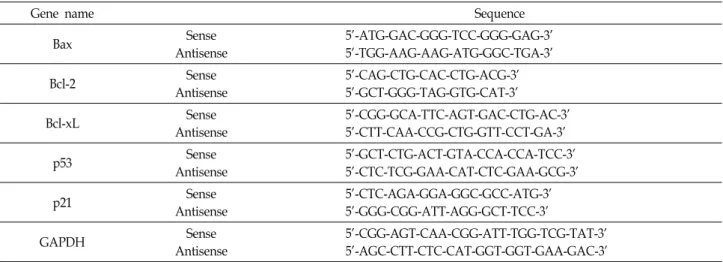
에 준하여 oligo dT primer와 AMV reverse transcriptase를 이용하여 2 μg의 RNA에서 cDNA를 합성하였다. 이 cDNA를 template로 사용하여 Bax, Bcl-2, p53, p21 유전자(Table 1)를 polymerase chain reaction (PCR)방법으로 증폭하였다. 이때 housekeeping 유전자인 glyceraldehydes-3-phosphate de- hydrogenase (GAPDH)유전자를 포함하여 internal control로 사용하였다. 각 PCR 산물들은 1% agarose gel을 이용하여 전 기영동하고 ethidium bromide (EtBr, Sigma, USA)를 이용하 여 염색한 후 ultra violet (UV)하에서 확인하였다.
결과 및 고찰
김치추출물의 A549 인체 폐암세포 증식저해 효과
표준김치(kimchi A)와 겨우살이 추출물을 첨가한 기능성 김치(kimchi B)가 A549 인체 폐암세포의 증식에 미치는 영향 을 조사하기 위한 hemocytometer count 결과는 Fig. 1A와 같 다. Fig. 1A에서 알 수 있듯이 김치 추출물의 첨가 농도가 증가 함에 따라서 암세포 증식률 및 생존율이 점차 감소하였으며, 2 mg/ml의 김치 추출물이 첨가된 배지에서 자란 암세포는 증식률 및 생존율이 모두 50% 이하로 감소되었다. 첨가농도 1 mg/ml과 2 mg/ml 에서 kimchi A에 비해서 kimchi B가 첨가된 배지에서 자란 암세포의 증식 억제율이 다소 증가되었 다.
MTT assay에 의한 결과도 hemocytometer count 결과와
Table 1. List of gene-specific primers for RT-PCR
Gene name Sequence
Bax Sense
Antisense
5'-ATG-GAC-GGG-TCC-GGG-GAG-3' 5'-TGG-AAG-AAG-ATG-GGC-TGA-3'
Bcl-2 Sense
Antisense
5'-CAG-CTG-CAC-CTG-ACG-3' 5'-GCT-GGG-TAG-GTG-CAT-3'
Bcl-xL Sense
Antisense
5'-CGG-GCA-TTC-AGT-GAC-CTG-AC-3' 5'-CTT-CAA-CCG-CTG-GTT-CCT-GA-3'
p53 Sense
Antisense
5'-GCT-CTG-ACT-GTA-CCA-CCA-TCC-3' 5'-CTC-TCG-GAA-CAT-CTC-GAA-GCG-3'
p21 Sense
Antisense
5'-CTC-AGA-GGA-GGC-GCC-ATG-3' 5'-GGG-CGG-ATT-AGG-GCT-TCC-3'
GAPDH Sense
Antisense
5'-CGG-AGT-CAA-CGG-ATT-TGG-TCG-TAT-3' 5'-AGC-CTT-CTC-CAT-GGT-GGT-GAA-GAC-3'
유사한 경향을 보였다(Fig. 1B). 김치추출물 첨가 농도가 높아 짐에 따라 암세포 증식 억제율이 증가하였다. 또한 1 mg/ml로 김치추출물을 처리한 결과를 보면 kimchi A의 증식 억제율에 비해 kimchi B의 증식 억제율이 높은 것으로 관찰되었다.
김치는 여러 암세포(AGS gastric cancer, HT-29 colon can- cer, MG-63 osteocarcinoma, HL-60 leukemia and Hep 3B liv- er cancer)의 성장 저해 효과가 알려져 있다[34, 35]. 이런 논문 과 유사하게 본 연구에서도 김치추출물의 처리는 암세포 증식 저해 효과가 관찰되었고, 특히 A549 인체 폐암세포 증식을 억제하는 것을 관찰 할 수 있었다. 또한 항암효과[29, 39]가 알려진 겨우살이 추출물을 김치에 첨가함에 따라 A549인체 폐암세포의 증식 억제 효과가 더 높아졌다. 이러한 결과로 암 환자를 위한 김치에 겨우살이 추출물을 첨가하는 것이 암세포 증식을 억제시킬 수 있을 것으로 사료된다.
DAPI 염색을 통한 핵관찰
김치의 처리에 의한 암세포의 증식 억제 효과가 apoptosis 에 의한 유발효과인지 알아보기 위하여 김치 추출물에 의한 apoptosis 가능성을 조사하였다(Fig. 2). 이를 위하여 DAPI staining을 통한 암세포 핵의 형태적 특징을 조사한 결과, 정상 배지에서 자란 A549 세포는 모두 정상적인 핵의 형태를 띠고 있었다. 그러나 kimchi B 추출물이 함유된 배지에서 자란 세포 의 핵은 정상배지에서 자란 세포들에서 관찰할 수 없는 apop- tosis 유발 특이적인 핵 내의 단편화에 의한 apoptotic body가 나타남으로 kimchi B는 apoptosis를 유발하는 것으로 관찰되 었다.
김치의 주재료인 배추의 항암효과는 glucosinolates의 분해 산물인 isothiocyanates의 apoptosis 및 세포주기 억제 기전에 의한 것으로 알려져 있다[45]. 또한 배추에는 주요 생리활성 물질인 glucosinolates뿐 아니라 polyphenols, flavonoides 등 이 함유되어 있고 이 물질들의 암세포 증식 억제 효능이 밝혀 진 바 있다[22]. 따라서 배추를 주재료로 만든 김치의 항암효과
는 apoptosis에 의할 것이며, apoptosis를 유발하는 성분으로 는 김치에 함유된 glucosinolates, polyphenols, flavonoides 등 을 들 수 있다.
또한 kimchi B에는 겨우살이 추출물을 첨가하였는데, 겨우 살이 추출물의 활성물질인 렉틴의 경우 여러 연구에서 apop- tosis를 유발하는 것으로 밝혀져 있다[24, 28, 42].
이러한 여러 활성물질이 복합적으로 함유된 kimchi B는 A549 폐암세포의 증식을 억제하였으며, DAPI 염색을 통해 핵의 DNA 단편화를 관찰하여, 김치의 암세포 증식억제 효과 는 apoptosis유발에 의한 것으로 관찰되었다.
김치추출물이 Bax, Bcl-2 and Bcl-xL 발현에 미치는 영향 Apoptosis의 유발에 관여하는 가장 대표적인 유전자인 Bcl-2 family 중 Bcl-2는 anti-apoptotic 분자로서 세포 내 미토 콘드리아와 결합하여 apoptosis를 유발시키는 cytochrome C 가 용출되지 못하게 하여 apoptosis를 억제한다. Bax는 pro- apoptotic 분자로서, Bcl-2와 Bax는 서로 dimer를 이루며, 만일 Bax가 주종의 단백질로 heterodimer를 만들면 apoptosis를 촉 진시키고, Bcl-2가 주종이면 apoptosis가 억제된다. 즉 Bax와 Bcl-2는 서로 heterodimer를 이룸으로써 미세한 발현의 차이 로 이 현상을 조절한다. Pro-apoptotic 분자로는 Bax, Bak, Bad 등이 있고, anti-apoptotic 분자로는 Bcl-2, Bcl-xL 등이 있다[1, 3, 14, 43].
김치추출물 처리에 의한 A549 세포의 apoptosis가 Bax, Bcl-2 and Bcl-xL 유전자의 발현 조절과 연관이 있는지를 조사 한 결과, Fig. 3에서 나타난 바와 같다. A549 세포에서 pro- apoptotic Bax의 발현이 농도 의존적으로 증가한 반면 anti- apoptotic Bcl-2 유전자의 발현은 상대적으로 감소하였음을 알 수 있었다. 그리고 kimchi A를 처리한 군보다 kimchi B를 처리 한 군에서 Bax의 발현이 더 증가되었으며, Bcl-2와 Bcl-xL의 발현이 더 감소되었다. 따라서 김치추출물 처리가 A549 세포 에서 Bax 유전자 발현을 증가하고 Bcl-2 유전자 발현을 억제하
A. Hemocytometer
B. MTT assay
Fig. 1. Growth inhibition of human lung carcinoma A549 cells after treatment with kimchi. (A) A549 cells were plated at 1×10³ cells per 60 mm plate, and incubated for 24 hr. Cells were treated with variable concentrations of kimchi for 48 hr. The cells were trypsinized, washed with PBS and the viable cells were scored by hemocytometer counts of trypan blue-excluding cells. Each point represents the mean ± SD of three independent experiments. (B) Cells were plated at 1×10³ cells/ml in 96-well plate. After 24 hr incubation, the cells were treated with various concentration of kimchi. MTT assay was performed after kimchi treatment for 48 hr. Each point represents the mean ± SD of three independent experiments.
Fig. 2. Induction of apoptosis by kimchi treatment in human lung carcinoma A549 cells by DAPI stain. Cells were incubated with kimchi for 48 hr, and then stained with DAPI. After 10 min incubation at room temperature, the cells were washed with PBS and photographed with a fluorescence microscope using blue filter. Magnification, ×400.
는 것을 관찰하였으며, kimchi B가 이들 유전자의 발현을 더 증가시켰다. 따라서 kimchi B의 A549세포에 대한 apoptosis 유발은 Bax와 Bcl-2의 mRNA 발현과 관련이 있는 것으로 관찰 되었다.
김치 추출물이 p53과 p21 전사에 미치는 영향
다양한 세포증식 억제 신호에 의해 유도되는 Cdk inhibitor 는 Cdk와의 강한 결합을 통하여 그들의 활성을 억제시키는 역할을 하는데, 그들은 크게 두 가지의 family로 분류(INK4 및 CIP/KIP family)되어지고 있다[13]. 이들 중 Cdk2와 결합
Fig. 3. Induction of Bax and inhibition of Bcl-xL by kimchi treatment in A549 human lung carcinoma cells by PCR. Cells were incubated with kimchi for 48 hr and total RNA was isolated and RT-PCR was performed using indicated primers. The amplified PCR products were run in a 1.5% agarose gel and visualized by EtBr staining. GAPDH was used as a housekeeping control gene.
Fig. 4. Induction of p53 and p21 by kimchi treatment in A549 human lung carcinoma cells. Cells were incubated with kimchi for 48 hr. Total RNAs of each sample were prepared reverse-transcriped and amplified by using specific primers for p53, p21 and GAPDH gene. PCR products were electrophoresed in 1.5% agarose gel containing 0.5 μg/ml EtBr and photographed.
GAPDH was used as a housekeeping control gene.
하면서 그들의 활성을 저해하는 것으로 알려진 CIP/KIP fam- ily에 속하는 p21은 DNA 손상에 의한 종양억제 유전자 p53에 의해 조절을 받으며, 이는 세포주기 상 G1 기에서 세포증식을 억제하는 세포주기와 연관된 가장 중요한 조절인자로 알려져 왔다[19, 31]. 그러나 p53에 의한 p21의 전사조절과는 관계없 이 암세포의 세포성장 억제나 분화유도에 p53 비의존적인 p21 유도조절기전이 하나씩 밝혀지고 있으며, p21 전사조절에 관 여하는 coactivator와 suppressor에 대한 연구들이 활발하게 진행 중이며, p21은 세포주기 조절과 세포분화, apoptosis에도 관여하는 세포증식에 중요한 조절인자로 인식된다[12, 44].
Fig. 4의 결과에 나타난 바와 같이 p53 mRNA 발현은 김치 추출물의 처리에 따른 변화가 관찰되지 않았다. 그러나 p21 mRNA 발현은 보면 저농도의 김치 처리 군에서는 거의 변화 가 없었지만 고농도의 김치추출물 처리 군에서는 p21 전사가 증가되었다. 이는 kimchi A 보다는 kimchi B 처리 군에서 p21 mRNA 발현이 더 증가되는 것을 관찰할 수 있었다. 따라서 kimchi B는 p53 비의존적인 p21의 기전에 의해 암세포 성장 억제에 관여하는 것으로 사료된다.
김치에는 암세포 성장을 억제하는 많은 성분들이 함유되어 있는데, 김치의주재료인 배추에는 glucosinolates, polyphe- nols, flavonoides이외에도 Indole-3-carbinol (I3C)함유되어 있는데, I3C은 인체 유방암세포와 전립선암 세포에서 apopto- sis를 유발시켜 암세포 성장을 저해시켰다는 보고가 있으며[8, 16], 무나 배추에서 유래하는 isothiocyanates 화합물들은 높은 항암 기능성을 가지게 된다[20]. 그리고 마늘에서 유래한 allyl sulfide 화합물들도 apoptosis를 유도하여 매우 높은 암세포 증식 억제 효과를 나타내고[30, 37], 고춧가루에서 유래하는 capsaicin도 apoptosis를 유도하여 세포 성장을 억제한다는 보 고가 있다[23, 32, 40]. 그리고 kimchi B는 암환자를 위해 겨우 살이 물추출물을 첨가하여 항암 기능성을 높였는데, 겨우살이 에는 활성물질인 렉틴이 포함되어 있고, 렉틴 투여시 apopto- sis를 촉진하는 caspase-9, fas-L 발현이 증가되는 연구가 있다 [26, 27]. kimchi B는 이러한 화합물들이 복합적으로 함유된 식품으로 apoptosis를 유도하여 암세포 증식을 억제할 수 있 을 것이며, 본 실험 결과 증가한 Bax와 감소한 Bcl-2 mRNA 유전자의 발현을 통해 kimchi B의 apoptosis가 유도됨이 관찰
되었고, 이는 증가한 p21 mRNA 발현과 관련이 있음을 확인 하였다.
본 연구에서는 암환자를 위한 김치를 개발하기 위하여 김치 에 겨우살이 물추출물을 첨가하여 폐암세포인 A549 세포에 대한 증식억제 효과를 hemocytometer count와 MTT assay를 이용하여 알아본 결과 김치추출물을 처리한 군에서 농도에 의존적으로 암세포 증식 억제 효과가 발견되었고, 특히 겨우 살이 물추출물이 첨가된 kimchi B가 높은 증식억제 효과를 나타냈다. 이러한 증식 억제 효과가 apoptosis에 의한 것인지 알아보기 위해서 DAPI 염색을 통해 암세포 핵의 형태적 특징 을 조사한 결과 kimchi B를 첨가한 군에서 DNA단편이 발견 되어, 김치추출물의 암세포 증식 억제효과는 apoptosis에 의 한 것으로 관찰되었다. Apoptosis의 기전을 알아보기 위하여 RT-PCR을 이용하여 Bax, Bcl-2, Bcl-xL 발현과 p53, p21 발현 을 측정한 결과 kimchi B를 첨가한 군에서 Bax가 증가하고 Bcl-2 유전자의 발현이 감소하여 이를 통해 apoptosis가 유도 되었고, 또한 p21 발현이 증가된 것으로 보아 kimchi B를 처리 한 A549인체 폐암세포는 이와 관련된 기전을 통해 apoptosis 가 일어나 증식이 억제되는 것으로 관찰되었다.
References
1. Adams, J. M. and Cory, S. 1998. The Bcl-2 protein family : Arbiters of cell survival. Science 281, 1322-1326.
2. Agarwal, M. L., Taylor, W. R., Chernov, M. V., Chernova, O. B. and Stark, G. R. 1998. The p53 network. J. Biol. Chem.
273, 1-4.
3. Antonsson, B. 2001. Bax and other pro-apoptotic Bcl-2 fam- ily ‘killer proteins’ and their victim the mitochondrion. Cell Tissue Res. 306, 347-361.
4. Atale, N., Gupta, S., Yadav, U. C. and Rani, V. 2014. Cell death assessment by fluorescent and nonfluorescent cyto- solic and nuclear staining techniques. J. Microsc. 255, 7-19.
5. Bussing, A., Suzart, K. and Schweizer, K. 1997. Differences in the apoptosis-inducing properties of Viscum albu. L.
extracts. Anticancer Drugs 8, 9-14.
6. Carmichael, J., DeGraff, W. G., Gazdar, A. F., Minna, J. D.
and Mitchell, J. B. 1978. Evaluation of a tetrazolium-based semiautomated colorimetric assay : assessment of chemo- sensitivity testing. Cancer Res. 47, 936-942.
7. Cheigh, H. S. and Park, K. Y. 1994. Biochemical, micro- biological and nutritional aspects of kimchi (Korean fer- mented vegetables products). Crit. Rev. Food Sci. Nutr. 34, 175-203.
8. Chinni, S. R., Li, Y., Upadhyay, S., Koppolu, P. K. and Sarkar, F. H. 2001. Indole-3-carbinol (I3C) induced cell growth inhibition, G1 cell cycle arrest and apoptosis in pros- tate cancer cells. Oncogene 20, 2927-2936.
9. Cho, E. J., Lee, S. M. and Park, K. Y. 1998. Standardization of kinds of ingredient in Chinese cabbage kimchi. Kor. J.
Food Sci. Technol. 30, 1456-1463.
10. Choi, S. M. 1991. Antiobesity and anticancer effect of red
pepper powder and kimchi. Ph.D. dissertation, Pusan National University, Busan, Korea.
11. Choi, Y. H. 2001. Research techniques for the cell cycle study. Exp. Mol. Med. 33, 15-36.
12. El-Deiry, W. S., Harper J. W., O'Connor, P. M., Velculescu, V. E., Canman, C. E., Jackman, J., Pietenpol, J. A., Burrell, M., Hill, D. E., Wang, Y., Wiman, K. G., Mercer, W. E., Kastan, M. B., Kohn, K. W., Elledge, S. J., Kinzler, K. W. and Vogelstain, B. 1994. WAF1/CIP1 is induced in p53-mediated G1 arrest and apoptosis. Cancer Res. 54, 1169-1174.
13. Elledge, S. J. and Harper, J. W. 1994. Cdk inhibitors : on the threshold of checkpoints and development. Curr. Opin.
Cell. Biol. 6, 847-852.
14. Farrow, S. N. and Brown, R. 1996. New members of the Bcl-2 family and their protein partners. Curr. Opin. Genet.
Dev. 6, 45-49.
15. Gartel, A. L. and Tyner, A. L. 1999. Transcriptional regu- lation of the p21 (WAF1/Cip1) gene. Exp. Cell Res. 246, 280- 289.
16. Ge, W., Fares, F. A. and Yannai, S. 1999. Induction of apop- tosis in MCF-7 cells by indole-3-carbinol is independent of p53 and bax. Anticancer Res. 19, 3199-3204.
17. Greenblatt, M. S., Bennett, W. P., Hollstein, M. and Harris, C. C. 1994. Mutations in the p53 tumor suppressor gene : clues to cancer etiology and molecular pathogenesis. Cancer Res. 54, 4855-4878.
18. Hajto, T., Hostanska, K., Frei, K., Rordorf, G. and Gabius, H. J. 1990. Increased secretion of tumor necrosis factor-α, interleukin 1, and interleukin 6 by human mononuclear cells exposed to β-Galactoside-specific galactoside-sepcific lectin from clinically applied mistletoe extract. Cancer Res. 50, 3322-3326.
19. Harper, J. W., Adami, G. R., Wei, N., Keyomarsi, K. and Elledge, S. J. 1993. The p21 Cdk-interacing protein Cip1 is a potent inhibitor of G1 cyclin-dependent kinases. Cell 75, 805-816.
20. Hecht, S. S. 1995. Chemoprevention by isothiocyanates. J.
Cell Biochem. 22, 195-209.
21. Hur, Y. M. 1996. Antimutagenic and anticancer effect of bae- chu kimchi. Ph.D. dissertation, Pusan National University, Busan, Korea.
22. Hwang, E. S., Hong, E. Y. and Kim, G. H. 2012.
Determination of bioactive compounds and anti-cancer ef- fect from extracts of Korean cabbage and cabbage. Kor. J.
Food Nutr. 25, 259-265.
23. Jung, M. Y., Kang, H. J. and Moon, A. 2001. Capsaicin-in- duced apoptosis in SK-Hep-1 hepatocarcinoma cells in- volves Bcl-2 downregulation and caspase-3 activation. Cancer Lett. 165, 139-145.
24. Khil, L. Y., Kim, W., Lyu, S., Park, W. B., Yoon, J. W. and Jun, H. S. 2007. Mechanisms involved in Korean mistletoe lectin-induced apoptosis of cancer cells. World J. Gastroenterol.
13, 2811-2818.
25. Kil, J. H. 2004. Studies on Development of cancer preventive and anticancer kimchi and its anticancer mechanism. Ph.D.
dissertation, Pusan National University, Busan, Korea.
26. Kim, M. J. and Kim, J. H. 2001. Anti-carcinogenic effects of Korean mistletoe extract and lectin in experimental hepatocarcinogenesis. J. Kor. Soc. Food Sci. Nutr. 30, 697-702.
27. Kim, M. J., Lee, M. S. and Kim, J. H. 2002. Effect of Korean mistletoe extract and lectin on the preneoplastic hepatic le- sion and apoptosis in experimental hepatocarcinogenesis. J.
Kor. Soc. Food Sci. Nutr. 31, 782-787.
28. Kim, M. S., So, H. S., Lee, K. M., Park, J. S., Lee, J. H., Moon, S. K., Ryu, D. G., Chung, S. Y., Jung, B. H., Kim Y. K., Moon, G. and Park, R. K. 2000. Activation of caspase cascades in Korean mistletoe(Viscum album var. coloratum) lectin-Ⅱ- induced apoptosis of human myeloleukemic U937 cells.
Gene. Phamacol. 34, 349-355.
29. Kuttan, G. and Kuttan, R. 1992. Immunomodulatory activity of a peptide isolated from Viscum album extract (NSC 635 089). Immunol. Invest. 21, 285-296.
30. Kwon, K. B., Yoo, S. J., Ryu, D. G., Yang, J. Y., Rho, H.
W., Kim, J. S., Park, J. W., Kim, H. R. and Park, B. H. 2002.
Induction of apoptosis by diallyl disulfide through activa- tion of caspase-3 in human leukemia HL-60 cells. Biochchem.
Pharmacol. 63, 41-47.
31. Morgan, D. O. 1995. Principles of CDK regulation. Nature 374, 131-134.
32. Morre, D. J., Chudo, P. J. and Morre, D. M. 1995. Capsaicin inhibits preferentially the NADH oxidase and growth of transformed cells in culture. Proc. Natl. Acad. Sci. USA 92, 1831-1835.
33. Park, J. G., Kramer, B. S., Steinberg, S. M., Carmichael, J., Collins, J. M., Minna, J. D. and Gazdar, A. F. 1987. Chemo- sensitivity testing of human colorectal carcinoma cell lines using a tetrazolium-based colorimetric assay. Cancer Res. 47, 5875-5879.
34. Park, K. Y. 1995. The nutritional evaluation and anti- mutagenic and anticancer effects of kimchi. J. Kor. Soc. Food Sci. Nutr. 24, 169-182.
35. Park, K. Y. and Rhee, S. H. 1999. Nutritional evaluation and
anticancer effect of kimchi. Proc. 8th Asian Congress of Nutrion, Seoul, Korea. pp. 149-152.
36. Park, K. Y., Kweon, M. H., Baik, H. S. and Cheigh, H. S.
1988. Effect of L-ascorbic acid of the mutagenicity of aflatox- in B1 in the Salmonella assay system. Environ. Muta. Carcino.
8, 13-21.
37. Siegers, C. P., Steffen, B., Robke, A. and Pentz, R. 1999. The effects of garlic preparations against human tumor cell proliferation. Phytomedicine 6, 7-11.
38. Skehan, P., Storeng R., Scudiero, D., Monks, A., McMahon, J., Vistica, D., Warren, J. T., Bokesch, H., Kenney, S. and Boyd, M. R. 1990. New colorimetric cytotoxicity assay for anticancer drug screening. J. Natl. Cancer Inst. 82, 1107-1112.
39. Steiner, R. 1920. Spiritual sciences and medicine. Rudolf Steiner Publishing Co., London
40. Toth, B., Rogan, E. and Walker, G. 1984. Tumorigenicity and mutagenicity studies with capsaicin of hot peppers. Anticancer Res. 4, 117-119.
41. Waga, S. Hannon, G. J., Beach, D. and Stillman, B. 1994.
The p21 inhibitor of cyclin-dependent kinases controls DNA replication by interaction with PCNA. Nature 369, 574-578.
42. Yoon, T. J., Yoo, Y. C., Kang, T. B., Shimazaki, K., Song, S. K., Lee, K. H., Kim, S. H., Park, C. H., Azuma, I. and Kim, J. B. 1999. Lectins isolated from Korean mistletoe (Viscum album coloratum) induce apoptosis in tumor cells.
Cancer Lett. 136, 33-40.
43. Zamzami, N. and Kroemer, G. 2001. The mitochondrion in apoptosis : how pandora’s box opens. Nat. Rev. Mol. Cell Biol. 2, 67-71.
44. Zeng, Y. X. and El-Deiry, W. S. 1996. Regulation of p21WAF1/
CIP1 expression by p53-independent pathways. Oncogene 12, 1557-1564.
45. Zhang, Y., Kensler, T. W., Cho, C. G., Posner, G. H. and Talalay, P. 1994. Anticarcinogenic activities of sulforaphane and structurally related synthetic norbornyl isothiocyanates.
Proc. Natl. Acad. Sci. USA 91, 3147-3150.
초록:겨우살이 물추출물 첨가 김치의 A549 인체 폐암 세포 증식저해 효과
길정하*
(부산대학교 식품영양학과)
김치는 한국에서 가장 인기 있는 발효식품이며, 여러 연구에서 암예방, 항비만, 항염증 등의 활성을 가지는 건 강기능성 식품으로 보고되고 있다. 본 실험에서는 김치의 기능성을 높이기 위하여 항암기능성이 알려진 겨우살이 추출물을 첨가하여 개발한 암환자용 김치(kimchi B)의 암세포 증식억제능 및 그 기전에 대하여 검토하였다. 인체 폐암 A549세포를 이용하여 증식저해 효과와 apoptosis 유도 및 관련된 mRNA 유전자 발현에 미치는 영향을 관찰 하였으며, 대조군으로는 표준화김치(kimchi A)를 사용하였다. A549 인체 폐암 세포를 이용한 성장 저해시험에서 MTT 방법과 hemocytometer를 이용하여 암세포 수를 개수한 결과, 김치를 첨가한 군에서 농도 의존적으로 증식 억제 효과가 나타났으며, 특히 kimchi B를 첨가한 군에서 더 높은 증식억제 효과를 확인할 수 있었다. DAPI 염색 을 통해 암세포 핵의 형태적 특징을 조사한 결과 kimchi B를 첨가한 군에서 DNA단편이 발견되어, A549 인체 폐암세포의 증식억제효과는 apoptosis에 의한 것으로 관찰되었다. Apoptosis의 기전을 알아보기 위하여 Bcl-2 family (Bax, Bcl-2, Bcl-xL) 발현과 p53, p21 발현을 측정한 결과, kimchi B를 첨가한 군에서 Bax 유전자는 증가하 고 Bcl-2 유전자 발현이 감소하여, 이들 유전자 발현과 관련되어 apoptosis가 유도되었음을 확인할 수 있었으며, 이들 유전자들의 발현은 p21 발현 증가에 의한 것으로 보아 kimchi B를 처리한 A549인체 폐암세포는 p53 비의존 적인 p21 발현증가에 의해 암세포 증식저해 효과를 나타낸 것으로 사료된다. 이 연구를 바탕으로 암환자들을 위 한 기능성이 증진된 김치 개발에 활용이 가능할 것으로 기대된다.