1. 서론
1.1 연구의 배경 및 목적
현대 사회가 고도로 발달하면서 각종 재난의 발생률이 증 가하고 있고, 재난의 규모가 점차 대형화되어가고 있다. 재난 의 유형 또한 매우 다양해지고 있으며, 최근에는 2016년 경주 지진, 2015년 중동호흡기증후군(MERS), 2014년 경주 마우 나리조트, 진도 세월호 침몰사고와 같은 재난이 발생하였다.
최근 10년간 각종 재난으로 인한 인명피해는 2,000명 이상이 며, 피해액은 14조 원을 넘어 서는 것으로 나타났다(Ministry of Public Safety & Security, 2015) 대형화 되어가는 재난으 로 인한 피해를 최소화하기 위해 국민안전처를 신설하고, 국 민안전처를 중심으로 재난관리 매뉴얼을 제작하였다. 보건복 지부 산하 중앙응급의료센터에서는 「재난응급의료 비상대응
매뉴얼」을 제작하여 대비 및 대응을 위한 노력을 지속적으로 하고 있다.
하지만 최근까지의 우리나라에서의 재난 대응 사례들을 보면 체계적인 대응이 현장에서 이루어지지 않으며 근무자 들의 매뉴얼 숙지가 부족하며(Ministry of Public Safety &
Security, 2015), 재난 현장에서의 응급의료를 위한 시설 설 치 기준이 모호하고, 설치 과정에서 현장지휘관 과의 의사소 통에 어려움을 겪고 있다(Cha et al., 2017). 특히, 현장응급 의료시설과 관련하여 재난 시 응급의료와 관련된 기준으로 활용되고 있는「재난응급의료 비상대응매뉴얼」에서는 ‘건물- 천막-노천’만을 시설기준으로 명시하고 있어, 재난 시 고려 되어야 하는 다양한 현장특성을 반영하는데 한계가 있다. 이 는 최근 이동형 병원에 대한 수요가 증가하면서 제시되고 있 는 유닛 모듈러 공법 등 현장에 필요한 기능을 신속히 구현할 수 있는 재난의료시설 설치방법이 반영되어있지 않기 때문이 다.
이에 본 논문에서는 재난발생시 응급의료시설 투입과 관련 된 의사결정항목을 도출하고, 도출된 의사결정항목과 유닛 모듈러 시스템의 적용을 고려한 「재난응급의료 비상대응매뉴 얼」에 대한 개선방안을 제시하고자 한다.
재난현장 응급의료시설 구축을 위한 매뉴얼에 관한 연구
윤유상1ㆍ서상욱*ㆍ이영2
1㈜피엠피지엠ㆍ2가천대학교 건축학과
A Study on the Manual for Emergency Medical Facility Constructing at Disaster Site
Yoon, Yousang
1, Suh, Sangwook
*, Lee, Young
21Corp.PMPgM.
2Department of Architecture, Gachon University
Abstract :
Recently, various types of disasters have been occurring all over the world, and the importance of disaster management system to minimize damage caused by disasters is emerging. In Korea, we have made many policy improvements related to disaster safety, such as the establishment of the National Security Service and the announcement of the National Safety Management Plan and made a lot of effort to secure facilities such as disaster relief hospitals after the Mauna Ocean Resort Gymnasium Collapse and the Sewol-ho incident, However, compared to advanced countries such as the US, Europe, and Japan, there is a shortage of emergency medical center per population, and disaster management systems have not been implemented efficiently due to lack of coordination among various agencies. The purpose of this study is to propose the efficient construction and systematic management of emergency medical facilities required for disaster situations. For this purpose, it is necessary to identify the current status of domestic emergency medical facilities compared to developed countries.
Keywords :
Disaster, Unit modular, Disaster Medical Assistance Manual, Advanced Medical Post
* Corresponding author: Suh, Sangwook, Department of Architectural Engineering, Gachon University, 1342, Seongnam-daero, Sujeong- gu, Seongnam-si, Gyeonggi-do, Republic of Korea
E-mail: [email protected]
Received September 4, 2017: revised - accepted September 15, 2017
1.2 연구의 범위 및 방법
본 연구에서 제시하는 개선방안은 「재난응급의료 비상대 응매뉴얼」내용 중 현장응급의료소와 관련된 내용으로 한정하 며, 현장응급의료소와 관련된 시설유형은 공장 제작된 부재 를 시공현장에 반입하여 조립하는 공법인 유닛 모듈러 시스 템(Lee et al., 2011)의 적용을 연구의 범위로 한정하였다.
본 연구에서는 최근 국내에서 발생하여 막대한 피해를 남 긴 6개의 재난사례를 분석하여 재난 현장에서의 의료 활동 및 시설투입 내용을 정리하였으며, 이를 통해 실제 재난현장 에서 의료진 및 의료시설 투입을 위해 조사된 내용과 관련 매 뉴얼(재난응급의료 비상대응매뉴얼)에 대한 내용을 분석하였 다. 재난현장 응급의료시설 투입과 관련된 의사결정사항은 국내외 응급의료 관련 논문과 최근 재난의료와 관련된 전문 가 그룹 토론 내용을 기반으로 도출하였다.
2. 예비적 고찰
재난현장 응급의료시설 구축에 필요한 의사결정사항 도출 및 관련 매뉴얼의 개선을 위해 재난 의료 매뉴얼과 국내외 재 난의료시설 현황에 대해 고찰하였다.
2.1 재난 의료 매뉴얼
「재난 및 안전관리 기본법」에 제시되어있는 재난이란 국민 의 생명·신체·재산과 국가에 피해를 주거나 줄 수 있는 것 으로서 자연재난과 사회재난을 말한다. 재난 발생 시 재난의 료에 관한 법규는 「재난 및 안전관리 기본법」, 「응급의료에 관 한 법률」, 「긴급구조대응활동 및 현장지휘에 관한 규칙」으로 정해져있으며, 최근 모든 정부기관과 공공기관에 응급의료 제공을 적용하기 위하여「재난응급의료 비상대응매뉴얼」을 배 포하였다.
「재난응급의료 비상대응매뉴얼」에는 각 기관별 역할을 언 급하였으며, 재난응급의료 체계를 정의하고 있다. 하지만 다 수사상자가 발생하는 대형 재난은 응급의료 수요가 공급을 초과하는 상황을 초래하며, 재난 현장에서 신속히 응급의료 활동을 실시해야 추가적인 인명피해를 막을 수 있고(Shin, 2016), 재난 현장에서 심각한 손상을 받은 환자가 구조될 경 우 현장 내에서 적절한 의료를 제공해야 생존 가능성을 높일 수 있다(Kim, 2012). 구조된 환자를 수용 가능한 병원으로 이 송한다 하더라도, 이송 전 환자 응급처치 및 안정화를 위한 처치 제공과 필요한 경우 일정기간의 진료가 필요하다(Cha et al., 2017). 재난 현장에서의 다수사상자발생으로 인해 현 장응급의료소 설치가 필요하나, 현행 매뉴얼 상에는 현장응 급의료소의 설치에 대해서 모호한 기준이 제시되어 있고, 국 내 재난의료지원시스템이 만들어진 후 국내에서는 대형재난 으로 인한 광범위 지역에서의 대규모 환자가 발생한 적이 없
기 때문에 대부분의 재난 대책은 주로 지역 내, 단기간의 재 난의료 활동으로 정해져 있다(Wang, 2016). 미국의 경우에 도 대형 재난으로 인해 발생한 다수의 사상자를 위한 연구가 진행되어 왔다. 하지만 연구가 지속되면서 초창기 목표였던 이송에 치중하였던 방향에서 이송보다는 현장에서 환자를 치 료할 수 있는 자원이 필요하고, 효과적이라고 판단하여 현장 으로의 응급의료 시설에 대한 연구가 시작되었다(Blackwell
& Bosse, 2007).
「재난응급의료 비상대응매뉴얼」상에도 중증도분류, 필요시 응급처치 후에 주변 응급의료시설로의 이송을 주목적으로 하 고 있으나, 의료진 투입과 관련된 내용을 중심으로 정리되어 있어, 의료시설투입과 관련된 내용이 미흡한 실정이다.
2.2 재난의료시설 현황 2.2.1 재난응급의료기관
2008년 중국 쓰촨성 지진 발생 당시 환자 구조 후 응급시 설로의 이송에서 손상된 도로로 인해 신속한 의료 제공이 어 려웠으며, 각 의료기관에서 응급환자의 수요를 충족시킬 수 없는 대규모의 환자가 발생하였다(Cheng et al., 2015).
재난 발생 시 대규모의 환자가 짧은 시간 내에 발생하여 동 시에 많은 환자들에게 응급의료를 제공해주어야 한다. Shin and Lee (2014)는 현장에서 병원으로의 이송자원의 수와 각 재난 거점병원의 환자 수용 능력은 제한적이어서 모든 수요 를 충족시킬 수 없으며, 한정적인 자원 내에서 피해 최소화를 위한 관리가 재난 시 응급의료의 중요한 문제라고 언급했으 며, Kang et al. (2012)은 환자의 상태나 병원의 능력을 고려 하여 환자를 분산 수용시키는 것이 중요하며, 환자들이 한 병 원으로 집중될 경우 응급실 내의 중증환자 치료에 문제를 야 기 시킬 수 있다고 언급했다. 또한 환자 이송에 중점을 둔 현 장대응에서 분산이송이 제대로 실시되지 않아 적절한 의료제 공이 불가능 한 의료시설로 이송되어 다시 이송되는 경우도 있다.
일본의 경우 1995년 한신 대지진 이후 재난 거점병원을 정 비하기 시작하여 2016년에는 전국에 694개소가 지정되었고, 최근에도 2011년 동일본 대지진을 겪으면서 정부차원에서 지 속적으로 재난 거점병원 정비를 위해 노력하고 있다.
미국의 재난 의료 대응체계는 2005년 허리케인 카트리나 이후 변화하기 시작하였고, 재난대응 관련병원은 규정되어 있지 않지만 각 병원들이 자체적으로 재난에 대해 준비하고 현재는 3,000명 이상의 의료인력이 활동하며, 1,800개 이상 의 사립병원이 재난 발생 시에 100,000병상을 지원한다.
국내에서도 중증응급환자 진료 인프라 확충을 위해 거점병 원을 20개소에서 40개소로 추가 지정 하면서 재난 거점병원 의 응급실 병상수가 640병상에서 1,170병상으로 증가하였다.
하지만 대규모 사상자가 발생하는 재난 시에는 현행 응급 의료 기관만으로 환자를 수용하는 것이 어려울 수 있으며, 응 급의학연구재단(2016)은 의료기관으로의 접근이 어려울 경우 와, 재난에 대비하기 위해 재난현장 응급의료시설 연구의 필 요성을 제기했다.
2.2.2 현장응급의료소
현장응급의료소란 재난현장에 출동한 응급의료관련자원을 총괄·지휘·조정·통제하고, 사상자를 분류·처치·이송하 기 위해 재난현장에 설치하는 의료소를 말한다(재난응급의료 비상대응매뉴얼, 2016). 재난 현장에서 현장응급의료소 설치 기준은 기존 건물에서 설치가 가능할 시에는 건물을 이용하 고, 건물의 이용이 제한되는 경우 천막을 설치하며, 천막 설 치도 불가능한 경우 노천에서 실시하도록 정해져 있다.
대량재난보다 적은 수의 사상자가 발생할 경우와 현장응급 의료소의 설치보다 인근 병원으로의 이송 시간이 더 적게 걸 릴 경우 현장에서 중증도분류 후 이송하는 것이 효과적이나, 다수의 사상자가 발생한 재난 상황 시에는 현장응급의료소의 설치가 필수적으로 요구된다(Wang, 2014). 하지만 재난 거 점병원 마다 보급한 현장응급의료소 텐트를 1동을 제외하고, 이외의 현황은 파악되어있지 않은 상황이다. 중국의 쓰촨성 지진 당시 구조 활동 중에서 중국의 안일한 태도 및 조직 관 리에 대한 문제가 제기되었는데, 중국의 부실한 조직관리 외 에도 체계적인 의료장비 부족이 심각한 문제로 지적되었다 (Cheng et al., 2015).
이와 같이 재난에 대한 신속한 대응을 위해 다양한 재난 유 형과 재난 현장에서의 응급의료 수요를 고려한 의료진 및 시 설 투입이 요구되므로, 이에 적합한 관련 매뉴얼의 보완이 시 급한 실정이다.
3. 재난현장 응급의료시설 투입 의사결정사항
본 장에서는 국내 주요 재난 사례 분석 내용을 기반으로 재 난의료시설 투입에 필요한 의사결정사항을 도출하였다.
3.1 재난 사례 분석
본 연구에서는 국내 재난 대응에 관한 보고서를 중점적 으로 분석하려 했으나, 공개되지 않는 내용들이 많아, 재 난 대응을 분석한 Cha et al. (2017), Shin (2016), Woo et al. (2015), Kim et al. (2015), Chae et al. (2015), Ko, et al.
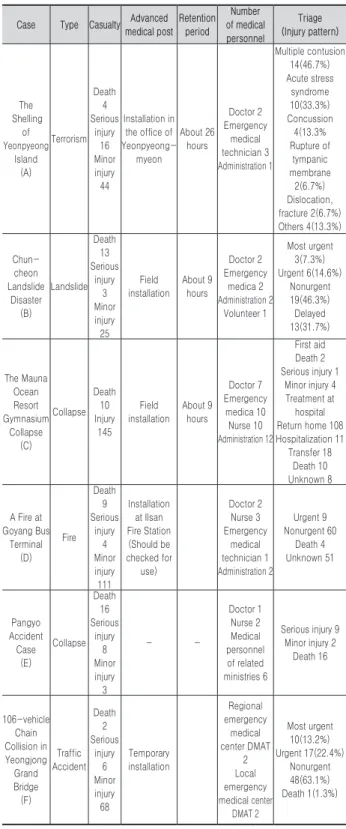
(2013), Jang et al. (2013)의 사례 논문 내용을 기반으로 분 석하였다. 본 연구에서 조사한 재난 사례 및 의료관련 내용은 다음 표(Table 1)에 정리하였다.
표에서 보는 바와 같이 현장응급의료소 설치 시 활동기간 이 9~26시간 정도이다. 국내에서는 현재 응급처치 후 거점
병원으로의 이송만을 고려하고 있어, 필요시 에어텐트 형태 로만 설치되고 있다. 그러나 최근 다양화, 대형화되고 있는 재난의 유형과 부상자 중증도 유형, 인근 병원 응급실의 수용 능력을 고려하였을 때 현장응급의료소의 장기간 존속 및 부 상종류에 따른 의료시설의 투입은 필수적으로 판단되어진다.
재난 대응에 관련된 사례 분석에는 재난 유형, 사상자, 현장응급
Table 1. Case study of disaster
Case Type Casualty Advanced medical post
Retention period
Number of medical personnel
Triage (Injury pattern)
The Shelling
of Yeonpyeong
Island (A)
Terrorism Death
4 Serious
injury 16 Minor injury
44
Installation in the office of Yeonpyeong-
myeon
About 26 hours
Doctor 2 Emergency
medical technician 3 Administration 1
Multiple contusion 14(46.7%) Acute stress
syndrome 10(33.3%) Concussion
4(13.3%
Rupture of tympanic membrane
2(6.7%) Dislocation, fracture 2(6.7%) Others 4(13.3%)
Chun- cheon Landslide
Disaster (B)
Landslide Death
13 Serious
injury 3 Minor injury
25
Field installation
About 9 hours
Doctor 2 Emergency
medica 2 Administration 2
Volunteer 1
Most urgent 3(7.3%) Urgent 6(14.6%)
Nonurgent 19(46.3%) Delayed 13(31.7%)
The Mauna Ocean Resort Gymnasium
Collapse (C)
Collapse Death
10 Injury
145 Field installation
About 9 hours
Doctor 7 Emergency
medica 10 Nurse 10 Administration 12
First aid Death 2 Serious injury 1
Minor injury 4 Treatment at hospital Return home 108 Hospitalization 11 Transfer 18
Death 10 Unknown 8
A Fire at Goyang Bus
Terminal (D)
Fire Death
9 Serious
injury 4 Minor injury
111
Installation at Ilsan Fire Station (Should be checked for
use)
Doctor 2 Nurse 3 Emergency
medical technician 1 Administration 2
Urgent 9 Nonurgent 60
Death 4 Unknown 51
Pangyo Accident Case
(E)
Collapse Death
16 Serious
injury 8 Minor injury
3
- -
Doctor 1 Nurse 2 Medical personnel of related ministries 6
Serious injury 9 Minor injury 2
Death 16
106-vehicle Chain Collision in Yeongjong Grand Bridge (F)
Traffic Accident
Death 2 Serious
injury 6 Minor injury
68
Temporary installation
Regional emergency
medical center DMAT
2 Local emergency medical center
DMAT 2
Most urgent 10(13.2%) Urgent 17(22.4%)
Nonurgent 48(63.1%) Death 1(1.3%)
의료소 설치여부, 의료진 투입 규모, 부상(중증도)분류가 어 느 정도 정리되어 있으나, 「재난응급의료 비상대응매뉴얼」 상 현장응급의료소는 에어텐트의 한 가지 유형으로 사용되기 때 문에 재난 유형 및 특성에 따른 다양한 유형의 재난현장 응급 의료시설 투입은 고려되지 못하고 있다.
3.2 의사결정사항 도출
재난현장 응급의료시설 구축과 관련된 효율적인 의사결정 을 위해서는 발생된 재난현장의 조사 및 분석을 통한 데이터 구축이 선행되어야 한다. 이를 위하여 재난현장에서 조사되 어야 할 항목이 정리되어야 하며, 조사된 내용을 토대로 재난 응급의료시설 구축에 필요한 의사결정이 수행되어야 한다.
이를 위해 본 연구에서는 재난현장 응급의료시설 구축에 필요한 의사결정사항을 기반으로 재난현장 응급의료시설 의 사결정을 위해 재난 현장에서 조사되어야 할 항목을 도출하 였다. 재난현장 응급의료시설 구축에 필요한 의사결정사항은 국내외 관련 논문 및 재난의료관련 전문가 토론 내용을 기반 으로 도출하였으며, 의사결정사항 도출을 위해 검토한 문헌 은 다음과 같다.
·재난응급의료 비상대응매뉴얼
·국내 이동형 병원 도입 및 효율적 운영방안 연구 결과보 고서(전문가 토론 내용)
·An introduction to portable field hospitals
위의 문헌에서 의사결정사항과 연계된 내용과 본 연구에서 도출한 의사결정사항은 다음과 같다.
·재난 유형 및 발생 사상자수를 고려한 현장의료 서비스 제공을 통한 신속대응(1. 투입여부)
·재난 피해지역 상황과 환자 처치 수준을 고려한 유형 결 정 필요(2. 투입유형)
·재난의 규모와 발생 사상자 수, 지역 내의 의료체계를 고 려한 응급의료시설 투입과 환자의 요구 치료 수준에 따른 수 용환자 수를 고려한 투입(3. 투입규모)
·재난 현장에서의 가장 기본적인 환자분류에서 최악의 재 난상황까지 대응 가능한 수준의 시설 대비 필요(4. 시설기능)
·투입되는 시설의 유형에 따른 각각의 설치 시간 고려(5.
설치기간)
·기본적인 설비 및 장비에서부터 재난 유형을 고려한 전 문 의료 설비 및 장비, 시설 유형에 따른 내장 설비 고려(6.
요구설비)
·시설 설치가 요구되는 재난 현장의 특징 및 날씨에 적응 하며, 시설의 외부 손상 등에 견디는 안전성 필요(7. 안전성)
·설치 후 운영이 시작되며 추가 요구조자가 없거나, 응급 의료지원의 수요가 없는 경우 종료, 지역 내 의료 공백이 발 생하는 경우는 추가적인 대처 필요(8. 유지기간)
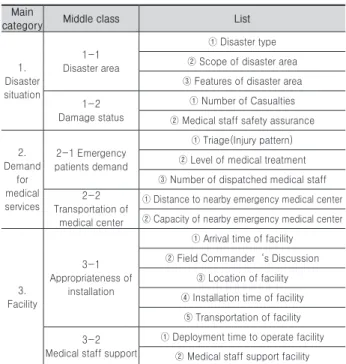
이상의 내용을 토대로 재난현장 응급의료시설과 관련된 의 사결정사항으로 투입여부, 투입유형, 투입규모, 시설기능, 설 치기간, 요구설비, 안전성, 유지기간이 도출되었으며, 재난 현장에서 각 항목에 대한 의사결정을 위해 조사되어야 할 항 목은 다음 그림과 같다.
Fig. 1. Deriving investigation items through decision-making standard
위의 그림에서의 재난현장 조사항목은 Table 2와 같이 각 조사항목 간 유사성에 따라 재분류하고 하위 개념을 포함할 수 있는 상위개념으로 분류하였다. 조사항목은 17개로 도출 하였고, 재난상황, 의료서비스 수요, 시설에 대한 항목으로 재분류 하였다.
Table 2. Advanced medical post type decision-making investigation
Main
category Middle class List
1.
Disaster situation
1-1 Disaster area
① Disaster type
② Scope of disaster area
③ Features of disaster area 1-2
Damage status
① Number of Casualties
② Medical staff safety assurance
2.
Demand for medical services
2-1 Emergency patients demand
① Triage(Injury pattern)
② Level of medical treatment
③ Number of dispatched medical staff 2-2
Transportation of medical center
① Distance to nearby emergency medical center
② Capacity of nearby emergency medical center
3.
Facility
3-1 Appropriateness of
installation
① Arrival time of facility
② Field Commander‘s Discussion
③ Location of facility
④ Installation time of facility
⑤ Transportation of facility 3-2
Medical staff support
① Deployment time to operate facility
② Medical staff support facility
6개의 국내 사례를 기반으로 재난현장 조사항목의 조사여 부를 분석한 결과는 Table 3와 같다.
Table 3. Advanced medical post type decision-making investigation through domestic disaster cases
No List Available for research(Cases)
A B C D E F
1 Disaster type ○ ○ ○ ○ ○ ○
2 Scope of disaster area ○ ○ ○ ○ ○ ○
3 Features of disaster area ○ × × △ ○ ○
4 Number of Casualties ○ ○ ○ ○ ○ ○
5 Medical staff safety assurance △ × × × × ×
6 Triage(Injury pattern) ○ ○ △ ○ △ ○
7 Level of medical treatment × ○ △ ○ × ○
8 Number of dispatched medical staff ○ △ ○ ○ ○ ○ 9 Distance to nearby emergency
medical center × ○ △ ○ × ○
10 Capacity of nearby emergency
medical center × × × × △ ×
11 Arrival time of facility ○ ○ ○ ○ △ ○
12 Field Commander‘s Discussion △ ○ × × ○ △
13 Location of facility △ △ × × × ×
14 Installation time of facility ○ ○ ○ × × ×
15 Transportation of facility ○ ○ ○ × △ ×
16 Deployment time to operate
advanced medical post ○ ○ × ○ ○ ○
17 Medical personnel support facility × × × × × ×
위의 표에서 보는 바와 같이 재난현장 응급의료시설 투입 여부를 결정할 수 있는 의사결정사항인 재난 피해 지역 특징, 주변 응급의료시설 수용 능력, 현장 지휘관 논의 사항, 의료 진 지원 시설 유무는 현재 조사된 사례에서 데이터를 추출할 수 없는 실정이다. 또한, 재난유형과 재난지역범위, 부상자 수는 각 사례에서 모두 조사가 이루어졌지만, 재난현장 응급 의료시설 투입과 관련된 기준이 제시되어 있지 않아 이에 대 한 보완이 필요하다. 재난 발생 시 이러한 항목들에 대한 파 악이 우선되고, 재난현장에서 원활한 의사결정을 위한 기준 이 제시되어야 하므로, 이 내용들에 대한 관련 매뉴얼의 보완 이 요구된다.
4. 재난현장 응급의료시설 구축 방안 4.1 재난현장 응급의료시설 유형 제시
유닛 모듈 시스템의 짧은 공기, 간편한 시공, 신속한 설치 와 제거, 이동의 용이성, 경제성, 재활용의 용이성 등의 장점 으로 사용되기 시작하였고, 현재는 새로운 건축의 형태를 이
루고 있다(Mun & Kim, 2013).
현장응급의료소 유형 결정을 위해서 현재 보유 중인 현장 응급의료소 에어텐트와 유닛 모듈 시스템기반의 컨테이너를 기능적으로 비교하여 나열한 내용은 Table 4와 같다
Table 4. Unit modular system types of advanced medical post
Tent Unit modular(Container)
Weight Lightness Relatively heavy
Size Small ISO 20 and ISO 40
Transport Portable Trailer or flights are need Installation
time
About 20~30 min (Air injection type 10 min) Available
area
30~180㎡ (Higher proportion compared to size)
Enable to use 3 times area of standard
Cost Inexpensive
High cost due to structural complexity and production costs
Structural
stability Low High (Excellent adaptability to extreme environments) Durability More than 5 years, but less
than a container More than a tent Medical
equipment Require extra transport Applicable within the modular Withdrawal Required about 4~6
experienced personnel No procedure
Others
- It is possible that connect between tent
- It is easy to composition of various modules
In some cases, a forklift is required for installation, but recently the container with its own hydraulic lift was developed
위의 표에서 보는 바와 같이 에어텐트는 무게, 크기, 운송 측면에서 유닛 모듈 시스템에 비해 장점을 가지고 있으나, 구 조적 안전성 및 내구성에 단점을 보여 장기간 시설 유지가 필 요한 대규모 재난에는 적합하지 않을 가능성이 높다. 기능 적 으로 비교된 요소들과 각 재난 사례를 기반으로 적합한 유형 을 투입하여야 각 상황에 적합한 대응을 할 것으로 판단되어 진다. 그러나 현재 유닛 모듈 시스템의 적용의 적합성을 결정 할 수 있는 기반 데이터가 구축되어 있지 않다. 재난현장 응 급의료시설은 재난 현장에 투입되므로 (1)간단한 구성, (2)전 천후 신뢰성, (3)이동성 및 신속한 구축, (4)일정한 규격, (5) 자체공급유지와 관련된 기능 구현이 요구된다(Cheng et al., 2015).
유닛 모듈 시스템 기반 재난현장 응급의료시설은 컨테이너 자체가 응급실 및 중환자실의 역할을 하며, 수술실 또는 별도 의 공조시스템이 필요한 경우 설비의 변화를 주어 설계되어 져야 한다. 적재된 컨테이너를 타 장비로 양중 하여 내릴 수 있지만, 최근에는 자체적으로 리프팅을 할 수 있는 장치를 포 함한 컨테이너의 개발로 컨테이너 자체만으로 구축할 수 있
다. 재난현장 응급의료시설에서의 유닛 모듈 시스템 적용을 위한 재난현장 조사 내용을 기반으로 유닛 모듈 시설의 종류 를 결정할 수 있으며, 유닛 모듈 시스템 기반의 재난현장 응 급의료시설의 종류를 구분한 내용은 Table 5와 같다.
Table 5. Changes in the Manual
Type Situation
Single type
- Site that can not put air tent - mid-scale disaster
- Some cases, that need to emergency surgery on site
Horizontally expandable
type
- Site that can not put air tent - A major disaster
- When capacity of nearby emergency medical center decreased
유닛 모듈 시스템 기반의 현장응급의료 시설은 현장응급의 료소의 건물 설치와 천막 설치 모두가 불가능하다고 판단되 어질 경우 선택한다. 단일 구조형은 중규모 재난상황에서 에 어텐트 투입이 불가능하고, 현장에서의 응급 처치 및 응급수 술이 필요한 현장에 투입되어진다. 수평 확장형의 경우 단일 구조형에서 확장시킬 수 있는 유닛이며, 다수의 사상자가 발 생하는 대규모 재난 상황과 주변 의료시설에서 환자 수용 능 력이 저하 또는 불가능 할 경우 병원의 역할을 수행하기 위해 투입되어진다.
4.2 재난응급의료 비상대응매뉴얼 적용방안 본 논문에서는 「재난응급의료 비상대응매뉴얼」 상 현장응 급의료 시행 장소 선정과 현장응급의료소 설치는 현장지휘소 와 상의하여 선정하지만, 본 연구에서는 현장응급의료소의 유형에 유닛모듈시설을 추가하는 방안을 제시하였다.
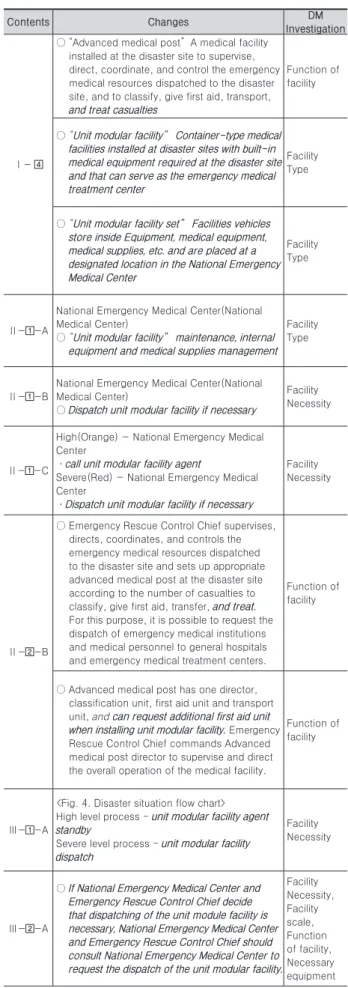
재난현장 응급의료시설 유형을 추가하기 위한 매뉴얼 개선 안은 Table 6과 같다. 본 논문에서 제안하는 시설관련 내용이 적용되어야 하는 부분은 Ⅰ장(개요)의 4절(용어정의), Ⅱ장 (기관별 역할과 지휘체계)의 1절(기관별 역할)의 가항(대비(평 상시 역할), 나항(대응(재난 시 역할), 다항(대응단계별 기관 별 주요활동), Ⅲ장(재난현장의 응급의료체계)의 1절(재난상 황 접수 및 전파)의 가항(재난상황 접수 및 전파), 2절(출동요 청 및 출동)의 가항(출동요청), 3절(선착대(보건소 신속대응 반, DMAT)도착), 3절의 라항(현장 의료수요 파악), 바항(현 장응급의료소 설치 요건), 4절(후발 DMAT 합류), 5절(현장응 급의료 활동)의 가항(DMAT), Ⅳ장(재난현장의 응급의료지원 인력의 구성 및 운영), 2절(중앙 DMAT), Ⅴ장(재난현장의 응 급의료지원 물품의 비축과 관리)이다. 아래 표에는 각 항목의 표시만 해두었다.
Table 6. Changes in the Manual
Contents Changes DM
Investigation
Ⅰ- 4
○ “Advanced medical post” A medical facility installed at the disaster site to supervise, direct, coordinate, and control the emergency medical resources dispatched to the disaster site, and to classify, give first aid, transport,
and treat casualties
Function of facility
○ “Unit modular facility” Container-type medical
facilities installed at disaster sites with built-in medical equipment required at the disaster site and that can serve as the emergency medical treatment center
Facility Type
○ “Unit modular facility set” Facilities vehicles
store inside Equipment, medical equipment, medical supplies, etc. and are placed at a designated location in the National Emergency Medical Center
Facility Type
Ⅱ-1-A
National Emergency Medical Center(National Medical Center)
○ “Unit modular facility” maintenance, internal
equipment and medical supplies management
Facility Type
Ⅱ-1-B
National Emergency Medical Center(National Medical Center)
○ Dispatch unit modular facility if necessary
Facility Necessity
Ⅱ-1-C
High(Orange) - National Emergency Medical Center
·call unit modular facility agent
Severe(Red) - National Emergency Medical Center
·Dispatch unit modular facility if necessary
Facility Necessity
Ⅱ-2-B
○ Emergency Rescue Control Chief supervises, directs, coordinates, and controls the emergency medical resources dispatched to the disaster site and sets up appropriate advanced medical post at the disaster site according to the number of casualties to classify, give first aid, transfer,
and treat.
For this purpose, it is possible to request the dispatch of emergency medical institutions and medical personnel to general hospitals and emergency medical treatment centers.
Function of facility
○ Advanced medical post has one director, classification unit, first aid unit and transport unit, and can request additional first aid unit
when installing unit modular facility. Emergency
Rescue Control Chief commands Advanced medical post director to supervise and direct the overall operation of the medical facility.Function of facility
Ⅲ-1-A
<Fig. 4. Disaster situation flow chart>
High level process - unit modular facility agent
standby
Severe level process - unit modular facility
dispatch
Facility Necessity
Ⅲ-2-A
○
If National Emergency Medical Center and Emergency Rescue Control Chief decide that dispatching of the unit module facility is necessary, National Emergency Medical Center and Emergency Rescue Control Chief should consult National Emergency Medical Center to request the dispatch of the unit modular facility.
Facility Necessity, Facility scale, Function of facility, Necessary equipment
Ⅲ- 3
* Advance team mission
- Identification and connection of on-site command system
- Secure site safety
- Communication system configuration - Identify on-site medical demands, Request
unit modular facilities and second team if
necessary- Selection of on-site emergency medical treatment site
Facility Necessity, Facility scale, Function of facility, Necessary equipment
Ⅲ-3-D
○ If National Emergency Medical Center requires more medical personnel at the same time, or if it takes more than 6 hours for on-site support activities, National Emergency Medical Center can request to dispatch DMAT at other Regional Emergency Medical Information Center and medical personnel at emergency medical treatment center, not Regional Emergency Medical Information Center. If
there needs more support, can request the dispatch of the unit modular facility through National Emergency Medical Center.
Facility Necessity, Facility scale, Function of facility, Necessary equipment
Ⅲ-3-F
○ IAdvanced medical post is available if existing buildings are available, and if there are no buildings, tents are installed. If the tent can not be installed, outdoor activities are carried out. If unit modular facility input is determined,
change from using tent to use of unit modular facility. If it is determined that tent installation is not possible, unit modular facility installation can be requested. (Building > unit modular facility > tent > outdoor)
Facility Necessity, Facility type, Installation period
Ⅲ- 4
DMAT advance team
· Focus on the activities of first aid unit after
installation of the unit module facility.
Function of facility
Ⅲ-5-A
○ First aid
- If the patient needs surgery in the field, the
patient is operated at the unit modular facility.
If the transfer is possible afterwards, the patient is transferred to transfer unit.
- If the patient can not be transported or
hospitals are unacceptable, it is accepted by the unit modular facility. If the transfer is possible, it is transferred to transfer unit.
Function of facility, Necessary equipment
Ⅳ
National DMAT - Transportation
Emergency motor vehicles (in request)Unit modular facility set
Maintenance Period
Ⅳ- 2
6) Dispatch process
○
The head of National Emergency Medical Center can decide on the set of unit modular facilities by considering the situation of the disaster site and consulting with Emergency Rescue Control Chief.
○
Have unit modular facility equipment at the location designated by National Emergency Medical Center and make it available for immediate dispatch.
Facility Necessity, Facility scale, Function of facility, Necessary equipment
Ⅴ
Unit modular facility supplies
○ Unit module facilities are managed by National Emergency Medical Center
○ Unit modular facility equipments are configured
according to the function of unit modular facility, and the supplies are adjusted and configured to the number patients in addition to the items in the existing mobile emergency support unit.
Safety, Maintenance Period Maintenance Period, Maintenance Period
Table 6은 「재난응급의료 비상대응매뉴얼」에 재난현장 응 급의료시설과 관련된 추가내용 안을 정리한 것이며, 이탤릭 체로 표시하였다. 재난현장 응급의료시설은 시설의 규모와 보유 및 관리를 위한 비용이 높을 것으로 예상되어 기존 현장 응급의료소의 관리와는 상이하게 중앙응급의료센터에서 보 유 및 관리를 하도록 한다. 재난현장 응급의료시설의 투입은 중앙응급의료센터장과 현장지휘관의 협의 후에 투입이 되며, 이를 통해 현장응급의료소의 기본 기능 3가지(중증도 분류, 응급처치, 이송)에서 부상자 치료라는 역할을 추가하였다. 치 료의 추가로 현장응급의료소의 인력 구성을 재난현장 응급의 료시설 설치 후에 재편성 하도록 내용을 보완하였으며, 재난 현장에서의 의료수요에 적합한 재난현장 응급의료시설의 기 능을 추가하였다.
5. 결론
재난의 유형이 다양화되면서, 재난에 의한 부상 유형과 이 에 필요한 시설체계의 다변화가 요구되고 있다. 세계 각국에 서 재난에 대한 대비 및 신속한 대응을 위한 노력을 기울이고 있으나, 응급의료 및 이에 필요한 시설에 관한 내용은 사례별 로 정리되어 있어 범용적으로 활용될 수 있는 매뉴얼은 부족 한 실정이다. 이에 본 연구에서는 현재 국내에서 활용되고 있 는 「재난응급의료 비상대응매뉴얼」 중 응급의료시설에 대한 내용을 보완하였으며, 이동형 병원에서 고려되고 있는 유닛 모듈 시스템의 적용방안을 제시하였다. 이를 위한 본 연구의 결과는 다음과 같다.
1) 국내에서 발생한 6개 주요 재난 사례를 분석한 결과, 응 급의료시설 투입과 관련된 의사결정을 위해 재난현장에서의 조사항목의 보완이 요구되었다.
2) 재난 응급의료관련 전문가 토론자료 등을 중심으로 재 난현장 응급의료시설과 관련된 의사결정사항과 재난현장 응 급의료시설과 관련된 의사결정을 위해 요구되는 재난현장 조 사항목을 도출하였다.
3) 재난현장 응급의료시설 의사결정사항을 기반으로 유닛 모듈 시스템 적용을 고려한 「재난응급의료 비상대응매뉴얼」
의 보완방안을 제시하였다.
유닛 모듈 시스템 기반의 응급의료 시설은 재난으로 인한 기반 시설 붕괴 및 사용 불가 시 의료시설의 역할을 수행하 며, 재난 지역의 복구 기간 동안 지역 내 근접한 거리에서 지 속적인 의료 서비스를 제공할 수 있으므로, 재난현장 응급의 료시설에 적용을 위한 지속적인 연구가 요구된다.
본 연구의 향후연구과제로는 재난현장 응급의료시설과 관 련된 의사결정 기준 제시를 위한 연구와 유닛 모듈 시스템 적 용을 위한 설계, 공장제작, 현장시공, 운영 및 유지관리의 절 차 및 방법에 대한 연구가 요구된다.
6
감사의 글
본 논문은 2017년도 정부(과학기술정보통신부)의 재원으로 한국연구재단의 지원을 받아 수행된 결과의 일부임(NRF – 2017R1A2B2004336).
References
Bin Cheng, Ruofei Shi, and Dingyuan Du. (2015).
“Mobile emergency (surgical) hospital: Development and application in medical relief of 4.20 Lushan earthquake in Sichual Province, China” Chinese Journal of Traumatology, (18)1, pp. 5-9.
Cha, M. I., Kim, G. W., Kim, C. H., Choa, M. H., Choi, D. H., Kim, I. B., Wang, S. J., Yoo, I. S., Yoon, H.
D., Lee, K. H., Cho, S. J., Heo, T., and Hong, E.S.
(2017). “A Study on the Disaster Medical Response during the Mauna Ocean Resort Gymnasium Collapse” J Korean Soc Emerg Med, 28(1), pp. 97- 108.
Chae, H. K., Kim, G. B., Park, W. N., Park, J. S., Seo, J. S., Kim, I. B., and Cha, M. I. (2015). “Experience of Disaster Medical Response System in a Fire at Goyang Bus Terminal” J Korean Soc Emerg Med, 26(2), pp. 149-157.
E. McLaughlin, and A. Papadopoulo. (2008). “An introduction to portable field hospitals” The International Electronic Journal of Rural and Remote Health Research, 8, p. 830.
Emergency Medicine research foundation (2016).
“A research report on introduction and effective operation of domestic mobile hospital”
Jang, B. H., Cho, J. S., Kim, J. J., Lim, Y. S., Lee, G., Yang, H. J., and Hyun, S. Y. (2013). “Disaster Medical Responses to the Shelling of Yeonpyeong Island” J Korean Soc Emerg Med, 24(4), pp. 439- 445.
Kang, S., Yun, S. H., Min, S. H., Kim, J. H., Han, S. B., Kim, J. S., and Paik, J. H. (2013). “An Evaluation of the Disaster Medical System after an Accident which Occurred after a Bus fell of the Incheon Bridge” J Korean Soc Emerg Med, 24(5), pp. 1-6.
Kim, N. Y. (2014). “Korean Disaster Surgical Response Team: A Novel Challenge in Disaster” J Acute Care Surg, 4(1), pp. 7-12.
Ko, H. J., Lee, K. H., Kim, O. H., Cha, Y. S., Cha, K. C., Kim, H., Hwang, S. O., Ahn, M. E., and Cho, J. W.
(2013). “Experiences of a Disaster Medical Assistant Team in the Chun-cheon Landslide Disaster” J Korean Soc Emerg Med, 24(5), pp. 493-499.
Lee, K. B., Kim, K. R., Shin, D. W., and Cha, H. S.
(2011). “A Proposal for Optimizing Unit Modular System Process to Improve Efficiency in Off- site Manufacture, Transportation and On-site Installation” Korean Journal of Construction Engineering and Management, KICEM, 12(6), pp.
14-21.
Ministry of Health & Welfare, National Emergency Medical Center (2016). Disaster Medical Assistance Manual.
Mun, Y. A. and Kim, M. K. (2013). “A Case Study of Amsterdam Student Housing Using Container Architecture for the Development of Temporary Dwelling Space – Focused on the Student Housing of “Keetwonen” Journal of the Architectural Institute of Korea Planning & Design, 29(7), pp. 135-143.
Shin, K. H. and Lee, T. S. (2014). “Priority Assignment for Emergency Medical Service Provision in Disaster by Considering Resource Limitation” J Korean Soc Hazard Mitig, 14(2), pp. 159-168.
Kim, G. Y., Park, K. O., Yoon, S. H., Park, K. H., Yoon, T. H., and Zhee, W. S. (2015). “Developing Advanced Emergency Operation and Disaster Recovery Processes for Gyeonggi-Do : Focused on the Pangyo Accident Case” Gyeonggi Research Institute, Policy Research 2015-37, pp. 1-277.
Shin, Y. S. (2016). “A study on System of Disaster Medical Response – Focused on Analysis of EMS Activity of Previous Step in the Hospital Regarding Incident Cases of Mass Casualty -” J Korean Soc Hazard Mitig, 16(3), pp. 143-150.
Thomas Blackwell and Michael Bosse (2007). “Use of an Innovative Design Mobile Hospital in the Medical Response to Hurricane Katrina” Annals of Emergency Medicine, (49)5, pp. 580-588.
Wang, S. J. (2014). “Principles and system of disaster medicine” J Korean Med Assoc, 57(12), pp. 985-992.
Wang, S. J. (2016). “Development of the Disaster Medical Manual in Korea” Journal of Korean Society of Disaster & Security, 9(1), pp. 39-45.
Woo, J. H., Lee, G., Cho, J. S., Yang, H. J., Lim, Y.
S., Kim, J. J., Park, W. B., Jang, J. Y., Jang, J.
H., Hyun, S. Y., and Cha, M. I. (2015). “Disaster Medical Responses to the Disaster Scene of Long- distance on Highway-Field Triage and Disaster Communication by Social Media for 106-vehicle Chain Collision in Yeong-Jong Grand Bridge” J Korean Soc Emerg Med, 26(5), pp. 449-457.
Yoo, I. S. (2015). “Disaster Planning in Korea” Hanyang Med Rev 2015, 35, pp. 157-173.
요약 :
최근 전 세계적으로 다양한 유형의 재난이 발생하고 있으며, 재난으로 인한 피해를 최소화하기 위한 재난관리 체계구축의 중 요성이 대두되고 있다. 국내에서도 마우나리조트, 세월호 사건 이후 국민안전처 신설, 국가안전관리기본계획 발표 등 재난안전과 관련하여 많은 정책적 개선을 추진하였으며, 재난거점병원을 확충하는 등 시설 확보에도 많은 노력을 기울였다. 그러나 미국, 유 럽, 일본 등 선진국과 비교하여 인구 당 응급의료시설이 부족한 실정이며, 재난 시 다양한 기관의 미흡한 협조체계로 효율적 재난 관리가 이행되지 못하고 있는 실정이다. 따라서 본 연구에서는 재난상황에 요구되는 응급의료시설의 효율적 구축과 체계적 운영방 안을 제시하고자 하며, 이를 위해 선진국 대비 국내 응급의료시설의 현황을 파악하고, 재난현장 응급의료시설 유형 및 상황별 구 축 방안을 제시하고자 한다.
키워드 :