Spatio-Temporal Join for Trajectory of Moving Objects in the Moving Object Database
Jai-Ho Lee
ETRI Telematics Research Division LBS Team 161 Gajeong-dong, Yuseong-gu, Daejeon, 305-350, Korea
[email protected]
Kwang-Woo Nam Kusan National Univ
san 68, Miryong-dong, Kunsan, Jeollabuk-do, 573-701 Korea [email protected]
Kwang-Soo Kim
ETRI Telematics Research Division LBS Team 161 Gajeong-dong, Yuseong-gu, Daejeon, 305-350, Korea
[email protected] Abstract: In the moving object database system, spatio-
temporal join is very import operation when we process join moving objects. Processing time of spatio-temporal join opera- tion increases by geometric progression with numbers of mov- ing objects. Therefore efficient methods of spatio-temporal join is essential to moving object database system.
In this paper, we propose spatio-temporal join algorithm with TB-Tree that preserves trajectories of moving objects, and show result of test. We first present basic algorithm, and pro- pose cpu-time tunning algorithm and IO-time tunning algo- rithm. We show result of test with data set created by moving object generator tool.
Keywords: moving object, join .
1. Introduction
Global Positioning System(GPS) has been widely ac- cepted as the technology for location objects such as vehicles on a highway or soldiers in a battlefield. Wire- less communications technology has also gained popu- larity. With these technologies in place, finding and managing the current location of moving objects have become possible. The Moving Object Database appeared in order to deal with objects changing location with time.
In this paper, we focus movong point among moving objects because our research oriented base engine for LBS applications. A Moving Point is a point object that moves along linear moving trajectory and occupies a part of Euclidian space over varying time. We need spatio- temporal acess methods that support efficiently spatio- temporal query such as “find some object within specific area durion specific period” and high performance. The spatio-temporal acess methods can be divided one re- seach managing future location based current location from the other reseach managing past location.
We can separate query into two types in moving object database. One is time-series query and the other is con- tinuous moving object query. The continuous moving
object query has slice, snapshot, project and join query.
We can process time-serises query and slice, snapshot and project query through one data aceess. But join query is required multiple data access. In addition, proc- essing time of join query increases by geometric pro- gression with object’s numbers. Generally, join opera- tion need data acess of several times. The spatio- temporal join operation is to make pairs with spatio- temporal attribute for two sets. And the import spatio- temporal join query is intersection of trajectory. A sam- ple query of spatio-temporal join is such as :
Select intersection( r.location, s.location ) From R r, S s;
The above example query means that search pairs of data intersecting their trajectory for two moving object data sets.
It is various and sophisticated to process query about moving object. So we need query process method con- sidered the characteritic of moving objects. Above all, we focus on design and implement algorithm of spatio- temporal join with spatio-temporal index. We will sug- gest a effective spatio-temporal join algorithm with spa- tio-temporal join index designed previous. A reason of using spatio-tmeporal index to procesing spatio-temporal join operation has a strong resemblance to using sptial index to processing spatial join operation. So we take into consinderation the TB-Tree index among diverse spatio-temporal indexes.
The structural characteristic of TB-tree is that entries
stored always are sorted by time. We can simplify and
improve spatio-temporal join algorithms. And using ex-
tra information stored at the leaf level, we can process
filter and refinement step only access index, in order to
process join query without acessing data. Those are the
reason why we chose TB-tree index as spatio-temporal
join index.
2. Related Works
Until now, many research focus on spatial join than spatio-temporal join.
The research of spatial join with R-tree started from [1]. In the [1], they presented join algorithm with R*-tree and used LRU buffer so as to reduce I/O time. They sug- gested two method reducing CPU time in the processing spatial join. One is resticting the search space and the other is sptaial sorting and plane sweep approach. In order to improve disk I/O time, they decide order of page demanded to read in buffer, in join processing. They improved I/O time using methods such as local plane- sweep order, local place-sweep order with pinning and local Z-order. We try appling these methodes to spatio- temporal join processing.
The TB-tree [2] discretely extracts moving object location, represents two continuous locations of ex- tracted moving objects as line segment, and represents set of connected line segements as trajectory. It is an access method that strictyly preserves trajectories such that a leaf node only contains segements belonging to the same trajectroy. And the TB-tree has doubly linked list that connects leaf nodes including parts of the same trajectory in a way that preserves trajectory evolution. So the TB-tree is supports trajectroy-based queries much more efficiently. Because the TB-tree use method that last entry is inserted new node, unlike the R-tree use split method, it has high space utilization.
3. Spatio-Temporal Join
We take two sets of moving object traejctory for spatio- temporal join with TB-tree. One is TB-tree R, the other is TB-tree S. We will experiment with CPU prcoessing time and I/O processing time by spatio-temporal join between R and S. Like performance test for spatial join in [1], to check the join condition in case of spatio- temporal join is far more expensive. Therefore, a good measure for performance consists of both, the number of disk accesses and the number of comparions.
The I/O-time is measured in the number of disk ac- cesses required for perfoming the join. The CPU-time of a spatio-temporal join is measured in the number of comparions. Comparions is to check the join condition, i.e. whether two MBB(minimum Bounding Box)s inter- sect or two trajectories intersects.
It is very difficult to get the real data for test of spatio- temporal join. So we use two moving object data set that generated by City Simulator among moving objects data genertors. Two data sets have different options when those are generating. But those are same attribute that a thousand of moving objects report a thousand of location.
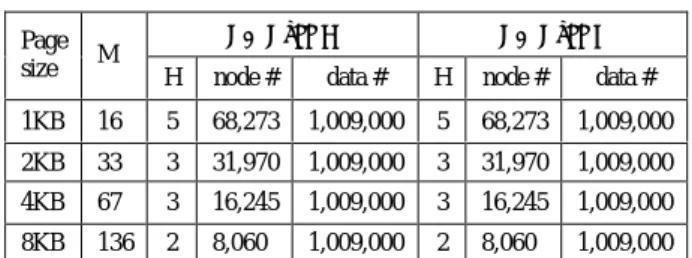
The “ Table 1 ” shows propertis of TB-tree R and S with diverse page sizes.
1) Basic Algorithm of a spatio-temporal join for TB- tree
We first describe the basic version of the algorithm, and then introduce extensions to it as well as ways to improve its performance
The basic algorithm of spatio-temporal join for TB- tree uses a characteristic of TB-tree strurecture that en- tries in nodes are sorted by time and MBB like cube.
Axises of cube consist of X axis, Y axis and T(time) axis.
If the MBBs of two node entrires Er and Es do not have a common intersection, there will be no pair (MBBr, MBBs). Otherwise there might be a pair of intersecting data MBBs in the corresponding subtrees. In the follow- ing subsections we assume that both trees are of the same height.
The following algorithm presents first approach.
In SpatioTemporalJoin1 algorithm, TB_Node is node type in TB-tree and each node contains a set of entry.
Table 1. Properties of TB-tree R and S.
TB-Tree R TB-Tree S
Page size M
H node # data # H node # data # 1KB 16 5 68,273 1,009,000 5 68,273 1,009,000 2KB 33 3 31,970 1,009,000 3 31,970 1,009,000 4KB 67 3 16,245 1,009,000 3 16,245 1,009,000 8KB 136 2 8,060 1,009,000 2 8,060 1,009,000
SpatioTemporalJoin1( R, S : TB_Node) (* height of R is equal height of S *)
SortedIntersectionTest( R,S, Seq );
For I = 1 To Seq.legth Do (Er, Es) = Seq[I];
if( Both R and S is a leaf page ) // Refinement
if( RealIntersectionTest(Er,Es) ) InsertResultHashTable(R.id,S.id) Else
ReadPage( Er.rrn );
ReadPage( Es.rrn )
SpatioTemporalJoin1( Er.rrn, Es,rrn ) End
End End
SortedIntersectionTest( Rseq, Sseq: Sequence of mbb;
var output : sequence of pair of MBB );
(*Rseq and Sseq are sorted *) output = null;
I = 1; j= 1;
While( I <= Rseq.Length and j <= Sseq.Length ) Do
If Rseq[I].StartTime < Sseq[I].StartTime Then InternalLoop( Rseq[I], j, Sseq, output ) I = I + 1;
Else
InternalLoop( Sseq[I], I, Rseq, output ) J= J + 1;
End
End
End
One Entry E consist of RRN(Relavtive Record Number) and MBB. The RRN is information of sub node.
The TB-tree has a structual charateristic that all entries are sorted by time. The SortedIntersectionTest function is applied plance-sweep method for intersection opera- tion using this characteristic. It is unnecessary to sort by one axix, because nodes were already sorted. The Sort- edIntersectionTest function performs plance sweep op- eration by time axis. Because a trajectory of one object can be stored in some nodes, a pair of object may be already finded. Therefore, we remove some replication as result sets store hash table.
The Table 2 shows results of the algorithm SpatioTem- poralJoin1 using TB-tree R and S as input. The spatio- temporal join is performed with various page sizes.
There are two parts in the algorihm SpatioTemporal- Join1 which are worth to be improved. First, CPU-time consumption is rather high since each entry of the one node is checked against all entries of the other node.
Second, pages are selected for the next call of Spatio- TemporalJoin1 without taking into account the I/O cost for reading these pages. A better apporach would be to compute the best sequence of pairs of pages required for computing the join on the next level of the TB-tree.
2) CPU-time Tunning
The consumption of CPU-time is proportional to the number of comparions required for computing the join condition (i.e the test whether two cubes or trajectories intersect). So our aim is to reduce the number of com- parions for each call of SpatioTemporalJoin1, i.e. for each pair of qualifying nodes.
In order to reduce CPU-time, we examine this ap- proach. For a given pair of node, we restrict the search space of the join such that in SpatioTemporalJoin1 only a small number of entries has to be considered. In algo- rithm SpatioTemporalJoin1, each entry of the one node is checked for the join condition using the plane sweep against all entries of the other node.
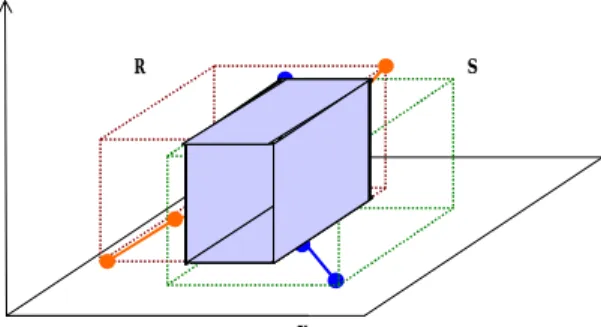
Let us consider two directory entries Er and Es which fulfil the join condition, i.e. Er.mbb ∩ Es.mbb ≠ ∅ . Then, SpatioTemporalJoin1 is invoked using Er.rrn and Es.rrn as input. The following property is very important with respect to reducing CPU-time. Only the entries of Er.rrn and Es.rrn which intersect the intersection cube Er.cube ∩ Es.cube may have a common intersection.
This property can be used for improving the join.
An example is illustrated in Fig. 1. When algorithm SpatioTemporalJoin1 performs the plane sweep, 4 seg-
ments in R area and 4 segements in S area are partici- pated. But new algorithm SpatioTemporalJoin2 are re- quired 3 segments in R area and 3 segements in S area.
Therefore, the number of comparions required for com- puting the join condition reduces. The modified algo- rithm is specified as follows.
Table reports the result for the number of comparions for both SpatioTemporalJoin1 and SpatioTemporalJoin2.
The results show improvement in the number of com-
parions.
3) IO-time Tunning
In order to reduce I/O-cost, we must computer a read schedule of pages required for spatio-temporal join of two TB-trees such that the number of disk access is
Table 3. Comparions of the with/without restricting the search space.
Page
size STJ1 STJ2 performance
gain 1KB 195,573,208 155,644,663 1.3 2KB 102,352,608 88,991,603 1.2 4KB 70,735,540 57,201,341 1.2 8KB 72,216,669 47,681,498 1.5
x
t R S
Fig. 1. Restricting the search space of a spatio-temporal join.
SpatioTemporalJoin2( R, S : Node, mbb : cube_Parallelepiped )
R = { Ei | (Ei ∈ R) and ( Ei.mbb ^ mbb <> null ) S = { Ei | (Ei ∈ S) and ( Ei.mbb ^ mbb <> null ) SortedIntersectionTest( R,S, Seq );
For I = 1 To Seq.legth Do (Er, Es) = Seq[I];
if( Both R and S is a leaf page ) // Refinement
if( RealIntersectionTest(Er,Es) ) InsertResultHashTable(Er,Es) Else
ReadPage( Er.rrn );
ReadPage( Es.rrn )
SpatioTemporalJoin2( Er.rrn, Es,rrn, Er.mbb ^ Es.mbb)
End End End Table 2. The number of disk access and comparion for Spatiotem-
poralJoin1
Page size # of comparions # of disk access
1KB 195,573,208 2,126,230
2KB 102,352,608 839,466
4KB 70,735,540 719,142
8KB 72,216,669 684,342
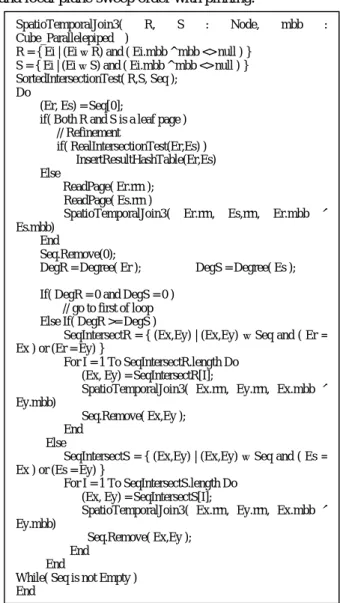
minimal. To solve this problem, we apply “local plane- sweep order with pinning” method that was already pre- sented in [1].
We determine a pair ( Er,Es ) of entries with respect to the local plane sweep order. After the correspongding subtree Er.rrn and Es.rrn, we compute degree of the cubes of both enteries. The degree of an cube of entry E, short degree(E.cube) is given by the number of intersec- tion between cube E.cube and the cubes which belong to entries of the other tree not processed util now. we pin the page in the buffer whose corresponding cube has maximal degree. The spatio-temporal join is perfomed on the pinned page with all other pages. Then we deter- min the next pair of entries using the local plane-sweep order again. In example of “Fig. 2”, We obtain de- gree(R1)=0 and degree(S2)=2. Thus, the read schedule is
<R1, S2, R4, R3, S1, S2>.
We call the corresponding join algorihm SpatioTe- moralJoin3 that reduce to repeat accesses for same page.
The Table 2 reports the result for the number of disk access for SpatioTemporalJoin1, SpatioTemporalJoin2 and SpatioTemporalJoin3. The results show a huge im- provement in the number of disk access.
4. Conclusions
In order to perform join query in moving object data- base that store trajectroies of moving point, we have pre- sented study of spatio-temporal join processing using TB-tree.
First, we have presented a straightforwd join algorithm For TB-tree. We have shown that this apprach requires optimization with respect to both CPU- and I/O-time. In order to reduce CPU- and I/O-time, we suggest tech- niques which make use of restricting the search space
and local plane-sweep order with pinning.
In our future work, we are interested in a more study of spatio-temporal joins.
References
[1] Brinkhoff , Hans-Peter Kriegel , Bernhard Seeger, Effi- cient processing of spatial joins using R-trees, Proceed- ings of the 1993 ACM SIGMOD international conference on Management of data, p.237-246, May 25-28, 1993, Washington, D.C., United States
[2] Dieter Pfoser, Christian S. Jensen, Yannis Theodoridis:
Novel Approaches in Query Processing for Moving Ob- ject Trajectories. VLDB 2000: 395-406
[3] Farshad Fotouhi, Sakti Pramanik: Optimal Secondary Storage Access Sequence for Performing Relational Join.
IEEE Trans. Knowl. Data Eng. 1(3): 318-328 (1989).
[4] Ming-Ling Lo, Chinya V. Ravishankar: Spatial Joins Using Seeded Trees. SIGMOD Conference 1994: 209- 220.
[5] Cotelo L., J. A. Forlizzi,, L, Guting, R. H. , Nardelli, E., and Schneider, M., "Algorithms for Moving Objects Da- tabases", FernUniversitat Hagen, Informatik-Report 289, October 2001.
x
t R1
S1
R2 R3
R4 S2
S R