• 검색 결과가 없습니다.

IEG 환경지질연구정보센터

N/A
N/A
Protected

Academic year: 2021

Share "IEG 환경지질연구정보센터"

Copied!
9
0
0

로드 중.... (전체 텍스트 보기)

전체 글

(1)

ISSN 1598-6438 (Print), ISSN 2287-8831 (Online)

≪ Review Paper ≫

Challenges of Groundwater as Resources in the Near Future

Jin-Yong Lee*

Department of Geology, Kangwon National University

ABSTRACT

Groundwater has been a very precious resource for human life and economic development in the world. With increasing population and food demand, the groundwater use especially for agriculture is largely elevated worldwide. The very much large groundwater use results in depletion of major aquifers, land subsidences in many large cities, anthropogenic groundwater contamination, seawater intrusion in coastal areas and accompanying severe conflicts for water security.

Furthermore, with the advent of changing climate, securing freshwater supply including groundwater becomes a pressing and critical issue for sustainable societal development in every country because prediction of precipitation is more difficult, its uneven distribution is aggravating, weather extremes are more frequent, and rising sea level is also threatening the freshwater resource. Under these difficulties, can groundwater be sustaining its role as essential element for human and society in the near future? We have to focus our efforts and wisdom on answering the question. Korean government should increase its investment in securing groundwater resources for changing climate.

Key words : Climate change, Extreme drought, Sea level rise, Seawater intrusion, Groundwater depletion

1. Groundwater Use in the World

Groundwater has long served human and society with a variety of ways including drinking, domestic use, irrigating crops (agriculture), business and industries and it is the nat- ural material that the annual production is the largest (Struckmeier et al., 2005). Worldwide annual groundwater abstraction is in the range of 600-1,100 km

3

per year, being 20-33% of total global freshwater abstraction for the vari- ous uses (Zektser and Everett, 2004; Shah et al., 2007; Döll, 2009; Siebert et al., 2010). Among them, the irrigation is the dominant use (Siebert et al., 2010), accounting for about 60% of groundwater abstraction and groundwater is supply- ing 25-40% of drinking water (but 80% in Europe and Rus- sia) in the world (Vrba and van der Gun, 2004; Struckmeier et al., 2005; NGWA, 2013).

According to Wada et al. (2010), the global groundwater abstraction was 312 km

3

/year in 1960 (this figure is not that much reliable because the global groundwater use data were not existing then and also now), but it steadily increased to 734 km

3

/year in 2000 (Fig. 1(a)), which is 135% increase

for the period. Now in 2013, the groundwater abstraction is estimated to be about 982 km

3

/year (Margat and van der Gun, 2013). The large groundwater abstractions are led by 15 countries including India, China, United States (US) and Bangladesh (NGWA, 2013; Table 1). Except only some nations like Indonesia, Russia, Japan, and Thailand, most countries consume groundwater dominantly for agricultural irrigation (Shah, 2009; Margat and van der Gun, 2013).

India's groundwater use has been exploding since 1960 (Fig. 1(b)) and thus there is a growing concern regarding this kind of water scavenging economy (Shah, 2009). Even though India receives a large amount of annual rainfall (averagely 2,000 mm/year but it is not equally distributed, 200-4,000 mm/year over the country), the irrigation area is also greatly increasing (e.g., tripled to 33.1 Mha for 1970- 1999; Rodell et al., 2009) and thus meeting this irrigation water demand is causing a severe groundwater depletion and water crisis (Rodell et al., 2009). The intensively irriga- tion dependent country is on the brink of economic col- lapse without essential mitigation measures, especially in this era of climate change.

*Corresponding author : [email protected]

Received : 2015. 3. 13 Reviewed : 2015. 4. 6 Accepted : 2015. 4. 16

Discussion until : 2015. 6. 30

(2)

Viewing the increasing patterns of groundwater use (see Fig. 1(b)), future of China is not that much optimistic. Com- pared with India (89%), its groundwater abstraction for irri- gation purpose is very low (54%) but total groundwater pumping is steadily increasing through 1960-2000. In the meanwhile, the groundwater use in the sector of industry is very notable (26%). The China's economy is rapidly devel- oping and expanding cultivated irrigation and water supply for urban and industrial development, resulting in overdraft of groundwater (Changming et al., 2001). Recently, shale gas development aggravates this water situation because the new technology, called fracking, applied for the gas devel- opment requires a large quantity of freshwater injection (20 million liters of water into each gas well; Howarth et al., 2011). China is the top country having technically recover- able shale gas resource and thus the energy source never be given up (Lee et al., 2015).

Even though the groundwater use in the US is also large, its trend is much different from the countries above. The groundwater abstraction was steadily increasing until 1990 but after then it was not elevated until 2010 (see Fig. 1(b)).

But the US is one of the largest agricultural production countries including China, Brazil, India, and Argentina (USDA, 2015) and thus irrigation purpose is predominant Table 1. Top 15 nations with the largest estimated annual groundwater abstraction as of 2010 (Margat and van der Gun, 2013; NGWA, 2013) and groundwater use in Korea (as of 2011; NGIC, 2015)

Country Population

(×1000) Area (km

2

) Groundwater use (km

3

/yr)

Groundwater use per person (m

3

/yr)

Groundwater use per area (m

3

/km

2

/yr)

Usage

Irrigation Domestic Industry

India 1,224,614 3,287,260 251.00 205 76,355 89% 9% 2%

China 1,341,335 9,596,960 111.95 83 11,665 54% 20% 26%

USA 310,384 9,826,680 111.70 360 11,367 71% 23% 6%

Pakistan 173,593 796,095 64.82 373 81,422 94% 6% 0%

Iran 73,974 1,648,200 63.40 857 38,466 87% 11% 2%

Bangladesh 148,692 143,998 30.21 203 209,795 86% 13% 1%

Mexico 113,423 1,964,380 29.45 260 14,992 72% 22% 6%

Saudi Arabia 27,448 2,149,690 24.24 883 11,276 92% 5% 3%

Indonesia 239,871 1,904,570 14.93 62 7,839 2% 93% 5%

Turkey 72,752 783,562 13.22 182 16,872 60% 32% 8%

Russia 142,985 17,098,200 11.62 81 680 3% 79% 18%

Syria 20,411 185,180 11.29 553 60,968 90% 5% 5%

Japan 126,536 377,915 10.94 86 28,948 23% 29% 48%

Thailand 69,122 513,120 10.74 155 20,931 14% 60% 26%

Italy 60,551 301,340 10.40 172 34,513 67% 23% 10%

Korea (south) 51,360 99,720 3.91 76 39,210 49% 46% 5%

Fig. 1. (a) Global groundwater abstraction and depletion and (b)

groundwater abstraction for some selected countries. The figures

are from Wada et al. (2010) and Shah et al. (2007), respectively,

but they are modified for this paper.

(3)

(71%; see Table 1). Especially, the total water withdrawals in California and Texas are over 20,000 million gallons per day (USGS, 2014). So for the agricultural sector, securing freshwater for irrigation is very critical for their business.

Recent (2013-2014) severe drought in California (Aghak- ouchak et al., 2014) resulted in devastating groundwater pumping increase (5 million acre-feet), and in damaging the state agriculture, total economic loss of 2.2 billion dollars and 1,7100 job losses (Howitt et al., 2014).

Groundwater depletion occurs when the abstraction exceeds its recharge, resulting in insustainability of water supplies, land subsidence and seawater intrusion (Wada et al., 2010). So the long-term groundwater over-exploitation indicated above has caused groundwater depletion in the world (Konikow and Kendy, 2005; Rodell et al., 2009;

Famiglietti, 2014). And many of depleted aquifers are not renewable. According to Taylor et al. (2013), the world- wide total groundwater depletion is 145 to 204 km

3

per year (Table 2). Among many continents, Asia has led this large depletion (73.5-76.5%) because it is mainly related with the great groundwater abstraction in India, China, Pakistan, and Bangladesh for agriculture. It is very disappointing that this depletion rate is steadily increasing (see Fig. 1(a) ; Wada et al., 2010). Even the groundwater depletion affects substan- tially the sea level rise (Konikow, 2011).

The widely known Ogallala aquifer in High Plains of US has been intensively pumped for crop irrigation and this caused a drastic water level decline up to 50 m (Gleeson et al., 2010). The lowered water levels have not been recov- ered, causing increase of crop production cost and reducing agricultural revenue. The residence times of groundwater in aquifers like Ogallala are commonly over 11,000 years and

thus once the aquifers are depleted, their renewals are prac- tically not possible within a reasonable time frame (Glee- son et al., 2010). All these groundwater abstraction and its depletion problem give us a question, how long does this use can be possible without our discretion on this problem?

2. Climate Change and Groundwater

Even though there are still disputes on causes of the glo- bal warming by either natural or anthropogenic, we gener- ally reach a consensus that the climate is changing both globally and locally. So the climate extremes (droughts and floods) are common (Easterling et al., 2000; Lee et al., 2015). With context of water resources management, the most important thing we must consider in this stage is to predict precipitation over time and space with enough spa- tial resolution and reliability. Our efforts for this seem a lit- tle bit successful under low and high CO

2

emission scenarios using various climate models even though the spatial resolution is not that much good (USGCRP, 2009;

USEPA, 2015).

For example, for the end of this century (~2100) under high emission scenario, in the winter, the precipitation will increase by 5-40% in the middle and north US, and Canada while the south US will get a less precipitation by 5-40%, than the recent precipitation (USGCRP, 2009). But in sum- mer, the precipitation will decrease in the south US and even in middle US while the increase by 5-30% will be shown only in north Canada (USGCRP, 2009). It is summa- rized that the upper US and Canada will have more precip- itation and the lower US will have less precipitation in the end of this century. Viewing the Korean Peninsula for RCPs Table 2. Estimates of global scale and continental scale groundwater depletion (GD) and equivalent sea level rise (SLR) (Taylor et al., 2013)

Region Flux based method Volume based method

GD (km

3

/yr) SLR (mm/yr) GD (km

3

/yr) SLR (mm/yr)

World 204 ± 30 660.57 ± 0.09 145 ± 39 60.40 ± 0.11

Asia 150 ± 25 660.42 ± 0.07 111 ± 30 60.31 ± 0.08

Africa 5.0 ± 1.5 60.014 ± 0.004 5.5 ± 1.5 0.015 ± 0.004

N. America .40 ± 10 660.11 ± 0.03 .26 ± 7 60.07 ± 0.02

S. America 1.5 ± 0.5 0.0042 ± 0.0014 0.9 ± 0.5 0.002 ± 0.001

Australia 0.5 ± 0.2 0.0014 ± 0.0006 0.4 ± 0.2 0.001 ± 0.0005

Europe 6.7 ± 2 660.02 ± 0.006 1.3 ± 0.7 0.004 ± 0.002

(4)

4.5 and 8.5, the precipitation in winter will be 3.0-7.2%

increase while that in summer will be 2.8-5.6% increase for the period of 2006-2049, but a wide spatial variation is noted (KMA, 2014). However, nevertheless of the above predictions for US and Korea, the reliability of the results cannot be guaranteed because the prediction uncertainties were not quantified (Taylor et al., 2013). But that is the best at this time.

Then, how about the groundwater? If climate, especially precipitation, changes, what will happen with groundwa- ter? Can we go further about the groundwater with the so called plausible precipitation projections? Taylor et al.

(2013) indicated that climate change influences the ground- water both in direct (recharge) and indirect (change in

groundwater use) ways. Here, I want to introduce some direct effects because they determine the latter (Table 3).

Eckhardt and Ulbrich (2003) projected groundwater recharge for 2070-2099 using greenhouse gas emission scenarios and SWAT model in the Dill catchment in Germany. The study said that groundwater recharge and streamflow will be reduced by up to 50%, which can be a threat to water avail- ability, water quality, and hydropower generation.

The Ogallala aquifer is one of the most productive water resources in the U.S. and about 30% of irrigation ground- water is from this aquifer (Rosenberg et al., 1999). Rosen- berg et al. (1999) predicted reduction of groundwater recharge up to 77% for three climate models, which will greatly aggravate the water situation in this depleting aquifer Table 3. Summary of some selected studies for impacts of climate change on groundwater

Region Scenario/recharge model Period Predicted results Reference

High Plains, USA Five GCMs/SWAP ~2075 Rainfall:-25% ~ +20%; recharge:

-75% ~ +35% Vaccaro (1992)

Ogallala, USA Three GCMs/HUMUS − Precipitation: -28% ~ +16%;

recharge: +8 ~ -77% Rosenberg et al. (1999) Geer basin, Belgium Seven GCMs /MOHISE 2010~2099 Decrease in GWL and recharge Brouyère et al. (2004) Grote-Nete, Belgium NATCC/WetSpass, MOD-

FLOW 2050~2100

Precipitation: -10% ~ +14%;

recharge: -40% ~ +14%; GWL:

-52 ~ +16 cm

Woldeamlak et al.

(2007)

Alicante, SE Spain -/ERAS 1900~2100 Recharge: -2% ~ -30% Aguilera and Murillo

(2009) East Anglia, England, Scot-

land GCMs/SMBM 2011~2100

Precipitation:+16% ~ +65%;

recharge: -20%, -40%, -7% for three regions

Herrera-Pantoja and His- cock (2008)

River Mitano, Uganda RCMs/SMBM 2070~2100 Precipitation: +14%; recharge:

+53%; runoff: +137% Mileham et al. (2009)

Dill, Germany GCMs/SWAT 2070-2099

Precipitation: -23% ~ +13%;

recharge: -3.0% ~ -7.5%; stream- flow: -4.1% ~ -6.9%

Eckhardt and Ulbrich (2003)

British Columbia, Canada CGCM1/HELP, MODFLOW 2010~2099 Recharge: +2% ~ +25% GWL:

-0.025 m ~ +0.05 m Scibek and Allen (2006)

Ontario, Canada GCM/HELP3 40 years Precipitation: +5% ~ +20%;

recharge: +100 mm/yr

Jyrkama and Sykes (2007)

Bievre-Valloire, France Two GCMs/ANSWERS 27 years (~2023)Decrease in recharge and GWL Bouraoui et al. (1999) Namoi, Howard, Scottsdale,

Australia GCMs/WAVES 112 years Rainfall:-10% ~ +10%; recharge:

-40% ~ +120% McCallum et al. (2010) Murray-Darling, Australia 15 GCMs/WAVES 1990~2030 Recharge: -12% ~ +32% Crosbie et al. (2010) Korea (south) RCMs/recharge equation 2000-2100 Rainfall: +32 ~ +33%: GWL:

-2.3 m ~ -3 m Jang et al. (2015)

GCM (General Circulation Model), SWAP (Soil-Water-Atmosphere-Plant), HUMUS (Hydrologic Unit Model for U.S.), MOHISE (inte-

grated hydrological model) GWL (groundwater level), NATCC (North Atlantic Thermohaline Circulation Change), ERAS (Estimation of

Recharge in Over-exploited Aquifers), SMBM (soil moisture balance method), RCM (Regional Climate Model), SWAT (Soil and Water

Assessment Tool), CGCM (Canadian Global Coupled Model), HELP (Hydrologic Evaluation of Landfill Performance), WAVES (Soil-

Vegetation-Atmosphere-Transfer Model)

(5)

(Jyrkama and Sykes, 2007). Woldeamlak et al. (2007) con- ducted a meaningful study on effect of climate change on groundwater system in the Grote-Nete catchment of Bel- gium. They used wet, cold, and dry climate scenarios and WetSpass model for groundwater recharge projection. The study indicated that groundwater level will decrease by 0.5 m on average (up to 3.1 m). And it stressed that the maximum water level drop will threaten shrubs and crop production in this area.

Jang et al. (2015) conducted a notable study on impact of climate change on groundwater resource in Korea (south).

Using regional climate models (with RCPs 4.5 and 8.5) and a simple precipitation-recharge-groundwater level equation, they predicted the groundwater level changes in four river basins for 2000-2100. They concluded that the groundwa- ter levels will be decreasing at all the basins with the two climate scenarios even though rainfall is projected to increase.

This result gives us some implications for water resources management strategy. In that case, we have to seriously consider less water consuming agricultural practices, espe- cially in high land cool vegetable fields and intensive agri- cultural areas (Lee et al., 2012).

All the above studies indicate that groundwater recharge and groundwater level are largely varying (decreasing or increasing) responding to climate change and their varia- tions will be much different with locations. But the predic- tion reliability largely depends on the climate models and thus they should be refined. Based on the improved climate models, the projections on the groundwater must be down-

scaled to practical application.

3. Threats in Coastal Areas

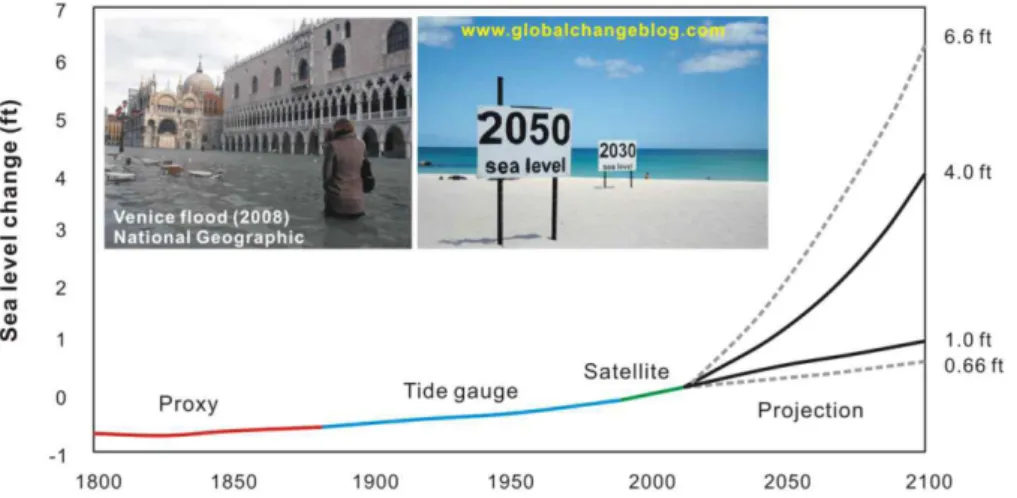
Recent global warming and climate change result in a worldwide sea level rise (Fig. 2; Parris et al., 2012) due to thermal expansion of seawater, water addition into oceans from melt glaciers and ice sheets, water input from ground- water depletion, etc. (Rahmstorf, 2007; Lee and Song, 2009; Konikow, 2011). This kind of sea level rise is accel- erated in the 20th century, which gives us a confirmation that a large portion of the rise is anthropogenic (Church and White, 2006; Nicholls and Cazenave, 2010). According to USEPA (2014), the global average sea level rise for 1880- 2013 is about 9 inches (22.86 cm). Korea is not that much different from this trend but it is confronting rather worse situation. The sea level rise rate around Korean peninsula for 1968-2007 is averagely 2.16 mm/year, which is much greater than a global average of 1.8 mm/year for a similar period (1961-2003) (Kim et al., 2009).

And then, what are the effects of the rising sea level on people and the environment? It will cause a devastating damage to coastal areas. Historically and now, many large cities with big population have been developed in the coastal areas in the world because water is relatively easily available there and the near sea provides a cheap and facil- itated transportation route. So residents in the coastal areas will experience frequent land subsidence, flood due to groundwater inundation (Rotzoll and Fletcher, 2012), and

Fig. 2. Global sea level changes (past and projection). This figure is from Parris et al. (2012) and it is modified for this paper. The two

inset photos are from National Geographic and globalchangeblog.com, respectively, which are open to the public.

(6)

eventually lose their lands, homes and jobs (businesses) due to the rising sea level (Nicholls et al., 1999; USEPA, 2014).

The lessened beach will not provide a space for a variety of beach recreational activities and the rising sea level will expel coastal plants and animals, and destroy the coastal ecosystems. We cannot be provided further valuable eco- services by this spoiled coastal nature.

What will happen with coastal groundwater? In coastal area, seawater is intruding the lands due to density differ- ence. The interface between freshwater and saltwater is given by the Ghyben-Herzberg relation (Verrjuit, 1968), assuming sharp interface, as follows:

where z and h are the thicknesses of the freshwater zones below and above the sea level, respectively, and ρ

f

and ρ

s

are the densities of freshwater and saltwater, respectively. If the sea level rises (the saline water heads are increasing), h becomes smaller at a fixed surface point and thus z is also becoming smaller, which means that the interface is much retreating landward. If the sea level rise becomes larger, the retreat is much greater. This kind of the saltwater encroach- ment poses a substantial threat to coastal crop production due to increased salinity of irrigation water, especially in western agricultural areas of Korea (Lee and Song, 2007).

So the sea level rise causes a big loss in groundwater resources. According to Nicholls and Cazenave (2010), the coastal areas of Africa and most southern Asia at low ele- vations are the most vulnerable to this sea level rise. Because the southern part of Asian continent including India, Viet- nam and China is heavy cropping area where irrigation is largely depending on groundwater, they may not meet a large proportion of worldwide food supply. Ranjan et al.

(2005) said that the sea level rise at a 2.0 mm/year will cause 5% loss of fresh groundwater in western US and that of 0.9 mm/year in Bengal Bay will cause 3% freshwater loss in Bangladesh. Masterson and Garabedian (2007) pro- vided an interesting study result on effects of the sea-level rise on groundwater flow in coastal aquifers of eastern US Simulations of sea-level rise of 2.65 mm/year for 1929- 2050 predicted decrease in 2% of thickness of fresh water lens away from streams while its decrease of 22-31% near

streams, which means a great groundwater loss in coastal cit- ies of US.

It can be summarized that the sea level rise derived from global warming and climate change is a big threat to groundwater resources in coastal areas in the world. Thus, without appropriate mitigation measures, we will face dev- astating consequences including loss of water supply, ground- water inundation, and land subsidence.

4. Discussion

It is fairly certain that there are some pressing groundwa- ter issues that we have to pay attention to, including chang- ing climate, groundwater depletion, and sea level rise (Gorelick and Zheng, 2015). Korea is also facing most of these problems such as changing precipitation (Jang et al., 2015), sea level rise (Kim et al., 2009), and seawater intru- sion especially in western coastal areas (Lee and Song, 2007; Song et al., 2007). Surface water is the most vulner- able to climate change, unlike groundwater. Nevertheless of this, Korean government has insisted so called surface water oriented water policy for a long time. It is known that this country is depending on groundwater at 11.5% (3.91 billion m

3

per year) among total water use (NGIC, 2015).

But the Korean government has only invested its budget (on water) in groundwater below 0.5%, the left is all allocated to surface water management. Korean people do not have any belief in quality of surface water or piped water (Lee et al., 2013), so they usually boil the piped water for drinking or they buy bottled waters made of groundwater. But it is much disappointing that government officials and people do not recognize the values of the precious groundwater as resources.

In the era of climate change, the groundwater is the last resort to water resources. But it must overcome many chal- lenges like climate extremes, over-exploitation, and sea level rise, for sustainable use. Most importantly, it is press- ing to teach people and government officials to know the groundwater's value. As seen above, the overdraft is surely a big problem but the underutilization of groundwater is also causing many problems like uneconomic abandon- ment of the precious water resource, urban inundation, etc.

(Lee and Koo, 2007; Giordano, 2009). Will the groundwa- z ρ

f

ρ

s

– ρ

f

--- h

=

(7)

ter be still promising in the future? It depends on efforts of relevant communities including university professors, research- ers in institutions, and groundwater professionals in many companies. Without due attention, they will lose groundwa- ter and also their job and business.

Acknowledgements

This study was supported by 2014 Research Grant from Kangwon National University (No. C1011753-01-01). I appreciate the helpful comments by the associate editor Dr.

Dong-Chan Koh and three anonymous reviewers.

References

Aghakouchak, A., Feldman, D., Stewardson, M.J., Saphores, J.D., Grant, S., and Sanders, B., 2014, Australia's drought: les- sons for California, Science, 343, 1430-1431.

Aguilera, H. and Murillo, J.M., 2009, The effect of possible cli- mate change on natural groundwater recharge based on a simple model: a study of four karstic aquifers in SE Spain, Environ.

Geol., 57, 963-974.

Bouraoui, F., Vachaud, G., Li, L.Z.X., Le Treut, H., and Chen, T., 1999, Evaluation of the impact of climate changes on water storage and groundwater recharge at the watershed scale, Clim.

Dyn., 15, 153-161.

Brouyère, S., Carabin, G., and Dassargues, A., 2004, Climate change impacts on groundwater resources: modelled deficits in a chalky aquifer, Geer basin, Belgium, Hydrogeol. J., 12, 123-134.

Changming, L., Jingjie, Y., and Kendy, E., 2001, Groundwater exploitation and its impact on the environment in the North China Plain, Water Int., 26(2), 265-272.

Church, J.A. and White, N.J., 2006, A 20th century acceleration in global sea-level rise, Geophy. Res. Lett., 33(1), L01602.

Crosbie, R.S., McCallum, J.L., Walker, G.R., and Chiew, F.H.S., 2010, Modelling climate-change impacts on groundwater recharge in the Murray-Darling Basin, Australia, Hydrogeol. J., 18, 1639-1656.

Döll, P., 2009, Vulnerability to the impact of climate change on renewable groundwater resources: a global-scale assessment, Environ. Res. Lett., 4, 035006.

Easterling, D.R., Meehl, G.A., Parmesan, C., Changnon, S.A., Karl, T.R., and Mearns, L.O., 2000, Climate extremes: observa- tions, modeling, and impacts, Science, 289, 2068-2074.

Eckhardt, K. and Ulbrich, U., 2003, Potential impacts of cli- mate change on groundwater recharge and streamflow in a cen-

tral European low mountain range, J. Hydrol., 284, 244-252.

Famiglietti, J.S., 2014, The global groundwater crisis, Nat. Clim.

Change, 4, 945-948.

Giordano, M., 2009, Global groundwater? Issues and solutions, Annu. Rev. Environ. Resour., 34, 7.1-7.26.

Gleeson, T., VanderSteen, J., Sophocleous, M.A., Taniguchi, M., Alley, W.M., Allen, D.M., and Zhou, Y., 2010, Groundwater sustainability strategies, Nat. Geosci., 3, 378-379.

Gorelick, S.M. and Zheng, C., 2015, Global change and the groundwater management challenge, Water Resour. Res., doi:

10.1002/2014WR016825.

Herrera-Pantoja, M. and Hiscock, K.M., 2008, The effects of climate change on potential groundwater recharge in Great Brit- ain, Hydrol. Process., 22, 73-86.

Howarth, R.W., Ingraffea, A., and Engelder, T., 2011, Natural gas: Should fracking stop?, Nature, 477, 271-275.

Howitt, R., Medellin-Azuara, J., MacEwan, D., Lund, J., and Sumner, D., 2014, Economic Analysis of the 2014 Drought for California Agriculture, Center for Watershed Sciences, Univer- sity of California, Davis, California, 20 p.

Jang, S., Hamm, S.Y., Yoon, H., Kim, G.B., Park, J.H., and Kim, M.S., 2015, Predicting long-term change of groundwater level with regional climate model in South Korea, Geosci. J. , DOI 10.1007/s12303-015-0002-9.

Jyrkama, M.I. and Sykes, J.F., 2007, The impact of climate change on spatially varying groundwater recharge in the grand river watershed (Ontario), J. Hydrol., 338, 237-250.

Kim, K.H., Shin, J., Koh, E.H., Koh, G.W., and Lee, K.K., 2009, Sea level rise around Jeju Island due to global warming and movement of groundwater/seawater interface in the eastern part of Jeju Island, J. Soil. Groundw. Environ., 14(3), 68-79 (in Korean with English abstract).

Konikow, L.F., 2011, Contribution of global groundwater deple- tion since 1900 to sea-level rise, Geophy. Res. Lett., 38(17), L17401.

Konikow, L.F. and Kendy, E., 2005, Groundwater depletion: A global problem, Hydrogeol. J., 13, 317-320.

Korea Meteorological Administration (KMA), 2014, Korea Cli- mate Change Assessment Report 2014: Summary for Policy- makers, KMA, Seoul, 52 p.

Lee, J.Y., Jeon, W.H., Park, Y., and Lim, H.G., 2012, Status and prospect of groundwater resources in Pyeongchang, Gangwon- do, J. Geol. Soc. Korea, 48(5), 435-444 (in Korean with English abstract).

Lee, J.Y. and Koo, M.H., 2007, A review of effects of land development and urbanization on groundwater environment, J.

Geol. Soc. Korea, 43(4), 517-528 (in Korean with English

(8)

abstract).

Lee, J.Y., Park, Y., Kim, N.J., and Jeon, W.H., 2013, Status of community drinking water in Korea: implications for appropri- ate management. J. Soil Groundw. Environ., 18(6), 56-68.

Lee, J.Y. and Song, S.H., 2007, Evaluation of groundwater qual- ity in coastal areas: implications for sustainable agriculture, Environ. Geol., 52(7), 1231-1242.

Lee, J.Y. and Song, S.H., 2009, Discussion on "Sea Level Rise Around Jeju Island due to Global Warming and Movement of Groundwater/seawater Interface in the Eastern Part of Jeju Island", J. Soil Groundw. Environ., 14(5), 1-4 (in Korean).

Lee, J.Y., Weingarten, M., and Ge, S., 2015, Induced seismicity:

The potential hazard from shale gas development and CO

2

geo- logic storage, Geosci. J. (in press).

Margat, J. and van der Gun, 2013, Groundwater Around the World, CRC Press, Balkema.

Masterson, J.P. and Garabedian, S.P., 2007, Effects of sea-level rise on ground water flow in a coastal aquifer system, Ground Water, 45(2), 209-217.

McCallum, J.L., Crosbie, R.S., Walker, G.R., and Dawes, W.R., 2010, Impacts of climate change on groundwater in Australia: a sensitivity analysis of recharge, Hydrogeol. J., 18, 1625-1638.

Mileham, L., Taylor, R.G., Todd, M., Tindimugaya, C., and Thompson, J., 2009, The impact of climate change on ground- water recharge and runoff in a humid, equatorial catchment: sen- sitivity of projections to rainfall intensity, Hydrol. Sci. J., 54(4), 727-738.

National Ground Water Association (NGWA), 2013, Facts About Global Groundwater Usage, www/ngwa.org, 2 p.

National Groundwater Information Center (NGIC), 2015, Groundwater use in Korea, www.gims.go.kr.

Nicholls, R.J. and Cazenave, A., 2010, Sea-level rise and its impact on coastal zones, Sciences, 328, 1517-1520.

Nicholls, R.J., Hoozemans, F.M.J., and Marchand, M., 1999, Increasing flood risk and wetland losses due to global sea-level rise: regional and global analyses, Global Environ. Change, 9(S1), S69-S87.

Parris, A., Bromirski, P., Burkett, V., Cayan, D., Culver, M., Hall, J., Horton, R., Knuuti, K., Moss, R., Obeysekera, J., Sal- lenger, A., and Weiss, J., 2012, Global Sea Level Rise Scenarios for the United States National Climate Assessment, NOAA Tech Memo OAR CPO-1, National Oceanic and Atmospheric Administration, Silver Spring, MD, 37 p.

Rahmstorf, S., 2007, A semi-empirical approach to projecting future sea-level rise, Science, 315, 368-370.

Ranjan, P., Kazama, S., and Sawamoto, M., 2005, Effect of sea level rise on the loss of fresh groundwater resources: case stud-

ies of western American coast and bay of Bengal, Annual J.

Hyd. Eng., 49, 97-102.

Rodell, M., Velicogna, I., and Famiglietti, J.S., 2009, Satellite- based estimates of groundwater depletion in India, Nature, 460, doi:10.1038/nature08238.

Rosenberg, N.J., Epstein, D.J., Wang, D., Vail, L., Srinivasan, R., and Arnold, J.G., 1999, Possible impacts of global warming on the hydrology on the Ogallala aquifer region, Clim. Change, 42, 677-692.

Rotzoll, K. and Fletcher, C.H., 2012, Assessment of groundwa- ter inundation as a consequence of sea-level rise, Nat. Clim.

Change, 3, 477-481.

Scibek, J. and Allen, D.M., 2006, Modeled impacts of predicted climate change on recharge and groundwater levels, Water Resour. Res., 42, W11405.

Shah, T., 2009, Climate change and groundwater: India's oppor- tunities for mitigation and adaptation, Environ. Res. Lett., 4, 035005.

Shah, T., Burke, J., and Villholth, K., 2007, Groundwater: a glo- bal assessment of scale and significance, Water For Food, Water for Life, Colombo, Sri Lanka, pp. 395-423.

Siebert, S., Burke, J., Faures, J.M., Frenken, K., Hoogeveen, J., Doll, P., and Portmann, F.T., 2010, Groundwater use for irriga- tion-a global inventory, Hydrol. Earth Syst. Sci., 14, 1863-1880.

Song, S.H., Lee, J.Y., and Park, N., 2007, Use of vertical elec- trical soundings to delineate seawater intrusion in a coastal area of Byunsan, Korea, Environ. Geol., 52, 1207-1219.

Struckmeier, W., Rubin, Y., and Jones, J.A.A., 2005, Groundwa- ter-Reservoir for a Thirty Planet? IUGS, Norway, 16 p.

Taylor, R.G., Scanlon, B., Döll, P., Rodell, M., van Beek, R., Wada, Y., Longuevergne, L., Leblance, M., Famiglietti, J.S., Edmunds, M., Konikow, L., Green, T.R., Chen, J., Taniguchi, M., Bierkens, M.F.P., MacDonald, A., Fan, Y., Maxwell, R.M., Yechieli, Y., Gurdak, J.J., Allen, D.M., Shamsudduha, M., His- cock, K., Yeh, P.J.F., Holman, I., and Treidel, H., 2013, Ground water and climate change, Nat. Clim. Change, 3, 322-329.

United States Department of Agriculture (USDA), 2015, World Agricultural Production, Circular Series WAP 2-15, 26 p.

United States Environmental Protection Agency (USEPA), 2014, Climate Change Indicators in the United States, Third Edition, EPA 430-R-14-004, http://www.epa.gov/climatechange/

indicators.

United States Environmental Protection Agency (USEPA), 2015, Future Climate Change, USEPA, http://www.epa.gov/cli- matechange/science/future.html.

United States Geological Survey (USGS), 2014, Estimated Use

of Water in the United States in 2010, Circular 1405, USGS,

(9)

Reston, Virginia, 64 p.

United States Global Change Research Program (USGCRP), 2009, Global Climate Change Impacts in the United States, Cambridge University Press, New York.

Vaccaro, J.J., 1992, Sensitivity of groundwater recharge esti- mates to climate variability and change, J. Geophy. Res., 97, 2821-2833.

Verrjuit, A., 1968, A note on the Ghyben-Herzberg formula, Bull. Int. Assoc. Sci. Hydrol., 13 (4), 43-46.

Vrba, J. and van der Gun, J., 2004, The World's Groundwater Resources, International Groundwater Resources Assessment

Centre, 10 p.

Wada, Y., van Beek, L.P.H., van Kempen, C.M., Reckman, J.W.T.M., Vasak, S., and Bierkens, M.F.P., 2010, Global deple- tion of groundwater resources, Geophy. Res. Lett., 37, L20402, doi: 10.1029/2010GL044571.

Woldeamlak, S.T., Batelaan, O., and De Smedt, F., 2007, Effects of climate change on the groundwater system in the Grote-Nete catchment, Belgium, Hydrogeol. J., 15, 891-901.

Zektser, I.S. and Everett, L.G., 2004, Groundwater Resources of

the World and Their Use, UNESCO IHP-VI Series, UNESCO,

Paris.

수치

Fig. 1. (a) Global groundwater abstraction and depletion and (b) groundwater abstraction for some selected countries
Fig. 2. Global sea level changes (past and projection). This figure is from Parris et al

참조

관련 문서

 Being first to market with a product that has a low performance level is never optimal..  Dialog can help prepare products “ready” to be accepted,

다양한 번역 작품과 번역에 관한 책을 읽는 것은 단순히 다른 시대와 언어, 문화의 교류를 넘어 지구촌이 서로 이해하고 하나가

The index is calculated with the latest 5-year auction data of 400 selected Classic, Modern, and Contemporary Chinese painting artists from major auction houses..

Today, it will be cloudy in the afternoon, and it’s going to rain at night.. On Saturday, it will be colder, and the rain will

Our results also showed that pigment epithelium-derived factor concentration in vitreous was higher than that in serum, suggesting that it is mainly derived from

월강수량 (monthly total) 평년편차 (anomaly from normal) 최근10년평균편차 (anomaly from 10yr mean)..

The world is facing environmental problems such as global warming due to the excessive use of fossil energy and energy issues, expanding the use and de-

With the opening of the Songdo Bridge 4, IFEZ is looking forward to less congestion in traffic that connects from Songdo International City locations, including Incheon New