• 검색 결과가 없습니다.

A Cross-cultural study of Body Image Perceptions between Korean and British University Students

N/A
N/A
Protected

Academic year: 2021

Share "A Cross-cultural study of Body Image Perceptions between Korean and British University Students"

Copied!
14
0
0

로드 중.... (전체 텍스트 보기)

전체 글

(1)

I. Introduction

Over the years, concerns about body image, shape, and weight have played a major role in the self-esteem and self-image of women in many countries. The physical experience of the body, always modified by the social categories through which, sustains a particular view of

Corresponding author: Seunghee Lee, Tel. +82-2-710-9857, Fax +82-2-2077-7324 E-mail : [email protected]

This research was supported by the Sookmyung Women’s University Research Grants (1-1403-0245).

society (Douglas, 1973). Douglas found that women perceive their own body size to be larger and men perceive their size to be smaller.

Oddly, neither men nor women think their same-sex peers appreciate their natural body size.

Traditionally, Asian cultures have pursued a combination of physical beauty and inner virtue

A Cross-cultural study of Body Image Perceptions between Korean and British University Students

Bu-Yong Kim

*

· Seunghee Lee

Dept. of Statistics, Sookmyung Women‘s University

*

Dept. of Clothing and Textiles, Sookmyung Women’s University

Abstract

This study explores the comparison of body image, body satisfaction, and clothing behaviors between Korean and British young women. Body image was measured by two methods: visual and verbal. For the data analysis, the Statistical Package for Social Science (SPSS) Version 16.0 for Windows was used to provide descriptive statistics, an independent sample t-test, and paired sample t- tests were applied in this study. Our results show that Korean and British female college students perceived ideal-body images that were smaller than their self defined body images. The ideal and self-images were ‐ significantly different in both groups. Both groups were dissatisfied with their own body size. The study was limited to a small sample size. Future studies using more participants from a more diverse age group and ethnic groups are recommended. The study will help marketers and retailers develop new products and new markets aimed at Korean and British women related to body image and body satisfaction.

Keywords : Cross culture, body image, Korean body image, Britain body image

(2)

as their own unique ideal of beauty (Lee et al.

2001). Body image is a multifaceted psychological construct that includes subjective attitudinal and perceptual experiences about one’s body, particularly its appearance (Cash &

Pruzinsky, 1990). Culture, upbringing, profession, stature and ethnicity may be some predominant factors behind high body image satisfaction.

Another study carried out in UK reported that Asian women were less likely to describe themselves as too fat, less dissatisfied with their body size, and less likely to want to lose weight in comparison with white women (Wardle et al., 1993). Forbes et al. (2001) examined culture as an important factor in body size ideals in African American and Latino Americans.

Body size dissatisfaction is regarded as part of the concept of body image and relates predominantly to the quantitative assessment of different parts of the body (Borland & Akram, 2007). Currently, beautiful is considered good and thinness is synonymous with beauty, which makes it valued by society while its opposite, obesity, is strongly rejected (Goswami et al., 2012).

Many research studies of cultural and ethnic differences in body image (perceived vs. ideal) and body satisfaction have focused on the differences between American and Asian (Korean, Taiwanese, and Japanese) women.

Women of different races struggle with the way western culture promotes the image of very thin Caucasian women as the ideal beauty (Druxman, 2003).

Research focuses on cross-cultural differences between Asia and other parts of the world, especially U.S. in young women’s perception of body image, body size, and body satisfaction.

However, little work has been done on the cross-cultural differences in these perceptual

variables with Asia and Europe countries, in particular, between Korean and British young women.

Therefore, the purpose of this study was to examine and understand the cultural and perceptual differences between two countries, Korea and Britain, in terms of ideal beauty, body image, and body satisfaction, and clothing behaviors. More specifically, the study is designed to answer the following research questions.

1. Is there a difference between Korean and British young women in their perception of body part satisfaction?

2. Is there a difference between Korean and British young women in their perception of self- and ideal- body images, and cultural ideal body image?

3. Is there a difference between Korean and British young women in their perception level of satisfaction/dissatisfaction with their own bodies?

4. Is there a difference between Korean and British young women in clothing behavior?

II. Review of literature

1. The definition of body image, body satisfaction (dissatisfaction)

The definition of body image centers on the way people perceive their own bodies, including collective attitudes, feelings, and fantasies (Fisher, 1986; Sault, 1994). Body image, or body self, refers to the images and feelings an individual holds about his or her body (Schilder, 1935; Rosenbaum, 1979).

Body image more specialized as body-size

dissatisfaction or satisfaction (Thompson et al,

1999). Body size dissatisfaction (satisfaction) is

(3)

regarded as part of the concept of body image and relates to the quantitative assessment of different parts of the body. It is measured as the discrepancy or difference between self-perceived real and ideal body size (Thompson & Gray, 1995; Showers & Larson, 1999).

2. Korean women’s body satisfaction

Korean women are highly interested in their appearance and fashion and engage in appearance behaviors such as using cosmetics, exercise, surgery, dieting, or fasting to transform their bodies into a more desired body form and thereby pursue a more western look (Nam &

Lee, 2001; Lee & Rudd, 1999). An increasing number of Korean women are in pursuit of a

“thin” body.

Lee and Rudd (1999) report that Koreans are more dissatisfied with their weight and with body parts compared to Americans. The researchers conducted a cross-cultural study of differences between American and Korean women in body image and attitudes to cosmetic surgery.

Although the American females were negatively disposed to cosmetic surgery, the Korean females were positive. Korean women with lower satisfaction with their body image were more tolerant of cosmetic surgery. To define beauty, 25% of the Korean sample chose ‘inner beauty’

and 25% chose western features of attractiveness, while 7% of the American females chose ‘inner beauty’ and 62% chose physical attractiveness.

Han (2000) studied the effects of thinness promoting TV messages on female college students’ body satisfaction and dieting behaviors. The experimental group was instructed to watch a variety of television

programs with thin characters. The control subjects watched a television program without thin characters. However, the more realistically the participants perceived thin television characters, the more they accepted the thin ideal, and the less satisfied they were with their own body images. In addition, the more study participants made upward comparisons and the more realistically they perceived thin characters on television, and increased dieting behaviors.

Another cross-cultural study compared appearance self-schema, body image, self-esteem, and dieting behaviors in Korea and the US. Jung and Lee (2006) found that women in both cultural groups with high appearance self-schema were less satisfied with their overall bodies and revealed lower self-esteem than those with low appearance self-schema. The study also found that Korean women placed greater importance on their appearance, were more critical of their bodies, and had lower self-esteem than women from the US had.

3. British, European American women’s body satisfaction

Ansari et al. (2010) analyzed the association of the socio-demographic factors: gender, age, country, and life style characteristics with body image perception. Danish students perceived their body image as “just right”, whereas more British participants felt “too fat”. The study investigated university students from two European countries: England and Denmark. The participants were sample of 816 British and 514 Danish students, United Kingdom and Denmark.

The vast majority of students at both universities had nationality of the respective country (at UC 96% from UK; at SDU 94% from Denmark).

Borland and Akram (2007) conducted a study

(4)

of women’s body image, age and advertising.

The results of the study show that older women are larger than younger women. They displayed a greater level of satisfaction and contentment with their body size and appearance. Gillen and Lefkowitz (2006) found that most European American and Latina American women believed that their peers’ ideal body size was thinner than their own size. Concerning racial and ethnic differences, research suggests that European Americans have larger actual-ideal discrepancies than African Americans (Aruguete et al., 2004;

Kronenfeld et al., 2010). Others show no racial/ethnic differences in actual-ideal discrepancies among African and European American women (Powell & Kahn, 1995).

Labat and DeLong (1990) focused on body cathexis and clothing ‘fit’ perceptions of 107 female consumers. The study found that a positive correlation between apparel ‘fit’

satisfaction and feelings of personal body.

In a study of British men’s female hair color preferences, Swami and Barrett (2011) found that blond females were approached significantly more frequently by men. Brunette females were rated as more physically attractive by British men in a study on physical attractiveness and personality ratings.

III. Research Method

1. Sample

The participants in this study were female college students. One hundred and eight subjects were from a central university in Seoul, Korea, and 68 from a university in England. The Korean and British participants’ ages ranged from 20 to 34 years and from 18 to 32 years,

with a mean age of 20.8 years (SD = 4.24) and of 21 years (SD = 2.41), respectively. The mean of BMI for Korean participants was 19.25 and the British were 20.26. All the participants were undergraduate students. The Korean participants were all ethnically Korean and the Britain.

The questionnaire were originally written in English and then translated into Korean. The completed questionnaires were back translated into English. The questionnaires were completed in two university classrooms (Korea and England). The classes were selected using convenience sampling method. All participation was voluntary and anonymous.

2. Materials and Data Analysis

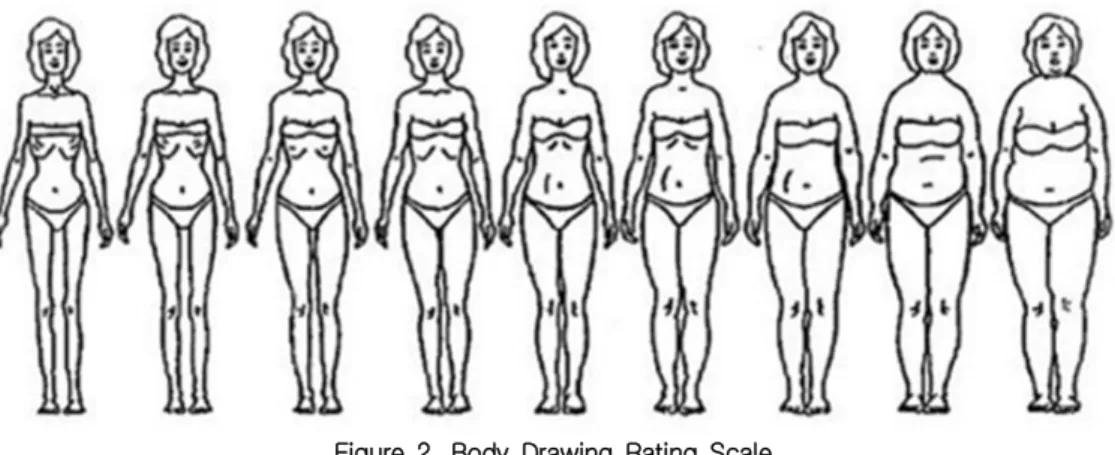
Our survey questionnaire included the following items: body satisfaction scales, a body image figure scale (using pictures of real people, rather than ideal drawings modified from the website of SPA brand H&M (figure 3;)from the thinnest to the heaviest (avoiding negative meaning of the word fattest). Somebody imageresearchesused Stunkard et al’s nine figure rating scale (1983), or body drawing rating scale (Thompson & Gray, 1995). However, those scales were drawings instead less reflect the real body figure. These reasons, this study used figure 3 from SPA brand H&M. This study used the figure 3 reflect of more realistic women’s figure than Stunkard et al.,’s (1983) and Thompson & Gray (1995).

10 items of Rosenberg self esteem scale –

(Rosenberg, 1965); such as on the whole I am

satisfied with myself, At times I think that I am

no good at all, I feel that I have a number of

good qualities, I am able to do things as well

as most other people, from strongly disagree to

strongly agree, 10 items of body image

assessment scale (Cash, 1994; Seong, & Choi,

(5)

Figure 1. Stunkard et al’s (1983) Nine Figure Rating Scale -Stunkard, A. J., Sorensen, T., & Schulsinger, F. (1983).

Figure 2. Body Drawing Rating Scale -Thompson & Gray, 1995

2011); I always worry about being fat, I care much about a small change of weight, I care about what people say about my weight gain from strongly disagree to strongly agree, and 15 items of clothing behavior scales (Kim, & Lim, 2010); Clothing is a true pleasure to me, I am often thinking about clothing, Nice clothing makes me feel happy, I always look other peoples’ clothing style from strongly disagree to strongly agree. The reliability of body image assessment scale was Cronbach’s =0.668 and α

clothing behavior scales was Cronbach’s =0.85. α The Statistical Package for Social Science (SPSS) Version16.0 for Windows was used to analyze descriptive statistics, an independent sample t-test, and paired sample t tests were conducted for the study.

IV. Results

1. Body parts satisfaction

(6)

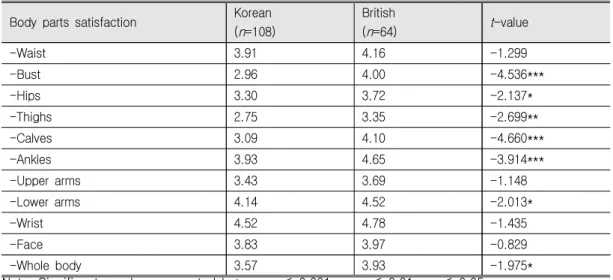
Table 1. Mean of Body Parts Satisfaction

Note. Significant p values are noted by: *** p ≤ 0.001, ** p ≤ 0.01, * p ≤ 0.05 Body parts satisfaction Korean

( n =108)

British

( n =64) t -value

-Waist 3.91 4.16 -1.299

-Bust 2.96 4.00 -4.536***

-Hips 3.30 3.72 -2.137*

-Thighs 2.75 3.35 -2.699**

-Calves 3.09 4.10 -4.660***

-Ankles 3.93 4.65 -3.914***

-Upper arms 3.43 3.69 -1.148

-Lower arms 4.14 4.52 -2.013*

-Wrist 4.52 4.78 -1.435

-Face 3.83 3.97 -0.829

-Whole body 3.57 3.93 -1.975*

Compared to Korean group, subjects in the British group were more satisfied with their all body parts such as waist, bust, hips, thighs, calves, ankles, upper arms, lower arms, wrists, face, and whole body.

There was a highly statistically significant difference (p= < 0.001) between the two groups with regard to the bust body part (2.96/4.00).

The calf (3.09/4.10) and ankle (3.93/4.65) body parts were significantly different at the level of p=< 0.001. The thighs (2.75/3.35) were significant difference at the level of p= < 0.01.

The lower arms (4.14/4.52) and whole body (3.57/3.93) were statistically difference at the level of p= <0.05.

2. Self-, ideal-, and culturally ideal- body images

An independent sample t-test was conducted to determine the perception of current self- and ideal-body images. The mean scores of the figures selected from the nine figures to represent

perceived self-body image and ideal-body size are shown in figure 3. No significant differences were found between the Korean and Britain female college students for either self-body image or ideal-body size.

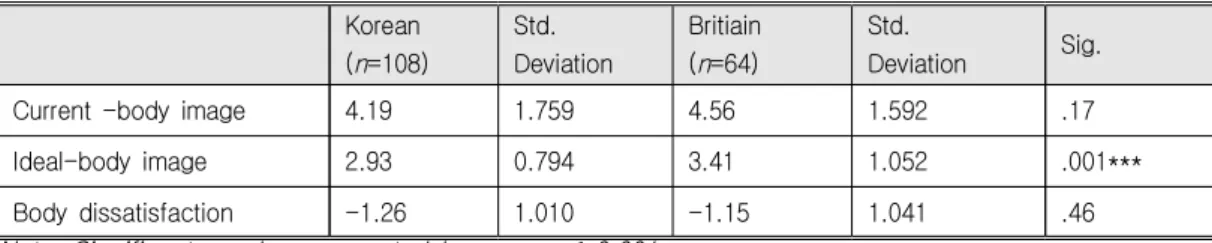
As shown in Table 2, paired sample t- tests were performed to determine the difference between self-body image and ideal-body image among the participants. The differences between Korean and British female current self-body images (4.19 and 4.56, respectively) were not statistically significant.

However, there was a statistically significant difference (p=< 0.001) between Korean and British ideal-body images (2.93 and 3.41, respectively). Furthermore, discrepancies between the ideal- and self- images were significantly different in both groups.

3. Body satisfaction and dissatisfaction

Body satisfaction/dissatisfaction scores were

determined for each subject by finding the

(7)

Figure 3. Nine Body Images

-http://www.hm.com/us/dressingroom/LADIES#page=53

Table 2. Self-image, Ideal Body Image, and Body Dissatisfaction, for Korean and British College Students

Note. Significant p values are noted by: *** p 0.001

Korean

( n =108)

Std.

Deviation

Britiain ( n =64)

Std.

Deviation Sig.

Current -body image 4.19 1.759 4.56 1.592 .17

Ideal-body image 2.93 0.794 3.41 1.052 .001***

Body dissatisfaction -1.26 1.010 -1.15 1.041 .46

difference between their ideal size and their self-body size perception on a scale of 1 to 9.

A positive score for body dissatisfaction signifies that the identification of ideal size was bigger than the perception of actual size, while a score of zero means that actual size and ideal size were the same, in which case there was no body dissatisfaction. A negative score for body dissatisfaction signifies that the identification of ideal size was smaller than the perception of actual size (Lee et al., 2006). The mean satisfaction/dissatisfaction scores were negative for both groups (Korean= -1.26, British = -1.15), suggesting that both groups were dissatisfied with their body size.

The quantified current-body image (4.19) of Korean participants is greater than their ideal-body image (2.93). The quantified current-body image (4.56) of British participants

is greater than their ideal-body image (3.41).

No significant differences were found between the Korean and British female college students for a culturally ideal-body size (3.05/3.11). As shown in Table 3, the differences between Korean and British participants’ culturally ideal-body size (3.05 and 3.11, respectively) were not statistically significant.

The differences between Korean and British

participants’ attractiveness to men (3.29 and

3.77) and average body sizes (3.81 and 4.44)

were highly statistically significant at the level of

p=< 0.003 and p=< 0.00, respectively. British

college students choose larger body sizes than

in the Korean cohort in terms of cultural body

image, attractiveness to men, and the average

body size of women on campus. In particular,

the women in the British cohort perceived their

bodies as larger than the average for women on

(8)

Table 3. Culturally Ideal- body Size Attractive to Men, and Average Body Size of Woman on Your Campus for Korean and British College Students

Note. Significant p values are noted by: *** p ≤ 0.001, ** p ≤ 0.01, *p ≤ 0.05 Korean

( n =108)

Std.

Deviation

Britain ( n =64)

Std.

Deviation Sig.

Culturally ideal body size 3.05 1.088 3.11 1.147 .725

Attractive to men 3.29 1.032 3.77 0.938 .003**

Average body size of woman on

your campus 3.81 1.077 4.44 1.139 .000***

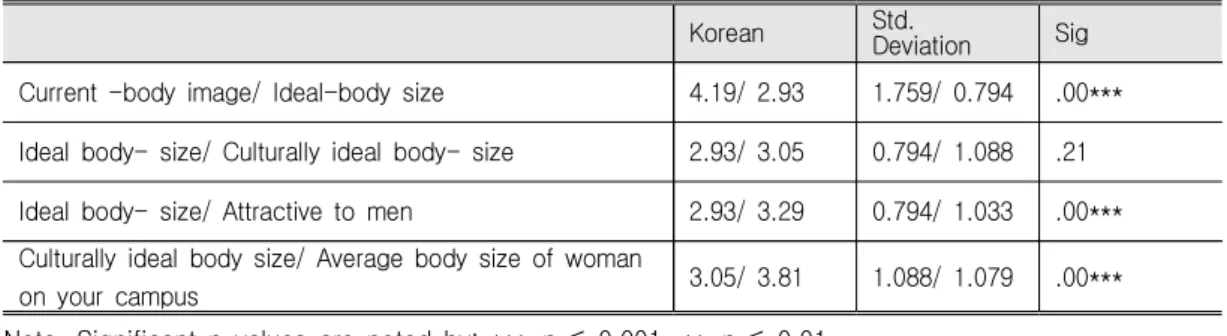
Table 4. In the Group Comparison (Current Body Image, Ideal-body Size, Culturally Ideal-body Size, Attractive to Men, and Average Body Size on the Campus) in Korean

Korean Std.

Deviation Sig Current -body image/ Ideal-body size 4.19/ 2.93 1.759/ 0.794 .00***

Ideal body- size/ Culturally ideal body- size 2.93/ 3.05 0.794/ 1.088 .21 Ideal body- size/ Attractive to men 2.93/ 3.29 0.794/ 1.033 .00***

Culturally ideal body size/ Average body size of woman

on your campus 3.05/ 3.81 1.088/ 1.079 .00***

Note. Significant p values are noted by: *** p ≤ 0.001, ** p ≤ 0.01

their campus. than their cultural ideal body size.

To understand the differences between Korean and British women’s current (present) body image compared to their ideal body size, their ideal body size with their cultural ideal body size, their ideal body size with their culture’s male perception of body sizes of attractive women, a paired sample t-test was performed.

There are statistically significant differences between current body image and ideal body size (4.19/2.93, p= < 0.00) in the Korean cohort. In addition, there are statistically significant differences between ideal body size and body size that is attractive to men (2.93/3.29, p= <

0.00) in the Korean group. However, there is no significant difference between their ideal body size and cultural ideal body size (2.93/3.05).

Korean women’s ideal body size is smaller than their perceptions of cultural ideal body size and body size attractive to men.

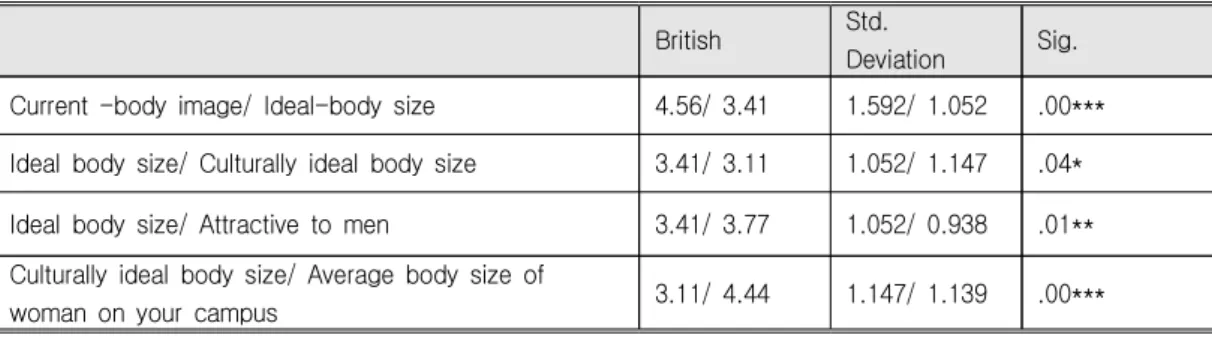
There are statistically significant differences between current body image and ideal body size (4.56/ 3.41, p= < 0.00) in the British cohort. In addition, there are statistically significant differences between ideal body size and women’s body size that men find attractive (3.41/ 3.77, p=< 0 .01) in the British group.

There is a statistical difference between their

ideal body size and cultural ideal body size

(3.41/ 3.11) in British women. The cultural ideal

body size is smaller than ideal body size in

British culture. The ideal body size is bigger

than the cultural ideal body size in British

culture.

(9)

Table 5. In the Group Comparison (Current Body Image, Ideal-body Size, Culturally Ideal-body Size, Attractive to Men, and Average Body Size on the Campus) in Britain

British Std.

Deviation Sig.

Current -body image/ Ideal-body size 4.56/ 3.41 1.592/ 1.052 .00***

Ideal body size/ Culturally ideal body size 3.41/ 3.11 1.052/ 1.147 .04*

Ideal body size/ Attractive to men 3.41/ 3.77 1.052/ 0.938 .01**

Culturally ideal body size/ Average body size of

woman on your campus 3.11/ 4.44 1.147/ 1.139 .00***

Note. Significant p values are noted by: *** p ≤ 0.001, ** p ≤ 0.01, * p ≤ 0.05

Table 6. Means for Items Assessing Self-esteem

Korean

( n =108)

Std.

Deviation

Britain ( n =64)

Std.

Deviation Sig.

-on the whole I am satisfied with

myself 2.89 0.553 2.83 0.450 .45

-At times I think that I am no

good at all 2.26 0.728 2.56 0.670 .005**

- I feel that I have a number of

good qualities 3.09 0.539 2.97 0.413 .11

-I am able to do things as well

as most other people 3.27 0.523 2.90 0.515 .00***

-I fell I do not have much to be

proud of 1.87 0.613 2.07 0.598 .032*

-I certainly feel useless at times 1.89 0.801 2.57 0.606 .00***

-I feel that I am a person of worth, at least the equal of others

3.33 0.641 2.93 0.516 .00***

-I wish I could have more

respect for myself 3.16 0.629 2.40 0.750 .00***

-All in all, I am inclined to feel

that I am a failure.. 1.87 0.775 1.87 0.653 .97

- I take a positive attitude toward

myself. 3.16 0.658 2.76 0.643 .00***

Note. Significant p values are noted by: *** p 0.001, ** p 0.01, *p 0.05

4. Clothing behavior of Korean and British young women

Korean participants show more self-esteem

than the British participants in terms of the

concepts: do things as well as most other

(10)

people (3.27/2.90, p=< 0.00), a person of worth (3.33/2.93, p=< 0.00), and a positive attitude toward myself (3.16/2.76, p=< 0.00) (Table 6).

There were statistically significant differences in the self-esteem concepts of: do not have much to be proud of (1.87/2.07, p= 0.03), feel useless at times (1.89/2.57, p= < 0.00), and could have more respect for myself (3.16/2.40, p=< 0.00).

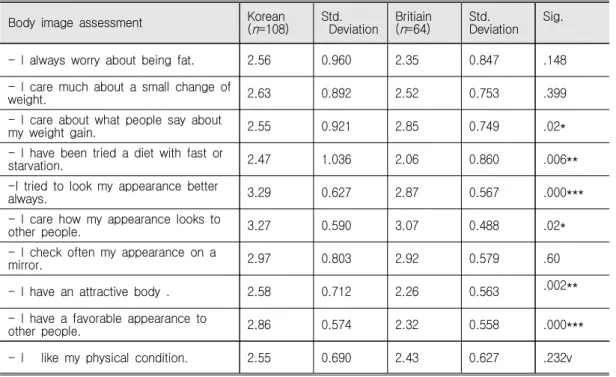
Korean participants displayed more consideration of “appearance” than British participants did. In questionnaire answers regarding appearance such as: I tried to look my appearance better always (3.29/2.87, p=<

0.00), I care how my appearance looks to other people (3.27/3.07, p= < 0.02), and I have a favorable appearance to other people (2.86/2.32, p= < 0.00).

Table 7. Mean of Body Image Assessment

Body image assessment Korean

( n =108) Std.

Deviation Britiain

( n =64) Std.

Deviation Sig.

- I always worry about being fat. 2.56 0.960 2.35 0.847 .148

- I care much about a small change of

weight. 2.63 0.892 2.52 0.753 .399

- I care about what people say about

my weight gain. 2.55 0.921 2.85 0.749 .02*

- I have been tried a diet with fast or

starvation. 2.47 1.036 2.06 0.860 .006**

-I tried to look my appearance better

always. 3.29 0.627 2.87 0.567 .000***

- I care how my appearance looks to

other people. 3.27 0.590 3.07 0.488 .02*

- I check often my appearance on a

mirror. 2.97 0.803 2.92 0.579 .60

- I have an attractive body . 2.58 0.712 2.26 0.563 .002**

- I have a favorable appearance to

other people. 2.86 0.574 2.32 0.558 .000***

- I like my physical condition. 2.55 0.690 2.43 0.627 .232v

Note. Significant p values are noted by: *** p 0.001, ** p 0.01, *p 0.05

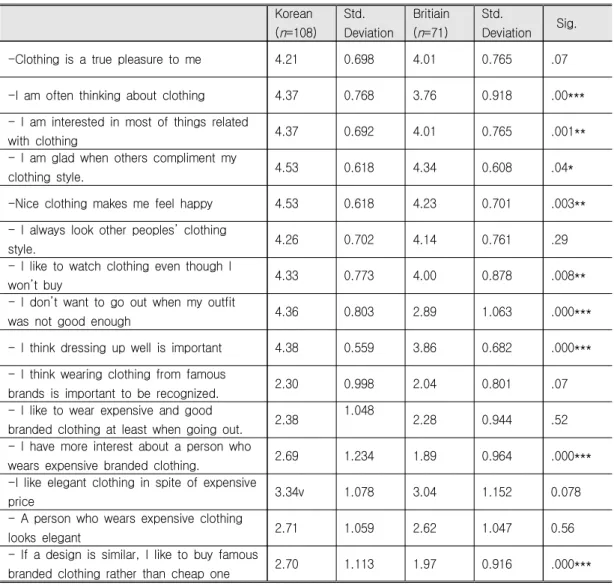
The questionnaire results indicate that British participants care more about what people say about their weight gain (2.55/2.85, p=< 0.02) the Korean participants. However, questionnaire responses to tried a diet with fast or starvation (2.47/2.06, p= <0.00) and have an attractive body (2.58/2.26, p=<0.00) were more greater in the British’s clothing (4.37/4.01, p=< 0.001), don’t want to go out when outfit was not good enough (4.36/2.89, p=< 0.000), think dressing well is important (4.38/3.86, p=< 0.000), and more interest in individuals who wear expensive brand clothing (2.69/1.89, p=< 0.00).

The answers regarding clothing behavior have

strong statistically significant differences, at the

level of p=0.00. To wear expensive and upscale

brand clothing, at least when going out, is not

different between the two countries. However,

(11)

Table 8. Means for Clothing Behavior

Korean ( n =108)

Std.

Deviation

Britiain ( n =71)

Std.

Deviation Sig.

-Clothing is a true pleasure to me 4.21 0.698 4.01 0.765 .07

-I am often thinking about clothing 4.37 0.768 3.76 0.918 .00***

- I am interested in most of things related

with clothing 4.37 0.692 4.01 0.765 .001**

- I am glad when others compliment my

clothing style. 4.53 0.618 4.34 0.608 .04*

-Nice clothing makes me feel happy 4.53 0.618 4.23 0.701 .003**

- I always look other peoples’ clothing

style. 4.26 0.702 4.14 0.761 .29

- I like to watch clothing even though I

won’t buy 4.33 0.773 4.00 0.878 .008**

- I don’t want to go out when my outfit

was not good enough 4.36 0.803 2.89 1.063 .000***

- I think dressing up well is important 4.38 0.559 3.86 0.682 .000***

- I think wearing clothing from famous

brands is important to be recognized. 2.30 0.998 2.04 0.801 .07

- I like to wear expensive and good

branded clothing at least when going out. 2.38 1.048

2.28 0.944 .52

- I have more interest about a person who

wears expensive branded clothing. 2.69 1.234 1.89 0.964 .000***

-I like elegant clothing in spite of expensive

price 3.34v 1.078 3.04 1.152 0.078

- A person who wears expensive clothing

looks elegant 2.71 1.059 2.62 1.047 0.56

- If a design is similar, I like to buy famous

branded clothing rather than cheap one 2.70 1.113 1.97 0.916 .000***

Note. Significant p values are noted by: *** p 0.001, ** p 0.01, *p 0.05

there is more interest in individuals who wear expensive brand clothing (2.69/1.89, p=< 0.00).

Korean students think more about individuals who wear expensive clothing brands (2.69/1.89, p=< 0.000) and believe nice clothing makes me feel happy (4.53/4.23, p= .003).

V. Discussion and Conclusion

Previous studies (Beck et al., 1976; Wildman

and Wildman, 1976) found that the bust was the

most sexually stimulating female body part for

males and that those men preferred busts larger

than what women possess on average. In our

study, we find that British study participants

(12)

were more satisfied with their busts than Korean women. The studies mentioned at the beginning of this paragraph document that Asian females think about their physical attraction from the point of Westerners (Beck et al., 1976; Wildman and Wildman, 1976). This leads to Koreans feeling less satisfied than British women with regard to body part satisfaction.

Our results suggest that ideal body image was less than self-defined body image in both countries. In both the Asian and Western cultures, females want a smaller body size than their actual body size. One of the results concerning ideal body size for the Korean group was significantly less than in the British group indicates that media, magazines, and TV commercials flood young women with information that promote “diet” products in the Korean market. In addition, this discrepancy between apparent thinness and obvious fatness is a concern to the health profession and government and leaves the Clothing industry with a sizing dilemma (Borland & Akram, 2007) Another finding was that ideal body size and cultural ideal body size for Korean women were similar. In contrast, women of Western culture perceived a smaller cultural ideal body size than their personal ideal body size. However, no significant differences were found between the Korean and British cultural ideal body size (3.05/3.11). This result supports that the transition of global and digital cultural exchanges.

There seems to be no difference between Asian and European cultures in terms of a Western cultural ideal body size perception.

Young women from both countries have the same ideal body size in their culture. That indicates magazines and media share information concerning ideal beauty and influences women

across global cultures.

Although there was no difference between culturally ideal body sizes, Korean women tend to want to be slender than British women. These results may be the logic behind Korea being a popular market for cosmetic surgery.

The comparison results of cultural ideal body size vs. average body size of woman from both countries showed how deprived ideal body size for cultural with average body size. The actual average women’s body size is larger than cultural ideal body size. Not only Asian but also western culture were the notion of deprived body image for women in their society.

British women perceive woman on their campus have larger average body sizes than their cultural ideal body size. Our study supports a study by Goswami et al. (2012) that found beautiful is considered good and thinness synonymous with beauty, which makes it valued by society; while its opposite, obesity, is strongly rejected.

Korean young women care about expensive brand-name clothing and Korean students have more interest in individuals who wear expensive brand-name clothing than British women. For the questions regarding subject appearance, statements may be related to Korea being a center for the cosmetic surgery industry and appeals to young consumers. Korean participants were more eager to consider

“appearance” than British participants.

Limitations and Recommendations for future research

The present study had some limitations. In spite of these limitations, this study contributes to the literature in several ways. The present study was limited by the small sample sizes.

Further studies on the perceptions of body size

(13)

and body image are warranted with larger samples using visual, verbal, attractiveness, peer influence measures and more focusing on a greater diversity of ethnic groups. And further analysis with cultural references goes to explain the differences in self esteem, body image, – and clothing behavior between Korean and British young women. Such studies should include subjects of different ages so that generational differences can be investigated.

Acknowledgments

The author thanks to Professor Micheal Hann from the Department of Human Ecology, Faculty of Department of Textiles and Clothing at University of Leeds, for his help with the British student data collection.

References

Ansari, W. E., Clausen, S. V., Mabhala, A., &

Stock, C. (2010). How do I look? Body image perceptions among University students from England and Denmark. International Journal of Environmental Research and Public Health, 7, 583-595.

Beck, S.B., Ward-Hull, C. I., & McLear, P. M.

(1976). Variables related to women’s somatic preferences of the male and female body.

Journal of Personality and Social Psychology, 34, 1200-1210.

Borland, H., & Akram, S. ( 2007). Age is no barrier to wanting to look good: women on body image, age and advertising. Qualitative Market Research, An International Journal, 10(3), 310-333.

Cash, T. & Pruzinsky, T. (1990). Body Images.

NY.: Guilford Press.

Cash, T. (1994). Body image attitudes:

evaluation investment and affect. Perceptual and motor skill, 78, 1168-1170.

Douglas, M. (1973). Natural symbols. London:

The Cresset press.

Druxman, L. (2003). The body image we see and feel: the latest research on how body image is felt by children, men and ethnic groups. IDEA Health & Fitness Source, 21(10), 40- 47.

Forbes, G. B., Adams-Curtis, L. E., Rade, B., &

Jaberg, P. (2001). Body dissatisfaction in women and men: The role of gender-typing and self-esteem. Sex Roles, 44, 461-484.

Gillen, M. M., & Lefkowitz, E. S. (2006). Gender role development and body image among male and female first year college students, Sex Roles, 55, 25-37.

Goswami, Sachdeva, & Sacheva (2012). Body image satisfaction among female college students. Industrial Psychiatry Journal, 21(2), 168 172 –

Han, M. (2000). A study on the effects of processing of thin promoting TV messages on college females’ body satisfaction and dieting behaviors. Korea Media Report, 14(3), 291-317.

Jung, J. & Lee, S-H. (2006). Cross-cultural comparisons of appearance self-schema, body image, self-esteem, and dieting behavior between Korean and U.S. Women. Family and Consumer Science Research Journal, 34(4), 350-365.

Kronenfeld, L. W., Reba-Harrelson, L., Von Holle, A., Reyes, M. L., & Bulik, C. M. (2010).

Ethnic and racial differences in body size perception and satisfaction. Body Image, 7, 131-136.

Labat, K. L. & DeLong, M. R. (1990). Body cathexis and satisfaction with fit of apparel.

Clothing and Textiles Research Journal, 8(2),

(14)

43-48.

Lee, S-H. & Rudd, N. (1999). Beneath the skin:

a cultural comparison of cosmetic surgery and body image among Korean and American females. The International Journal of Costume Cultural, 2(1), 21-30.

Lee, S-H., Rudd, N.A., & Kim, J. (2001). Body image I: A comparison of ideal beauty, body image, and appearance management behaviors among Korean and American Women. Journal of the Korean Society of Clothing and Textiles, 25(5), 969-980.

Lee, S., Ulrich, P.V., & Connell, L.J. (2006).

Body image perceptions of adolescent daughters and their mothers in U.S.. Journal of the Korean Society of Clothing and Textiles, 30(12), 1714-1722.

Nam, Y. J. & Lee, S.H. (2001). Comparison of perceived body size and actual body size between Korean and American college women. Journal of the Korean Society of Clothing and Textiles, 25(4), 764-772. . Lee, S., Ulrich, P.V., & Connell, L.J. (2006).

Body image perceptions of adolescent daughters and their mothers in U.S.. Journal of the Korean Society of Clothing and Textiles, 30(12), 1714-1722.

Powell, A. D., & Kahn, A. S. (1995). Racial differences in women’s desire to be thin.

International Journal of Eating Disorders, 17, 191-195.

Rosenberg, M. (1965). Society and the adolescent self-image. Princeton, NJ:

Princeton University Press

Seong, N., & Choi, S. (2011). The relationships between body image and total fashion image.

Journal of the Korean society of design culture, 17(2), 244-251.

Showers, C. J., & Larson, B. E. (1999). Looking at Body Image: The Organization of Self‐

Knowledge About Physical Appearance and Its Relation to Disordered Eating. Journal of personality, V (67), 659-700.

Stunkard, A. J., Sorensen, T., & Schulsinger, F.

(1983). Use of the Danish Adoption Register for the study of obesity and thinness. In S.

Kety (Ed.). The Genetics of neurological and psychiatric disorders (pp. 115-120). New York: Raven Press.

Swami, V., & Barrett, S. (2011). British men’s hair color preferences. Scandinavian Journal of Psychology, 52, 595-600.

Thompson, M. A., & Gray, J. J. (1995).

Development and validation of a new body-image assessment scale. Journal of personality assessment, 64, 258-269.

Thompson, J. K., Heinberg, L. J., Altabe, M., &

Tantleff-Dunn, S. (1999).Exacting beauty:

Theory, assessment, and treatment of body image disturbance. American Psychological Association.

Wardle, J., Bindra, R., Fairclough, B., &

Westcombe, A. (1993). A culture and body image: body perception and weight concern in young Asian and Caucasian British women.

Journal of Community Applied Social Psychology, 3, 173-181.

Wildman, R. W., & Wildman, R. W. (1976). Note on males’ and females’ preferences for opposite-sex body parts, bust size, and bust-revealing clothing, Psychological Reports, 38, 483-486.

Received (September 30, 2015)

Revised (November 16, 2015; December 17, 2015)

Accepted(December 18, 2015)

수치

Figure  2.  Body  Drawing  Rating  Scale  -Thompson  &amp;  Gray,  1995
Table  1.  Mean  of  Body  Parts  Satisfaction
Table  2.  Self-image,  Ideal  Body  Image,  and  Body  Dissatisfaction,  for  Korean  and  British  College  Students
Table  4.  In  the  Group  Comparison  (Current  Body  Image,  Ideal-body  Size,  Culturally  Ideal-body  Size,  Attractive  to  Men,  and  Average  Body  Size  on  the  Campus)  in  Korean
+4

참조

관련 문서

Purpose: The aim of this study is to identify the relationship between knowledge and awareness of radiation department students and their intent in

The purpose of this study was to investigate how the Da Vinci body board exercise program affects the body balance and physical stress of women with body imbalance.. For

A study on the relationship between body mass index and the food habits of college students. Keilins respiratory chain concept and its

Third, the analysis of the body-centered vertical speed between male.. and female students showed that male students appeared faster than female students at

The purpose of this study was to investigate the change of body composition and physical fitness after 12 weeks of practice with middle-aged women centered

• The fundamental relation between the forces acting on a rigid body in plane motion and the acceleration of its mass center and the angular acceleration of the body

In this thesis, tracked vehicle's dynamic performance of the two models, single-body model and Multi-body model, were compared through the numerical simulation.. The

• The fundamental relation between the forces acting on a rigid body in plane motion and the acceleration of its mass center and the angular acceleration of the body is