저단백질 TMR을 기초사료로 급여한 홀스타인 거세우에 있어서 CNCPS fraction별 고함유 단백질 공급이 반추위 발효패턴 및 혈액대사물질에 미치는 영향
최창원*
대구대학교 동물자원학과
Effects of CNCPS fraction-enriched proteins on ruminal fermentation and plasma metabolites in holstein steers fed TMR containing low protein
Chang Weon Choi*
Department of Animal Resources, Daegu University, Gyeongsan, Gyeongbuk 712-714, Korea Received on 17 July 2015, revised on 19 August 2015, accepted on 25 August 2015
Abstract : Four ruminally cannulated Holstein steers (BW 401.0 ± 2.22 kg) fed TMR containing low protein (CP 9.63
%) as a basal diet were used to investigate the effects of cornell net carbohydrates and protein system (CNCPS) fraction enriched protein feeds on rumen fermentation and blood metabolites. The steers used in a 4 × 4 Latin square design consumed TMR only (control), TMR with rapeseed meal (AB1), TMR with soybean meal (B2) and TMR with perilla meal (B3C), respectively. The protein feeds were substituted for 30 % crude protein of TMR intake. For measuring ruminal pH, ammonia-N and volatile fatty acids (VFA), ruminal digesta was sampled through ruminal cannula at 1 h-interval after the afternoon feeding. Blood was sampled via the jugular vein after the ruminal digesta sampling. Different CNCPS fraction-enriched proteins did not affect (p>0.05) ruminal pH except B3C being numerically low compared with the other groups. Ammonia-N and VFA were not significantly different among the experimental groups. Numerically low ammonia-N appeared in the steers fed rapeseed meal even though it contained high soluble N composition (A and B
1fractions).
The discrepancy is unclear; however this may be related to low protein level in the diet and/or low DM intake. Blood metabolites were not significantly affected by the protein substitution except for blood urea nitrogen that was significantly (p<0.05) increased.
Key words : CNCPS, Fraction, Protein, Ruminal fermentation, Holstein
*Corresponding author: Tel: +82-53-850-6721 E-mail address: [email protected]
I. 서 론
반추위에서 단백질 분해과정은 소화효소가 아닌 반추위 내 서식하고 있는 반추위 미생물에 의한 분해가 일어난다 는 점에서 단위동물의 위와는 차이가 있다(Choi, 2003).
이러한 단백질 분해과정의 정확한 측정과 해석은 매우 어 려운데, 이것은 사료 단백질 분해와 미생물 단백질 분해 및 합성이 동시에 일어나기 때문이다(Choi, 2003; Wallace, 1988). 이 사료분해과정은 반추동물의 생리적 기능 유지와
생산력의 최대화와 직접적인 연관성이 있어(Choi et al.,
2006; Wallace, 1991) 지난 수십 년 동안 많은 동물영양학
자들이 반추동물의 단백질 분해과정의 정확한 측정을 시도
한 바 있다(Choi et al., 2006; Hristov and Broderick,
1994; Ørskov and McDonald, 1979). 하지만, 시도된 측정
방법은 제한적인 조건, 방법학적인 오류와 전제조건의 요
구 등으로 인해 정확한 결과 도출에 한계가 있었고(Choi,
2003; Choi et al., 2006), 이러한 방법적 한계를 극복하고
자 미국 코넬대학교에서는 다양한 방법과 사료를 이용한 새
로운 단백질 분해과정 측정 방법 즉, Cornell net carbohydrate
and protein system (CNCPS)을 발표하고 지속적으로 그
Table 1. Nitrogen fractionation (% of CP) of experiment feeds by CNCPS method.
Fraction
1TMR Rapeseed meal Soybean meal Perilla meal
A fraction 24.8 24.7 10.2 22.9
B
1fraction 6.5 11.2 9.6 7.1
B
2fraction 39.7 27.1 50.6 12.8
B
3fraction 5.0 14.5 5.4 13.1
C fraction 24.1 22.5 24.2 44.1
방법을 개선하고 있다(Fox et al., 2004; Licitra et al.
1996). 우리나라에서는 한국젖소사양표준에서 CNCPS의 모델을 도입하여 영양소 분획과 단백질, 에너지 요구량 등 을 추정하는 시도를 하였다(RDA, 2012). 하지만, 국내 사 료자원과 반추동물을 이용한 자료가 절대적으로 부족한 현 실에서 CNCPS 모델 추정식에 의한 예측자료는 국내 현장 적용하기에는 한계가 있으며, 이는 CNCPS 모델의 검증과 정확한 한국젖소사양표준의 제정을 위해서 국내 in vivo 시험을 통한 기초 자료의 확보가 절실히 요구된다. 따라서, 본 연구에서는 저단백질 섬유질배합사료(TMR)를 기초사 료로 급여한 홀스타인 거세우를 대상으로 CNCPS에서 제 시한 nitrogen (N) fractions (A, B
1, B
2, B
3및 C fractions;
Licitra et al., 1996)별로 다량 함유된 단백질을 선정하여 생체급여한 후 반추위 발효패턴과 혈액대사생리에 미치는 영향을 조사하고자 실시하였다.
II. 재료 및 방법
1. CNCPS fraction별 대표사료 선정
단백질 fraction별 대표사료를 선정하기 위해 기존의 문 헌을 통해 후보사료를 1차 검색 후 그 중 fraction별 함유량 이 높고 국내에 사용되고 있는 사료로 선발하였다(Choi, 2003; Choi et al., 2015; Jin, 2011; Licitra et al., 1996).
선발된 사료는 Licitra 등(1996)이 제안한 분석방법에 의거 하여 N fraction을 분석하되(Table 1), 국내 통용되고 있는 사료 중 A와 B
1fraction 및 B
3와 C fraction을 구분하여 특이적으로 높고, 동시에 다른 N fraction은 낮은 사료를 선발하기는 현실적으로 어렵기 때문에 시험의 원활한 수행 을 위해 A와 B
1대표사료로 채종박, B
2대표사료로 대두박 및 B
3와 C 대표사료로 임자박을 최종 선정하였다.
2. In vivo 시험 및 분석
본 실험은 온도 및 습도 자동 제어 시스템이 설치되어 있는 대구대학교 생명환경대학 지구온난화 연구동에서 수 행되었다. 반추위 캐뉼라를 장착한 홀스타인 거세우 4두 (평균체중 401.0±2.2 kg)를 공시하여 사료 및 대사케이지 적응기(28일)에는 저수준의 CP (9.63 %)이 함유된 TMR을 자유채식 시켰다. 적응기 후 본 시험에서는 대사시험의 결 과해석의 효율성을 위해 최소 증체유도(또는 미증체) 및 공 시사료 전량섭취 유도를 위해 한국젖소사양표준에서 제시 하고 있는 건물섭취량보다 낮게 체중대비 2.0% 수준으로 급여하였다(RDA, 2012). 시험설계는 4 × 4 라틴방각법에 의해 수행되었고, 이에 따라 시험구는 TMR 급여구(대조 구), TMR + 채종박 급여구(AB1), TMR + 대두박 급여구 (B2), TMR + 임자박 급여구(B3C)로 각각 구분하였고, 각 피리어드 당 21일 총 112일(적응기 포함)동안 수행되었다.
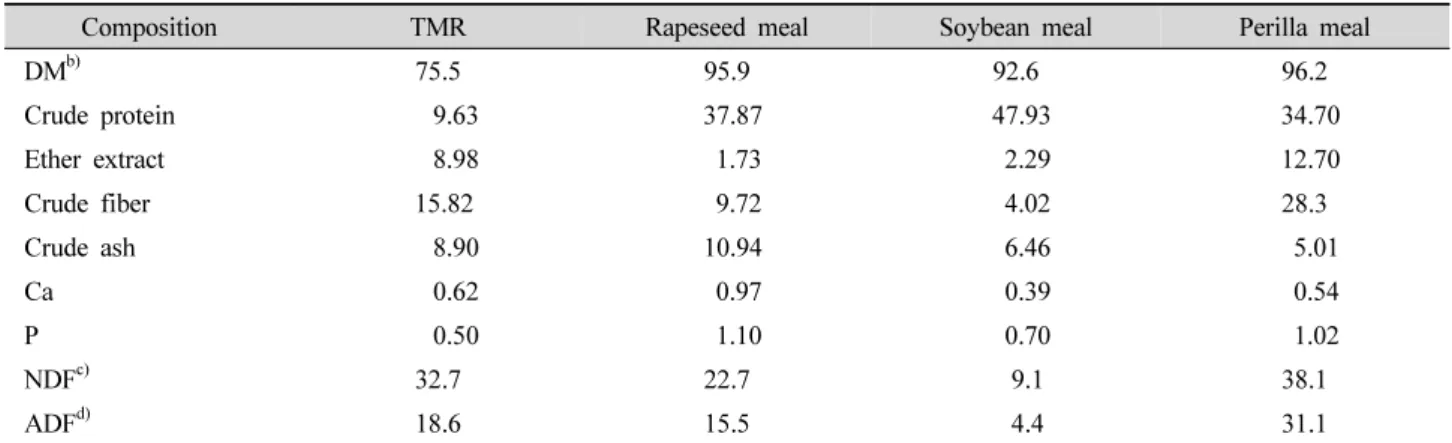
처리구의 단백질 급여는 기초사료인 TMR의 CP 30%를 선 발된 단백질 사료를 이용하여 대체, 전 시험구의 급여 CP가 일정하도록 설계하였다. 전 시험기간 동안 사료는 전량 섭 취되었고, 물과 미네랄 블록은 자유 섭취시켰다. 각 피리어 드 당 사료섭취량 결정을 위해 체중 측정은 적응기 및 각 피리어드 종료 시 측정하였다. 사료의 일반성분은 AOAC(1995)법에 의해 분석하였고 ADF와 NDF함량은 Georing과 Van Soest(1970)의 방법에 의해 분석하였다 (Table 2).
각 피리어드 마지막 날(21일째) 반추위 캐뉼라를 통해
오후 사료 급여 후 0, 1, 2, 3, 4, 5, 6, 7 및 8 h에 반추위
소화액을 채취하여 8겹의 cheesecloth으로 필터링한 후 즉
시 pH를 측정하였고, 동시에 암모니아-N와 휘발성지방산
(VFA) 측정을 위해 채취하였다. 암모니아-N은 Choi와
Oh(2011)의 방법에 따라 반추위액 10 ml당 HgCl
2포화용액
1 ml을 넣고 3,000 rpm에서 15분간 원심분리하여 상층액
Table 2. Chemical composition of experimental feeds (% of DM basis)
a).
Composition TMR Rapeseed meal Soybean meal Perilla meal
DM
b)75.5 95.9 92.6 96.2
Crude protein 9.63 37.87 47.93 34.70
Ether extract 8.98 1.73 2.29 12.70
Crude fiber 15.82 9.72 4.02 28.3
Crude ash 8.90 10.94 6.46 5.01
Ca 0.62 0.97 0.39 0.54
P 0.50 1.10 0.70 1.02
NDF
c)32.7 22.7 9.1 38.1
ADF
d)18.6 15.5 4.4 31.1
a)
All experimental steers had free access to water and a mineral block during the entire experiment.
b)
DM - dry matter.
c)
NDF - neutral detergent fiber.
d)
ADF - acid detergent fiber.
을 1.5 ml microtube에 담아 냉동보관(-70℃)하였고, 분 석 시 시료를 spectrophotometer (UVIKON 923 Double beam UN/VIS, Milan, Italy)를 이용하여 630 nm에서 optical density값을 측정하였다. VFA분석은 반추위액 10 ml당 HgCl
2포화용액 1ml, 25% phosphoric acid 2 ml 및 internal standard로 pivalic acid 0.4 ml를 첨가한 후 3,000 rpm에서 20분간 원심분리 후 상층액을 1.5 ml microtube에 담아 냉동보관(-70℃)하고, Erwin 등(1961) 의 방법에 따라 gas-chromatography (varian model CP-3800, USA)로 분석하였다.
혈액은 매 period 마지막 날 경정맥에서 10 ㎖의 혈액을 채취한 후, 24시간 냉장보관 후 원심분리(3,000 rpm, 15 분)하여 혈장을 분리하고, 분석 시까지 –70℃ 초저온 냉동고 에 보관하였다. 분리된 혈장은 albumin, glucose, triglyceride, creatitnine, total protein, blood urea nitrogen (BUN) 등 혈액대사물질은 자동 혈액 분석기(Modular Analytics, Roche, Germany)를 이용하여 분석하였다.
3. 통계분석
본 실험의 결과는 SAS package program(2002)의 GLM (general linear model)을 이용하여 분산분석하고, 시험구 의 평균간 비교는 Duncan’ multiple range test (5% 유의 수준)로 하였다(Steel and Torrie, 1980).
III. 결과 및 고찰
1. 사료 단백질 fractionation
Licitra 등(1996)의 방법을 이용하여 사료별 단백질 분획 결과, 채종박은 A와 B
1fraction이 35.9%로 다른 단백질 사료에 비해 가장 높았고, 대두박은 B
2fraction (50.6 %), 임자박은 B
3와 C fraction이 57.2 %로 각 fraction별로 가 장 높은 비율을 보이고 있다(Table 1). 이것은 기존 연구에 서 보고된 각 단백질의 N 분획과 전체적으로 유사하였다 (Choi, 2003; Jin, 2011; Licitra et al., 1996). 기초사료로 급여된 TMR의 N 분획 결과, 용해성 단백질(A 및 B
1)은 채 종박과 유사하며 난용해성 및 불용성 단백질(B
2, B
3및 C) 은 대두박과 유사한 N fraction 구성을 보였다.
2. 반추위 발효패턴
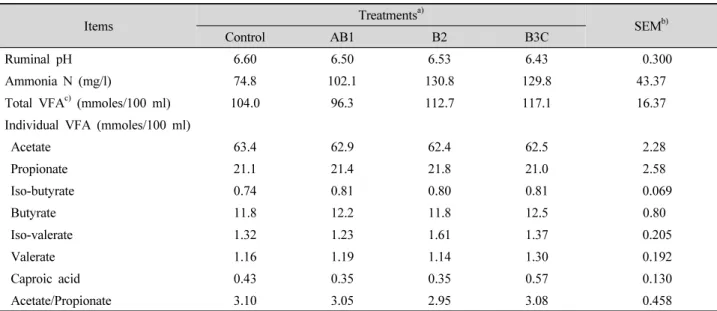
CNCPS N fraction별 고함유 단백질 급여에 의한 반추 위내 pH 및 패턴 변화는 전체적으로 통계적 유의성이 나타 나지는 않았다(p>0.05; Table 3 및 Fig. 1). 대조구, AB1 및 B2 처리구 간 반추위내 pH 패턴 변화가 비교적 유사하 게 나타난 것은 전술한 사료 fraction 구성의 유사성 또는 기초사료의 낮은 CP수준에서 기인한 것으로 추측된다.
B3C구의 반추위 pH가 사료급여 후 4-5시간 이후에도 다
른 시험구에 비해 비교적 낮게 유지되었는데, 이러한 결과
Table 3. Effect of CNCPS fraction-enriched proteins on ruminal fermentation of Holstein steers fed TMR containing low crude protein.
Items Treatments
a)SEM
b)Control AB1 B2 B3C
Ruminal pH 6.60 6.50 6.53 6.43 0.300
Ammonia N (mg/l) 74.8 102.1 130.8 129.8 43.37
Total VFA
c)(mmoles/100 ml) 104.0 96.3 112.7 117.1 16.37
Individual VFA (mmoles/100 ml)
Acetate 63.4 62.9 62.4 62.5 2.28
Propionate 21.1 21.4 21.8 21.0 2.58
Iso-butyrate 0.74 0.81 0.80 0.81 0.069
Butyrate 11.8 12.2 11.8 12.5 0.80
Iso-valerate 1.32 1.23 1.61 1.37 0.205
Valerate 1.16 1.19 1.14 1.30 0.192
Caproic acid 0.43 0.35 0.35 0.57 0.130
Acetate/Propionate 3.10 3.05 2.95 3.08 0.458
a)
Treatments were TMR only (control), TMR with rapeseed meal (AB1), TMR with soybean meal (B2) and TMR with perilla meal (B3C), respectively.
b)
Standard error of the mean.
c)
VFA: volatile fatty acid.
Fig. 1. Changes in ruminal pH of steers fed TMR containing low crude protein supplemented with various protein. Treatments were TMR only (◆), TMR with rapeseed meal (■), TMR with soybean meal (▲) and TMR with perilla meal (X), respectively.
의 원인은 비교적 높은 B
3, C fraction의 영향인 것으로 생각된다. 하지만, CNCPS 모델에서는 A 및 B
1fraction은 반추위내에서 매우 빨리 분해되므로 100% 분해되는 것으
서는 반추위 분해속도가 빠른 단백질이 다량 급여될 때 반
추위 pH가 급격히 감소한다는 기존 연구와는 다소 상반된
결과이다(Lee, 2006). 이것은 기초사료의 CP수준(9.63%;
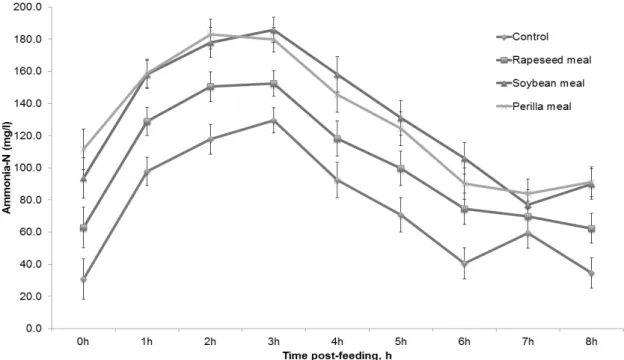
Fig. 2. Changes in ruminal ammonia N of steers fed TMR containing low crude protein supplemented with various protein. Treatments were TMR only (◆), TMR with rapeseed meal (■), TMR with soybean meal (▲) and TMR with perilla meal (X), respectively.
의미하는 것으로 추가 연구가 필요하다고 판단된다.
반추위 내 total VFA 및 individual VFA는 시험처리에 따른 유의적인 차이를 나타내지 않았다(p>0.05; Table 3 and Fig. 2). 이 결과는 단백질 사료의 종류가 VFA 농도에 특별한 영향을 주지 않는다는 기존 연구결과와 일치하였다 (Pritchard and Males, 1985). 하지만, 기초사료(또는 추 가사료)의 단백질의 수준이 반추위 미생물의 종류와 활성 에 영향을 줄 수 있으므로(Jin, 2011; Wallace, 1988) 본 연구결과는 향후 기초사료의 단백질 수준과, N fractionation 그리고 VFA 패턴 간의 상호관계 연구의 기초자료로 활용 될 수 있을 것으로 판단된다.
일일 평균 반추위 소화액 암모니아-N 농도는 대조구, AB1, B2 및 B3C구에서 각각 74.8, 102.1, 130.8 및 129.8 mg/l로 나타났다(Table 3). 암모니아-N 농도는 시험구간 통계적 유의성은 나타나지 않았지만(p>0.05), 수치적으 로 B2와 B3C구의 농도가 높게 나타났다. 일반적으로 반추 위액 암모니아-N 농도가 50 mg/l 이상을 유지하면 미생물 체 단백질의 합성량을 극대화할 수 있으며 특별히 반추위 미생물의 발효를 억제하지 않는 점을 고려할 때(Choi and Oh, 2011), 본 연구의 공시축은 정상적인 반추위 대사를 가졌다고 보여진다. 그러나 같은 CP 수준을 급여하고 비교 적 용해성 N 함량이 높은 채종박이 급여된 AB1구에서 B2
와 B3C구보다 낮은 암모니아-N은 CNCPS 방법에 의한 사 료 N fractionation만으로 설명하기에는 한계가 있다. 또 한, Armentano 등(1993)은 용해성 단백질 농도가 높으면 반추위액 암모니아-N 농도가 증가한다고 보고한 바 있다.
따라서, 반추위 pH 패턴에서 언급한 바와 같이 본 연구에 서 사용된 기초사료의 낮은 CP 수준이나 반추위 미생물 등 다양한 사양요인에서 기인할 수 있는 바(Henning et al., 1993; McAllister et al., 1990), 향후 기초사료의 CP수준 에 따른 추가 연구가 필요할 것으로 생각된다.
3. 혈액대사물질
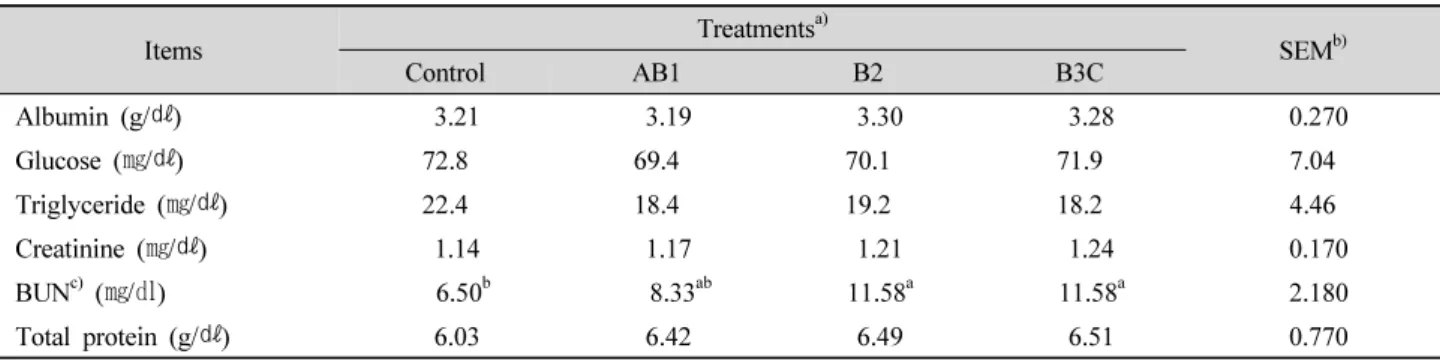
N fraction별 고함유 단백질의 급여는 albumin의 농도
에는 영향을 미치지 않는 것으로 나타났다(p>0.05; Table
4). 수치적으로 albumin 함량은 대조구와 AB1구(3.21 및
3.19 g/㎗)가 B2와 B3C구(3.30 및 3.28 g/㎗)보다 낮게
나타났다. 일반적으로 혈중 albumin의 감소는 체내 단백
질 합성이 비교적 왕성하게 일어난 현상으로 볼 수 있다
(Gentry et al., 1999). 이것은 creatine 대사작용의 최종
생산물로 근육량 증가에 비례하여 증가하여 총 근육량의
index로 알려진 혈중 creatinine이 대조구와 AB1구에 비
해 B2와 B3C구에서 수치적으로 높게 나타남을 미루어 볼
Table 4. Effect of CNCPS fraction-enriched proteins on blood metabolites of Holstein steers fed TMR containing low crude protein.
Items Treatments
a)SEM
b)Control AB1 B2 B3C
Albumin (g/ ㎗) 3.21 3.19 3.30 3.28 0.270
Glucose ( ㎎/㎗) 72.8 69.4 70.1 71.9 7.04
Triglyceride ( ㎎/㎗) 22.4 18.4 19.2 18.2 4.46
Creatinine ( ㎎/㎗) 1.14 1.17 1.21 1.24 0.170
BUN
c)( ㎎/㎗) 6.50
b8.33
ab11.58
a11.58
a2.180
Total protein (g/ ㎗) 6.03 6.42 6.49 6.51 0.770
a, b
Means in a row with different superscripts are significantly different (p<0.05).
a)
Treatments were TMR only (control), TMR with rapeseed meal (AB1), TMR with soybean meal (B2) and TMR with perilla meal (B3C), respectively.
b)
Standard error of the mean.
c)
BUN: blood urea nitrogen.
때 더욱 명확해짐을 알 수 있다(Eisemann et al., 1989).
혈중 glucose 농도는 69.4-72.8 ㎎/㎗로 통계적 유의성은 없었다. 일반적으로 혈중 glucose 농도는 반추위의 프로피 온산의 증감과 gluconeogenesis의 증감과 관련되거나 소 장에서 glucose 흡수율의 증감을 추측할 수 있으나(Camplell and Farrell, 2003), 본 연구의 처리인 N fraction과는 직 접적인 연관성은 찾기 어렵다. 혈중 중성지방과 총 단백질 은 처리간 통계적 유의성은 나타나지 않았다(p>0.05).
BUN 농도에서는 대두박과 채종박이 급여된 B2와 B3C 구가 대조구에 비해 유의적으로(p<0.05), AB1구보다는 수 치적으로 높게 나타났다. BUN은 반추동물에 있어서 질소 의 축적 현상을 가늠할 수 있는 중요한 index인데, BUN 농도는 단백질 합성이 일어나는 조직에서의 질소 축적 현 상을 반영하는 것으로(Enright et al., 1990), 반추위 벽으 로 흡수되는 암모니아가 증가하면 간에서 요소합성량을 증 가시켜 BUN 수치를 높인다(Choi and Oh, 2011). 본 연구 에서도 마찬가지로 각 시험구별 BUN 농도가 반추위 암모 니아-N 농도와 일치하고 있음을 보여준다(Fig. 2 and Table 4). 그러나 일반적으로 알려져 있는 CP 수준이나 용 해성 단백질 급여가 많아질 때 반추위 암모니아-N 농도 역시 증가하고 이에 따라 BUN 농도 역시 증가된다는 기존 연구 결과(Armentano et al., 1993; Choi and Oh, 2011;
Lee, 2006)를 고려하면 본 연구에서 용해성 N fraction이 높은 AB1구의 낮은 암모니아와 BUN 농도는 설명하기 한계 가 있다. 다만, 이는 사료의 용해성 N fraction 역시 반추위 에서 모두 이용되지 않고 하부소화기관으로 유입될 수 있 음을 제시한 연구결과(Choi, 2003)에 비추어 볼 때, 반추위
암모니아-N 수준과 반추위 벽을 통한 흡수량이 다를 수 있음을 의미하며 그 기전의 출발점으로 급여된 기초사료의 낮은 CP 수준에서 기인할 수 있을 것으로 추측된다. 따라 서, 향후 기초사료의 CP 수준에 따른 N fraction 관련 반추 위 생체 대사기전의 추가 연구가 필요할 것으로 판단된다.
IV. 결 론
본 연구는 반추위 캐뉼라를 장착한 홀스타인 거세우 4두
(평균체중 401.0±2.2 kg)를 공시하여 단백질 수준이 낮은
(CP 9.63%) TMR 급여 시 CNCPS에서 제안하는 단백질
fraction별 다량 함유된 단백질 공급이 반추위 발효패턴 및
혈액대사물질에 미치는 영향을 조사하고자 실시하였다. 시
험설계는 4 × 4 라틴방각법에 의해 수행되었고, 이에 따라
처리는 TMR 급여구(대조구), TMR 및 채종박 급여구(AB1),
TMR 및 대두박 급여구(B2), TMR 및 임자박 급여구(B3C)
로 각각 구분하였다. 처리구에 사용된 단백질은 CNCPS 분
석결과에 따라 A와 B
1fraction 함량이 높은 사료로 채종
박, B
2fraction이 높은 사료로 대두박 및 B
3와 C fraction
이 높은 사료로 임자박을 선발하였고, 기초사료인 TMR 섭
취량의 30% 대체 급여하였다. 반추위 소화액은 오후 사료
섭취 후 1시간 간격으로 채취하여 반추위 pH, 암모니아-N
및 휘발성지방산(VFA) 분석을 대비하였고, 혈액은 반추위
소화액 채취종료 후 경정맥을 통해 채취하였다. CNCPS
fraction별 단백질 공급은 반추위 pH에 영향을 미치진 못
하였으나(p>0.05), B3C구는 다른 시험구에 비해 수치적
으로 낮게 나타났다. 암모니아-N 및 VFA 역시 시험구 간
통계적 유의성은 나타나지 않았다(p>0.05). 특히 용해성 N의 함유량이 높은 채종박을 급여했음에도 불구하고 AB1 구에서 다른 급여구보다 수치적으로 낮은 반추위 암모니아 -N가 나타났으며, 이는 기초사료의 낮은 단백질 급여 또는 낮은 건물 섭취량과 관련이 있다고 추측된다. 유의적으로 증가한 혈중요소태질소를 제외하고는(p<0.05), CNCPS fraction별 고함유 단백질의 대체급여가 혈액대사물질에 미치는 영향은 없었다(p>0.05).
감사의 글
본 연구는 농촌진흥청 공동연구사업(PJ009289042015) 의 지원에 의해 이루어졌습니다.
참 고 문 헌