한수지 54(4), 445-455, 2021
445
Copyright © 2021 The Korean Society of Fisheries and Aquatic Science pISSN:0374-8111, eISSN:2287-8815
Korean J Fish Aquat Sci 54(4),445-455,2021
Original Article
서 론
조사지역인한국의남해는계절별로특성이다른수괴들에의 해물리적요건이변동하는곳으로
,
남해연안의계절에따른해 황변동은섬진강,
제주난류,
대마난류의영향을받는다(Jeong et al., 2013; Kim, 2000; Choi et al., 2020).
이처럼고유한해수 특성이나타나는수괴들이인접한지역은조경역을형성하거나 서로혼합되어유용수산자원의육성에매우중요한위치를차 지한다(Kang and Jeon, 1999; Kim, 2000; Jeong et al., 2013).
이러한해양환경의물리적변동은생물의종조성이나
bio-
mass
에직·
간접적으로영향을줄수있다.
수온의변화는식물 플랑크톤의성장률증감에영향을주어biomass
를변동시킬수 있으며(Reynolds, 2006; Lewandowska et al., 2014),
염분의변 화는식물플랑크톤군집구조의변화를야기할수있다(Fehling et al., 2012). 1
차소비자및2
차생산자의역할을하는동물플랑크톤역시수온이나염분등의변화에따른생물상변화를겪으
며
, mesocosm
실험조건하에서사육된요각류의경우수온의변화에따라우점종및군집밀도의변화가나타났으며
(Lewan- dowska et al., 2014)
현장샘플을통한동물플랑크톤분석에서 도계절변화에따른수괴의변동으로인해우점종및개체수의 변동이있었다(Arashkevich et al., 2002; Moon et al., 2010).
동 물플랑크톤은생태계내먹이사슬을유기적으로연결할수있 는생물집단으로동물플랑크톤군집의변동은해양생물상의 연쇄적변동을초래할수있다(Winder and Jassby, 2011).
동물 플랑크톤군집의변동은플랑크톤식성어류및자치어의먹이 선택성에영향을미칠뿐만아니라(Lankov et al., 2010; Kim et al., 2013; Lee et al., 2021)
동물플랑크톤과자치어의시공간적 인분포패턴은궁극적으로자치어의성장과생존에영향을줄 수있다(Dam and Baumann, 2017).
또한동물플랑크톤군집의 변동은성어의크기에변화를초래하거나,
한생태계내의우점한국 남해 동물플랑크톤 군집 구조의 계절 변동
이예지*·이정훈·김영혜
국립수산과학원 연근해자원과
Seasonal Variation of Zooplankton Community Structure in Southern Sea of Korea
Ye Ji Lee*, Jeong hoon Lee and Yeonghye Kim
Fisheries Resources Management Division, National Institute of Fisheries, Busan 46083, Korea
We aimed to study the structure of the zooplankton community in the Southern Sea of the Republic of Korea. Zoo- plankton samples were collected in February (winter), May (spring), August (summer), and November (autumn) of 2020. The zooplankton collected belonged to a total of 166 taxa and 12 phyla, including some unidentified individuals and those from upper taxa. The number of taxa collected were the highest in winter at 117, and the lowest in May at 93. The dominant taxa were Oikopleura spp. in the winter, Gastropoda larvae in the spring, and Paracalanus parvus s.l. in the summer and autumn. The community structure of the zooplankton was clearly distinguishable between the seasons. The mean density of zooplankton was the highest in autumn and the lowest in summer (576,039 and 313,000 individuals/1,000 m
3, respectively). Based on the analysis of relationships between the density of the six major taxa and environmental factors, a significant correlation (P<0.05) between the four taxa and environmental factors was found. Therefore, in order to understand changes in the zooplankton community, quantitative and qualitative investi- gations of biological factors as well as physical factors should be conducted.
Keywords: Zooplankton community structure, Southern sea of Korea, Environmental factor
*Corresponding author: Tel: +82. 51. 720. 2277 Fax: +82. 51. 720. 2292 E-mail address: [email protected]
This is an Open Access article distributed under the terms of the Creative Commons Attribution Non-Commercial Licens (http://creativecommons.org/licenses/by-nc/3.0/) which permits unrestricted non-commercial use, distribution, and reproduction in any medium, provided the original work is properly cited.
Received 14 April 2021; Revised 10 May 2021; Accepted 2 August 2021 저자 직위: 이예지(연구원), 이정훈(연구사), 김영혜(연구관) https://doi.org/10.5657/KFAS.2021.0445
Korean J Fish Aquat Sci 54(4), 445-455, August 2021
종을바꾸는등상위생태계포식자에게영향을줄수있을뿐 아니라
(Möllmann et al., 2008; Ljungström et al., 2020),
식물 플랑크톤섭이를통해식물플랑크톤군집을조절하며(Suffrian
et al., 2008)
미세먹이망구조내에서박테리오플랑크톤의풍도조절과에너지전달에중요한역할을한다
(Zöllner et al., 2009;
Zingel et al., 2016).
따라서동물플랑크톤군집조사는저차생 태계와고차생태계를아우르는해양생태계의흐름을파악할 수있기때문에어업자원관리측면에서도매우중요하다.
우리나라남해에서이루어진동물플랑크톤군집조사는물리 적환경요소중주로수온
,
염분과관련하여이루어졌다(Moon et al., 2010; Do et al., 2017; Seo et al., 2018).
동물플랑크톤군 집중우점을차지하는요각류는수직일주운동을하는분류군 으로써수온,
염분뿐만아니라탁도또한이들의생태에영향을 미칠수있다(Roman et al., 2001).
따라서본연구는동물플랑 크톤군집의계절적변동을밝힘과동시에수온,
염분및탁도 의관측을통해동물플랑크톤군집과환경요소사이의상관성 을밝히고자한다.
재료 및 방법
동물플랑크톤시료는한국의남해에서계절조사로써
2020
년2
월(
동계), 5
월(
춘계), 8
월(
하계), 11
월(
추계)
에총4
회에걸쳐 채집하였다(Fig. 1).
동물플랑크톤은여수계를 설치한망구φ 80 cm,
망목330 μm Bongo net
를이용하여평균선속2-3 knot
로10
분간경사채집하였다.
채집된시료는90%
알코올로고정 후실험실로운반하였다.
조사해역의환경조건은CTD (Sea- bird 911plus; Sea Bird scientific, Washington, USA)
를이용하 여수온,
염분,
탁도를관측하였다.
동물플랑크톤시료는해부 현미경하에서가능한한종수준까지동정하였고(Mitsuo and
Masaaki, 1997), Bogorov counting chamber
에1/512-1/64
만 큼을취하여해부현미경하에서종별로계수한후1,000 m
3당 개체수(ind./1,000 m
3)
로환산하였다.
각계절별동물플랑크톤군집의종다양성파악을위해
Shan- non-Weaver
의종다양성지수(H')
를구하였으며(Shannon and
Weaver, 1963),
각군집에영향을미치는분류군을파악하기위해
SIMPER (similarity-percentages procedure)
분석을실 시하였다.
각계절별동물플랑크톤군집간유사도를구하기위 해Bray-Curtis
유사도 지수(similarity index)
를 이용하였고60%
유사도 수준에서 다차원배열법(multidimensional scal-
ing, MDS)
을적용해유사한그룹을유집하였다.
군집밀도의계절별차이의유의성을검정하기위하여일원분산분석
(One- way ANOVA)
를실시한후사후검정으로Dunnett test
를적용 하였다.
환경요소와동물플랑크톤군집분포의상관관계를알 아보기위해정준대응분석(canonical correspondence analysis, CCA)
을실시하였고,
이중전계절출현동물플랑크톤중합산
50%
이상을나타냈던주요6
개의분류군을대상으로피어슨상관분석
(pearson correlation test)
을실시하여신뢰성을검 증하였다.
결 과
해양환경
조사기간동안수온
(°C),
염분(psu),
탁도(NTU)
를측정하여 해양환경을파악하였다(Fig. 2).
동계의수온은13.4-16.0°C
범 위였으며 평균 수온은14.6°C
로 나타났다.
염분은34.2-34.5 psu
범위였으며평균염분은34.3 psu,
탁도는0.8-1.9 NTU
범 위로평균탁도는1.3 NTU
로나타났다.
춘계의수온은15.9-
(A)
(B)
(C)
Winter Spring Summer Autumn
Longitude
Latitude Salinity (psu)Turbidity (NTU)Temperature (°C)
(A) (B) (C) (D)
Latitude
Longitude
Density (ind./1,000 m3)
Latitude
Longitude Fig. 1. Sampling site in Southern sea of Korea. Dashed line, sampling site.
동물플랑크톤 군집 구조
447
17.5°C
범위로나타났고평균수온은16.7°C
였다.
염분은33.2- 34.0 psu
범위였으며평균염분은33.8 psu
였다.
탁도는0.8-1.8
NTU
범위로평균탁도는1.1 NTU
였다.
하계의수온범위는18.2-19.6°C
로평균수온은18.8°C
로나타났으며염분범위는33.3-33.7 psu,
평균염분은33.5 psu
로나타났다.
탁도는0.7- 2.5 NTU
범위였으며평균탁도는1.1 NTU
로나타났다.
추계의수온범위는
17.4-19.7°C
범위로나타났으며평균수온은18.6°C
였다.
염분은33.5-34.4 psu
범위로평균염분은34.0 psu
였으며탁도범위는0.7-3.4 NTU
였으며평균탁도는1.2 NTU
였다
.
동물플랑크톤 군집 구조
계절별 동물플랑크톤 종 조성 및 밀도
조사기간동안출현한전체동물플랑크톤은
12
문(Phylum)
에 속한166
개의분류군이었다(Table 1).
각계절별출현한문수 는동계9
개,
춘계10
개,
하계10
개,
추계10
개였으며이중절 지동물문(Arthropoda)
이모든계절에서가장우점하였다.
출현한분류군은 동계에총
117
개였으며이중미충류(Chordata)
(A)
(B)
(C)
Winter Spring Summer Autumn
Longitude
Latitude Salinity (psu)Turbidity (NTU)Temperature (°C)
(A) (B) (C) (D)
Latitude
Longitude
Density (ind./1,000 m3)
Latitude
Longitude
Fig. 2. Environmental condition in Southern sea of Republic of Korea, 2020.
(A)
(B)
(C)
Winter Spring Summer Autumn
Longitude
Latitude Salinity (psu)Turbidity (NTU)Temperature (°C)
(A) (B) (C) (D)
Latitude
Longitude
Density (ind./1,000 m3)
Latitude
Longitude
Fig. 3. Density of zooplankton community in Southern sea of Korea in winter (A), spring (B), summer (C) and autumn (D), 2020.
인
Oikopleura spp.
가출현비25.4%
로최우점하였다.
춘계에는 총94
개의분류군이출현하였으며이중복족류인Gastropoda larvae
가출현비43.2%
로최우점하였다.
하계와추계는각각105, 106
개의분류군이출현하였으며두계절모두공통적으로요각류인
Paracalanus parvus s.l.
이각각출현비19.0%, 17.0%
로최우점하였다
.
각계절별군집의종다양성지수(H')
는동계 에3.01
그리고춘계와하계에각각2.28, 3.01
그리고추계에3.23
로나타나춘계에가장낮았으며추계에가장높았다.
동계의 동물플랑크톤 총 군집 밀도는 정점별로
95,601.0- 954,808.8 ind./1,000 m
3 범위를나타냈으며평균밀도는335, 386.6 ind./1,000 m
3로나타났다(Fig. 3A, Table 1A).
춘계의총 군집밀도는61,171.5-1,089,191.2 ind./1,000 m
3 범위였으며 평균밀도는353,058.8 ind./1,000 m
3였다(Fig. 3B, Table 1B).
하계의총군집밀도는
31,917.6-659,032.0 ind./1,000 m
3로나 타났으며평균밀도는313,000.5 ind./1,000 m
3로조사기간중(B) Taxa
(The number of total taxa, 94) Density
(ind./1,000 m3)Abundance (%)
Annelida 4,798.4 0.13
Arthropoda 2,881,048.5 76.71
Copepoda
Euchaetidae spp. copepodite 494,691.2 11.68
Calanus sinicus 257,606.4 6.08
Calanus spp. copepodite 256,214.4 6.05 Paracalanus parvus s.l. 139,561.6 3.29 Ditrichocorycaeus affinis 118,428.8 2.80 Eucalanidae spp. copepodite 83,489.6 1.97
Bestiolina similis 58448.0 1.38
Ostracoda
Conchoecia spp. 378,593.6 8.94
Amphipoda
Themisto spp. juvenile 79,756.8 1.88
Bryozoa 512.0 0.01
Chaetognatha 53,796.8 1.27
Sagittidae spp. juvenile 52,276.8 1.23
Chordata 17,620.8 0.42
Cnidaria 9,216.0 0.22
Dinoflagellata 71,337.6 1.68
Dinophyceae
Noctiluca scintillans 71,337.6 1.68
Echinodermata 23.6 0.00
Mollusca 1,833,417.2 43.27
Gastropoda larvae 1,829,382.4 43.18
Pisces 2,296.2 0.05
Total 4,236,693.9 100.0
Average of zooplankton density
in spring 353,058.8 ind./1,000 m3
Table 1. Zooplankton community structure collected in Southern sea of Republic of Korea in winter (A), spring (B), summer (C) and autumn (D) 2020 (Taxa with an abundance of more than 1%) (A)
Taxa
(The number of total taxa, 117) Density
(ind./1,000 m3)Abundance (%)
Annelida 1,822.8 0.05
Arthropoda 2,795,418.2 69.39
Copepoda
Euchaetidae spp. copepodite 437,856.0 10.87 Paracalanus parvus s.l. 342,118.4 8.49
Paracalanidae spp. 199,008.0 4.94
Calanus spp. copepodite 161,011.2 4.00
Bestiolina similis 143,366.4 3.56
Scolecithrichidae spp. copepodite 122,611.2 3.04
Oncaea venusta 113,772.8 2.82
Scolecithricella nicobarica 102,464.0 2.54
Oithona similis 85,094.4 2.11
Calanus sinicus 71,644.0 1.78
Clausocalanus furcatus 61,324.8 1.52 Scolecithricella longispinosa 49,920.0 1.24 Ditrichocoryceaus affinis 49,491.2 1.23 Clausocalanus farrani 46,542.4 1.16 Ostracoda
Conchoecia spp. 283,022.4 7.03
Chaetognatha 42,672.4 1.06
Chordata 1,037,601.6 25.76
Appendicularia
Oikopleura spp. 1,024,864.0 25.44
Cnidaria 21,581.6 0.54
Dinoflagellata 79,244.8 1.97
Dinophyceae
Noctiluca scintillans 79,244.8 1.97
Echinodermata 13.2 0.00
Mollusca 41,258.9 1.02
Pisces 9,064.9 0.23
Total 4,028,678.4 100.0
Average of zooplankton density
in winter 335,386.6 ind./1,000 m3
동물플랑크톤 군집 구조
449
가장낮은값을보였다
(Fig. 3C, Table 1C).
추계의총군집밀도 는84,007.0-952,440.0 ind./1,000 m
3범위였으며평균밀도는 Table 1. Continued(C) Taxa
(The number of total taxa, 105) Density
(ind./1,000 m3)Abundance (%)
Annelida 4,798.4 0.13
Arthropoda 2,881,048.5 76.71
Copepoda
Paracalanus parvus s.l. 712,179.2 18.96 Euchaetidae spp. copepodite 404,556.8 10.77
Acartia omorii 244,528.0 6.51
Calanus spp. copepodite 169,136.0 4.50
Oithona similis 165,884.8 4.42
Bestiolina similis 136,121.6 3.62
Acartia pacifica 132,742.4 3.53
Oncaea venusta 109,747.2 2.92
Oithona atlantica 108,688.0 2.89
Paracalanidae spp. 62,040.0 1.65
Calanus sinicus 60,172.8 1.60
Clausocalanus furcatus 60,198.4 1.60 Clausocalanus farrani 52,294.4 1.39 Euphausiacea
Euphausiidae spp. calyptopis 89,891.2 2.39 Ostracoda
Conchoecia spp. 70,828.8 1.89
Bryozoa 5,684.8 0.15
Chaetognatha 25,984.0 0.69
Chordata 101,363.2 2.70
Appendicularia
Oikopleura spp. 99,705.6 2.65
Cnidaria 1,700.0 0.05
Dinoflagellata 540,649.6 14.39
Dinophyceae
Noctiluca scintillans 540,649.6 14.39
Echinodermata 2,412.8 0.06
Mollusca 50,148.7 1.34
Gastropoda larvae 48,084.8 1.28
Pisces 142,215.5 3.79
Unidentified Pisces eggs 137,147.4 3.65
Total 3,756,005.5 100.0
Average of zooplankton density
in summer 313,000.5 ind./1,000 m3
(D) Taxa
(The number of total taxa, 106) Density
(ind./1,000 m3)Abundance (%)
Annelida 5,936 0.09
Arthropoda 5,582,418.4 80.76
Copepoda
Paracalanus parvus s.l. 1,172,112.0 16.96 Euchaetidae spp. copepodite 884,796.8 12.80
Oncaea venusta 481,977.6 6.97
Paracalanidae spp. 253,844.8 3.67
Clausocalanus furcatus 231,654.4 3.35 Eucalanidae spp. copepodite 198,163.2 2.87
Undinula vulgaris 176,231.2 2.55
Oithona similis 163,002.4 2.36
Calanus spp. copepodite 147,500.8 2.13
Acartia pacifica 124,921.6 1.81
Centropages furcatus 123,353.6 1.78
Calanus sinicus 122,248.0 1.77
Bestiolina similis 108,953.6 1.58
Euphausiacea
Euphausiidae spp. furcilia 313299.2 4.53 Euphausiidae spp. calyptopis 211635.2 3.06 Ostracoda
Conchoecia spp. 132,406.4 1.92
Bryozoa 5,683.2 0.08
Chaetognatha 91,326.7 1.32
Sagittidae spp. juvenile 85,433.6 1.24
Chordata 525,174.4 7.60
Appendicularia
Oikopleura spp. 511,712.0 7.40
Cnidaria 135,724.8 1.96
Unidentified Hydrozoa 102,016 1.48
Dinoflagellata 153,420.8 2.22
Dinophyceae
Noctiluca scintillans 153,420.8 2.22
Echinodermata 13,331.2 0.19
Mollusca 395,128.0 5.72
Gastropoda larvae 327,622.4 4.74
Pisces 4,318.9 0.06
Total 6,912,462.4 100.0
Average of zooplankton density
in autumn 576,038.5 ind./1,000 m3
576,038.5 ind./1,000 m
3로조사기간중가장높은값을나타냈 다(Fig. 3D, Table 1D).
각계절별평균밀도는하계와추계간 에유의한차이가있는것으로나타났으며(ANOVA, Dunnett test, P<0.05, Standard error=100,903.1),
그외의계절간에는 유의한차이가없는것으로나타났다(ANOVA, Dunnett test, P>0.05) (Table 2).
각 계절별동물플랑크톤 군집은 각각
60%
미만의 유사도를보여군집조성에있어차이가있는것으로나타났다
(Fig.
4).
각군집의분리에기여한분류군은 동계-
춘계,
춘계-
하계 에는Gastropoda larvae
였으며,
동계-
하계의경우Oikopleura spp.
의기여도가가장높은것으로나타났다.
동계-
추계,
춘계-
추계,
하계-
추계군집의분리에가장많은기여도를나타낸분 류군은P. parvus s.l.
로나타났다.
주요 분류군의 계절별 변동
사계절 출현한 모든 동물플랑크톤 밀도 합산의
50%
이상 을차지한주요분류군은순서대로P. parvus s.l., Gastropoda larvae, Euchaetidae spp. Copepodite (
요각류미성체), Oiko- pleura spp., Conchoecia spp.
그리고Noctiluca scintillans
였다. 6
개의분류군밀도의합산은각계절별로도높은비율을나타 냈다.
이들은동계에출현한모든동물플랑크톤밀도중54.8%
를차지하였으며
,
춘계에69.2%,
하계에49.9%
그리고추계에46.0%
를차지하였다.
P. parvus s.l.
의춘계밀도는139,561.6 ind./1,000 m
3로가장 낮았으며하계와추계의밀도는각각712,179.2 ind./1,000 m
3, 1,172,112.0 ind./1,000 m
3로직전계절에비해급격한밀도증 가가나타났다. Gastropoda larvae
의밀도는동계에36,857.6 ind./1,000 m
3으로가장낮았고봄철에밀도값이1,829,382.4 ind./1,000 m
3로약50
배가량증가하였으나하계의밀도값이48,084.8 ind./1,000 m
3으로다시약40
배가량감소하는등계 절에따른극심한변동이나타났다. Euchaetidae spp. copepo-
dite
의밀도는동계부터하계까지큰차이가나타나지않았으나하계의밀도가
404,556.8 ind./1,000 m
3이었고추계의밀도가884,796.8 ind./1,000 m
3으로하계에비해2
배가량증가한모 습이나타났다. Oikopleura spp.
의밀도는동계에1,024,864.0 ind./1,000 m
3으로 가장 높았고 춘계의 밀도가17,144.0 ind./1,000 m
3으로약60
배가량감소하였으며하계와추계에 접어들며각각직전계절에비해6
배, 5
배가량증가하여역시 계절에따른극심한증감을나타내었다. Conchoecia spp.
의밀 도또한춘계에378,593.6 ind./1,000 m
3으로가장높은값을 보이다하계에접어들며5
배가량감소하는등계절에따른변 화가큰것으로나타났다. N. scintillans
는동계와춘계는각각79,244.8 ind./1,000 m
3, 71,337.6 ind./1,000 m
3으로비슷한밀 도로출현하였지만하계가되자밀도가540,649.6 ind./1,000
m
3로동계와춘계에비해7-8
배가량증가한모습이나타났다(Table 1).
환경 요소와 동물플랑크톤 군집 밀도 상관관계
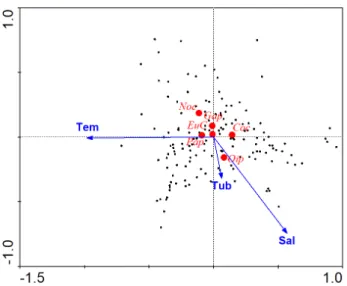
연구기간동안관측된환경요소와동물플랑크톤군집구조변 동사이의관계를알아보기위해정준대응분석을실시하였다.
분석결과 제1
축과제2
축의 고유치(eigenvalue)
는 각각0.17, 0.12
였으며,
전체자료분산에대한누적기여율은13.4%
를나 타냈다.
또한제1, 2
축은환경요인과동물플랑크톤군집사이 의상관관계를89.9%
설명하였다.
주요6
개의분류군에대한 피어슨상관분석을실시한결과이중4
개의분류군만이환경 요소와유의한상관관계를나타내었다. P. parvus s.l.
은수온과 양의상관관계를보였으며, Conchoecia spp.
는수온과음의상 관관계,
탁도와양의상관관계를나타냈다(pearson correlation analysis, P<0.05). Oikopleura spp.
는염분과양의상관관계를 보였으며N. scintillans
는수온과양의상관관계,
염분과음의 상관관계를 나타냈다(Pearson correlation analysis, P<0.05) (Fig. 5, Table 3).
Table 2.One-way ANOVA evaluation of seasonal zooplankton average density in Southern sea of Korea (post-test, Dunnett test)
(I)Season Season (J) Mean difference (I-J) Standard error P
Winter 240,653.0 100,903.1 0.140
Autumn Spring 222,980.7 114,453.5 0.311
Summer 262,988.0* 89,163.1 0.046
*P<0.05.
Fig. 4. Similarity of zooplankton community between each sea- sons in Southern sea of Republic of Korea, 2020. Dotted line, 60%
similarity line.
동물플랑크톤 군집 구조
451
고 찰
동물플랑크톤의군집구조및밀도의변화는해류또는수괴 의변동에의한환경요인에영향을받는다
(Roman et al., 2001;
Otto et al., 2014; Pinchuk and Eisner, 2017).
남아프리카Ka-
souga
하구에서조사한동물플랑크톤군집의밀도는수온과유의한관계를보였으며해류의움직임에따라우점군집이변 화하는모습이나타났다
(Froneman, 2004). Newfoundland
와Labrador Shelf
에서조사한동물플랑크톤군집구조는수괴의특징과강력한연관을가지고있었다
(Pepin et al., 2011).
우리 나라남해에서조사한동물플랑크톤출현개체수는계절에따 라변동하는수온,
염분,
엽록소-a
농도에영향을받을뿐만아니라대마난류의세력및세기에따라조절되고있었다
(Moon et al., 2010).
통영-
남해도인근에서조사한동물플랑크톤군집 역시수온,
염분과같은환경요인과유의한상관관계가있는 것으로나타났다(Do et al., 2017).
본연구에서군집밀도에있 어하계-
추계를제외한모든계절은유의한차이를나타내지않 았다.
그러나군집구조에서있어서는사계절모두뚜렷한차 이를나타냈으며이는조사기간동안높은출현비를나타낸P.
parvus s.l., Gastropoda larvae
그리고Oikopleura spp.
에의해 구분지어졌다.
또한종다양성은계절에따라변동하였다.
이는 물리적환경요소가각계절에출현한주요분류군의생태에영 향을미쳤음을시사하며정준대응분석결과와6
개의분류군을 대상으로한피어슨상관분석결과를통해환경요소가이들의 밀도에상관성을가지고있음을확인할수있었다.
그러나환경 요인과는어떠한관련도없는분류군이존재함에따라동물플 랑크톤의변동은환경요인뿐만아니라군집조성의변동에따 라군집의생태학적,
생물학적특성이변동하여나타난것으로 생각되며,
따라서군집내에서우점을차지한생물을대상으로 한연구가필요할것으로생각된다.
P. parvus s.l.
은온대연안종으로우리나라연안에서사계절모두출현하는것으로알려져있으며여름철에대량증식하는 것으로 알려져있다
(Hawng and Choi, 1993; Peterson et al., 2002; Seo et al., 2018).
하지만남해에서조사한P. parvus s.l.
의밀도는여름철에가장낮고가을철에가장높았으며
(Moon et
al., 2010),
가막만에서조사한P. parvus s.l.
의밀도는겨울철에 가장높은값이나타나는등(Soh et al., 2002)
해역별로출현양 상이일정하지않았다. P. parvus s.l.
의분포는물리적요소에 의해결정된다고하였지만(Seo et al., 2018) P. parvus s.l.
자체 의재생산력이나식물플랑크톤의생체량등생물학적요인또한분포에영향을미칠수있는것으로알려져있다
(Lee et al.,
2012; Seo et al., 2013).
본연구에서P. parvus s.l.
은세가지환 경요소중수온과양의상관관계를나타내었다.
본연구의조사 해역에서출현한P. parvus s.l.
의밀도는조사기간중가장고 온을나타내었던하계에높은값을나타내었으나가장높은밀도는추계에나타났다
.
추계는평균수온18.6°C
로하계의평균수온
18.8°C
과유사하여수온조건에있어서P. parvus s.l.
이번 성하기에적절했을것으로사료된다.
그러나사계절중최적환 경수온조건을나타낸하계가아닌추계에가장높은밀도를나 타낸것은이러한물리적요인에더하여외부적인요인또한영 향을주었을것으로생각된다.
추계는일반적으로춘계이후2
차식물플랑크톤bloom
이일어나는것으로알려져있으며,
본 조사에서나타난P. parvus s.l.
의높은밀도값은이들이번성하 기에적절한수온을유지함과동시에이들의먹이생물이되는 식물플랑크톤의bloom
시기에영향을받았기때문으로추측된 다.
그러나본조사에서는엽록소-a
농도조사를포함한식물플 랑크톤관련조사를수행하지않아이에대해추가조사가필요 할것으로생각된다.
Table 3. Pearson correlation coefficient (r) between density of main zooplankton group and environmental factors in Southern sea of Korea
Temperature
(°C) Salinity
(psu) Turbidity (NTU)
Conchoecia spp. 0.33* 0.19 -0.34*
Euchaetidae spp. copepodite 0.27 0.16 -0.21
Gastropoda larvae 0.13 0.03 -0.26
Noctiluca scintillans -0.38* -0.39* -0.21
Oikopleura spp. -0.06 0.43* 0.09
Paracalanus parvus s.l. 0.43* -0.15 0.15
*Significant correlation (P<0.05).
Fig. 5. CCA (Canonical correspondence analysis) bioplot for environmental factors (blue arrows) and zooplankton (dots, red circles). Sal, salinity; Tem, temperature; Tub, turbidity; Coc, Con- choecia spp.; EuC, Euchaetidae spp. copepodite; Gap, Gastropoda larvae; Noc, Noctiluca scintillans; Oip, Oikopelura spp.; Pap, Par- acalanus parvus s.l..