[논 문] 한국재료학회지 DOI: 10.3740/MRSK.2008.18.1.018 Kor. J. Mater. Res.
Vol. 18, No. 1 (2008)
18
†Corresponding author
E-Mail :[email protected] (J. Lee)
Anisotropy of Wetting of Molten Fe on
α-Al
2O
3Single Crystal
Seungyoun Cho and Joonho Lee†
Department of Materials Science & Engineering, Korea University, 5-1 Anam-dong, Seongbuk-ku, Seoul 136-701, Republic of Korea
(Received December 5, 2007 : Accepted December 18, 2007)
Abstract The wetting behavior of molten Fe on α-Al2O3 single crystals with three different crystallographic orientations, R , A , and C(0001), was investigated using the sessile drop method under a 10%H2- Ar atmosphere at 1873 K. It was found that the differences in the contact angle of the three differently oriented α-Al2O3 single crystals were not significant (within 5o, which corresponded to the changes in the work of adhesion of 157 mJ/m2) due to the surface reconstruction.
Key words bonding, crystalline oxides, sessile drop method, surface structure, wetting.
1. Introduction
Alumina is widely used in areas such as refractory, catalyst, electronic packaging, fiber reinforced composites, artificial prosthetic joints, etc.1) Knowledge of metal-alumina bonding and wetting is of great importance not only in the fabrication of metal-alumina composite materials but also in under- standing of nucleation and growth of alumina inclusions in metal refining process, and many studies have examined the wettability of molten metals on alumina substrates.
Although many studies focused on measuring the contact angle between molten metal and alumina substrate, only a limited number of studies examined the effect of the surface orientation of the alumina substrates.2-6) Vikner2) investigated the contact angle between molten Cu and α- Al2O3 single crystals, and reported that the contact angle on the C face is slightly lower than that on the R face (only by 3o). Recently, Shen et al.3) re-examined the contact angle between Cu and α-Al2O3 single crystals, but were unable to find a surface orientation dependence on the contact angle. Ownby et al.4) investigated the contact angle between molten Al and α-Al2O3 single crystals, but could not find any surface orientation dependence of the contact angle.
Shen et al.5) re-examined the contact angle between molten Al and α-Al2O3 single crystals, and found that the contact angle on the C(0001) surface is much larger than that on the other surfaces. They reported that the contact angles were in the order of R ≤ A ≤ C . Recently, Lee
et al.6) reported that the contact angle between molten Au and α-Al2O3 single crystals changes slightly with the surface orientation in the order of C ≤ A ≤ R. From these reports, it is clear that the effect of the surface orientation on the wetting of molten metals on α-Al2O3 is not well understood.
In this study, the surface orientation dependence of the wettability of molten Fe on α-Al2O3 single crystals with three different crystallographic orientations, R, A, and C was examined by using the sessile drop method.
2. Experimental Procedure
High-purity α-Al2O3 single crystal plates (99.99 wt%, Kyocera Co., Ltd., Japan) and high purity (99.998 wt%) Fe rods (Nilaco Co., Japan) were used in this study. The single crystals of φ 20 mm×1 mm had three faces, R , A , and C(0001), and the average surface roughness (Ra) of the crystal substrates was estimated to be approxi- mately 0.1 nm using an atomic force microscope (Nanoscope IV, Veeco Instruments, USA).6)
The experimental apparatus used for the sessile drop measurements consisted of a MoSi2 resistance furnace and an image capturing system. Figure 1 shows a schematic diagram of the experimental apparatus. The furnace temperature was monitored using a Pt-30%Rh/Pt-6%Rh thermocouple, and was controlled automatically within ± 1K. Inside an alumina reaction tube, an alumina stance was settled to sustain and adjust the level of the substrates prior to the experiments.
A piece of Fe rod (~0.1 g) on an α-Al2O3 substrate was (0112) (1120)
(0112) (1120)
Anisotropy of Wetting of Molten Fe on α-Al2O3 Single Crystal 19
placed at the center of the reaction chamber. The reaction chamber was then sealed and evacuated to 1.33 Pa using a vacuum pump and filled with a purified 10%H2-Ar gas mixture. This procedure was repeated three times. The 10%H2- Ar gas mixture was then flowed for 12 hrs in order to ensure complete removal of residual oxygen. The furnace was heated to 1873K at a rate of 200K/hr under a 10%H2- Ar atmosphere. Upon melting, the Fe rod forms an axi-symme- trical sessile drop. The contact angle slightly decreased with increasing temperature due to the advancing triple line (the solid/liquid/vapor interface). After the experimental tem- perature has been stabilized at 1873K within 15 min, the shape of the sessile drop was captured using a high-resolu- tion CCD camera (2048×2048 pixels). A He-Ne laser (λ = 632.8 nm) and absorption filters were used for better image acquisition. The contact angle was then analyzed from the captured images.
3. Results and discussion
Table 1 summarizes the experimental results. The contact angle on R, A, and C faces of the α-Al2O3 single crystals were 99o, 100o, and 104o, respectively. Therefore, it is believed that there is no significant dependence of the contact angle of Fe on the crystallographic orientation.
However, the work of adhesion, which is calculated from the Young-Dupré equation (1), might have some dependence on the surface orientation due to the large surface tension value of Fe.
Wad=σSV− σLV− σSL=σLV(1+cosθ) (1) where σSV, σLV, σSL, and θ are the solid-vapor, liquid- vapor, solid-liquid interfacial free energies and the contact angle, respectively. At 1873K, the interfacial free energy between molten Fe and the vapor is 1831 mN/m.7) Table 1 shows the work of adhesion of molten Fe on the R, A, and C faces of the α-Al2O3 single crystals. Although the differences in the contact angle of the three different α-Al2O3 single crystal faces were less than 5o, the differences in the work of adhesion were 157 mJ/m2.
The differences in the work of adhesion might be related to the bonding states at the interface, i.e. the physical and chemical bonding properties. According to Eustathopoulos and Drevet’s approximation, the physical (van der Waals’s) work of adhesion can be roughly estimated to be 0.4σLV,8) when the surface orientation dependence of the work of adhesion (or contact angle) is ignored. If this appro- ximation is followed, the portion of the physical work of adhesion of Fe on α-Al2O3 was estimated to be approximately 730 mJ/m2, which is approximately half of the results obtained Fig. 1. Schematic diagram of the experimental setup of the sessile drop method.
Table 1. The contact angle and the work of adhesion for Fe on the R, A, and C faces of α-Al2O3 single crystals.
System Property Surface orientation
R A C
Fe- α-Al2O3 At 1873K
Contact angle (o) 99 100 104
Surface tension (mN/m) 1831[7] 1831[7] 1831[7]
Work of adhesion (mJ/m2) 1545 1513 1388
20 Seungyoun Cho and Joonho Lee
experimentally (1388~1545 mJ/m2). Therefore, under the present experimental condition, it is believed that the fraction of chemical bonding, which might strongly depend on the surface structure of α-Al2O3, is considerable at the Fe-α-Al2O3 interface (approximately 50% of the total bonding energy).
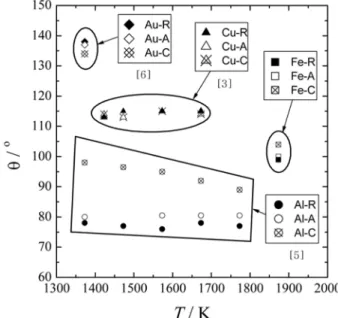
In Figure 2 and 3, variation in the contact angle and the corresponding work of adhesion for Al, Au, Cu and Fe with the different faces of α-Al2O3 single crystals, R, A, and C are shown respectively. If the same approximation8)
is applied to the experimental results of the Al-α-Al2O3 system after Shen et al.,5) the fraction of chemical bonding at the Al-α-Al2O3 interface at 1773K was estimated to be approximately 60~67%. The difference in the work of adhesion of Al ranges from 100 to 300 mJ/m2 for the three different surface orientations of α-Al2O3, where the work of adhesion is in the order of C ≤ A ≤ R. (Fig. 3) Shen et al. reported that the weaker adhesion of Al to the C face compared with the other faces is due to the surface structure of α- Al2O3–atomic termination (Al or O) and chemical bonding at the interface.5) For the Al-α-Al2O3 system, the chemical bonding on the O-terminated surface (A and R faces) may be dominated by the Al-O bond (511 kJmol-19)) rather than by the Al-Al bond (133 kJmol-1 9)), whereas that on the Al-terminated surface (C face) can be affected by the Al- Al bond yielding a lower work of adhesion. This model can be expanded to the wetting behavior of Cu and Au on α-Al2O3 single crystals.3,6) No surface orientation depen- dence was observed for the Cu-α-Al2O3 system. (Fig. 3) In this case, the difference in the bonding strength between Cu-O (269 kJmol-1 9)) and Al-Cu (217 kJmol-1 9)) is not large. Therefore, no contact angle dependence on surface structure could be observed.3) On the other hand, the work of adhesion for the Au-α-Al2O3 system is in the order of C ≤ A ≤ R. (Fig. 3) Lee et al. reported that the wetting of α-Al2O3 by molten Au is dominated by the Al-Au bond (325.9 kJmol-19)), because O does not make a bond with Au in the solid or liquid state.6)
This model can explain the difference in wettability observed in the Fe-α-Al2O3 system. The bonding energy of Fe-O and Al-Fe was estimated to be 423 kJ/mol (The bond strength in the relative diatomic molecules was calculated at 1873K with the enthalpy data of O, Fe, and FeO of gas phase obtained from FactSage database) and 48~66 kJ/mol (The Al-Fe bond strength was calculated by using enthalpy data from the references 10 and a simple assumption of the regular solution model) respectively.
Since the bonding energy of Al-Fe is much lower than that of Fe-O, it is anticipated that the C face (Al-terminated surface) would have a smaller work of adhesion. This is supported by the fact that the contact angles of Fe in this study are in the same order of R ≤ A ≤ C as Al, i.e., the work of adhesions are in the order of C ≤ A ≤ R.
However, the differences in the work of adhesion between these three faces are ≤157 mJ/m2, which supports the hypothesis that the Fe-O bond is the main one.
The surface energy dependence on the surface structure Fig. 3. Variation in the work of adhesion for Al, Au, Cu and
Fe on α-Al2O3 single crystals of three different faces, R, A, and C.
Fig. 2. Variation in the contact angle of Al, Au, Cu and Fe with the different faces of α-Al2O3 single crystals, R, A, and C.
Anisotropy of Wetting of Molten Fe on α-Al2O3 Single Crystal 21
of α-Al2O3 might explain the slight difference in the work of adhesion, only 157 mJ/m2. The relative surface energies of ceramic materials can be determined by Wulf’s shape of a crystal particle or a pore. Using this method, the relative surface energy of α-Al2O3 was estimated by Choi et al.11) and Kitayama and Glaeser12) at 1873K. According to Choi et al., the surface energy of the C face was the lowest among the faces considered. On the other hand, Kitayama and Glaeser12) reported that the surface energy of the C face was the largest. Manassidis and Gillan showed that the surface structure of α-Al2O3 would change significantly as a result of surface reconstruction, yielding a decrease in the surface free energy from the first principle calculation.13) From this calculation, the surface energy of the unreconstructed C face showed the largest value at 0K, whereas that of the reconstructed C face showed the smallest value. Shen et al. demonstrated that the initial surface structure of α-Al2O3 single crystals (as received) only persists at tempe- ratures lower than 1473 K, above which the surface structure, particularly that of the C face, is reconstructed. (The first layer composed of Al overlaps with the second layer composed of O.)5) Accordingly, it appears that the surface energy of the C face at 1873K would be the lowest among the three faces, as reported by Choi et al. Therefore, it is believed that the work of adhesion has a small dependence on the surface orientation (only by 157 mJ/m2) due to surface reconstruction.
4. Conclusions
The contact angle and the work of adhesion of molten Fe on α-Al2O3 single crystals with three different crystallog- raphic orientations, R , A , and C(0001) were investigated under a 10%H2-Ar atmosphere at 1873 K.
It was found that the contact angle differences for the three differently oriented α-Al2O3 single crystals was ≤5o, and the work of adhesion ranges from 1388~1545 mJ/m2. Based on the simple approximation after Euatathopoulos and Drevet, the fraction of chemical bonding was estimated
to be approximately 50% of the total bonding at the Fe-α- Al2O3 interface. Although the work of adhesion for the C face was the lowest due to the structural characteristics of the Al-terminated surface of α-Al2O3, this value was only slightly different from the other R and A faces (by 157 mJ/m2) due to the surface reconstruction.
Acknowledgements
The author would like to thank Prof. Toshihiro Tanaka, Osaka University, Osaka, for his helpful discussion and encouragements.
References
1. W. D. Callister Jr, Materials Science and Engineering, 6th ed., p.426-602, John Wiley & Sons, Inc., New York, (2003).
2. Vikner P. DEA report, LTPCM, INP Grenoble, France, (1993), in N. Eustathopoulos, M.G. Nicholos and B.
Drevet, Wettablility at high temperatures, p. 205, Elsevier Science, Oxford, England, (1999).
3. P. Shen, H. Fujii, T. Matsumoto and K. Nogi, J. Mater.
Sci., 40, 2329 (2005).
4. P. D. Ownby, K. Wen, K. Li and A. Weirauch Jr., J. Am.
Ceram. Soc., 74, 1275 (1991).
5. P. Shen, H. Fujii, T. Matsumoto and K. Nogi, Acta. Mater., 52, 887 (2004).
6. J. Lee, H. Ishimura and T. Tanaka, Scripta Mater., 54, 1369 (2006).
7. J. Lee, A. Kiyose, S. Nakatsuka, M. Nakamoto and T.
Tanaka, ISIJ Int., 44, 1793 (2004).
8. N. Eustathopoulos and B. Drevet, Mater. Sci. Eng., A249, 176 (1998).
9. Y.-R. Luo and J. A. Kerr in D. R. Lide, editor-in-chief., CRC handbook of chemistry and physics, 86th ed., CRC Press p. 9-54~59 (2005-2006).
10. K. Rzyman, Z. Moser, A.P. Miodownik, L. Kaufman, R.E.
Watson and M. Weinert, Calphad, 24, 309 (2000).
11. J. H. Choi, D. Y. Kim, B. J. Hockey, S. M. Wiederhorn, C. A. Handwerker, J. E. Blendell, W. C. Carter and A. R.
Roosen, J. Am. Ceram. Soc., 80, 62 (1997).
12. M. Kitayama and A. Glaeser, J. Am. Ceram. Soc., 85, 611 (2002).
13. I. Manassidis and M. J. Gillan, J. Am. Ceram. Soc., 77, 335 (1994).
(0112) (1120)