Analysis of satisfaction with clinical training in dental hygiene students
Eun-Young Jeon
1, So-Hee An
1, Il-Soon Park
2*1
Professor. Dept. of Dental Hygiene, Kyungbok University
2
Professor. Dept. of Dental Hygiene, Kyungdong University
치위생(학)과 학생의 임상실습 만족도 분석
전은영
1, 안소희
1, 박일순
2*1
경복대학교 치위생과, 교수
2
경동대학교 치위생학과, 교수
Abstract This study examined satisfaction with clinical training according to school system and school-related characteristics and analyzed the effect of satisfaction by clinical training task on the overall satisfaction with clinical training. Participants were convenience sampled from students of K University in Gangwon-do (n=279) and K University in Gyeonggi-do (n=154) who have undergone clinical training.
The overall satisfaction with clinical training in dental hygiene students differed according to the school system, school-related characteristics, satisfaction by clinical training topic, and satisfaction by clinical training task. Satisfaction by clinical training task had an effect on overall satisfaction with clinical training.
Thus, substantial effort, such as ensuring appropriate contents and methods of training.
Key Words : Clinical training, Satisfaction with clinical training, Satisfaction by clinical training task, Satisfaction by clinical training topic, School-related characteristics
요 약 본 연구는 치위생(학)과 학생들에게 보다 나은 임상실습교육을 제공하기 위해 학제와 재학특성에 따른 임상실습 만족을 파악하고, 임상실습 업무별 만족이 전반적인 임상실습 만족도에 미치는 영향을 분석하였다. 연구대상은 임상실 습 경험이 있는 강원도 소재의 K 대학(279명)과 경기도 소재의 K 대학(154명)을 편의추출 하였다. 임상실습에 대한 치위생(학)과 학생들의 전반적인 만족도는 학제, 재학특성, 임상실습 내용별 만족, 임상실습 업무별 만족에 따라 차이가 있었다. 또한, 임상실습 업무별 만족도는 임상실습 전반적 만족도에 영향을 주는 것으로 나타났다. 이에 체계적인 실습 교육을 제공하기 위한 실습 내용과 방법의 적절성을 확보하는 등의 적극적인 노력이 요구되며, 임상실습 만족도에 대한 지속적인 후속연구가 필요할 것이다.
주제어 : 임상실습, 임상실습 만족도, 임상실습 업무별 만족도, 임상실습 내용별 만족도, 재학특성
*This research was supported by the Kyungdong University Research Grants 2019.
*Corresponding Author : Il-soon Park([email protected])
Received September 26, 2019 Revised October 27, 2019
Accepted December 20, 2019 Published December 28, 2019
1. Introduction
Dental hygienists are professionals in charge of preventive treatment and oral health education in dental institutions[1]. Growing interest and demands for oral health in recent years have highlighted the importance of professional competency of dental hygienists [2].
Therefore, colleges that train dental hygienists offer clinical training in order to equip students with systematic clinical competency [3].
Clinical training is an essential part of the formal curriculum for dental hygiene, and it not only provides an opportunity for students to unlock their potential but also directly helps students to perform the duty of dental hygienists [4-6]. Through clinical training, students apply knowledge they have acquired in lectures to identify their problems, serve as moderators to solve problems, and assess the outcomes of intervention and readjust accordingly [7, 8].
Students’ experiences during clinical training have an impact on their values. Choi [9] reported that employment intention increases with increasing learning performance during clinical training, and that it has a positive effect on students’ values pertaining to their occupation. In contrast, Park [10] reported that low learning performance during clinical training has an adverse impact on carrying out the duties of dental hygienists, as well as pushing students away from the department, such as diminishing their interest in their major and impair academic performance.
Therefore, students’ learning performance in clinical training must be appropriately utilized, and it can be divided into satisfaction and educational outcomes. Students’ educational outcomes can be assessed by the professor or training instructor based on their clinical performance. Although educational outcomes are certainly important as learning performance, understanding students’ satisfaction with clinical
training through self-evaluation and identifying the factors that influence their satisfaction is also essential for manage the quality of clinical training outcomes [11, 12]. Students are able to understand their strengths and weaknesses through this process and explore ways to improve [13], while schools can utilize this as baseline data for enhancing the quality of clinical education.
Park [14] argued that school education and training instruction must be mutually systematized in order to effectively apply theoretical education given in school in clinical training. Chang [15] and Noh [16] proposed the desirable direction of a clinical training program by analyzing clinical training contents and examining satisfaction according to degree of performance training, while Park [17]
reestablished the direction of clinical training contents by investigating satisfaction by clinical training facility. Although prior studies have examined satisfaction as baseline data to systematize clinical training contents, studies investigating how students’ School-related characteristics or satisfaction with each of the clinical training tasks impact the overall satisfaction with clinical training are lacking.
Hence, this study aims to investigate satisfaction with clinical training according to school system and School-related characteristics and analyze the effects of satisfaction for each clinical training task on the overall satisfaction with clinical training, in an attempt to devise specific measures to provide better clinical training instruction to dental hygiene students.
2. Methods 2.1 Participants
Current dental hygiene students were set as
the target population, and students from K
University in Gangwondo and K University in Gyeonggido were convenience sampled. The specific inclusion criteria were as follows:
1) Dental hygiene students who have undergone dental clinical training
2) Students who understood the purpose of this study and provided an informed consent
The survey was administered for about three months from April 6, 2019 to July 12, 2019 using a structured, self-reported online questionnaire.
A total of 490 students submitted the survey, and after excluding 57 questionnaires with missing and insincere responses, 433 (88.4%) were included in the final analysis.
2.2 Instruments
The instrument used in this study was developed and modified by Park [14], and it consists of school system, school-related characteristics, satisfaction by clinical training topic, and satisfaction by clinical training task.
School system was classified into three-year and four-year systems. For school-related characteristics, motive for choosing the major, average grades, satisfaction with major, length of clinical training, and person who assigns the training facility.
Satisfaction by clinical training topic consisted of satisfaction with interestingness of training and increased understanding, satisfaction with pride in the roles of dental hygienists, satisfaction with understanding of patients, and dental care and understanding. Satisfaction by clinical training task consisted of satisfaction with preventive dental care, satisfaction with oral health education, satisfaction with dental care cooperation, and satisfaction with hospital and patient management. Each item was rated on a five-point Likert scale.
The Cronbach alpha in Park’s [14] study was 0.89, and that in this study was 0.78.
2.3 Data analysis
The collected data were analyzed using the IBM SPSS Statistics ver. 23.0 (IBM Co., Armonk, NY, USA).
The reliability of each variable was examined using the Cronbach’s alpha for internal consistency among measures. Satisfaction with clinical training according to clinical training facility was assessed with chi-square test in multiple response analysis. Differences in overall satisfaction with clinical training, satisfaction by clinical training topic, and satisfaction by clinical training task according to school system and school-related characteristics were analyzed with independent sample t-test and one-way ANOVA.
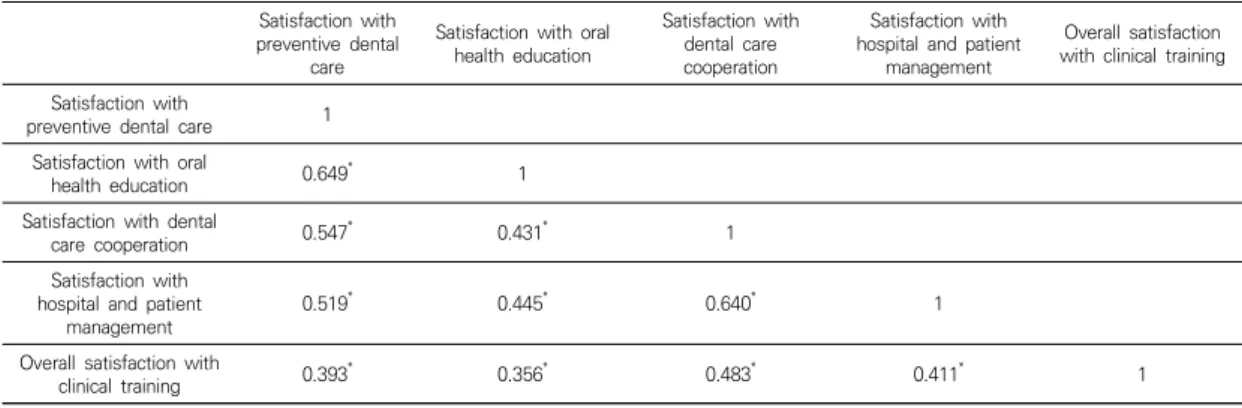
The association between satisfaction by clinical training task and satisfaction with clinical training was analyzed with Pearson correlation, and the effects of satisfaction by clinical training task on satisfaction with clinical training were identified with multiple regression. Statistical significance was set at 0.05.
3. Results 3.1 Clinical training facility
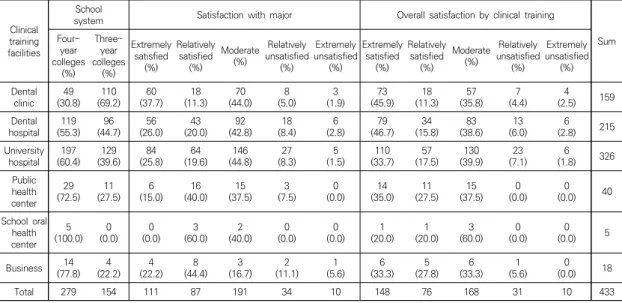
Participants’ clinical training facilities were identified with multiple response chi-square analysis. Clinical training in dental clinics was the most common among students in three-year colleges (69.2%). Of students who did their clinical training in a dental clinic, 44.0% were
“moderately” satisfied with major, and 45.9%
were “extremely satisfied” with clinical training.
Clinical training in dental hospitals was the most common among students in four-year colleges (55.3%). Of students who did their clinical training in a dental hospital, 42.8% were
“moderately” satisfied with major (42.8%) and
46.7% were “extremely satisfied” with clinical
training. Clinical training in university hospitals
Clinical training facilities
School
system Satisfaction with major Overall satisfaction by clinical training Four- Sum
year colleges
(%) Three-
year colleges
(%)
Extremely satisfied
(%)
Relatively satisfied
(%)
Moderate (%)
Relatively unsatisfied
(%)
Extremely unsatisfied
(%)
Extremely satisfied
(%)
Relatively satisfied
(%)
Moderate (%)
Relatively unsatisfied
(%)
Extremely unsatisfied
(%) Dental
clinic 49
(30.8) 110
(69.2) 60
(37.7) 18
(11.3) 70
(44.0) 8
(5.0) 3
(1.9) 73
(45.9) 18
(11.3) 57
(35.8) 7
(4.4) 4
(2.5) 159 Dental
hospital 119 (55.3) 96
(44.7) 56
(26.0) 43
(20.0) 92
(42.8) 18
(8.4) 6
(2.8) 79
(46.7) 34
(15.8) 83
(38.6) 13
(6.0) 6
(2.8) 215 University
hospital 197 (60.4) 129
(39.6) 84
(25.8) 64
(19.6) 146
(44.8) 27
(8.3) 5
(1.5) 110
(33.7) 57
(17.5) 130
(39.9) 23
(7.1) 6
(1.8) 326 Public
health center
(72.5) 29 11
(27.5) 6
(15.0) 16
(40.0) 15
(37.5) 3
(7.5) 0
(0.0) 14
(35.0) 11
(27.5) 15
(37.5) 0
(0.0) 0
(0.0) 40
School oral health center
(100.0) 5 0
(0.0) 0
(0.0) 3
(60.0) 2
(40.0) 0
(0.0) 0
(0.0) 1
(20.0) 1
(20.0) 3
(60.0) 0
(0.0) 0
(0.0) 5
Business 14 (77.8) 4
(22.2) 4
(22.2) 8
(44.4) 3
(16.7) 2
(11.1) 1
(5.6) 6
(33.3) 5
(27.8) 6
(33.3) 1
(5.6) 0
(0.0) 18
Total 279 154 111 87 191 34 10 148 76 168 31 10 433
Table 1. Clinical training facility
was the most common among students in four-year colleges (60.4%). Of students who did their clinical training in a university hospital, 44.8% were “moderately” satisfied with major and 39.9% were “moderate” with clinical training.
Clinical training in public health centers was the most common among students in four-year colleges (72.5%). The most common responses for satisfaction with major was “relatively satisfied”
(40.0%) and that for satisfaction with clinical training was “moderate” (37.5%). Only students in four-year colleges did their clinical training in school oral health center. Of these students, 60%
were “relatively satisfied” with major and 60.0%
were “moderate” with clinical training. Clinical training in dentistry-related enterprises was the most common among students in four-year colleges (77.8%). The most common responses for satisfaction with major was “relatively satisfied”
(44.4%) and that for satisfaction with clinical training was “extremely satisfied” (33.3%) and
“moderate” (33.3%) (see Table 1).
3.2 Differences in satisfaction with clinical training according to school system
Differences in satisfaction with clinical
training according to participants’ school systems were analyzed with independent sample t-tests.
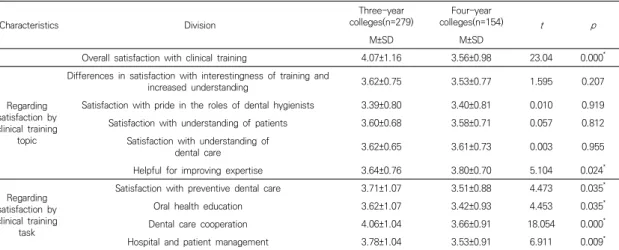
Overall satisfaction with clinical training was significantly higher among students in three-year colleges (4.07) than among students in four-year colleges (3.56). Regarding satisfaction by clinical training topic, satisfaction with “helpful for improving expertise” was higher among students in four-year colleges (3.80) than among students in three-year colleges (3.64) (F=5.104, p=0.024).
Regarding satisfaction by clinical training task, satisfaction with preventive dental care (F=4.473, p=0.035), oral health education (F=4.453, p=0.035), dental care cooperation (F=18.054, p=0.000) and hospital and patient management (F=6.911, p=0.009) were significantly higher among students in three-year colleges than among those in four-year colleges (see Table 2).
3.3 Satisfaction with clinical training according to school-related characteristics
Differences in satisfaction with clinical
training according to motive for choosing major,
average grades, satisfaction with major, length of
clinical training, and person who assigns the
training facility were examined with independent
Characteristics Division Three-year
colleges(n=279) Four-year
colleges(n=154) t p
M±SD M±SD
Overall satisfaction with clinical training 4.07±1.16 3.56±0.98 23.04 0.000
*Regarding satisfaction by clinical training
topic
Differences in satisfaction with interestingness of training and
increased understanding 3.62±0.75 3.53±0.77 1.595 0.207
Satisfaction with pride in the roles of dental hygienists 3.39±0.80 3.40±0.81 0.010 0.919 Satisfaction with understanding of patients 3.60±0.68 3.58±0.71 0.057 0.812
Satisfaction with understanding of
dental care 3.62±0.65 3.61±0.73 0.003 0.955
Helpful for improving expertise 3.64±0.76 3.80±0.70 5.104 0.024
*Regarding satisfaction by clinical training
task
Satisfaction with preventive dental care 3.71±1.07 3.51±0.88 4.473 0.035
*Oral health education 3.62±1.07 3.42±0.93 4.453 0.035
*Dental care cooperation 4.06±1.04 3.66±0.91 18.054 0.000
*Hospital and patient management 3.78±1.04 3.53±0.91 6.911 0.009
**p-value were obtained by Independent T-test (p<0.05)
Table 2. Differences in satisfaction with clinical training according to school system
Characteristics Satisfaction by clinical training
Division n M±SD t/F p
Motive for choosing major
Good for
employment 270 3.71±1.08
1.44 0.218 Helpful for
improving
expertise 37 3.86±1.08 Personality 33 3.88±1.02
Others
recommend 71 3.87±1.03 Others 22 3.32±1.17
Average grades
4.0 GPA or
higher 80 4.01±1.09
a3.886 0.009
*3.0~3.9 217 3.78±1.04
ab2.0~2.9 117 3.51±1.08
b2.0 GPA or lower 19 3.53±1.17
abSatisfaction with major
Extremely
satisfied 111 4.29±1.06
a20.07 0.000
*Relatively
satisfied 87 3.86±0.82
bModerate 191 3.58±1.03
bRelatively
unsatisfied 34 2.94±0.81
cExtremely
unsatisfied 10 2.40±1.35
cLength of
clinical training
10 weeks or less 184 3.63±1.13
b4.032 0.018
*10–20 weeks 185 3.93±1.05
a20 weeks or
more 84 3.62±0.96
abAtraining facility Themselves School 251 182 3.81±1.11 2.348 0.126 3.65±1.03
*p-value were obtained by Independent T-test, One-Way ANOVA (p<0.05), abcThe same superscript letter denotes the same subgroup by post-hoc Scheffe test
Table 3. Satisfaction with clinical training according to school-related characteristics
sample t-tests and one-way ANOVA. There were statistically significant differences according to average grades (F=3.886, p=0.009), satisfaction with major (F=20.07, p=0.001), and length of clinical training (F=4.032, p=0.018). Post-hoc analysis showed that the mean satisfaction score was higher among students with a 4.0 GPA or higher than among those with a 2.0 GPA or higher. The mean satisfaction score was higher among those who are “extremely satisfied” with their major than among those who are “relatively satisfied” or “moderate,” and the mean satisfaction score was low among those who are “relatively unsatisfied” or “extremely unsatisfied” with their major. The mean satisfaction score was higher among students who have completed 10–20 weeks of clinical training than among those who have completed 10 weeks of clinical training or less (see Table 3).
3.4 Satisfaction by clinical training topic according to school-related characteristics
Differences in satisfaction with interestingness
of training and increased understanding,
satisfaction with pride in the roles of dental
hygienists, satisfaction with understanding of
patients, and dental care and understanding
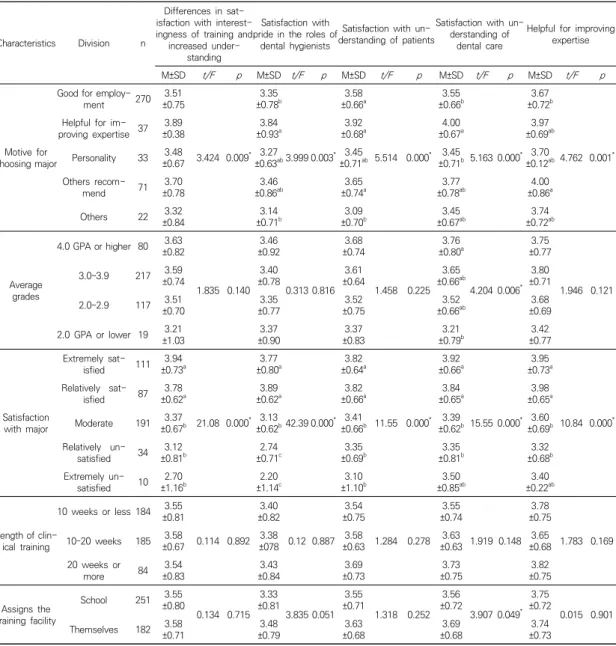
according to participants’ school-related characteristics were analyzed with independent t-tests and one-way ANOVA. Satisfaction with interestingness of training and increased understanding statistically significantly differed according to motive for choosing major (F=3.424, p=0.009) and satisfaction with major (F=21.08, p=0.000). Post-hoc analysis showed that the mean satisfaction score was higher among those who are
“extremely satisfied” and “relatively satisfied” with major than those who are “moderate” and “extremely unsatisfied” with major.
Pride in the roles of dental hygienists statistically significantly differed according to motive for choosing major (F=3.999, p=0.003) and satisfaction with major (F=42.39, p=0.000).
Post-hoc test showed that the mean score was higher among those who chose their major because it was “right for them” than among those who chose the major because it was “good for employment” or for “other reasons.” The mean score was higher among those who are “extremely satisfied” and “relatively satisfied” with their major than among those who are “moderate.” The mean score was higher among those who are “moderate”
with their major than among those who are
“relatively unsatisfied” and “extremely unsatisfied.”
The mean score was higher among those who are
“satisfied” and “relatively satisfied” with their major than among those who are “moderate.”
There were statistically significant differences in satisfaction with understanding of patients according to motive for choosing major (F=5.514, p=0.000) and satisfaction with major (F=11.55, p=0.000). Post-hoc analysis showed that the mean score was higher among those who chose their major because “it is right for them,” “others recommended it,” and “it is good for employment”
than among those who chose the major for “other reasons.” The mean score was higher among those who are “extremely satisfied” and “relatively satisfied” with their major than among those who are “moderate,” “relatively unsatisfied,” and
“extremely unsatisfied.”
Satisfaction with understanding of dental care statistically significantly differed according to motive for choosing major (F=5.163, p=0.000), average grades (F=4.204, p=0.006), satisfaction with major (F=15.55, p=0.000), and person who assigns the training facility (F=3.907, p=0.049).
The mean score was higher among students whose training facility was chosen by “themselves” than those whose facility was chosen by their “schools.”
Post-hoc test showed that the mean score was higher among those who chose their major because
“it is right for them” than among those who chose the major because “it is good for employment” or chose the major “in consideration of their personality.” Regarding average grades, students with a 4.0 GPA or higher showed a higher score than those with a 2.0 GPA or lower. Regarding satisfaction with major, those who were
“extremely satisfied” and “relatively satisfied” with their major showed a higher mean score than those who are “moderate” and “relatively unsatisfied.”
Satisfaction with “helpful for improving expertise” statistically significantly differed according to motive for choosing major (F=4.762, p=0.001) and satisfaction with major (F=10.84, p=0.000). Post-hoc test revealed that the mean score was higher for students who chose their major because “others recommended it” than for students who chose the major because “it is good for employment.” Post-hoc test for satisfaction with major showed that the mean score was higher for those who are “extremely satisfied” and
“relatively satisfied” with their major than those who are “moderate” and “relatively unsatisfied”
with their major (see Table 4).
3.5 Satisfaction by clinical training task according to school-related characteristics
Differences in satisfaction with preventive
dental care, oral health education, dental care
cooperation, and hospital and patient management
Characteristics Division n
Differences in sat- isfaction with interest- ingness of training and
increased under- standing
Satisfaction with pride in the roles of
dental hygienists
Satisfaction with un- derstanding of patients
Satisfaction with un- derstanding of
dental care
Helpful for improving expertise
M±SD t/F p M±SD t/F p M±SD t/F p M±SD t/F p M±SD t/F p
Motive for choosing major
Good for employ-
ment 270 3.51
±0.75
3.424 0.009
*±0.78 3.35
b3.999 0.003
*±0.66 3.58
a5.514 0.000
*±0.66 3.55
b5.163 0.000
*±0.72 3.67
b4.762 0.001
*Helpful for im-
proving expertise 37 3.89
±0.38 3.84
±0.93
a3.92
±0.68
a4.00
±0.67
a3.97
±0.69
abPersonality 33 3.48
±0.67 3.27
±0.63
ab3.45
±0.71
ab3.45
±0.71
b3.70
±0.12
abOthers recom-
mend 71 3.70
±0.78 3.46
±0.86
ab3.65
±0.74
a3.77
±0.78
ab4.00
±0.86
aOthers 22 3.32
±0.84 3.14
±0.71
b3.09
±0.70
b3.45
±0.67
ab3.74
±0.72
abAverage grades
4.0 GPA or higher 80 3.63
±0.82
1.835 0.140
±0.92 3.46
0.313 0.816
±0.74 3.68
1.458 0.225
±0.80 3.76
a4.204 0.006
*±0.77 3.75
1.946 0.121 3.0~3.9 217 3.59
±0.74 3.40
±0.78 3.61
±0.64 3.65
±0.66
ab3.80
±0.71 2.0~2.9 117 3.51
±0.70 3.35
±0.77 3.52
±0.75 3.52
±0.66
ab3.68
±0.69 2.0 GPA or lower 19 3.21
±1.03 3.37
±0.90 3.37
±0.83 3.21
±0.79
b3.42
±0.77
Satisfaction with major
Extremely sat-
isfied 111 3.94
±0.73
a21.08 0.000
*±0.80 3.77
a42.39 0.000
*±0.64 3.82
a11.55 0.000
*±0.66 3.92
a15.55 0.000
*±0.73 3.95
a10.84 0.000
*Relatively sat-
isfied 87 3.78
±0.62
a3.89
±0.62
a3.82
±0.66
a3.84
±0.65
a3.98
±0.65
aModerate 191 3.37
±0.67
b3.13
±0.62
b3.41
±0.66
b3.39
±0.62
b3.60
±0.69
bRelatively un-
satisfied 34 3.12
±0.81
b2.74
±0.71
c3.35
±0.69
b3.35
±0.81
b3.32
±0.68
bExtremely un-
satisfied 10 2.70
±1.16
b2.20
±1.14
c3.10
±1.10
b3.50
±0.85
ab3.40
±0.22
abLength of clin- ical training
10 weeks or less 184 3.55
±0.81
0.114 0.892
±0.82 3.40
0.12 0.887
±0.75 3.54
1.284 0.278
±0.74 3.55
1.919 0.148
±0.75 3.78
1.783 0.169 10–20 weeks 185 3.58
±0.67 3.38
±078 3.58
±0.63 3.63
±0.63 3.65
±0.68 20 weeks or
more 84 3.54
±0.83 3.43
±0.84 3.69
±0.73 3.73
±0.75 3.82
±0.75 Assigns the
training facility
School 251 3.55
±0.80
0.134 0.715
±0.81 3.33
3.835 0.051
±0.71 3.55
1.318 0.252
±0.72 3.56
3.907 0.049
*±0.72 3.75
0.015 0.901 Themselves 182 3.58
±0.71 3.48
±0.79 3.63
±0.68 3.69
±0.68 3.74
±0.73
*p-value were obtained by Independent T-test, One-Way ANOVA (p<0.05)
abc
The same superscript letter denotes the same subgroup by post-hoc Scheffe test
Table 4. Satisfaction by clinical training topic according to school-related characteristics
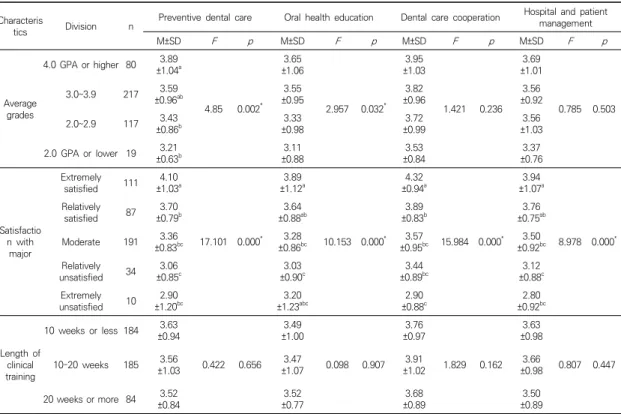
according to participants’ school-related characteristics were analyzed with independent t-tests and one-way ANOVA. Satisfaction with preventive dental care statistically significantly differed according to average grades (F=4.85, p=0.002) and satisfaction with major (F=17.101, p=0.000). Post-hoc test showed that the mean score was higher among students with a 4.0 GPA or
higher than those with a 2.0 GPA or higher and those with a 2.0 GPA or lower.
Regarding satisfaction with major, the mean score was higher for students who are “extremely satisfied” than those who are “relatively satisfied,”
“moderate,” “relatively unsatisfied,” and “extremely
unsatisfied,” and the mean score was higher for
students who are “relatively satisfied” than for
Characteris
tics Division n Preventive dental care Oral health education Dental care cooperation Hospital and patient management
M±SD F p M±SD F p M±SD F p M±SD F p
Average grades
4.0 GPA or higher 80 3.89
±1.04
a4.85 0.002
*±1.06 3.65
2.957 0.032
*±1.03 3.95
1.421 0.236
±1.01 3.69
0.785 0.503
3.0~3.9 217 3.59
±0.96
ab3.55
±0.95 3.82
±0.96 3.56
±0.92
2.0~2.9 117 3.43
±0.86
b3.33
±0.98 3.72
±0.99 3.56
±1.03 2.0 GPA or lower 19 3.21
±0.63
b3.11
±0.88 3.53
±0.84 3.37
±0.76
Satisfactio n with
major
Extremely
satisfied 111 4.10
±1.03
a17.101 0.000
*±1.12 3.89
a10.153 0.000
*±0.94 4.32
a15.984 0.000
*±1.07 3.94
a8.978 0.000
*Relatively
satisfied 87 3.70
±0.79
b3.64
±0.88
ab3.89
±0.83
b3.76
±0.75
abModerate 191 3.36
±0.83
bc3.28
±0.86
bc3.57
±0.95
bc3.50
±0.92
bcRelatively
unsatisfied 34 3.06
±0.85
c3.03
±0.90
c3.44
±0.89
bc3.12
±0.88
cExtremely
unsatisfied 10 2.90
±1.20
bc3.20
±1.23
abc2.90
±0.88
c2.80
±0.92
bcLength of clinical training
10 weeks or less 184 3.63
±0.94
0.422 0.656
±1.00 3.49
0.098 0.907
±0.97 3.76
1.829 0.162
±0.98 3.63
0.807 0.447 10–20 weeks 185 3.56
±1.03 3.47
±1.07 3.91
±1.02 3.66
±0.98 20 weeks or more 84 3.52
±0.84 3.52
±0.77 3.68
±0.89 3.50
±0.89
*p-value were obtained by Independent T-test, One-Way ANOVA (p<0.05)
abc